Even though it's been nearly a year since the demise of Pitchfork Media's smartly written film discussion site The Dissolve, the now-defunct site's animated short about PG-13's negative effect on the quality of American movies continues to resonate. From May 8, 2015, here's a repost of my discussion of "A Brief History of PG-13."
The Pitchfork.tv webseries Frames takes musicians' NSFW anecdotes and reinterprets them in animated form. For example, Detroit rapper Danny Brown's tales of his days as a drug dealer were transformed by Frames into the Hanna-Barbera cartoon I always dreamed of. All that was missing from Frames' Danny Brown episode was Don Messick voicing a Philly blunt that talks and greets Danny Brown with "What up doe?" Now Frames director Mack Williams has taken "The ongoing failure of the PG-13 rating," an excellent 2014 article Chris Klimek wrote for Pitchfork's sister site The Dissolve, and given it the animated treatment for Pitchfork.tv as well. In only two minutes full of genuinely funny sight gags by Williams and the animators at the Brooklyn studio Pig Apple (my favorite sight gag has to be the MPAA disrupting the duo from Once), "A Brief History of PG-13" amusingly elucidates how much the MPAA rating system is bullshit.
As narrator Radam Pooman says in "A Brief History of PG-13," the MPAA created PG-13 in 1984 as a response to the outcry from parents over the violence or intense moments in blockbusters Steven Spielberg either produced or directed. The subversive dark comedy Gremlins, which Spielberg produced and Joe Dante directed, and Indiana Jones and the Temple of Doom (and to a lesser extent, the Spielberg-produced, credited-solely-to-Tobe-Hooper-but-Spielberg-actually-did-a-shitload-of-the-directing-too original version of Poltergeist in 1982) were too graphic and harrowing as PG films. But they also weren't R enough--or rather, as Bullhorn pronounces it in the ad campaign for the original Black Dynamite, R-uh enough--to be stamped with R-uh. In fact, Temple of Doom's posters and ads got stamped with a box that said, "This film may be too intense for younger children." The Dissolve article points out that Spielberg himself approached the MPAA with an idea for a rating between PG and R-uh. So PG-13 was born, crawling out of the MPAA's slimy sac like Stripe in Gremlins, but while Stripe caused small-town mayhem, PG-13 has done something far worse in the years since its inception.
"It makes movies more generic and less adventurous," wrote Andrew Whalen in a 2014 iDigitalTimes article that, just like the Dissolve piece and the Pitchfork.tv animated short, decries the damage PG-13 has done to American filmmaking and the overall brokenness of the rating system. "It was meant to provide more flexibility to filmmakers, not less. It failed because it soon became clear that the PG-13 rating hit the sweet spot for putting butts in seats: not too mature that a family can't attend together, edgy enough that teens don't look down their noses at it."
When film critics like Matt Zoller Seitz complain about a certain sameness in present-day, live-action superhero movies and their lack of inventive filmmaking or even human personality (the fact that the animated superhero movies The Incredibles, Big Hero 6 and Batman: Mask of the Phantasm have more personality in their filmmaking than most of their live-action counterparts is proof that animation is where the superhero genre works best), PG-13 is mostly to blame for those things. In trying to conform to a PG-13, the directors of these movies have ended up stifling their own creativity (or maybe they never had it to begin with). Does anybody ever wonder why Paul Verhoeven, at one time the king of hard R, returned to the Netherlands? It has to be because a film like his hard-R original version of RoboCop--the kind of subversive and offbeat superhero movie the likes of Seitz must be longing to see more of these days--couldn't get made today by a major Hollywood studio. Those studios are too busy chasing PG-13s. In fact, that's exactly what happened to RoboCop when Elite Squad director José Padilha rebooted the former Orion Pictures franchise last year for Sony. It spawned a bland-as-fuck PG-13 remake. When Gremlins gets remade too, that version's bound to get a PG-13 as well, but I wouldn't be surprised if it turns out to be blander than the PG-rated Dante version.
Speaking of which, PG-13 has also led to strange contradictions. As "A Brief History of PG-13" points out, affection between gay characters in Love Is Strange and F-bombs in Once landed those inoffensive and non-violent indies an R. Meanwhile, the exploding head in the 1989 Bond flick Licence to Kill--an example of graphic violence neither "A Brief History of PG-13" nor the Dissolve essay mentions, as well as the most gruesome moment in the Bond franchise, before Daniel Craig's nads came into contact with a carpet beater in Casino Royale--merited only a PG-13. And what did Casino Royale also receive, in spite of that brutal torture scene, the gore and the 22-person body count? Yep: a PG-13.
"A Brief History of PG-13" is such a good animated short that I'd like to see Williams do more animated tie-ins with The Dissolve. The site's discussions of Midnight Run with Adam Scott and Running Scared with Paul Scheer are crying out for the animated treatment, as is Noel Murray's essay "Why great comics don't always make great movies." If there's one thing that's missing from "A Brief History of PG-13," it's an idea for a solution that's better than PG-13. But what would that idea be? /Film's David Chen was onto something when he implied that the MPAA should be dismantled.
"We're heading towards an age when we don't need a mommy-like organization to dictate what our delicate sensibilities can and can't be exposed to," wrote Chen in 2010. "I deeply hope that the MPAA's irrelevance is imminent."
Occasionally on Friday, I discuss the week's best first-run animated series episode I saw. It's the "Brokedown Merry-Go-Round" Show of the Week. Stream "Brokedown Merry-Go-Round," my one-hour mix of original score tracks from animated shows or movies, right now!
Brock might not think so, but The Venture Bros.' move to big, bad New York is the best thing to happen to the OSI's toughest agent, probably since the life-changing day he bought his first Zeppelin LP. "It Happening One Night" is the latest Venture Bros. episode to make abundantly clear that the Venture family bodyguard has been off his game ever since he rejoined Team Venture in New York.
Samson's clearly no match for the New York supervillains he's had to tussle with ever since the newly wealthy Dr. Venture went from being small potatoes to an antagonist everyone in the Guild of Calamitous Intent wants to arch (Brock's new fuckbuddy Warriana has had to save Brock twice), and now in "It Happening One Night," he thinks the ninja-themed family restaurant where Hank has his dinner date with Sirena Ong is an actual ninja hideout (the ninja restaurant is a real-life thing in Tribeca, by the way). So Brock roughs up the waiters, including Jared (Nathan Fillion), a.k.a. the Brown Widow, who's so badly in debt he makes flat-broke Peter Parker in Spider-Man 2 look like a Kardashian kid.
Ninja New York in Tribeca
The Venture Bros. version of Ninja New York
Earlier this season, Brock told Hank to Google one of his heroes, Steve McQueen. Maybe if Brock bothered to do the same kind of research online while trying to keep an eye on Hank during his night out with Wide Wale's daughter, he wouldn't have wound up looking kind of stupid after being told that the ninja stronghold he infiltrated--he and his temporary sidekick Rocco (Mark Gagliardi), the Ong family bodyguard Sirena so detests, even go through the trouble of knocking a couple of waiters out and donning their fake ninja garb--is merely a trendy sushi joint.
A lapse in judgment like that may make Brock look bad as a spy who was trained to always be aware of his surroundings, but it's a good creative move for the show, which clearly struggled over what to do with Brock a few seasons ago. I have a theory for why Venture Bros. creator Jackson Publick separated Brock from the Ventures for a while and replaced him with reformed pedophile Sgt. Hatred: he simply got bored with having Brock always save the day. That kind of thing makes for terrific action sequences, but it can also become boring in the middle of a comedy show that's primarily about mediocrity. Brock was becoming too perfect a human being, even though this Swedish murder machine will always somehow be a funny character, thanks to whatever the fuck Patrick Warburton brings to the page, as well as because of the brilliant thing Publick and Doc Hammer wanted to do with Brock from the start.
They wanted to take Race Bannon and make him both psychotic on the battlefield (go revisit "Victor. Echo. November." on Hulu if you've forgotten how psychotic Brock can really be) and a frequently bored-sounding blue-collar type who viewed the guarding of a narcissistic super-scientist like Dr. Venture as work that's beneath him, even though he likes Dean and Hank (and H.E.L.P.e.R. too). It's like how Benson hated being the butler to the Tates but was kind to Jessica, Corinne and Billy because they were the only Tates who weren't snooty or racist. A.V. Club contributor Kevin Johnson's weird assessment that Brock hates Dean and Hank (in a typo-ridden guest review the A.V. Club recently posted when its regular Venture Bros. reviewer was gone for a week) is a total misreading of Brock's relationship with them. The OSI agent's Benson-style attachment to these boys who so badly need someone like him to guide them through--and away from--the craziness Dr. Venture brought into their lives is an essential part of The Venture Bros. It brings some genuine warmth to the show but never crosses into sentimentality (someone in a Reddit forum about Johnson's review interestingly counteracted his misreading by astutely pointing out that whenever Brock gets frustrated with Dean or Hank, it brings to mind Louis C.K. whenever he talks about getting annoyed by his daughters).
Speaking of Benson, competence can become comedy kryptonite, so when Benson became too competent and sensible--and popular--to continue being around the craziness of the other characters on Soap, he was spun off into his own show. Publick and Hammer's way of keeping Brock's similar type of competence from becoming stale was not to give Brock his own show but to sideline Brock and give him a Craig-era-Bond-like identity crisis as a professional killer (like when he went off the grid and lived with the duo of Steve Summers and his boyfriend Sasquatch, the show's parody of The Six Million Dollar Man's Bigfoot storyline) or to bring him down to Earth and depower him a bit, like how Publick and Hammer are depowering him now in New York. I bet that's why Publick and Hammer reinstated him as the family's bodyguard: they finally figured out how to make Brock interesting again, and the soft reboot the show is experiencing in New York has a lot to do with that.
Brock's arc this season is basically "if 007 had to fight someone like MODOK, he would definitely lose, and if you put 007 in the bedroom with a woman like Warriana, he would definitely not be in charge in the bedroom like he's always written to be in the Bond movies." It's an enjoyable way to play around with the spy genre assassin character who's always good at everything and to mock the wish-fulfillment fantasy side of the Bond movies. The Swedish murder machine is at his most interesting when he gets knocked around a bit, whether in battle or in the bedroom, like in "Tanks for Nuthin'."
Dr. Mrs. the Monarch, the voice of reason in the Monarch household, is also being similarly depowered a bit, even though as a Guild member, she now has more power and authority than her husband. If she weren't so distracted by both the stress of being Councilwoman 1 and the marital discord that's developed due to her rise in power, she'd be her old smarter self again and she'd be better able to track down the supervillain-killing mystery man who's been creating a bloodbath within the Guild (but is doing so accidentally, of course). The Monarch uses that state of distractedness--and his wife's love of role-playing during sex--to trick her into getting tranqed and to lure her away from finding out he's been arching other Guild members as the Blue Morpho in order to have Dr. Venture all to himself again.
There have been some complaints in the past from Venture Bros. viewers about how often pedophilia has been used as humor on the show (speaking of which, I rewatched "Everybody Comes to Hank's" the other day because of this week's focus on Hank's love life and was surprised by how the revelation that Dermott Fictel was the product of a relationship between a Woody Allen-esque Dr. Venture and the underage president of his fan club was a rare reference to wrong-on-so-many-levels sex that wasn't totally played for laughs, and, man, Publick and Hammer were really sticking it to Allen in that scene too). But lately, ever since the tranq-addicted Pirate Captain's relapse, I feel like the constant tranqing of characters on the show has become a similarly tiresome gag. Dr. Mrs. the Monarch becomes the latest character to get tranqed--perhaps the repetition of the dart gags is intended to be a joke about how the Morpho and his son (and even the new villains this week) are the hackiest and least creative people when it comes to taking down their enemies--and this umpteenth tranqing sort of ruins the lovely sight of Dr. Mrs. the Monarch cosplaying as Daisy Mae from Li'l Abner and not even bothering to Deep South-ify her incongruous Harvey Fierstein accent.
Former Hannibal composer Brian Reitzell and the recently unretired Siouxsie Sioux (Photo source: EW.com)
Brian Reitzell's eerie score music from Bryan Fuller's now-defunct Hannibal is completely bonkers. It's largely non-melodic and is more like sound FX rather than traditional-sounding score music. Think the horror equivalent of Gil Melle's similarly creepy and non-melodic synth score from The Andromeda Strain, but performed with bronze percussion instruments or old-fashioned oddities like a Newton's cradle--which, as the Hannibal composer and music supervisor pointed out to interviewer Hrishikesh Hirway on 99% Invisible, was chosen to represent the synapses firing inside the brain of FBI profiler and "empathy disorder" sufferer Will Graham (Hugh Dancy)--and a bullroarer (a piece of wood on a string, spun around to produce a roaring noise and used in Aboriginal religious ceremonies).
During Reitzell's Hannibal score albums (the kind of score albums that are made to be listened to only on headphones in order to catch all the various intricacies of Reitzell's nifty soundscapes), you're more able to notice how bonkers the sound design in Reitzell's score music is because your attention isn't drawn to either the gruesome prosthetic makeup on Raúl Esparza as the disfigured Frederick Chilton or the shots of misshapen corpses in grisly crime scenes that look like art installations created by the world's most fucked-up sculptors. A couple of lengthy excerpts from the score albums for Hannibal's first two seasons (the nearly 12-minute "Trou Normand" and the eight-minute "Tome-wan") are currently in rotation on AFOS, and, like Reitzell once warned about his own music from Hannibal, they're "not something to play alone in the dark while driving!"
Brian Reitzell's score for HANNIBAL is the greatest TV scoring job since Angelo Badalamenti's TWIN PEAKS.
— Matt Zoller Seitz (@mattzollerseitz) May 3, 2014
Will Graham deduces why a murdered musician was transformed into a cello in the Hannibal episode "Fromage."
Aside from the occasional use of Bach and Mozart compositions as source cues (Hannibal Lecter may be a cannibal, but his tastes in dinner music lean towards the classy and erudite), Reitzell refrained from conventional melodies for so long that when the time came for Fuller and Reitzell to close the book on Hannibal, Reitzell wanted to say thank you to the show's small but passionate audience--known as the Fannibals--for expressing their love for the show by finally treating them to a conventional melody at the end of "The Wrath of the Lamb," the series finale. The final six episodes of Hannibal were loaded with fan service, whether they were fast-forwarding the series timeline to retell Red Dragon, the 1981 Thomas Harris novel that started it all and introduced Dr. Lecter, heightening the homoerotic tension between Will and Mads Mikkelsen's Hannibal (but, as Hannibal regular Scott Thompson points out, never really getting them to consummate it) or gifting the Fannibals with an original song that intriguingly carries several different meanings, from the most obvious one, the bizarre love between Will and his frenemy, to the possibility that the song is also about the post-NBC future of the show itself.
I'm no Goth, and I've never cared for Goths, but I've always liked the music of Siouxsie and the Banshees, whose songs have been discovered by a whole new audience after The Weeknd sampled the band's "Happy House" for "House of Balloons/Glass Table Girls" back in 2011. "Love Crime," Siouxsie Sioux's first recording in eight years, is a perfect way for Reitzell--a Banshees fan who co-wrote the tune with Sioux, a fan of Fuller's show--to musically conclude Hannibal, as well as one of Sioux's best songs, a hypnotic ballad in the mold of "Face to Face," the Siouxsie and the Banshees tune that was such a musical highlight of Batman Returns.
The Sioux/Reitzell tune, which I've added to AFOS rotation this week, is also a far better Bond song than "Writing's on the Wall," Sam Smith's official Bond theme for Spectre. Even though "Love Crime" is a ballad and the "I will survive" refrain is an especially resonant and bittersweet lyric for viewers and TV critics who are heartbroken over NBC's cancellation of Hannibal and are hoping Fuller will get his wish to someday revisit the Harris characters in some form or other, "Love Crime" is thankfully devoid of the sappiness of "Whining's on the Wall."
Like "Face to Face" before it, "Love Crime" feels like the Bond song Sioux always wanted to perform but will never get to because she's too weird for the Top 40 radio-obsessed Broccolis. Sioux isn't quite Sade. Now Sade's the performer I've always wanted for a Bond theme, more so than anyone else, even Sioux--"Smooth Operator" would have been perfect for opening a Roger Moore-era Bond flick--yet the Broccolis have stupidly ignored Sade all these years. But with "Love Crime," Sioux proves she was always worthy to join the likes of Shirley Bassey and Shirley Manson. She and Reitzell also prove what a folly several of the Broccolis' choices for Bond main title themes have been ever since Lulu's voice cracked at the end of 1974's "The Man with the Golden Gun," and that high note Lulu clearly had trouble powering through helped cause "The Man with the Golden Gun," a tune even the late John Barry admitted to being ashamed of producing, to become the first of several main title themes in the Bond catalog that are painful to listen to.
That's not all that "Love Crime" surpasses. Will's confrontation with serial killer Francis Dolarhyde (oddly spelled as Dollarhyde by Michael Mann and played by Tom Noonan) to the tune of Iron Butterfly's "In-A-Gadda-Da-Vida" during 1986's Manhunter--the first time Red Dragon was brought to the screen--remains a classic musical moment in a Mann movie, especially when Iron Butterfly drummer Ron Bushy's drum roll accompanies the William Peterson version of Will badassedly smashing through the window to stop Dollarhyde. Sioux and Reitzell actually recorded "Love Crime" way before "Wrath of the Lamb" episode writers Fuller, Steve Lightfoot and Nick Antosca came up with the scenes "Love Crime" ended up being paired with in the final cut: Will and Hannibal fighting Dolarhyde (now back to one L and played by Richard Armitage) together; a badly wounded Will experiencing a baptism in blood and taking a gutshot Hannibal along with him in his plunge off the cliff; and a drugged Bedelia Du Maurier (Gillian Anderson) being served her own severed and roasted leg by an unknown dinner guest (could that guest be her former patient and partner-in-crime Hannibal?). But after hearing what Sioux and Reitzell accomplished with "Love Crime"--and seeing how beautifully the tune fits with those striking images of Dolarhyde, Will, Hannibal and Bedelia--I prefer "Love Crime" over the drunkenly sung "In-A-Gadda-Da-Vida" as cathartic music for the defeat of Dolarhyde.
The lyrics during "In-A-Gadda-Da-Vida" were always dumb anyway. They're the "I'mma take her ass down when she bring her friend around/Fuck 'em both like ayo" of 20-minute makeout songs for white people. The lyrics are so distractingly inane they make you wish Mann's music editor carved up "In-A-Gadda-Da-Vida" into an instrumental like how Hannibal carves up his victims for dinner.
Plus "In-A-Gadda-Da-Vida" doesn't have the aforementioned layers of meaning "Love Crime" carries. In addition to the subject matter of the bond between Will and Hannibal (notice the double meaning of "I will," which could also be interpreted as "I, Will"), "Love Crime" is also about Hannibal and Bedelia. Fuller pointed out to TV critic Alan Sepinwall that "what's so fun is that... we hear [Sioux] say, 'I will survive, I will survive,' as we're pushing in on Bedelia, and that could mean she's singing from Hannibal's perspective and it means he has survived and will eat this woman now, or Bedelia's point of view that it's like, 'You may have cut off this leg, but I've got this fork and I'm gonna do some damage before it's done.'"
"Love Crime" could also be interpreted as an anthem for the show itself and its existence in the "deadly game" known as network TV. I'm amazed that a show with so much gore, cannibalism, dark humor and bizarre dream sequences and such a thoughtful approach to mortality and morality managed to last this long on a network like NBC.
Three seasons are a ripe old age for a Fuller show about the subject of death. It's the longest a Fuller creation has lasted on TV (Wonderfalls, the first time many of us developed a crush on Hannibal regular Caroline Dhavernas, lasted only one season, while Pushing Daisies managed to stay alive for two, just like Dead Like Me, which Fuller also created, but he quit Dead Like Me early on due to creative differences). Fuller, who devised the ending of "The Wrath of the Lamb" so that it could be both a satisfying conclusion and the start of a possible new chapter, may think that "the most interesting chapter of Will Graham's story has yet to be told"--Sioux's "I will survive" refrain is basically what must be playing inside Fuller's head whenever he tantalizes the Fannibals with the possibility of a miniseries or movie where Dancy and Mikkelsen would reprise their roles--but personally, I think Will's story ended at the right point.
Plus the continuation of Hannibal would have gotten in the way of what I think Fuller--who's now showrunning the Starz adaptation of Neil Gaiman's American Gods and is attempting to revive Steven Spielberg's Amazing Stories--is destined for: returning to the franchise that gave him his start, Star Trek, and bringing it back to TV (c'mon, CBS All Access, let Fuller have the conn). Three seasons are the perfect lifespan for shows about serial killers who are superhumanly able to get away with so much heinous shit for so long, as opposed to the 38 seasons of Dexter and the 67 seasons of Criminal Minds. Sometimes the feasts with smaller portions are the better ones.
"Love Crime" is now in rotation during the AFOS blocks "AFOS Prime" and "New Cue Revue." Lakeshore Records will release the Hannibal Season 3 Volume 1 and Volume 2 score albums digitally this Friday and on CD in early 2016, just in time for yesterday's DVD and Blu-ray debut of Hannibal's third and final season.
I'm more of a fan of the music of 007 than the actual 007 movies themselves (although I'm fond of From Russia with Love, On Her Majesty's Secret Service, The Living Daylights and the 2006 Casino Royale, and I like a lot of what Sam Mendes and Penny Dreadful showrunner John Logan--as well as regular Coen Brothers cinematographer Roger Deakins--brought to the table in Skyfall). It's a franchise that's committed more misses than hits in its 53-year history, artistically speaking, and I understand why Andrew Ti from Yo, Is This Racist? despises the 007 movies a lot more than I do. "He's like the literal personification of imperialism," grumbles Ti about a franchise that's either ridiculed and emasculated Asian men (Licence to Kill) or killed off the ones who, for a change, aren't villains like half-Pinoy ex-wrestler Dave Bautista's Spectre henchman character Mr. Hinx (A View to a Kill). I'm sure Ti would also be thrilled about the time Bond told a black sidekick to fetch him his shoes.
That's why--despite how well Daniel Craig plays Bond as a broken man and how interestingly the underrated Timothy Dalton similarly portrayed the Ian Fleming character as a damaged soul (particularly when he's seen still mourning his murdered wife Tracy in Licence to Kill)--I've never viewed this personification of imperialism as a hero I'd root for and completely identify with. I may ogle the Bond women and admire the artistry of some of the Bond action sequences, but I've never felt like these action movies were being made for me--in the same way that Justin Lin was making Fast Five and Furious 6 specifically for me and creating the first non-stereotypical, post-Sulu Asian American cinematic action hero in the form of Sung Kang's Han, a character Lin so regretted killing off in The Fast and the Furious: Tokyo Drift that he ballsily rewound the Fast and the Furious series timeline just so he could include Han in the action again.
I've seen all the 007 movies except Moonraker (Buffy once warned me against renting it), and the best and most fascinating thing about these movies that are still being run with a tight fist by the same family that started them (the story of the Broccoli family business, by the way, is another fascinating tale in itself) is often the score music. "It's mean stuff. It's not pretty or sanitised. It sounds tough. That's why [John Barry's] work has been sampled so much by hip-hop artists - those sinister horn stabs, especially," wrote superproducer Mark Ronson about the aural template that was established in the '60s by the late Barry and later recreated by Barry fan David Arnold in five consecutive 007 movies and regular Mendes composer Thomas Newman in Skyfall and now Spectre. Even when the movie's terrible, either Barry or Arnold would bring an unmistakable pulse to the original music. Unfortunately, that pulse is missing from "Writing's on the Wall," the newly released Spectre theme performed by British singer/songwriter Sam Smith and written by the blue-eyed soul artist (in what he claims to be only 20 minutes of songwriting) and Jimmy Napes, who both penned "Stay with Me," the 2014 Smith pop hit that bizarrely sounds like the love child of Tom Petty's "I Won't Back Down" and the theme from I'll Fly Away.
I'm not going to be like a lot of haters of the Spectre theme on social media and dismiss the theme with an extremist, Blaine and Antoine-style "Hated it!" (although some of those anti-"Writing's on the Wall" tweets are amusing, particularly one woman's description of the tune as "a drunk elephant tried to do karaoke to an Adele song whilst singing like James Blunt"), because the theme is actually an okay 007 ballad in the mold of Louis Armstrong's "We Have All the Time in the World" from On Her Majesty's Secret Service's dating montage and the Pretenders' "If There Was a Man" at the end of The Living Daylights, which were both produced by Barry. In fact, the best aspect of "Writing's on the Wall" is its Barry-style dramatic orchestrations, particularly before Smith's trademark falsetto comes in and warbles typical 007 song lyrics like "I'm prepared for this/I never shoot to miss." The first 15 seconds are classic 007 travelogue music.
But as an opening title theme for a 007 movie, "Writing's on the Wall" leans a little too adult contemporary for my tastes. "I wanted a touch of vulnerability from Bond, where you see into his heart a little bit," said Smith to NPR about lyrics like the rather adult contemporary-ish "How do I live, how do I breathe?/When you're not here I'm suffocating." RogerEbert.com writer Odie "Odienator" Henderson would complain on his blog about Adele's beloved and pitch-perfect "Skyfall" being too slow and putting him to sleep. Henderson doesn't understand that "Skyfall" is supposed to have a funereal tone because the song is actually about the death of M and is written from her point of view. That's why it would have been stupid to open Skyfall with a "View to a Kill"-style dance floor banger, whereas "Writing's on the Wall" is the kind of somnambulant tune Henderson misguidedly thought "Skyfall" was.
"Where's the intrigue? Where's the danger?," wonders Idolator in its pan of "Writing's on the Wall." After those terrific first 15 seconds, the song never really builds towards anything memorable or punchy. What particularly makes "Writing's on the Wall" disappointing is that it reteamed Smith and Napes with the U.K. garage act Disclosure, a.k.a. brothers Guy and Howard Lawrence, but it has little of the spark of earlier Smith/Napes/Disclosure tracks. I had no idea Disclosure had a hand in producing the Spectre theme until I saw several pop music blogs take note of Disclosure's involvement, right after I downloaded the "Writing's on the Wall" single from Amazon and then listened to it and thought I had teleported into the "Brian McKnight helps Martin propose to Gina in the park" episode of Martin instead of an action thriller.
"The reason we got involved afterwards was to try and add a bit of post production and they just wanted it to sound a little more spacey and add something behind it that wasn't just a straight-up orchestra," said the duo to the U.K.'s Capital FM radio network. While trying to lend a hand to something that they've said is "a lot more along the 'Goldfinger' lines," Disclosure, an act I enjoy for never being too saccharine in their music, sacrificed too much of what makes them great and took a turn towards the saccharine. k.d. lang and Garbage previously proved in Tomorrow Never Dies' Arnold-produced "Surrender" and the Arnold-produced opening title theme for The World Is Not Enough, respectively, that you can bring your own stamp to a traditional-sounding 007 tune and honor the 007 sound without sacrificing too much of your musical identity. I know I keep using the word "pulse" to refer to what "Writing's on the Wall" lacks, but that's the best word I can come up with to describe the thing that's absent from the Spectre theme and had permeated the previous Smith/Napes/Disclosure collabos "Latch" and "Together," which features some unknown nobody named Nile Rodgers.
Where's some of the sinewy garage sound that also distinguishes Disclosure's work with other acts like AlunaGeorge, as well as their work on their own (my personal favorite Disclosure banger, by the way, is "When a Fire Starts to Burn")?
Every Throwback Thursday, I pull out from my desk cabinet--with my eyes closed--a movie ticket stub I didn't throw away, and then I discuss the movie on the ticket and maybe a little bit of its score, which might be now streaming on AFOS. Today, instead of drawing some random ticket, I'm intentionally pulling out the ticket that says "Spy," due to the Melissa McCarthy comedy's box-office success and the excitement over the beginning of the filming of McCarthy's Ghostbusters reboot. This will be the final post here on the AFOS blog before I take a two-or-three-week-long break from the blog in July. The blog--and that goes for the blog's year-long TBT series as well--will resume with new posts in the middle of July.
The least creative thing about writer/director Paul Feig's enjoyably foul-mouthed action comedy Spy is its title. Spy is also the title of a fairly recent Britcom about an MI5 agent and his 10-and-a-half-year-old son. The Feig movie's original title was Susan Cooper. By the end of the movie, Melissa McCarthy and Feig have created such a distinctive and likable new heroine--and managed to give her a satisfying dramatic arc in addition to her comedic antics--that you won't forget the name Susan Cooper, and her name deserves to be part of the branding of the super-spy franchise that will likely arise from Spy, much like how Austin Powers' name is part of the title of every movie of his and Jason Bourne's name is in the title of every Bourne movie, including ones he doesn't even bother to appear in.
But then again, Feig's the kind of director who seems to prefer movie titles that don't take up too much space on a marquee. I Am David, Bridesmaids, The Heat, Spy and Ghostbusters are all titles that are easy work for marquee changers, especially ones who'd get an anxiety attack after finding out they have to put the letters up for Those Daring Young Men in Their Jaunty Jalopies.
Mondo poster illustrated by The Dude Designs (Photo source: Birth.Movies.Death.)
So had Sky 1 not come out with a show called Spy, I'd be more enamored with the movie's title because it nicely conveys in just three letters that Susan was born to be one. But because Spy is a comedy, the transition from mission control support to CIA field agent for Susan, who's a winning mix of Midwestern politeness and the fearlessness of McCarthy's Boston cop character Shannon Mullins from The Heat, isn't exactly a smooth one. That transition is initially loaded with the usual slapstick McCarthy frequently excels at, as well as the honest and comically appalled reactions many Feig characters have to any kind of mayhem (think the bridesmaids' varied reactions to food poisoning in Bridesmaids or Sandra Bullock amusingly panicking over a knife shoved into her thigh and wanting so badly to break her vow to never curse in The Heat). Spy arose out of Feig's wish to make a spy movie like one of his favorite movies, the 2006 version of Casino Royale, but because these are Feig characters, not Bond movie characters who respond to everything in the most badass and suave (as well as PG-13-friendly and extremely--and implausibly--sanitized) ways, they puke from the sight of accidentally impaling someone they've killed or launch into a barrage of F-bombs when they don't get their way.
But once McCarthy's Bridesmaids co-star Rose Byrne enters the picture and Susan becomes more confident about her field work and is able to infiltrate the Byrne character's enemy organization, thanks to a very particular set of skills (like intuition) that Susan's overconfident colleague/work rival Rick Ford (Jason Statham) is too bullheaded and inept to possess, Spy takes an interesting turn as a spy comedy. It becomes a comedy about an underestimated spy who's good at her job instead of incompetent (Get Smart) or competent but immature (Archer), which also makes it an intriguing companion piece to the Marvel Studios show Agent Carter, another story of a frequently underestimated female spy. But where's the conflict when the central character's a competent spy? Isn't that a comedy killer? When McCarthy has such great--and often improvised--dialogue and trades insults with the consistently funny likes of a perfectly cast (and perfectly big-haired) Byrne as a villainous arms dealer and Statham in what has to be the funniest and greatest role of his career as the hilariously useless Ford, nobody has to worry about the disappearance of humor.
Occasionally on Friday, I discuss the week's best first-run animated series episode I saw. It's the "Brokedown Merry-Go-Round" Show of the Week. "Brokedown Merry-Go-Round," a two-hour block of original score tracks from animated shows or movies, airs weekdays at 2pm Pacific on AFOS.
The Pitchfork.tv webseries Frames takes musicians' NSFW anecdotes and reinterprets them in animated form. For example, Detroit rapper Danny Brown's tales of his days as a drug dealer were transformed by Frames into the Hanna-Barbera cartoon I always dreamed of. All that was missing from Frames' Danny Brown episode was Don Messick voicing a Philly blunt that talks and greets Danny Brown with "What up doe?" Now Frames director Mack Williams has taken "The ongoing failure of the PG-13 rating," an excellent 2014 article Chris Klimek wrote for Pitchfork's sister site The Dissolve, and given it the animated treatment for Pitchfork.tv as well. In only two minutes full of genuinely funny sight gags by Williams and the animators at the Brooklyn studio Pig Apple (my favorite sight gag has to be the MPAA disrupting the duo from Once), "A Brief History of PG-13" amusingly elucidates how much the MPAA rating system is bullshit.
As narrator Radam Pooman says in "A Brief History of PG-13," the MPAA created PG-13 in 1984 as a response to the outcry from parents over the violence or intense moments in blockbusters Steven Spielberg either produced or directed. The subversive dark comedy Gremlins, which Spielberg produced and Joe Dante directed, and Indiana Jones and the Temple of Doom (and to a lesser extent, the Spielberg-produced, credited-solely-to-Tobe-Hooper-but-Spielberg-actually-did-a-shitload-of-the-directing-too original version of Poltergeist in 1982) were too graphic and harrowing as PG films. But they also weren't R enough--or rather, as Bullhorn pronounces it in the ad campaign for the original Black Dynamite, R-uh enough--to be stamped with R-uh. In fact, Temple of Doom's posters and ads got stamped with a box that said, "This film may be too intense for younger children." The Dissolve article points out that Spielberg himself approached the MPAA with an idea for a rating between PG and R-uh. So PG-13 was born, crawling out of the MPAA's slimy sac like Stripe in Gremlins, but while Stripe caused small-town mayhem, PG-13 has done something far worse in the years since its inception.
"It makes movies more generic and less adventurous," wrote Andrew Whalen in a 2014 iDigitalTimes article that, just like the Dissolve piece and the Pitchfork.tv animated short, decries the damage PG-13 has done to American filmmaking and the overall brokenness of the rating system. "It was meant to provide more flexibility to filmmakers, not less. It failed because it soon became clear that the PG-13 rating hit the sweet spot for putting butts in seats: not too mature that a family can't attend together, edgy enough that teens don't look down their noses at it."
When film critics like Matt Zoller Seitz complain about a certain sameness in present-day, live-action superhero movies and their lack of inventive filmmaking or even human personality (the fact that the animated superhero movies The Incredibles, Big Hero 6 and Batman: Mask of the Phantasm have more personality in their filmmaking than most of their live-action counterparts is proof that animation is where the superhero genre works best), PG-13 is mostly to blame for those things. In trying to conform to a PG-13, the directors of these movies have ended up stifling their own creativity (or maybe they never had it to begin with). Does anybody ever wonder why Paul Verhoeven, at one time the king of hard R, returned to the Netherlands? It has to be because a film like his hard-R original version of RoboCop--the kind of subversive and offbeat superhero movie the likes of Seitz must be longing to see more of these days--couldn't get made today by a major Hollywood studio. Those studios are too busy chasing PG-13s. In fact, that's exactly what happened to RoboCop when Elite Squad director José Padilha rebooted the former Orion Pictures franchise last year for Sony. It spawned a bland-as-fuck PG-13 remake. When Gremlins gets remade too, that version's bound to get a PG-13 as well, but I wouldn't be surprised if it turns out to be blander than the PG-rated Dante version.
Speaking of which, PG-13 has also led to strange contradictions. As "A Brief History of PG-13" points out, affection between gay characters in Love Is Strange and F-bombs in Once landed those inoffensive and non-violent indies an R. Meanwhile, the exploding head in the 1989 Bond flick Licence to Kill--an example of graphic violence neither "A Brief History of PG-13" nor the Dissolve essay mentions, as well as the most gruesome moment in the Bond franchise, before Daniel Craig's nads came into contact with a carpet beater in Casino Royale--merited only a PG-13. And what did Casino Royale also receive, in spite of that brutal torture scene, the gore and the 22-person body count? Yep: a PG-13.
"A Brief History of PG-13" is such a good animated short that I'd like to see Williams do more animated tie-ins with The Dissolve. The site's discussions of Midnight Run with Adam Scott and Running Scared with Paul Scheer are crying out for the animated treatment, as is Noel Murray's essay "Why great comics don't always make great movies." If there's one thing that's missing from "A Brief History of PG-13," it's an idea for a solution that's better than PG-13. But what would that idea be? /Film's David Chen was onto something when he implied that the MPAA should be dismantled.
"We're heading towards an age when we don't need a mommy-like organization to dictate what our delicate sensibilities can and can't be exposed to," wrote Chen in 2010. "I deeply hope that the MPAA's irrelevance is imminent."
I don't care for Madonna and her cultural-appropriating ass, but I've always liked the music of William Orbit. The Drake-scaring pop star's hit single from the summer of 1999, "Beautiful Stranger," a '60s-pop-flavored tune she recorded for Austin Powers: The Spy Who Shagged Me, is my favorite pop song Orbit has produced because it's Orbit at his most playful-sounding, from the Ron Burgundy flute funk to the harpsichord riffs (the harpsichord is also integral to why my favorite Michael Jackson tune is "I Wanna Be Where You Are"). "Beautiful Stranger" is featured in The Spy Who Shagged Me for like only 30 seconds, during a non-comedic scene where the titular '60s spy mourns the loss of his mojo. Because of "Beautiful Stranger," I would have been interested in what Madonna and Orbit would have recorded together for Guy Ritchie's upcoming remake of The Man from U.N.C.L.E., had Ritchie and Madonna never split.
"Beautiful Stranger" is pitch-perfect for the breezy, psychedelic, Laugh-In-esque and Derek Flint-inspired Austin Powers franchise, whereas Madonna's other original spy movie theme, the Mirwais-produced electroclash tune "Die Another Day," doesn't quite work for 007 (it would have worked for some other spy franchise: maybe Totally Spies?). The Die Another Day theme makes you wonder if Madonna or Mirwais ever even watched an actual 007 movie beforehand, even though she claimed that the Die Another Day screenplay influenced the lyrics she wrote (the orchestral string riffs during "Die Another Day" came not from Die Another Day score composer David Arnold but from Madonna's "Don't Tell Me" collaborator, the late New Jack City score composer Michel Colombier, and I would have enjoyed Colombier's string riffs a little more if they had at least some ounce of thematic connection to anything Arnold wrote for his score).
I fell in love with "Beautiful Stranger" again a few weeks ago while overhearing it being played on some store PA during a round of book-shopping or grocery-shopping (I can't remember which kind of shopping it was). So that's why I'm adding "Beautiful Stranger" to the playlist for the espionage genre music block "AFOS Incognito," where it can be enjoyed without having to be subjected to any visuals directed by Brett Ratner, Mondays through Thursdays at midnight Pacific on AFOS.
There's one other piece of music from a 1999 spy comedy that I'm adding to "AFOS Incognito," and this spy comedy isn't exactly as beloved as The Spy Who Shagged Me was back in 1999. It's from the second and final film in Warner Bros.' late '90s mission to ruin your favorite TV shows, Wild Wild West, the Will Smith/Kevin Kline blockbuster loosely based on the '60s spy show/proto-steampunk western of nearly the same name (the show was called The Wild Wild West, while the movie omitted "The" from the title).
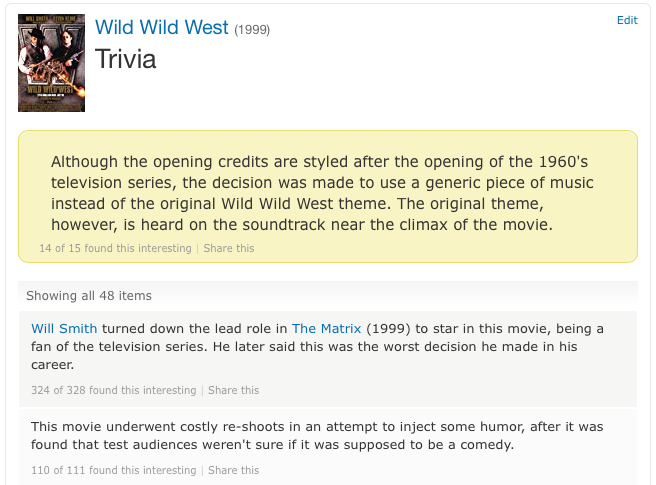
Fortunately, the selected piece of music isn't the ubiquitous-on-the-1999-airwaves Will Smith/Dru Hill theme tune that was never worthy of sampling Stevie Wonder's "I Wish." It's the other memorable piece of music from Wild Wild West: the rousing main title theme by a legendary composer who wrote a million rousing themes for westerns, the late Magnificent Seven score composer Elmer Bernstein. That Bernstein main title theme is the only thing I like about Wild Wild West. IMDb is wrong: it's not "a generic piece of music." It's classic Bernstein western music, faithful in spirit to Richard Markowitz's equally rousing '60s Wild Wild Westtheme tune, which either the filmmakers couldn't get the full rights to or were too dunderheaded to use more often in the film because of their hubris and contempt for the source material (although I wouldn't consider The Wild Wild West a perfect show: it suffers from that old '60s and '70s spy show staple of stupidly putting white actors in yellowface or brownface). The theme is too good for such a hackily written steaming pile and such a chemistry-deficient buddy action flick.
Speaking of chemistry, this might have improved the movie: instead of casting Kline, whom Smith had no chemistry with, as Artemus Gordon, Alfonso Ribeiro, whom Smith had a shitload of chemistry with from 1990 to 1996, should have been cast as Artemus. And instead of the movie's lame depiction of Artemus as this never-convincing master of disguise Kline looked as embarrassed to be portraying as Kline's washed-up Soapdish actor character looked when he had to play Willy Loman in front of confused and senile dinner theater customers, I would have written Ribeiro's short and black Artemus as an excellent master of disguise who--because both the Wild Wild West TV show and movie never gave a shit about being authentic to the period--came up with the most effective and ludicrous-for-any-period prosthetic makeup technology for altering his looks, as well as his height, race or gender. Plus it would have been amusing to have a black guy walk around with the name Artemus.
Anyway, like Stevie Wonder, I wish that theme (BLAM!) was (BLAM!) written for a different score. There lies my problem with adding to AFOS rotation enjoyable score cues from movies that are so terrible. It's so difficult to erase those movies' wretchedness from your mind when you hear these score cues that are the only redeeming elements of those movies. So to enjoy the Bernstein score cue a little more, you just have to pretend it's not from Wild Wild West.
Man, why do post-Blazing Saddles, pre-Django Unchained westerns with black heroes have such a lousy track record? Why do sci-fi westerns that are neither the '60s Wild Wild West nor the cult favorite Brisco County Jr. have such a lousy track record? Smith and his Men in Black director Barry Sonnenfeld clearly wanted to turn Wild Wild West into a Blazing Saddles for the '90s and with splashier action sequences, except Blazing Saddles knew how to be funny.
Blazing Saddles also didn't need a $170 million budget to land its jokes. The Nostalgia Chick pointed out that Shane Black, the writer and director of one of my favorite movies, Kiss Kiss Bang Bang--a buddy comedy that, like Blazing Saddles, was able to dazzle despite a limited budget--was attached to an earlier attempt to make a Wild Wild West movie. It's one of the most interesting parts of the Nostalgia Chick's 17-minute discussion of the many things that went wrong with Sonnenfeld's Razzie sensation, including Smith rejecting the role of Neo in The Matrix and choosing to play such an unlikable and overly cocky spy.
See? This is why Ribeiro would have been a great big-screen partner for Smith: unlike Kline's snooty and stiff Artemus, the equally snooty but more underdog-ish Ribeiro--due to his chemistry with Smith--would have been able to make Smith's overly cocky Agent West more likable and relatable when they interacted with each other. It would have been like how halfway through its run, the small-town lawyer sitcom Ed gave Michael Ian Black's annoying and overly cocky Phil Stubbs character a new bowling alley boss he grew to despise, in the form of the more level-headed Eli Goggins, played by the always charismatic Daryl "Chill" Mitchell. As both Phil's foil and a character who, unlike Tom Cavanagh's rather timid Ed, had the guts to challenge Phil and bring him back down to Earth whenever Phil's antics grated on everyone's nerves, including the viewer's, Eli made Phil the myopic and self-absorbed schemer a much less annoying and one-note character for the rest of the show's run.
I also wish I were in the universe where Will and Carlton reunited on the big screen as West and Artemus. Yeah, maybe it would have been too much of a rehash of the Will/Carlton dynamic from The Fresh Prince of Bel-Air for some moviegoers, but Ribeiro would have given Smith something more interesting to play against than whatever hacky shit Kline was doing. However, a completely different universe where Black's Wild Wild West got made instead is an even more enticing alternate universe. Now that is a version of Wild Wild West that would be worthy of Bernstein's main title theme. How many screenwriters did Wild Wild West have? Black's screenwriting work all by himself is frequently superior to the combined results of the 20,000 screenwriters who tried to polish the turd called Wild Wild West.
Many things doomed The Fresh Prince of Hot-Air, from its constant reshoots to skinny-pantsed '60s Wild Wild West star Robert Conrad's dissatisfaction with the script when Sonnenfeld offered him a cameo and he refused. The original Jim West bad-mouthing a reboot of his show and not giving it his blessing is like if the original Spock, when he was alive, tweeted, "I hope this new Star Trek crashes and burns," or if Michael Keaton stepped out and said, "My son showed me that new Batman trailer. Why is Ben Affleck being such a saggy diaper that leaks?" That doesn't bode well for your reboot. But when your film's key art is basically inverted key art from the 1993 megaflop Super Mario Bros., your film's really doomed.
When the only person who benefited from some part of the film is producer Jon Peters--that giant mechanical spider the extremely weird Peters kept threatening to squeeze into aborted movie versions of '90s Superman comic book storylines and Sandman finally made it into one of his productions--that's how terrible the film is. You know Patton Oswalt's six-minute distillation of the wretchedness and bloatedness of Wild Wild West (while he was being interviewed by the comedy news site/stand-up comedy record label A Special Thing)? It's six times more entertaining than Wild Wild West itself.
Every Throwback Thursday, I randomly pull out from my desk cabinet--with my eyes closed--a movie ticket I saved. Then I discuss the movie on the ticket and maybe a little bit of its score, which might be now streaming on AFOS.
Robert Zemeckis' Flight, the story of an airline pilot whose heroism in the cockpit is called into question after investigators discover he was intoxicated, is a rare example of the mismarketing of a film actually paying off. Paramount sold Flight primarily as a "prestige" disaster flick, even though Flight's riveting plane crash sequence lasts only eight minutes in the movie's first half-hour. How the hell do you sell the rest of the movie, a dark addiction drama about both Denzel Washington and Kelly Reilly's struggles to get clean? You just simply don't.
Nobody really enjoys addiction dramas. The only people who enjoy them are the actors who make them and get their kicks--and occasionally, an impressive paycheck--from going Method to portray junkies or alcoholics. Addiction dramas are often such a repetitive slog, due to the addict characters' repetitive habits and relapses, while the ones that are less tedious or simply better-crafted aren't really made for repeat viewing. I admire the filmmaking on display in Requiem for a Dream, but the film's third act was so harrowing and nightmarish I'm not itching to watch it again.
Leaving out Flight's addiction footage and only hinting at it in the legal drama clips was as risky a marketing move for Paramount as emphasizing the addiction angle would have been: what if the most hardcore Denzel stans--particularly black moviegoers with conservative tastes in film (read: Tyler Perry movies) who love it when Denzel plays either a positive role model or an action hero, which, by the way, are the kinds of roles where I tend to find Denzel to be at his least compelling as an actor--come to Flight to see their hero valiantly pilot an endangered plane as advertised, but they wind up being turned off by seeing him portray such a flawed and often unsympathetic boozer for the rest of the film? And then what if they leave the theater feeling had, took, hoodwinked and bamboozled, and as a result, the word-of-mouth for Flight turns sour? Yet Paramount's odd strategy somehow worked because all of Denzel's dramatic material after the badass plane crash sequence turned out to be equally captivating anyway--his subtle, gutsy and convincing performance as alcoholic airline pilot Whip Whitaker is more worthy of a Best Actor Oscar trophy than his Oscar-winning turn in Training Day--and Flight ended up becoming a critical and financial success in 2012.
After a string of often creepy-looking motion-capture fantasy movies that divided both critics and moviegoers, Flight marked the welcome return of the craftsman behind Used Cars, Back to the Future and Cast Away to grown-up filmmaking (yes, he made the Best Picture Oscar winner Forrest Gump, but the sappy and underwhelming Gump is hardly grown-up filmmaking). I haven't watched Used Cars, Zemeckis' only R-rated film until he made Flight, but I'm aware that the 1980 cult favorite is Zemeckis at his most biting and raunchy, raunchier than what the animators attempted to get away with during much of the material involving either Jessica Rabbit, Baby Herman or Betty Boop in Zemeckis' 1988 classic Who Framed Roger Rabbit. This mischievous side of Zemeckis from Used Cars and Roger Rabbit resurfaces in the unlikeliest of movies: Flight.
Part of what makes Flight better than the average addiction drama is the levity Zemeckis sneaks into this mostly somber piece of Denzel Oscar-bait, whether it's in the comic relief scenes where John Goodman temporarily steals the show as Harling Mays, Whip's oddly maternal drug dealer, or the opening hotel room scene where former My Name Is Earl viewers got to finally see Nadine Velazquez in all her full-frontal glory. The opening scene, which establishes Whip's alcoholism and coke habit, as well as the similar substance abuse problems of Velazquez's flight attendant character Katerina, is almost comedic in how it upends moviegoers' expectations about a typical introduction of a Denzel character and basically says, "Whip's not exactly the noble character Denzel frequently plays" (although he's played tormented alcoholics before, like in Courage Under Fire). It's even got Whip making a Bond-style pun while staring at Katerina's naked ass:
Zemeckis even sneaks in a pair of in-jokes about one of Denzel's most frequent collaborators and a past Denzel movie. I'm going to invert the following screen shot like Whip does with his plane.
Peep the stack of VHS tapes in the Whitaker family's old countryside house. One of the tapes is a copy of Top Gun, which was made by Tony Scott, who directed Denzel in Crimson Tide, Man on Fire, Déjà Vu, the Taking of Pelham One Two Three remake and Unstoppable. I wouldn't be surprised if that was both Zemeckis and Denzel's way of paying tribute to Scott, even before the Crimson Tide director committed suicide while Flight was in post-production. Another video in that stack is a copy of Denzel's 1987 Steve Biko movie Cry Freedom. That means that Flight takes place in a bizarre reality where Denzel is a movie star and an alcoholic pilot who looks a lot like Denzel becomes a media darling for unconventionally and skillfully piloting a malfunctioning plane to safety, but nobody ever comes up to Whip and says, "Hey, has anybody ever told you you've got the marquee good looks of Denzel? Here's my number at CAA. Let's do lunch some time."
Hmm, I wonder why Virtuosity isn't in that stack of videos. Anyway, another element that elevates Flight above the standard addiction drama is the movie's engaging and non-didactic legal drama side, particularly in the scenes between Denzel and Don Cheadle as Whip's efficient--and quietly frustrated, especially over Whip's behavior--lawyer, which are at times as electric as the scenes between Denzel and Cheadle in Devil in a Blue Dress. In Flight, Denzel and Cheadle reverse their Devil in a Blue Dress roles as, respectively, the straight arrow and the troublemaker who has to be kept in line by the former. Flight is as close to the Denzel-as-Easy/Cheadle-as-Mouse reunion movie we'll sadly never get to see due to Devil in a Blue Dress' box-office failure during the weekend of the O.J. Simpson verdict in 1995.