Thursday, August 9, 2012

The amount of Olympic movies--and Olympic movie scores--is as small as my desire to watch tape-delayed Olympic events

I always thought the first-season Starfleet uniforms on Star Trek: The Next Generation made the Enterprise crew look like either Olympic bobsledders or figure skaters.
Cool Runnings
"I have to begin by noting this is a fairly small genre," warned Talk of the Nation host Neal Conan on NPR before he discussed with a colleague their favorite movies about the Olympics last week, as American viewers reached the tail end of their first week of mostly tape-delayed (bleh!) Olympic fever. Conan wondered why there aren't so many Olympic movies. You would think with their cinematic scale and dramatic stories of struggle and uplift that the Olympics would be as frequent a subject in film as baseball, but that hasn't been the case.

"One reason may have to do with the international aspect of the Olympics and the fact that sometimes we think of sports movies as coming to a climax of the big game, with the good guys versus the bad guys. But with this whole Olympic ideal of a world community of sport, there are theoretically no bad guys in the Olympics," theorized Talk of the Nation film commentator Murray Horwitz, who also mentioned the International Olympic Committee's tight leash on the Olympic brand as another possible reason for the small amount of Olympic movies.

Tokyo was the site for the Summer Olympics in 1964, B.S. (Before Steroids).
Tokyo Olympiad (Photo source: DVD Beaver)
It's also a genre that hasn't yielded a film I could consider a masterpiece. (I've never seen the Toshiro Mayuzumi-scored Tokyo Olympiad, Kon Ichikawa's 1965 documentary about the 1964 games, One Day in September, the 1999 doc about the massacre at the 1972 Munich Olympics, and Munich, Steven Spielberg's take on the 1972 tragedy, but I'm aware those three films are highly respected.) I haven't seen Chariots of Fire since the '80s, but I remember being kind of bored by the film, so its trouncing of Raiders of the Lost Ark in the 1981 Best Picture Oscar race has always been absurd to me.

The NPR guys are fans of Miracle and Cool Runnings, which both happen to be Disney movies. Miracle is a good but not great sports movie, bolstered by Kurt Russell's compelling performance as 1980 U.S. Hockey Team coach Herb Brooks. As for Cool Runnings, the late John Candy killed it in a change-of-pace dramatic turn, and if you're not moved by the Jamaican bobsledders' emergence from their accident in the film's climax, you're a goddamn robot (report back to your leader Mitt Romney for instructions on how to better relate to the carbon units because he's such an expert).

But Cool Runnings diverges so much from what actually happened to the Jamaican team (for instance, Candy's disgraced coach character never existed), and the fish-out-of-water shtick that was written for Cosby and Where I Live star Doug E. Doug borders on Stepin Fetchit-y. Doug was so good in his breakout role as the wanna-be militant in Hangin' with the Homeboys. I always wanted to see the cameras follow his Homeboys character to a theater where Cool Runnings was playing just so I could see his reaction to that Rasta who's so damn scared all the time like a butler in some '30s movie.

"They've pulled down the Berlin Wall. The Palestinians and the Israelis are talking peace. But they're still making comedies like Cool Runnings, in which cartoonish natives scratch their heads and try to make sense of the white world," complained then-Washington Post film critic Desson Thomson in 1993.

What about the music in these Olympic movies? Do their original scores make you scratch your head like a Disneyfied Rasta? Or like Kerri Walsh Jennings and Misty May-Treanor's threepeat or Gabby Douglas and her coach Liang Chow's success story or the standing ovation Saudi runner Sarah Attar received while making history despite finishing last, do they make your spirit soar?

Because there aren't a lot of Olympic movies, the "Feeling Very Olympic Today" playlist I assembled from the highlights of those movies' original scores isn't a lengthy one. That's why I padded the playlist with John Williams' Olympic compositions. The playlist kicks off with Vangelis' overplayed but rousing Chariots of Fire main title theme, which Rowan Atkinson amusingly poked fun at during his appearance as Mr. Bean in the London opening ceremonies. Hans Zimmer's Cool Runnings score and the catchy "Jamaican Bobsledding Chant"--penned by Yul Brenner himself, Malik Yoba--aren't on Spotify, so Cool Runnings is represented by the cover of Johnny Nash's "I Can See Clearly Now" that Jimmy Cliff recorded for the movie.

Slap Shot, Shaolin Soccer, the original Longest Yard, the original Bad News Bears, Diggstown, Breaking Away and White Men Can't Jump are my favorite sports movies. It's too bad the Olympic movie genre hasn't given us a movie as subversive or clever as those works.

Tuesday, August 7, 2012

5-Piece Cartoon Dinner (08/07/2012): Scooby-Doo!, Ben 10: Omniverse, Ultimate Spider-Man, Adventure Time and Regular Show

'Baby want hot-ass Daphne to poop into baby's mouth!'
Like that old homosexual millionaire in The Autobiography of Malcolm X, he wants Daphne to powder him up and spank him.

Each Tuesday in "5-Piece Cartoon Dinner," I dine on five of the week's most noteworthy animated cable shows that are found outside my Adult Swim comfort zone. The episodes are reviewed in the order of when they first aired.

Scooby-Doo mysteries aren't all that difficult to figure out, so I correctly guessed that Scooby-Doo! Mystery Incorporated villain Crybaby Clown (Mark Hamill, as demented-sounding as always) was really movie star Baylor Hotner (Matt Lanter), who disguised himself in Norbit-style prosthetics as research for a role he coveted. But these mysteries usually aren't ambitiously serialized or stretched out for a few episodes, which sets Mystery Incorporated apart from previous incarnations of Scooby.

A 21-year-old David Boreanaz is pissed off over the Philadelphia Flyers losing another game.

What also sets the show apart from past incarnations are the moody small-town setting (Crystal Cove instead of the more benign Coolsville); a grown-up sense of humor (instead of The Three Stooges or The Harlem Globetrotters as guest stars, Mystery Incorporated opts for the likes of Lewis Black as a secretly villainous ex-detective and Harlan Ellison as himself); and the fact that it takes its protagonists seriously for once, even though they carry on lengthy conversations with talking dogs and parrots as if they're regular people.

As Chris Sims notes at ComicsAlliance, Mystery Incorporated has taken a previously bland character like Fred--who's still voiced by Frank Welker--and used his blandness to reimagine him as an unexpectedly tragic figure (but not so tragic that he has an addiction to smack or picks up hitchhikers in the Mystery Machine and takes them to motels to torture them in order to feel alive).

"Fred is given a love of traps that comes off as about as one-note as Shaggy being hungry all the time. It's built for gags, giving him a funny obsession that [sic] so that he can be cheerily oblivious to Daphne's professions of love," writes Sims. "But as the show goes on, and it's revealed piece by piece that Fred's father has told him that his mother abandoned their family, his obsession with keeping things from getting away from him takes on a whole new light. It shifts from something that's pure comedy to a joke with an undercurrent of genuine sadness that grows ever larger as the truth about his life starts to come out."

Sheriff Stone is so inept he makes Prez from The Wire look like Commissioner Gordon.

All these novel (for a Scooby show) touches could be why Cartoon Network has been burning off most of Mystery Incorporated's second season without much fanfare each weekday afternoon since last week. Often when Cartoon Network execs wind up with an interesting and ambitious show with a cult following like Mystery Incorporated (a blogger over at Wired considers it "the true inheritor of the Buffy crown") or Genndy Tartakovsky's Sym-Bionic Titan, they really don't know what to do with it. The bizarre treatment of Mystery Incorporated as an afterthought is either because they have no clue how to market it or because they were probably soured by contract disputes with the show's producers, which delayed the second season. I'm not an industry insider, so I don't really know why Mystery Incorporated lapsed into Burnoff Theater.

Do they both take their glasses off when they make out? Without her glasses, Velma would mistake Marcy's elbows for breasts.
Hot Dog Water and Velma

But what I do know is that the first seven episodes of the new season have been as satisfying as the episodes from the first season's back half, which I first caught between seasons. So much has happened in one week. Mystery Incorporated temporarily replaced Daphne with Marcy "Hot Dog Water" Fleach (Linda Cardellini, reunited with her live-action Scooby co-star Matthew Lillard), a former rival of Velma's who's clearly attracted to Velma (now is that why Cartoon Network, which lost its shit over Adventure Time's implication that Princess Bubblegum and Marceline were briefly more than friends, sidelined Mystery Incorporated?). Daphne learned of Baylor's scheme as Crybaby Clown and dumped him. She rejoined Mystery Incorporated, which resulted in the ousting of Hot Dog Water, who pretended to be upset by the ouster and actually anticipated it so that she could use it as ammo to plot against the team with the backing of Black's Mr. E character. I wouldn't be surprised if Hot Dog Water's plot is a continuation of Mr. E's attempt to block the team from collecting every piece of the Planispheric Disk, the key to finding Crystal Cove's hidden conquistador treasure.

Also, Fred is getting to know his long-lost birth parents, "trap-making mystery solvers" Brad Chiles (Tim Matheson) and Judy Reeves (Tia Carrere), whose names are straight out of The Rocky Horror Picture Show and whose non-verbal female puppy Nova is Scooby's first non-food-related object of affection. Brad and Judy are also former Mystery Incorporated members like Mr. E and local DJ Cassidy Williams (Vivica A. Fox). The fact that the couple is secretly in cahoots with Mr. E and the evil parrot Professor Pericles (Udo Kier), Scooby's predecessor as the team mascot--and their lack of remorse for sketchy past activities Cassidy still feels guilty about having been complicit in--are both bound to crush Fred's morale and leave him in a worse state than he was at the end of last season.

This rising conspiracy against the teens illuminates what Sims notes is a major theme of this show: "Adults are either outright liars or complicit in some kind of deception." And when these adults aren't just the costumed perps who are unmasked and busted by the team at the end of every episode and are figures whom Fred and his friends have placed their trust in--like Mr. E, Cassidy and now, Fred's real parents--it brings some genuine drama to the franchise's premise of teens who defy their fears to find the truth.

It's a cynical view of the world that Mystery Incorporated is amazingly unafraid to embrace, but to keep the show from being a total downer, the writers offset the ominousness of the rising conspiracy with humorous standalone storylines like a hilarious spoof of Andy Warhol--here, he's called Randy Warsaw (Billy West)--and his history as a control freak. In the funniest second-season episode so far, "Art of Darkness!," a perp with a grudge against Warsaw seizes control of his metal sculptures and uses them to attack and engulf models and singers Warsaw has molded into art-scene superstars, so Warsaw ends up replacing his missing emo art-rock star Eeko (Grey DeLisle) with Scooby. Warsaw sticks an Edgar Winter wig on the Great Dane and renames him Freako.

"That voice," purrs Warsaw when he first hears Scooby speak. "It's anti-art. Anti-music. It's--it's anti-words."

The sight of Scooby singing a droning, Velvet Underground & Nico-style tune is one of many reasons why--rut-roh--I'll miss Mystery Incorporated when Cartoon Network inevitably cancels it after this season is over.

The only thing wrong with this picture is that Chick-fil-A would never hire Shaggy because he's always high on the marijuana and his relationship with his male dog looks suspicious.
(Photo source: David Willis)

***

Cartoon Network's Ben 10 superhero franchise for preteen viewers isn't my cup of tea, but I wanted to catch the first part of "The More Things Change," Ben 10: Omniverse's two-part series premiere (the conclusion will air together with part 1 when the series officially premieres on September 22), because it's one of the last things credited to the late Dwayne McDuffie, whom I got to briefly meet a couple of years before his death. McDuffie, a Ben 10 veteran whose '90s Milestone comics I enjoyed as a teen, received a "story by" credit with his wife and writing partner Charlotte Fullerton for "The More Things Change."

I'm not familiar with the Ben 10 cartoons. My only exposure to the franchise has been the last half-hour of Ben 10: Alien Swarm, one of Cartoon Network's live-action Ben 10 TV-movies. Alien Swarm featured Barry Corbin in a terrible hairpiece as Ben Tennyson's grandfather Max, a retired member of the intergalactic peacekeeping force known as the Plumbers (fortunately, this group of Plumbers isn't afflliated with a right-wing dickweed who calls himself Joe). On Omniverse, Grandpa Max (Paul Eiding) has summoned a young alien Plumber named Rook Blanko (Bumper Robinson) to help out his grandson (Yuri Lowenthal), who's been bragging about not needing a partner to help him fight alien threats ever since his previous Plumber sidekicks, cousin Gwen (Ashley Johnson) and her boyfriend Kevin Levin (Greg Cipes), left for college.

Of course, Ben won't admit it, but he needs all the help he can get because even though he's become a capable hero like his grandpa due to the Omnitrix, the gadget on his wrist that allows him to temporarily assume the forms of powerful alien warriors, he doesn't have much control over the device. It doesn't give Ben the ability to choose which alien he wants to be, so he has to constantly improvise with whatever form the Omnitrix converts him into. It's like having Clive Anderson on your wrist, except instead of him telling you to act out a visit to the dry cleaner as a cowboy who speaks in questions only, he's turned you into a shape-shifting alien with a body made out of Lego blocks, and he doesn't speak and proceed to badger you with insults about your silly American ways or your short stature.

Tuesday, July 31, 2012

5-Piece Cartoon Dinner (07/31/2012): Iron Man, Ultimate Spider-Man, Scooby-Doo!, Adventure Time and Regular Show

In a deleted scene, Fred is seen eating Scooby Snacks out of an alley trash bin.
All Hipster Fred can think about right now is where he could score some PBR.

Each Tuesday in "5-Piece Cartoon Dinner," I dine on five of the week's most noteworthy animated cable shows that are found outside my Adult Swim comfort zone. The episodes are reviewed in the order of when they first aired.

Iron Man: Armored Adventures, which centered on a teenage version of inventor/superhero Tony Stark (Adrian Petriw), quietly ended its two-season run on Nicktoons last Wednesday. The animation on this Canadian-made show isn't bad for a CG-animated show. I like how at the end of the Rooney-soundtracked opening titles--nice original theme, by the way, from Dweezil Schwartzman or whatever his name is--Iron Man quivers like Buzz Lightyear pressing his wrist laser button while he activates his suit's repulsor ray from his palm, which makes it look as if this much younger Tony is still adjusting to the power of his repulsor rays. But the show's human character designs and lighting look cheap and low-res compared to what we see on other CG shows like Disney's noir-tinged Tron: Uprising and Bruce Timm's strikingly lit Green Lantern: The Animated Series.


While I find the look of Armored Adventures to be on the undernourished side, the writing, supervised by story editor Brandon Auman, is pretty decent. Though Armored Adventures is made for an audience that's younger than, say, Young Justice's--hence the de-aging of Tony, James Rhodes (Daniel Bacon) and Pepper Potts (Anna Cummer), who, instead of being Tony's assistant, is Tony and Rhodey's classmate on this show--it isn't as juvenile as I often find the writing on Ultimate Spider-Man to be. In other words, there aren't any anvillicious voiceovers from Tony or forced cutaway gags. I particularly liked Armored Adventures' recent crossover with the X-Men characters, the Auman-scripted "X-Factor," which had Tony and Rhodey coming to the aid of their mutant classmate Annie, who was on the run from Magneto and was revealed at the end of the episode to be a young Jean Grey.

In "The Makluan Invasion, Part 2: Unite!," Armored Adventures' series finale, the battle between Iron Man's allies and the Makluan forces for the coveted 10 Rings resembles the climax of Joss Whedon's The Avengers (this two-parter's team of heroes is the same as Whedon's roster, except it's missing Captain America, Thor and Maria Hill, who's Russian-accented on this show for some odd reason, and in their place is Black Panther), but Auman actually wrote the finale before Whedon began work on his movie. Hulk (Mark Gibbon) surprises his friends by joining them late in battle like in Whedon's movie, but he's a lot different here. He experienced an intelligence boost during his last appearance on the show, so he talks in full sentences (just like on The Avengers: Earth's Mightiest Heroes) and would be able to land a job as an ESL teacher. (The most physical side effect of Hulk's added brainpower was a change in skin color from green to '60s comics-era gray.)

Missing from this team are Captain America, who's still a Popsicle, and Thor, who's still trying to pass shop class back on Asgard.

A couple of other major differences between "The Makluan Invasion" and the Whedon movie are the involvement of War Machine and Rescue, Pepper's armored alter ego (which probably pleases female viewers who are campaigning for Gwyneth Paltrow's Pepper to suit up as Rescue in Iron Man 3), and due to the low budget, a reduced sense of scale. The Manhattan streets on this show are often empty. Where did all the bystanders go? Without those civilians, the battle between Team Stark/S.H.I.E.L.D. and the titular aliens isn't as high-stakes as the one between the Avengers and the Chitauri. Maybe that's also due to the fact that I'm in TV-Y7-land here instead of the PG-13-level alien-invasion drama of the Whedon film or the more morbid turf of a celeb-slaughtering Irwin Allen disaster flick, so I shouldn't be expecting Robert Wagner running around on fire like Richard Pryor or something.

Auman wrote "The Makluan Invasion" as both a season finale and series finale in case the series didn't get renewed. So because Nicktoons has basically cancelled Armored Adventures, the series concludes with Iron Man, War Machine and Rescue flying off into the sunset and eagerly looking forward to their new lives as superheroes whose secret identities are now known to the public, which learns of their unmasked selves after Tony accidentally loses his helmet while escaping the destruction of the Makluan mothership, and Rhodey and Pepper happen to be be unmasked when they retrieve him. Rhodey and Pepper's parents also learn of their children's secret lives and are unusually understanding about their new jobs. I'm surprised that Rhodey's lawyer mother Roberta (Catherine Haggquist) doesn't ask her son something like, "Hey, remember that internship at Matt Murdock's firm? Because in case the superheroing thing doesn't work out... Also, they've got dental."

***

The comedic material on Ultimate Spider-Man is much less cringe-inducing than usual this week. I don't know if it's because Scott Mosier--the Kevin Smith crony and SModcast network co-founder who co-wrote this week's "Beetle Mania" episode and had a hand in several other upcoming episodes--has something to do with it (I don't listen to Mosier and Smith's podcasts, so I can't tell which lines in "Beetle Mania" are ones Mosier would come up with). I actually laughed during one gag (Peter imagines the ambitious, Tara Strong-voiced Mary Jane as the new boss of the Bugle and pictures her with J. Jonah Jameson hair) and enjoyed another that requires the pause button in order to see it (a Bugle news channel ticker posts items like "Snow in July? Storm refuses to comment" and "Alison Blaire's new album goes platinum in the first week," a reference to Dazzler, the mutant pop singer from the X-Men comics).

This green-eyed bandit may be difficult for S.H.I.E.L.D. to defeat, but he doesn't speak, so he'd definitely lose in a battle with that other green-eyed bandit, Erick Sermon.

Again, the C-list villain in the show's cold open, the recurring, bad glue pun-loving nuisance known as the Trapster (Steven Weber), is more memorable than the main heavy, the nearly mute Beetle (Steve Blum), whom Spidey and the S.H.I.E.L.D. trainees must protect both MJ and Jameson from when the armored assassin attempts to attack the outspoken Bugle editor-in-chief at his office building, just when MJ happens to be there to be interviewed by Jameson for a Bugle internship. The main villains on Ultimate Spider-Man have tended to be on the boring and easy-to-defeat side, including this week's uninteresting titular foe and the one-note Venom, although the Mark Hamill-voiced Nightmare from the Doctor Strange episode had, for once, some personality and formidableness (he kept everyone in New York imprisoned in their nightmares, which makes that small-town menace Freddy Krueger look like a pussy) and required more than just webbing and brute strength from Spidey in order to be defeated.

Series composer Kevin Manthei's half-orchestral/half-punk score music really stands out this week. He gives MJ a memorable and charming leitmotif for strings that perfectly suits the aspiring journo's persistent yet relaxed demeanor. And then someone in the Disney XD control room apparently got his drank on all Saturday night and was asleep at the wheel because he forgot to squeeze out the Ultimate Spider-Man end credits with one of Chi McBride's "Fury Files" segments for the "Marvel Universe" block, so we got to hear all of Manthei's end credits theme, which Manthei has referred to as a punk tune that "continues the tradition of the classic animated Spider-Man song in terms of being catchy." Manthei wrote it so that someone can easily sing "Spider-Man, Spider-Man" repeatedly over it, much like the late, great Shirley Walker's theme for the Man of Steel on Superman: The Animated Series. I may not always agree with Ultimate Spider-Man's comedic or narrative choices, but it's nice to hear an animated Marvel series step its game up in terms of score music for a change.

Monday, July 30, 2012

Close to "Rome"

Fuck the slapstick. Fran Jeffries' booty is the highlight of the first Pink Panther movie, no doubt.
(Photo source: Poetic and Chic)

"Rome, Italian Style," which I named after one of my favorite SCTV sketches, is an hour-long block I launched on A Fistful of Soundtracks last summer as a way to give some airplay to the badass and lush Rome album, the '60s Italian film music-inspired project produced by superduperproducer Danger Mouse and Magic City composer Daniele Luppi and featuring Jack White and Norah Jones on vocals. Besides the Rome tracks, the 11am block (which airs every weekday except Friday) also features '60s and '70s film and TV theme covers and tracks from outside the film and TV music world that were modeled after '60s and '70s film and TV scores.

The following tunes that I found on Spotify aren't currently part of the "Rome, Italian Style" playlist, but they ought to be.

Jones' new breakup-themed album Little Broken Hearts, which was produced by Danger Mouse, feels like a companion piece to Rome.


Both the Blue Harlem and Lena Horne tracks are covers of "Meglio Stasera" from the first Pink Panther. For some reason, the shots of Selina Kyle atop the Batpod in The Dark Knight Rises made me flash back to the first few seconds of this:


Tuesday, July 24, 2012

5-Piece Cartoon Dinner (07/24/2012): Motorcity, Gravity Falls, Ultimate Spider-Man, The Avengers and Regular Show

'Are you accusing me of phone hacking, Stark? I don't like phone hacking. I LOVE phone hacking!'
A typically serene moment in J. Jonah Jameson's office
Each Tuesday in "5-Piece Cartoon Dinner," I dine on five of the week's most noteworthy animated cable shows that are found outside my Adult Swim comfort zone. The episodes are reviewed in the order of when they first aired.

According to an angry asian man post last week, at the recent 2012 San Diego Comic-Con, the Hasbro-owned Hub family channel, the home of the surprise hit My Little Pony: Friendship Is Magic, passed out fortune cookies with racist "Ching chong a-ling long" messages inside (a Hub network exec later publicly apologized for the racist cookies). Isn't the hero of The Hub's Kaijudo: Rise of the Duel Masters, a cartoon I've sometimes covered in this column, a half-Asian kid who has to put up with racist bullying?

I've seen the message inside one of the fortune cookies that's intended for The Hub. It says, 'You're a shitty channel, and you'll get only one fucking hit: My Little Pony.'
Way to be as tolerant as one of your own original shows, Hub. If the channel formerly known as Discovery Kids disappeared tomorrow from my DirecTV channel roster like all the Viacom channels temporarily did during the carriage dispute between Viacom and DirecTV last week, I wouldn't bat an eye, even though legendary voice actor and current Motorcity big bad Mark Hamill is now one of the station announcers. The Hub is now that inessential to me.

Open your fortune cookie, Hub. The message inside says, "In two years, you'll end up being a 24-hour infomercial channel and then totally falter." In bed.

***

Jen's sleeves. That's what first caught my eye during Downtown when the animated sitcom aired too briefly on MTV in 1999.

'Hey, Kool Aid!'
Jen from Downtown
The baggy sweater-wearing Asian American tomboy's overlong sleeves also happened to be the first bit of character business that made me take notice of the distinctive animation style of the studio I later learned was called Titmouse, when studio co-founder Shannon Prynoski wrote on my guestbook (aw, guestbooks--remember those?) in 2004 to tell me she's a fan of my radio station A Fistful of Soundtracks. I e-mailed her back to say I enjoyed Downtown, as well as the hallucination sequence her studio animated for Beavis and Butt-head Do America, and she said she tuned into AFOS late at night while working on a then-upcoming Cartoon Network show called Megas XLR.

After first learning about Megas from her, I became a fan of Titmouse's work and have followed most of the studio's output since Megas, from the occasional Metalocalypse rerun to Freaknik: The Musical and now, the animated version of Black Dynamite and Motorcity. I haven't watched an entire Downtown episode in 13 years (I know that the show can be YouTubed, and its creator, Shannon's husband Chris, found a clever way to make the entire series available to its fans, but I keep putting off re-watching it), and I've forgotten all the dialogue from Downtown since then, but I've never forgotten Jen's sleeves because that's the inventiveness of Titmouse in a nutshell.

Subtle character animation has always been Titmouse's forte, and Motorcity's "Off the Rack" episode is filled with plenty of it, which is why I'm kind of frustrated that Disney XD delayed the episode until last Thursday night. If "Off the Rack" feels like an episode from earlier in Motorcity's run, that's because it's the sixth one produced by Titmouse (we're 11 episodes into Motorcity's 20-episode season), and Disney XD has been airing Motorcity episodes out of order.

Shuffling the episode order is a network business decision I don't always understand. The practice, which I first noticed back when Fox unveiled Batman: The Animated Series' first few episodes in 1992 (the first episode that ever aired, a Catwoman story, was actually the 13th one produced), makes less and less sense in an age when time-shifted viewing is making both the Nielsen ratings system and ratings-driven business decisions increasingly irrelevant. NBC did it with Homicide: Life on the Street in its first season because they didn't think the bottle episode "Night of the Dead Living," one of the earliest episodes that was filmed, would hook viewers like the season's slightly more higher-stakes episodes (like the "Gone for Goode" pilot or "Three Men and Adena") would, so they banished it to later in the season.

Delaying "Night of the Dead Living" was an odd move because I ended up finding that bottle episode (an abandoned baby at the precinct brings out sides of the cop characters we'd never seen before) to be more fascinating and rewatchable than most of the first season's other higher-stakes episodes. This wasn't the last time NBC would eff around with Homicide's episode order. Two seasons later, a similar airdate shuffle resulted in the death of a major character (Jon Polito's conspiracy-theory-obsessed Steve Crosetti) being inadvertently spoiled a few weeks before NBC aired the episode that revealed his demise.

In a less older example, Fox shuffled Firefly's intended order because they wanted to make the Joss Whedon show more appealing to the kinds of viewers they wanted to attract. The network wasn't satisfied with the Firefly pilot as a premiere episode (Fox felt the pilot had too much woe-is-me and not enough derring-do, according to the A.V. Club), so they asked Whedon to come up with a more action-packed premiere. The episode switch didn't pay off. Fox cancelled Firefly a few weeks later due to low ratings, and the show ended up becoming more popular on DVD.

Motorcity isn't serialized like Homicide was, so when Disney XD shuffles episodes around, it's not as disastrous as the Crosetti mishap, but it's still noticeable, like in "Blond Thunder" and "Off the Rack," which throws an intriguing monkey wrench into Julie Kane's efforts to hide her parentage from the Burners while also hiding her allegiance to her freedom fighter friends from her evil businessman father Abraham Kane. Julie's jeopardized double life is the kind of dramatic predicament that usually pops up early on in an action show's run to basically say to the viewers, "And these are the stakes! Stake it up! Stake it up! Stake it up!" (her parentage was revealed in the first episode, and as I said before, "Off the Rack" was sixth in Titmouse's production order). So it's bizarre and off-putting to see Disney XD delay that kind of story (which was written by George Krstic, who, as we saw in "Power Trip" and "Going Dutch," is great at raising the show's stakes) to a point in the season that's later than when Titmouse intended.

The monkey wrench into Julie's balancing act is the new Safe-T-Suit that Kane has implemented on each of his KaneCo employees, including Julie, who works as an intern for her father and is using her access to spy on his plans. The Safe-T-Suit is the latest advancement in protective wear ("Stability magnets, collar side airbags, safety form parachute pants!"). With just a push of a button on a special ring that's similar to that ring the Flash carries around his red costume in, the suit self-inflates from out of the ring and completely covers the wearer, and then it can easily fold itself back into the ring when the wearer wants to deactivate it.

The T is for tyranny.
(Photo source: Hair Nets and Dog Food)
But because this is Abraham Kane we're talking about here, he's secretly designed the suit so that he can hack into any suit and manipulate via Minority Report-style interfaces the movements of whichever employee is wearing a suit ring, mainly to prevent disgruntled employees from defecting Detroit Deluxe. Kane's external control is like bloodbending on The Legend of Korra, but without the creepy bone-grinding sound FX and the anguished faces in which the victims look like they're on the toilet, taking the world's most painful deuce. When his scanners alert him that a suit has been deployed outside of Detroit Deluxe and inside Motorcity, Kane deduces from the suit's hidden camera footage that a Burner has stolen it, and he activates the external control.

The tyrannical tycoon forcibly summons the Burner back to KaneCo Tower for punishment without realizing that the Burner inside the suit is his own daughter (the camera is--rather conveniently--unable to adjust its own lens so that Kane can see her face). Julie feels guilty over missing out on a recent Burners battle against her evil dad's Sector Enforcer Drones because of the duties that her cover at KaneCo entails. She bristles when Texas questions her loyalty to the Burners and calls her "Miss Deluxe" again like he did in "Ride the Lightning." So she attempts to make up for her absence by heading off to attack the Enforcer Drone factory on her own with the help of her suit's abilities, right when her dad unknowingly bloodbends her.

Claire does her best impression of Missy Elliott in the 'Supa Dupa Fly' video.

'Dude. Calm down, Chuck. It's just a bunch of my fans saying whattup in an unusually clingy way.'
(Photo source: Hair Nets and Dog Food)
The technobabble-heavy resolution to the suit crisis is a bit convoluted. After Chuck helps Texas rescue from external control mode Julie's best friend Claire (the animators somehow work into the mayhem a hilarious, how-did-this-make-it-onto-Disney-XD? shot of Chuck accidentally sitting on Texas' face), Chuck eagerly hugs the girl he's had a crush on, and the hug's disabling of the suit makes him realize the suit can be shut down if its "protection threshold" is overloaded. Wouldn't it be easier to just slip the rings off the workers' fingers and shut down the suits that way? However, the visuals before and after the resolution are some of the most amazing shots this series has ever done. Mike Chilton may despise the sterile city he used to work in, but Detroit Deluxe looks mighty spiffy during the moment when Kane hijacks hundreds of his employees' suits all at once and activates "dive mode" to unleash a swarm of these frightened-looking human missiles on Mike's car Mutt. And then just when I thought the "dive mode" shot of the red flood of KaneCo workers swarming on Mutt was the episode's visual highlight, "Off the Rack" immediately tops it with shots of a Katamari Damacy-style "human ball" that Kane forms out of the workers' bodies to squash the Burners' rides.

Julie tries to steal the NOC list or some shit.
(Photo source: Hair Nets and Dog Food)
Another visual highlight in "Off the Rack" is the aforementioned subtle character animation, especially for Julie (and Claire too, when she expresses her enthusiasm over receiving the suit). Because this is her spotlight episode, Julie does a lot of running around and spying here (she gets to reenact the "Tom Cruise dangles from a wire" heist scene from the first Mission: Impossible movie). I don't know if it's because it's cable and not Saturday morning network TV--so cartoon studios aren't forced to work under production schedules that were stricter back when ABC, CBS, Fox and NBC were in charge of cartoons, and the animation work back then was really cookie-cutter as a result--but this series, particularly during "Off the Rack," is loaded with stunning feature film-quality animation, which was such a rarity to see on the small screen back when I was a Batman: The Animated Series-watching teen.
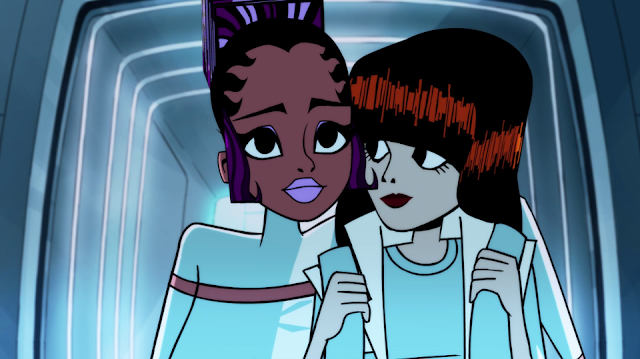
Claire and Julie are apparently at a Hype Williams video shoot.
(Photo source: Hair Nets and Dog Food)
The Ovation channel has lately been repeating Frank and Ollie, director Theodore Thomas' 1995 documentary about the legendary Disney studio partnership between his father Frank Thomas and his fellow animator Ollie Johnston, and though I'm not a Disney fan, the doc has made me better appreciate the subtle character animation that the duo was known for. Thomas and Johnston's animation style lives on in amusing tics that the Titmouse animators have given to the Motorcity characters, like the self-confident and headstrong Julie's frequent tic of resting her hand on her hip, even when she's in multiple-hologram form when she uses her trusty holographic gadget to confuse adversaries.

"I really dug animating Julie doing spy stuff... and it's made all the sweeter when the action ramps up later ([animator] Ben Li is amazing)," posted Titmouse animator Parker Simmons on Tumblr about "Off the Rack." He added, "Julie is definitely one of my favorite characters to animate when she's in confident sweetheart mode, not schoolmarm mode."

And that's another thing I enjoyed about "Off the Rack." In several episodes, Julie, whose secret double life I've been waiting to get more of a glimpse of ever since the premiere, has done nothing more than act as a schoolmarm to Mike or Texas when she's not engaged in battle or tossing her boomerang at Kanebots, so it's great to see her intensely driven character fleshed out a bit more. We've never seen Julie look frightened before. Kanebots don't scare her. What scares her more is losing control over her double life.

She's also not the screamy type--that would be Chuck--so it's surprising to see her scream for the first time in the series, when her dad hijacks her suit to make her steal Mutt from Mike and drive away to KaneCo Tower at a speed so insanely high it would make David Letterman piss his pants. But Julie quickly learns to keep her cool, and she regains her smile when Mike busts into his own car to help her out and her dad makes her repeatedly punch Mike in the shoulder. Both Julie's nicely drawn expressions while she's trapped inside the suit and the suit design itself made me think of Jen's overlong sleeves.

I didn't figure Julie to be a fan of Balki and the 'Dance of Joy.'
(Photo source: Hair Nets and Dog Food)
It all amazingly ties back to Jen's sleeves.