Showing posts with label Barack Obama. Show all posts
Monday, July 27, 2015
Shows I Miss (Already): Key & Peele
Since 2009, the AFOS blog's "Shows I Miss" series has looked back at highly entertaining TV shows that were gone too soon and were too clever to last on commercial TV, from 2003's Keen Eddie to last year's Selfie. Comedy Central's hilarious Key & Peele is the first "Shows I Miss" entry in which the show closed up shop not because of the network but because the stars (who, in Keegan-Michael Key and Jordan Peele's case, also doubled as the lead writers) wanted to move on: over the weekend, Key confirmed that the show's current season, which wrapped up filming last November, is also its last in an exclusive interview with The Wrap, and Peele did the same thing on Twitter.
It's not surprising that Key and Peele are eager to move on and concentrate on film projects like Keanu, which will star the duo and will be directed by Peter Atencio (the same director who brought so much cinematic flair to Key & Peele's sketches in the first four seasons and helped change the perception that sketch comedy should be cheap-looking and visually uninteresting). Last year, Peele told L.A. Weekly, "If our show is to have any kind of legacy, it should be that it didn't go on too long."
Last Friday's series finale announcement is the biggest thing that separates Key & Peele from the sketch comedy show it's often (and sometimes rather unfairly) compared to, the groundbreaking, no-holds-barred Chappelle's Show. Unlike Dave Chappelle, whose "I'm going out for a pack of cigarettes"-style departure from his own hit show was one of the most bizarre exits from a TV show ever, Key and Peele get to end their hit show on their own terms.
If you don't remember the whole controversy over the demise of Chappelle's Show, Chappelle became so upset over seeing white fans of the show laugh at his sketches for the wrong reasons that he didn't come back to finish work on what became known as "the lost episodes." I have a theory for Chappelle's meltdown and subsequent escape from Comedy Central to South Africa: they were actually a cover for himself to go off the grid and do secret agent work nobody--not even his former writing partner Neal Brennan or his family in Ohio--knows about. Chappelle's a secret agent when he's not doing stand-up, which explains why he now has the physique of a black Daniel Craig.
Chappelle's Show became unwatchable without Chappelle's approval on the final cut (one of the lost episodes was a non-comedic, town hall meeting-style--and rather pointless--episode about whether or not Chappelle's opinion that the "Stereotype Pixies" sketch, which triggered his exit, was reinforcing racial stereotypes was right: re-fucking-ally?). Meanwhile, Key & Peele's final season is, fortunately, far from an abomination like that aborted third season of Chappelle's Show was. Some Key & Peele fans might not agree--particularly those who miss the segments where Key and Peele would interact with a studio audience and have also grown tired of the antics of some of the show's few recurring characters, like Peele's Meegan, the petulant millennial afflicted with both vocal fry and lousy movie theater behavior--but Key & Peele is still one of the most consistently funny sketch comedy shows on the air. Last week's ChildFund International commercial parody with Peele as a social worker loosely based on the bearded ChildFund guy, asking viewers to donate fake beards to Third World kids, and the latest Meegan and Andre sketch (is it me or did Peele model Meegan's voice after Mindy Kaling, the current boss of Key and Peele's old MADtv pal Ike Barinholtz?) were both absolute riots.
To the viewers who say they miss Key & Peele's studio audience segments, you do know those segments were sort of a compromise between the show's crew and Comedy Central, right? A behind-the-scenes battle that not many of those Key & Peele viewers seem to be aware of is the battle over the inclusion of studio audience laughter in every sketch: the network insisted on a laugh track, while Key, Peele and Atencio didn't want laughter. In 2013, Atencio discussed on Tumblr his past disagreements with the network over the laughter and said, "Our feeling was that because the sketches had a filmic quality to them, the laughter was distracting, and in a way cheapened the effort we had put into making the sketches work as individual short films." He added, "A lot of our sketches rely on setting up a believable world in often very serious genres and then subverting them, and so having that laughter cut in during an action movie or sci-fi style opening was like pouring ice-water on the viewer."
Key, Peele and Atencio had to continually persuade the network that a laugh track would get in the way of, as Atencio pointed out, "the dialogue, music, and sound-effects, all of which play a role in the comedy in most of our scenes." They ultimately won the battle and came up with a way to include audience laughter without having it intrude on the sketches: laughter would be present only during Key and Peele's hosting segments in front of a live studio audience. But the show actually got even better when it completely did away with the studio audience segments and replaced them with True Detective-style fake road trip scenes between Key and Peele as themselves (ad-libbing to each other just like in the studio audience segments), and it became clear that what Key, Peele and Atencio really wanted to do with the show this whole time was to channel the laugh track-less vibe of sketch comedy movies like Monty Python's The Meaning of Life and the John Landis flicks Kentucky Fried Movie and Amazon Women on the Moon.
To me, Key, Peele and Atencio's preference for the absence of often annoying audience laughter is as great a legacy as the show's smartly written satire about racially motivated police harassment of black men and other racial issues (like the "Negrotown" musical number, which bashes everything from racist bankers to cultural appropriation) or the unique--and unapologetically nerdy--comedic voice of two biracial comedians. Key & Peele's experiment of abolishing laugh tracks from filmed sketch comedy has caused other Comedy Central sketch shows like Kroll Show and Inside Amy Schumer to follow suit, which is a thing of beauty. I hate laugh tracks. Why do I need to be told when to laugh? They never made sense when Scooby, Shaggy, Fred, Daphne and Velma were getting chased around by ghosts to the sound of canned laughter, and they never made sense now.
Another one of Key & Peele's charms was that it wasn't trying to be Chappelle's Show (speaking of which, here's why some of us former Chappelle's Show viewers are still a little frustrated with Chappelle's abrupt exit: his departure was responsible for the increased presence of the unfunny and racist Mind of Mencia on Comedy Central's schedule, as well as the network's annoying attempts to market the neo-conservative Mind as the next Chappelle's Show). I like the film writing of Kartina Richardson, but her complaints during Key & Peele's first season that Key and Peele are "black folk who want to move past race" and that the show's writing is tepid in comparison to Chappelle's no-holds-barred material and it "makes fun of blacks in a way white liberals will allow themselves to enjoy, under the guise of 'talking about race'" were really weird complaints, especially when race is frequently on the minds of both Peele, who's been working on a script for a horror flick he wants to make about "the fears of being a black man today," and Key (Richardson's negative review of Key & Peele is over at Salon, but I don't want to link to Salon because that site is as slow and laggy as Wendell trudging through a brony convention). In those earlier seasons, Key & Peele was interesting precisely because it wasn't another Chappelle's Show: the obsessions of Key, Peele and Atencio ("Labyrinth. That's my world. NeverEnding Story. Willow," said Peele to White Teeth author Zadie Smith in the New Yorker) are mostly different from those of Chappelle and Neal Brennan's. But Key & Peele eventually did dive into the kind of edgier material about race that Richardson felt the show lacked--like "Negrotown" and the Trayvon Martin-related sketch that opened "Les Mis," the show's third-season premiere--and it ended up excelling at that kind of material.
There is one area where Key & Peele definitely surpassed Chappelle's Show (besides the five seasons Key & Peele will now have amassed), and that would be the fact that it got a few non-black comedians of color some extra screen time on largely vanilla Comedy Central. For instance, Filipino American improv comic Eugene Cordero appeared a few times on Key & Peele, which is better than Chappelle's Show's weird casting of either extremely wooden Asian non-actors or what I assume to be relatives of Chappelle's Asian wife as Asian characters and SNL's continuing practice of casting white actors as Asians. You bet your ass it's offensive and lame whenever the white comedians on SNL play Asians, even without yellowface or brownface makeup. Occasionally, Key has played South Asian characters on the show--like that Indian pediatrician in the unsettling "Make-a-Wish" Halloween sketch with Lauren Lapkus--even though he's neither South nor Asian, but he's actually convincing and non-offensive as an Indian guy (perhaps the reason why Key doesn't sound like Hari Kondabolu's priceless description of Apu as "a white guy doing an impression of a white guy making fun of my father" is due to help from his wife, a dialect coach).
Key & Peele did a few other things better than SNL, like any of Key & Peele's sketches about Barack Obama, which wouldn't have existed had Lorne Michaels chosen Peele to bring his impression of the President to SNL (Peele once said, "I had some good friends over there, and a great meeting with Lorne and they asked me to do it, but I couldn't go for contractual reasons. I was on MADtv... It was a whole fiasco. It was such a shame, SNL is one of my favorite shows of all time"). The sketches with Peele as Obama and Key as his "anger translator" Luther may be viral sensations, but my favorite Key & Peele Obama sketch is "Obama: The College Years," mainly because of the way it makes fun of terrible, subtle-as-an-anvil dialogue in historical dramas like that cheesy line Joely Richardson had to say in The Patriot (Mel Gibson: "May I sit with you?" Richardson: "It's a free country. Or at least it will be").
The little visual touches Atencio came up with for the degraded early '80s videotape look of the fake footage of young Obama are a good example of Atencio's visual flair. That flair and Peele's nerdy love of horror movies were integral to another highlight of Key & Peele's run: the show's ability to pull off horror genre parody sketches that were genuinely unnerving in addition to being funny. The aforementioned "Make-a-Wish" sketch is especially unnerving. It features a creepy performance by Peele as an evil kid whose dying wishes are more elaborate than "I wish I could be Batman." Peele seems to be particularly obsessed with Thomas Harris adaptations like Manhunter, The Silence of the Lambs and the Hannibal TV show, which explains why the Harris Cannibalistic Universe inspired not one but two sketches: "Hall of Mirrors," featuring Peele as a serial killer who's got Francis Dolarhyde's cleft lip, Ted Levine's voice and Joe Isuzu's inability to lie effectively, and "Sex Detective," which has Peele playing a brooding, Will Graham-like criminal profiler in a dead-on spoof of the masturbatory overtones of loner detectives like the occasionally Graham-like Fox Mulder, whose love of beating the meat was hinted at on The X-Files (extra points for the casting of former Criminal Minds star Paget Brewster as another detective).
"Sex Detective" is so dead-on that it's forever ruined the HCU for me. Thanks to "Sex Detective," Hannibal's pilot episode remains the only Hannibal episode I've watched because I know I won't be able to watch the rest of Hannibal without thinking of Peele's MacGruber-ish moans from "Sex Detective" and chuckling. That's how terrific a Key & Peele genre spoof like "Sex Detective" is: it has the power to ruin whole genres, just like how Walk Hard: The Dewey Cox Story was so brutal in skewering musician biopic clichés that it caused me to be unable to take any musician biopic seriously anymore.
The intensity of Key & Peele's horror sketches, whether that sketch is "Make-a-Wish," the explanation for Steve Urkel's dominance on Family Matters or either of the Thomas Harris spoofs, sheds light on one last standout thing about Key & Peele: the two stars are excellent actors in addition to being great comedic minds (Zadie Smith points out that "If the depth Key brings to comic moments is unexpected, the bigger surprise is that he's doing comedy at all: he intended to be a classical actor"). So many of last week's negative reviews about the Adam Sandler blockbuster Pixels have noted that Sandler sleepwalks through the movie. In other words, the energy level Sandler once had in his earliest comedic vehicles--and in more challenging and risky movies like Punch-Drunk Love, in which Sandler movie fan Paul Thomas Anderson got a career-best performance out of Sandler--is completely gone. On Key & Peele, neither Key nor Peele could ever be guilty of such a thing. They acted their asses off in every sketch, and that sort of commitment to whatever material comes their way is something studio comedy filmmaking could really use right now. Comedy Central's latest loss is now studio comedy filmmaking's gain.
Labels:
Barack Obama,
Chappelle's Show,
Dave Chappelle,
Hannibal,
Jordan Peele,
Keegan-Michael Key,
Key and Peele,
MADtv,
Manhunter,
NSFW,
Peter Atencio,
R.I.P.,
scripted TV,
Shows I Miss,
SNL,
TV music,
Tyler James Williams
Friday, September 12, 2014
"Brokedown Merry-Go-Round" Show of the Week: Space Dandy, "Lovers Are Trendy, Baby"
Every Friday in "'Brokedown Merry-Go-Round' Show of the Week," I discuss the week's best first-run animated series episode I saw. "Brokedown Merry-Go-Round," a two-hour block of original score tracks from animated shows or movies, airs weekdays at 2pm Pacific on AFOS.
Kimiko Ueno is a writer to watch. She's responsible for two of Space Dandy's funniest episodes, "I Can't Be the Only One, Baby," a frenetic half-hour that's grown on me since its airing in July, and last season's "Sometimes You Can't Live with Dying, Baby," a riff on the zombie genre that features the show's most sublime use of its Douglas Adams-style narrator (his matter-of-fact narration is an element of Space Dandy that plays better in subtitled Japanese than in English because matter-of-fact foreign narration, whether it's delivered by a Japanese announcer or a British documentarian, is just funnier, and not for xenophobic reasons).
In "I Can't Be the Only One, Baby," the pulling of "cosmic pubes" caused Dandy, Meow and QT to ping-pong back and forth between other dimensions. In those other realities, they had awkward and often argumentative encounters with their parallel counterparts, who were completely different from all the other much more identical parallel counterparts we saw in previous and subsequent episodes, that is if Space Dandy viewers' theory that each episode takes place in a different reality is a correct one (the counterparts Dandy, Meow and QT met in "I Can't Be the Only One, Baby" more closely resembled the stars of animated shows that are way more popular in Japan than Space Dandy, which has failed to catch on with the Japanese public and is a more popular show over here in America). For instance, in one reality, Meow was a sexy woman in a dance leotard instead of a male cat, while in a much more emo reality, he was a terrifying-looking cyborg with a frozen smile who spoke only in creepy-sounding electronic meows that would constantly drive his morose shipmate Emo Dandy to want to kill himself. And like "Sometimes You Can't Live with Dying, Baby," "I Can't Be the Only One, Baby" made sublime use of the narrator at one point and had him bickering with his parallel counterparts as well.
Ueno also wrote "Rock 'n' Roll Dandy, Baby," a Behind the Music-like rockumentary parody where would-be rocker Dandy spent more time bickering with his bandmate over what to name their band and how their merch should look than actually creating music. "Lovers Are Trendy, Baby"--in which Scarlet (Houko Kuwashima), the prim Alien Registration Center clerk who always rejects the unregisterable creatures that Dandy brings to her, pays the pompadoured alien hunter to pose as her boyfriend in order to ward off her stalker ex-boyfriend Dolph (Kazuya Nakai)--isn't quite as funny as those three previous Ueno episodes, but it reteams Ueno with director Masahiro Mukai, who helmed the chaos of "I Can't Be the Only One, Baby."
Mukai brings much of his visual panache from the cosmic pubes episode to this one as well, especially in any scene involving the machine gun-wielding silver and red mecha from the show's opening titles, which finally makes an appearance here and turns out to be piloted by Dolph. Because this is a sci-fi comedy show full of spaceships and giant mechs, instead of stalking Scarlet in a tourist disguise or in a Spider-Man costume, Dolph spies on her from the cockpit of his floating mecha, the winner of the least conspicuous stalker vehicle of the year.
You keep expecting Mukai to stage a battle between Dolph's mecha and Dandy's Hawaii Yankee, a Hawaiian shirt-wearing mecha that's been absent this season, but they never get to the fireworks factory, and "Lovers Are Trendy, Baby" is the lesser for it. However, "Lovers Are Trendy, Baby" scores points for getting a man and a woman who's constantly repulsed by him to bond over the film and TV work of Chuck Norris, action genre veteran, famously wooden actor, ubiquitous Internet meme and right-wing nutjob.
For most of the episode, Dandy and Scarlet have nothing in common, and Dandy is constantly at his worst behavior during their pretend dates on the romantic getaway planet known as Trendy. He spits game at some other hottie in the middle of his beach date with Scarlet, which sends her unleashing her fury at him, while my favorite running gag has Scarlet frequently apologizing to little kids for Dandy snatching their belongings from them and making them cry.
But then Dandy unearths Scarlet's DVD copy of Missing in Action from the mess he's made of her house after he tries to protect her from a man-faced spider straight out of John Carpenter's The Thing (if that house is a vacation rental, I can't wait to see the discussion she'll have with the constantly broke Dandy over how to cover the damages), and their adoration of the Missing in Action star begins to bring them closer together and raises the possibility that this fake couple could turn into a real one. Dandy and Scarlet also out themselves as fans of the short-lived Chuck Norris: Karate Kommandos, an actual kids' cartoon and one of many inspirations for Adult Swim's upcoming '80s cartoon spoof Mike Tyson Mysteries, which will star the voices of Mike Tyson and Norm Macdonald.
For some reason, I'm having flashbacks to Chris Rock's old "Terry Armstrong" bit about athletes who always refer to themselves in the third person. Chuck Norris' intro for Chuck Norris: Karate Kommandos makes Chuck Norris' show look like a fake Chuck Norris cartoon from Robert Smigel, but it's not a Smigel TV Funhouse segment about the Chuck Norris-ness of Chuck Norris. Karate Kommandos was an actual half-hour piece of shit from Scooby-Doo, Where Are You! creators Joe Ruby and Ken Spears, whose Ruby-Spears studio also produced the inexplicable Rambo cartoon, which was a 30-minute commercial for a Rambo action figure line, and the occasional TV Funhouse target Mister T, which starred the A-Team scene-stealer as the coach of a multiracial team of mystery-solving gymnast kids (Mister T makes the Brady Kids Saturday morning cartoon look like Shakespeare).
If Dandy and Scarlet bonded over the much more revered Bruce Lee, whom Spike Spiegel idolized and emulated during Space Dandy general director Shinichiro Watanabe's more serious Cowboy Bebop (and is far less problematic to Asian Americans as a martial arts hero than his white Way of the Dragon nemesis), it wouldn't be as amusing. Because Dandy the bumbling lout and Scarlet the lonely office drone are kitschy Watanabe characters, as opposed to badass Watanabe characters like Spike and his femme fatale love interest Julia (although Scarlet has a badass side that she expresses in her Jeet Kune Do skills), it makes more comedic sense for Scarlet and Dandy, who's delusional about his prowess with the ladies, to idolize the similarly delusional Norris than to idolize Bruce. The star of both Karate Kommandos and the frequently ridiculed Walker, Texas Ranger was under the delusion that America would take seriously his warning that re-electing President Obama would bring about "1,000 years of darkness." (Dandy's also delusional about being an intergalactic celebrity, just like how Peter Quill thinks "Star-Lord" is a name everyone in space is familiar with during Guardians of the Galaxy. Junichi Suwabe, the Chris Parnell-esque voice of Dandy in Japan, is great at portraying this delusional and self-absorbed side of Dandy, so it's fitting that Suwabe was chosen to dub for Chris Pratt in the Japanese release of Guardians that's opening over there tomorrow.)
The references to a real-life obscure cartoon instead of a made-up one with a dumb-sounding and unconvincing fake title are a nice touch in Ueno's script, as are Scarlet's evident fetish for '80s action stars (it's not surprising that one of her exes is a blond jerk named after Dolph Lundgren) and the episode's open ending, which was clearly influenced by Watanabe's love of ambiguity. For anybody in the audience who might be a shipper of Dandy and Scarlet (and I keep coming back to this, but God, the word--and very concept of--"shippers" make me wish they never existed), the ending is pure torture, but for the rest of us, it's one of many reasons why Watanabe, whose work has proven that he's as far from the dark ages of Ruby-Spears as one can get, makes several of the best animated shows to come out of Japan.
Kimiko Ueno is a writer to watch. She's responsible for two of Space Dandy's funniest episodes, "I Can't Be the Only One, Baby," a frenetic half-hour that's grown on me since its airing in July, and last season's "Sometimes You Can't Live with Dying, Baby," a riff on the zombie genre that features the show's most sublime use of its Douglas Adams-style narrator (his matter-of-fact narration is an element of Space Dandy that plays better in subtitled Japanese than in English because matter-of-fact foreign narration, whether it's delivered by a Japanese announcer or a British documentarian, is just funnier, and not for xenophobic reasons).
In "I Can't Be the Only One, Baby," the pulling of "cosmic pubes" caused Dandy, Meow and QT to ping-pong back and forth between other dimensions. In those other realities, they had awkward and often argumentative encounters with their parallel counterparts, who were completely different from all the other much more identical parallel counterparts we saw in previous and subsequent episodes, that is if Space Dandy viewers' theory that each episode takes place in a different reality is a correct one (the counterparts Dandy, Meow and QT met in "I Can't Be the Only One, Baby" more closely resembled the stars of animated shows that are way more popular in Japan than Space Dandy, which has failed to catch on with the Japanese public and is a more popular show over here in America). For instance, in one reality, Meow was a sexy woman in a dance leotard instead of a male cat, while in a much more emo reality, he was a terrifying-looking cyborg with a frozen smile who spoke only in creepy-sounding electronic meows that would constantly drive his morose shipmate Emo Dandy to want to kill himself. And like "Sometimes You Can't Live with Dying, Baby," "I Can't Be the Only One, Baby" made sublime use of the narrator at one point and had him bickering with his parallel counterparts as well.
Ueno also wrote "Rock 'n' Roll Dandy, Baby," a Behind the Music-like rockumentary parody where would-be rocker Dandy spent more time bickering with his bandmate over what to name their band and how their merch should look than actually creating music. "Lovers Are Trendy, Baby"--in which Scarlet (Houko Kuwashima), the prim Alien Registration Center clerk who always rejects the unregisterable creatures that Dandy brings to her, pays the pompadoured alien hunter to pose as her boyfriend in order to ward off her stalker ex-boyfriend Dolph (Kazuya Nakai)--isn't quite as funny as those three previous Ueno episodes, but it reteams Ueno with director Masahiro Mukai, who helmed the chaos of "I Can't Be the Only One, Baby."
Mukai brings much of his visual panache from the cosmic pubes episode to this one as well, especially in any scene involving the machine gun-wielding silver and red mecha from the show's opening titles, which finally makes an appearance here and turns out to be piloted by Dolph. Because this is a sci-fi comedy show full of spaceships and giant mechs, instead of stalking Scarlet in a tourist disguise or in a Spider-Man costume, Dolph spies on her from the cockpit of his floating mecha, the winner of the least conspicuous stalker vehicle of the year.
You keep expecting Mukai to stage a battle between Dolph's mecha and Dandy's Hawaii Yankee, a Hawaiian shirt-wearing mecha that's been absent this season, but they never get to the fireworks factory, and "Lovers Are Trendy, Baby" is the lesser for it. However, "Lovers Are Trendy, Baby" scores points for getting a man and a woman who's constantly repulsed by him to bond over the film and TV work of Chuck Norris, action genre veteran, famously wooden actor, ubiquitous Internet meme and right-wing nutjob.
For most of the episode, Dandy and Scarlet have nothing in common, and Dandy is constantly at his worst behavior during their pretend dates on the romantic getaway planet known as Trendy. He spits game at some other hottie in the middle of his beach date with Scarlet, which sends her unleashing her fury at him, while my favorite running gag has Scarlet frequently apologizing to little kids for Dandy snatching their belongings from them and making them cry.
But then Dandy unearths Scarlet's DVD copy of Missing in Action from the mess he's made of her house after he tries to protect her from a man-faced spider straight out of John Carpenter's The Thing (if that house is a vacation rental, I can't wait to see the discussion she'll have with the constantly broke Dandy over how to cover the damages), and their adoration of the Missing in Action star begins to bring them closer together and raises the possibility that this fake couple could turn into a real one. Dandy and Scarlet also out themselves as fans of the short-lived Chuck Norris: Karate Kommandos, an actual kids' cartoon and one of many inspirations for Adult Swim's upcoming '80s cartoon spoof Mike Tyson Mysteries, which will star the voices of Mike Tyson and Norm Macdonald.
For some reason, I'm having flashbacks to Chris Rock's old "Terry Armstrong" bit about athletes who always refer to themselves in the third person. Chuck Norris' intro for Chuck Norris: Karate Kommandos makes Chuck Norris' show look like a fake Chuck Norris cartoon from Robert Smigel, but it's not a Smigel TV Funhouse segment about the Chuck Norris-ness of Chuck Norris. Karate Kommandos was an actual half-hour piece of shit from Scooby-Doo, Where Are You! creators Joe Ruby and Ken Spears, whose Ruby-Spears studio also produced the inexplicable Rambo cartoon, which was a 30-minute commercial for a Rambo action figure line, and the occasional TV Funhouse target Mister T, which starred the A-Team scene-stealer as the coach of a multiracial team of mystery-solving gymnast kids (Mister T makes the Brady Kids Saturday morning cartoon look like Shakespeare).
If Dandy and Scarlet bonded over the much more revered Bruce Lee, whom Spike Spiegel idolized and emulated during Space Dandy general director Shinichiro Watanabe's more serious Cowboy Bebop (and is far less problematic to Asian Americans as a martial arts hero than his white Way of the Dragon nemesis), it wouldn't be as amusing. Because Dandy the bumbling lout and Scarlet the lonely office drone are kitschy Watanabe characters, as opposed to badass Watanabe characters like Spike and his femme fatale love interest Julia (although Scarlet has a badass side that she expresses in her Jeet Kune Do skills), it makes more comedic sense for Scarlet and Dandy, who's delusional about his prowess with the ladies, to idolize the similarly delusional Norris than to idolize Bruce. The star of both Karate Kommandos and the frequently ridiculed Walker, Texas Ranger was under the delusion that America would take seriously his warning that re-electing President Obama would bring about "1,000 years of darkness." (Dandy's also delusional about being an intergalactic celebrity, just like how Peter Quill thinks "Star-Lord" is a name everyone in space is familiar with during Guardians of the Galaxy. Junichi Suwabe, the Chris Parnell-esque voice of Dandy in Japan, is great at portraying this delusional and self-absorbed side of Dandy, so it's fitting that Suwabe was chosen to dub for Chris Pratt in the Japanese release of Guardians that's opening over there tomorrow.)
The references to a real-life obscure cartoon instead of a made-up one with a dumb-sounding and unconvincing fake title are a nice touch in Ueno's script, as are Scarlet's evident fetish for '80s action stars (it's not surprising that one of her exes is a blond jerk named after Dolph Lundgren) and the episode's open ending, which was clearly influenced by Watanabe's love of ambiguity. For anybody in the audience who might be a shipper of Dandy and Scarlet (and I keep coming back to this, but God, the word--and very concept of--"shippers" make me wish they never existed), the ending is pure torture, but for the rest of us, it's one of many reasons why Watanabe, whose work has proven that he's as far from the dark ages of Ruby-Spears as one can get, makes several of the best animated shows to come out of Japan.
![]() |
| According to Space Dandy's alien alphabet, the logo on Scarlet's bikini says "Elle." |
Monday, December 31, 2012
The year 2012, as told through tweets I favorited
AFOS, which I finally upgraded from mono to stereo earlier this month, was occasionally mentioned on Twitter by other people in 2012, either to express their disappointment in iTunes dumping AFOS from its station list (another reason to dislike iTunes, but I can't really do anything about their decision to dump AFOS) or to praise my station for streaming movie themes they enjoyed hearing. Author Scott Pearson, a contributor to Simon & Schuster's Star Trek: Strange New Worlds and Star Trek: Myriad Universes anthologies, did both:
The AFOS blog's new "5-Piece Cartoon Dinner" column received a few shout-outs and retweets on Twitter, mostly from staffers at Titmouse because I said a few nice things about the animation studio's collabos with Disney: Randy Cunningham: 9th Grade Ninja and the even more impressive--and anti-authoritarian--Motorcity. The latter action cartoon is a one-season wonder that looks remarkably like a big-budget animated feature film each week and is another unfortunate casualty in a TV landscape that hasn't been kind lately to true sci-fi like Motorcity. Alyssa Rosenberg posted a piece on ThinkProgress where she lamented the lack of true sci-fi shows on the currently-more-fantasy-oriented--and crap-oriented--Syfy. Motorcity, which was slept on by even the few TV critics out there who regularly cover animated shows, was exactly the kind of sci-fi show Rosenberg was clamoring for.
I favorited Motorcity writer George Krstic's tweet about my review of his "Power Trip" episode mainly because of the joke he cracked about himself and his colleagues:
Enough about me. What about the rest of 2012?
(Most year-end lists can make for boring and grueling reading. Reflecting on the past year by skimming through tweets I favorited is turning into an entertaining alternative from scrolling through endless year-end articles and think pieces.)
Quite a bit of fun resulted on Twitter from the much-hyped second season of Downton Abbey (I once tweeted, "Note to self: Don't forget to add #DowntonAbbey to the list of 'Shit White People Like That I Don't Understand the Appeal Of.'"):
Artists whom I've been giving heavy airplay to on AFOS got the chance to kick it with their idols:
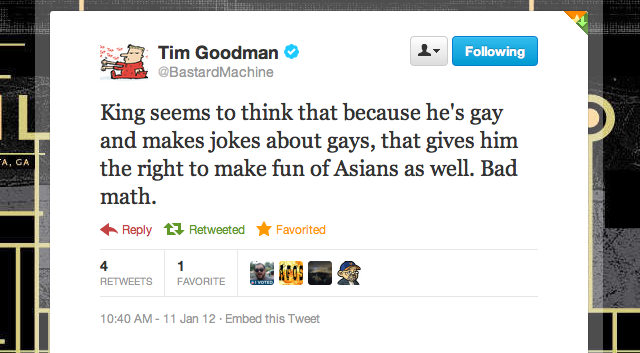
There was 2 Broke Girls showrunner Michael Patrick King's stupid defense of the racist material that's being written for the Korean Long Duk Dong on the show, or as GQ writer Lauren Bans amusingly calls the openly gay King's brand of humor, "gaycism":
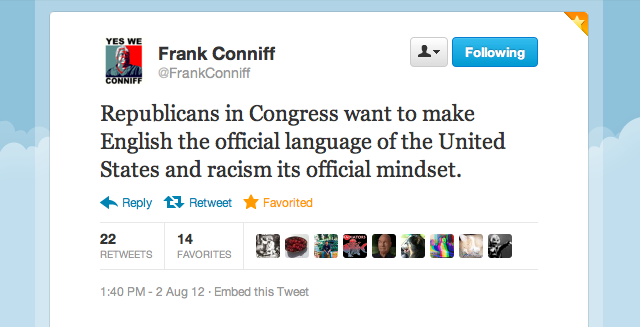
Ignorance came not just from sitcom joke writers but also from TV stars and, as usual, the far right:
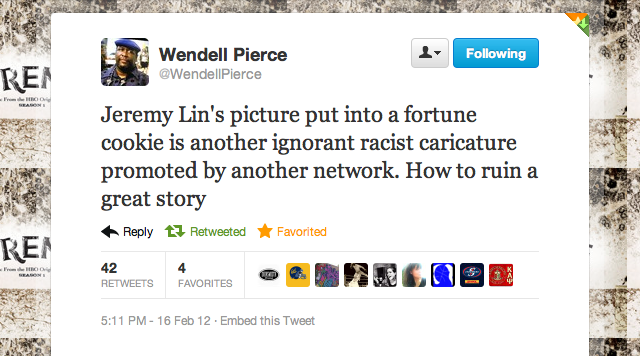
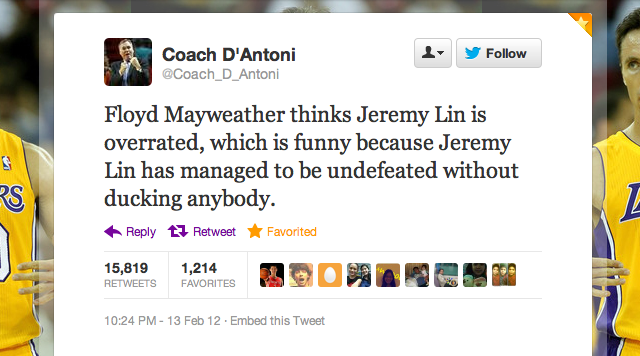
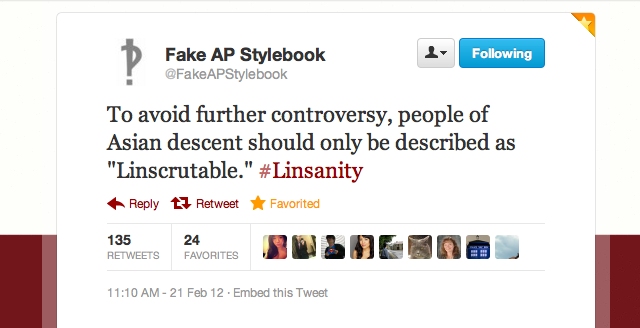
There was Linsanity (and the inevitable and stupid racial slurs in response to the rise of the NBA's first Asian American star player):
There was also the fall of aging (and disappointingly homophobic) champ Manny Pacquiao:
The AFOS blog's new "5-Piece Cartoon Dinner" column received a few shout-outs and retweets on Twitter, mostly from staffers at Titmouse because I said a few nice things about the animation studio's collabos with Disney: Randy Cunningham: 9th Grade Ninja and the even more impressive--and anti-authoritarian--Motorcity. The latter action cartoon is a one-season wonder that looks remarkably like a big-budget animated feature film each week and is another unfortunate casualty in a TV landscape that hasn't been kind lately to true sci-fi like Motorcity. Alyssa Rosenberg posted a piece on ThinkProgress where she lamented the lack of true sci-fi shows on the currently-more-fantasy-oriented--and crap-oriented--Syfy. Motorcity, which was slept on by even the few TV critics out there who regularly cover animated shows, was exactly the kind of sci-fi show Rosenberg was clamoring for.
I favorited Motorcity writer George Krstic's tweet about my review of his "Power Trip" episode mainly because of the joke he cracked about himself and his colleagues:
Enough about me. What about the rest of 2012?
(Most year-end lists can make for boring and grueling reading. Reflecting on the past year by skimming through tweets I favorited is turning into an entertaining alternative from scrolling through endless year-end articles and think pieces.)
Quite a bit of fun resulted on Twitter from the much-hyped second season of Downton Abbey (I once tweeted, "Note to self: Don't forget to add #DowntonAbbey to the list of 'Shit White People Like That I Don't Understand the Appeal Of.'"):
Artists whom I've been giving heavy airplay to on AFOS got the chance to kick it with their idols:
There was 2 Broke Girls showrunner Michael Patrick King's stupid defense of the racist material that's being written for the Korean Long Duk Dong on the show, or as GQ writer Lauren Bans amusingly calls the openly gay King's brand of humor, "gaycism":
Ignorance came not just from sitcom joke writers but also from TV stars and, as usual, the far right:
There was Linsanity (and the inevitable and stupid racial slurs in response to the rise of the NBA's first Asian American star player):
There was also the fall of aging (and disappointingly homophobic) champ Manny Pacquiao:
Monday, April 30, 2012
And now, something interesting someone else wrote about a work that's represented in my "Ask for Babs" mix: Fast Five (gear two)
Because Universal was founded 100 years ago today by nickelodeon owner Carl Laemmle, I've chosen to focus today's "Ask for Babs" mix-related blog post (which is the last of these posts) not on an article about a blockbuster from Universal's past like Jaws or Back to the Future but on a piece about a Universal film franchise that hints at the studio's future, as well as the future of American cinema in general.
Boston Globe film critic Wesley Morris' 2011 essay "Fast forward" insightfully discusses why Universal's Fast and the Furious movies, including the Justin Lin-directed series highlight Fast Five, are so special, particularly to moviegoers of color like myself and Morris who have always wanted to see someone make some good action films that reflect the multiracial world we live in and opt to treat "race as a fact of life as opposed to a social problem or an occasion for self-congratulation":
Go on and laugh your Benetton, Kumbaya, Kashi, quinoa laugh, but it’s true: The most progressive force in Hollywood today is the “Fast and Furious” movies. They’re loud, ludicrous, and visually incoherent. They’re also the last bunch of movies you’d expect to see in the same sentence as “incredibly important.” But they are—if only because they feature race as a fact of life as opposed to a social problem or an occasion for self-congratulation. (And this doesn’t even account for the gay tension between the male leads, and the occasional crypto-lesbian make-out.)
The fifth installment, “Fast Five,” comes out Friday, and unlike most movies that feature actors of different races, the mixing is neither superficial nor topical. It has been increasingly thorough as the series goes on—and mostly unacknowledged. That this should seem so strange, so rare, merely underscores how far Hollywood has drifted from the rest of culture.
The movies have often dealt with race, of course, and when they do they tend to treat it as a serious and unwieldy problem...
That is the loose history of race as a subject in Hollywood: the province of a liberal white industry that wanted to promote fairness and equality, often at the expense of realism and sometimes at the cost of the black characters’ humanness. Movies about race still tend to be self-congratulatory (“Crash”) or mine tension for comedy, the way “48 Hours” and its offspring have...
The “Fast and Furious” movies, by contrast, are free of this angst. They’re basically a prolonged party for a ring of street-racing urban car thieves...
It was a place the movies had never precisely seen before: gangs of young people of different races unified by automotive exhilaration. There were blacks, Asians of all kinds, Mexicans, Michelle Rodriguez, and whatever Vin Diesel and Jordana Brewster are...
Since then, the series has spiraled even further into a world that’s post-racial, post-American, post-almost every category you can think of, including coherent... “Fast Five” sends the gang to Brazil, brings back Tyrese, and invites the half-black, half-Samoan Dwayne “The Rock” Johnson to chase Brian and Dom around Rio...
It’s a strange thing to see these movies as a novelty in 2011, and not because Barack Obama is president. The series has grossed just under $1 billion, and for the young and youngish people who’ve bought tickets (and rented and downloaded it), this is just how the world looks. And it’s how a lot of pop culture looks, too. Last February’s Grammys telecast was a cross-racial bonanza, whose highlight was the team-up of Janelle Monáe, B.o.B, and Bruno Mars, two black artists and one half-Hispanic, half-Filipino, all popular, who, for one evening, tinkered with pop, hip-hop, and rock so that the music they made no longer had a genre.
The movies, meanwhile, have become lucrative in their segregation. While most major-studio productions feature white casts, Tyler Perry has capitalized on the void... From this, the major studios have taken perhaps the wrong lesson: more all-black movies. It’s a development that appears to obviate a need for more integrated ones...
You wouldn’t draw much of a popular audience, mixed or otherwise, to a movie about race, of course. And that is the accidental genius of the “Fast and Furious” movies. They’re not about race. Race—and casualness about race—is just their hallmark. They’re about something else, a great American unifying principle: sexy cars that everybody wants to drive.
Even (or maybe especially) when they’re demolishing the Dominican Republic or tearing up Brazil, these films couldn’t be more American. If we don’t know where race is headed in this country, or where in the movies it ought to be, perhaps we should climb aboard. In the end, it might not be Barack Obama who drives us into the future. It may just be Vin Diesel and The Rock.
Tuesday, March 15, 2011
Coffey is the color
To promote the upcoming self-titled album by legendary and frequently sampled Motown guitarist Dennis Coffey, Strut Records recently dropped a fantastic 45-minute mix of old Coffey tunes, hip-hop tracks that sampled Coffey's work and new material from the April 26 release. The instrumental jam "7th Galaxy," a new joint from Coffey's Strut album, starts at 04:55 in the "Constellations" mix, which was assembled by DJ House Shoes. "7th Galaxy" needs to turn up as chase music in a TV show or movie pronto.
The mix includes one of my all-time favorite movie themes, Coffey's Black Belt Jones theme, and another blaxploitation soundtrack tune that features Coffey's guitar work, Edwin Starr's "Easin' In" from Hell Up in Harlem. I was first exposed to "Easin' In" via "Nickel Bags" by Digable Planets, while LL Cool J's "Jingling Baby" introduced me to the Black Belt Jones theme.
I once saw a TCM featurette that pointed out that the Magnificent Seven montage of Yul Brynner and his crew journeying on horseback to the Mexican villagers looked really lethargic and unexciting without Elmer Bernstein's energetic main theme. The Black Belt Jones opening title sequence takes place in the dullest of settings, an L.A. parking lot--not exactly the most dynamic location to showcase the martial arts skills ofBushido Brown Jim Kelly. I guess director Robert Clouse had much less dough to work with than he did on his previous movie with Kelly, the Hong Kong-based Enter the Dragon. Like Bernstein's theme during the Magnificent Seven montage, Coffey's funky theme helps distract you from how shabby the opening title sequence looks despite the fisticuffs (ComicsAlliance editor Chris Sims noted on his Invincible Super-Blog that even the fisticuffs look compromised too: "It may SEEM like Black Belt Jones is moving slow, and that the guys he's fighting are drunk, but I assure you that's not the case. In order to get an 'R' rating they actually had to slow the film down because audiences in the Seventies could not handle that much brutal action.").
YouTube comments sections are too often full of inane or racist junk, but there was one comment below the video of the Black Belt Jones opening credits that amused me and caused me to do something I've never done before in a YouTube comments section, and that's click on "thumbs up":
"Obama should enter Congress with this theme and kick some Republican butt."
Word.
There are so many hot beats in Strut's Coffey mix, which concludes with "All Your Goodies Are Gone," a terrific blue-eyed soul collabo with Mayer Hawthorne from the new album, a release that Strut hopes will introduce Coffey to a new generation of beatheads. I particularly enjoyed the mix's juxtapositions of "Jingling Baby" with the Black Belt Jones breakbeat and "Easin' In" with "Nickel Bags."
Constellations - The A to Z of Dennis Coffey: A Mix By House Shoes by Strut
[Via Potholes in My Blog]
The mix includes one of my all-time favorite movie themes, Coffey's Black Belt Jones theme, and another blaxploitation soundtrack tune that features Coffey's guitar work, Edwin Starr's "Easin' In" from Hell Up in Harlem. I was first exposed to "Easin' In" via "Nickel Bags" by Digable Planets, while LL Cool J's "Jingling Baby" introduced me to the Black Belt Jones theme.
I once saw a TCM featurette that pointed out that the Magnificent Seven montage of Yul Brynner and his crew journeying on horseback to the Mexican villagers looked really lethargic and unexciting without Elmer Bernstein's energetic main theme. The Black Belt Jones opening title sequence takes place in the dullest of settings, an L.A. parking lot--not exactly the most dynamic location to showcase the martial arts skills of
![]() |
| (Photo source: Cinema is Dope/Museum of Cinema) |
YouTube comments sections are too often full of inane or racist junk, but there was one comment below the video of the Black Belt Jones opening credits that amused me and caused me to do something I've never done before in a YouTube comments section, and that's click on "thumbs up":
"Obama should enter Congress with this theme and kick some Republican butt."
Word.
There are so many hot beats in Strut's Coffey mix, which concludes with "All Your Goodies Are Gone," a terrific blue-eyed soul collabo with Mayer Hawthorne from the new album, a release that Strut hopes will introduce Coffey to a new generation of beatheads. I particularly enjoyed the mix's juxtapositions of "Jingling Baby" with the Black Belt Jones breakbeat and "Easin' In" with "Nickel Bags."
Constellations - The A to Z of Dennis Coffey: A Mix By House Shoes by Strut
[Via Potholes in My Blog]
Labels:
Barack Obama,
Black Belt Jones,
Dennis Coffey,
Elmer Bernstein,
film music,
Hell Up in Harlem,
hip-hop,
House Shoes,
Jim Kelly,
Motown,
sampling,
Strut Records,
The Magnificent Seven,
YouTube
Tuesday, January 20, 2009
Obama's inauguration: America reboots itself
For readers who aren't my Facebook friends, I've compiled and reposted the status updates that I wrote on the Facebook/CNN Inauguration Day coverage site on this uplifting day of history and balls.-----
Jimmy just booed the arrival of Mr. Potter from It's a Wonderful Life.
via CNN.com Live - 8:39am
Wow, the surviving Tuskegee Airmen are at the inauguration.
via CNN.com Live - 9:24am
Amen!
via CNN.com Live - 9:37am
Jimmy is wondering how the other cable channels are covering the inauguration. I hear the Sci Fi Channel sent Mansquito to interview the crowd.
via CNN.com Live - 9:47am
Favorite part of Obama's inaugural speech: "The world is changing and we have to change with it."
via CNN.com Live - 9:51am
Jimmy enjoyed that recent Slate.com article that basically said, "What's Bush gonna do now? No one will hire his ass."
via CNN.com Live - 9:59am
The President and the First Lady's parade walk was badass. South Side, walk it out!
via CNN.com Live - 1:19pm
TV One is doing the best coverage right now: Anchor #1: "Joe the Plumber is enjoying his 15 minutes of fame." Anchor #2: "And it's 14 minutes too long."
via CNN.com Live - 2:35pm
Jimmy is trying to figure out what the Howard U. Marching Band has been playing. Whatever it is, it's slammin'. Sounded like "I Need a Freak" by Sexual Harassment.
via CNN.com Live - 3:29pm
Labels:
Barack Obama,
CNN,
Dick Cheney,
Facebook,
George W. Bush,
It's a Wonderful Life,
Joe the Plumber,
Michelle Obama,
Rev. Joseph Lowery,
Slate,
Syfy,
The Daily Show,
Tuskegee Airmen,
TV One,
Unk
Sunday, January 18, 2009
Obamicons created by me
Below are Obamicons I created on Paste Magazine's Create Your Obamicon site, which allows users to do their own posters in the style of Shepard Fairey's Obama "Hope" poster.
Subscribe to:
Posts (Atom)