Showing posts with label Elmer Bernstein. Show all posts

Wednesday, June 24, 2015

The late James Horner was the master of suspenseful '90s hacking scene music during Sneakers and Clear and Present Danger

James Horner's arpeggios are swirling in the heavens tonight.

"There were so many Horners," said Matt Zoller Seitz to fellow journalist S.I. Rosenbaum during a RogerEbert.com conversation about the work of legendary film composer James Horner, who died at 61 in a single-engine plane crash earlier this week. "There was the shoot 'em up, macho, urban Horner of 48 HRS and Commando and Red Heat, the grand adventure Horner of the Trek films and Aliens and Titanic and Avatar, the caper Horner of Sneakers... He really did have range."

Anyone who's a film music fan has a favorite Horner. Film music heads who are into Horner deep cuts--and are of the opinion that Horner tended to repeat himself, especially in the middle part of his career--will likely say the Horner of Battle Beyond the Stars is their favorite, while more casual film music heads will likely pick the Horner who made teenage girls cry with his score to Titanic. For me, it's either the Horner who made nerds cry with his scores to Star Trek II: The Wrath of Khan and Star Trek III: The Search for Spock or the Horner who gave the third best performance, right below Denzel Washington and Andre Braugher, in Glory and crafted, with the help of the Boys Choir of Harlem, a powerful and operatic score for that 1989 white-savior-movie-that's-somehow-better-than-the-average-white-savior-movie.

The eerily prescient Sneakers is one of many movies I just never got around to seeing until more than 20 years after its release. On New Year's Eve 2014, it was one of several titles Netflix streaming was getting rid of from its library after that night, so I couldn't pass up the chance to stream before its expiration this caper movie I--a fan of caper movies--bizarrely overlooked for too long. I instantly fell in love with the score Horner wrote for Sneakers. It's now one of my favorite Horner scores. Like Gimme the Loot composer Nicholas Britell said about the Sneakers score, it's music you wouldn't expect to hear in a hacker movie. "It features unlikely elements--choirs, folk themes, minimalist piano, the saxophone of Branford Marsalis--that lend the film an unusual emotional richness and depth," wrote Britell.

Dig the score cue Horner created for the scene where Robert Redford's crew discovers the codebreaker to end all codebreakers, and Redford and Sidney Poitier both realize it's too much power for anyone to have. I'm not a musicologist--I'd be unable to tell you the difference between an arpeggio and an ostinato--so I have no idea what Horner was doing with the piano during this scene. It sounds like he grabbed a cat that was wandering around the recording studio and let it walk all over the keys. It turned out to be an inventive and effective way to build tension for that scene.


So now I have a new favorite Horner: the Horner who, through his music, could take something as mundane-looking and boring on the screen as typing things into a PC and make it exciting. Horner's work in Sneakers reminds me of Clear and Present Danger, where Horner also worked his magic on a similar moment of computer-related tension. The nerve-wracking Bogota ambush sequence is what everyone remembers about Clear and Present Danger, but an equally memorable sequence--and one that's handled with a bit more humor, especially when Harrison Ford discovers there's no paper in his printer--is Ford's attempt to salvage all evidence of the government conspiracy Henry Czerny helped orchestrate right when Czerny deletes it from what we now call "the cloud." It's the second best action sequence in the movie, even though nobody fires a gun or a missile and nobody dies. Horner had a lot to do with that.

There's an old featurette TCM used to frequently air between movies about how crucial Elmer Bernstein's score was in enhancing The Magnificent Seven. The featurette took a clip where Bernstein's rousing main theme accompanied shots of Yul Brynner and his crew riding on horseback rather lethargically and posited that without Bernstein's theme, the scene was dead. Without Horner's "Deleting the Evidence" cue, which is part of the playlist for the AFOS espionage genre music block "AFOS Incognito," the computer showdown sequence would have been dead too.


Throughout Clear and Present Danger, Horner made use of a shakuhachi, a Japanese flute, to heighten tension. It's kind of an unconventional choice, just like the clumsy kitty cat stepping on the piano keys during Sneakers, because it makes you think, "Did one of those Peruvian pan flute bands that invaded South Park also invade the orchestra?," but it works for the hacking sequence. Horner would get pilloried a lot by film music critics for recycling his own previous motifs when he was alive, but that's not the case here: his score to Clear and Present Danger, a blockbuster that came out two years after Sneakers, sounds much different from his score to Redford's movie, and it echoes the differences in tone between the serious-minded Clear and Present Danger and the much more light-hearted Sneakers.

Today, hacking scenes are such a cliché that I can't watch another hacking scene without thinking of Jimmy Kimmel Live's transformation of Scandal into a telenovela. In one of those Kimmel Live sketches, Scandal star Guillermo Diaz made fun of the ways actors pretend to type on laptops by basically channeling the piano-playing sight gags in Tom and Jerry's "The Cat Concerto" and Bugs Bunny's "Rhapsody Rabbit" while he was typing. So from now on, every time I sit through a dramatic hacking scene, I can't get out of my head the funny image of Guillermo Diaz typing like Bugs Bunny on the piano. But back when these scenes hadn't yet crossed the line into unintentional silliness and very '90s Fisher Stevens entrances, Horner was the master of scoring these scenes, and his skills with those scenes were honed while working on the franchise that made his career: Star Trek. Again, it all goes back to Star Trek. Hell, everything goes back to Star Trek. What David Strathairn and Harrison Ford are doing at their terminals is basically what Kirk and Spock did to trick Khan into lowering his starship's shields in Star Trek II and what Kirk and Scotty similarly pulled off to steal back the Enterprise from Starfleet in Star Trek III. Horner's brilliance with musical texture and enlivening action that has the potential to look as dull as office work was also key to why those moments of starship bridge console trickery are such highlights of those Trek films.

I haven't been interested in a Horner score in ages, but now that his score to the upcoming Chilean miner survival drama The 33 has ended up being one of the last things he composed before his death, I'm curious about his work in The 33 (and in this summer's Antoine Fuqua-directed boxing drama Southpaw). I wouldn't be surprised if Horner was able to take another potentially static-looking scenario like a bunch of miners trapped for more than two weeks under a collapsed mine and help make that compelling as well. Which Horner are we getting for his last couple of scores?

Selections from Horner's scores to Star Trek II and The Rocketeer can be heard during both "AFOS Prime" and "Hall H" on AFOS, while selections from his score to Clear and Present Danger (and hopefully someday, selections from his score to Sneakers) can be heard during "AFOS Incognito."

Monday, April 20, 2015

When enjoyable scores are attached to terrible movies, or why I feel kind of awful about adding Wild Wild West score music to "AFOS Incognito" rotation

Hanging by a little thread: Boredom the Spider...

I don't care for Madonna and her cultural-appropriating ass, but I've always liked the music of William Orbit. The Drake-scaring pop star's hit single from the summer of 1999, "Beautiful Stranger," a '60s-pop-flavored tune she recorded for Austin Powers: The Spy Who Shagged Me, is my favorite pop song Orbit has produced because it's Orbit at his most playful-sounding, from the Ron Burgundy flute funk to the harpsichord riffs (the harpsichord is also integral to why my favorite Michael Jackson tune is "I Wanna Be Where You Are"). "Beautiful Stranger" is featured in The Spy Who Shagged Me for like only 30 seconds, during a non-comedic scene where the titular '60s spy mourns the loss of his mojo. Because of "Beautiful Stranger," I would have been interested in what Madonna and Orbit would have recorded together for Guy Ritchie's upcoming remake of The Man from U.N.C.L.E., had Ritchie and Madonna never split.

"Beautiful Stranger" is pitch-perfect for the breezy, psychedelic, Laugh-In-esque and Derek Flint-inspired Austin Powers franchise, whereas Madonna's other original spy movie theme, the Mirwais-produced electroclash tune "Die Another Day," doesn't quite work for 007 (it would have worked for some other spy franchise: maybe Totally Spies?). The Die Another Day theme makes you wonder if Madonna or Mirwais ever even watched an actual 007 movie beforehand, even though she claimed that the Die Another Day screenplay influenced the lyrics she wrote (the orchestral string riffs during "Die Another Day" came not from Die Another Day score composer David Arnold but from Madonna's "Don't Tell Me" collaborator, the late New Jack City score composer Michel Colombier, and I would have enjoyed Colombier's string riffs a little more if they had at least some ounce of thematic connection to anything Arnold wrote for his score).

I fell in love with "Beautiful Stranger" again a few weeks ago while overhearing it being played on some store PA during a round of book-shopping or grocery-shopping (I can't remember which kind of shopping it was). So that's why I'm adding "Beautiful Stranger" to the playlist for the espionage genre music block "AFOS Incognito," where it can be enjoyed without having to be subjected to any visuals directed by Brett Ratner, Mondays through Thursdays at midnight Pacific on AFOS.


There's one other piece of music from a 1999 spy comedy that I'm adding to "AFOS Incognito," and this spy comedy isn't exactly as beloved as The Spy Who Shagged Me was back in 1999. It's from the second and final film in Warner Bros.' late '90s mission to ruin your favorite TV shows, Wild Wild West, the Will Smith/Kevin Kline blockbuster loosely based on the '60s spy show/proto-steampunk western of nearly the same name (the show was called The Wild Wild West, while the movie omitted "The" from the title).

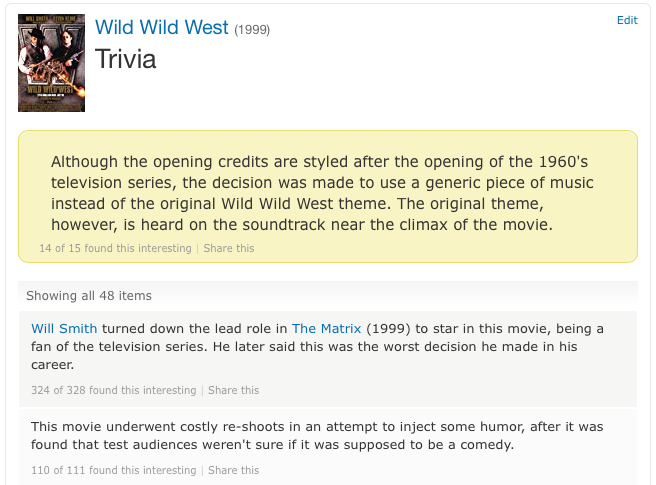
Fortunately, the selected piece of music isn't the ubiquitous-on-the-1999-airwaves Will Smith/Dru Hill theme tune that was never worthy of sampling Stevie Wonder's "I Wish." It's the other memorable piece of music from Wild Wild West: the rousing main title theme by a legendary composer who wrote a million rousing themes for westerns, the late Magnificent Seven score composer Elmer Bernstein. That Bernstein main title theme is the only thing I like about Wild Wild West. IMDb is wrong: it's not "a generic piece of music." It's classic Bernstein western music, faithful in spirit to Richard Markowitz's equally rousing '60s Wild Wild West theme tune, which either the filmmakers couldn't get the full rights to or were too dunderheaded to use more often in the film because of their hubris and contempt for the source material (although I wouldn't consider The Wild Wild West a perfect show: it suffers from that old '60s and '70s spy show staple of stupidly putting white actors in yellowface or brownface). The theme is too good for such a hackily written steaming pile and such a chemistry-deficient buddy action flick.

The words 'from dusk till dawn' could also perfectly describe how long it felt to watch Wild Wild West in the theater.

Speaking of chemistry, this might have improved the movie: instead of casting Kline, whom Smith had no chemistry with, as Artemus Gordon, Alfonso Ribeiro, whom Smith had a shitload of chemistry with from 1990 to 1996, should have been cast as Artemus. And instead of the movie's lame depiction of Artemus as this never-convincing master of disguise Kline looked as embarrassed to be portraying as Kline's washed-up Soapdish actor character looked when he had to play Willy Loman in front of confused and senile dinner theater customers, I would have written Ribeiro's short and black Artemus as an excellent master of disguise who--because both the Wild Wild West TV show and movie never gave a shit about being authentic to the period--came up with the most effective and ludicrous-for-any-period prosthetic makeup technology for altering his looks, as well as his height, race or gender. Plus it would have been amusing to have a black guy walk around with the name Artemus.

Anyway, like Stevie Wonder, I wish that theme (BLAM!) was (BLAM!) written for a different score. There lies my problem with adding to AFOS rotation enjoyable score cues from movies that are so terrible. It's so difficult to erase those movies' wretchedness from your mind when you hear these score cues that are the only redeeming elements of those movies. So to enjoy the Bernstein score cue a little more, you just have to pretend it's not from Wild Wild West.


Man, why do post-Blazing Saddles, pre-Django Unchained westerns with black heroes have such a lousy track record? Why do sci-fi westerns that are neither the '60s Wild Wild West nor the cult favorite Brisco County Jr. have such a lousy track record? Smith and his Men in Black director Barry Sonnenfeld clearly wanted to turn Wild Wild West into a Blazing Saddles for the '90s and with splashier action sequences, except Blazing Saddles knew how to be funny.

Blazing Saddles also didn't need a $170 million budget to land its jokes. The Nostalgia Chick pointed out that Shane Black, the writer and director of one of my favorite movies, Kiss Kiss Bang Bang--a buddy comedy that, like Blazing Saddles, was able to dazzle despite a limited budget--was attached to an earlier attempt to make a Wild Wild West movie. It's one of the most interesting parts of the Nostalgia Chick's 17-minute discussion of the many things that went wrong with Sonnenfeld's Razzie sensation, including Smith rejecting the role of Neo in The Matrix and choosing to play such an unlikable and overly cocky spy.

See? This is why Ribeiro would have been a great big-screen partner for Smith: unlike Kline's snooty and stiff Artemus, the equally snooty but more underdog-ish Ribeiro--due to his chemistry with Smith--would have been able to make Smith's overly cocky Agent West more likable and relatable when they interacted with each other. It would have been like how halfway through its run, the small-town lawyer sitcom Ed gave Michael Ian Black's annoying and overly cocky Phil Stubbs character a new bowling alley boss he grew to despise, in the form of the more level-headed Eli Goggins, played by the always charismatic Daryl "Chill" Mitchell. As both Phil's foil and a character who, unlike Tom Cavanagh's rather timid Ed, had the guts to challenge Phil and bring him back down to Earth whenever Phil's antics grated on everyone's nerves, including the viewer's, Eli made Phil the myopic and self-absorbed schemer a much less annoying and one-note character for the rest of the show's run.

I also wish I were in the universe where Will and Carlton reunited on the big screen as West and Artemus. Yeah, maybe it would have been too much of a rehash of the Will/Carlton dynamic from The Fresh Prince of Bel-Air for some moviegoers, but Ribeiro would have given Smith something more interesting to play against than whatever hacky shit Kline was doing. However, a completely different universe where Black's Wild Wild West got made instead is an even more enticing alternate universe. Now that is a version of Wild Wild West that would be worthy of Bernstein's main title theme. How many screenwriters did Wild Wild West have? Black's screenwriting work all by himself is frequently superior to the combined results of the 20,000 screenwriters who tried to polish the turd called Wild Wild West.

Many things doomed The Fresh Prince of Hot-Air, from its constant reshoots to skinny-pantsed '60s Wild Wild West star Robert Conrad's dissatisfaction with the script when Sonnenfeld offered him a cameo and he refused. The original Jim West bad-mouthing a reboot of his show and not giving it his blessing is like if the original Spock, when he was alive, tweeted, "I hope this new Star Trek crashes and burns," or if Michael Keaton stepped out and said, "My son showed me that new Batman trailer. Why is Ben Affleck being such a saggy diaper that leaks?" That doesn't bode well for your reboot. But when your film's key art is basically inverted key art from the 1993 megaflop Super Mario Bros., your film's really doomed.

I'm sure the late Bob Hoskins always wished he could do to all copies of the Super Mario Bros. movie the same exact thing that the IRA does to Bob Hoskins at the end of The Long Good Friday.

When the only person who benefited from some part of the film is producer Jon Peters--that giant mechanical spider the extremely weird Peters kept threatening to squeeze into aborted movie versions of '90s Superman comic book storylines and Sandman finally made it into one of his productions--that's how terrible the film is. You know Patton Oswalt's six-minute distillation of the wretchedness and bloatedness of Wild Wild West (while he was being interviewed by the comedy news site/stand-up comedy record label A Special Thing)? It's six times more entertaining than Wild Wild West itself.

Thursday, August 21, 2014

Tip-Top Quotables: "No one should ever be allowed to say there is no history of racial tension here," plus a few other great lines this week

Just tell him what you want him to fuck, America, and he'll fuck it for you.

My favorite monthly section in old Source magazine issues was "Hip-Hop Quotables," in which the Source editors printed out their favorite new rap verse of the month, from the first bar to the last. "Tip-Top Quotables," which I've named after that Source section, is a collection of my favorite quotes of the week from anywhere, whether it's a recent TV show or a new rap verse. "TTQ" won't appear on this blog every week. It'll appear whenever the fuck I feel like it.

* "Much as I scoffed at the very notion of a good MacGruber movie, I'd probably put it at the very top of SNL adaptations. At a minimum, it's the one SNL-to-screen adaptation to take a mostly one-joke sketch idea (e.g. 'It's Pat' or 'The Roxbury Guys') and successfully expand and reconfigure it for the screen. And while I'm here, I'll echo the praise for [Will] Forte's performance, which is committed and fearlessly self-deprecating. After all the things he does in this movie—the loud back-to-back sex scenes, the celery stick, the 'just tell me what you want me to fuck' scene—he can probably bid farewell to any Al Franken-like political aspirations he might have had."--Scott Tobias, The Dissolve, "The '80s ambience, jury-rigged gags, and dumb bravado of MacGruber"

* "Every good spoof needs a straight man. Airplane! had Leslie Nielsen's Dr. Rumack, who never cracked even as he pulled eggs out of a sick woman's mouth. Blazing Saddles had Gene Wilder's Waco Kid, who didn't bat an eye at outlaws punching horses in the face. [Powers] Boothe's unflappable Col. Faith is a sturdy presence throughout MacGruber, but the movie's true straight man is [Jorma] Taccone, who shoots MacGruber as if it were a legitimately badass balls-to-the-wall action spectacular. Most modern spoofs, shot on the cheap by hacks, look like garbage. MacGruber looks good enough to stand beside (or, in some cases, ahead of) its inspirations. No matter how broad Forte gets—and at one point, he's waddling through an action scene naked, with a celery stalk hanging out of his ass—Taccone never shoots him like he's in on the joke. There are many deadpan actors; Taccone is the rare deadpan director."--Matt Singer, The Dissolve, "From box-office bomb to cult favorite in the making: Classic MacGruber"


(NOTE: The Harold Faltermeyer-esque score cue from the "celery stalk hanging out of MacGruber's ass" scene starts at 2:00 of "MacGruber's Suite" by MacGruber score composer Matthew Compton. Don't miss the profane hidden track that starts at 5:30.)

* "There was no main title... and I didn't make a theme for [the end credits] either because I always wanted to leave on whatever tone the outgoing scene had. So there was a different end-title piece of music each time. It's one of the most important chunks of musical real estate because it's a chance to sum up your musical story, but there's no picture, there's no dialogue. It's not competing with any other sound. It's a great spot to showcase the music. So, the end titles became my favorite spot. But I also used it as a place to do something that was unexpected. One track is called 'Falling off a Bicycle,' and another one is called 'Goodnight Nurse Elkins.' Those started out as one-of-a-kind pieces. I hadn't written anything like that for the rest of the show. So, I threw my hardest musical curveballs for the end credits."--Cliff Martinez, discussing with TVGuide.com the electronic score music he wrote for the first season of The Knick


* "Composers were close, and often attended each other's recording sessions. One such day, Elmer and his friends were listening to one of their peers record a score with a strikingly memorable theme. They snuck a few musicians to a smaller studio, and recorded a jazz combo version of this composer's theme, arranging it from memory. That night, when they all got together socially, they played their tape, telling their mark it was the radio. Shocked to hear a small combo playing his own theme, the panicked composer turned white and asked what the music was. Elmer and his friends told him it was a hit song that had been on the radio for weeks. The poor composer thought he had accidentally ripped off a popular song, and momentarily contemplated the task of rewriting his entire score! Elmer and his fellow pranksters laughed, and poured him a drink."--Outlander composer Bear McCreary, recalling an elaborate prank that his mentor Elmer Bernstein told him he used to pull on other film composers

* "Even though that theme was used on The Next Generation, I associate it with Star Trek: The Motion Picture, which was like the coming of Jesus Christ to me. The score is super thematic, it's deep, it employs many modern sounds. Despite the fact that Goldsmith was traditional, he was always trying to find ways to be with the times that were, so he'd bring in the blaster beam, that thing that was the new thing and some of his efforts had dated themselves, like in the '80s we used some of those electronics, but Star Trek remains timeless. That Blaster Beam thing, a lot of the water phone sounds they use and so forth. you combine that beautiful sweeping version of that theme over the most beautiful thing ever created by man— the Enterprise— and it's just complete, absolute orgasm."--X-Men: Days of Future Past composer John Ottman on the one film score he'd take with him to a desert island


* "The heart of the film is that the Guardians are all adrift in their universes, emotionally and spatially lost. So, it's appropriate that the film starts on a song that croons, 'Nothin's a matter with your head, baby, find it/ Come on and find it/ Hell, with it, baby, 'cause you're fine and you're mine.' It's a mission statement as much as a stylistic choice, a ballad of inclusion in a cold universe. It's also Star-Lord's best way of seeking out maternal advice while lost in space; the song's inquiry of 'Don't you feel right, baby?' allows Star-Lord to converse with a woman that he's lost, one who he rejected right before her passing in a fit of childish sadness. The film is, among about 50 other things, the chronicle of Star-Lord's struggle to accept that he was just afraid and not a bad person."--Dominick Mayer, Consequence of Sound, "How Guardians of the Galaxy Topped the Charts"


* "I can't believe that the only name they got right was fucking Kumail Nanjiani."--Harmontown co-host Jeff B. Davis, mocking L.A. Times TV critic Robert Lloyd's typo-ridden positive review of Harmontown, which misidentified Davis as "Jim Davis" and misspelled "podcast" as "pocast" (in fact, Davis was wrong--not even the L.A. Times critic got Nanjiani's name right either)

'I'm that typo guy'--Robert Lloyd rapping

And the fucking L.A. Times missed this too!

* "It looks more like a colonoscopy than a costume. Plus, even if you have superpowers, it's impossible to crawl along the roof while keeping your back arched and your rear high. Too many covers like that, and Spider-Woman is going to need physical therapy."--Amanda Marcotte, mocking Spider-Woman's ass-up pose in the poorly received variant cover artwork drawn by erotic comic book artist Milo Manara for the first issue of Marvel's relaunch of Spider-Woman, as part of a Slate post called "This Week in Butts"

Wednesday, December 18, 2013

The Doctor and the Devil: These are among the tracks I've added to AFOS rotation this month

John Nathan-Turner didn't like how these opening titles looked like a trip through a vacuum cleaner tube. I think he was confusing 'vacuum cleaner tube' with 'colonoscopy video.'
(Photo source: Art of the Title)

Delia Derbyshire, "Doctor Who (Original Theme)" (now playing during "Hall H")

In England, hiding behind the couch became a tradition for kids who grew up watching monsters chase after the Doctor and his companions on telly on Saturday night. But in America, those of us who grew up watching The Electric Company and 3-2-1 Contact back-to-back at 5pm on the local PBS station weren't exposed to Doctor Who on only one night of the week. Thanks to PBS, we were exposed to it every weeknight, right after the Bloodhound Gang would try to bust a cocaine ring or something. The Doctor Who opening titles meant that 3-2-1 Contact was over and it was time to change the channel as soon as possible because for a four-year-old like me, the Doctor Who title sequence--with its intense-looking, psychedelic slit-scan vortex FX, its photo of a somber-looking Tom Baker and that otherworldly piece of early electronica written by Ron Grainer and performed by BBC Radiophonic Workshop musician Delia Derbyshire--was scary as shit.


But unlike you Brits who yelped and cowered from the sight of giant pepper shakers with toilet plunger arms hollering "Exterminate!" at'cha boy, I didn't hide behind the couch whenever the Doctor Who titles came on. My brain merely shivered a little and then I switched to a different channel. That's how I rolled, and to me, the Doctor Who titles were scarier than any of the rubber monsters I would see a few years later, which was when I finally had the guts to get past those spooky and unsettling titles and watch the rest of the show.

"I remember as a child I was terrified by [the theme]. It just strikes fear into your very soul," noted British comedian Bill Bailey at the start of his "Docteur Qui" number during Bill Bailey's Remarkable Guide to the Orchestra, in which he amusingly broke it down on the piano and pointed out how Grainer's melody is basically Belgian jazz.


The two Derbyshires
Delia Derbyshire (top); Sarah Winter as Derbyshire in An Adventure in Space and Time (bottom)

In An Adventure in Space and Time, the BBC's recent made-for-TV biopic about William Hartnell's resurgence as a TV star during Doctor Who's first few years, we get to briefly see Derbyshire (played by Sarah Winter) fiddle around with analog tape reels and perform the theme on keyboard (she's also seen explaining the origin of the TARDIS dematerialization sound FX: house keys scraped against a piano wire). Today, her arrangement of the theme--which, except for a few tweaks in the sound FX and the musical transition from episode credits to opening scene, remained unchanged in the opening titles from 1963 to 1979--isn't scary-sounding at all because since childhood, we've been subjected to much scarier things, like Dana Perino trying to rap or Alison Gold singing about Chinese food. But it hasn't lost its power as a trippy and effective musical encapsulation of exploring the unknown, which is why when I received Silva Screen's Doctor Who: The 50th Anniversary Collection and the Derbyshire version turned up as Track 1, I immediately added it to the "Hall H" playlist.

How filthy! Inspector Spacetime was never this filthy!
(Photo source: SMOSH)

Murray Gold, "All the Strange, Strange Creatures" (from series 3 of Doctor Who; now playing during "AFOS Prime," "New Cue Revue" and "Hall H")

One thing I've noticed about modern Doctor Who is that Murray Gold, who's been the show's composer since 2005, hasn't really referenced the Grainer theme, outside of the opening and closing titles and the "Sound of Drums/Last of the Time Lords" drumbeat motif that represents a certain old nemesis of the Doctor's. It's understandable because the Grainer theme doesn't really represent the Doctor as a heroic character--the theme's alien nature signifies that it's more of a theme about traveling through space and time and, like I said before, encountering the unknown--so Gold has written all-new themes to represent the heroism of the Doctor and his homies and emphasize the adventure side of this modernized and much less lethargically paced Doctor Who. These themes are more heroic-sounding than the Grainer piece, and because the BBC has given modern Doctor Who a bigger budget to work with, they're more cinematic and epic in tone and orchestration. (They also make for slightly more appealing listening than the mostly synthy and atonal score cues that were written for the show from the early '70s to the late '80s. Hardcore Doctor Who fans might enjoy that '70s-to-'80s section of the 50th Anniversary Collection album more than most listeners for nostalgic reasons, while others who are only familiar with Doctor Who in its present form might find that part of the compilation to be kind of grueling as music.)

The rousing "I Am the Doctor" motif Gold introduced in Matt Smith's first year as the Doctor is a good example of modern Doctor Who's cinematic sound, as is Gold's "All the Strange, Strange Creatures" motif from a couple of years before. "All the Strange, Strange Creatures," which reappears on the 50th Anniversary Collection album, is referred to as "The Trailer Music" because it was used in series 3 trailers, while I remember it best in an alternate form as the cue during the pivotal moment when an amnesiac professor played by special guest star Derek Jacobi regains his memory, and it turns out he's the long-unseen Master, the Moriarty to the Doctor's Sherlock.

Fuck those songs of the Ood. After 50 years of running through corridors, 'Runnin'' by the Pharcyde is really the Doctor's song.

Outside the context of the show, "All the Strange, Strange Creatures" brings back all those memories of the 10th Doctor and Martha Jones running around and continuing the show's tradition of chase scenes inside corridors. White sneakers--or as the 11th Doctor and the War Doctor prefer to call them in "The Day of the Doctor," sand shoes--just look wrong when paired with a suit and tie, but now that I think about it, the 10th Doctor's preference for sneaks makes some sense because of all that running he did.


She's probably thinking, 'Damn, I miss those Flashdance leg warmers.'

Elmer Bernstein, "Theme from Devil in a Blue Dress" (now playing during "The Whitest Block Ever")

Before his breakout role in One False Move director Carl Franklin's 1995 Walter Mosley adaptation Devil in a Blue Dress as Mouse the trigger-happy thug ("If you ain't want him killed, why'd you leave him with me?"), Don Cheadle was known only as the uptight, by-the-book D.A. on Picket Fences--or for that one time he showed up as Will's best friend from the Philly streets really early on in The Fresh Prince of Bel-Air's run. Devil in a Blue Dress was meant to be a Denzel Washington vehicle, but the unassuming-looking, average-sized Cheadle straight-up stole the flick, like how the equally unassuming-looking, modest-of-height Kendrick Lamar steals damn near every posse cut or collabo he guests on these days: with attitude, energy, calm and wit.

Here we see Mouse being his usual pacifistic self.
(Photo source: The Blue Vial)

Wednesday, May 23, 2012

James Wong Howe was one of Hollywood's greatest Asian American craftsmen, so because it's Asian Pacific American Heritage Month, peep Howe's handiwork below

J.J. Hunsecker rules Manhattan LIKE A MUTHAFUCKIN' BOSS!
Sweet Smell of Success (Photo source: DVD Beaver)

The Elmer Bernstein-scored Sweet Smell of Success is one of my favorite older movies because it's cynical, hard-bitten, pre-curse-words-allowed-in-movies Hollywood screenwriting at its best. Its cinematographer was James Wong Howe.

Sweet Smell of Success minus great writing = the TV series Smash
Sweet Smell of Success (Photo source: DVD Beaver)
J.J. Hunsecker's way too creepily obsessed with his sister. He and Tony Montana and Angelina Jolie's brother should get together and form some sort of creepy club.
Sweet Smell of Success (Photo source: DVD Beaver)

Howe's sterling work in black and white also graced the first Thin Man installment and Hud, two films that I first saw on TCM and are always worth revisiting on that channel, partly because of Howe's cinematography.

Myrna Loy, the original Mrs. Hart to Hart before there was a Mr. and Mrs. Hart to Hart
The Thin Man (Photo source: FilmFanatic.org)
'Operator, can you tell me why these motion pictures contain 'Thin Man' in the title even though they have nothing to do with the thin man from the first movie?'
The Thin Man (Photo source: FilmFanatic.org)
Is that a PBR in your hand, Hud? Don't try to be a fucking hipster.
Hud (Photo source: This Distracted Globe)
Hud and The Hustler were reasons why when Paul Newman made Harper, Lew Archer's last name was changed to Harper so that the movie would be another Newman box-office hit with an H-word for a title. I wonder why they didn't change Slap Shot's title to Hockey Fuck or something.
Hud (Photo source: This Distracted Globe)

In 2004, I wrote and recorded three Asian Pacific American Heritage Month interstitials for the Fistful of Soundtracks channel. One interstitial centered on Howe. The other two were about Margaret Cho and Homicide: Life on the Street writer James Yoshimura. Below is the entire three-minute interstitial I did on Howe. The last time I heard my Howe segment was about eight years ago. I forgot that I worked Method Man's "Bring the Pain" into the segment. Nice choice for a bed, 2004 me.

Take it away, partial transcript of 2004 me:

"Howe was one of the first cinematographers who perfected deep focus photography, in which both the foreground and the distant background are clearly seen. Another Howe innovation was the way he shot the boxing sequences in Body and Soul. A boxer himself when he was a teenager, Howe grabbed a pair of roller skates, climbed into the ring with the actors and filmed the action with a handheld camera. Though only five-foot-two, Howe was a badass. He was described by those who knew him as a tough perfectionist and a taskmaster. He was openly hostile to film crews. He was particularly hostile towards racists and had to deal with them on and off the sets. In an L.A. Times article, Howe's Caucasian widow recalled an incident at a restaurant in which a bigot tried to humiliate Howe and his wife by shoving them off their seats. Howe got the best of the bully using his high school boxing skills… Howe died in 1976, leaving behind a body of work that influenced cinematographers everywhere. Howe was a man who worked hard with his lights and camera to capture beauty, even if it was in a town that exhibited the ugliest behavior towards him and his people."


A roller skating jam named 'James Wong Howe'
Come on, everybody, wear your roller skates today. (Photo source: Film Monitor)
Goddamn, back in the '30s, they even dressed up when they worked behind the camera, which is awesome. It's as if James Wong Howe is saying to future cinematographers, 'Fuck you, you 21st-century cinematographers who'll be going to work in T-shirts, cargo shorts and flip-flops. I'm makin' this look good.'
James Wong Howe prepares to film The Thin Man on the 1934 movie's set. (Photo source: Dr. Macro's High Quality Movie Scans)

Friday, March 30, 2012

March Madness March of the Day archive

And this is where Jimmy Jam and Terry Lewis got their whole look, except for the jhericurl stuff. A black Muslim in jhericurls would be like a white male dancer on Soul Train: an odd fucking sight.
The "Fruit of Islam" sequence from Malcolm X

Friday, March 2, 2012: Intro
Monday, March 5, 2012: "The Plot" from Mission: Impossible by Lalo Schifrin
Tuesday, March 6, 2012: "The Imperial March (Darth Vader's Theme)" from The Empire Strikes Back by John Williams
Wednesday, March 7, 2012: "Main Title" from The Great Escape by Elmer Bernstein
Thursday, March 8, 2012: "Space March" from You Only Live Twice by John Barry
Friday, March 9, 2012: "Prelude to War" from Battlestar Galactica by Bear McCreary
Monday, March 12, 2012: "Washington Ending & Raiders March" from Raiders of the Lost Ark by John Williams
Tuesday, March 13, 2012: "Fruit of Islam" from Malcolm X by Terence Blanchard
Wednesday, March 14, 2012: "Main Title" from Batman by Danny Elfman
Thursday, March 15, 2012: "Stripes March" by Elmer Bernstein
Friday, March 16, 2012: "Monster Battle March (Main Title)" from Invasion of the Astro-Monster by Akira Ifukube
Monday, March 19, 2012: "Baraat" from Monsoon Wedding by Mychael Danna
Tuesday, March 20, 2012: "Prelude and Main Title" from Superman: The Movie by John Williams
Wednesday, March 21, 2012: "March of the Beggars" from Duck, You Sucker by Ennio Morricone
Thursday, March 22, 2012: "Attack" from Patton by Jerry Goldsmith
Friday, March 23, 2012: "Blame Canada" from South Park: Bigger, Longer & Uncut by Trey Parker and Marc Shaiman
Monday, March 26, 2012: "Captain America March" from Captain America: The First Avenger by Alan Silvestri
Tuesday, March 27, 2012: "Main Title" from Spartacus by Alex North
Wednesday, March 28, 2012: "Main Title" from Star Trek: The Motion Picture by Jerry Goldsmith
Thursday, March 29, 2012: "Theme from Human Target" by Bear McCreary
Friday, March 30, 2012: "1941 End Credits" by John Williams

March Madness March of the Day: "1941 End Credits" by John Williams

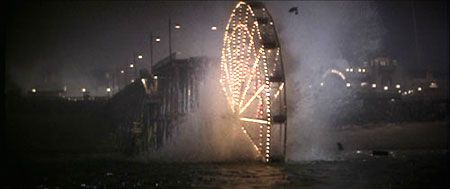
The visual effects in 1941's ferris wheel sequence are wonderful, but the best part isn't a visual effect. It's the brief shot of wanna-be ventriloquist Eddie Deezen covering his dummy's eyes as if it can see.

"Williams brings on the movie's signature piece, the 'March from 1941,' which will inform and underlie almost everything that comes after it. The march, instantly hummable, melds the fighting spirit of everything from Kenneth Alford and Malcolm Arnold's 'Colonel Bogey March' (The Bridge on the River Kwai), to the playful exuberance and bombast of Elmer Bernstein's The Great Escape, to the echoes of lost national spirit that tumble through Jerry Goldsmith's rousing score for Patton. Yet Williams is never caught cribbing lines or themes--the genius of the music is that is [sic] finds its own spirit, equivalent to the cacophonous madness of the film, yet also coursing with a generous and goofy charm and sense of its own scale that makes a listener laugh even without the attendant imagery."

--from film blogger Dennis Cozzalio's 2010 post about John Williams' 1941 score

Unless it's a Chris Rock routine, a Lewis Black rant, a Will Ferrell girlie-crying jag or Nicolas Cage screaming "Oh no! Not the bees!! Not the bees!! Aaaaaaaaahhhhhhhh!!! Oh! They're in my eyes!! My eyes!!," yelling is such a comedy killer for me. If you like your comedy broad and always shouty, the expensive 1979 WWII farce 1941, Steven Spielberg's first--and not surprisingly, only--attempt at directing a straight-up comedy, is up your alley. But for the rest of us, 1941 can be a chore to watch as it tries too hard to be funny and assumes nonstop loudness--even the end credits curtain call consists of clips of cast members yelling--will automatically yield laughs. No wonder the few funny or amusing moments in Spielberg's John Carter-style financial failure are, of course, moments where no one's yelling.

The whole story of getting 1941 made may be more fascinating than the film itself. 1941 producer and right-wing nutjob John Milius wanted to call his film The Night the Japs Attacked. We have then-MGM production chief Dan Melnick to thank for objecting to the use of "Japs" in the project's early title (back when it was attached to MGM and was nothing more than a Robert Zemeckis/Bob Gale screenplay that was darker-humored and smaller-scale than the finished product). 1941 is an example of a movie where I wish I were a fly on the wall--or better yet, an extra or crew member or whoever was put in charge of the craft services table--because I would have been surrounded by comedy icons like John Belushi, his SNL pal and Blues Brothers bandmate Dan Aykroyd, John Candy and Joe Flaherty; legendary actors like Toshiro Mifune, Christopher Lee and Warren Oates; and '70s hotties like Nancy Allen and that girl from Eight Is Enough. It's the ultimate "film that must have been more fun to make than sit through."

If you squint really hard at this cover of the graphic novel adaptation of the megaflop 1941, you can make out John Carter leaping behind John Belushi and attempting to flee from all the press coverage of Disney's big-ass financial loss.
In 1979, 1941 famously tanked. So did the little-known
graphic novel tie-in. (Photo source: Steve Bissette)
Spielberg is capable of comedy (see Jaws, Raiders of the Lost Ark, Catch Me If You Can or E.T.'s fish-out-of-water gags), so why did he drop the ball in 1941? Was it because of "too many cooks" syndrome--as 1941 cast member Tim Matheson implied in an A.V. Club "Random Roles" interview where he also noted that "It was fun to shoot, but I didn’t know what the core of it was"--or was the party-animal atmosphere on the set to blame? Vulture's "History Proves the More Fun a Movie Set Is, the Less Fun the Movie Is" slideshow argued that it was the latter.

"Belushi and Aykroyd... turned the set into one big playground where they could wildly drive around in their own vintage New York taxicab and throw out random scene ideas that Spielberg gladly accepted," noted the Vulture list. "First assistant director Jerry Ziesmer's memoir, Ready When You Are, Mr. Coppola, Mr. Spielberg, Mr. Crowe, paints a portrait of an out-of-control set where everybody was constantly cracking each other up."

Actually, I come not to bury 1941 (because so many have attacked it so well already, and I'm having a hard time trying to restrain myself from constantly dissing it), but to praise its few highlights. Let's list them now: the skillfully shot USO dance number/fight sequence (it hints at what 1941 would have been like as a musical, which, at one point during production, was what Spielberg wanted to turn 1941 into, and it also proves that the film would have been better off focusing mostly on the teenage characters); the offbeat sight of Robert Stack crying over Dumbo; the wonderful pre-CGI visual effects for the ferris wheel set piece; and the most memorable highlight, John Williams' terrific score.

So I don't find 1941 to be as hilarious as fans of Spielberg's original and longer cut like Dennis Cozzalio do, but I do agree with Cozzalio about Williams' "March from 1941." A great piece of symphonic anarchy, the theme is as loud as the movie's brand of property damage-reliant humor, but aren't all national anthems supposed to be performed loudly? The 1941 march is like the national anthem of Notreadyforprimetimeplayalistica or some country in an alternate reality where comedy nerds run Congress, the Supreme Court justices are stand-ups like Dom Irrera (who's had plenty of judicial experience presiding over Audience Network's Supreme Court of Comedy) and Paul Mooney (too bad he's not a Supreme Court justice because I would love to see Mooney verbally rip apart the conservative justices over matters like President Obama's health care law) and flags were flown at half-mast when Belushi, his '70s SNL colleague Gilda Radner and '80s and '90s SNL regular Phil Hartman died.

Like yesterday's penultimate "March Madness March of the Day," Bear McCreary's Human Target theme, the 1941 march captures the spirit of other classic themes without regurgitating their melodies. It's outlasted the movie it originated from.


All the other "March Madness March of the Day" posts from this week:
"Theme from Human Target" by Bear McCreary
"Main Title" from Star Trek: The Motion Picture by Jerry Goldsmith
"Main Title" from Spartacus by Alex North
"Captain America March" from Captain America: The First Avenger by Alan Silvestri

This is the final "March Madness March of the Day" post.

Thursday, March 15, 2012

March Madness March of the Day: "Stripes March" by Elmer Bernstein

Quien es mas sexy? P.J. Soles o Sean Young?
There are two fantastic pieces of music that director Ivan Reitman's 1981 military comedy Stripes introduced to me. One is "Do Wah Diddy Diddy," a song from way before my time that soldiers adopted as a marching cadence after watching Bill Murray and Harold Ramis choose it as their cadence in Stripes ("The first time we screened this for a real movie audience, people started applauding as soon as they started singing 'Do Wah Diddy,'" recalled Reitman during the Stripes DVD commentary). The other is the spirited "Stripes March" by Elmer Bernstein, whose iconic Great Escape score Reitman utilized to temp-track Stripes before Bernstein recorded the Stripes score.


That march is so tied to the misfit likes of John Winger (Murray), Russell Ziskey (Ramis), Ox (John Candy), Cruiser (John Diehl) and Elmo (Judge Reinhold) that when it wound up as trailer music for another military comedy, 1994's Renaissance Man, I thought, "Hey, that belongs to Stripes, man! Don't be claiming that. That's like if the Beetlejuice TV ads copped Ray Parker Jr.'s 'Ghostbusters.' Get your own soundalike shit!"

The cinema blog Radiator Heaven posted a really good overview of Stripes a few years ago. It pointed out how superb all the major players in the film's cast were, from the perfectly cast Warren Oates as drill instructor Sergeant Hulka to Murray. His Second City training was put to great effect, like in the film's first few minutes, in which a cab-driving Winger has to put up with a snooty old socialite (Fran Ryan) who's his fare, or the improvised scene where Hulka (who, as we realize in this scene, isn't the film's villain--that would be John Larroquette as incompetent Captain Stillman) has Winger and the other recruits introduce themselves ("Chicks dig me because I rarely wear underwear, and when I do, it's usually something unusual").

The Radiator Heaven post doesn't mention Bernstein's catchy Stripes march, but it does acknowledge how effective Bernstein's score is during an early scene that straddles the line between comedy and drama ("Bernstein’s first musical cue appears and it is a slightly sad, whimsical tune"). Winger--whom Community(*) creator Dan Harmon named Joel McHale's study group leader character Jeff Winger after as a shout-out to both Murray and a film that must have influenced how Harmon sometimes has Community bravely and effectively straddle the line between comedy and drama--is dumped by his girlfriend (Roberta Leighton) right after quitting his cabbie job. He's then forced to deal with the fact that the lack of purpose in his life has driven away his girlfriend and is the reason for the rut he's in. "Interestingly," noted Radiator Heaven's J.D., "no music plays during this scene so that the gravitas of the scene, if you will, is not undermined by manipulative music. Bernstein’s whimsical score only returns when Russell arrives and the two banter back and forth."

J.D. also noted that Stripes' anti-authoritarian-misfits-in-an-authoritarian-setting template "would prove to be so successful that it was exploited in films like Police Academy." Sure, Michael Winslow's beatboxing and sound effects gags always elicit a chuckle, but everything else the Police Academy movies did, Stripes did it better. And that includes the soundtrack.

(*) Hell yeah, Community's back on the air tonight!

Wednesday, March 7, 2012

March Madness March of the Day: "Main Title" from The Great Escape by Elmer Bernstein

Steve McQueen realizes he just pooped his pants.
I'll just let the late Elmer Bernstein have the floor.

"The score for The Great Escape was not about action at all. It was in that theme that everybody knows now; it was about indomitability, about not being put down, about spirit. That was the essential thing about the score, as exemplified by the character that Steve McQueen played."

--Bernstein, from the liner notes of Varèse Sarabande's The Great Escape: The Deluxe Edition score album

Friday, July 15, 2011

"Rome, Italian Style" Track of the Day: Jimmy Smith, "Walk on the Wild Side"

You know what would have made the Ripley's Believe It or Not Museum 10 times more fun? Jack Palance's awesome voice. They should have gotten him to record narration for every single museum display. To a certain generation, Palance will always be that weird old dude who did one-handed push-ups on the Oscars, but I'll always remember him for 'Believe it... or not.'
Song: "Walk on the Wild Side" by master Hammond B-3 organ player and Beastie Boys "Root Down" sample source Jimmy Smith
Released: 1962
Why's it part of the "Rome, Italian Style" playlist?: I first took notice of "Walk on the Wild Side"--not to be confused with the Lou Reed classic of the same name--when I heard it during Martin Scorsese's Casino. I later discovered that Smith's exhilarating instrumental was a cover of a movie theme, Elmer Bernstein's theme from the 1962 New Orleans bordello drama Walk on the Wild Side, which starred Laurence Harvey, Capucine and Jane Fonda (that was an interesting way for Scorsese to insert a shout-out to Bernstein, whom he previously worked with on Cape Fear and The Age of Innocence: he needle-dropped a cover of one of Bernstein's earlier compositions).

The instrumental version of Bernstein's Walk on the Wild Side theme accompanies one of legendary movie title designer Saul Bass' best opening title sequences, which, unlike most of Bass' other sequences, doesn't use any animation and is simply footage of an alley cat, cleverly edited to the tempo of Bernstein's slinky-sounding theme. The catfight at the end of Bass' titles pits a black cat against a white cat. It's like a Real Housewives of Atlanta fight scene with better acting.

The word on the street is Robert De Niro would like to pet this black pussy.
(Photo source: The Movie Title Stills Collection)
Though its lyrics contain gospel-style references to the promised land of heaven, it's odd how this theme from a then-risque '60s movie about New Orleans hoes has become a gospel standard. It's like if Blondie's "Call Me" from American Gigolo got rewritten as "Call Me (Hello Lord)" or something.

I always liked the Charles M. Schulz version of luggage for runaways and hitchhikers: a simple stick with a polka-dotted sack tied to it at the end.
Walk on the Wild Side star Jane Fonda models Timbuk2's new "Hitchhiking Ho" line.


All the other "Rome, Italian Style" Tracks of the Day from this week:
Goldfrapp, "Pilots"
Mike Patton, "Deep Down"
Barry Adamson, "The Big Bamboozle"
John Zorn, "Erotico (The Burglars)"

Tuesday, March 15, 2011

Coffey is the color

Here we see Dennis Coffey playing 'Scorpio' for an audience made up of the not-in-the-picture Oscar the Grouch and his homeless buddies.
To promote the upcoming self-titled album by legendary and frequently sampled Motown guitarist Dennis Coffey, Strut Records recently dropped a fantastic 45-minute mix of old Coffey tunes, hip-hop tracks that sampled Coffey's work and new material from the April 26 release. The instrumental jam "7th Galaxy," a new joint from Coffey's Strut album, starts at 04:55 in the "Constellations" mix, which was assembled by DJ House Shoes. "7th Galaxy" needs to turn up as chase music in a TV show or movie pronto.

The mix includes one of my all-time favorite movie themes, Coffey's Black Belt Jones theme, and another blaxploitation soundtrack tune that features Coffey's guitar work, Edwin Starr's "Easin' In" from Hell Up in Harlem. I was first exposed to "Easin' In" via "Nickel Bags" by Digable Planets, while LL Cool J's "Jingling Baby" introduced me to the Black Belt Jones theme.


I once saw a TCM featurette that pointed out that the Magnificent Seven montage of Yul Brynner and his crew journeying on horseback to the Mexican villagers looked really lethargic and unexciting without Elmer Bernstein's energetic main theme. The Black Belt Jones opening title sequence takes place in the dullest of settings, an L.A. parking lot--not exactly the most dynamic location to showcase the martial arts skills of Bushido Brown Jim Kelly. I guess director Robert Clouse had much less dough to work with than he did on his previous movie with Kelly, the Hong Kong-based Enter the Dragon. Like Bernstein's theme during the Magnificent Seven montage, Coffey's funky theme helps distract you from how shabby the opening title sequence looks despite the fisticuffs (ComicsAlliance editor Chris Sims noted on his Invincible Super-Blog that even the fisticuffs look compromised too: "It may SEEM like Black Belt Jones is moving slow, and that the guys he's fighting are drunk, but I assure you that's not the case. In order to get an 'R' rating they actually had to slow the film down because audiences in the Seventies could not handle that much brutal action.").

Man, they come right out of a comic book.
(Photo source: Cinema is Dope/Museum of Cinema)

YouTube comments sections are too often full of inane or racist junk, but there was one comment below the video of the Black Belt Jones opening credits that amused me and caused me to do something I've never done before in a YouTube comments section, and that's click on "thumbs up":

"Obama should enter Congress with this theme and kick some Republican butt."

Word.

There are so many hot beats in Strut's Coffey mix, which concludes with "All Your Goodies Are Gone," a terrific blue-eyed soul collabo with Mayer Hawthorne from the new album, a release that Strut hopes will introduce Coffey to a new generation of beatheads. I particularly enjoyed the mix's juxtapositions of "Jingling Baby" with the Black Belt Jones breakbeat and "Easin' In" with "Nickel Bags."

Constellations - The A to Z of Dennis Coffey: A Mix By House Shoes by Strut

[Via Potholes in My Blog]

Wednesday, December 23, 2009

"On, Donner! On, Blitzen! On, Chuy! On, Tavo! C'mon, Becto!": 10 current favorite Christmas tracks

Alyson Hannigan was looking very Dr. Girlfriend-ish when Harvey Fierstein redubbed her voice in How I Met Your Mother's recent smoking addiction episode.
The following is inspired by a holiday music meme I first saw posted by Matt on Scrubbles.net. Like Matt said in his list, some of us require a bit of acid in our eggnog (or in our DVD players--my favorite holiday movie is The Ref, the film where Kevin Spacey memorably tells his evil mom he'll get her a cross for Christmas so that whenever she feels unappreciated for her sacrifices, she can climb on up and nail herself to it).

10. The Pogues and Kirsty MacColl, "Fairytale of New York"
Now that's my idea of the perfect Pasko song. The cover version with Dr. Girlfriend as Shane MacGowan and the Monarch as MacColl is hilariously fooked up.

9. OutKast, "Player's Ball"
Andre 3000 and Big Boi's very first single was originally a Yuletide joint, in which the Player's Ball happens on Christmas Day instead of "all day e'ryday." The Christmas Day line is removed from the Southernplayalisticadillacmuzik version, but most of the other holiday references remain ("Ain't no chiminies in the ghetto/So I won't be hangin' my socks on no tip").

8. Darlene Love, "Christmas (Baby Please Come Home)"
I first heard this tune during the opening credits of Gremlins. I've grown fond of "Baby Please Come Home" because of Love's annual performance of the Phil Spector-produced standard on Letterman's Christmas shows.

7. Donny Hathaway, "This Christmas"
Everyone from Patti LaBelle to woman-beating douches have covered "This Christmas," but Hathaway's 1970 original will always be the best version. It's mostly because of the thunderous percussion and them funky horns. Earlier this month, the Chicago Sun-Times published a terrific article that contains interesting tidbits about the Chicago native's classic recording, like its unlikely ties to film music (the song's bridge was inspired by Elmer Bernstein's Magnificent Seven theme!).

6. Booker T. & the MGs, "Merry Christmas Baby"
Atlantic's 1991 Soul Christmas compilation is my favorite holiday CD, thanks to the inclusion of "This Christmas," Clarence Carter's "Back Door Santa" and the sizzling Booker T. & the MGs cover of singer Charles Brown's 1947 standard, which was featured in David Sedaris' classic 1992 NPR reading of The Santaland Diaries.

5. Vince Guaraldi Trio, "Skating"
This is the only track on the list that's from a film or TV score. My favorite tune from the Charlie Brown Christmas soundtrack is neither "Christmas Time Is Here" nor "Linus and Lucy." It's the underappreciated "Skating." Guaraldi once said, "I don't think I'm a great piano player." Nah, during "Skating," Guaraldi was a great piano player.

4. The Waitresses, "Christmas Wrapping"
Like in "This Christmas," the horn section sounds so tight during "Christmas Wrapping."

3. Cheech & Chong, "Santa Claus and His Old Lady"
Donde esta Santa Cleese? Another enjoyable Christmas track involving a Latino comedian is Horatio Sanz's "I Wish It Was Christmas Today," which was covered earlier this week by Julian Casablancas and the Roots.

2. Patton Oswalt, "My Christmas Memory"
I lose it every time I hear Oswalt's impression of a slowed-down David Seville from "The Chipmunk Song (Christmas Don't Be Late)."

God, MTV sucks so much now. I miss that '80s MTV Christmas graphic that was animated by the late Keith Haring to the sounds of 'Christmas in Hollis.'
1. Run-DMC, "Christmas in Hollis"
Jam Master Jay's killer "Back Door Santa" sample is a reason why millions of us continue to exclaim "Goddamn, that DJ made my day!" long after his death.