Showing posts with label The Great Escape. Show all posts

Friday, March 30, 2012

March Madness March of the Day: "1941 End Credits" by John Williams

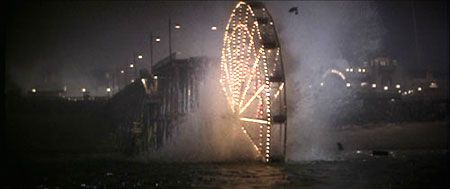
The visual effects in 1941's ferris wheel sequence are wonderful, but the best part isn't a visual effect. It's the brief shot of wanna-be ventriloquist Eddie Deezen covering his dummy's eyes as if it can see.

"Williams brings on the movie's signature piece, the 'March from 1941,' which will inform and underlie almost everything that comes after it. The march, instantly hummable, melds the fighting spirit of everything from Kenneth Alford and Malcolm Arnold's 'Colonel Bogey March' (The Bridge on the River Kwai), to the playful exuberance and bombast of Elmer Bernstein's The Great Escape, to the echoes of lost national spirit that tumble through Jerry Goldsmith's rousing score for Patton. Yet Williams is never caught cribbing lines or themes--the genius of the music is that is [sic] finds its own spirit, equivalent to the cacophonous madness of the film, yet also coursing with a generous and goofy charm and sense of its own scale that makes a listener laugh even without the attendant imagery."

--from film blogger Dennis Cozzalio's 2010 post about John Williams' 1941 score

Unless it's a Chris Rock routine, a Lewis Black rant, a Will Ferrell girlie-crying jag or Nicolas Cage screaming "Oh no! Not the bees!! Not the bees!! Aaaaaaaaahhhhhhhh!!! Oh! They're in my eyes!! My eyes!!," yelling is such a comedy killer for me. If you like your comedy broad and always shouty, the expensive 1979 WWII farce 1941, Steven Spielberg's first--and not surprisingly, only--attempt at directing a straight-up comedy, is up your alley. But for the rest of us, 1941 can be a chore to watch as it tries too hard to be funny and assumes nonstop loudness--even the end credits curtain call consists of clips of cast members yelling--will automatically yield laughs. No wonder the few funny or amusing moments in Spielberg's John Carter-style financial failure are, of course, moments where no one's yelling.

The whole story of getting 1941 made may be more fascinating than the film itself. 1941 producer and right-wing nutjob John Milius wanted to call his film The Night the Japs Attacked. We have then-MGM production chief Dan Melnick to thank for objecting to the use of "Japs" in the project's early title (back when it was attached to MGM and was nothing more than a Robert Zemeckis/Bob Gale screenplay that was darker-humored and smaller-scale than the finished product). 1941 is an example of a movie where I wish I were a fly on the wall--or better yet, an extra or crew member or whoever was put in charge of the craft services table--because I would have been surrounded by comedy icons like John Belushi, his SNL pal and Blues Brothers bandmate Dan Aykroyd, John Candy and Joe Flaherty; legendary actors like Toshiro Mifune, Christopher Lee and Warren Oates; and '70s hotties like Nancy Allen and that girl from Eight Is Enough. It's the ultimate "film that must have been more fun to make than sit through."

If you squint really hard at this cover of the graphic novel adaptation of the megaflop 1941, you can make out John Carter leaping behind John Belushi and attempting to flee from all the press coverage of Disney's big-ass financial loss.
In 1979, 1941 famously tanked. So did the little-known
graphic novel tie-in. (Photo source: Steve Bissette)
Spielberg is capable of comedy (see Jaws, Raiders of the Lost Ark, Catch Me If You Can or E.T.'s fish-out-of-water gags), so why did he drop the ball in 1941? Was it because of "too many cooks" syndrome--as 1941 cast member Tim Matheson implied in an A.V. Club "Random Roles" interview where he also noted that "It was fun to shoot, but I didn’t know what the core of it was"--or was the party-animal atmosphere on the set to blame? Vulture's "History Proves the More Fun a Movie Set Is, the Less Fun the Movie Is" slideshow argued that it was the latter.

"Belushi and Aykroyd... turned the set into one big playground where they could wildly drive around in their own vintage New York taxicab and throw out random scene ideas that Spielberg gladly accepted," noted the Vulture list. "First assistant director Jerry Ziesmer's memoir, Ready When You Are, Mr. Coppola, Mr. Spielberg, Mr. Crowe, paints a portrait of an out-of-control set where everybody was constantly cracking each other up."

Actually, I come not to bury 1941 (because so many have attacked it so well already, and I'm having a hard time trying to restrain myself from constantly dissing it), but to praise its few highlights. Let's list them now: the skillfully shot USO dance number/fight sequence (it hints at what 1941 would have been like as a musical, which, at one point during production, was what Spielberg wanted to turn 1941 into, and it also proves that the film would have been better off focusing mostly on the teenage characters); the offbeat sight of Robert Stack crying over Dumbo; the wonderful pre-CGI visual effects for the ferris wheel set piece; and the most memorable highlight, John Williams' terrific score.

So I don't find 1941 to be as hilarious as fans of Spielberg's original and longer cut like Dennis Cozzalio do, but I do agree with Cozzalio about Williams' "March from 1941." A great piece of symphonic anarchy, the theme is as loud as the movie's brand of property damage-reliant humor, but aren't all national anthems supposed to be performed loudly? The 1941 march is like the national anthem of Notreadyforprimetimeplayalistica or some country in an alternate reality where comedy nerds run Congress, the Supreme Court justices are stand-ups like Dom Irrera (who's had plenty of judicial experience presiding over Audience Network's Supreme Court of Comedy) and Paul Mooney (too bad he's not a Supreme Court justice because I would love to see Mooney verbally rip apart the conservative justices over matters like President Obama's health care law) and flags were flown at half-mast when Belushi, his '70s SNL colleague Gilda Radner and '80s and '90s SNL regular Phil Hartman died.

Like yesterday's penultimate "March Madness March of the Day," Bear McCreary's Human Target theme, the 1941 march captures the spirit of other classic themes without regurgitating their melodies. It's outlasted the movie it originated from.


All the other "March Madness March of the Day" posts from this week:
"Theme from Human Target" by Bear McCreary
"Main Title" from Star Trek: The Motion Picture by Jerry Goldsmith
"Main Title" from Spartacus by Alex North
"Captain America March" from Captain America: The First Avenger by Alan Silvestri

This is the final "March Madness March of the Day" post.

Thursday, March 15, 2012

March Madness March of the Day: "Stripes March" by Elmer Bernstein

Quien es mas sexy? P.J. Soles o Sean Young?
There are two fantastic pieces of music that director Ivan Reitman's 1981 military comedy Stripes introduced to me. One is "Do Wah Diddy Diddy," a song from way before my time that soldiers adopted as a marching cadence after watching Bill Murray and Harold Ramis choose it as their cadence in Stripes ("The first time we screened this for a real movie audience, people started applauding as soon as they started singing 'Do Wah Diddy,'" recalled Reitman during the Stripes DVD commentary). The other is the spirited "Stripes March" by Elmer Bernstein, whose iconic Great Escape score Reitman utilized to temp-track Stripes before Bernstein recorded the Stripes score.


That march is so tied to the misfit likes of John Winger (Murray), Russell Ziskey (Ramis), Ox (John Candy), Cruiser (John Diehl) and Elmo (Judge Reinhold) that when it wound up as trailer music for another military comedy, 1994's Renaissance Man, I thought, "Hey, that belongs to Stripes, man! Don't be claiming that. That's like if the Beetlejuice TV ads copped Ray Parker Jr.'s 'Ghostbusters.' Get your own soundalike shit!"

The cinema blog Radiator Heaven posted a really good overview of Stripes a few years ago. It pointed out how superb all the major players in the film's cast were, from the perfectly cast Warren Oates as drill instructor Sergeant Hulka to Murray. His Second City training was put to great effect, like in the film's first few minutes, in which a cab-driving Winger has to put up with a snooty old socialite (Fran Ryan) who's his fare, or the improvised scene where Hulka (who, as we realize in this scene, isn't the film's villain--that would be John Larroquette as incompetent Captain Stillman) has Winger and the other recruits introduce themselves ("Chicks dig me because I rarely wear underwear, and when I do, it's usually something unusual").

The Radiator Heaven post doesn't mention Bernstein's catchy Stripes march, but it does acknowledge how effective Bernstein's score is during an early scene that straddles the line between comedy and drama ("Bernstein’s first musical cue appears and it is a slightly sad, whimsical tune"). Winger--whom Community(*) creator Dan Harmon named Joel McHale's study group leader character Jeff Winger after as a shout-out to both Murray and a film that must have influenced how Harmon sometimes has Community bravely and effectively straddle the line between comedy and drama--is dumped by his girlfriend (Roberta Leighton) right after quitting his cabbie job. He's then forced to deal with the fact that the lack of purpose in his life has driven away his girlfriend and is the reason for the rut he's in. "Interestingly," noted Radiator Heaven's J.D., "no music plays during this scene so that the gravitas of the scene, if you will, is not undermined by manipulative music. Bernstein’s whimsical score only returns when Russell arrives and the two banter back and forth."

J.D. also noted that Stripes' anti-authoritarian-misfits-in-an-authoritarian-setting template "would prove to be so successful that it was exploited in films like Police Academy." Sure, Michael Winslow's beatboxing and sound effects gags always elicit a chuckle, but everything else the Police Academy movies did, Stripes did it better. And that includes the soundtrack.

(*) Hell yeah, Community's back on the air tonight!

Wednesday, March 7, 2012

March Madness March of the Day: "Main Title" from The Great Escape by Elmer Bernstein

Steve McQueen realizes he just pooped his pants.
I'll just let the late Elmer Bernstein have the floor.

"The score for The Great Escape was not about action at all. It was in that theme that everybody knows now; it was about indomitability, about not being put down, about spirit. That was the essential thing about the score, as exemplified by the character that Steve McQueen played."

--Bernstein, from the liner notes of Varèse Sarabande's The Great Escape: The Deluxe Edition score album

Thursday, March 5, 2009

AFOS: "The Inmates Are Taking Over the Asylum" playlist

Airing this week on the Fistful of Soundtracks channel is the 2008 Fistful of Soundtracks: The Series episode "The Inmates Are Taking Over the Asylum" (WEB96), in which I compiled my favorite selections from scores to films that were distributed by United Artists, which turns 90 years old this May.

'We have in effect put all our rotten eggs in one basket. And we intend to watch this basket carefully.'

1. Elmer Bernstein, "The Street (Main Title)" (from Sweet Smell of Success), Crime Jazz: Music in the First Degree, Rhino
2. Adolph Deutsch, "Main Title - Theme from The Apartment," The Apartment, United Artists
3. Elmer Bernstein, "Main Title and Calvera," The Magnificent Seven, Rykodisc
4. Elmer Bernstein, "Main Title," The Great Escape: The Deluxe Edition, Varèse Sarabande
5. The London Studio Symphony Orchestra, "Theme from The Fugitive," The Fugitive, Silva Screen
6. John Barry, "Opening Titles," From Russia with Love, EMI
7. Henry Mancini, "The Pink Panther Theme," The Pink Panther, RCA
8. Ennio Morricone, "L'Estasi Dell'Oro," Il Buono, Il Brutto, Il Cattivo, GDM
9. Quincy Jones, "Shag Bag, Hounds & Harvey" (from In the Heat of the Night), In the Heat of the Night/They Call Me MISTER Tibbs!, Rykodisc
10. Henry Mancini featuring the Party Poops, "The Party (vocal)," The Party, RCA
11. John Barry, "Midnight Cowboy," Midnight Cowboy, EMI-Manhattan
12. Al Kooper, "Love Theme," The Landlord, United Artists
13. Bobby Womack & Peace, "Across 110th Street," Across 110th Street, Rykodisc
14. Jack Sheldon, "The Long Goodbye," Fitzwilly/The Long Goodbye, Varèse Sarabande
15. David Shire, "End Title," The Taking of Pelham One Two Three, Retrograde
16. Bill Conti, "The Final Bell," Rocky, EMI-Manhattan
17. The Gap Band, "I'm Gonna Git You Sucka," I'm Gonna Git You Sucka, Arista
18. Mellow, "Seek You," CQ, Emperor Norton

Repeats of A Fistful of Soundtracks: The Series air Monday night at midnight, Tuesday and Thursday at 4am, 10am, 3pm, 7pm and 11pm, Wednesday night at midnight, and Saturday and Sunday at 7am, 9am, 11am, 1pm, 3pm and 5pm.