This is the eighth of 12 or 13 all-new blog posts that are being posted on a monthly basis until this blog's final post in December 2017.
Named after a Simon & Garfunkel tune that's like a turtlenecked-and-khaki-pantsed precursor to Prince's "Little Red Corvette" ("I hit the road and I'm gone"), Baby Driver is Edgar Wright's wonderful antidote to superhero movie fatigue (the recent thrills of Wonder Woman aside), as well as a subtle rebuke to the often-afraid-of-idiosyncrasy superhero movie studio system that chewed the idiosyncratic Wright up and spat him out (back in 2014). Wright's caper flick is the inventively told, occasionally Kid Koala-scored story of a 20-something getaway driver known simply as Baby, whose method of drowning out the tinnitus he's suffered from since childhood is to continually play the likes of the Jon Spencer Blues Explosion and Bob & Earl in his omnipresent iPod earbuds, even during high-speed car chases. While mowing through truffle parmesan butter popcorn at a Baby Driver screening at the Alamo Drafthouse, I realized Wright basically made a movie about me.
Sure, I'm not a getaway driver and I can't parkour my way out of a tight spot like Baby astoundingly can at one point during Baby Driver, but at all hours in my apartment building, I always wear headphones full of music from my phone or my Mac, not to drown out tinnitus, but to drown out annoying footstep noises from my apartment's paper-thin ceiling. Atop the ceiling, it always sounds like two elephants fucking.
Baby Driver
Part of the challenge of writing these blog posts in the past nine years--and now, in addition to the posts, a prose novel manuscript--has been trying to concentrate while all these infuriating noises from my ceiling ensue. If it weren't for my headphones drowning those noises out, I don't think I could ever get any shit done in my apartment, and I don't think I could ever sleep at night either (for that, I switch off the music and put on in my headphones a copy of one of those eight-hour YouTube audio clips of starship white noise from Star Trek: The Next Generation, and then I'm out cold like Riker after having to listen to Data's poetry slam).
My very first blog post of 2016 was originally going to be either a piece about Electric Boogaloo, the Cannon Films documentary that's now streaming on Netflix, or a piece about Creed and why I like Ludwig Göransson's original score from that film so much that I'm adding the score to AFOS rotation. It was going to be a typically quiet and uneventful slide into the new year here at this blog, right? [Dana Carvey's John McLaughlin voice] Wrong! Live365, the Bay Area Internet radio hosting platform I've gotten along well with--it's the company that's powered AFOS for 13 years--ended 2015 with a huge announcement.
Recent changes in music licensing regulations and the end of the Webcaster Settlement Act, which allowed for low-revenue Internet radio stations to pay lower royalties to record labels than those paid by the likes of Pandora, have resulted in Live365's investors leaving the company and Live365 laying off nearly its entire staff. The company has already moved out of its longtime Foster City office space.
The future doesn't look good for Live365. The company informed its Pro broadcasters that it will allow them to continue running their radio stations until January 31. I'm one of Live365's Pro broadcasters, so that means, yes, unless Live365 is somehow saved by a new group of investors or it gets some other kind of 11th-hour rescue, AFOS is going off the air on January 31.
My response to that is this: good. It's time to call it quits as an Internet radio broadcaster.
I've seen a few Live365 Pro or non-Pro broadcasters tell their listeners that they either have started to look for other streaming platform options or have shut down their Live365 streams to begin streaming independently. I won't be doing the same for AFOS. Some of the enthusiasm I had during the first few years of running the station has simply disappeared. The audience for AFOS has also disappeared, although there are still one or two listeners who holler at me on Facebook or Twitter. Why listen to a 24-hour station when other platforms allow you to curate your own playlists with ease or when you can simply YouTube any piece of music you like? (I don't even listen to Internet stations anymore. I prefer to listen to DJ mixes. The Internet has changed so much since 2003 and 2004. Those years were when my listeners were at their most responsive and vocal, so I used to do hour-long shows where I would read aloud their e-mails to me. And then one day, the e-mails suddenly stopped coming, so without those e-mails, I stopped doing mailbag shows.)
I still listen to the film and TV score albums that my station's programming is comprised of, so I've continued to update the station playlists once or twice a month to attempt to keep the station from sounding stale. But I haven't talked into a microphone and recorded original content for AFOS since 2009. I got tired of not getting paid for speaking on the mic.
I never earned a dime from AFOS, much like how college radio DJs who currently host score music radio programs (just like I did when I was a university student) or any other kind of program don't get paid by their stations for spinning music. But I never intended to earn a dime from AFOS anyway. I did all this only because I like to stream score music and I'm passionate about the work of a few film composers, many of whom are prolific (Ennio Morricone), while others aren't as prolific and really ought to be prolific (like David Holmes or, from the rugged lands of Shaolin, RZA, who's better at film scoring than acting).
P.J. Soles from John Carpenter's Halloween (Photo source: Popcorn Cinema)
The following is a repost of one of my most well-received pieces from earlier this year, originally posted on March 20, 2015. In between the time I wrote the piece and now, John Carpenter composed the main title theme for the CBS summer show Zoo.
The most significant and impressive piece of work John Carpenter has made in the last 15 years is neither a feature film nor a TV-movie. It's John Carpenter's Lost Themes, a new collection of original Carpenter instrumentals that, in the Albertus font-loving filmmaker/composer's own words, are "meant to score the movies in your head." The Sacred Bones Records album is Carpenter's entry into the imaginary soundtracks genre, where the likes of Black Dynamite composer Adrian Younge (2000's Venice Dawn) and the duo of Danger Mouse and Magic City composer Daniele Luppi (2011's Rome) have created score cues or theme tunes for movies that don't exist.
Lost Themes tracks like "Vortex" and "Abyss" resemble outtakes from Carpenter's scores to the 1988 cult favorite They Live and the mad-underrated In the Mouth of Madness, and except for the really cheesy Big Trouble in Little China end title theme sung by Carpenter himself, that Carpenter synth sound Lost Themes reacquaints us with has aged remarkably well. It's aged so well that Carpenter's pulsating and frequently sampled 1976 Assault on Precinct 13 main title theme--which Carpenter has said was influenced by Led Zeppelin's "Immigrant Song" and is in rotation during both the AFOS morning block "Beat Box" and "AFOS Prime"--sounds like it could have been recorded yesterday, while the likes of Steven Price, frequent Steven Soderbergh collaborator David Holmes and It Follows composer Rich Vreeland, a.k.a. Disasterpeace, dig the Carpenter sound so much that they borrow from Carpenter in their respective film scores.
I'd add some of the Lost Themes instrumentals to AFOS rotation, but the station format focuses only on score music written for movies and TV shows that aren't imaginary, and I don't have enough station hard drive space to launch a new imaginary soundtrack music block just to stream Lost Themes selections. For about a year, the station schedule included "Rome, Italian Style," an imaginary soundtrack music block I named after one of my favorite SCTV sketches (and a rare SCTV sketch that's not marred by an annoying laugh track). Younge's Venice Dawn tracks and Luppi's Rome tracks were part of the "Rome, Italian Style" playlist, and if the block still existed, those tracks would have shared space with the Lost Themes pieces. The Carpenter sound, which is basically '70s and '80s Italian film music, would have been a nice fit with the '60s Italian film vibe of the Venice Dawn and Rome tracks.
Junta Juleil's Culture Shock and Consequence of Sound both have gotten creative and used the Lost Themes instrumentals to fancast fictional Carpenter movies featuring those tracks. For example, in their movie idea built out of the Lost Themes track "Purgatory," Consequence of Sound imagined a 1988 murder mystery starring Kevin Dillon, Ernie Hudson and Daryl Hannah in her At Play in the Fields of the Lord skinny-dipping scene heyday, while "Purgatory" got Junta Juleil author Sean Gill to envision a completely implausible but much more enticing movie: a Big Trouble in Little China mini-reunion between Dennis Dun and Kurt Russell, who reprises his non-Carpenter role as Captain Ron.
John Carpenter directs Victor Wong and Donald Pleasence on the set of Prince of Darkness, one of seven big-screen Carpenter movies I haven't seen yet. All those remaining seven movies do not star Kurt Russell, Carpenter's muse.
I'd indulge in some Lost Themes-inspired fancasting too, but I don't want to bite Junta Juleil and Consequence of Sound's style, so I'm going to do a completely different approach to playing around with Lost Themes and demonstrating how Carpenter's new instrumentals can make anything sound exciting and atmospheric. I'm going to unearth a plot synopsis I wrote three years ago for a never-finished horror short story and spice it up--or rather, Carpenter it up--with Lost Themes selections.
"The Pet" was my attempt to create a new Filipino monster that would have joined the creepy likes of the aswang and the manananggal. The story would have mixed Filipino monster folklore with one of the most unsettling horror tropes, eye trauma. Here's a good example of how unsettling that trope can be: I was so bothered by a Lasik operation-gone-wrong episode of the short-lived early '00s supernatural show The Others (no relation to the Nicole Kidman haunted house flick of the same name) that I've refused to undergo Lasik surgery to improve my eyesight. At the time I was trying to write "The Pet" as a submission to a Filipino YA horror anthology (it was called HORROR, with the title in all caps, as if it were a book by Meek Mill), I thought, "Eye trauma is terrifying, so how do I work that into the creation of a new monster?"
The result was a story where I only got as far as completing four pages. I ended up missing the anthology submission deadline because I was never satisfied with both the dialogue I wrote and the legal hurdles the story's characters would have overcome in order to acquire the titular creature. Also, I think "The Pet" would be better off as either an episode of a horror comedy anthology show or a short film rather than as a short story in print. I always imagined it as a Joe Dante suburban comedy/thriller with a John Carpenter score--and a Filipino American backdrop.
Examples of the not-so-shitty work of Mark Woollen's trailer house (Photo source:New Yorkmagazine)
Movie trailers are a form of advertising I first became fascinated with in 2005, when I started experimenting with using '70s movie radio spots as interstitials to introduce the next piece of music on AFOS. For example, if the next tune on AFOS was the Love Unlimited Orchestra's "Theme from Together Brothers," it was going to be preceded by an actual Together Brothers radio spot from 1974.
A few months later, playing around with those old radio spots made me realize the audio from the spooky Batman Begins bat noises TV spot worked fantastically as a similar intro for any Batman Begins score track on the stream. This saved me the trouble of opening GoldWave and recording an intro to ID the composer and score album for every single track on the four different playlists AFOS consisted of at the time (today, AFOS consists of 56 different playlists).
From then on, I scoured the Interweb tubes for every single trailer or TV spot for a movie or TV show I could get my hands on and then re-edit into interstitials (and I continue to scour for trailer audio, as well as shorten them for radio because a lot of trailers contain huge chunks of wordless visual action or vague-sounding dialogue that would make no sense on radio). I wound up getting a few thumbs up in listener e-mails and on Twitter for this trailer-audio-as-interstitials approach. Someone tweeted that AFOS has a DJ Food vibe because of it. It was better than the occasional harsh criticisms I used to receive about the sound of my voice on AFOS.
Check out
A Fistful of Soundtracks on tunein.
Its got a DJ-Food feeling to it.
By 2006, I had listened to so much trailer audio that I stopped dismissing trailers as annoying commercials that would always get in the way of my enjoyment of the feature presentation, whether I'm watching that feature in the theater or on disc, and I started to respect the art of producing and editing these trailers. I've become a fan of the Buddha Jones trailer house's laugh-out-loud funny trailer campaigns for 2011's The Muppets and Muppets Most Wanted, and I've grown to admire Hollywood trailer producer Mark Woollen and his eponymous trailer house's inventive work on the campaigns for films like Little Children, In the Loop and Gone Girl.
"Mark has the difficult task and very rare talent of finding a film's DNA in 120 seconds. Once he finds it, he translates it not by revealing its story but by expressing, in a clear but mysterious way, the film's emotional essence," said Alejandro González Iñárritu to New York magazine about Woollen, who crafted the trailers and TV spots for Iñárritu's Best Picture Oscar winner Birdman. Woollen has been pushing for stylish trailers that move away from extremely on-the-nose and frequently parodied trailer styles like the tired comedy trailer template The Simpsons once made fun of in its fake trailers for an Ed O'Neill sports comedy called Soccer Mummy and a Going Ape/Dunston Checks In-ish piece of shit called Editor-in-Chimp.
Some of my all-time favorite trailers, like the ones for Albert Brooks' Real Life and the 2002 documentary Comedian, don't even include any footage from the film and are amusing short films by themselves. I also started to respect the art of narrating trailers. I had listened to so much trailer audio by 2006 that I started to be able to identify the names of the voices behind the voiceovers. Before 2006, I used to often get Hal Douglas, the announcer who appeared as himself in the Comedian trailer, mixed up with Don LaFontaine, because their authoritative voices sometimes sounded the same. After 2006, I was able to tell them apart, and I can now do the same with any announcer who's become more prominent in the trailer voiceover biz since the deaths of LaFontaine and later, Douglas ("Yo, that's Ashton Smith in that TV spot. And that's definitely Keith David. Or is that Dorian Harewood, the voice of NBC? Nah, that's definitely David").
So when Childrens Hospital regular Lake Bell starred in and directed In a World..., an indie comedy about a post-LaFontaine trailer voiceover industry (as well as the Bell character's frustrations over that industry being such a sausage fest), I felt like she made that movie just for me. The movie's opening montage of archival footage of LaFontaine at work was excellent as an opening title sequence, and I especially enjoyed how a lot of In a World... took place in recording studios, a world I'm familiar with from my days of either being involved with college radio or recording content for AFOS inside a cozy and loungey studio.
It's also great whenever any publication takes an In a World...-like look at the trailer biz and discusses at length the unknown history of cutting together trailers or, in the case of the A.V. Club, the stylistic choices that go into making a standout trailer (one "AVQ&A" panelist says, "While I appreciate the art of a tasteful teaser, sometimes I just want to be told exactly what the hell is going on," while another panelist says, "My answer happens to be the opposite... I like a trailer that doesn't tell me anything about what's going on"). The A.V. Club's September 25 Q&A with its own staff writers about "What makes a great trailer?" inspired the bloggers over at The Solute--a film discussion blog founded by film lovers who became online friends in the surprisingly calm and civil comments section of Pitchfork Media's much-missed The Dissolve--to discuss examples of terrible trailers for good movies.
The Solute post scores points for not overlooking the most notorious recent example of coming attractions that are so atrociously made that they're incongruous with the word "attraction" and they wind up diminishing the attractiveness of whatever film they're hyping. That example would have to be the shitty trailers that caused the surprisingly enjoyable Edge of Tomorrow to get squished at the box office as if it were Tom Cruise's body getting run over by an Army truck.
But the king of terrible trailers for good or great movies has to be the American trailer for the Samuel Goldwyn Company release of Henry V, Kenneth Branagh's 1989 big-screen directorial debut. In 1989, the most talked-about trailer campaign belonged to Batman, not just because the footage presented a dark Batman who had never been depicted on screen before, but also because of the extremely minimalist approach of the Tim Burton film's 1988 teaser trailer: no voiceover narration, no music (Woollen's Little Children trailer became notable for also containing no music) and not even an appearance by either the title of the film or its about-to-be-ubiquitous, Anton Furst-designed logo at the end of the trailer. The minimalist approach was due to Warner Bros.' eagerness to rush a teaser trailer into theaters to intensify the buzz for Batman. It's funny how the Batman teaser's lack of narration ended up influencing a lot of trailers today when it was really a result of the trailer house not having enough time to record narration for the teaser. A similar minimalist approach also distinguished another trailer from 1989: the original U.K. trailer for Henry V, which opted for no narration and simply relied on Shakespeare's dialogue and Patrick Doyle's epic score from the film to sell the drama and gritty war-movie feel of Branagh's first Shakespeare adaptation for the screen.
Doyle's very first film score kicked off a long-lasting cinematic partnership with Branagh (before Henry V, Doyle had scored Branagh's 1987 stage production of Twelfth Night) that continued recently with Doyle's score for Branagh's version of Cinderella earlier this year. The Henry V score remains my favorite work of Doyle's. That's why selections from the Henry V score are in rotation on AFOS. "One of Pat's great gifts is for melody, and I wanted every tune to make an impact. The great set pieces needed underscoring as powerful and immediate as the words themselves," wrote Branagh in the Henry V score album liner notes.
Henry V's 14-minute St. Crispin's Day speech score cue, which Doyle has covered on piano in his recent Varèse Sarabande release The Music of Patrick Doyle: Solo Piano, is the Branagh film's most memorable example of underscoring that's as powerful and immediate as the words themselves. The Crispin's Day cue also became a staple of trailers or TV broadcast promos for feel-good movies in the '90s. But the Henry V cues that actually better sum up for me the drive and pulse of Branagh's film (recently reissued on Blu-ray by Shout! Factory) are "Opening title--'O! for a Muse of fire,'" which was used in most of the British trailer, and "'Once more unto the breach,'" which is in rotation on AFOS. So how did the trailer house that produced the American trailer for Henry V manage to fuck it all up? It stupidly didn't use "'O!' for a Muse of fire,'" "'Once more unto the breach'" or any other cue from Doyle's exceptional score. The chintzy synth music in Henry V's American trailer is, to borrow a line from Henry V, like a foul and ugly witch limping so tediously away. Cue Jean-Ralphio.
Why the fuck does the American trailer music sound like walk-in music at a 1988 Christian leadership retreat? The music that was chosen by the American trailer house is so atrocious and shoddy-sounding I actually removed as much as I could of it from the intro that transitions into either "'Once more unto the breach'" or "'Non nobis, Domine'" whenever they get streamed by AFOS. Also, the music, which doesn't sound like anything Doyle would ever compose, fails to convey that this is the kind of non-stodgy and visually interesting Shakespeare movie that's capable of a remarkable shot like the epic tracking shot Branagh came up with to powerfully illustrate the costs of war. To its credit, the American trailer doesn't omit Shakespeare's dialogue to make Henry V more palatable to American moviegoers who either are unfamiliar with the play or doze off whenever they hear Shakespeare. But unfortunately, it tacks on an announcer who delivers some of the most drab-sounding late '80s/early '90s trailer copy this side of the 1993 Batman: Mask of the Phantasmtrailer ("It was one of history's greatest adventures, led by a soldier who wouldn't retreat").
Combined with that feel-good music that creates the notion that this movie is boring homework, the addition of a cheesy announcer totally kills the mood and the aura of political intrigue that were more effectively indicated by the film's British trailer, a trailer that, stylistically, is much closer to the largely voiceover-less, Woollen-style trailers that are being made today. Henry V's American trailer is exhibit A in how not to shape a trailer out of historical material that can be difficult to market to a non-art-house American crowd, as well as how not to make a trailer, period. "The Samuel Goldwyn Company presents a bold new film by Kenneth Branagh"? Nah, B, it should be "The Samuel Goldwyn Company misrepresents a bold new film by Kenneth Branagh."
Selections from the 1989 Henry V score are in rotation during "AFOS Prime."
AFOS has a Tumblr--an infrequently updated one, to be more accurate. I joined Tumblr in 2012 mostly to see if I could attract Tumblr users to either AFOS or the AFOS blog.
Since 2012, I've discovered that I don't care much for Tumblr as a platform or a place to compose original content (also after 2012, it was bought by Yahoo). If you want to write a long-form post on Tumblr or get that post to look exactly like how you want it to look, you can't rely on Tumblr for any of that. Any attempt to code on Tumblr a piece of writing of any size ought to be accompanied by nothing but Price Is Right failure horns.
How the fuck did Dan Harmon manage to accomplish paragraph breaks in the long-form posts he used to write on Tumblr? Over on that platform, a simple, normal-looking paragraph break is damn near impossible to code into existence. Tumblr makes it so impossible for you to create paragraph breaks because they want to make your writing look like that of a rambling and mentally unstable 14-year-old who doesn't know what a paragraph break is.
I like my paragraph breaks, Tumblr. Fuck you. I like being able to pause between ideas while reading through something and mentally catch a breath. If you can't give me that, Tumblr, catch a fade.
I looked around the Internet to see if I was alone in finding Tumblr to be the shittiest platform for composing long-form writing, and I stumbled into a 2014 listicle by a blogger named Liz Galvao. Yes, I know I've said I despise the listicle format so much that if I ever run into any hed that begins with a numeral, I refuse to read anything below that hed. But it was a critique of Tumblr's many fails as a platform, which became so frustrating for Galvao that she switched from Tumblr to WordPress for composing posts ("Most of the templates don't even let you pick your own font! This is supposed to be MY space on the Internet as a writer, and I can't even pick the font? That's fucked"), and I couldn't resist reading through her rant.
"In-post editing is SUPER limited on Tumblr. I can't italicize a word in the title of a post, for example, which drove me crazy every time I wrote about a TV show. I can't change the size or color of a word in the body of a text post, something that should be incredibly easy to do with basic HTML," wrote Galvao.
Meanwhile, all those things can be achieved on either WordPress, the service Word Is Bond contributors like myself and Hardeep Aujla use for composing Word Is Bond posts, or Blogger, which is why I've stuck to Blogger for composing long-form writing. All Tumblr is good for is reblogging .GIFs. Tumblr, you're as reliable as a Yahoo content editor who can't tell Damon Wayans Sr. and Damon Wayans Jr. apart. Tumblr and Yahoo, you deserve each other.
Jason and the Argonauts (Photo source: DVD Beaver)
I had no idea the Oakland film score album label Intrada is actually 30 years old until reading about the label's 30th anniversary reception, which took place at L.A.'s Walt Disney Concert Hall over Labor Day Weekend. Besides being one of my favorite score album labels--selections from four of Intrada's expanded score album reissues are currently in rotation on AFOS--Intrada is one of the most professional score album labels/businesses when it comes to either handling production mistakes (when the label realized an expanded reissue of Alan Silvestri's Judge Dredd score contained a previously released re-recording of Jerry Goldsmith's beloved Dredd trailer music rather than the original recording as listed, it immediately stopped shipping copies and went back to correct the error) or simply being a music retail store.
Intrada is also a store that specializes in soundtrack albums. In fact, before Intrada started venturing into producing and releasing score albums in 1985 (its first release was the Basil Poledouris score from the original Red Dawn), it originated as a brick-and-mortar soundtrack store on Vallejo Street in San Francisco. When Amazon ran out of physical copies of Daniel Pemberton's excellent score to the new Man from U.N.C.L.E. two weeks ago, and I needed a physical copy of the U.N.C.L.E. score album for AFOS airplay (my laptop hard drive never has enough space to carry full albums in digital form), the first store I clicked to was Intrada. That's simply because of the Intrada online store's reliability in the past (whereas I had a lousy experience with some other soundtrack label/store, and unless I've thrown shade at it before, that store shall remain nameless). In just a few days rather than one week or more recently, three weeks, there it was in my mailbox, ready to be U.N.C.O.R.K.E.D.
Intrada's beginnings as a brick-and-mortar record shop in San Francisco (Photo source: Max Bellochio)
(Photo source: Bellochio)
Earlier this year, I vowed to never write a listicle again because 1) listicles at their worst are such lazy and vacuous writing; 2) the only list I want to read from anybody these days is the list of groceries I just scrawled down and stuffed into my shirt pocket a few minutes ago; 3) every time I see an article hed that consists of a numeral followed by a plural noun followed by "That You Didn't Know Were This," I feel like elbowing a millennial hed writer in the face; and 4) if your film music blog or pop culture site has posted tons of listicles where the hed begins with a numeral, and it continues to subject people to such lists, your blog or site sucks. So without ever succumbing to the listicle format, I will cite my favorite Intrada releases, just in time for the label's 30th anniversary. It's an intrada to Intrada, if you will. The first of these favorite Intrada releases of mine is the first Intrada release I ever snapped up for AFOS airplay, and this was back when AFOS was a college radio show and it wasn't an Internet radio station yet. Tombstone composer Bruce Broughton's 1998 re-recording of Bernard Herrmann's grand-sounding score from 1963's Jason and the Argonauts is no longer part of AFOS rotation due to station hard drive space, but if I did restore it to rotation, it would be the only film score re-recording that's part of any of the AFOS playlists.
I usually don't care for film score re-recordings because a lot of them don't sound like the film scores as I remember them--they sometimes don't even bother to replicate the same tempo--but Broughton's 1999 Jason and the Argonauts album is one of the better ones. Broughton and the Sinfonia of London's faithful and sonically pleasing reconstruction of Herrmann's score gives his Argonauts score the proper album release it never had. For many score album collectors, the 1999 Argonauts album is one of the first things that come to mind in regards to how Intrada label head Douglass Fake "pioneered re-recordings of scores unavailable on CD," as Film Score Monthly soundtrack CD artwork designer Joe Sikoryak once wrote on FSM's message boards.
Jerry Fielding's Bring Me the Head of Alfredo Garcia score album and the expanded score reissues for The Wind and the Lion (a rare collaboration between Goldsmith and director John Milius) and Kurt Russell's 1993 Wyatt Earp western Tombstone are three other Intrada releases that used to be part of AFOS rotation but currently aren't, and those three scores are indispensable parts of the action flicks they were written for. But of those three albums, the expanded Tombstone album is the most special for containing unused versions of Broughton's score cues and even Goldsmith's studio logo music for Cinergi (the '90s production company behind Tombstone), a logo jingle that could take on "Looking at Heaven," Broughton's imposing and swaggering Tombstone end title theme, in a duel of "¿Cuyos cuernos son más machos? ¿Bruno Broughton o Geraldo Goldsmith?"
The Intrada releases that do currently have selections that are part of AFOS rotation are, like the expanded Tombstone album, good examples of the high quality Intrada demonstrates in both extra content and packaging. The label's expanded reissues of the late James Horner's score from Clear and Present Danger--the score where a shakuhachi, a Japanese flute, became an effective way to make a suddenly empty printer paper tray sound like the end of the world--and Craig Safan's spirited Last Starfighter score are huge improvements over previous editions, as are the label's expanded reissues of the late Leonard Rosenman's score from Star Trek IV: The Voyage Home and Cliff Eidelman's score from Star Trek VI: The Undiscovered Country. It's fitting that Intrada wound up reissuing these Trek movie scores because of the label office's Bay Area location and Trek's use of San Francisco as a central Earthbound setting. Intrada's series of Trek score reissues from IV to VI continues the series of Trek score reissues that FSM began with Horner's scores to Star Trek II: The Wrath of Khan and Star Trek III: The Search for Spock and uses the same artwork and remastering crew members from the FSM editions (Sikoryak, reissue producer Lukas Kendall and digital mastering engineer Mike Matessino). The reissues carry comprehensive track-by-track liner notes and give Trek heads the option of enjoying both the albums as they first heard them on vinyl (or cassette) when they were younger and the score cues in their original and complete form.
The bonus tracks on the expanded Trek IV and Trek VI albums are as golden as the fleece from Jason and the Argonauts. Though Wrath of Khan is the perfect Trek film (sorry, Star Trek: The Motion Picture defenders, but a three-way between a robot lady, a NASA satellite and a child-molesting star of 7th Heaven isn't as affecting an ending as you think it is), it contains some last-minute reshoots, particularly a final shot of Spock's casket on the Genesis planet that Wrath of Khan producer Harve Bennett added to soften the blow of Spock's death after some negative test screening reactions, and Horner had to insert some new music in order to accommodate the reshot footage. FSM's Wrath of Khan score reissue includes as a bonus track the version of the end title cue before Bennett asked Horner to squeeze in additional music, and the original version gives us a glimpse into an intriguing alternate reality where Spock never came back and nobody kept trying to remake Wrath of Khan by half-assedly killing off major characters during starship battle scenes. Intrada's Trek score reissues are filled with equally fascinating extras. Rosenman's mostly light-hearted Trek IV score is the most divisive of the scores from the first six Trek movies, and one of my favorite parts of Rosenman's score is a cue that didn't make the final cut. It's Rosenman's update of the late Alexander Courage's opening title theme from the '60s Trek, a cue that was intended to accompany the film's opening titles and was meant to, as described by the Trek IV screenplay, announce that "We're in for a classic, good old Star Trek time."
But when the late Leonard Nimoy, who directed Trek IV, heard the new arrangement of Courage's full theme, he thought the cue failed to properly introduce Trek IV as a jubilant and tonally lighter change of pace in the big-screen adventures of Kirk and his crew, so he asked Rosenman to take the cue he already completed for Trek IV's end titles, which was full of the sense of fun and adventure Nimoy wanted for the opening titles, and reshape that for the opening. Intrada's expanded Trek IV album saves Rosenman's unused arrangement like it's an endangered whale, and that's the version of the Trek IV main title theme that's currently in rotation on the AFOS blocks "Hall H" and "AFOS Prime."
One other bonus track that makes Intrada's Trek IV score reissue worthwhile is the complete version of the previously unreleased "I Hate You," the source cue during Kirk and Spock's encounter on a San Francisco bus with an '80s punk played by Kirk Thatcher, Nimoy's assistant and an associate producer on the sequel (his name is a familiar one if you read the puppeteer credits at the end of Muppet projects). The source cue Thatcher wrote and recorded for his scene is basically a typical '80s sitcom version of punk rock, even after Thatcher objected to all the songs MCA Records, the label that first released the Trek IV score album, recommended for the boombox in his scene because he didn't think they were punk enough--which makes me wonder if MCA absent-mindedly forgot to suggest to the Trek IV filmmakers a bunch of cuts off its terrific Repo Man soundtrack (a classic punk album that also contains selections that are in rotation on "AFOS Prime"). Although that punk rock scene is the most sitcommy and Republican-dolt-reacting-to-10-year-old-changes-in-music-ish moment in Trek IV, the presence of "I Hate You" on the expanded album reminds you how funny Thatcher actually is in his mute bit part.
As interesting as those two Trek IV bonus tracks are, even they're outgunned and outwarped in terms of specialness by the two most noteworthy bonus tracks on Intrada's Trek VI score reissue: two versions of the exhilarating Trek VI trailer music, which marked the first time a Trek movie had original music written for its advertising campaign by the movie's composer, who was Cliff Eidelman in this case. Back in fall 1991, Eidelman's trailer music tantalizingly hinted at the more serious and dramatic direction Wrath of Khan director Nicholas Meyer wanted for both the 1991 sequel and Eidelman's score (Meyer envisioned quoting Holst's The Planets throughout the sequel, but The Planets was too expensive for his blood, so he settled for a Planets-style score), and it did so in only less than two and a half minutes.
Fully loaded score album reissues and lavishly produced re-recordings are among Intrada's finest moments as a label (the same goes for Varèse Sarabande). But when Intrada presents a previously unreleased film or TV score in its entirety for the first time, more than 25 years after the film or show debuted, that's special too, especially when that world premiere release allows listeners to pay closer attention to subtleties in the music that could easily be overlooked due to action sequence sound FX or other circumstances.
Director Peter Hyams' 1977 NASA conspiracy thriller Capricorn One is one of the weirdest conspiracy thrillers from the '70s: O.J. Simpson plays one of the good guys; Telly Savalas shows up for a comedic cameo where he's basically playing Ernest Borgnine; Sam Waterston tells a lengthy joke to himself that turns into a monologue that's as crazy as the one his actress daughter Katherine delivers completely nude 37 years later during Inherent Vice; the reporter characters, who are often either expendable or simply evil in other films, actually get to live through the whole film and triumph; and the film is more concerned with pleasing the audience than with becoming as bleak as The Parallax View or Chinatown. It's a crowd-pleasing and enthralling conspiracy thriller in a lot of the same weird ways that the late Tony Scott's Enemy of the State is a crowd-pleasing and enthralling conspiracy thriller (speaking of Enemy of the State, what's with all the shots of people's pets, and why is the scene where Frasier regular Dan Butler barely says a word to Jon Voight and looks like he's about to jump out of his seat and fuck Voight up in front of the NSA my favorite scene in that flick?). Capricorn One wouldn't have held up as a thriller without either Hyams' action filmmaking skills, particularly during a still-remarkable-looking helicopter chase Hyams wisely left unscored, or Jerry Goldsmith's thunderous and menacing score, which was only available in the form of a less avant-garde-sounding Warner Bros. Records re-recording before Intrada got its hands on the score recording sessions and released in 2005 the score cues as they were featured in the film.
"The actual soundtrack has more to say [than the re-recording]. It still leaps out of the starting gate but then heads off to explore. It's more complex," wrote Douglass Fake in the liner notes of the Capricorn One score album, which went out of print and was recently reissued by Intrada with remastered sound. The album allows Capricorn One fans to discern those aural complexities, particularly in the film version of the end title theme, which is currently in rotation on "AFOS Prime."
Instead of the triumphant composition Goldsmith chose as the final track in his Capricorn One re-recording, Fake restores to the conclusion the end titles' restatement of the menacing motif Goldsmith created for the helicopters that chase the terrified astronauts who refuse to play ball and pretend their faked mission to Mars was real, a cue that's "neither triumphant nor in major" and is, as Fake adds, "powerful and thought provoking." My first encounter with that helicopter theme wasn't in Capricorn One itself. The helicopter theme was a fixture of '90s KMEL afternoon drive-time host Rick Chase's show, and whenever I'd hear that instrumental bed during Chase's show, I'd be like, "I wanna see the movie that instrumental's from because the movie's probably bonkers." When I did finally watch Capricorn One, I was right about its bonkersness.
We have Intrada to thank for allowing the audience to enjoy all these exemplary scores in their purest form and in the best possible audio quality. Listening to these scores in that caliber of audio quality and in their entirety really makes you feel like you're either an Argonaut, an Earp, a heroic Starfleet officer or a crusading reporter. Here's to 30 more years of bonus surprises and passionate reassessments of old but outstanding scores from Intrada.
Selections from Intrada's releases of the scores from Clear and Present Danger, The Last Starfighter, Star Trek IV, Star Trek VI, Capricorn One and Marvel's The Avengers can currently be heard on AFOS.
"There were so many Horners," said Matt Zoller Seitz to fellow journalist S.I. Rosenbaum during a RogerEbert.com conversation about the work of legendary film composer James Horner, who died at 61 in a single-engine plane crash earlier this week. "There was the shoot 'em up, macho, urban Horner of 48 HRS and Commando and Red Heat, the grand adventure Horner of the Trek films and Aliens and Titanic and Avatar, the caper Horner of Sneakers... He really did have range."
Anyone who's a film music fan has a favorite Horner. Film music heads who are into Horner deep cuts--and are of the opinion that Horner tended to repeat himself, especially in the middle part of his career--will likely say the Horner of Battle Beyond the Stars is their favorite, while more casual film music heads will likely pick the Horner who made teenage girls cry with his score to Titanic. For me, it's either the Horner who made nerds cry with his scores to Star Trek II: The Wrath of Khan and Star Trek III: The Search for Spock or the Horner who gave the third best performance, right below Denzel Washington and Andre Braugher, in Glory and crafted, with the help of the Boys Choir of Harlem, a powerful and operatic score for that 1989 white-savior-movie-that's-somehow-better-than-the-average-white-savior-movie.
The eerily prescientSneakers is one of many movies I just never got around to seeing until more than 20 years after its release. On New Year's Eve 2014, it was one of several titles Netflix streaming was getting rid of from its library after that night, so I couldn't pass up the chance to stream before its expiration this caper movie I--a fan of caper movies--bizarrely overlooked for too long. I instantly fell in love with the score Horner wrote for Sneakers. It's now one of my favorite Horner scores. Like Gimme the Loot composer Nicholas Britell said about the Sneakers score, it's music you wouldn't expect to hear in a hacker movie. "It features unlikely elements--choirs, folk themes, minimalist piano, the saxophone of Branford Marsalis--that lend the film an unusual emotional richness and depth," wrote Britell.
Dig the score cue Horner created for the scene where Robert Redford's crew discovers the codebreaker to end all codebreakers, and Redford and Sidney Poitier both realize it's too much power for anyone to have. I'm not a musicologist--I'd be unable to tell you the difference between an arpeggio and an ostinato--so I have no idea what Horner was doing with the piano during this scene. It sounds like he grabbed a cat that was wandering around the recording studio and let it walk all over the keys. It turned out to be an inventive and effective way to build tension for that scene.
So now I have a new favorite Horner: the Horner who, through his music, could take something as mundane-looking and boring on the screen as typing things into a PC and make it exciting. Horner's work in Sneakers reminds me of Clear and Present Danger, where Horner also worked his magic on a similar moment of computer-related tension. The nerve-wracking Bogota ambush sequence is what everyone remembers about Clear and Present Danger, but an equally memorable sequence--and one that's handled with a bit more humor, especially when Harrison Ford discovers there's no paper in his printer--is Ford's attempt to salvage all evidence of the government conspiracy Henry Czerny helped orchestrate right when Czerny deletes it from what we now call "the cloud." It's the second best action sequence in the movie, even though nobody fires a gun or a missile and nobody dies. Horner had a lot to do with that.
There's an old featurette TCM used to frequently air between movies about how crucial Elmer Bernstein's score was in enhancing The Magnificent Seven. The featurette took a clip where Bernstein's rousing main theme accompanied shots of Yul Brynner and his crew riding on horseback rather lethargically and posited that without Bernstein's theme, the scene was dead. Without Horner's "Deleting the Evidence" cue, which is part of the playlist for the AFOS espionage genre music block "AFOS Incognito," the computer showdown sequence would have been dead too.
Throughout Clear and Present Danger, Horner made use of a shakuhachi, a Japanese flute, to heighten tension. It's kind of an unconventional choice, just like the clumsy kitty cat stepping on the piano keys during Sneakers, because it makes you think, "Did one of those Peruvian pan flute bands that invaded South Park also invade the orchestra?," but it works for the hacking sequence. Horner would get pilloried a lot by film music critics for recycling his own previous motifs when he was alive, but that's not the case here: his score to Clear and Present Danger, a blockbuster that came out two years after Sneakers, sounds much different from his score to Redford's movie, and it echoes the differences in tone between the serious-minded Clear and Present Danger and the much more light-hearted Sneakers.
Today, hacking scenes are such a cliché that I can't watch another hacking scene without thinking of Jimmy Kimmel Live's transformation of Scandal into a telenovela. In one of those Kimmel Live sketches, Scandal star Guillermo Diaz made fun of the ways actors pretend to type on laptops by basically channeling the piano-playing sight gags in Tom and Jerry's "The Cat Concerto" and Bugs Bunny's "Rhapsody Rabbit" while he was typing. So from now on, every time I sit through a dramatic hacking scene, I can't get out of my head the funny image of Guillermo Diaz typing like Bugs Bunny on the piano. But back when these scenes hadn't yet crossed the line into unintentional silliness and very '90s Fisher Stevens entrances, Horner was the master of scoring these scenes, and his skills with those scenes were honed while working on the franchise that made his career: Star Trek. Again, it all goes back to Star Trek. Hell, everything goes back to Star Trek. What David Strathairn and Harrison Ford are doing at their terminals is basically what Kirk and Spock did to trick Khan into lowering his starship's shields in Star Trek II and what Kirk and Scotty similarly pulled off to steal back the Enterprise from Starfleet in Star Trek III. Horner's brilliance with musical texture and enlivening action that has the potential to look as dull as office work was also key to why those moments of starship bridge console trickery are such highlights of those Trek films.
I haven't been interested in a Horner score in ages, but now that his score to the upcoming Chilean miner survival drama The 33 has ended up being one of the last things he composed before his death, I'm curious about his work in The 33 (and in this summer's Antoine Fuqua-directed boxing drama Southpaw). I wouldn't be surprised if Horner was able to take another potentially static-looking scenario like a bunch of miners trapped for more than two weeks under a collapsed mine and help make that compelling as well. Which Horner are we getting for his last couple of scores?
Selections from Horner's scores to Star Trek II and The Rocketeer can be heard during both "AFOS Prime" and "Hall H" on AFOS, while selections from his score to Clear and Present Danger (and hopefully someday, selections from his score to Sneakers) can be heard during "AFOS Incognito."
I don't care for Madonna and her cultural-appropriating ass, but I've always liked the music of William Orbit. The Drake-scaring pop star's hit single from the summer of 1999, "Beautiful Stranger," a '60s-pop-flavored tune she recorded for Austin Powers: The Spy Who Shagged Me, is my favorite pop song Orbit has produced because it's Orbit at his most playful-sounding, from the Ron Burgundy flute funk to the harpsichord riffs (the harpsichord is also integral to why my favorite Michael Jackson tune is "I Wanna Be Where You Are"). "Beautiful Stranger" is featured in The Spy Who Shagged Me for like only 30 seconds, during a non-comedic scene where the titular '60s spy mourns the loss of his mojo. Because of "Beautiful Stranger," I would have been interested in what Madonna and Orbit would have recorded together for Guy Ritchie's upcoming remake of The Man from U.N.C.L.E., had Ritchie and Madonna never split.
"Beautiful Stranger" is pitch-perfect for the breezy, psychedelic, Laugh-In-esque and Derek Flint-inspired Austin Powers franchise, whereas Madonna's other original spy movie theme, the Mirwais-produced electroclash tune "Die Another Day," doesn't quite work for 007 (it would have worked for some other spy franchise: maybe Totally Spies?). The Die Another Day theme makes you wonder if Madonna or Mirwais ever even watched an actual 007 movie beforehand, even though she claimed that the Die Another Day screenplay influenced the lyrics she wrote (the orchestral string riffs during "Die Another Day" came not from Die Another Day score composer David Arnold but from Madonna's "Don't Tell Me" collaborator, the late New Jack City score composer Michel Colombier, and I would have enjoyed Colombier's string riffs a little more if they had at least some ounce of thematic connection to anything Arnold wrote for his score).
I fell in love with "Beautiful Stranger" again a few weeks ago while overhearing it being played on some store PA during a round of book-shopping or grocery-shopping (I can't remember which kind of shopping it was). So that's why I'm adding "Beautiful Stranger" to the playlist for the espionage genre music block "AFOS Incognito," where it can be enjoyed without having to be subjected to any visuals directed by Brett Ratner, Mondays through Thursdays at midnight Pacific on AFOS.
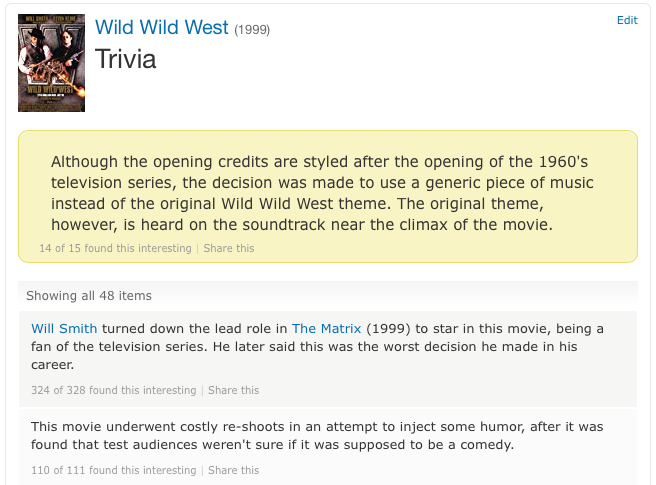
There's one other piece of music from a 1999 spy comedy that I'm adding to "AFOS Incognito," and this spy comedy isn't exactly as beloved as The Spy Who Shagged Me was back in 1999. It's from the second and final film in Warner Bros.' late '90s mission to ruin your favorite TV shows, Wild Wild West, the Will Smith/Kevin Kline blockbuster loosely based on the '60s spy show/proto-steampunk western of nearly the same name (the show was called The Wild Wild West, while the movie omitted "The" from the title).
Fortunately, the selected piece of music isn't the ubiquitous-on-the-1999-airwaves Will Smith/Dru Hill theme tune that was never worthy of sampling Stevie Wonder's "I Wish." It's the other memorable piece of music from Wild Wild West: the rousing main title theme by a legendary composer who wrote a million rousing themes for westerns, the late Magnificent Seven score composer Elmer Bernstein. That Bernstein main title theme is the only thing I like about Wild Wild West. IMDb is wrong: it's not "a generic piece of music." It's classic Bernstein western music, faithful in spirit to Richard Markowitz's equally rousing '60s Wild Wild Westtheme tune, which either the filmmakers couldn't get the full rights to or were too dunderheaded to use more often in the film because of their hubris and contempt for the source material (although I wouldn't consider The Wild Wild West a perfect show: it suffers from that old '60s and '70s spy show staple of stupidly putting white actors in yellowface or brownface). The theme is too good for such a hackily written steaming pile and such a chemistry-deficient buddy action flick.
Speaking of chemistry, this might have improved the movie: instead of casting Kline, whom Smith had no chemistry with, as Artemus Gordon, Alfonso Ribeiro, whom Smith had a shitload of chemistry with from 1990 to 1996, should have been cast as Artemus. And instead of the movie's lame depiction of Artemus as this never-convincing master of disguise Kline looked as embarrassed to be portraying as Kline's washed-up Soapdish actor character looked when he had to play Willy Loman in front of confused and senile dinner theater customers, I would have written Ribeiro's short and black Artemus as an excellent master of disguise who--because both the Wild Wild West TV show and movie never gave a shit about being authentic to the period--came up with the most effective and ludicrous-for-any-period prosthetic makeup technology for altering his looks, as well as his height, race or gender. Plus it would have been amusing to have a black guy walk around with the name Artemus.
Anyway, like Stevie Wonder, I wish that theme (BLAM!) was (BLAM!) written for a different score. There lies my problem with adding to AFOS rotation enjoyable score cues from movies that are so terrible. It's so difficult to erase those movies' wretchedness from your mind when you hear these score cues that are the only redeeming elements of those movies. So to enjoy the Bernstein score cue a little more, you just have to pretend it's not from Wild Wild West.
Man, why do post-Blazing Saddles, pre-Django Unchained westerns with black heroes have such a lousy track record? Why do sci-fi westerns that are neither the '60s Wild Wild West nor the cult favorite Brisco County Jr. have such a lousy track record? Smith and his Men in Black director Barry Sonnenfeld clearly wanted to turn Wild Wild West into a Blazing Saddles for the '90s and with splashier action sequences, except Blazing Saddles knew how to be funny.
Blazing Saddles also didn't need a $170 million budget to land its jokes. The Nostalgia Chick pointed out that Shane Black, the writer and director of one of my favorite movies, Kiss Kiss Bang Bang--a buddy comedy that, like Blazing Saddles, was able to dazzle despite a limited budget--was attached to an earlier attempt to make a Wild Wild West movie. It's one of the most interesting parts of the Nostalgia Chick's 17-minute discussion of the many things that went wrong with Sonnenfeld's Razzie sensation, including Smith rejecting the role of Neo in The Matrix and choosing to play such an unlikable and overly cocky spy.
See? This is why Ribeiro would have been a great big-screen partner for Smith: unlike Kline's snooty and stiff Artemus, the equally snooty but more underdog-ish Ribeiro--due to his chemistry with Smith--would have been able to make Smith's overly cocky Agent West more likable and relatable when they interacted with each other. It would have been like how halfway through its run, the small-town lawyer sitcom Ed gave Michael Ian Black's annoying and overly cocky Phil Stubbs character a new bowling alley boss he grew to despise, in the form of the more level-headed Eli Goggins, played by the always charismatic Daryl "Chill" Mitchell. As both Phil's foil and a character who, unlike Tom Cavanagh's rather timid Ed, had the guts to challenge Phil and bring him back down to Earth whenever Phil's antics grated on everyone's nerves, including the viewer's, Eli made Phil the myopic and self-absorbed schemer a much less annoying and one-note character for the rest of the show's run.
I also wish I were in the universe where Will and Carlton reunited on the big screen as West and Artemus. Yeah, maybe it would have been too much of a rehash of the Will/Carlton dynamic from The Fresh Prince of Bel-Air for some moviegoers, but Ribeiro would have given Smith something more interesting to play against than whatever hacky shit Kline was doing. However, a completely different universe where Black's Wild Wild West got made instead is an even more enticing alternate universe. Now that is a version of Wild Wild West that would be worthy of Bernstein's main title theme. How many screenwriters did Wild Wild West have? Black's screenwriting work all by himself is frequently superior to the combined results of the 20,000 screenwriters who tried to polish the turd called Wild Wild West.
Many things doomed The Fresh Prince of Hot-Air, from its constant reshoots to skinny-pantsed '60s Wild Wild West star Robert Conrad's dissatisfaction with the script when Sonnenfeld offered him a cameo and he refused. The original Jim West bad-mouthing a reboot of his show and not giving it his blessing is like if the original Spock, when he was alive, tweeted, "I hope this new Star Trek crashes and burns," or if Michael Keaton stepped out and said, "My son showed me that new Batman trailer. Why is Ben Affleck being such a saggy diaper that leaks?" That doesn't bode well for your reboot. But when your film's key art is basically inverted key art from the 1993 megaflop Super Mario Bros., your film's really doomed.
When the only person who benefited from some part of the film is producer Jon Peters--that giant mechanical spider the extremely weird Peters kept threatening to squeeze into aborted movie versions of '90s Superman comic book storylines and Sandman finally made it into one of his productions--that's how terrible the film is. You know Patton Oswalt's six-minute distillation of the wretchedness and bloatedness of Wild Wild West (while he was being interviewed by the comedy news site/stand-up comedy record label A Special Thing)? It's six times more entertaining than Wild Wild West itself.
I don't like looking back at the past. I'd rather think about the present and the future, which is why a recent subject in this blog's Throwback Thursday series, The World's End--a cautionary film about the dangers of nostalgia and remaining in the past--resonates so much with me. Edgar Wright's film agrees a lot with me about staying focused on the future and never looking back. If I look at the blog archive at the bottom of my blog and the last few posts I wrote are all about subjects that took place before the '00s, I get really worried. "Uh-oh, I better not spend too much time in the past. Stay in the now," I think to myself. That's why I did for a couple of years a weekly series of posts about new TV (but focused on animation). Newer TV is always more fascinating to me than older TV. I don't even like film or TV blogs where the authors write only about old films or old TV, a.k.a. what Arthur Chu would call the pre-Selfie, pre-Fresh Off the Boat world. It's like those authors are basically saying, "Film and TV were better when it was all white folks." Uh, no, it wasn't, Teabagger.
This year, UC Santa Cruz--the university whose alums include Maya Rudolph, Cary Fukunaga and more recently, DJ Dahi--is celebrating its 50th anniversary. As part of the festivities, UCSC's campus radio station is inviting all former DJs, from Bullseye host Jesse Thorn to a classmate who occasionally keeps in touch with me, Yukiya Jerry Waki, to return to the station later this month and reminisce about their time there. I hate reunions and prefer to avoid them like the plague. So on some mornings in the past few weeks, I'll wake up thinking to myself, "Nah, I'll skip this Santa Cruz one." But then on other mornings, I'll wake up thinking, "Okay, maybe I'll drop by, probably tell someone a wacky story about that terrible time I did my radio show immediately after a sweaty, all-white drum circle performed live at the studio--so the studio smelled like the inside of an outhouse at a summer music festival for the rest of that afternoon--and after only a couple of hours of reminiscing, I bounce, and then it's straight to grabbing both a burger at Jack's and the next bus back north."
I'll always be grateful for what the station taught me about radio, broadcasting, chart reporting, interacting with the labels and so on--it was where AFOS began, as a two-hour show where I got the chance to interview on the phone Mark Hamill, '60s Star Trek composer Gerald Fried and my personal favorite interviewee on the phone during those UCSC years, a now-retired TV critic named Joyce Millman--but my time at the station also consisted of a few things I'm not proud of or that were just plain stupid. A reunion will just make me relive those cringeworthy moments I'd rather not revisit.
What I said about Bad Boys as an "eye Teen Reviewer" for the San Jose Mercury News back in 1995 (April 14, a week after Bad Boys' April 7 opening, to be exact), word for word and with every single Merc style guide preference preserved, straight off a clipping I still have of my own article:
'Bad Boys' is fun — for a formula movie
EYE TEEN REVIEWER Jim Aquino
THE cop-buddy comedy "Bad Boys" (not to be confused with the 1983 Sean Penn prison pic of the same name) is the latest flashy action movie from the Simpson-Bruckheimer assembly line, which has churned out such blockbuster hits as "Beverly Hills Cop" and "Top Gun."
Directed by Michael Bay, the genius behind the popular, Clio-winning "Aaron Burr?" milk commercial, "Bad Boys" sticks to the tried-and-true formula that made Don Simpson and Jerry Bruckheimer big-name producers back in the '80s: gaudy visuals, extravagant action sequences, a big-time soundtrack and a script that's high on concept and low on subtlety.
After producing a low-profile film such as the dark, dialogue-driven comedy "The Ref," it appears that Simpson and Bruckheimer want to go back to making big, dumb movies again. "The Ref" worked because it fit star Denis Leary's edgy, verbose persona, and never tried to soften Leary's cynical humor. "Bad Boys" could have been as satisfying as "The Ref," if its script were as clever overall as the snappy, entertaining interplay between its two leads, sitcom stars Martin Lawrence and Will Smith.
Lawrence and Smith, playing mismatched Miami police detectives Marcus Burnett and Mike Lowery, rise above the formulaic cops-vs.-heroin thieves plot to deliver top-notch performances. "Bad Boys" runs too long at more than two hours, but it remains watchable because of these charismatic, energetic stars and their fast, funny and often improvised delivery.
"Bad Boys," originally written for Dana Carvey and Jon Lovitz, is strong on visuals, thanks to first-time director Bay, who must have watched a lot of Tony Scott movies. The Miami setting is wonderful to look at, and the set pieces are well-staged.
But "Bad Boys" suffers from uninteresting bad guys and a story line that offers few surprises, aside from the amusing subplot in which neurotic family man Burnett and smooth ladies' man Lowery switch identities. Tea Leoni, who was so memorable as the sexy bohemian girlfriend on the short-lived sitcom "Flying Blind," plays a key witness.
"Bad Boys" isn't original or groundbreaking, but it's fun and entertaining, thanks to Lawrence and Smith.
What I think about Bad Boys in 2015, on the day before the date of the 20th anniversary of its release:
Of all the movie reviews I wrote for the Mercury News while in high school and then college, the mixed review of Bad Boys--at that point in his filmography, the Fresh Prince had just won over critics because of his big-screen debut in the film version of Six Degrees of Separation, but he hadn't made Independence Day yet--is one of the only two or three reviews where I still stand by every word. For instance, Michael Bay was at his best as a director of commercials like that classic "Got milk?" ad (although putting the words "Michael Bay" and "genius" in the same sentence back then makes me cringe); The Ref remains a terrific antidote to Yuletide mawkishness; and I still can't remember the name of Burnett and Lowery's boring nemesis. Like Dana Gould did when he couldn't remember the name of the villain Ben Gazzara played in Road House, I'm just going to call their boring nemesis Drago.
All the other reviews I wrote back then can go in the shredder. That was the biggest problem with being a film critic for print media. If some part of your opinion about a film would change (and my opinions sometimes do), you couldn't go back and change what you said in print like you can now easily do on a blog or in digital media.
Aside from a clunky and racist bit of attempted comedy where Shaun Toub--a.k.a. Dr. Yinsen from the first Iron Man flick--shows up as a stereotypical Middle Eastern convenience store clerk (an ominous sign of comedic things to come in Transformers: Revenge of the Fallen) who racially profiles Lawrence and Smith because of the visible guns in their holsters, Bad Boys remains one of Michael Bay's few tolerable movies. That's mainly due to the dialogue between Martin and Will ("Don't be alarmed, we're Negroes"), the most enduring part of the first Bad Boys, which cost only $17 million to make. I prefer smaller-scale Michael Bay over larger-scale, giant-robot-testicles-flashing Michael Bay, which is why I never bothered to watch 2003's much bigger-budgeted and longer-in-running-time Bad Boys II, even though Simon Pegg and Nick Frost were seen worshiping Bad Boys II in Hot Fuzz, an Edgar Wright film that trounces Bad Boys in all sorts of ways, simply because it's an Edgar Wright film (I hear 2013's Pain & Gain is supposed to be a return to Bay's smaller-budgeted roots, but I haven't seen that one yet either).
The Bad Boys original score by Mark Mancina still holds up too and hasn't aged poorly at all. During "AFOS Prime" and "Beat Box" on AFOS, you can hear a previously unreleased version of the film's dancehall-influenced main title theme, Mancina's "Prologue - The Car Jacking," taken from La-La Land Records' out-of-print Bad Boys score album and featured below. (The Bad Boys song album's not too shabby either. I remember practicing to get my driver's license to the sounds of Diana King's dancehall-style "Shy Guy.")
If you still find Bad Boys--or Drago--to be too generic for your tastes, perhaps reading Shield creator Shawn Ryan's mostly sardonic live-tweets of Bay's Bad Boys DVD commentary while he watched Bad Boys for the first time ever in 2012 will make the film go down easier. "Michael goes silent on commentary for a few minutes," tweeted Ryan, who actually likes the movie, during a lull in Bay's pontifi-bating. "Perhaps he took a break to write nasty email to Megan Fox."