The AFOS blog's year-long Throwback Thursday series concludes its run on December 10. Today's edition of TBT is a repost of a TBT piece from April 9. It's perfect for the day before the day when consumerism whips its dick out and unloads on every single crazed shopper's face.
Cell phones have ruined movies forever. They've made it more difficult for screenwriters to come up with suspenseful situations. You couldn't write either Rear Window or North by Northwest today because every moment of suspense would become impossible for the nitpickers in the audience to take seriously due to "Hmm, you know he or she could use his or her smartphone to save his or her own ass in this situation." The constant advances in cell phone technology have even affected movies that have aged pretty well--when they don't involve phone scenes, that is. The appearance of any kind of phone in a largely timeless movie that's not a present-day cell phone immediately makes that otherwise timeless movie dated.
Thanks to the cutting-edge work of cinematographer Jeff Cronenweth and director David Fincher, whose visuals have always been cutting-edge and distinctive (whether in Fincher-directed music videos like Aerosmith's "Janie's Got a Gun" video or more recent Fincher films like the Cronenweth-lensed Gone Girl), the 1999 anti-consumerism cult favorite Fight Club looks like it could have been filmed yesterday, and it stands the test of time--for several minutes. But then Edward Norton is seen standing in a pay phone booth to dial up his new soap salesman friend Tyler Durden (Brad Pitt), and Fight Club instantly becomes dated.
I had not watched Fight Club in 16 years, before rewatching it as prep for today's edition of Throwback Thursday. In addition to containing the only film score by the Dust Brothers of Paul's Boutique fame (who really ought to compose more scores, due to their outstanding work on the 1999 film, which can be heard during either "AFOS Prime" or the first 33 seconds of the trailer below), Fight Club remains my favorite Fincher film. It's still my favorite even when the appearance of a pay phone wrecks the timelessness and anonymity both Fincher and the various adapters of Chuck Palahniuk's thought-to-have-been-unfilmable 1996 novel of the same name, including credited screenwriter Jim Uhls and uncredited Andrew Kevin Walker from Seven, tried to aim for in their portrayal of modern-day malaise (the city Fight Club takes place in is unspecified, despite the frequent use of L.A. locations, as is the name of Norton's narrator character, although the shooting script referred to him as Jack--we'll call him Jack from this point on).
Much of the appeal of Fight Club stems from the fact that we've all experienced Jack's feelings of malaise (he's nameless for a reason: so that male audience members can name the narrator after themselves). Okay, so you may not be a privileged white male yuppie like Jack, but you can definitely relate to his dissatisfaction with his job as an auto recall specialist and the feeling of emptiness that triggers his insomnia and has him doing anything to feel alive, whether it's going through an IKEA shopping phase, faking diseases and crashing support group meetings with his frenemy Marla Singer (Helena Bonham Carter) or forming with Tyler an underground fight club to blow off steam, for men only (no Marlas allowed).
A good example of the film's ability to connect with viewers long after it tanked at the box office (Palahniuk's material isn't unfilmable--it's unmarketable, as 20th Century Fox realized while inanely trying to sell Fight Club as a TBS Movie for Guys Who Like Movies back in 1999) was when former RogerEbert.com editor Jim Emerson interestingly called Fight Club one of the most accurate depictions of clinical depression ever made and praised how it captures the way that depression is all-consuming. "It helped shake me out of the grips of a depression that was sucking me down at the time," wrote Emerson.
I don't care for Madonna and her cultural-appropriating ass, but I've always liked the music of William Orbit. The Drake-scaring pop star's hit single from the summer of 1999, "Beautiful Stranger," a '60s-pop-flavored tune she recorded for Austin Powers: The Spy Who Shagged Me, is my favorite pop song Orbit has produced because it's Orbit at his most playful-sounding, from the Ron Burgundy flute funk to the harpsichord riffs (the harpsichord is also integral to why my favorite Michael Jackson tune is "I Wanna Be Where You Are"). "Beautiful Stranger" is featured in The Spy Who Shagged Me for like only 30 seconds, during a non-comedic scene where the titular '60s spy mourns the loss of his mojo. Because of "Beautiful Stranger," I would have been interested in what Madonna and Orbit would have recorded together for Guy Ritchie's upcoming remake of The Man from U.N.C.L.E., had Ritchie and Madonna never split.
"Beautiful Stranger" is pitch-perfect for the breezy, psychedelic, Laugh-In-esque and Derek Flint-inspired Austin Powers franchise, whereas Madonna's other original spy movie theme, the Mirwais-produced electroclash tune "Die Another Day," doesn't quite work for 007 (it would have worked for some other spy franchise: maybe Totally Spies?). The Die Another Day theme makes you wonder if Madonna or Mirwais ever even watched an actual 007 movie beforehand, even though she claimed that the Die Another Day screenplay influenced the lyrics she wrote (the orchestral string riffs during "Die Another Day" came not from Die Another Day score composer David Arnold but from Madonna's "Don't Tell Me" collaborator, the late New Jack City score composer Michel Colombier, and I would have enjoyed Colombier's string riffs a little more if they had at least some ounce of thematic connection to anything Arnold wrote for his score).
I fell in love with "Beautiful Stranger" again a few weeks ago while overhearing it being played on some store PA during a round of book-shopping or grocery-shopping (I can't remember which kind of shopping it was). So that's why I'm adding "Beautiful Stranger" to the playlist for the espionage genre music block "AFOS Incognito," where it can be enjoyed without having to be subjected to any visuals directed by Brett Ratner, Mondays through Thursdays at midnight Pacific on AFOS.
There's one other piece of music from a 1999 spy comedy that I'm adding to "AFOS Incognito," and this spy comedy isn't exactly as beloved as The Spy Who Shagged Me was back in 1999. It's from the second and final film in Warner Bros.' late '90s mission to ruin your favorite TV shows, Wild Wild West, the Will Smith/Kevin Kline blockbuster loosely based on the '60s spy show/proto-steampunk western of nearly the same name (the show was called The Wild Wild West, while the movie omitted "The" from the title).
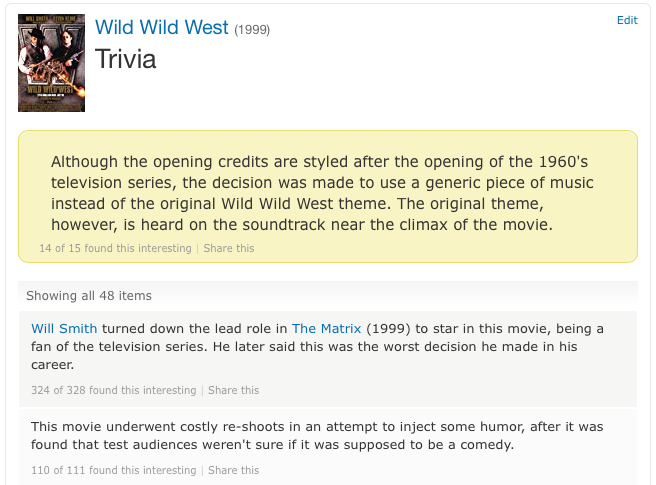
Fortunately, the selected piece of music isn't the ubiquitous-on-the-1999-airwaves Will Smith/Dru Hill theme tune that was never worthy of sampling Stevie Wonder's "I Wish." It's the other memorable piece of music from Wild Wild West: the rousing main title theme by a legendary composer who wrote a million rousing themes for westerns, the late Magnificent Seven score composer Elmer Bernstein. That Bernstein main title theme is the only thing I like about Wild Wild West. IMDb is wrong: it's not "a generic piece of music." It's classic Bernstein western music, faithful in spirit to Richard Markowitz's equally rousing '60s Wild Wild Westtheme tune, which either the filmmakers couldn't get the full rights to or were too dunderheaded to use more often in the film because of their hubris and contempt for the source material (although I wouldn't consider The Wild Wild West a perfect show: it suffers from that old '60s and '70s spy show staple of stupidly putting white actors in yellowface or brownface). The theme is too good for such a hackily written steaming pile and such a chemistry-deficient buddy action flick.
Speaking of chemistry, this might have improved the movie: instead of casting Kline, whom Smith had no chemistry with, as Artemus Gordon, Alfonso Ribeiro, whom Smith had a shitload of chemistry with from 1990 to 1996, should have been cast as Artemus. And instead of the movie's lame depiction of Artemus as this never-convincing master of disguise Kline looked as embarrassed to be portraying as Kline's washed-up Soapdish actor character looked when he had to play Willy Loman in front of confused and senile dinner theater customers, I would have written Ribeiro's short and black Artemus as an excellent master of disguise who--because both the Wild Wild West TV show and movie never gave a shit about being authentic to the period--came up with the most effective and ludicrous-for-any-period prosthetic makeup technology for altering his looks, as well as his height, race or gender. Plus it would have been amusing to have a black guy walk around with the name Artemus.
Anyway, like Stevie Wonder, I wish that theme (BLAM!) was (BLAM!) written for a different score. There lies my problem with adding to AFOS rotation enjoyable score cues from movies that are so terrible. It's so difficult to erase those movies' wretchedness from your mind when you hear these score cues that are the only redeeming elements of those movies. So to enjoy the Bernstein score cue a little more, you just have to pretend it's not from Wild Wild West.
Man, why do post-Blazing Saddles, pre-Django Unchained westerns with black heroes have such a lousy track record? Why do sci-fi westerns that are neither the '60s Wild Wild West nor the cult favorite Brisco County Jr. have such a lousy track record? Smith and his Men in Black director Barry Sonnenfeld clearly wanted to turn Wild Wild West into a Blazing Saddles for the '90s and with splashier action sequences, except Blazing Saddles knew how to be funny.
Blazing Saddles also didn't need a $170 million budget to land its jokes. The Nostalgia Chick pointed out that Shane Black, the writer and director of one of my favorite movies, Kiss Kiss Bang Bang--a buddy comedy that, like Blazing Saddles, was able to dazzle despite a limited budget--was attached to an earlier attempt to make a Wild Wild West movie. It's one of the most interesting parts of the Nostalgia Chick's 17-minute discussion of the many things that went wrong with Sonnenfeld's Razzie sensation, including Smith rejecting the role of Neo in The Matrix and choosing to play such an unlikable and overly cocky spy.
See? This is why Ribeiro would have been a great big-screen partner for Smith: unlike Kline's snooty and stiff Artemus, the equally snooty but more underdog-ish Ribeiro--due to his chemistry with Smith--would have been able to make Smith's overly cocky Agent West more likable and relatable when they interacted with each other. It would have been like how halfway through its run, the small-town lawyer sitcom Ed gave Michael Ian Black's annoying and overly cocky Phil Stubbs character a new bowling alley boss he grew to despise, in the form of the more level-headed Eli Goggins, played by the always charismatic Daryl "Chill" Mitchell. As both Phil's foil and a character who, unlike Tom Cavanagh's rather timid Ed, had the guts to challenge Phil and bring him back down to Earth whenever Phil's antics grated on everyone's nerves, including the viewer's, Eli made Phil the myopic and self-absorbed schemer a much less annoying and one-note character for the rest of the show's run.
I also wish I were in the universe where Will and Carlton reunited on the big screen as West and Artemus. Yeah, maybe it would have been too much of a rehash of the Will/Carlton dynamic from The Fresh Prince of Bel-Air for some moviegoers, but Ribeiro would have given Smith something more interesting to play against than whatever hacky shit Kline was doing. However, a completely different universe where Black's Wild Wild West got made instead is an even more enticing alternate universe. Now that is a version of Wild Wild West that would be worthy of Bernstein's main title theme. How many screenwriters did Wild Wild West have? Black's screenwriting work all by himself is frequently superior to the combined results of the 20,000 screenwriters who tried to polish the turd called Wild Wild West.
Many things doomed The Fresh Prince of Hot-Air, from its constant reshoots to skinny-pantsed '60s Wild Wild West star Robert Conrad's dissatisfaction with the script when Sonnenfeld offered him a cameo and he refused. The original Jim West bad-mouthing a reboot of his show and not giving it his blessing is like if the original Spock, when he was alive, tweeted, "I hope this new Star Trek crashes and burns," or if Michael Keaton stepped out and said, "My son showed me that new Batman trailer. Why is Ben Affleck being such a saggy diaper that leaks?" That doesn't bode well for your reboot. But when your film's key art is basically inverted key art from the 1993 megaflop Super Mario Bros., your film's really doomed.
When the only person who benefited from some part of the film is producer Jon Peters--that giant mechanical spider the extremely weird Peters kept threatening to squeeze into aborted movie versions of '90s Superman comic book storylines and Sandman finally made it into one of his productions--that's how terrible the film is. You know Patton Oswalt's six-minute distillation of the wretchedness and bloatedness of Wild Wild West (while he was being interviewed by the comedy news site/stand-up comedy record label A Special Thing)? It's six times more entertaining than Wild Wild West itself.
Every Throwback Thursday, I randomly pull out from my desk cabinet--with my eyes closed--a movie ticket I saved. Then I discuss the movie on the ticket and maybe a little bit of its score, which might be now streaming on AFOS.
Cell phones have ruined movies forever. They've made it more difficult for screenwriters to come up with suspenseful situations. You couldn't write either Rear Window or North by Northwest today because every moment of suspense would become impossible for the nitpickers in the audience to take seriously due to "Hmm, you know he or she could use his or her smartphone to save his or her own ass in this situation." The constant advances in cell phone technology have even affected movies that have aged pretty well--when they don't involve phone scenes, that is. The appearance of any kind of phone in a largely timeless movie that's not a present-day cell phone immediately makes that otherwise timeless movie dated.
Thanks to the cutting-edge work of cinematographer Jeff Cronenweth and director David Fincher, whose visuals have always been cutting-edge and distinctive (whether in Fincher-directed music videos like Aerosmith's "Janie's Got a Gun" video or more recent Fincher films like the Cronenweth-lensed Gone Girl), the 1999 anti-consumerism cult favorite Fight Club looks like it could have been filmed yesterday, and it stands the test of time--for several minutes. But then Edward Norton is seen standing in a pay phone booth to dial up his new soap salesman friend Tyler Durden (Brad Pitt), and Fight Club instantly becomes dated.
I had not watched Fight Club in 16 years, before rewatching it as prep for today's edition of Throwback Thursday. In addition to containing the only film score by the Dust Brothers of Paul's Boutique fame (who really ought to compose more scores, due to their outstanding work on the 1999 film, which can be heard during either "AFOS Prime" or the first 33 seconds of the trailer below), Fight Club remains my favorite Fincher film. It's still my favorite even when the appearance of a pay phone wrecks the timelessness and anonymity both Fincher and the various adapters of Chuck Palahniuk's thought-to-have-been-unfilmable 1996 novel of the same name, including credited screenwriter Jim Uhls and uncredited Andrew Kevin Walker from Seven, tried to aim for in their portrayal of modern-day malaise (the city Fight Club takes place in is unspecified, despite the frequent use of L.A. locations, as is the name of Norton's narrator character, although the shooting script referred to him as Jack--we'll call him Jack from this point on).
Much of the appeal of Fight Club stems from the fact that we've all experienced Jack's feelings of malaise (he's nameless for a reason: so that male audience members can name the narrator after themselves). Okay, so you may not be a privileged white male yuppie like Jack, but you can definitely relate to his dissatisfaction with his job as an auto recall specialist and the feeling of emptiness that triggers his insomnia and has him doing anything to feel alive, whether it's going through an IKEA shopping phase, faking diseases and crashing support group meetings with his frenemy Marla Singer (Helena Bonham Carter) or forming with Tyler an underground fight club to blow off steam, for men only (no Marlas allowed).
A good example of the film's ability to connect with viewers long after it tanked at the box office (Palahniuk's material isn't unfilmable--it's unmarketable, as 20th Century Fox realized while inanely trying to sell Fight Club as a TBS Movie for Guys Who Like Movies back in 1999) was when former RogerEbert.com editor Jim Emerson interestingly called Fight Club one of the most accurate depictions of clinical depression ever made and praised how it captures the way that depression is all-consuming. "It helped shake me out of the grips of a depression that was sucking me down at the time," wrote Emerson.
I don't like looking back at the past. I'd rather think about the present and the future, which is why a recent subject in this blog's Throwback Thursday series, The World's End--a cautionary film about the dangers of nostalgia and remaining in the past--resonates so much with me. Edgar Wright's film agrees a lot with me about staying focused on the future and never looking back. If I look at the blog archive at the bottom of my blog and the last few posts I wrote are all about subjects that took place before the '00s, I get really worried. "Uh-oh, I better not spend too much time in the past. Stay in the now," I think to myself. That's why I did for a couple of years a weekly series of posts about new TV (but focused on animation). Newer TV is always more fascinating to me than older TV. I don't even like film or TV blogs where the authors write only about old films or old TV, a.k.a. what Arthur Chu would call the pre-Selfie, pre-Fresh Off the Boat world. It's like those authors are basically saying, "Film and TV were better when it was all white folks." Uh, no, it wasn't, Teabagger.
This year, UC Santa Cruz--the university whose alums include Maya Rudolph, Cary Fukunaga and more recently, DJ Dahi--is celebrating its 50th anniversary. As part of the festivities, UCSC's campus radio station is inviting all former DJs, from Bullseye host Jesse Thorn to a classmate who occasionally keeps in touch with me, Yukiya Jerry Waki, to return to the station later this month and reminisce about their time there. I hate reunions and prefer to avoid them like the plague. So on some mornings in the past few weeks, I'll wake up thinking to myself, "Nah, I'll skip this Santa Cruz one." But then on other mornings, I'll wake up thinking, "Okay, maybe I'll drop by, probably tell someone a wacky story about that terrible time I did my radio show immediately after a sweaty, all-white drum circle performed live at the studio--so the studio smelled like the inside of an outhouse at a summer music festival for the rest of that afternoon--and after only a couple of hours of reminiscing, I bounce, and then it's straight to grabbing both a burger at Jack's and the next bus back north."
I'll always be grateful for what the station taught me about radio, broadcasting, chart reporting, interacting with the labels and so on--it was where AFOS began, as a two-hour show where I got the chance to interview on the phone Mark Hamill, '60s Star Trek composer Gerald Fried and my personal favorite interviewee on the phone during those UCSC years, a now-retired TV critic named Joyce Millman--but my time at the station also consisted of a few things I'm not proud of or that were just plain stupid. A reunion will just make me relive those cringeworthy moments I'd rather not revisit.
"[Alexander] Payne and [writing partner Jim] Taylor manage to fully develop their characters without sacrificing the cynicism and venom of their satire," I wrote back when Payne's 1999 cult classic Election was first released (Wayback Machine, I'm not going to like it, but take my ass back to an age of ugly HTML design!). Payne recalls battling with MTV Films to keep some of Rolfe Kent's original score from being ousted from Election, as part of a fascinating HuffPo oral history about the making of the Matthew Broderick/Reese Witherspoon political satire, still one of my favorite movies from the legendary movie year of 1999.
"I wanted some degree of Morricone in that score, and indeed we used some actual Morricone. Tracy's mental scream is stolen from a spaghetti Western. Even Quentin Tarantino told me later, 'Oh, I always wanted to use actual spaghetti-Western music.' You hear stolen spaghetti-Western music earlier than you do in any Tarantino film. I got there first. But it was a bit of a difficult situation with the record company that gave us a bunch of the rock songs that are in the film. Between MTV and the record label, they wanted a lot more. I remember the fight I had to go through to have the opening credits have score, not a rock song. It was de rigueur for movies to have some kind of rock song in the opening credits and end credits. I had to tell them I'm making a motion picture, not a jukebox."
Over at The Dissolve, David Ehrlich deftly examines the growing wave of indie musicians bringing their talents to film scoring, and how it's resulted in either remarkable, experimental-sounding work (Daniel Hart's Ain't Them Bodies Saints score and Mica Levi's truly alien-sounding Under the Skin score) or unhappy work experiences like the Oblivion score, a collabo between Tron: Uprising composer Joseph Trapanese and a reportedly dissatisfied Anthony Gonzalez of M83. But I don't think the Oblivion score sounds as terrible as Ehrlich makes it out to be. Selections from the Oblivion score can be heard on "AFOS Prime" and "Hall H" on AFOS.
"Movies are challenging musicians to rethink how they write their music, and musicians are challenging movies to rethink how they use it. Now that projectors in most theaters hum with a quiet digital buzz rather than the stampeding clatter of celluloid, it sounds as if scores have finally begun to embrace a new purpose."
Another smartly written piece of film writing praises recent cutting-edge score music, but this time, the article emanates from an unlikely source: the sexy sex advice site Nerve.com. Matt Patches explains at length why composer Andrew Hewitt's score for The Double, actor Richard Ayoade's latest directorial effort, excels at taking risks musically. Then Patches briefly points out why a similarly risky approach that Hans Zimmer and "the Magnificent Six" (a collective that included Pharrell Williams and Johnny Marr) brought to the Amazing Spider-Man 2 score doesn't succeed as effectively as Hewitt's effort does.
The risky element of the ASM2 score I'm referring to isn't the Kendrick Lamar guest verse at the start of "It's On Again," the sequel's Zimmer/Pharrell/Alicia Keys end title theme, a Kendrick guest feature I like, of course, because I'm a Kendrick fan. I'm referring to the love-it-or-hate-it, kind of dumb-sounding Electro chanting ("He lied to me/He shot at me"). But Patches gives the Magnificent Six some credit for trying something different.
"Zimmer's attempts to enliven the background with vocalization ultimately fails. Movies need more of failures like that. Spastic horror movies with hyper-editing and lighting of every color prove audiences can stomach directors maximizing each element of filmmaking. So why not music? The 21st century deserves cinematic tunes worth obsessing over (and if they're turned into disco tracks, so be it)."
Ever wondered why at the end of Michael Mann's Thief, one-man killing machine James Caan mows down a bunch of mobsters to the tune of a ripoff of Pink Floyd's "Comfortably Numb"? Mann wanted to use "Comfortably Numb" but was unable to clear it, so he asked composer Craig Safan, who later became best known for writing the Last Starfighter score and all the incidental music on Cheers, to write and record a "Comfortably Numb" soundalike (it's called "Confrontation" on Tangerine Dream's Thief soundtrack album). The shootout music tidbit is one of 10 pieces of trivia about the making of the classic 1981 crime flick that Criterion Collection disc producer Curtis Tsui posted in a slideshow article to promote Criterion's recent Blu-ray release of Thief.
I hate slideshow articles, but I dig Thief so much that the slideshow format didn't bother me this time.
"As iconic as Tangerine Dream's electronic score has become, Mann himself still sometimes wonders whether it was the right choice for the film. He appreciates the abstraction of the music from a formal perspective, but his more intuitive inclination was toward the blues."
John Powell, who wrote perhaps his best score for How to Train Your Dragon (which can be heard on AFOS) and recently returned to DreamWorks Animation's popular franchise to score the upcoming How to Train Your Dragon 2, was the recent subject of a huge Variety profile. He recalled to the magazine why the score to John Woo's still-entertaining Face/Off, his first major credit, was both a good experience for him as a then-newcomer to Hollywood and one of his five favorite film music projects.
"The premiere was at the Mann Chinese; Hans (Zimmer) got me a limo. There was a big crowd, and as I got out of the limo, there was this sigh of disappointment when they realized that it wasn't John Travolta. I recommend this to all Hollywood composers. Within a small group of people, we may be well known, but it's not why people go to the movies."
"Blame Canada" may not be the best original song from the foul-mouthed 1999 hit South Park: Bigger, Longer & Uncut--that would be the fart-tastic "Uncle Fucka"--but Trey Parker and Marc Shaiman's Canuck-baiting march is the most prime-time TV-friendly, which must be why "Blame Canada" and none of the other Bigger, Longer & Uncut musical numbers landed a Best Original Song Oscar nomination in 2000. (Plus, it's got a hilarious closing verse.)
In the film, "Blame Canada" was sung by several different parental characters. Almost all of them were played by the South Park TV series' immensely talented voiceover artist Mary Kay Bergman, who unfortunately committed suicide a few months before the song was nominated. Despite containing far less profanity than the other Bigger, Longer & Uncut tunes, "Blame Canada" was still too controversial for the musical number portion of the 2000 Oscar telecast.
ABC censors were uncomfortable with the occasional cursing in "Blame Canada," as well as lyrics that referred to the Ku Klux Klan and "that bitch Anne Murray too." They wanted Parker and Shaiman to write a sanitized version of "Blame Canada" for prime-time. Parker and Shaiman refused to change a single word because it would have contradicted Bigger, Longer & Uncut's stance on censorship. However, they settled on having Robin Williams--who entered the stage with his mouth covered in duct tape--turn his face away from the camera and not utter the f-word at the point of the number when he was supposed to say it.
Last year, Parker and Matt Stone's The Book of Mormon hit Broadway with way more curse words than "Blame Canada," and barely anybody was offended. In fact, the same Mormons who might have been too afraid to see Bigger, Longer & Uncut at a multiplex in 1999 didn't care about The Book of Mormon's profane lyrics. They embraced Parker and Stone's surprisingly uplifting musical about their faith and helped make it a Broadway sensation. Times have changed, indeed.
Song: "Still" by Geto Boys Released: 1996 Why's it part of the "Rock Box" playlist?: It's the Office Space copier-bashing scene music.
Whenever I get frustrated with a misbehaving copier, I wonder if there's a baseball bat lying around nearby, and I start to mutter, "Back up in yo' ass with the resurrection..."
Song: "Where Is My Mind?" by Pixies Released: 1988 Why's it part of the "Rock Box" playlist?: It turns up at the end of Fight Club, while the nameless Edward Norton character and his girlfriend Marla (Helena Bonham Carter) watch the results of the Norton character's plan to free everyone from the stranglehold of credit card companies by obliterating all the companies' office buildings. "The ending of the film provided a bit of a prelude to the global financial crisis that the world is currently embroiled in," says a Popdose blogger about Fight Club's final scene.
A year before Fight Club's 1999 release, the frequently covered Pixies tune made its first soundtrack appearance in the Adrien Grenier/Clark Gregg coming-of-age flick The Adventures of Sebastian Cole, which is about the strained relationship between a misfit teen and his cross-dressing stepdad and is worth checking out if you ever wanted to know what Agent Coulson from the Iron Man movies and the upcoming screen version of Thor looks like in a lady's wig, a dress and heels.
Inspired by the odd behavior of the little fish that followed around Pixies frontman Black Francis while he went scuba diving in the Caribbean ("Animals were hiding behind the rock/Except for little fish"), the tune has turned into a go-to song for conveying inner turmoil or insanity. "Where Is My Mind?" has also been used in Veronica Mars' "Driver Ed" episode, Criminal Minds, The 4400, HBO's stylish and well-produced promos for its broadcast premiere of The Dark Knight, It's Kind of a Funny Story (which features a piano-only instrumental version by French pianist Maxence Cyrin instead of the original Pixies version) and the full-frontal flasher chase scene in Observe and Report (where the flabby flasher's dick flaps back and forth in vomit-inducing, psyche-scarring slow-motion to the tune of a faithful cover version by City Wolf).
But the most effective use of "Where Is My Mind?" remains the conclusion of Fight Club. The oddly uplifting track will forever be identified with the uplifting sight of every credit card company being blown to smithereens.
The last time I saw The Limey was on an Artisan Entertainment screener tape during its art-house run 10 years ago. Steven Soderbergh's superb follow-up to the beloved Out of Sight was one of many highlights of a great and still-unsurpassed movie year (1999), and after stumbling into the film on IFC the other night and stopping whatever I was writing on my computer to watch it for the second time, it still is a highlight of '99.
I noticed a few things in this second viewing. The hot gangster's moll (played by a pre-daytime TV Amelia Heinle) spends a lot of time getting wet during the movie; Lesley Ann Warren is one of the finest-looking untouched-by-plastic-surgery sixtysomething actresses; Bill Duke must have been hired to play the marshals' disabled boss in the Out of Sight spinoffKaren Sisco based on his now-classic reaction to Terence Stamp's long speech from his DEA office desk ("There's one thing I don't understand. The thing I don't understand is every motherfuckin' word you're saying."); and some of the themes in Cliff Martinez's eerie score appear to have been an homage to equally eerie scores from late '60s/early '70s thrillers like Klute and Point Blank (which The Limey is often compared to, and Soderbergh is such a fan of the John Boorman classic that he recorded a commentrak for it).
I've read about the Limey DVD's infamous Soderbergh/Lem Dobbs commentrak--in which Dobbs argued with Soderbergh about the changes the director made to his script--but never listened to it. Now I'm itching to hear the commentrak.
My year-long postings of past or long-buried writing continue with a piece I wrote about The Limey at the time of its release.
The Limey
Artisan
Starring Terence Stamp, Peter Fonda, Lesley Ann Warren, Luis Guzman, Barry Newman, Joe Dallesandro, Nicky Katt, Amelia Heinle
Music by Cliff Martinez
Photographed by Ed Lachman
Written by Lem Dobbs
Directed by Steven Soderbergh
If Sarah Flack never gets an Oscar nomination for her ingenious editing of Steven Soderbergh's witty, melancholy revenge thriller/character study The Limey, then the members of the Academy ought to be taken out. The story of a British ex-con named Wilson (Terence Stamp) who tries to reconnect with his murdered daughter while searching the streets of L.A. for her killer, The Limey is told in a jigsaw-puzzle narrative style that shuffles past and present events. For instance, whenever Wilson discovers an important clue about his daughter's whereabouts before she was killed, the film cuts to a shot of a pensive, brooding Wilson, alone in a motel room or on an airplane. Are we watching him before he embarks on his journey through L.A. or are we seeing him on his way home to England, reflecting on his trip?
The nonlinear technique will befuddle some viewers, especially those expecting to see a "TBS Movie for Guys Who Like Movies." But it's a crucial--and inspired--device because it underscores how time makes very little sense to Stamp's title character, who, when the film opens, has just been released from a nine-year prison sentence that has messed with his concept of time, like it would do to any long-term inmate.
Wilson isn't the only character in The Limey who's disconnected from time. Terry Valentine (Peter Fonda) is a faded Hollywood record producer who never got over the end of the free-spirited '60s. This uneasy rider has gone to seed and turned to the drug trade to stay wealthy as he lures young starlets half his age with his hedonistic lifestyle and with stories about the '60s. One of these aspiring actresses is Wilson's daughter Jenny (Melissa George), who dated Valentine and lived with him before her death. Wilson's trail leads him to Valentine, but is Jenny's former lover really responsible for her tragic fate?
Stamp and Fonda are compelling as older, wearier versions of their '60s screen personas. Luis Guzman has an amusing and poignant supporting turn as a friend of Jenny's who assists Wilson on his manhunt, despite the language barrier between the two (the Angelenos' inability to understand Wilson's cockney slang is a running joke that fortunately isn't overused). Soderbergh calls The Limey "a very simple revenge film with a lot of '60s baggage." Although the plot may be a bit on the thin side, The Limey is anything but a simple revenge film. The characters are hardly the automatons of Charles Bronson shoot-'em-ups. Soderbergh and screenwriter Lem Dobbs refuse to paint them in simplistic strokes. The seedy Valentine, sort of an underworld Humbert Humbert with his taste for younger women, may be the villain here, but like Humbert, he's more pathetic than malicious; the film empathizes with his yearning for his younger, less desperate days. It's Valentine's associates, volatile, snarky hitman Stacy (Nicky Katt) and his older partner Uncle John (Joe Dallesandro), who are more greedy and evil than Fonda's character. As for Wilson, he's a man of contradictions. He has regrets about the life he led before prison (cleverly depicted in flashbacks composed of footage taken from Stamp's 1967 film Poor Cow, in which he also played a criminal named Wilson), most of all because it severed his relationship with his daughter. Yet he finds himself reverting back to the criminal life that drove her away in order to find her killer, which leads to another explanation for the jigsaw-puzzle storytelling: it suits the story of a man who's a puzzle, even to himself.
1. Stan Marsh, Kenny McCormick, Kyle Broflovski, Eric Cartman, Sharon Marsh and Sheila Broflovski, "Mountain Town," South Park: Bigger, Longer & Uncut, Atlantic
2. Michael Kamen, "The Eye of the Storm," The Iron Giant, Varèse Sarabande
3. David Newman, "Prologue: Galaxy Quest Clip," Galaxy Quest, Super Tracks Music Group
4. Randy Newman, "Zurg's Planet," Toy Story 2, Walt Disney
5. Rolfe Kent, "Election," Election, Sire
6. Canibus with Biz Markie, "Shove This Jay-Oh-Bee," Office Space, Interscope
7. The Dust Brothers, "Stealing Fat," Fight Club, Restless
8. Thomas Newman, "Still Dead," American Beauty: Original Motion Picture Score, DreamWorks
9. Lisa Gerrard & Pieter Bourke, "Liquid Moon," The Insider, Columbia/Sony Music Soundtrax
10. Angelo Badalamenti, "Country Waltz," The Straight Story, Windham Hill
11. Carter Burwell, "Subcon Chase," Being John Malkovich, Astralwerks
12. Bill Conti, "Glider Pt. 1," The Thomas Crown Affair: Music from the MGM Motion Picture, Ark21/Pangaea
13. Danny Elfman, "End Credits," Sleepy Hollow, Hollywood
14. Don Davis, "Main Title/Trinity Infinity" (from The Matrix), Varèse Sarabande: A 25th Anniversary Celebration, Varèse Sarabande
15. James Newton Howard, "Malcolm Is Dead," The Sixth Sense, Varèse Sarabande
16. The People of South Park, "Mountain Town (Reprise)," South Park: Bigger, Longer & Uncut, Atlantic
Because this is episode WEB99, the show will consist of selections from scores to the most noteworthy and inventive films of the year 1999, including Office Space, Election, Fight Club and a film I like a little less than the other three but Laurence Fishburne was such a badass in it: The Matrix. John Frizzell's score for Office Space was never released, so Office Space will be represented here by Canibus and Biz Markie's closing credits shout-out to Johnny Paycheck, "Shove This Jay-Oh-Bee."
"Spirit of '99" begins streaming tonight at midnight and repeats tomorrow and Thursday at 4am, 10am, 3pm, 7pm and 11pm, Wednesday at midnight, and Saturday and Sunday at 7am, 9am, 11am, 1pm, 3pm and 5pm.