Showing posts with label Robin Williams. Show all posts

Monday, August 29, 2016

AFOS Blog Rewind: Wolfpop has a pair of movie talk shows that are worth your time


The following is a repost of my November 20, 2014 discussion of Maltin on Movies and Denzel Washington Is the Greatest Actor of All Time Period.

Midroll Media's Wolfpop is a new sister network to the Earwolf podcast network, and its aim is to bring both plenty of production polish and big names (from the worlds of comedy, publishing and entertainment reporting) to a type of podcast format that's been around since podcasting's not-so-polished-sounding beginnings: pop culture talk. On November 4, Wolfpop--which is being curated by Paul Scheer, star of The League and co-host of his own movie talk podcast, Earwolf's How Did This Get Made?--launched 563,000 different pop culture podcasts. Even though I'm unemployed, I don't have time to listen to all 563,000 of them, but there are two Wolfpop shows that immediately caught my attention because of both the talent involved and the intriguing film-related subjects of their shows.

Maltin on Movies pairs up Leonard Maltin with comedian Baron Vaughn and gives the duo a different film-related topic to discuss each week (for example, episode 2 was about the unexpected rise of the McConaissance). Meanwhile, former Totally Biased host W. Kamau Bell and his fellow Totally Biased staff writer (and old Bay Area roommate) Kevin Avery make a case for why Denzel Washington is the illest on the succinctly titled Denzel Washington Is the Greatest Actor of All Time Period.


Vaughn, Bell and Avery are terrific choices for Wolfpop show hosts. Besides the conversational skills they've honed as hosts of previous podcasts (Vaughn hosted the All Things Comedy network's Deep Shit, while Bell did a podcast with Living Colour's Vernon Reid and had another movie talk podcast with Avery, Siskel & Negro, before they reteamed for the new Wolfpop show), it's also always wonderful to hear comedians of color hosting weekly podcasts. Sure, there's also Aisha Tyler (Girl on Guy), Margaret Cho (Monsters of Talk) and Kumail Nanjiani (The Indoor Kids, The X-Files Files), but, um, that's about it. The L.A. comedy podcast community is so lily-white it pours mayo into its tacos. It's so white it thinks Dilla was that lady who used to always tell jokes about her husband Fang on Carson. It's so white it has sex to Mumford & Sons. It's so white...

As an animation historian and an expert on older periods of film, Maltin is phenomenal. When I was a kid, I loved leafing through Of Mice and Magic, Maltin's thick tome about the history of American animation, so much that I would repeatedly renew it at the public library. But as a reviewer of live-action American films, the former Entertainment Tonight film critic isn't exactly one of my favorites. He gave only two (or two and a half) stars to Taxi Driver, The Long Goodbye, Kiss Kiss Bang Bang, Dead Men Don't Wear Plaid and Miller's Crossing, all movies I love. As long as Maltin doesn't talk about either Taxi Driver, The Long Goodbye, Kiss Kiss Bang Bang, Dead Men Don't Wear Plaid or Miller's Crossing on this new podcast, Maltin on Movies is worth a listen each week.

Thursday, November 12, 2015

Throwback Thursday Throwback: Short Term 12

Short Term 12 star Brie Larson was a frontrunner for Emilia Clarke's role of Sarah Connor in Terminator: Genisys. The way that movie spells 'genesis' is so fuckyng insypyd.

Today's edition of Throwback Thursday is a repost of a TBT piece from April 2, 2015.

There was only one word that kept surfacing in the mental notes I took in my head as I was watching Short Term 12 for the third time, in preparation for today's edition of Throwback Thursday, and that word was "economical." Asian American indie filmmaker Destin Cretton's second feature film, the story of a group foster home counselor (Brie Larson) and her determination to save her facility's newest resident (Justified's Kaitlyn Dever) from the same kind of child abuse she herself used to be subjected to, is a triumph of economical storytelling, a film that prefers to show rather than tell, while many other films with similar subject matter opt to smother the audience with dollops of on-the-nose exposition, speechifying and worst of all, mawkishness.

'SXSW has a lot of companies that specialize in pens, T-shirts and beer cozies.'--Hari Kondabolu
Destin Cretton (center), the Short Term 12 cast and the film's SXSW Grand Jury Award

Neither of those three things show up to ruin Short Term 12, which Cretton based on his own 2009 short film of the same name. The only major exposition the audience receives at the start of the film is the terse instructions Larson's character Grace gives to Nate (Rami Malek), the facility's newest staffer, about how to handle the at-risk kids they're assigned to look after ("Remember, you are not their parent, you are not their therapist; you are here to create a safe environment, and that's it"). None of the backstories of the film's four main characters--Grace, her good-humored co-worker and boyfriend Mason (John Gallagher Jr.), Dever's character Jayden and Marcus (Keith Stanfield), a resident with both musical and ichthyological aspirations who's turning 18, so his new age requires him to move out of the short-term home, but he's deeply troubled about having to leave--are unveiled in clumsily written infodumps or pointless flashbacks. They're unveiled gradually, piece by piece, and at believable moments. For example, when Marcus refuses to celebrate his 18th birthday with a party or cake and simply requests to have his head shaven, the film withholds for a while from the audience Marcus' reason for his request. When the film finally makes clear--after the haircut--why Marcus wanted it, it's an unexpected and quietly devastating moment.

Nobody in the film says "My dad's been hitting me" or "I was raised by the system" when they first appear on screen. It just wouldn't ring true. Grace, Jayden and Marcus are survivors of abuse who have difficulties with communication and trusting anyone, so Jayden and Marcus prefer to express the pain they're experiencing through the art they create. In Marcus' case, his art takes the form of a mesmerizing freestyle Cretton shot in one long uninterrupted take.

Marcus' freestyle scene is a good example of the effectiveness of Short Term 12's digital cinematography.

Short Term 12 was shot with Red cameras.

Winter's Bone was also shot with Red cameras.

I like any digital camera that's named after a Bruce Willis action flick.

The believable and stripped-down dialogue is a great example of the verisimilitude Cretton aimed for in Short Term 12 (Cretton himself once worked at a similar facility for at-risk youth, and his experience with social work is evident in moments like Grace's thorough inspection of the kids' rooms for drugs and the scene where Mason and Nate have to carefully restrain Jayden when she has a meltdown in her room). This is the kind of off-kilter film where a character like Mason introduces himself not in a monologue about how his foster family saved him from the streets--that monologue is saved for later, for the most fitting occasion--but in a monologue to Nate about a comedically disastrous workday: the day he shit his pants in front of a kid who tried to run away from both him and Short Term 12, to be exact. It's a brilliant way to establish Mason's compassion and doggedness--a doggedness that surfaces later when he has to deal with Grace's sudden reticence about both being pregnant with his child and accepting his marriage proposal--without lapsing into the standard bad-movie-writing method (ridiculed most memorably by Walk Hard: The Dewey Cox Story) of having Mason declare that "I'm compassionate and dogged."

Grace is equally compassionate and dogged in both her attempts to help the introverted Jayden, who's too scared to report her father's abuse, and her interactions with another similarly introverted charge of hers, Sammy (Alex Calloway), who frequently makes escape attempts that are foiled by Grace, Mason and another counselor, Jessica (a pre-Brooklyn Nine-Nine Stephanie Beatriz, who bizarrely looks and sounds 10 years younger than how she normally looks in her leathery, Emma Peel/Catwoman-esque cop outfits on Nine-Nine). But because Grace didn't grow up with the type of loving and nurturing parents Mason was lucky to have and she still bears emotional and self-inflicted scars from the years of physical and sexual abuse she suffered, social work is more of a challenge for her emotionally and mentally than it is for Mason. Margaret Cho recently said in an interview that the late Robin Williams, one of the kindest comedians she knew in the business, "knew how to give but he had a problem receiving." That perfectly describes Grace.

Kaitlyn Dever also played the kid Raylan has to rescue from Mags Bennett on Justified. I'm two seasons behind on Justified. I wonder if Jeremy Davies is still being outacted by his own hairdo on the show.

Jayden's ordeals outside the facility--combined with Grace's fear that the system will fail Jayden, as well as the distressing news that Grace's abusive father is about to be released from prison--reawaken inner demons Grace has fought so hard to suppress. They cause Grace to have doubts about her future with Mason and to shut her fiancé out of the pain she's experiencing and he so desperately wants to help her overcome. Much of the beauty of Larson's excellent performance as Grace is due to her ability to physically express Grace's private worries that she might someday pass on the cycle of abuse to her and Mason's child--without ever verbalizing those worries.

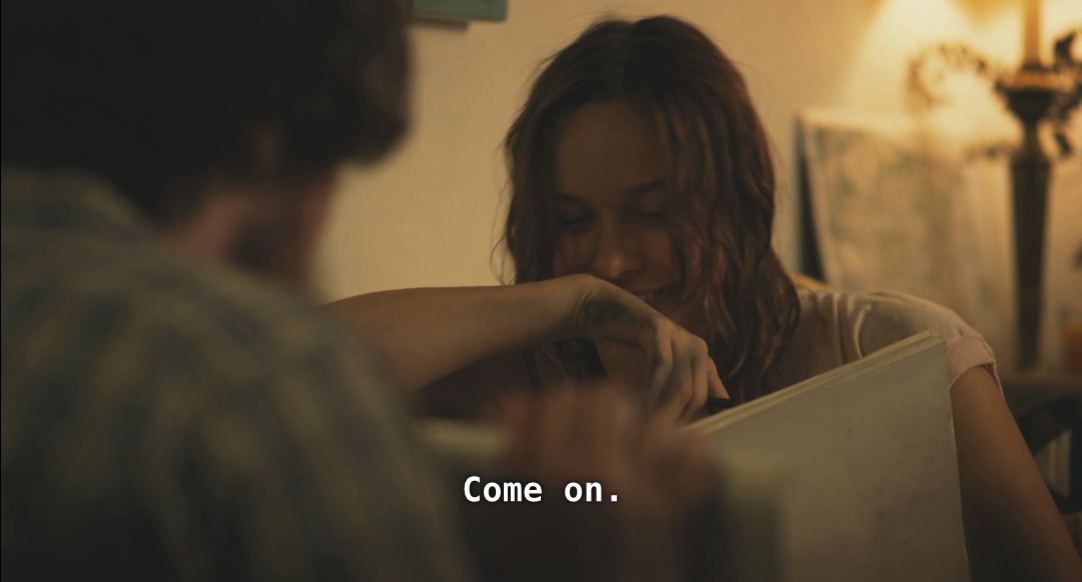
The film's implication that artistic expression has saved and will continue to save these troubled kids' lives--including Grace's--is never spelled out in dialogue either. It's nicely conveyed in only visual terms. Speaking of which, as someone who'd always get huge pencil stains on the sides of the hands while doodling or sketching with pencils, I love how Cretton and cinematographer Brett Pawlak let the audience see the pencil stains on the sides of Grace and Mason's hands while they're relaxing at home by sketching portraits of each other.

I know I've sworn off writing listicles because I now hate them so much, but up next is a list of people Mason's pencil sketch of Grace bears more of a resemblance to instead of closely resembling Brie Larson.

1. Demetri Martin

2. Neil Young

3. Joaquin Phoenix in Inherent Vice

Larson's performance is another one of those performances that make you say, "Why, Academy? Why the hell did you sleep on this performance?" The SXSW audience was far more attuned to Short Term 12's stripped-down wondrousness. They awarded Short Term 12 with Audience and Grand Jury prizes in 2013. This gritty but life-affirming film makes me eager to see what else Larson, Dever and Stanfield have up their sleeves acting-wise, as well as any of Cretton's future film work. It's hard to dislike any film where a character names his pet fish after a certain legendary Queensbridge rapper who happens to have a way with telling a story, just like Short Term 12 itself.

Spoiler alert: Nas suffers a terrible fate at the facility. In other words, Short Term 12 let Nas down.

None of Joel P West's minimalist score cues from Short Term 12--which, to borrow the words of animator Timothy Reckart regarding Ry Cooder's Paris, Texas score, don't dictate the emotions of the film and instead suggest the depth of those emotions--are currently in rotation on AFOS, but they ought to be.

Thursday, April 2, 2015

Throwback Thursday: Short Term 12

Short Term 12 star Brie Larson was a frontrunner for Emilia Clarke's role of Sarah Connor in Terminator: Genisys. The way that movie spells 'genesis' is so fuckyng insypyd.

Every Throwback Thursday, I randomly pull out from my desk cabinet--with my eyes closed--a movie ticket I saved. Then I discuss the movie on the ticket and maybe a little bit of its score, which might be now streaming on AFOS. This week, I drew the ticket that said "Thor." But I feel like I've said all I could say about the first Thor movie in my discussion of Thor: The Dark World a couple of weeks ago. Also, I'm tired of talking about superhero movies. So I'm ditching the movie I drew--it's my blog, I can do what I want--and focusing my attention this week on a smaller-scale movie about a completely different kind of hero. Even after its release two years ago, it still deserves as much attention as the kind a superhero movie always gets from the press before its release, and if you're not familiar with this little movie, familiarize yourself with it now on Netflix streaming.

There was only one word that kept surfacing in the mental notes I took in my head as I was watching Short Term 12 for the third time, in preparation for today's edition of Throwback Thursday, and that word was "economical." Asian American indie filmmaker Destin Cretton's second feature film, the story of a group foster home counselor (Brie Larson) and her determination to save her facility's newest resident (Justified's Kaitlyn Dever) from the same kind of child abuse she herself used to be subjected to, is a triumph of economical storytelling, a film that prefers to show rather than tell, while many other films with similar subject matter opt to smother the audience with dollops of on-the-nose exposition, speechifying and worst of all, mawkishness.

'SXSW has a lot of companies that specialize in pens, T-shirts and beer cozies.'--Hari Kondabolu
Destin Cretton (center), the Short Term 12 cast and the film's SXSW Grand Jury Award

Neither of those three things show up to ruin Short Term 12, which Cretton based on his own 2009 short film of the same name. The only major exposition the audience receives at the start of the film is the terse instructions Larson's character Grace gives to Nate (Rami Malek), the facility's newest staffer, about how to handle the at-risk kids they're assigned to look after ("Remember, you are not their parent, you are not their therapist; you are here to create a safe environment, and that's it"). None of the backstories of the film's four main characters--Grace, her good-humored co-worker and boyfriend Mason (John Gallagher Jr.), Dever's character Jayden and Marcus (Keith Stanfield), a resident with both musical and ichthyological aspirations who's turning 18, so his new age requires him to move out of the short-term home, but he's deeply troubled about having to leave--are unveiled in clumsily written infodumps or pointless flashbacks. They're unveiled gradually, piece by piece, and at believable moments. For example, when Marcus refuses to celebrate his 18th birthday with a party or cake and simply requests to have his head shaven, the film withholds for a while from the audience Marcus' reason for his request. When the film finally makes clear--after the haircut--why Marcus wanted it, it's an unexpected and quietly devastating moment.

Nobody in the film says "My dad's been hitting me" or "I was raised by the system" when they first appear on screen. It just wouldn't ring true. Grace, Jayden and Marcus are survivors of abuse who have difficulties with communication and trusting anyone, so Jayden and Marcus prefer to express the pain they're experiencing through the art they create. In Marcus' case, his art takes the form of a mesmerizing freestyle Cretton shot in one long uninterrupted take.

Marcus' freestyle scene is a good example of the effectiveness of Short Term 12's digital cinematography.

Short Term 12 was shot with Red cameras.

Winter's Bone was also shot with Red cameras.

I like any digital camera that's named after a Bruce Willis action flick.

The believable and stripped-down dialogue is a great example of the verisimilitude Cretton aimed for in Short Term 12 (Cretton himself once worked at a similar facility for at-risk youth, and his experience with social work is evident in moments like Grace's thorough inspection of the kids' rooms for drugs and the scene where Mason and Nate have to carefully restrain Jayden when she has a meltdown in her room). This is the kind of off-kilter film where a character like Mason introduces himself not in a monologue about how his foster family saved him from the streets--that monologue is saved for later, for the most fitting occasion--but in a monologue to Nate about a comedically disastrous workday: the day he shit his pants in front of a kid who tried to run away from both him and Short Term 12, to be exact. It's a brilliant way to establish Mason's compassion and doggedness--a doggedness that surfaces later when he has to deal with Grace's sudden reticence about both being pregnant with his child and accepting his marriage proposal--without lapsing into the standard bad-movie-writing method (ridiculed most memorably by Walk Hard: The Dewey Cox Story) of having Mason declare that "I'm compassionate and dogged."

Grace is equally compassionate and dogged in both her attempts to help the introverted Jayden, who's too scared to report her father's abuse, and her interactions with another similarly introverted charge of hers, Sammy (Alex Calloway), who frequently makes escape attempts that are foiled by Grace, Mason and another counselor, Jessica (a pre-Brooklyn Nine-Nine Stephanie Beatriz, who bizarrely looks and sounds 10 years younger than how she normally looks in her leathery, Emma Peel/Catwoman-esque cop outfits on Nine-Nine). But because Grace didn't grow up with the type of loving and nurturing parents Mason was lucky to have and she still bears emotional and self-inflicted scars from the years of physical and sexual abuse she suffered, social work is more of a challenge for her emotionally and mentally than it is for Mason. Margaret Cho recently said in an interview that the late Robin Williams, one of the kindest comedians she knew in the business, "knew how to give but he had a problem receiving." That perfectly describes Grace.

Kaitlyn Dever also played the kid Raylan has to rescue from Mags Bennett on Justified. I'm two seasons behind on Justified. I wonder if Jeremy Davies is still being outacted by his own hairdo on the show.

Jayden's ordeals outside the facility--combined with Grace's fear that the system will fail Jayden, as well as the distressing news that Grace's abusive father is about to be released from prison--reawaken inner demons Grace has fought so hard to suppress. They cause Grace to have doubts about her future with Mason and to shut her fiancé out of the pain she's experiencing and he so desperately wants to help her overcome. Much of the beauty of Larson's excellent performance as Grace is due to her ability to physically express Grace's private worries that she might someday pass on the cycle of abuse to her and Mason's child--without ever verbalizing those worries.

The film's implication that artistic expression has saved and will continue to save these troubled kids' lives--including Grace's--is never spelled out in dialogue either. It's nicely conveyed in only visual terms. Speaking of which, as someone who'd always get huge pencil stains on the sides of the hands while doodling or sketching with pencils, I love how Cretton and cinematographer Brett Pawlak let the audience see the pencil stains on the sides of Grace and Mason's hands while they're relaxing at home by sketching portraits of each other.

I know I've sworn off writing listicles because I now hate them so much, but up next is a list of people Mason's pencil sketch of Grace bears more of a resemblance to instead of closely resembling Brie Larson.

1. Demetri Martin

2. Neil Young

3. Joaquin Phoenix in Inherent Vice

Larson's performance is another one of those performances that make you say, "Why, Academy? Why the hell did you sleep on this performance?" The SXSW audience was far more attuned to Short Term 12's stripped-down wondrousness. They awarded Short Term 12 with Audience and Grand Jury prizes in 2013. This gritty but life-affirming film makes me eager to see what else Larson, Dever and Stanfield have up their sleeves acting-wise, as well as any of Cretton's future film work. It's hard to dislike any film where a character names his pet fish after a certain legendary Queensbridge rapper who happens to have a way with telling a story, just like Short Term 12 itself.

Spoiler alert: Nas suffers a terrible fate at the facility. In other words, Short Term 12 let Nas down.

None of Joel P West's minimalist score cues from Short Term 12--which, to borrow the words of animator Timothy Reckart regarding Ry Cooder's Paris, Texas score, don't dictate the emotions of the film and instead suggest the depth of those emotions--are currently in rotation on AFOS, but they ought to be.

Thursday, November 20, 2014

The Wolf of Pop Street: Paul Scheer's new pop culture-themed podcast network introduces a pair of movie talk shows that are worth your time

On Wolfpop's new show Movies on Maltin, movie characters get to pick apart the most baffling capsule reviews by Leonard Maltin.

Midroll Media's Wolfpop is a new sister network to the Earwolf podcast network, and its aim is to bring both plenty of production polish and big names (from the worlds of comedy, publishing and entertainment reporting) to a type of podcast format that's been around since podcasting's not-so-polished-sounding beginnings: pop culture talk. On November 4, Wolfpop--which is being curated by Paul Scheer, star of The League and co-host of his own movie talk podcast, Earwolf's How Did This Get Made?--launched 563,000 different pop culture podcasts. Even though I'm unemployed, I don't have time to listen to all 563,000 of them, but there are two Wolfpop shows that immediately caught my attention because of both the talent involved and the intriguing film-related subjects of their shows.

Maltin on Movies pairs up Leonard Maltin with comedian Baron Vaughn and gives the duo a different film-related topic to discuss each week (for example, episode 2 was about the unexpected rise of the McConaissance). Meanwhile, former Totally Biased host W. Kamau Bell and his fellow Totally Biased staff writer (and old Bay Area roommate) Kevin Avery make a case for why Denzel Washington is the illest on the succinctly titled Denzel Washington Is the Greatest Actor of All Time Period.

Adolph Caesar's ghost attempts to beat up Denzel for making him sit through Virtuosity.

Vaughn, Bell and Avery are terrific choices for Wolfpop show hosts. Besides the conversational skills they've honed as hosts of previous podcasts (Vaughn hosted the All Things Comedy network's Deep Shit, while Bell did a podcast with Living Colour's Vernon Reid and had another movie talk podcast with Avery, Siskel & Negro, before they reteamed for the new Wolfpop show), it's also always wonderful to hear comedians of color hosting weekly podcasts. Sure, there's also Aisha Tyler (Girl on Guy), Margaret Cho (Monsters of Talk) and Kumail Nanjiani (The Indoor Kids, The X-Files Files), but, um, that's about it. The L.A. comedy podcast community is so lily-white it pours mayo into its tacos. It's so white it thinks Dilla was that lady who used to always tell jokes about her husband Fang on Carson. It's so white it has sex to Mumford & Sons. It's so white...

As an animation historian and an expert on older periods of film, Maltin is phenomenal. When I was a kid, I loved leafing through Of Mice and Magic, Maltin's thick tome about the history of American animation, so much that I would repeatedly renew it at the public library. But as a reviewer of live-action American films, the former Entertainment Tonight film critic isn't exactly one of my favorites. He gave only two (or two and a half) stars to Taxi Driver, The Long Goodbye, Kiss Kiss Bang Bang, Dead Men Don't Wear Plaid and Miller's Crossing, all movies I love. As long as Maltin doesn't talk about either Taxi Driver, The Long Goodbye, Kiss Kiss Bang Bang, Dead Men Don't Wear Plaid or Miller's Crossing on this new podcast, Maltin on Movies is worth a listen each week.

Despite some of his tastes in live-action films, Maltin is--like he's always been during his appearances on other podcasts--likable and level-headed in many of the same ways that the late Roger Ebert was. He may not agree with you about an unconventional indie flick you might adore, but at least he's not going to be a dick about it. He's never going to say something racist about your Korean friend like Rex Reed would do, and he's never going to boo you off the stage like Armond White rudely does to actors and directors he incomprehensibly dislikes.

Now if only the monster from Bong Joon-ho's The Host would do this to Rex Reed.

Maltin's friendliness and approachability ("The friendliest film critic I know," says DVD Savant author Glenn Erickson) must have been why Joe Dante let bygones be bygones after he was disappointed with Maltin's negative review of his first Gremlins movie, and he got Maltin to appear during Gremlins 2: The New Batch in a cameo as himself--delivering that same negative review of Gremlins. It's also why the L.A. comedy community likes to hang out with Maltin. Sarah Silverman memorably got him to pretend to be her date in the audience during her parody of award show acceptance speeches on Comedy Central's Night of Too Many Stars autism telethon ("Richard Roeper cannot hold a candle to you as a film critic or as an oral lover"), and Doug Benson frequently has Maltin on as a guest on Doug Loves Movies, which uses the Leonard Maltin Movie Guide app on Benson's phone to run the show's Leonard Maltin Game.

But does that same congeniality make for lively and entertaining discussions about film like the frequently contentious pairing of Siskel and Ebert did? Not very often. So this is where Baron Vaughn--who's actually as knowledgeable about modern-day cinema as Maltin but isn't quite as familiar with older periods of film like him--comes in. Vaughn's light banter with Maltin and his ability to keep their conversations engaging are why he's an ideal partner for Maltin. They're not contentious like the Sneak Previews and At the Movies hosts used to be, but fortunately, Vaughn and Maltin's congruent opinions about the three films they select for discussion each week (the first film is one they highly recommend, the second film is one they agree is an artistic failure and the third is a lesser-known title that they both wish had received more shine) haven't resulted in boring talk.

For the first time in his long career as a reviewer (and host of various film talk shows where, unlike in podcasts, the conversations have to be much shorter and snappier and completely edited down), Maltin is as interesting a conversationalist as either Siskel or Ebert, thanks to Vaughn. He's brought out some great stories from Maltin, like his recollection of the first time he taped a press-junket interview with the late Robin Williams, a famously energetic and laugh-inducing interviewee, for Entertainment Tonight.

Denzel Washington Is the Greatest is a less serious movie talk show than Maltin on Movies, but it's equally worthwhile. I was a fan of W. Kamau Bell's late, lamented Totally Biased and its progressive brand of humor about race (Totally Biased was as close as we got to a weekly TV version of one of my all-time favorite humor books, ego trip's Big Book of Racism!), so it's comforting to have a piece of that show back, even if it's just in the form of a podcast about Denzel movies starring two of its writers.

"Denzealots" Bell and Kevin Avery intend to analyze a different Denzel movie each week--I can't wait until they reach either Crimson Tide or Malcolm X, which are neck and neck as my favorite Denzel movie--and rate it in terms of "Denzelishness," like how often "Denzel does that thing with his lip." Because Washington has starred in so many movies since his big-screen debut in Carbon Copy, a 1981 comedy where George Segal co-starred as his newly discovered biological father, the size of his filmography is making me wonder if the run of Bell and Avery's new podcast will be as long as the decade-long run that's been estimated for Mission Log, the Roddenberry Entertainment podcast that's been reviewing every single episode of each screen incarnation of Star Trek in chronological order.

Even though it was closed by the time Siskel and Negro was on the air, this lobby looks so fucking much like Gould Cinemas, the most ratchet discount movie theater in San Jose during the '80s.

Whatever the case, I'm excited about where this Denzel podcast is going to go, especially because Bell says he wants to have guests on the show. I can't think of a more ideal guest than either Slate's Aisha Harris, who wrote a good piece about Washington's recent Liam Neeson-style career turns as a "geriaction" hero; stand-up comic Reggie Reg, who does the best Denzel impression anywhere; or Bronson Pinchot, who once said he hated working with Washington during the filming of Courage Under Fire--and due to Avery's current stint as a writer for the incredible Last Week Tonight with John Oliver, that has me crossing my fingers for Oliver himself to show up one day on Washington Is the Greatest. (That's mainly because Washington played a British military vet in 1988's For Queen & Country, and I want to hear Oliver evaluate Washington's accent in that film.)

Bell and Avery's entertaining podcast has also made me look back on the huge amount of terrific soundtracks or original scores in Washington's filmography, from Terence Blanchard's rousing Malcolm X score to Elmer Bernstein's work on Devil in a Blue Dress. Speaking of which, Bernstein's "Theme from Devil in a Blue Dress" and the Branford Marsalis Quartet's "Mo' Better Blues" can currently be enjoyed during "The Whitest Block Ever" on AFOS, while Hans Zimmer's "Roll Tide" from Crimson Tide and selections from Blanchard's Malcolm X score can be heard during "AFOS Prime." "Chaiyya Chaiyya," A.R. Rahman's classic tune from the 1998 Hindi film Dil Se, which is also part of "AFOS Prime" rotation, wasn't written for Inside Man, but that Spike Lee/Denzel collabo is the first place where most American moviegoers like myself vibed out to it (although in a slightly modified form with added trumpet riffs by Blanchard and newly recorded guest verses by Panjabi MC).


Best of all, Bell and Avery's discussions of why black people often leave movie screenings so early (Bell points out that it's most likely because they have to pick up their kids from school) or why Bell considers historical dramas like A Soldier's Story (Avery refers to the 1984 movie as "the thing that red-alerted a lot of black women to Denzel Washington") and Glory to be "black people homework" are imbued with the same insight and hilarious observations about life as a person of color that made Totally Biased such a keeper during its short life span. Here's hoping Wolfpop doesn't front on Washington Is the Greatest and abruptly put an end to it like FXX did to Totally Biased.

Monday, November 10, 2014

TV Guide helps them decide: Boston stand-up Ken Reid and his fellow comedians rummage through old TV Guides on TV Guidance Counselor

An upcoming intense episode of Gotham will be all about little Bruce Wayne devoting his precocious energies to sewing together this same exact raglan jersey with a bat on the chest because Gotham is such a subtle TV show, with subtle lines like 'Hey, Nygma, stop being a RIDDLER full of riddles, alright?!'
Ken Reid (Photo source: Time Out)

Long before Brad Pitt became a respected movie star and incomprehensible perfume pitchman, he started out as a guest performer on '80s shows like Growing Pains and the original 21 Jump Street. Twenty-seven years ago today, the first of Pitt's two guest shots on Growing Pains aired on ABC (the season in which another future movie star, Leonardo DiCaprio, joined the Growing Pains cast as the Seavers' adopted son would take place much later). In the November 10, 1987 Growing Pains episode "Who's Zoomin' Who?," the future star of Moneyball and Fury played a hunky transfer student who made the heart of teenage Carol Seaver go pitter-patter, no pun intended.

If you listen to just the middle portion of an episode of Boston comedian Ken Reid's TV Guidance Counselor podcast, you could sometimes mistake TV Guidance Counselor for being a podcast about Growing Pains, due to how often Reid brings up the Seavers and the Seaver kids' quirky classmates (remember Stinky Sullivan, Ben's frequently mentioned and initially unseen buddy?). But it's more than just a Growing Pains lovefest.


What makes TV Guidance Counselor an interesting listen--especially for TV nerds--is the focus of the conversations between Reid and guests like Hari Kondabolu, Kumail Nanjiani, impressionist James Adomian, Parker Lewis Can't Lose star Melanie Chartoff and O.G. SNL cast member Laraine Newman. It isn't yet another umpteenth podcast about how these performers got started in comedy. Instead, the focus of TV Guidance Counselor is on their pop culture obsessions and TV-watching habits (as Jackie Kashian has frequently said on her podcast The Dork Forest, people whose only job is as a road comic often find themselves watching a lot of TV during the day to bide their time). Reid's framing device for getting his guests to open up about their tastes in TV is especially clever: he has each of them pick out programs they'd like to watch from the listings in an issue from his collection of old TV Guides, and then Reid and his guests share with each other their memories of those programs.

So in addition to mentions of the Seaververse, listeners are treated to discussions of short-lived gems like the underrated sitcoms of Bonnie Hunt (she's another favorite Reid topic) or the cheesiest elements of forgotten '80s and '90s afternoon cartoons like the Fantastic Four clone Bionic Six, as well as intriguing tangents like Kondabolu's encyclopedic knowledge of obscure characters from '90s ABC "TGIF" sitcoms. That's bizarre to see coming from Kondabolu because you wouldn't expect Kondabolu--currently the sharpest and most provocative stand-up in terms of material about racial issues--to have devoured the most whitebread '90s sitcoms when he was younger (it's like finding out that Malcolm X liked watching The Donna Reed Show). It's just one of many odd revelations from guests throughout Reid's podcast, and over e-mail, I got the TV Guidance Counselor host to discuss his fascination with TV Guide as both a conversation starter and a magazine and why he's built a podcast around a magazine nobody really uses anymore as a listings guide due to the ease of getting much more up-to-date and comprehensive program listings off the Internet or the cable/satellite box.

For an evil high school principal, Ms. Musso was oddly hot, in a present-day Julia Louis-Dreyfus on Veep kind of way.
(Photo source: Reid)

Jimmy J. Aquino: Did you inherit your TV Guide collection from a relative or did that collection grow because you simply loved the magazine from the start?

Ken Reid: It's kind of a mixture. We always got the magazine in my house, ever since I can remember (and we always had a two-slice toaster, but I digress...). I would pay for my own subscription after a while when times were tight. I kept a few from growing up, but the bulk of my current collection comes from two libraries. One in Maine and one in Nebraska. They were both purging their periodicals and I picked up decades of issues for nothing.

JJA: Did you have a favorite TV Guide staff writer? For instance, I liked anything Frank Lovece wrote for TV Guide because he was a Taxi fan who authored a whole book on Taxi.

KR: I liked Howard Polskin because he would tend to write about trends and "new" innovations. His pieces tended to incorporate a bit of the social analysis stuff that I really enjoy. It wasn't too in-depth, it was still 1980s TV Guide, but it was a good taste of that for a mainstream magazine. Jeff Jarvis, the Couch Critic was the other one whose name always stuck in my head. He was really the only person with a specific weekly column, that I can remember. I enjoyed how opinionated his reviews were, without always being negative. He backed up his opinions and they were well-thought-out and he wasn't afraid to trash a show, despite potentially angering a network. So much of the TV Guide writing wasn't attributed to anyone, which is kind of fascinating to me. The movie reviews, Jeers and Cheers and the show descriptions were always my favorite things in the issue, and they were written by this monolithic, mysterious "TV Guide Staff."

The people who kept tinkering with Mork and Mindy and adding pointless characters every season were enormous shazbotheads.
(Photo source: Michael Schneider)

JJA: What reasons would you give to someone to not throw away any old TV Guide issues that are still lying around in their basement or attic?

KR: They are great time capsules. It's always the same way people use the Internet Wayback Machine now. These things that were designed to be extremely "of the moment" and disposable always reflect an exact place and time best. The articles are always interesting as well. There's a fair amount of predictive writing in TV Guide, which shows will be hits, what new TV technology will be and it's fun to see where they were right and where they were wrong. It also makes you put our current media culture into perspective. Changes happen so gradually people don't tend to notice them as much. When you look at a TV Guide from 1987, and look at say, their gossip section, The Grapevine, you see how much our culture has changed in relation to its relationship with celebrities and the media.

They really do jar memories you never knew you still had. Just flipping through a week and reading some show names or descriptions tends to flood people with memories. That's one of the things I love doing about the show. I've had a ton of guests say things to me like "I didn't watch a lot of TV" or "I don't remember anything really from when I was a kid" and after the five-minute flipping through the TV Guide, they prove both of those statements to be incredibly inaccurate.

If Fresno were a 2014 show instead of a 1986 show, the raisins would be heavily Botoxed.
Remember the miniseries spoof Fresno?
It's one of many forgotten--and actually
not-so-shitty--'80s and '90s shows that
made the cover of TV Guide.
Also, if you need an alibi, it'll provide you with some pretty detailed, date- and time-specific information.

Outside of that, one word, decoupage.

JJA: How did the podcast come about? Was it because you were itching for a way to put your IMDb-ish encyclopedic knowledge of TV actors and '80s and '90s sitcoms to use?

KR: Ten years into stand-up, I was falling out of love with performing here in Boston a bit. All of my friends and peers had more or less moved to N.Y. or L.A. and the scene here was in a real lull. For years, people had told me I should do a podcast, but I never really had an idea that I thought was different enough from everything else out there. The idea itself actually came from my friend and a very funny comedian himself, Sean Sullivan. I had all these TV Guides displayed in racks in my house, I flip through them and I watch a lot of old TV. He had been prodding me to do a podcast for years and at one point just laid the concept out. Get someone over, have them go through your old TV Guides and then you talk about it.

That was enough to motivate me to give it a go. I figured if I recorded a few and wasn't happy with them, I didn't have to put them out. I listen to a fair amount of podcasts, but some of them, even ones I recognize as being good quality ones, I find very alienating. It becomes a bit too "inside" and although the people on the mics are having fun and are funny, I feel like I'm eavesdropping on strangers at the booth behind me in a restaurant. So I wanted to make sure I wasn't doing the same thing with something I might record.

I never really show off my IMDb brain stuff. I never talk about pop culture stuff on stage. All my stand-up is real stories/experiences. So getting to use that part of my brain on the show has been really fun.

JJA: You're a fan of both Growing Pains and its spinoff Just the Ten of Us. Growing Pains was dismissed as a bland Family Ties ripoff when it aired, but Growing Pains was actually kookier than Family Ties because it boasted writers from WKRP, and they came up with a few meta or high-concept episodes that were genuinely funny. Personally, I think Just the Ten of Us holds up better than Growing Pains, because it wasn't concerned with doing preachy Very Special Episodes like Growing Pains frequently was. Plus [Just the Ten of Us lead character] Coach Lubbock's older daughters were hot, and [middle daughter] Connie, who was sort of a precursor to Lisa Simpson and Daria, was way more interesting than either of the Seaver kids. If you had to persuade viewers to give Growing Pains a chance on DVD or Amazon Instant or to give Just the Ten of Us a chance on YouTube, what would you say to make your case for both of them?

KR: I agree with all your statements. Just the Ten of Us is a better show for a lot of reasons. Most of the writers on Growing Pains jumped ship to Just the Ten of Us, they got four seasons of GP under their belts and were really in the prime of their writing on Just the Ten of Us and were not afraid to try some dark, clever and weird stuff. It was also a strange set-up, a poor Catholic family. The dynamic between the parents was fun and seemed "real" to me. They fought, sometimes they hated their kids, but ultimately always were a family and not a cartoonish collection of clichés and plot devices.


You had the pedigree of WKRP, but you also had people who had sharpened their skills on a solid family sitcom. It managed to make a lot of great meta commentary about sitcoms themselves without losing its heart and the reality and humor of the characters. I think it also benefited from not having [a Kirk Cameron-type heartthrob star] on the show. It was a true ensemble. The daughters being hot helped as well, no doubt. But the characters were pretty complicated. It managed to have the blue-collar gallows humor that I'm a sucker for on shows like Roseanne and tackle a lot of issues like questioning faith, mental illness and some other potentially really heavy topics in a light way without making light of them or using them for dismissive fodder for shock humor. It's a pretty delicate and difficult balance to achieve and they pulled it off pretty well. It also benefits from having less than three seasons, so it never really had time to lose steam like Growing Pains did. Short answer: it's a sweet, fun, funny show with smart humor and a great cast. Plus hot daughters, if that's your thing.

Growing Pains at its best did capture what it felt like to be a teenager. There are some great "epic quest" episodes, specifically the two-part "Dance Fever" episode from season 3 and Ben's search for glue to finish a school project in "Ben and Mike's Excellent Adventure" from season 5, [that] really capture that all-nighter, high-stakes, night-of-your-life, coming-of-age quality that so many teenage movies and television series strive for but miss. Its best episodes stick with you and have a real sense of a universe of the show. It builds on itself and has a history that's nice. It doesn't feel like a totally artificial, no-stakes sitcom world.


TV Guidance Counselor, which just recorded a live on-stage episode with Emmanuel Lewis as Reid's guest, can be heard at tvguidancecounselor.tumblr.com or Reid's SoundCloud. Below is my favorite TV Guidance Counselor episode, which features Kumail Nanjiani, star of HBO's Silicon Valley and host of his own TV-related podcast, The X-Files Files.

Monday, October 27, 2014

I'm still here

I hear there are people on Reddit forums who actually cosigned the hacking of nude pics of Jennifer Lawrence and other actresses. Looking forward to the day when some female hacker responds to that by leaking nude pics of those dumb pro-'Fappening' motherfuckers.

I caught a couple of people mentioning AFOS on a Reddit forum. The one-year-old forum's subject was Ennio Morricone's frequently covered and sampled Good, the Bad and the Ugly score cue "The Ecstasy of Gold," which can be heard during "AFOS Prime" every day and was faithfully re-created by Simpsons composer Alf Clausen during his score for the show's "Super Franchise Me" episode from a few weeks ago.


"I wonder if it still broadcasts," said a commenter about AFOS on the forum a year ago.

"His blog is still going strong; he has some real treasures in there every once in a while (there was one on the Batman animated series from the 90s that was awesome)," replied another commenter.

Yes, AFOS is still here. And this AFOS blog that barely anybody reads is still around, even though I've found it difficult in the last couple of years to find AFOS-related topics to write about (and I've found my attentions drifting elsewhere), which is why I added "'Brokedown Merry-Go-Round' Show of the Week," so that this blog has something new every week and doesn't look like it's been abandoned like so many other blogs I used to regularly read. I wanted to write about new TV in the weekly feature that evolved into "'Brokedown Merry-Go-Round' Show of the Week," but I didn't want to do recaps because they're boring (to both write and read) and pointless as fuck, and I didn't want to write about any of the same five or six shows everybody writes about, so I opted to focus on adult animation. Then I chose to adhere to a two-posts-a-week schedule for the AFOS blog. One post would be the weekly one about grown-up animation on TV, while the other post would be about something related to music, soundtracks, film, live-action TV or AFOS station content, so that people don't think this blog is only about animation.

I also made a rule for myself that I've adhered to since 2012: never post on this blog anything that's less than 140 characters and can easily be posted on Twitter. I hate it when people on their Blogspot sites--or on any other blog, even ones I've contributed posts to--write a post that's either less than 140 characters or consists solely of one photo or one YouTube video. Put that shit on Twitter, goddammit, not on Blogspot. That's what Twitter is for! Blogspot works best as a platform for long-form material (while Tumblr does not because trying to code your own post on Tumblr is like opening an umbrella up your ass; shout to the late Robin Williams). Blogspot isn't Twitter, Mr. Middle-Aged Geezer who can't get his platforms straight and thinks an Instagram is who you send to sing to somebody on their birthday.

Tuesday, September 9, 2014

Hickory dickory Dock, peep the new score by Ad-Rock

Dock Ellis: The Pre-Curler Years
The late Dock Ellis' primacy as a pitcher for the Pittsburgh Pirates was way before my time, so director Jeffrey Radice's No No: A Dockumentary does a solid job chronicling a transitional period in baseball I was never really aware of, since I'm someone who doesn't pay much attention to baseball outside of whatever gets covered in the news. Now in theaters and on VOD after well-received screenings earlier this year at Sundance and SXSW, No No interviews Ellis' surviving teammates and uses footage of both Ellis in his heyday and an interview with Ellis from towards the end of his life to recall the period when black baseball players like Ellis became the first of their profession to criticize the baseball establishment for its racial slights at the time. The outspoken Ellis' iconoclasm--he got in trouble with the MLB for wearing hair curlers on the field--coincided with the rise of the Black Panthers and the emergence of Soul Train and Shaft in pop culture.

But, of course, the part of Ellis' life in No No that's the most fascinating--even more so than Ellis' activism--to audiences at Sundance or SXSW and anyone who's renting No No on iTunes is the no-hitter Ellis threw while on acid at a 1970 Pirates vs. Padres game. Ellis was the ultimate high-functioning addict, pitching terrifically while whacked out on something, whether it was LSD or Dexamyl, a.k.a. greenies, the stimulant that's still popular among baseball players as a form of medication to get through the most physically demanding aspects of the game.


Pitching on acid for nine straight innings isn't exactly a simple thing to do, as the late Robin Williams detailed during his final HBO stand-up special Weapons of Self Destruction. A clip of Williams' Weapons of Self Destruction bit about Ellis' infamous no-no (that's baseball slang for a no-hitter, by the way) is very briefly featured at the start of No No.


But Ellis' heavy drug use eventually spiraled out of control--due to grief over the 1972 death of his friend and Pirates teammate Roberto Clemente--and it ruined his career and marriages, so after his retirement, he got sober and became a drug counselor. While No No isn't exactly an anti-drug piece--the Radice doc mocks the clumsiest tactics of the anti-drug contingent by frequently cutting away to unintentionally silly footage from Dugout, a poorly acted 1981 educational filmstrip produced by the Kroc Foundation (the charitable group founded by Joan Kroc, wife of '70s and '80s Padres owner Ray Kroc, the McDonald's tycoon) to warn kid athletes against drug use--the doc's tough-minded exploration of the consequences of addiction would have pleased Ellis, who came to view the addicts he helped get clean as an achievement that was more important to him than any of his past feats on the pitcher's mound.

Adam Horovitz is a far better Jewish rapper than 2 Live Jews.
The other part of No No I looked forward to the most before its debut on VOD last week--besides the discussion of the LSD no-hitter--was its original score by Beastie Boys member Adam Horovitz, who made his debut as a film composer when he scored The Truth About Lies, an as-of-yet unreleased Odette Annable indie comedy that was first shot in 2012. Ad-Rock's funky No No score is reminiscent of the Beasties' instrumental interludes during Check Your Head and Ill Communication (which were compiled in the first Beasties album I bought, as well as one of the earliest CDs I bought, 1996's The In Sound from Way Out). It perfectly suits the doc's segments about the brashly attired, politically conscious pitcher's '70s heyday.

The No No score is also the closest we'll ever get to a second Beasties all-instrumental album, because I doubt Ad-Rock and Mike D will continue recording as the Beasties without the late MCA (and I wouldn't blame them). Horovitz's score is used judiciously too: thankfully, there's no score cue during the doc's most emotional moment, when Radice plays archival audio of Ellis tearing up and sobbing while re-reading aloud a letter of support he received from Jackie Robinson, the legend who paved the way for Ellis' accomplishments as both a pitcher and an athlete fighting discrimination.

Outside of the doc, the Horovitz score isn't available anywhere. The closest thing to the score's wordless soulfulness is, of course, the Beasties' first and last album of original instrumentals, 2007's The Mix-Up, particularly the lava lamp swagger of "Off the Grid." To borrow the words of an old Impressions tune featured prominently during No No's appreciation of the 1971 Pirates' predominantly black roster, The Mix-Up is a winner--just like Horovitz's new score and No No: A Dockumentary itself.

Thursday, August 21, 2014

Tip-Top Quotables: "No one should ever be allowed to say there is no history of racial tension here," plus a few other great lines this week

Just tell him what you want him to fuck, America, and he'll fuck it for you.

My favorite monthly section in old Source magazine issues was "Hip-Hop Quotables," in which the Source editors printed out their favorite new rap verse of the month, from the first bar to the last. "Tip-Top Quotables," which I've named after that Source section, is a collection of my favorite quotes of the week from anywhere, whether it's a recent TV show or a new rap verse. "TTQ" won't appear on this blog every week. It'll appear whenever the fuck I feel like it.

* "Much as I scoffed at the very notion of a good MacGruber movie, I'd probably put it at the very top of SNL adaptations. At a minimum, it's the one SNL-to-screen adaptation to take a mostly one-joke sketch idea (e.g. 'It's Pat' or 'The Roxbury Guys') and successfully expand and reconfigure it for the screen. And while I'm here, I'll echo the praise for [Will] Forte's performance, which is committed and fearlessly self-deprecating. After all the things he does in this movie—the loud back-to-back sex scenes, the celery stick, the 'just tell me what you want me to fuck' scene—he can probably bid farewell to any Al Franken-like political aspirations he might have had."--Scott Tobias, The Dissolve, "The '80s ambience, jury-rigged gags, and dumb bravado of MacGruber"

* "Every good spoof needs a straight man. Airplane! had Leslie Nielsen's Dr. Rumack, who never cracked even as he pulled eggs out of a sick woman's mouth. Blazing Saddles had Gene Wilder's Waco Kid, who didn't bat an eye at outlaws punching horses in the face. [Powers] Boothe's unflappable Col. Faith is a sturdy presence throughout MacGruber, but the movie's true straight man is [Jorma] Taccone, who shoots MacGruber as if it were a legitimately badass balls-to-the-wall action spectacular. Most modern spoofs, shot on the cheap by hacks, look like garbage. MacGruber looks good enough to stand beside (or, in some cases, ahead of) its inspirations. No matter how broad Forte gets—and at one point, he's waddling through an action scene naked, with a celery stalk hanging out of his ass—Taccone never shoots him like he's in on the joke. There are many deadpan actors; Taccone is the rare deadpan director."--Matt Singer, The Dissolve, "From box-office bomb to cult favorite in the making: Classic MacGruber"


(NOTE: The Harold Faltermeyer-esque score cue from the "celery stalk hanging out of MacGruber's ass" scene starts at 2:00 of "MacGruber's Suite" by MacGruber score composer Matthew Compton. Don't miss the profane hidden track that starts at 5:30.)

* "There was no main title... and I didn't make a theme for [the end credits] either because I always wanted to leave on whatever tone the outgoing scene had. So there was a different end-title piece of music each time. It's one of the most important chunks of musical real estate because it's a chance to sum up your musical story, but there's no picture, there's no dialogue. It's not competing with any other sound. It's a great spot to showcase the music. So, the end titles became my favorite spot. But I also used it as a place to do something that was unexpected. One track is called 'Falling off a Bicycle,' and another one is called 'Goodnight Nurse Elkins.' Those started out as one-of-a-kind pieces. I hadn't written anything like that for the rest of the show. So, I threw my hardest musical curveballs for the end credits."--Cliff Martinez, discussing with TVGuide.com the electronic score music he wrote for the first season of The Knick


* "Composers were close, and often attended each other's recording sessions. One such day, Elmer and his friends were listening to one of their peers record a score with a strikingly memorable theme. They snuck a few musicians to a smaller studio, and recorded a jazz combo version of this composer's theme, arranging it from memory. That night, when they all got together socially, they played their tape, telling their mark it was the radio. Shocked to hear a small combo playing his own theme, the panicked composer turned white and asked what the music was. Elmer and his friends told him it was a hit song that had been on the radio for weeks. The poor composer thought he had accidentally ripped off a popular song, and momentarily contemplated the task of rewriting his entire score! Elmer and his fellow pranksters laughed, and poured him a drink."--Outlander composer Bear McCreary, recalling an elaborate prank that his mentor Elmer Bernstein told him he used to pull on other film composers

* "Even though that theme was used on The Next Generation, I associate it with Star Trek: The Motion Picture, which was like the coming of Jesus Christ to me. The score is super thematic, it's deep, it employs many modern sounds. Despite the fact that Goldsmith was traditional, he was always trying to find ways to be with the times that were, so he'd bring in the blaster beam, that thing that was the new thing and some of his efforts had dated themselves, like in the '80s we used some of those electronics, but Star Trek remains timeless. That Blaster Beam thing, a lot of the water phone sounds they use and so forth. you combine that beautiful sweeping version of that theme over the most beautiful thing ever created by man— the Enterprise— and it's just complete, absolute orgasm."--X-Men: Days of Future Past composer John Ottman on the one film score he'd take with him to a desert island


* "The heart of the film is that the Guardians are all adrift in their universes, emotionally and spatially lost. So, it's appropriate that the film starts on a song that croons, 'Nothin's a matter with your head, baby, find it/ Come on and find it/ Hell, with it, baby, 'cause you're fine and you're mine.' It's a mission statement as much as a stylistic choice, a ballad of inclusion in a cold universe. It's also Star-Lord's best way of seeking out maternal advice while lost in space; the song's inquiry of 'Don't you feel right, baby?' allows Star-Lord to converse with a woman that he's lost, one who he rejected right before her passing in a fit of childish sadness. The film is, among about 50 other things, the chronicle of Star-Lord's struggle to accept that he was just afraid and not a bad person."--Dominick Mayer, Consequence of Sound, "How Guardians of the Galaxy Topped the Charts"


* "I can't believe that the only name they got right was fucking Kumail Nanjiani."--Harmontown co-host Jeff B. Davis, mocking L.A. Times TV critic Robert Lloyd's typo-ridden positive review of Harmontown, which misidentified Davis as "Jim Davis" and misspelled "podcast" as "pocast" (in fact, Davis was wrong--not even the L.A. Times critic got Nanjiani's name right either)

'I'm that typo guy'--Robert Lloyd rapping

And the fucking L.A. Times missed this too!

* "It looks more like a colonoscopy than a costume. Plus, even if you have superpowers, it's impossible to crawl along the roof while keeping your back arched and your rear high. Too many covers like that, and Spider-Woman is going to need physical therapy."--Amanda Marcotte, mocking Spider-Woman's ass-up pose in the poorly received variant cover artwork drawn by erotic comic book artist Milo Manara for the first issue of Marvel's relaunch of Spider-Woman, as part of a Slate post called "This Week in Butts"

Thursday, August 14, 2014

Tip-Top Quotables: "Attention aspiring George Zimmermans," plus a few other great lines this week

'Payday loan industry, don't you ever again lie to me like I'm Montel Williams. I am not Montel Williams. I am not Montel Williams!'
My favorite monthly section in old Source magazine issues was "Hip-Hop Quotables," in which the Source editors printed out their favorite new rap verse of the month, from the first bar to the last. "Tip-Top Quotables," which I've named after that Source section, is a collection of my favorite quotes of the week from anywhere, whether it's a recent TV show or a new rap verse. "TTQ" won't appear on this blog every week. It'll appear whenever the fuck I feel like it.

(Photo source: Hari Kondabolu)

* "The show needed him as much as he needed it. As scripted, Brisco's infallibility has the potential to read as smug and overbearing, and there are moments early in the run where even Campbell's charms can't quite overcome the 'oh thank God the white man is here to save us' vibe. But the clear pleasure the actor takes in everything he does on screen comes through, and keeps the hero from turning into a bland, square-jawed twerp. Typically Campbell plays lovable blowhards and larger-than-life buffoons, but here, he's called on to be a largely traditional leading man, and he delivers a mixture of steadfast decency, optimism, and perpetual bemusement that is just about perfect."--the A.V. Club's Zack Handlen, recalling the one-season wonder The Adventures of Brisco County Jr., which remains rewatchable despite its "oh thank God the white man is here to save us" vibe

* "That's right: some payday lenders are currently dressing themselves up as Native Americans. I thought only Johnny Depp was allowed to do that!"--Last Week Tonight's John Oliver


* "Perfectly placed in a set at a bar's dance night, it will just about burn the place down as sweaty drunk people go absolutely fucking nuts over the Purple One's coos and weird chatter about that 'Electric word, life.' And while Prince is certainly not perfect, though he might think he is, 'Let's Go Crazy,' well, it's as perfect as a song can be."--the A.V. Club's Marah Eakin on "Let's Go Crazy" from Purple Rain


(Photo source: David Roth)

(Photo source: Desus)

(Photo source: Desus)

* "And it is a hip-hop generation that is being stopped and harassed. They are being targeted and forced to carry the weight of assumptions heaped onto them. Just because the music they listen to carries violent themes doesn't mean that they do."--Stephen A. Crockett Jr., The Root, "Rage Is the Right Response to What Happened in Ferguson"

Comedian/performance artist Kristina Wong trolls the SketchFactor app, after racist SketchFactor users posted warnings about ethnic neighborhoods that they deem as "sketchy" (Photo source: Wong)

(Photo source: Wong)

(Photo source: Wong)

(Photo source: Wong)

* "When corporations refuse to protect their employees from harassment through cultural, bureaucratic, and technological failures, they not only enable this sort of specialized abuse but contribute to it. It would be easy—too easy—for people to dismiss this sexist-trolling of Jezebel as the same problems and roadblocks dealt with by any other Gawker site. But, no, the reality is that this abuse is not the same. If companies that publish the writing of authors who disproportionately experience hatred and harassment want to address those issues ethically and according to need, they cannot do so simply by addressing them 'equally'—by asking them, as Jezebel has tacitly been asked, to work within a technological framework that taxes and punishes them significantly more."--Laura Hudson, Wired, "How Indifferent Corporations Help Sexist Internet Trolls Thrive"

* "Bacall is terrified of her first movie role. She can barely hold a match to light her cigarette without trembling like a leaf. In take after take, she tilts her chin downward, burying it into her chest to steady her nerves, while lifting her eyes up—a pose that manages to convey both sexiness and street smarts. It will later be called 'The Look.' Watching the movie, you would never guess she is anything other than defiant and confident. She’s hypnotic."--EW film critic Chris Nashawaty, discussing the late Lauren Bacall's breakout performance in To Have and Have Not

* "We watched the show together every week. And for those thirty minutes, my grandmother and I communicated in a way we couldn't otherwise—through our shared laughter and understanding that what we were witnessing was a phenomenal talent who transcended things like language and culture."--playwright Philip W. Chung, recalling how the late Robin Williams' antics on Mork & Mindy broke the language barrier between his grandmother, who spoke no English, and himself (he spoke barely any Korean)

* "You know, Alan Menken wrote a beautiful score for Aladdin, and he wrote score for the Genie's bits, too. But here's what happened: When we got on the dubbing stage, Alan realized that the score fought Robin's comedy rhythms. It was like two sets of rhythms that you were trying to listen to. So in many cases, we diminished that score when Robin was going to town—or just didn't have it altogether—and instead let his voice provide the rhythm. Comedy is a very delicate thing a lot of the time, and a factor like that can make a huge difference as to whether or not you're laughing."--Aladdin animator Eric Goldberg, recalling the trickiness of finding the right kind of score music to accompany Williams' voice work

* "Comedians can be a sad bunch, you know. You know what's the saying? Ignorance is bliss. So if ignorance is bliss, what's the opposite of ignorance? Must not be bliss. And your job as a comedian, you know, is basically to notice everything. And the better the comedian, the more aware he or she is of the world around them. So you know, it can be not a happy place. Sometimes you can have too much information. Sometimes you can know too much. So no, I was not, I'm never shocked at a comedian dealing with depression."--Chris Rock, explaining to ABC News why he thinks so many comedians suffer from severe depression, which Williams struggled with

(Photo source: Daily Show staff writer Travon Free)

* "It's a role that showcases Williams' underappreciated capacity for nuance — the scene in which he's being comforted by a total stranger and can't stop himself from giggling at the absurdity, a reaction the woman he's talking to keeps mistaking for tears, passing him tissues. Or like this scene from the end (mild spoilers!), in which his face conveys such a quicksilver mix of sadness, regret, resignation, and the slightest touch of mischief. That clip doesn't include the lines that follow, in voiceover, as the soundtrack kicks off the perfect song and a callback to earlier in the film: 'I used to think the worst thing in life was to end up all alone. It's not. The worse thing in life is ending up with people who make you feel all alone.' It's an observation to break your heart, but the sequence that it's a part of is filled with such complex but exhilarated joy and mourning all at once. It's the kind of role Williams could pull off so well. God, he'll be missed."--film writer Alison Willmore, explaining why the 2009 indie World's Greatest Dad contains her favorite Williams performance (it also happens to be my favorite non-genie performance of his)

* "There will be much celebration, in the coming weeks and months, of Robin Williams' life and career. But perhaps the best tribute to him would be if we all reached out to the troubled people in our lives and let them know that we are here for them. Because Robin Williams was there for us."--Paul F. Tompkins