Showing posts with label Q&A. Show all posts

Friday, March 27, 2015

Timothy Reckart's inventive "Head Over Heels" may be the first film with a featurette about film scoring that's longer than the film itself

This house is crazier than the Jamiroquai house, where everybody walks around like they're on a treadmill.
It's been such a long time since I've written enthusiastically about a short film that I've forgotten how my own blog style guide's policy goes for when I have to type out titles of short films. So I've had to go back to older material from my blog and verify that policy. It turns out that I'm supposed to bookend titles of short films with quotation marks instead of italicizing them, just like with titles of short stories or TV series episodes.

Stop-motion animator Timothy Reckart's 2012 short Head Ov... "Head Over Heels," which Reckart just recently made available to watch in its entirety online for free, is so good I kind of wish it won the Best Animated Short Oscar in 2013 instead of Disney's "Paperman." (In 2013, "Head Over Heels" and "Paperman" also happened to be up against the Simpsons theatrical short "The Longest Daycare," which I love for both its jab at Ayn Rand and the adversary "Longest Daycare" writers James L. Brooks, Matt Groening, Al Jean, David Mirkin, Michael Price and Joel H. Cohen chose to pit Maggie against.) Like "Head Over Heels," "Paperman" is a clever short about a man struggling to communicate his feelings to a woman he adores. But "Head Over Heels" is about adult problems--like how do you salvage a long-term relationship that has lost its spark, and how do you do that when so many obstacles to communication are in the way?--and that makes it the more intriguing of the two Oscar-nominated 2012 romantic shorts.

The Annie Awards ceremony is my favorite award show named after an orphan who was born without eyeballs.
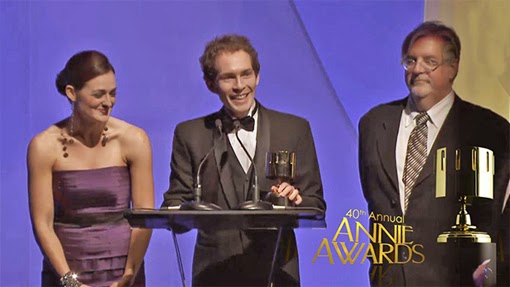
Timothy Reckart, accepting his Annie Award for "Head Over Heels" (Photo source: Animation Magazine)

An Annie Award winner for Best Student Project (it was made at the National Film and Television School in the U.K.), Reckart's 10-minute film is both a dialogue-less and surprisingly affecting comedy about a strained marriage and a nifty sci-fi short story set in a bizarre and unexplained reality where the laws of physics are different from our world's laws of physics. So because of the reality the short takes place in, the biggest obstacle to communication between middle-aged Walter and his ex-ballet dancer wife Madge isn't the increasingly common problem of smartphone addiction. Instead, it's gravity.

Walter and Madge live in a floating house where Walter's ceiling is Madge's floor and her ceiling is his floor. We don't know what exactly caused their marriage to become strained or why they no longer share the same gravity. All we do know is that it's entertaining to watch them go about their day as if everything's normal in their topsy-turvy world.


Meanwhile, in our topsy-turvy world where special features, which, for a long time, have been the best part of a DVD or Blu-ray, are unfortunately becoming an endangered species because younger viewers prefer to stream movies instead of watching bonus-filled physical copies of them, Reckart's strategy of getting viewers to watch his short online is noteworthy. It's not just because of his wish to keep special features alive by treating viewers to a bunch of fascinating little extras about the making of "Head Over Heels" ("On the one hand, the death of DVD is great, because the physical production of DVDs has been a barrier to entry for short filmmakers like me. On the other hand, what happened to special features?," says Reckart). It's also because one of those bonuses is an audio-only featurette about film scoring--and it's almost three times longer than "Head Over Heels" itself, like how the documentary about the making of Superman Returns is much longer than Superman Returns itself (and a slightly more enjoyable film too, simply because of the moment when Kevin Spacey cracks up the film's crew with his Brando impression while audio of Brando as Jor-El is being played aloud on the set).


Any featurette about the film scoring process is worthwhile to me because I put strictly film and TV score music into rotation on my radio station, and I'm always interested in hearing about how that kind of music gets made. Film and TV scoring is a process not a lot of people understand or are aware of, even after the release of Forgetting Sarah Marshall, whose main character was a struggling (and way-too-frequently-naked) TV composer, so the audience saw a few scenes of him at work. Featurettes like the scoring discussion Reckart recorded with Jered Sorkin, his short's composer, are invaluable because they get those outsiders to understand the process.

I had only five questions for Reckart--whose prior stop-motion shorts include 2009's "Token Hunchback," a mockumentary about a Hollywood actor born with a hunchback--when I interviewed him over e-mail. That's because in the extras or in other interviews, he goes into so much detail about the animation process and the music that he basically answers all the other questions I had about the making of "Head Over Heels."

Monday, November 10, 2014

TV Guide helps them decide: Boston stand-up Ken Reid and his fellow comedians rummage through old TV Guides on TV Guidance Counselor

An upcoming intense episode of Gotham will be all about little Bruce Wayne devoting his precocious energies to sewing together this same exact raglan jersey with a bat on the chest because Gotham is such a subtle TV show, with subtle lines like 'Hey, Nygma, stop being a RIDDLER full of riddles, alright?!'
Ken Reid (Photo source: Time Out)

Long before Brad Pitt became a respected movie star and incomprehensible perfume pitchman, he started out as a guest performer on '80s shows like Growing Pains and the original 21 Jump Street. Twenty-seven years ago today, the first of Pitt's two guest shots on Growing Pains aired on ABC (the season in which another future movie star, Leonardo DiCaprio, joined the Growing Pains cast as the Seavers' adopted son would take place much later). In the November 10, 1987 Growing Pains episode "Who's Zoomin' Who?," the future star of Moneyball and Fury played a hunky transfer student who made the heart of teenage Carol Seaver go pitter-patter, no pun intended.

If you listen to just the middle portion of an episode of Boston comedian Ken Reid's TV Guidance Counselor podcast, you could sometimes mistake TV Guidance Counselor for being a podcast about Growing Pains, due to how often Reid brings up the Seavers and the Seaver kids' quirky classmates (remember Stinky Sullivan, Ben's frequently mentioned and initially unseen buddy?). But it's more than just a Growing Pains lovefest.


What makes TV Guidance Counselor an interesting listen--especially for TV nerds--is the focus of the conversations between Reid and guests like Hari Kondabolu, Kumail Nanjiani, impressionist James Adomian, Parker Lewis Can't Lose star Melanie Chartoff and O.G. SNL cast member Laraine Newman. It isn't yet another umpteenth podcast about how these performers got started in comedy. Instead, the focus of TV Guidance Counselor is on their pop culture obsessions and TV-watching habits (as Jackie Kashian has frequently said on her podcast The Dork Forest, people whose only job is as a road comic often find themselves watching a lot of TV during the day to bide their time). Reid's framing device for getting his guests to open up about their tastes in TV is especially clever: he has each of them pick out programs they'd like to watch from the listings in an issue from his collection of old TV Guides, and then Reid and his guests share with each other their memories of those programs.

So in addition to mentions of the Seaververse, listeners are treated to discussions of short-lived gems like the underrated sitcoms of Bonnie Hunt (she's another favorite Reid topic) or the cheesiest elements of forgotten '80s and '90s afternoon cartoons like the Fantastic Four clone Bionic Six, as well as intriguing tangents like Kondabolu's encyclopedic knowledge of obscure characters from '90s ABC "TGIF" sitcoms. That's bizarre to see coming from Kondabolu because you wouldn't expect Kondabolu--currently the sharpest and most provocative stand-up in terms of material about racial issues--to have devoured the most whitebread '90s sitcoms when he was younger (it's like finding out that Malcolm X liked watching The Donna Reed Show). It's just one of many odd revelations from guests throughout Reid's podcast, and over e-mail, I got the TV Guidance Counselor host to discuss his fascination with TV Guide as both a conversation starter and a magazine and why he's built a podcast around a magazine nobody really uses anymore as a listings guide due to the ease of getting much more up-to-date and comprehensive program listings off the Internet or the cable/satellite box.

For an evil high school principal, Ms. Musso was oddly hot, in a present-day Julia Louis-Dreyfus on Veep kind of way.
(Photo source: Reid)

Jimmy J. Aquino: Did you inherit your TV Guide collection from a relative or did that collection grow because you simply loved the magazine from the start?

Ken Reid: It's kind of a mixture. We always got the magazine in my house, ever since I can remember (and we always had a two-slice toaster, but I digress...). I would pay for my own subscription after a while when times were tight. I kept a few from growing up, but the bulk of my current collection comes from two libraries. One in Maine and one in Nebraska. They were both purging their periodicals and I picked up decades of issues for nothing.

JJA: Did you have a favorite TV Guide staff writer? For instance, I liked anything Frank Lovece wrote for TV Guide because he was a Taxi fan who authored a whole book on Taxi.

KR: I liked Howard Polskin because he would tend to write about trends and "new" innovations. His pieces tended to incorporate a bit of the social analysis stuff that I really enjoy. It wasn't too in-depth, it was still 1980s TV Guide, but it was a good taste of that for a mainstream magazine. Jeff Jarvis, the Couch Critic was the other one whose name always stuck in my head. He was really the only person with a specific weekly column, that I can remember. I enjoyed how opinionated his reviews were, without always being negative. He backed up his opinions and they were well-thought-out and he wasn't afraid to trash a show, despite potentially angering a network. So much of the TV Guide writing wasn't attributed to anyone, which is kind of fascinating to me. The movie reviews, Jeers and Cheers and the show descriptions were always my favorite things in the issue, and they were written by this monolithic, mysterious "TV Guide Staff."

The people who kept tinkering with Mork and Mindy and adding pointless characters every season were enormous shazbotheads.
(Photo source: Michael Schneider)

JJA: What reasons would you give to someone to not throw away any old TV Guide issues that are still lying around in their basement or attic?

KR: They are great time capsules. It's always the same way people use the Internet Wayback Machine now. These things that were designed to be extremely "of the moment" and disposable always reflect an exact place and time best. The articles are always interesting as well. There's a fair amount of predictive writing in TV Guide, which shows will be hits, what new TV technology will be and it's fun to see where they were right and where they were wrong. It also makes you put our current media culture into perspective. Changes happen so gradually people don't tend to notice them as much. When you look at a TV Guide from 1987, and look at say, their gossip section, The Grapevine, you see how much our culture has changed in relation to its relationship with celebrities and the media.

They really do jar memories you never knew you still had. Just flipping through a week and reading some show names or descriptions tends to flood people with memories. That's one of the things I love doing about the show. I've had a ton of guests say things to me like "I didn't watch a lot of TV" or "I don't remember anything really from when I was a kid" and after the five-minute flipping through the TV Guide, they prove both of those statements to be incredibly inaccurate.

If Fresno were a 2014 show instead of a 1986 show, the raisins would be heavily Botoxed.
Remember the miniseries spoof Fresno?
It's one of many forgotten--and actually
not-so-shitty--'80s and '90s shows that
made the cover of TV Guide.
Also, if you need an alibi, it'll provide you with some pretty detailed, date- and time-specific information.

Outside of that, one word, decoupage.

JJA: How did the podcast come about? Was it because you were itching for a way to put your IMDb-ish encyclopedic knowledge of TV actors and '80s and '90s sitcoms to use?

KR: Ten years into stand-up, I was falling out of love with performing here in Boston a bit. All of my friends and peers had more or less moved to N.Y. or L.A. and the scene here was in a real lull. For years, people had told me I should do a podcast, but I never really had an idea that I thought was different enough from everything else out there. The idea itself actually came from my friend and a very funny comedian himself, Sean Sullivan. I had all these TV Guides displayed in racks in my house, I flip through them and I watch a lot of old TV. He had been prodding me to do a podcast for years and at one point just laid the concept out. Get someone over, have them go through your old TV Guides and then you talk about it.

That was enough to motivate me to give it a go. I figured if I recorded a few and wasn't happy with them, I didn't have to put them out. I listen to a fair amount of podcasts, but some of them, even ones I recognize as being good quality ones, I find very alienating. It becomes a bit too "inside" and although the people on the mics are having fun and are funny, I feel like I'm eavesdropping on strangers at the booth behind me in a restaurant. So I wanted to make sure I wasn't doing the same thing with something I might record.

I never really show off my IMDb brain stuff. I never talk about pop culture stuff on stage. All my stand-up is real stories/experiences. So getting to use that part of my brain on the show has been really fun.

JJA: You're a fan of both Growing Pains and its spinoff Just the Ten of Us. Growing Pains was dismissed as a bland Family Ties ripoff when it aired, but Growing Pains was actually kookier than Family Ties because it boasted writers from WKRP, and they came up with a few meta or high-concept episodes that were genuinely funny. Personally, I think Just the Ten of Us holds up better than Growing Pains, because it wasn't concerned with doing preachy Very Special Episodes like Growing Pains frequently was. Plus [Just the Ten of Us lead character] Coach Lubbock's older daughters were hot, and [middle daughter] Connie, who was sort of a precursor to Lisa Simpson and Daria, was way more interesting than either of the Seaver kids. If you had to persuade viewers to give Growing Pains a chance on DVD or Amazon Instant or to give Just the Ten of Us a chance on YouTube, what would you say to make your case for both of them?

KR: I agree with all your statements. Just the Ten of Us is a better show for a lot of reasons. Most of the writers on Growing Pains jumped ship to Just the Ten of Us, they got four seasons of GP under their belts and were really in the prime of their writing on Just the Ten of Us and were not afraid to try some dark, clever and weird stuff. It was also a strange set-up, a poor Catholic family. The dynamic between the parents was fun and seemed "real" to me. They fought, sometimes they hated their kids, but ultimately always were a family and not a cartoonish collection of clichés and plot devices.


You had the pedigree of WKRP, but you also had people who had sharpened their skills on a solid family sitcom. It managed to make a lot of great meta commentary about sitcoms themselves without losing its heart and the reality and humor of the characters. I think it also benefited from not having [a Kirk Cameron-type heartthrob star] on the show. It was a true ensemble. The daughters being hot helped as well, no doubt. But the characters were pretty complicated. It managed to have the blue-collar gallows humor that I'm a sucker for on shows like Roseanne and tackle a lot of issues like questioning faith, mental illness and some other potentially really heavy topics in a light way without making light of them or using them for dismissive fodder for shock humor. It's a pretty delicate and difficult balance to achieve and they pulled it off pretty well. It also benefits from having less than three seasons, so it never really had time to lose steam like Growing Pains did. Short answer: it's a sweet, fun, funny show with smart humor and a great cast. Plus hot daughters, if that's your thing.

Growing Pains at its best did capture what it felt like to be a teenager. There are some great "epic quest" episodes, specifically the two-part "Dance Fever" episode from season 3 and Ben's search for glue to finish a school project in "Ben and Mike's Excellent Adventure" from season 5, [that] really capture that all-nighter, high-stakes, night-of-your-life, coming-of-age quality that so many teenage movies and television series strive for but miss. Its best episodes stick with you and have a real sense of a universe of the show. It builds on itself and has a history that's nice. It doesn't feel like a totally artificial, no-stakes sitcom world.


TV Guidance Counselor, which just recorded a live on-stage episode with Emmanuel Lewis as Reid's guest, can be heard at tvguidancecounselor.tumblr.com or Reid's SoundCloud. Below is my favorite TV Guidance Counselor episode, which features Kumail Nanjiani, star of HBO's Silicon Valley and host of his own TV-related podcast, The X-Files Files.

Wednesday, September 4, 2013

5-Piece Cartoon Dinner Extra: Back to the Futurama past (with former Futurama assistant director A.L. Baroza)

Leela and Fry watch the skies--and the Nielsen ratings results.
Tonight, Futurama, which premiered on March 28, 1999 on Fox, airs its final episode on Comedy Central, the network that--to the delight of fans of the animated cult favorite and its direct-to-video, post-Fox cancellation spinoff movies--brought Futurama back to series form in 2010. For those who have been frozen in a cryogenic tube in the last few years, Futurama is about a 20th century pizza delivery boy named Fry (Billy West), a stranger in a strange land called the 31st century.

Helping Fry to continually adjust to 31st century life after his awakening from an accidental cryogenic sleep are his 173-year-old descendant, the unsurprisingly exposition-y Professor Farnsworth (also West), a boozy robot roommate named Bender (John DiMaggio) and Leela (Katey Sagal), a one-eyed, karate-chopping delivery ship captain who was raised in an "orphanarium." Several things have kept Futurama from being a lame retread of The Jetsons, which it appeared to be at first: the misanthropic brand of humor of Life in Hell and Simpsons mastermind Matt Groening, who co-created the show with writer David X. Cohen, gorgeous state-of-the-art animation and some brilliantly written episodes that, in addition to being genuinely funny, also hold up as solid and cerebral sci-fi, particularly "Godfellas," "The Late Philip J. Fry" and the surprisingly moving "Jurassic Bark."

And then there are episodes that are just plain funny from start to finish, like "Where No Fan Has Gone Before." An homage to Fry's favorite show, the original Star Trek, 2002's "Where No Fan" somehow managed to get the voices of nearly all the surviving (and still-bickering) '60s Trek cast members together in the same episode, if not the same recording booth (the only surviving cast member who sat out the episode was the late James Doohan, whose refusal to participate resulted in a couple of great gags about a Doohan replacement named Welshie).

I've seen the head of that smiley-face robot that's lying behind the Rocky IV robot's head before, and it's fucking bugging me that I can't remember where that robot's from!
In the recent Futurama episode "Assie Come Home," a robot chop shop is strewn with pieces of the Iron Giant; C3P0; Muffit II from the '70s Battlestar Galactica; Rosie the Robot Maid from The Jetsons; Octus from Sym-Bionic Titan; Robo Bill and Robo Ted from Bill & Ted's Bogus Journey; Alpha 5 from Mighty Morphin Power Rangers; Gigantor; Paulie's robot from Rocky IV; a Dalek; and a Cylon. (Photo source: Sexy Machine)
Animated comedy shows aren't exactly known for bringing great change and upheaval to their characters' lives and making such a thing permanent (for instance, you'll never see Bart, Lisa and Maggie age, unless it's a DC Elseworlds-style Simpsons episode about an alternate future), and Futurama was no exception. Even through all the countless body (or brain) transformations and deaths they've experienced, the Planet Express crew has remained fundamentally the same: Fry's still lazy, Bender always looks out for number one, Leela's always more sensible than the other two, Amy Wong (Lauren Tom) bangs anything that moves, as long as they're not Asian (a young Asian woman on a white show who's scripted to bone everybody except Asian guys--how surprising!), and so on.

But there's one story thread on Futurama that's evolved over the years, and it's the relationship between Fry and his fellow misfit Leela. Their gradual romance (which became an official thing in the Comedy Central years) was the focus of what was thought to have been the final Futurama episode when the series aired on Fox, and it's once again the focus of the this-time-for-real series finale. Many Futurama viewers think the show has lost some of its luster writing-wise--which often happens to shows that go past five seasons--so tonight, will Futurama go out in high style and win back those viewers?

Shortly before Futurama takes its bow for the third and most likely final time, I got A.L. Baroza, an assistant director and storyboard artist on the show during its Comedy Central run, to recall to me his five favorite Futurama episodes that he worked on. Not surprisingly, one of them involved an elaborate mechanical killing machine sequence that also happens to be one of my favorite pieces of animation the show has ever done. After Futurama wrapped up production, A.L. has moved on to storyboarding Fox's Axe Cop, based on the Nicolle brothers' completely nonsensical superhero comic of the same name.

This new Futurama coloring book is surprisingly boring.
(Photo source: The Infosphere)
"The Tip of the Zoidberg" (season 6, episode production number 6ACV18; aired August 18, 2011)
"In the earlier episode 'The Duh-Vinci Code,' I storyboarded this Rube Goldberg sequence where Fry and the Prof get launched into space from the Parthenon. I guess the Futurama powers-that-be must have liked it since in 'Tip,' I got the Murderlator sequence, which is a Rube Goldberg machine that pretty much took up an entire act of the script. It was the hardest storyboard sequence to board in my entire animation career. Although it was a somewhat painful experience, it was worth it, in no small part due to the CGI crew at Rough Draft Glendale, who modeled some (but not all!) of the Murderlator sequence. And the episode was nominated for an Emmy!"

Wow, NBC shelled out a shitload of cash for the challenges on American Ninja Warrior.

"Overclockwise" (season 6, episode production number 6ACV25; aired September 1, 2011)
"I enjoyed doing the Cosmically Aware Bender stuff where I could bring all my years of reading Jack Kirby and Jim Starlin comics to good use. Alternately, I loved doing the extended take of Fry and Leela that closed out the episode, just two characters acting and reacting silently. I love doing scenes that give viewers the feels, as the kids call it these days."

'Shoo, Fry, don't bother me!'... is a line that's not in this scene.

In panel 5, Leela slaps Fry and then in panel 6, Fry slaps Leela back. Without the animation or any slap visual FX, it looks like Fry is about to puke from bad shellfish and then Leela is about to do the same too.
(Photo source: Sexy Machine)

Wednesday, May 6, 2009

Gerald's game: Star Trek composer Gerald Fried opened hailing frequencies with A Fistful of Soundtracks back in 1999

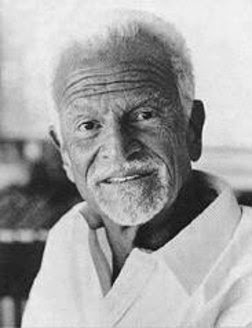
Gerald FriedIn his stand-up act, Dana Gould hilariously envisioned the composer of the Spock bass guitar theme from the original Star Trek as a tortured drug addict cursing loudly at four in the morning like a junkie version of Don Music from Sesame Street while trying to come up with the perfect theme for Spock. The calm and genial Gerald Fried--the now-retired TV and film composer who penned both Spock's theme and Kirk's frequently spoofed fight theme for Star Trek's 1967 "Amok Time" episode--isn't exactly Don Music on smack.

As I await both J.J. Abrams' new Star Trek feature film and its Michael Giacchino score--which I've refused to hear excerpts from until I see the film itself--I thought it would be the perfect time to transcribe half of a phoner I recorded with Fried (pronounced "freed") for the terrestrial radio incarnation of A Fistful of Soundtracks in 1999. (Almost all the pre-2000 broadcasts of A Fistful of Soundtracks were pre-recorded on audiocassette, and I don't have the equipment to transfer audiocassette content to computer--the audio quality would suck anyway--so I'd rather just post text of the interview below.)

During our conversation, Fried promoted the 1999 Silva Screen Records release Dr. Strangelove: Music from the Films of Stanley Kubrick, which contained re-recordings of themes Fried composed for the first few films of his childhood friend Kubrick. But what I was most interested in was Fried's TV work, which he loved doing despite the rushed schedules and older TV's tendency to recycle score music to cut costs ("As a composer, it's disturbing to hear music I wrote for one scene appear somewhere else," said Fried in a 1991 Starlog magazine interview). I particularly enjoyed talking with Fried about his scores for the Roots miniseries, which I first caught when the Family Channel (now ABC Family) reran it while I was in high school, and the original Star Trek, which I grew up watching and is now being relaunched by Abrams on the big screen.

Young Spock gives 90210 Kirk an 'Amok Time'-style ass-whupping.
(Photo source: TrekCore)

Jimmy J. Aquino: Now Jerry Goldsmith wrote the theme to The Man from U.N.C.L.E. Lalo Schifrin wrote the theme to Mission: Impossible. Alexander Courage wrote the theme to Star Trek. When you worked on those shows, were you ordered by the producers to compose in their styles or were you allowed artistic freedom?

Gerald Fried: We had to refer to the theme, which was okay with me. I think both those themes... The Sandy Courage thing, you know, that female voice--that was kind of stupid to me. Jerry's theme and Lalo's theme from Mission: Impossible are just fine. I had no problem using them.

As far as style goes, the first year, Jerry Goldsmith, I think, scored most of the Man from U.N.C.L.E.s, and it was a kind of symphonic style. Then they brought me in the second year, and Lalo also did a few of them, and we were the ones who changed it into a kind of Latino jazz... you know, the... [Hums his faster-paced arrangement of Goldsmith's U.N.C.L.E. main title theme.] That was my kind of contribution. They wanted style change from Jerry's style, and then it stuck pretty much like that for the next two or three years, however long the series ran.

JJA: Yeah, when it changed to color, they got campier and less serious.

GF: Yeah, which was part of the joy of doing it.

JJA: Now I want to talk about what I remember you the most for, your work for Star Trek. You did a total of five episodes: "Shore Leave," "Amok Time" I remember most fondly, as well as "Catspaw," "Friday's Child" and "The Paradise Syndrome." Was Star Trek taken seriously in the industry when it initially aired on NBC like it was by the sci-fi community or did everybody you know in the industry dismiss it as, you know, shallow, Flash Gordon-type hokum?

GF: Somewhere in between. They had no idea that it would become part of Americana. But neither did they see it as a piece of junk. You got some pretty classy writers--Harlan Ellison and some of the big sci-fi writers--so I think it was respected, and Gene Roddenberry was kind of an impressive guy. But certainly, they had no idea that it was going to take hold as it did.

JJA: I remember reading reviews from the '60s when it premiered, and Variety and TV Guide dismissed it as being shallow and just another space opera.

GF: Heh! Okay. I hope Gene Roddenberry is enjoying that statistic wherever he is.

JJA: He got the last laugh.

GF: Yes, he sure did.

JJA: Now for "Shore Leave," you wrote two unforgettable themes: the love theme for when Kirk is reunited with Ruth, his first love, and the Irish tune for Finnegan, Kirk's bully from his academy days. Tell me about writing those themes.

GF: Well, the love theme--the flute solo--was just kind of a movie-type pop thing, which I thought was appropriate and immediately accessible. The other one--I figured, well, how do you do it? It was an opportunity to write something special, kind of like an epic Irish fistfight. Remember the movie The Quiet Man? Something like that. To keep it Irish and keep it large and keep it insouciant like the Finnegan character was. So it seemed like a jig would be a good idea, and I was nervous about it because whenever you take a gamble, you're always in danger of having some conservative person throw it out. Well, [Bob] Justman and Roddenberry did not throw it out. But you do get nervous when you take chances like that, which I always do because I think any good composer... Jerry Goldsmith is the greatest chance-taker, probably of all time, and Elmer Bernstein... Yeah, I love them for that, for letting me do something with some kind of left-field imagination.

JJA: Now in "Amok Time," you created a theme for Spock for bass guitar. Let's talk about that. Why a bass guitar for Spock?

GF: Spock had a lot of trouble with emotion. If he did have any, he hardly knew how to get it out. Now if you try to play a lyrical line on a big thumpy bass guitar, you're gonna have trouble sounding lyrical, so I thought it would be a match to write a lyrical theme but put it on the bass guitar. It somehow parallels Spock's trouble and confusion with emotion.

JJA: Who played the bass guitar?

GF: Barney Kessel.

JJA: What were some of his previous credits? Did he work with you before?

GF: Yeah, he was a studio guitarist by the time I came to him, but before that, he was one of the half-dozen greatest jazz guitarists in history. You'll find him on records like with Art Tatum and Earl "Father" Hines. He's right up on the top. In fact, he, Herb Ellis, Joe Pass, Kenny Burrell, Eddie Lang and Charlie Christian--I just named to you the half-dozen great guitar players of all time.

JJA: Before you wrote the scores for the Star Trek episodes, were you handed the script or did you watch the episode first? The dailies?

GF: Yeah, there were no videocassettes in those days, so you get a chance to see... no, not the dailies. They called it then a workprint, and that was usually like about 10 or 12 days before airtime, so it was very scary. You just go home and work practically 22 hours a day for an intensive five or six days. You see it once. At first, Bob Justman--and maybe even Roddenberry for the first one--sit there with you and then we talk about where the music should go. The last few, they were so busy and so tired and so worried about the next show that I just thought by myself with the music editor in the room and just chose where the music goes and what I should do by myself.

'Spock, let go! This big-ass Hershey's Kiss on a stick is MINE!'JJA: Now your music for the Kirk/Spock fight scene in "Amok Time" has been called the greatest fight music ever written for television. It's even been quoted in parodies of Star Trek.

GF: Oh yeah. [Laughs.]

JJA: For instance, the characters on Mystery Science Theater 3000 would hum the fight music whenever they saw a B-movie fight scene.

GF: [Laughs.] That's funny. I know. I get royalties from The Simpsons and The Cable Guy. I know it was used there.

JJA: Do fans at the Star Trek cons come up to you and hum the fight music?

GF: Yeah, I actually attended two or three of those Star Trek conventions. There was a program. I made a suite of all my main themes from Star Trek into sort of a concerto for oboe, which I played myself. I'm still an oboe player. Yeah, some people would come up and talk mostly about those specifically.

JJA: I know that in television, like you said before, composers don't have much time to work with. Do you feel your music is better when it's written in such a limited amount of time or do you feel the opposite?

GF: I had only one opportunity to find out because 100 percent has been on a rushed schedule. The exception is the documentary Birds Do It, Bees Do It. I had lots of time for that. That was my one and only Oscar nomination, so maybe there is a correlation. Except for that, I have no way of knowing!

The 'Amok Time' action figure collection: for lonely housewives who want to reenact the 'Amok Time' fight with their Kirk and Spock dolls but always thought, 'It needs tons of kissing.'

JJA: Now themes from your Star Trek scores would be recycled in many episodes. Were you flattered by this or did you find that practice inappropriate?

GF: Well, if I were to give a speech on the aesthetics of film composing, I'm sure I would rant and rave about "music must be composed specifically for this and that." But when you get your music, for one thing, played on network television, you've got a helluva lot of money, and that kind of tempers your thinking... It doesn't temper your thinking. It tempers your mouth, so I didn't do any public complaining. Sometimes, I thought it was ludicrous what they did, and sometimes, I think, "Well yeah, alright, it sort of works." But generally, I'd like to go down in the books as saying it's a bad policy. It makes a product out of movie and TV stuff. I still like to consider it a great art form, so with that high road in mind, I come down against it.

JJA: So how do you feel when people come up to you and say, "Oh, I like that love theme from 'This Side of Paradise,'" but it was the love theme from "Shore Leave"?

GF: Yeah. [Laughs.] I smile. What are you gonna do? Read them a lecture on cinematic aesthetics?

JJA: Anybody who has worked on the original Star Trek, whether they're an actor, a writer or a composer, is always stopped on the street and remembered for their contribution even if it was only a guest stint. Why do you think Star Trek has been so popular?

GF: I think the intent and quality of the writing and the concept of it, to try and comment on earthly problems in terms of outer space... The dynamics of jealousy, rage, envy, power, lust and all those things were commented on intelligently and fairly. I think they reflected--as all good writing does--on the conditions of all the people down here on Earth, and I think that came through.

JJA: Any advice for anybody who took one listen to your music from Star Trek and said, "I wanna do that too"?

GF: [Laughs.] Yeah, it's possible. There will always be music for movies and television. It's hard to get into because a lot of people want to do it, but if there's a major motivation, and the person is willing to do the work and the research and become an all-around person in music... The days of having specialists are over. Producers need to hire a composer who they know has enough range, so that they can handle whatever problem might come up. Yeah, my advice is go for it.