Showing posts with label J.J. Abrams. Show all posts

Monday, November 21, 2016

Star Trek 101 and beyond

Star Trek III: The Search for Spock

I have a couple of confessions to make. I run a Tumblr about accidental Star Trek cosplay, but as an adult, I've never cosplayed as anybody, and I don't plan to ever do so. It's just not for me, even though I admire the artistry that goes into a lot of professional cosplayers' recreations of their favorite fictional characters. Also, I do love Star Trek for its progressiveness and the banter between the actors, particularly the original cast members, and I'm enough of a fan that I could rattle off some of the names of authors who received credit for writing the '60s episodes, even though Star Trek creator Gene Roddenberry heavily rewrote their shit ("The Enemy Within"?: I Am Legend author Richard Matheson; the episode with Andrea the sexy android?: that was a Robert Bloch joint), but I haven't watched every single thing with Star Trek's name on it.

As a kid, I knew that the third season of the original Star Trek was mostly trash (the budget was clearly slashed, and the actors were told to compensate for the budget cuts by constantly acting as if they were starring in what we now call a telenovela), so I've avoided watching most of that final season. I skipped most of the sixth and seventh seasons of Star Trek: The Next Generation when they first aired on syndicated TV, and I did the same with most of Star Trek: Deep Space Nine's first season, so there's a whole bunch of Next Generation and DS9 episodes I have yet to catch for the first time. I got bored with Star Trek: Voyager and quit after the first season, although I would occasionally check out a later Voyager episode like "Memorial."

The sci-fi franchise, which celebrated its 50th anniversary earlier this year, has produced so many hours of episodic TV and spawned so many feature films that I now see how it would be intimidating, especially for anybody whose familiarity with Star Trek is limited to the 2009 J.J. Abrams movie, to decide which episodes of the '60s version (or any of its spinoffs) to stream if you want to further understand what all the fuss over Star Trek is about. I just realized how daunting it would be for a newbie to step into that shared universe when I recently told a Harry Potter fan who happens to be the wife of a friend at my apartment building that I found Harry Potter and the Sorcerer's Stone to be a tedious movie when I watched it on DVD in 2002, and it put me off Harry Potter for good.

The friend's wife said she felt the same way about the subject of my Tumblr, Star Trek. So she proposed a deal: she would finally watch a Star Trek episode or movie if I put aside my disdain for the first Potter movie and agreed to watch the rest of the Potter movie franchise. I said, "It's a deal!" The only problem is that I have a novel manuscript that's kind of in the way, so how the fuck can I find the time to watch all eight hours and 17 minutes of Harry Potter and the Chamber of Secrets?

Thursday, December 3, 2015

Thinking outside the Fox: A speculation over how The Force Awakens will open without the Fox fanfare (accompanied by my older brother's doodles in the 1978 Star Wars Storybook from when he was six)


When Star Wars: The Force Awakens premieres in just two weeks, it will be the first live-action Star Wars film to open without composer Alfred Newman's majestic 20th Century Fox fanfare, due to Disney's 2012 acquisition of Lucasfilm and the transfer of the role of distributor of the Star Wars films from Fox to Disney. The last Star Wars film that played in theaters actually didn't open with the Fox fanfare either: 2008's CG-animated Star Wars: The Clone Wars, a prelude to the CG-animated TV show of the same name, was distributed by Warner Bros. instead of Fox.

Yet some Star Wars fans are still experiencing separation anxiety in regards to Newman's fanfare, a familiar staple of previous live-action Star Wars installments, even after learning to live without it when they saw the Clone Wars film.


If a Star Wars fanboy you know or tolerate is saying something along the lines of "It just ain't Star Wars without the Fox logo music," it's time to get him to rip that Band-Aid off. It's time to tell him to get over the absence of the Fox fanfare and grow up, fuzzball. To borrow the words of Jacob Hall over at ScreenCrush, are we really going to get sentimental and worked up about a movie studio's theme music being removed from a film franchise the studio no longer owns? "We shouldn't," said Hall. "That would be silly. But we are!"

Well, I'm not. There are other things I'm much more concerned about than the disappearance of a corporation's fanfare. Those things include the original score music within the new film, provided once again by the beloved John Williams (meanwhile, Hamilton mastermind Lin-Manuel Miranda wrote the film's new cantina music?: that's what I call a coup), and the ways the George Lucas-less Force Awakens will handle the much-needed return of the kind of character who was missing for too long from the Star Wars films and whose absence was the biggest reason why I despise the Lucas-directed prequel trilogy. That would be the character who takes a gander at all the mysticism and craziness surrounding him and says, "Yeah, this is bullshit. But I'll just go along with it. For now." In other words: Han Solo.

My older brother was a calligraphy nerd in grade school, and his 1978 copy of The Star Wars Storybook, which I unearthed from our parents' garage a couple of years ago, was clearly the beginning of that.

The prequels badly needed a foil to gruffly react to "hokey religions and ancient weapons." In the classic trilogy, Han--the reluctant hero who will be played once again in The Force Awakens by similarly reluctant Star Wars star Harrison Ford, who once famously grumbled to Lucas that "You can write this shit, but you can't say it"--served that purpose entertainingly, and to a certain extent, so did Princess Leia, whose barbs were directed at walking carpets and nerf herders rather than hokey religions and ancient weapons.

A character like Han (and occasionally, Leia) is integral to breaking up the monotony of the ultra-solemn Jedi characters (the prequels clearly intended Ewan McGregor's slightly cranky version of Obi-Wan to be the new Han figure, but it just wasn't the same), the similarly solemn politician characters and the mostly dour Sith characters. Han's presence also supplies to the proceedings a certain dose of grown-up comedic energy (as opposed to the brand of humor that was written for six-year-olds like Jar Jar's puerile and Fetchit-y bits of comic relief during The Phantom Menace). Without a character like Han, the Star Wars films unfortunately turned into a stuffy BBC costume drama in space. Or as Screen Junkies announcer Jon Bailey astutely summed up Attack of the Clones during the Honest Trailer for that prequel, "People sitting and talking, standing and talking, walking and talking, one person standing and talking while another is sitting and talking, people standing and talking, then taking a seat for more talking."


Back to things that aren't as lethargic. Look, I agree that Newman's rousing 1954 arrangement of his own 1933 Fox fanfare--an extended update that was designed to herald Fox's CinemaScope logo for films shot in the CinemaScope widescreen format Fox introduced in the '50s to compete with square-shaped TV--is a great little piece of music. It's so great it inspired Williams to write the Star Wars opening title theme in the same key. In fact, the studio suits so enjoyed hearing again the 1954 version at the start of a Fox film when Star Wars brought it back to accompany the "A Lucasfilm Limited Production" card--by the way, the demise of the CinemaScope label caused the studio to revert to the shorter 1933 fanfare for most of the '70s, while the studio's Planet of the Apes franchise opted to completely ditch studio artist Emil Kosa Jr.'s animated Fox logo--that the 1954 version became the permanent arrangement of the fanfare after Star Wars. (That move by Fox resulted in two of my favorite takes on the 1954 fanfare: musician Bennie Wallace's Dixieland funk version at the start of White Men Can't Jump and Ralph Wiggum's rendition of the last few notes of the 1954 fanfare at the start of The Simpsons Movie.) But it's time to move on, man. Star Wars is not going to fall apart without that 1954 fanfare (and if you really can't let go of that fanfare, bring your phone or mp3 player along with you to the theater like they suggested over at the A.V. Club, put on your earbuds and cue up either the fanfare or "20th Century Foxney" when The Force Awakens begins). However, I'm curious about how The Force Awakens will open without it.

When Disney reissued the previous six live-action Star Wars films on digital platforms earlier this year and replaced the Fox fanfare with Lucasfilm's fanfare on five of those films (but with no Disney castle logo, much like how movies produced by Marvel Studios, another arm of Disney, never open with the Disney logo), that Lucasfilm fanfare wasn't favorably received. "The new score will now accompany all Star Wars films going forward, with the only exception being the original film, which 20th Century Fox still hold [sic] distribution rights for," wrote Kwame Opam about the Lucasfilm fanfare over at The Verge. Opam is kind of incorrect. The Lucasfilm fanfare isn't a newly written piece. It's merely some Skywalker Ranch grunt's Pro Tools re-edit of the last few notes of Williams' end title music from The Empire Strikes Back.

Illustration by six-year-old Jonas Aquino

Illustration by Aquino

Illustration by Aquino

Many fanboys assume The Force Awakens will open with the same fanfare that's been tacked on to The Empire Strikes Back and the four subsequent Star Wars films for their digital releases. I have a feeling The Force Awakens won't use that chopped-up fanfare. I think the new film should open with complete silence before the classic Williams theme kicks in--it's more powerful that way and it's preferable over some old Williams fanfare from 1980 or even a new Williams fanfare--and I think it will.

Disney's Force Awakens marketing campaign has been effective at building suspense and excitement and not giving too much of the film away. I have a feeling the film itself will continue in that vein by opting for silence right before the return of the classic Williams theme. But whatever Disney, Lucasfilm and Bad Robot decide to do at the start of The Force Awakens, like my older brother cornily scrawled in pencil about the Rebels inside the Death Star when he was six, the Force will be with them.


And whatever they do will be far better than "People sitting and talking, standing and talking, walking and talking, one person standing and talking while another is sitting and talking, people standing and talking, then taking a seat for more talking."

The music of Star Wars is part of "AFOS Prime" and "Hall H" on AFOS. Star Wars is represented in both those blocks by the Empire Strikes Back score cues "The Battle of Hoth" and "The Rebel Fleet/End Title," which was, as mentioned earlier, later compressed and re-edited into the Lucasfilm fanfare at the start of the digital releases of the Star Wars films.


Monday, December 1, 2014

Star Wars: The Force Awakens teaser trailer breakdown

Ah, Star Wars!
The green screen FX for this scene are extraordinary. Andy Serkis put on an unusual-looking motion-capture suit to do this, and he's really convincing in the role of The Following Preview Has Been Approved To Accompany This Feature By The Motion Picture Association Of America, Inc.

Nothing but Star Wars!
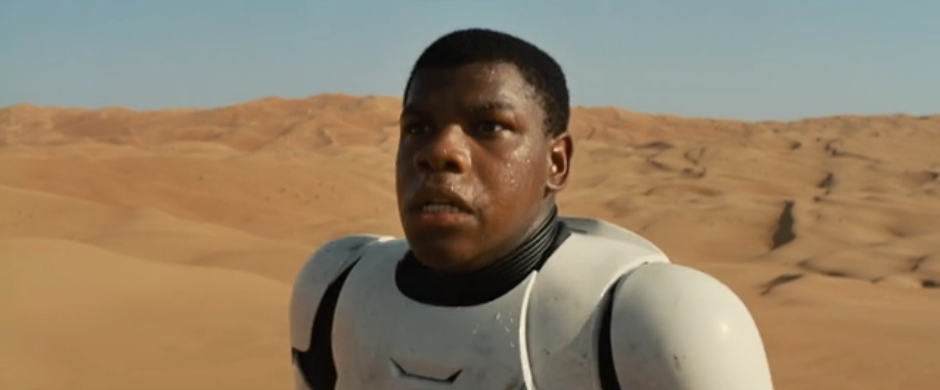
Here we see John Boyega on the toilet after a very bad order of fish and chips.

Gimme those Star Wars!
This is what came out of John Boyega's ass while he took that painful shit.

Don't let them end!
Ah, Star Wars!
Whoa, SWAT team, aren't you a little overdressed for the peaceful protest of the Ferguson verdict?

If they should bar wars...
Please let these Star Wars stay-ay!
Daisy Ridley rides off on what every teenage Star Wars fangirl will want for Christmas in 2015: a big-ass USB drive.

And hey! How about that nutty Star Wars bar?
Oscar Isaac took the part of a cat-loving folk singer in Inside Llewyn Davis even though he dislikes cats. He also took the part of a helmeted Rebel Alliance fighter pilot even though he dislikes helmets because they give him Albert Einstein hair.

Can you forget all those creatures in there?
Adam Driver presents the latest technology in cutting down trees.

And hey! Darth Vader in that black and evil mask...
Did he scare you as much as he scared me-e-e-e?
Aaaaaaa!!!
The puke-stained T-shirt of the cameraman who ralphed while filming this battle scene up in the sky is now going for $1,200 on eBay.

Judging from the new sequel's shorter title, unlike George Lucas, J.J. Abrams is sensitive to the arms and hands of theater marquee letter changers.
From a six-year nightmare of shitty dialogue, wooden acting, racial stereotypes and turgid storytelling.


Wednesday, April 30, 2014

The casting of John Boyega and Oscar Isaac boosts Star Wars: Episode VII from "Why is this being made?" to "Shit done got interesting"

More flare than a waiter from Office Space
(Photo source: Tor)
"I'm not going to play Luke again. He's over. He had a beginning, a middle and an end," said Mark Hamill to me in a phone interview we recorded on a late Sunday night in 1998 for a Batman: The Animated Series-related episode of the terrestrial radio incarnation of A Fistful of Soundtracks.

Flash forward to 2014. Disney has finally confirmed--after about a year of "Lucasfilm's been talking to us"-type comments to the press from the original Star Wars trilogy stars--that Hamill will reunite with Harrison Ford, Carrie Fisher, Peter Mayhew (Chewbacca), Anthony Daniels (C3P0) and Kenny Baker (R2D2) for J.J. Abrams' tentatively titled Star Wars: Episode VII.

So much for "I'm not going to play Luke again."

Wow, this new two-color Instagram filter sucks.
A Star Wars: Episode VII cast read-through at Pinewood Studios
I'm what you call a lapsed Star Wars fan. I love the first two Star Wars films. That's about it. I don't care for the rest of the franchise, although Genndy Tartakovsky's cel-animated Clone Wars shorts from the early 2000s were pretty solid and way more satisfying than George Lucas' dreadful and woodenly executed prequel trilogy (as is Matthew Haley and David Walker's fake Blackstar Warrior trailer, which I still wish would be made into an actual movie). So when Hamill, Ford and Fisher started giving hints to the press about reprising their roles in Episode VII, I was both glad for their return and skeptical about it because the last time Ford reunited with a former co-star for a Lucasfilm project, it resulted in another post-1989 Lucasfilm sequel I'd like to have Lacuna'd from my memory: Indiana Jones and the Kingdom of the Crystal Skull.

One of the reasons why Crystal Pepsi was underwhelming was because Crystal Gravy was badly in need of a rewrite from Lawrence Kasdan, who co-wrote Raiders of the Lost Ark, The Empire Strikes Back and Return of the Jedi (Kasdan, who, along with Ford, wanted Han Solo to be killed off in that threequel but were both overruled, isn't to blame for the problems of that film). Abrams' recruitment of Kasdan for the Episode VII screenplay was the first good sign about Episode VII. (However, I'm still concerned about Abrams as a director: are we getting the Abrams who directed both the still-excellent Lost pilot and the first and best Chris Pine Star Trek film--and also got a great villainous performance out of the late Philip Seymour Hoffman in Mission: Impossible III--or the Abrams who directed the mediocre, Khan-whitewashing Star Trek Into Darkness?)

An equally promising sign of things to come is this week's confirmed casting of John Boyega, the British star of one of my favorite sci-fi flicks of the last 10 years, Attack the Block, and Oscar Isaac, who was terrific as a dickish '60s folk singer in the Coen Brothers' Inside Llewyn Davis, as two of the new Star Wars leads. (With Isaac's Llewyn co-star Adam Driver on board in a villain role, it'll be especially fun to see Isaac go from crashing on Driver's couch to firing ion cannons at him. And with Max von Sydow playing what I assume to be Driver's Sith master too? Sweet.)

I've noticed that Boyega, who received accolades at Sundance this year for his performance as a South Central L.A. ex-con in Imperial Dreams (a film that, by the way, was scored by the talented Flying Lotus, who ought to be scoring more films), is first billed in the non-alphabetical cast list in Disney's Episode VII casting announcement. Is this a hint that this trilogy under Abrams' direction will be the first Star Wars trilogy with a person of color as the lead? As someone who wants to see more diversity in, well, everything, I sincerely hope so. As early as Attack the Block, Boyega proved that he's capable of the gravitas that's required to spearhead a sci-fi/fantasy franchise like Star Wars.

John Boyega prepares to go all Ghost Dog on an alien dog.
John Boyega in Attack the Block
"Moses' trajectory from irresponsible thug to adult who decides to own up to his mistakes... is believable and compelling, thanks to Boyega," I wrote back in 2011, when I first saw Attack the Block. "He has a couple of intriguing little moments where the badass and authoritative gang leader façade disappears, and with some great acting by Boyega with just his eyes, we see a scared kid who's in over his head and whom the film later reveals--in one of its best scenes--to be much younger than he appears to be."

Now envision Boyega bringing all those moments of believability and vulnerability to a Jedi who's learning the ways of the Force, under the direction of a filmmaker who didn't take a 22-year break from directing that resulted in his storytelling skills becoming as rusty as the chassis of a Gonk droid. Perhaps my lapsed faith in Star Wars will finally be restored.

I have no idea who she is. Maybe some Downton Abbey nerd can tell me.
British newcomer Daisy Ridley will help keep Star Wars: Episode VII from turning into a sausage fest.

Hear the music of Star Wars during "AFOS Prime" and "Hall H" on AFOS. Star Wars is represented in both those blocks by the Empire Strikes Back score cues "The Battle of Hoth" and "The Rebel Fleet/End Title," by John Williams, who's returning to score Episode VII.


Thursday, June 25, 2009

These are the bonuses of the starship Enterprise: Paramount announces its Star Trek Blu-ray/DVD extras


YouTube comedian Shyaporn pokes fun at J.J. Abrams' Star Trek in a funny spoof that calls attention to something I didn't notice even after watching the movie twice: Kirk--whether it's his preteen self or his academy cadet self--does an awful lot of hanging off cliffs during the movie.


Shyaporn's YouTube channel is a must-click channel (X-Men Origins: Wolverine and those YouTube "5000 impressions in 2 minutes" videos get nice skewerings there too). I would have discovered Shyaporn's Star Trek spoof sooner, like back when Abrams' Star Trek was, uh, more relevant, but because I'm Filipino, I'm late to everything.

Star Trek's DVD and Blu-ray release date won't be as late as I constantly am to things. Paramount has announced the street date and bonus features (from a filmmakers' commentrak to deleted scenes that were briefly glimpsed in the trailers), and the date is sooner than I expected: October 8. Here are some of the extras Paramount will include on both the DVD and Blu-ray editions of the summer's most popular and acclaimed blockbuster (suck it, Paramount's other cash cow, Transformers: Revenge of the Fetchit):

- Audio commentary (J.J. Abrams, Bryan Burk, Alex Kurtzman, Damon Lindelof, Roberto Orci) translated into Klingonese

- Audio commentary by a group of irate Trekkies who couldn't enjoy the movie because the Starfleet uniform insignia didn't stick to the original TV series' rule that each Starfleet ship has its own insignia

- Featurettes: "He Blinded Me with Lens Flares!: The Cinematography of Dan Mindel," "Red Balls in Your Mouth: J.J. Abrams' Red Ball Fetish," "How to Recreate the IMAX Experience: Just Press Your Face Against the Blu-ray Player Screen"

- Deleted scenes:

* Spock's birth

* McCoy's birth

* Uhura's birth

* Scotty's birth

* Sulu's birth

* Chekov's birth

* Spock's bris

* McCoy gets taken to the cleaners in divorce court

* Cadet Kirk is reunited with Biggs Darklighter

* Ayel tortures Pike by performing spoken-word poetry

* Nero tortures Pike with a screening of Ang Lee's Hulk

* The explanation for Kirk's swift promotion from cadet to starship captain (SPOILER ALERT: he slept with Fleet Admiral Madea)

Thursday, May 21, 2009

Star Trek: Three out of five ain't bad

From Ward Sutton's Village Voice cartoon about Star Trek.
Throughout this year, I'm posting older material--like non-Blogspot posts from a few years ago, unpublished writing I've kept buried in my computer and transcripts of interviews from A Fistful of Soundtracks' terrestrial radio years.

In the summer of 2007, Cinematical was looking for some new bloggers. One of the posts I submitted to them was a list of things I hoped to see in J.J. Abrams' Star Trek film. Cinematical didn't hire me, and I never posted that Trek wish list--until now.

From 2007, here are "Five things that ought to be in J.J. Abrams' Star Trek flick." It's amusing to see which wishes came true (#4, #5 and #1--I was surprised by how well the movie pulled off #1) and which ones didn't (#2 and #3). I'm posting this never-before-published article word-for-word and without any revisions or changes.

---------------

The advance one-sheet that gave Trekkies a nerdgasm in 2007.
Batman Begins brought new life to a moribund movie series, as did Casino Royale. Will J.J. Abrams' Star Trek reboot do the same for a franchise that's been marred by illogical big-screen installments (any Next Generation flick except First Contact) and bland spinoffs (Enterprise)? As we await the Christmas 2008 release date, here's a wish list of things I'd like to see in Abrams' Trek.

1. Uniforms that actually look like uniforms. The Starfleet shirts that William Ware Theiss designed for the male officers on the original series always bugged me because they don't look like uniforms made for a futuristic space Navy. They look more like softball ringer tees. I keep expecting to see Spock run out a bunt.

The advance one-sheet hints that Abrams is retaining the gold/blue/red color scheme of the old uniforms. The Dick Tracy-colored shirts would look better if they were worn under a badass single-breasted jacket, like costumer Robert Fletcher's more cinematic-looking (and fat-friendly) Wrath of Khan uniforms.

As for the sexy miniskirts Theiss created for the female officers, I've always been a leg man, so those can stay.

2. No time travel. Trek's most overused plot gimmick doesn't need another rehashing.

3. Exploration of strange new worlds. When was the last time anybody did some exploring in these movies? Well, First Contact showed the Vulcans discovering Earth, and...that's about it.

4. Genuine chemistry between the new Kirk, Spock and McCoy. Who cares how the Enterprise's nacelles will look, fanboys? I'm more concerned about whether or not Zachary "Sylar" Quinto--the new Spock--and his two not-yet-cast co-stars will be able to sell the friendship between these characters like William Shatner, Leonard Nimoy and DeForest Kelley did.

5. A great balance of action, science and character development. If the film is all action, you wind up with something like Nemesis, which tried to recapture the excitement of the starship battles in Nicholas Meyer's Trek installments but had none of the tension and wit Meyer brought to those sequences. Too much science and Treknobabble and the film turns into the tedious Star Trek: The Motion Picture.

Thursday, May 14, 2009

Classic Star Trek now remastered with added lens flares

'Cadet Kirk, I'd be able to spot the mining ship's position on screen if these damn lens flares weren't fucking blinding me.'
This YouTube video by user "partmor" cracked me up--it's the vintage 1967 trailer for the old-school Star Trek episode "Space Seed," but what if it were filled with the lens flares that cinematographer Daniel Mindel (Enemy of the State, Mission: Impossible III) made heavy use of during J.J. Abrams' Star Trek(*)? Someone was obsessed with Holly Valance's naked "Kiss Kiss" video, All Saints' "Never Ever" video and Jay-Z's "Jigga What, Jigga Who" video while working on the new Star Trek.


[Via Geeks of Doom]

And this concludes today's edition of "Stuff That's Funny Only to Cinematography Geeks."

(*) Abrams' Trek is the best Trek feature film since 1996's First Contact. Michael Giacchino's exciting Trek score is a nice throwback to the epic sounds of '80s Trek film composers Jerry Goldsmith and James Horner after years of yawn-inducing, tinny-sounding musical wallpaper by Rick Berman's stable of composers. Giacchino's "That New Car Smell" cue (track 13 on the Varèse Sarabande score album) is straight out of those '80s Goldsmith/Horner Trek scores.

Wednesday, May 6, 2009

Gerald's game: Star Trek composer Gerald Fried opened hailing frequencies with A Fistful of Soundtracks back in 1999

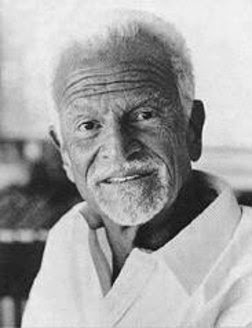
Gerald FriedIn his stand-up act, Dana Gould hilariously envisioned the composer of the Spock bass guitar theme from the original Star Trek as a tortured drug addict cursing loudly at four in the morning like a junkie version of Don Music from Sesame Street while trying to come up with the perfect theme for Spock. The calm and genial Gerald Fried--the now-retired TV and film composer who penned both Spock's theme and Kirk's frequently spoofed fight theme for Star Trek's 1967 "Amok Time" episode--isn't exactly Don Music on smack.

As I await both J.J. Abrams' new Star Trek feature film and its Michael Giacchino score--which I've refused to hear excerpts from until I see the film itself--I thought it would be the perfect time to transcribe half of a phoner I recorded with Fried (pronounced "freed") for the terrestrial radio incarnation of A Fistful of Soundtracks in 1999. (Almost all the pre-2000 broadcasts of A Fistful of Soundtracks were pre-recorded on audiocassette, and I don't have the equipment to transfer audiocassette content to computer--the audio quality would suck anyway--so I'd rather just post text of the interview below.)

During our conversation, Fried promoted the 1999 Silva Screen Records release Dr. Strangelove: Music from the Films of Stanley Kubrick, which contained re-recordings of themes Fried composed for the first few films of his childhood friend Kubrick. But what I was most interested in was Fried's TV work, which he loved doing despite the rushed schedules and older TV's tendency to recycle score music to cut costs ("As a composer, it's disturbing to hear music I wrote for one scene appear somewhere else," said Fried in a 1991 Starlog magazine interview). I particularly enjoyed talking with Fried about his scores for the Roots miniseries, which I first caught when the Family Channel (now ABC Family) reran it while I was in high school, and the original Star Trek, which I grew up watching and is now being relaunched by Abrams on the big screen.

Young Spock gives 90210 Kirk an 'Amok Time'-style ass-whupping.
(Photo source: TrekCore)

Jimmy J. Aquino: Now Jerry Goldsmith wrote the theme to The Man from U.N.C.L.E. Lalo Schifrin wrote the theme to Mission: Impossible. Alexander Courage wrote the theme to Star Trek. When you worked on those shows, were you ordered by the producers to compose in their styles or were you allowed artistic freedom?

Gerald Fried: We had to refer to the theme, which was okay with me. I think both those themes... The Sandy Courage thing, you know, that female voice--that was kind of stupid to me. Jerry's theme and Lalo's theme from Mission: Impossible are just fine. I had no problem using them.

As far as style goes, the first year, Jerry Goldsmith, I think, scored most of the Man from U.N.C.L.E.s, and it was a kind of symphonic style. Then they brought me in the second year, and Lalo also did a few of them, and we were the ones who changed it into a kind of Latino jazz... you know, the... [Hums his faster-paced arrangement of Goldsmith's U.N.C.L.E. main title theme.] That was my kind of contribution. They wanted style change from Jerry's style, and then it stuck pretty much like that for the next two or three years, however long the series ran.

JJA: Yeah, when it changed to color, they got campier and less serious.

GF: Yeah, which was part of the joy of doing it.

JJA: Now I want to talk about what I remember you the most for, your work for Star Trek. You did a total of five episodes: "Shore Leave," "Amok Time" I remember most fondly, as well as "Catspaw," "Friday's Child" and "The Paradise Syndrome." Was Star Trek taken seriously in the industry when it initially aired on NBC like it was by the sci-fi community or did everybody you know in the industry dismiss it as, you know, shallow, Flash Gordon-type hokum?

GF: Somewhere in between. They had no idea that it would become part of Americana. But neither did they see it as a piece of junk. You got some pretty classy writers--Harlan Ellison and some of the big sci-fi writers--so I think it was respected, and Gene Roddenberry was kind of an impressive guy. But certainly, they had no idea that it was going to take hold as it did.

JJA: I remember reading reviews from the '60s when it premiered, and Variety and TV Guide dismissed it as being shallow and just another space opera.

GF: Heh! Okay. I hope Gene Roddenberry is enjoying that statistic wherever he is.

JJA: He got the last laugh.

GF: Yes, he sure did.

JJA: Now for "Shore Leave," you wrote two unforgettable themes: the love theme for when Kirk is reunited with Ruth, his first love, and the Irish tune for Finnegan, Kirk's bully from his academy days. Tell me about writing those themes.

GF: Well, the love theme--the flute solo--was just kind of a movie-type pop thing, which I thought was appropriate and immediately accessible. The other one--I figured, well, how do you do it? It was an opportunity to write something special, kind of like an epic Irish fistfight. Remember the movie The Quiet Man? Something like that. To keep it Irish and keep it large and keep it insouciant like the Finnegan character was. So it seemed like a jig would be a good idea, and I was nervous about it because whenever you take a gamble, you're always in danger of having some conservative person throw it out. Well, [Bob] Justman and Roddenberry did not throw it out. But you do get nervous when you take chances like that, which I always do because I think any good composer... Jerry Goldsmith is the greatest chance-taker, probably of all time, and Elmer Bernstein... Yeah, I love them for that, for letting me do something with some kind of left-field imagination.

JJA: Now in "Amok Time," you created a theme for Spock for bass guitar. Let's talk about that. Why a bass guitar for Spock?

GF: Spock had a lot of trouble with emotion. If he did have any, he hardly knew how to get it out. Now if you try to play a lyrical line on a big thumpy bass guitar, you're gonna have trouble sounding lyrical, so I thought it would be a match to write a lyrical theme but put it on the bass guitar. It somehow parallels Spock's trouble and confusion with emotion.

JJA: Who played the bass guitar?

GF: Barney Kessel.

JJA: What were some of his previous credits? Did he work with you before?

GF: Yeah, he was a studio guitarist by the time I came to him, but before that, he was one of the half-dozen greatest jazz guitarists in history. You'll find him on records like with Art Tatum and Earl "Father" Hines. He's right up on the top. In fact, he, Herb Ellis, Joe Pass, Kenny Burrell, Eddie Lang and Charlie Christian--I just named to you the half-dozen great guitar players of all time.

JJA: Before you wrote the scores for the Star Trek episodes, were you handed the script or did you watch the episode first? The dailies?

GF: Yeah, there were no videocassettes in those days, so you get a chance to see... no, not the dailies. They called it then a workprint, and that was usually like about 10 or 12 days before airtime, so it was very scary. You just go home and work practically 22 hours a day for an intensive five or six days. You see it once. At first, Bob Justman--and maybe even Roddenberry for the first one--sit there with you and then we talk about where the music should go. The last few, they were so busy and so tired and so worried about the next show that I just thought by myself with the music editor in the room and just chose where the music goes and what I should do by myself.

'Spock, let go! This big-ass Hershey's Kiss on a stick is MINE!'JJA: Now your music for the Kirk/Spock fight scene in "Amok Time" has been called the greatest fight music ever written for television. It's even been quoted in parodies of Star Trek.

GF: Oh yeah. [Laughs.]

JJA: For instance, the characters on Mystery Science Theater 3000 would hum the fight music whenever they saw a B-movie fight scene.

GF: [Laughs.] That's funny. I know. I get royalties from The Simpsons and The Cable Guy. I know it was used there.

JJA: Do fans at the Star Trek cons come up to you and hum the fight music?

GF: Yeah, I actually attended two or three of those Star Trek conventions. There was a program. I made a suite of all my main themes from Star Trek into sort of a concerto for oboe, which I played myself. I'm still an oboe player. Yeah, some people would come up and talk mostly about those specifically.

JJA: I know that in television, like you said before, composers don't have much time to work with. Do you feel your music is better when it's written in such a limited amount of time or do you feel the opposite?

GF: I had only one opportunity to find out because 100 percent has been on a rushed schedule. The exception is the documentary Birds Do It, Bees Do It. I had lots of time for that. That was my one and only Oscar nomination, so maybe there is a correlation. Except for that, I have no way of knowing!

The 'Amok Time' action figure collection: for lonely housewives who want to reenact the 'Amok Time' fight with their Kirk and Spock dolls but always thought, 'It needs tons of kissing.'

JJA: Now themes from your Star Trek scores would be recycled in many episodes. Were you flattered by this or did you find that practice inappropriate?

GF: Well, if I were to give a speech on the aesthetics of film composing, I'm sure I would rant and rave about "music must be composed specifically for this and that." But when you get your music, for one thing, played on network television, you've got a helluva lot of money, and that kind of tempers your thinking... It doesn't temper your thinking. It tempers your mouth, so I didn't do any public complaining. Sometimes, I thought it was ludicrous what they did, and sometimes, I think, "Well yeah, alright, it sort of works." But generally, I'd like to go down in the books as saying it's a bad policy. It makes a product out of movie and TV stuff. I still like to consider it a great art form, so with that high road in mind, I come down against it.

JJA: So how do you feel when people come up to you and say, "Oh, I like that love theme from 'This Side of Paradise,'" but it was the love theme from "Shore Leave"?

GF: Yeah. [Laughs.] I smile. What are you gonna do? Read them a lecture on cinematic aesthetics?

JJA: Anybody who has worked on the original Star Trek, whether they're an actor, a writer or a composer, is always stopped on the street and remembered for their contribution even if it was only a guest stint. Why do you think Star Trek has been so popular?

GF: I think the intent and quality of the writing and the concept of it, to try and comment on earthly problems in terms of outer space... The dynamics of jealousy, rage, envy, power, lust and all those things were commented on intelligently and fairly. I think they reflected--as all good writing does--on the conditions of all the people down here on Earth, and I think that came through.

JJA: Any advice for anybody who took one listen to your music from Star Trek and said, "I wanna do that too"?

GF: [Laughs.] Yeah, it's possible. There will always be music for movies and television. It's hard to get into because a lot of people want to do it, but if there's a major motivation, and the person is willing to do the work and the research and become an all-around person in music... The days of having specialists are over. Producers need to hire a composer who they know has enough range, so that they can handle whatever problem might come up. Yeah, my advice is go for it.

Tuesday, February 17, 2009

AFOS: "Galloping Around the Cosmos" playlist

Airing this week on the Fistful of Soundtracks channel is the 2008 Fistful of Soundtracks: The Series episode "Galloping Around the Cosmos" (WEB94), which focuses on the music from the original series era of the Star Trek feature films. J.J. Abrams' new Trek film is being scored by frequent Abrams collaborator Michael Giacchino, whose scoring sessions were captured by ScoringSessions.com with tongue firmly planted in cheek.

I'll take 'Things That Make a Commitmentphobe Run the Fuck Away' for $200, Alex.

1. Jerry Goldsmith, "Ilia's Theme," Star Trek: The Motion Picture: 20th Anniversary Collector's Edition, Columbia/Legacy
2. Jerry Goldsmith, "Main Title/Klingon Battle," Star Trek: The Motion Picture: 20th Anniversary Collector's Edition, Columbia/Legacy
3. James Horner, "Genesis Countdown," Star Trek II: The Wrath of Khan, GNP/Crescendo
4. James Horner, "Epilogue/End Title," Star Trek II: The Wrath of Khan, GNP/Crescendo
5. Leonard Rosenman, "Chekov's Run," Star Trek IV: The Voyage Home, MCA
6. Leonard Rosenman, "Home Again: End Credits," Star Trek IV: The Voyage Home, MCA
7. Ray Heindorf & the Warner Bros. Studio Orchestra, "Main Title" (from East of Eden), A Tribute to James Dean, Sony Classical
8. Cliff Eidelman, "Sign Off," Star Trek VI: The Undiscovered Country, MCA
9. Cliff Eidelman, "Star Trek VI Suite," Star Trek VI: The Undiscovered Country, MCA

Repeats of A Fistful of Soundtracks: The Series air Monday night at midnight, Tuesday and Thursday at 4am, 10am, 3pm, 7pm and 11pm, Wednesday night at midnight, and Saturday and Sunday at 7am, 9am, 11am, 1pm, 3pm and 5pm.

Wednesday, November 19, 2008

New trailer proves movie version of '70s cartoon show Star Trek doesn't look promising

The original Star Trek's opening title card.

By special guest blogger Sonny Gautier

One of my favorite TV shows is the Saturday morning cartoon Star Trek, which NBC first broadcast in 1973. It aired right after Hanna-Barbera's Butch Cassidy and the Sundance Kids cartoon and followed the adventures of Captain Kirk and the crew of a "starship" called the U.S.S. Enterprise. Their mission was to explore outer space. Along the way, the crew would butt heads with evil Klingon commanders, Orion pirates and dangerous energy cloud monsters.

Captain Kirk tussles with an Orion pirate.
The captain was bad. I dug that episode when he fought that turkey from the Orion pirate ship over a shipment of medicine for a sick Mr. Spock, his pointy-eared first officer from the planet Vulcan.

Spock, Kid Spock and a tiger about to go tiger.
The Vulcan soul brother was an even badder dude than Kirk. He could read minds and he was always calm and cool like another hero of mine, John Shaft. When Spock traveled back in time to his childhood on his homeworld, he took down a wild Vulcan tiger by pinching it in the neck, which was some sort of mystical Vulcan ass-whupping move. That was bad. With moves like that, Spock will never die!

Lt. Uhura, holdin' it down on the switchboard.
I also dug how the ship had a black crewmember manning the switchboard. I especially liked when Lt. Uhura got to be captain for a whole story because all the men from the Enterprise were captured by an all-female planet. Black folks don't often get such high positions of power on TV like Uhura did in that Star Trek episode.

Lt. Uhura, holdin' it down as landing party leader.
So because I'm a fan of this forgotten cartoon, I was ecstatic about Paramount Pictures' upcoming major motion picture based on Star Trek.

That is until I saw the preview for it.

The movie doesn't look quite right. It doesn't look like the Star Trek I remember.

Kid Spock.
First of all, who cares about what Kirk and Spock were like as kids? The cartoon already showed us that Spock had a hard life as a mutt on Vulcan. His mama was human, his dad was Vulcan and the other Vulcan kids wanted to beat his ass. Why do we have to be told again how Spock came up? What else do we need to know, man? Can we just cut to the chase and see what the title says they're supposed to be doing, which is exploring space?

New Kirk.
Kirk looks too young to be captain. He looks more like a cadet. And what the hell happened to his Orange Kool-Aid-colored hair?

Jimmy told me that there's this TV show called Pimp My Ride, in which a bunch of people soup up your rickety old car. Looks like they've pimped Kirk's ride.
The new Enterprise is too fast a ship now! In the animated show, the Enterprise was never that fast! This will take some getting used to.

Spock loses his shit.
Why is Spock trying to pimp-slap Kirk? He never pimp-slapped anybody in the cartoon.

Damn, Uhura!
One thing I dig about the preview is Uhura. She looks outta sight! Uhura was the finest sister on Saturday morning TV since Valerie from Josie and the Pussycats in Outer Space. Because Star Trek was a Saturday morning cartoon, I never got to see her in a bra. Now I finally get to. Right on!

Another thing they never allowed on the NBC cartoon: intense ship-to-ship warfare.
Another thing I like is the brief footage of starships at war. The cartoon was never that intense and it never had so many things blow up. Man, I never saw so many ships attack each other like that!

This week's special guest director on Star Trek: Ingmar Bergman. Note: I wrote this alt tag--Jimmy A.
There's not a lot of face-to-face dialogue in the preview. In the cartoon, everyone talked to each other all the time and did it real close to the camera. Real close. And only their eyes and mouths moved.

Arex and M'Ress, two characters from the original show who got bamboozled by this J.J. Abrams guy.
Where's the orange skinny dude with three arms? Where's the alien cat lady? Where are those forcefield belts that the Enterprise crew wore whenever they walked out into space? It's not Star Trek without them.

C'mon, J.J. Abrams! How could you forget the forcefield belts? That's as important to Star Trek as the transporter room or the Enterprise. Without the Enterprise, Star Trek ain't nothing.
Often, a preview isn't really helpful in telling you if the flick is any good or not (that Superfly T.N.T. preview didn't prepare me for how much of a letdown that movie was), so I guess I'll reserve judgment until I see the entire Star Trek movie, which comes out this May. I hope it lives up to the cartoon.

----------

Me again, Sonny Gautier.Sonny Gautier is a new Fistful of Soundtracks listener from Bed-Stuy and he offered to review the new Star Trek trailer for my blog. Due to brain damage caused by exposure to too many Sid and Marty Krofft shows, a then-adolescent Sonny lapsed into a coma in 1974 and didn't wake up until last month, which means he missed the 10 Star Trek feature films and four Trek live-action spinoff shows that followed the cartoon. Because Sonny's only taste of Trek was the Saturday morning version before he slipped into his coma, he didn't know Trek originated as a live-action show until I pointed it out to him via e-mail a couple of hours ago. Because he doesn't want to be laughed at for his mistakes, Sonny has demanded that I remove his post. Yeah right, like I'm gonna remove it. This shit's too funny.

J.J. Abrams, don't let me down.