This is the second of 12 or 13 blog posts that are being posted on a monthly basis from January 2017 until this blog's final post in December 2017.
Once upon a time, I ran an Internet radio station that streamed film and TV score music. I don't really miss running it. The audience for it dwindled over the years, and even though Live365, the Bay Area company that powered the station before the end of the Webcaster Settlement Act led to Live365's demise early last year, is being resuscitated, I don't have any plans to bring back the station.
But I've kept the station alive on Mixcloud, where I've archived a few hours of old station content and posted lots of new one-to-two-hour mixes of music from original scores. The most popular of those mixes has been a mix of Kyle Dixon/Michael Stein score cues from the first season of Netflix's unexpectedly popular Stranger Things. It's called "Where's Barb?"
Late last year, the score albums for the Magnificent Seven remake and the film version of Fences, which both star Denzel Washington, were sent to my inbox, and that made me want to edit together an entire mix of score cues from Denzel movies. Denzel has been one of my favorite actors, ever since he stole the 1989 white savior movie Glory (and won an Oscar for stealing it) in the same way Don Cheadle would later steal Devil in a Blue Dress from Denzel. In Glory, he was basically the Toshiro Mifune character from Seven Samurai: the shit-talking troublemaker and outsider who learns to channel his anger and penchant for self-destruction into a worthy cause and then (SPOILER!) dies a hero.
The late James Horner's score from that 1989 Civil War movie, Terence Blanchard's 1992 Malcolm X score and Hans Zimmer's 1995 Crimson Tide score are a trifecta of Denzel-related instrumental badassery. Put those three scores together in either a mix or an hour of radio programming, and that hour of music is automatically going to sound as rousing and badass as a Denzel speech. Procrastinating on a writing project or that load of laundry? Put on the badass "Fruit of Islam" from Malcolm X's classic hospital march sequence. Immediately after hearing "Fruit of Islam," shit is going to be done. Laundry is going to be washed.
This month is the perfect time to post a mix of score cues from Denzel flicks. Several of Denzel's most highly regarded movies are frequently recommended during Black History Month by the likes of film critics and librarians, and Fences, Denzel's third big-screen directorial effort, is up for a few Oscars this weekend. Viola Davis, who reprised a role she had alongside Denzel in one of the various stage versions of Fences, is the frontrunner for the Best Supporting Actress trophy.
Throughout the Mixcloud mixes, I like to drop audio clips from the movies or TV shows that I've selected for score cue airplay. For this Denzel mix, I could have gone with audio from Denzel speeches as the connective tissue between each Denzel movie score cue, but I decided to go with something even more brash as connective tissue: clips from the very funny Earwolf podcast Denzel Washington Is the Greatest Actor of All Time Period, hosted by stand-ups W. Kamau Bell, the host of the CNN documentary series United Shades of America, and Kevin Avery, a writer for Last Week Tonight.
Bell, Avery and a special guest Denzealot, whether it's another comedian, a black filmmaker or one of Denzel's previous co-stars, dissect the work of their favorite charismatic actor, with lots of humor and occasional jabs at things like Virtuosity (the poorly received 1995 Denzel cyber-thriller that pitted 'Zel against a murderous A.I. played by a pre-L.A. Confidential Russell Crowe) and Denzel's visible discomfort during Much Ado About Nothing's frolicking scenes. Denzel himself is aware of the podcast's existence. But I highly doubt he's ever going to be a guest on this podcast that both celebrates his many triumphs as an actor (as well as a director of both episodic TV and small-scale feature films) and dredges up Virtuosity-esque career missteps, and Denzel's recent Fences press junket comment about not wanting to live in the past confirmed it. The podcast doesn't just live in Denzel's big-screen (and small-screen) past. It raises kids and builds a whole garden of gladioli in his past.
Jason and the Argonauts (Photo source: DVD Beaver)
I had no idea the Oakland film score album label Intrada is actually 30 years old until reading about the label's 30th anniversary reception, which took place at L.A.'s Walt Disney Concert Hall over Labor Day Weekend. Besides being one of my favorite score album labels--selections from four of Intrada's expanded score album reissues are currently in rotation on AFOS--Intrada is one of the most professional score album labels/businesses when it comes to either handling production mistakes (when the label realized an expanded reissue of Alan Silvestri's Judge Dredd score contained a previously released re-recording of Jerry Goldsmith's beloved Dredd trailer music rather than the original recording as listed, it immediately stopped shipping copies and went back to correct the error) or simply being a music retail store.
Intrada is also a store that specializes in soundtrack albums. In fact, before Intrada started venturing into producing and releasing score albums in 1985 (its first release was the Basil Poledouris score from the original Red Dawn), it originated as a brick-and-mortar soundtrack store on Vallejo Street in San Francisco. When Amazon ran out of physical copies of Daniel Pemberton's excellent score to the new Man from U.N.C.L.E. two weeks ago, and I needed a physical copy of the U.N.C.L.E. score album for AFOS airplay (my laptop hard drive never has enough space to carry full albums in digital form), the first store I clicked to was Intrada. That's simply because of the Intrada online store's reliability in the past (whereas I had a lousy experience with some other soundtrack label/store, and unless I've thrown shade at it before, that store shall remain nameless). In just a few days rather than one week or more recently, three weeks, there it was in my mailbox, ready to be U.N.C.O.R.K.E.D.
Intrada's beginnings as a brick-and-mortar record shop in San Francisco (Photo source: Max Bellochio)
(Photo source: Bellochio)
Earlier this year, I vowed to never write a listicle again because 1) listicles at their worst are such lazy and vacuous writing; 2) the only list I want to read from anybody these days is the list of groceries I just scrawled down and stuffed into my shirt pocket a few minutes ago; 3) every time I see an article hed that consists of a numeral followed by a plural noun followed by "That You Didn't Know Were This," I feel like elbowing a millennial hed writer in the face; and 4) if your film music blog or pop culture site has posted tons of listicles where the hed begins with a numeral, and it continues to subject people to such lists, your blog or site sucks. So without ever succumbing to the listicle format, I will cite my favorite Intrada releases, just in time for the label's 30th anniversary. It's an intrada to Intrada, if you will. The first of these favorite Intrada releases of mine is the first Intrada release I ever snapped up for AFOS airplay, and this was back when AFOS was a college radio show and it wasn't an Internet radio station yet. Tombstone composer Bruce Broughton's 1998 re-recording of Bernard Herrmann's grand-sounding score from 1963's Jason and the Argonauts is no longer part of AFOS rotation due to station hard drive space, but if I did restore it to rotation, it would be the only film score re-recording that's part of any of the AFOS playlists.
I usually don't care for film score re-recordings because a lot of them don't sound like the film scores as I remember them--they sometimes don't even bother to replicate the same tempo--but Broughton's 1999 Jason and the Argonauts album is one of the better ones. Broughton and the Sinfonia of London's faithful and sonically pleasing reconstruction of Herrmann's score gives his Argonauts score the proper album release it never had. For many score album collectors, the 1999 Argonauts album is one of the first things that come to mind in regards to how Intrada label head Douglass Fake "pioneered re-recordings of scores unavailable on CD," as Film Score Monthly soundtrack CD artwork designer Joe Sikoryak once wrote on FSM's message boards.
Jerry Fielding's Bring Me the Head of Alfredo Garcia score album and the expanded score reissues for The Wind and the Lion (a rare collaboration between Goldsmith and director John Milius) and Kurt Russell's 1993 Wyatt Earp western Tombstone are three other Intrada releases that used to be part of AFOS rotation but currently aren't, and those three scores are indispensable parts of the action flicks they were written for. But of those three albums, the expanded Tombstone album is the most special for containing unused versions of Broughton's score cues and even Goldsmith's studio logo music for Cinergi (the '90s production company behind Tombstone), a logo jingle that could take on "Looking at Heaven," Broughton's imposing and swaggering Tombstone end title theme, in a duel of "¿Cuyos cuernos son más machos? ¿Bruno Broughton o Geraldo Goldsmith?"
The Intrada releases that do currently have selections that are part of AFOS rotation are, like the expanded Tombstone album, good examples of the high quality Intrada demonstrates in both extra content and packaging. The label's expanded reissues of the late James Horner's score from Clear and Present Danger--the score where a shakuhachi, a Japanese flute, became an effective way to make a suddenly empty printer paper tray sound like the end of the world--and Craig Safan's spirited Last Starfighter score are huge improvements over previous editions, as are the label's expanded reissues of the late Leonard Rosenman's score from Star Trek IV: The Voyage Home and Cliff Eidelman's score from Star Trek VI: The Undiscovered Country. It's fitting that Intrada wound up reissuing these Trek movie scores because of the label office's Bay Area location and Trek's use of San Francisco as a central Earthbound setting. Intrada's series of Trek score reissues from IV to VI continues the series of Trek score reissues that FSM began with Horner's scores to Star Trek II: The Wrath of Khan and Star Trek III: The Search for Spock and uses the same artwork and remastering crew members from the FSM editions (Sikoryak, reissue producer Lukas Kendall and digital mastering engineer Mike Matessino). The reissues carry comprehensive track-by-track liner notes and give Trek heads the option of enjoying both the albums as they first heard them on vinyl (or cassette) when they were younger and the score cues in their original and complete form.
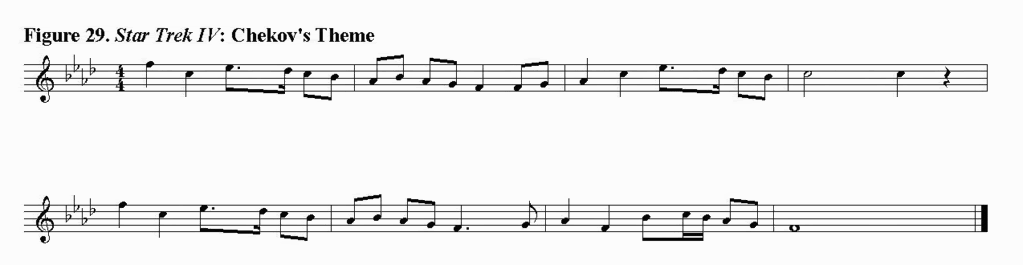
The bonus tracks on the expanded Trek IV and Trek VI albums are as golden as the fleece from Jason and the Argonauts. Though Wrath of Khan is the perfect Trek film (sorry, Star Trek: The Motion Picture defenders, but a three-way between a robot lady, a NASA satellite and a child-molesting star of 7th Heaven isn't as affecting an ending as you think it is), it contains some last-minute reshoots, particularly a final shot of Spock's casket on the Genesis planet that Wrath of Khan producer Harve Bennett added to soften the blow of Spock's death after some negative test screening reactions, and Horner had to insert some new music in order to accommodate the reshot footage. FSM's Wrath of Khan score reissue includes as a bonus track the version of the end title cue before Bennett asked Horner to squeeze in additional music, and the original version gives us a glimpse into an intriguing alternate reality where Spock never came back and nobody kept trying to remake Wrath of Khan by half-assedly killing off major characters during starship battle scenes. Intrada's Trek score reissues are filled with equally fascinating extras. Rosenman's mostly light-hearted Trek IV score is the most divisive of the scores from the first six Trek movies, and one of my favorite parts of Rosenman's score is a cue that didn't make the final cut. It's Rosenman's update of the late Alexander Courage's opening title theme from the '60s Trek, a cue that was intended to accompany the film's opening titles and was meant to, as described by the Trek IV screenplay, announce that "We're in for a classic, good old Star Trek time."
But when the late Leonard Nimoy, who directed Trek IV, heard the new arrangement of Courage's full theme, he thought the cue failed to properly introduce Trek IV as a jubilant and tonally lighter change of pace in the big-screen adventures of Kirk and his crew, so he asked Rosenman to take the cue he already completed for Trek IV's end titles, which was full of the sense of fun and adventure Nimoy wanted for the opening titles, and reshape that for the opening. Intrada's expanded Trek IV album saves Rosenman's unused arrangement like it's an endangered whale, and that's the version of the Trek IV main title theme that's currently in rotation on the AFOS blocks "Hall H" and "AFOS Prime."
One other bonus track that makes Intrada's Trek IV score reissue worthwhile is the complete version of the previously unreleased "I Hate You," the source cue during Kirk and Spock's encounter on a San Francisco bus with an '80s punk played by Kirk Thatcher, Nimoy's assistant and an associate producer on the sequel (his name is a familiar one if you read the puppeteer credits at the end of Muppet projects). The source cue Thatcher wrote and recorded for his scene is basically a typical '80s sitcom version of punk rock, even after Thatcher objected to all the songs MCA Records, the label that first released the Trek IV score album, recommended for the boombox in his scene because he didn't think they were punk enough--which makes me wonder if MCA absent-mindedly forgot to suggest to the Trek IV filmmakers a bunch of cuts off its terrific Repo Man soundtrack (a classic punk album that also contains selections that are in rotation on "AFOS Prime"). Although that punk rock scene is the most sitcommy and Republican-dolt-reacting-to-10-year-old-changes-in-music-ish moment in Trek IV, the presence of "I Hate You" on the expanded album reminds you how funny Thatcher actually is in his mute bit part.
As interesting as those two Trek IV bonus tracks are, even they're outgunned and outwarped in terms of specialness by the two most noteworthy bonus tracks on Intrada's Trek VI score reissue: two versions of the exhilarating Trek VI trailer music, which marked the first time a Trek movie had original music written for its advertising campaign by the movie's composer, who was Cliff Eidelman in this case. Back in fall 1991, Eidelman's trailer music tantalizingly hinted at the more serious and dramatic direction Wrath of Khan director Nicholas Meyer wanted for both the 1991 sequel and Eidelman's score (Meyer envisioned quoting Holst's The Planets throughout the sequel, but The Planets was too expensive for his blood, so he settled for a Planets-style score), and it did so in only less than two and a half minutes.
Fully loaded score album reissues and lavishly produced re-recordings are among Intrada's finest moments as a label (the same goes for Varèse Sarabande). But when Intrada presents a previously unreleased film or TV score in its entirety for the first time, more than 25 years after the film or show debuted, that's special too, especially when that world premiere release allows listeners to pay closer attention to subtleties in the music that could easily be overlooked due to action sequence sound FX or other circumstances.
Director Peter Hyams' 1977 NASA conspiracy thriller Capricorn One is one of the weirdest conspiracy thrillers from the '70s: O.J. Simpson plays one of the good guys; Telly Savalas shows up for a comedic cameo where he's basically playing Ernest Borgnine; Sam Waterston tells a lengthy joke to himself that turns into a monologue that's as crazy as the one his actress daughter Katherine delivers completely nude 37 years later during Inherent Vice; the reporter characters, who are often either expendable or simply evil in other films, actually get to live through the whole film and triumph; and the film is more concerned with pleasing the audience than with becoming as bleak as The Parallax View or Chinatown. It's a crowd-pleasing and enthralling conspiracy thriller in a lot of the same weird ways that the late Tony Scott's Enemy of the State is a crowd-pleasing and enthralling conspiracy thriller (speaking of Enemy of the State, what's with all the shots of people's pets, and why is the scene where Frasier regular Dan Butler barely says a word to Jon Voight and looks like he's about to jump out of his seat and fuck Voight up in front of the NSA my favorite scene in that flick?). Capricorn One wouldn't have held up as a thriller without either Hyams' action filmmaking skills, particularly during a still-remarkable-looking helicopter chase Hyams wisely left unscored, or Jerry Goldsmith's thunderous and menacing score, which was only available in the form of a less avant-garde-sounding Warner Bros. Records re-recording before Intrada got its hands on the score recording sessions and released in 2005 the score cues as they were featured in the film.
"The actual soundtrack has more to say [than the re-recording]. It still leaps out of the starting gate but then heads off to explore. It's more complex," wrote Douglass Fake in the liner notes of the Capricorn One score album, which went out of print and was recently reissued by Intrada with remastered sound. The album allows Capricorn One fans to discern those aural complexities, particularly in the film version of the end title theme, which is currently in rotation on "AFOS Prime."
Instead of the triumphant composition Goldsmith chose as the final track in his Capricorn One re-recording, Fake restores to the conclusion the end titles' restatement of the menacing motif Goldsmith created for the helicopters that chase the terrified astronauts who refuse to play ball and pretend their faked mission to Mars was real, a cue that's "neither triumphant nor in major" and is, as Fake adds, "powerful and thought provoking." My first encounter with that helicopter theme wasn't in Capricorn One itself. The helicopter theme was a fixture of '90s KMEL afternoon drive-time host Rick Chase's show, and whenever I'd hear that instrumental bed during Chase's show, I'd be like, "I wanna see the movie that instrumental's from because the movie's probably bonkers." When I did finally watch Capricorn One, I was right about its bonkersness.
We have Intrada to thank for allowing the audience to enjoy all these exemplary scores in their purest form and in the best possible audio quality. Listening to these scores in that caliber of audio quality and in their entirety really makes you feel like you're either an Argonaut, an Earp, a heroic Starfleet officer or a crusading reporter. Here's to 30 more years of bonus surprises and passionate reassessments of old but outstanding scores from Intrada.
Selections from Intrada's releases of the scores from Clear and Present Danger, The Last Starfighter, Star Trek IV, Star Trek VI, Capricorn One and Marvel's The Avengers can currently be heard on AFOS.
"There were so many Horners," said Matt Zoller Seitz to fellow journalist S.I. Rosenbaum during a RogerEbert.com conversation about the work of legendary film composer James Horner, who died at 61 in a single-engine plane crash earlier this week. "There was the shoot 'em up, macho, urban Horner of 48 HRS and Commando and Red Heat, the grand adventure Horner of the Trek films and Aliens and Titanic and Avatar, the caper Horner of Sneakers... He really did have range."
Anyone who's a film music fan has a favorite Horner. Film music heads who are into Horner deep cuts--and are of the opinion that Horner tended to repeat himself, especially in the middle part of his career--will likely say the Horner of Battle Beyond the Stars is their favorite, while more casual film music heads will likely pick the Horner who made teenage girls cry with his score to Titanic. For me, it's either the Horner who made nerds cry with his scores to Star Trek II: The Wrath of Khan and Star Trek III: The Search for Spock or the Horner who gave the third best performance, right below Denzel Washington and Andre Braugher, in Glory and crafted, with the help of the Boys Choir of Harlem, a powerful and operatic score for that 1989 white-savior-movie-that's-somehow-better-than-the-average-white-savior-movie.
The eerily prescientSneakers is one of many movies I just never got around to seeing until more than 20 years after its release. On New Year's Eve 2014, it was one of several titles Netflix streaming was getting rid of from its library after that night, so I couldn't pass up the chance to stream before its expiration this caper movie I--a fan of caper movies--bizarrely overlooked for too long. I instantly fell in love with the score Horner wrote for Sneakers. It's now one of my favorite Horner scores. Like Gimme the Loot composer Nicholas Britell said about the Sneakers score, it's music you wouldn't expect to hear in a hacker movie. "It features unlikely elements--choirs, folk themes, minimalist piano, the saxophone of Branford Marsalis--that lend the film an unusual emotional richness and depth," wrote Britell.
Dig the score cue Horner created for the scene where Robert Redford's crew discovers the codebreaker to end all codebreakers, and Redford and Sidney Poitier both realize it's too much power for anyone to have. I'm not a musicologist--I'd be unable to tell you the difference between an arpeggio and an ostinato--so I have no idea what Horner was doing with the piano during this scene. It sounds like he grabbed a cat that was wandering around the recording studio and let it walk all over the keys. It turned out to be an inventive and effective way to build tension for that scene.
So now I have a new favorite Horner: the Horner who, through his music, could take something as mundane-looking and boring on the screen as typing things into a PC and make it exciting. Horner's work in Sneakers reminds me of Clear and Present Danger, where Horner also worked his magic on a similar moment of computer-related tension. The nerve-wracking Bogota ambush sequence is what everyone remembers about Clear and Present Danger, but an equally memorable sequence--and one that's handled with a bit more humor, especially when Harrison Ford discovers there's no paper in his printer--is Ford's attempt to salvage all evidence of the government conspiracy Henry Czerny helped orchestrate right when Czerny deletes it from what we now call "the cloud." It's the second best action sequence in the movie, even though nobody fires a gun or a missile and nobody dies. Horner had a lot to do with that.
There's an old featurette TCM used to frequently air between movies about how crucial Elmer Bernstein's score was in enhancing The Magnificent Seven. The featurette took a clip where Bernstein's rousing main theme accompanied shots of Yul Brynner and his crew riding on horseback rather lethargically and posited that without Bernstein's theme, the scene was dead. Without Horner's "Deleting the Evidence" cue, which is part of the playlist for the AFOS espionage genre music block "AFOS Incognito," the computer showdown sequence would have been dead too.
Throughout Clear and Present Danger, Horner made use of a shakuhachi, a Japanese flute, to heighten tension. It's kind of an unconventional choice, just like the clumsy kitty cat stepping on the piano keys during Sneakers, because it makes you think, "Did one of those Peruvian pan flute bands that invaded South Park also invade the orchestra?," but it works for the hacking sequence. Horner would get pilloried a lot by film music critics for recycling his own previous motifs when he was alive, but that's not the case here: his score to Clear and Present Danger, a blockbuster that came out two years after Sneakers, sounds much different from his score to Redford's movie, and it echoes the differences in tone between the serious-minded Clear and Present Danger and the much more light-hearted Sneakers.
Today, hacking scenes are such a cliché that I can't watch another hacking scene without thinking of Jimmy Kimmel Live's transformation of Scandal into a telenovela. In one of those Kimmel Live sketches, Scandal star Guillermo Diaz made fun of the ways actors pretend to type on laptops by basically channeling the piano-playing sight gags in Tom and Jerry's "The Cat Concerto" and Bugs Bunny's "Rhapsody Rabbit" while he was typing. So from now on, every time I sit through a dramatic hacking scene, I can't get out of my head the funny image of Guillermo Diaz typing like Bugs Bunny on the piano. But back when these scenes hadn't yet crossed the line into unintentional silliness and very '90s Fisher Stevens entrances, Horner was the master of scoring these scenes, and his skills with those scenes were honed while working on the franchise that made his career: Star Trek. Again, it all goes back to Star Trek. Hell, everything goes back to Star Trek. What David Strathairn and Harrison Ford are doing at their terminals is basically what Kirk and Spock did to trick Khan into lowering his starship's shields in Star Trek II and what Kirk and Scotty similarly pulled off to steal back the Enterprise from Starfleet in Star Trek III. Horner's brilliance with musical texture and enlivening action that has the potential to look as dull as office work was also key to why those moments of starship bridge console trickery are such highlights of those Trek films.
I haven't been interested in a Horner score in ages, but now that his score to the upcoming Chilean miner survival drama The 33 has ended up being one of the last things he composed before his death, I'm curious about his work in The 33 (and in this summer's Antoine Fuqua-directed boxing drama Southpaw). I wouldn't be surprised if Horner was able to take another potentially static-looking scenario like a bunch of miners trapped for more than two weeks under a collapsed mine and help make that compelling as well. Which Horner are we getting for his last couple of scores?
Selections from Horner's scores to Star Trek II and The Rocketeer can be heard during both "AFOS Prime" and "Hall H" on AFOS, while selections from his score to Clear and Present Danger (and hopefully someday, selections from his score to Sneakers) can be heard during "AFOS Incognito."
One reason why I used to like glimpsing behind-the-scenes footage of Star Trek: The Next Generation on entertainment news shows in the '90s was because I got to see--from the news cameraman's point of view--what the actors looked like when they shook themselves around on the Enterprise-D bridge or shuttlecraft sets for scenes where the ship was under attack. Without the dramatic camera tilts, the actors looked goofier than Justin Bieber in an oversized baseball cap he stole from Pharrell's hat shop. All that flailing around (without the aid of those massive hydraulic gimbals that the crews of The Hunt for Red October and Crimson Tide were able to afford in order to believably simulate submarine motion) is a huge part of Star Trek acting, which Brent Spiner once described during one of those entertainment news shows as "a cross between Shakespeare and flying around the house with a towel around your neck."
Nowadays, there's motion stabilization software that can take the final versions of Star Trek battle scenes, remove the camera tilts and make those scenes look just like those old behind-the-scenes EPK clips of Star Trek actors shimmying around like crazy-looking white people in a B-52's video. The results of Star Trek getting motion-stabilized are being posted on a subreddit called Star Trek Stabilized. Somebody on YouTube must have noticed that the Star Trek actors' movements without the camera-shaking closely resemble the slo-mo'd thrashing around and twerking during the insane video for the DJ Snake/Lil Jontrap hit "Turn Down for What," which was directed by the Daniels (a.k.a. directors Daniel Kwan, the dancer whose crotch has a life of its own in the video, and Daniel Scheinert).
Now that anonymous somebody has taken Star Trek Stabilized .gifs and mashed them up with "Turn Down for What." The shit is perfect.
All that's missing from "Turn Down for Spock" is the sight of Data yelling "Yeaaah!" and "What!" Lil Jon is the black Jerry Lewis (I keep expecting to hear him yell out "Flavin!" in the middle of a track), and Holodeck Joe Piscopo once taught Data how to do a Jerry Lewis impression, so Data would be Lil Jon/Jerry Lewis in this situation. (Of course, like a lot of soundtrack album collectors, a lot of Star Trek heads are musically narrow-minded, "get off my Salam grass lawn" types who don't understand either trap or the "Turn Down for Spock" video's references to the Daniels' video, so they leave annoying YouTube comments under the "Turn Down for Spock" video like "Music ruined it for me" and "Great compilation, but the soundtrack is crap.")
One of the .gifs in "Turn Down for Spock" is a clip from a Star Trek II: The Wrath of Khan battle scene. The title of the classic James Horner score cue during that particular battle scene is "Surprise Attack."
"Surprise Attack" isn't currently in rotation on "AFOS Prime" and "Hall H" on AFOS. But a bunch of other Star Trek II score cues are part of those AFOS blocks, including an alternate version of the Star Trek II epilogue cue that contains neither music Horner had to add at the last minute because of reshoots nor audio of Leonard Nimoy's voiceover (of what is now stupidly known as the Captain's Oath), and that alternate version is worthy of Spock's favorite adjective of "fascinating."
Manigong Bagong Taon. This is the only year-end list I will do because I hate doing these year-end things. Selections from all five of the following CDs can be heard during "Assorted Fistful" on the Fistful of Soundtracks channel.
5. Big Trouble in Little China (La-La Land)
The cheesy end title song, in which director/composer John Carpenter does his own singing, hasn't aged as well as the rest of Carpenter's score or the movie itself, which remains subversive for giving its Asian American characters a chance to shine as the heroes of the piece for once in a genre that still doesn't care for Asian American protagonists (and no, Jackie Chan doesn't count as an Asian American lead, shitbird).
4. Batman: Mask of the Phantasm (La-La Land)
La-La Land followed up the long-overdue Batman: The Animated Series box set with an expanded version of the score from the show's 1993 feature-length spinoff. Before Christopher Nolan came along, the Bruce Timm incarnation of Batman was the definitive screen take on the Dark Knight. Batman: The Animated Series was also beautifully scored by the late Shirley Walker, who provided music for Phantasm that's both powerful and playful (the choir is actually singing backwards pronunciations of the names of Phantasm crew members and orchestrators).
3. The Split (Film Score Monthly)
I was on a Donald E. Westlake kick during the summer because of the release of Darwyn Cooke's adaptation of The Hunter and the debut--in any format--of an unknown and very sampleworthy Quincy Jones score to a forgotten 1968 Jim Brown flick based on The Seventh. Say the following five words--"caper movie score by Q"--and I'm there, baby.
2. Star Trek II: The Wrath of Khan (Film Score Monthly)
One cool thing about FSM's reissue of the Khan score is that it gives listeners the option of hearing the film's end title music without Leonard Nimoy's voiceover, an element of the 1982 Atlantic release that annoyed those who prefer not to hear dialogue during score albums. Also, it's nice to finally have the complete score. Somewhere, Ricardo Montalban's smiling.(*)
(*) I hate that Flanders-esque catchphrase from Fantasy Island. It's mostly because a former co-worker I couldn't stand liked to say "Smiles, everyone, smiles" a lot.
1. Bullitt (Film Score Monthly)
FSM also stands for Fulla Surprises, Man. Sometimes, I won't visit the FSM site for weeks, and I'll miss announcements like the debut release of Lalo Schifrin's Bullitt score as it was heard in the film (Schifrin's 1968 and 2000 re-recordings of his score, one of which is included on the CD, are both decent, but I always preferred the way the score originally sounded in the film). I didn't know about FSM's Bullitt CD until a couple of weeks ago and immediately snapped it up. The Bullitt score is my second favorite Schifrin film score after Enter the Dragon. The main theme has been covered so often that it's a shame the original rendition hasn't been available on CD until now.
Starting today at 8am, these September '09 playlists (intro'd by yours truly, of course) will air all through the month on the Fistful of Soundtracks channel. Until September 29, they'll be repeated every Tuesday and Thursday at 4am, 10am, 3pm, 7pm and 11pm and every Saturday and Sunday at 7am, 9am, 1pm, 3pm and 5pm.
"Eelmatic":
1. James Horner, "The Eels of Ceti Alpha V/Kirk in Space Shuttle," Star Trek II: The Wrath of Khan, Retrograde/Film Score Monthly
2. James Horner, "Captain Terrell's Death," Star Trek II: The Wrath of Khan, Retrograde/Film Score Monthly
"Promises, Promises":
3. Tom Jones, "Promise Her Anything" (from Promise Her Anything), Their Greatest Hits: Tom Jones and Engelbert Humperdinck, Rebound
4. Klaus Badelt, "The Promise," The Promise, Superb
"Chase Those Crazy Beatheads Out of Town":
5. Barry De Vorzon, "Baseball Furies Chase," The Warriors, Spectrum
6. J.J. Johnson, "Willie Chase," Willie Dynamite, Hip-O Select/Geffen
"Harkness, Everybody, Harkness":
7. Ben Foster, "Here Comes Torchwood," Torchwood: Children of Earth, Silva Screen
8. Ben Foster, "Judgement Day," Torchwood: Children of Earth, Silva Screen
"Tarantino Raided My Soundtrack Cabinets":
9. Ennio Morricone, "Algiers November 1, 1954" (from Battle of Algiers), The Ennio Morricone Anthology: A Fistful of Film Music, Rhino
10. Giorgio Moroder & David Bowie, "Cat People (Putting Out Fire)," Cat People, MCA
11. Lalo Schifrin, "Tiger Tank," Kelly's Heroes, Film Score Monthly
"The Hottie and the Ostinati":
12. The Paramount Studio Orchestra, "Prelude and Rooftop," Vertigo, Varèse Sarabande
13. The Paramount Studio Orchestra, "The Streets," Vertigo, Varèse Sarabande
"Schnapps for Breakfast":
14. Bernard Herrmann, "Thank God for the Rain," Taxi Driver, Arista
15. Bernard Herrmann, "Getting Into Shape/Listen You Screwheads/Gun Play/Dear Father & Mother/The Card/Soap Opera," Taxi Driver, Arista
"R.I.P. Erich Kunzel":
16. Cincinnati Pops Orchestra, "Overture" (from The Seventh Voyage of Sinbad), The Great Fantasy Adventure Album, Telarc
"I Guess This Means That Alias/Alias Crossover's a Possibility Now":
17. Michael Giacchino, "On the Train," Alias: Season Two, Varèse Sarabande
18. Eric Rogers, "Spider-Woman," Sci-Fi's Greatest Hits Vol. 4: Defenders of Justice, TVT
"English as Language Second":
19. Ennio Morricone with Maurizio Graf, "Il Ritorno Di Ringo" (from The Return of Ringo), The Ennio Morricone Anthology: A Fistful of Film Music, Rhino
20. Guido & Maurizio De Angelis featuring Susi & Guy, "Driving All Around" (from Il Cittadino Si Rebella), Beretta 70: Roaring Themes from Thrilling Italian Policefilms 1971-80, Crippled Dick Hot Wax!
21. Seatbelts featuring Masayoshi Furukawa, "You Make Me Cool" (from the "Mushroom Samba" episode), Cowboy Bebop: No Disc, Victor
22. Seatbelts featuring Mai Yamane, "Want It All Back" (from the "Asteroid Blues," "Stray Dog Strut" and "Speak Like a Child" episodes), Cowboy Bebop: No Disc, Victor
"Westlake Ho":
23. Johnny Mandel, "Trackdown" (from Point Blank), Point Blank/The Outfit, Film Score Monthly
24. Quincy Jones, "Kifka Car Caper," The Split, Film Score Monthly
25. Quincy Jones, "Main Title," The Hot Rock, Prophecy
26. Jerry Fielding, "Office Scuffle/Kenilworth Heist/Casino Heist" (from The Outfit), Point Blank/The Outfit, Film Score Monthly
"Say Si, Not Oui":
27. La-33, "La Pantera Mambo," La-33, Walboomers
28. The Wondermints, "The Party," Shots in the Dark, Donna
"Alley OOP":
29. Elliot Goldenthal, "Obligatory Car Chase," Demolition Man: The Original Orchestral Score, Varèse Sarabande
30. Hans Zimmer, "Show Me Your Firetruck" (from Backdraft), Passions & Achievements, Milan
31. Royal Scottish National Orchestra, "End Credits" (from First Knight), Hollywood '95, Varèse Sarabande
"There Are Never Possibilities":
32. James Horner, "Epilogue (original version)/End Title," Star Trek II: The Wrath of Khan, Retrograde/Film Score Monthly
I was hoping a May 21 post about my unpublished 2007 wish list for J.J. Abrams' Star Trek prequel or reboot or preboot or whatever would be my last Trek-related post for a while. No dice.
A Film Score Monthly blogger recently posted a list of five Trek score cues that best sum up or represent the venerable franchise. It's a nice list--it's cool to see Gerald Fried get some love, and though I still think the nearly wordless Star Trek: The Motion Picture travel pod sequence (in which Admiral Kirk looks like he wants to take his own starship behind a Spacedock and get her pregnant) is overlong, it's hard to dispute the post's argument that the pod sequence contains one of Jerry Goldsmith's most sublime moments as a film composer. The list inspired me to post my five favorite cues from the franchise and stream a block of these five tunes on the Fistful of Soundtracks channel all through August.
1. Charles Napier, "Heading Out to Eden," Star Trek ("The Way to Eden")
This "Way to Eden" number is one of Trek's proudest musical moments.
2. Charles Napier, "Hey Out There!," Star Trek ("The Way to Eden")
This other "Way to Eden" highlight is such a poignant expression of Gene Roddenberry's philosophy of IDIC (Infinite Diversity in Infinite Combinations).
3. Charles Napier, "The Good Land," Star Trek ("The Way to Eden")
Aw, Trek, you can do no wrong.
Not exactly a shining moment in the career of legendary female Trek scriptwriter D.C. Fontana (who hid behind an even more male-sounding pseudonym for the heavily rewritten "Way to Eden"), Trek's atrocious space hippies episode is proof that network TV series writers in their 30s or 40s aren't the best people to turn to when you need someone to capture the pulse of the counterculture.
"I Hate You" is such an ersatz punk tune Avril Lavigne mistook it for the real thing.
It's funny that Thatcher complained about the inaccurate sound of the music that was previously selected for the Trek IV bus scene because lyrics-wise, the song he contributed ended up sounding only slightly more authentic. A real punk band would never say "Screw you!" like Thatcher's "Edge of Etiquette" did during "I Hate You."
Seriously, here are my actual five definitive Trek cues.
1. Gerald Fried, "The Ritual/Ancient Battle/2nd Kroykah," Star Trek ("Amok Time") Fried would bristle whenever the show would recycle cues like what I think is his crowning achievement, the piece that launched a million Trek music parodies ("Sometimes, I thought it was ludicrous what they did [to keep the series' music budget down], and sometimes, I think, 'Well yeah, alright, it sort of works.'"), but after the show's post-network success, I bet he's been touched by how much recognition and spoofage his catchy fight theme receives.
2. Sol Kaplan, "Kirk Does It Again," Star Trek ("The Doomsday Machine")
Oh, so that's where John Williams got his Jaws theme from.
3. Jerry Goldsmith, "Spock Walk," Star Trek: The Motion Picture
The cue that best captures the cerebral and mysterious feel of The Motion Picture isn't the rousing but somewhat out-of-place main title theme. It's the eerie "Spock Walk," which accompanies the movie's only genuinely thrilling sequence (besides the still-dazzling opening shot of the Klingon armada and the upgraded Enterprise's launch sequence): Spock's thruster-suited trip into the v'gina of V'Ger. As a Trek installment, ST:TMP is uninvolving, witless and flat (the original cast comes off as nervous and stiff in their first feature film together), but it's a triumph of mood and atmosphere, especially during the spacewalk sequence and the sterling Goldsmith cue that accompanies it.
4. James Horner, "Battle in the Mutara Nebula," Star Trek II: The Wrath of Khan
My favorite Trek II cue, which kicks off when Kirk bites into his apple and tells Saavik, "I don't like to lose," accompanies the perfectly paced sequence in which the Enterprise and the Reliant circle each other like a matador and a bull with nacelles instead of horns.
5. Michael Giacchino's Star Trek main title theme (not found on the score album--the brief cue is most likely just snippets of "Enterprising Young Men" edited together)
The moment this enjoyably pompous new theme played over the opening title image of the gleaming Starfleet arrowhead insignia, I knew Trek was back--even though the theme wasn't Alexander Courage's classic fanfare. Like the rest of Giacchino's new material during the score, Kirk's theme, in its various forms, perfectly embodies the spirit of classic Trek.
Some viewers are disappointed that Courage's fanfare doesn't appear until the film's climax. Have they forgotten this is a prequel? To borrow Giacchino's own words, this film is about everything that came before the Trek we know. Delaying the classic Trek theme (a la the late appearance of "The James Bond Theme" in David Arnold's Casino Royale score to enhance the moment when the upstart hero finally comes into his own) was a bold and fitting move.
Airing this week on the Fistful of Soundtracks channel is the 2008 Fistful of Soundtracks: The Series episode "Galloping Around the Cosmos" (WEB94), which focuses on the music from the original series era of the Star Trek feature films. J.J. Abrams' new Trek film is being scored by frequent Abrams collaborator Michael Giacchino, whose scoring sessions were captured by ScoringSessions.com with tongue firmly planted in cheek.
1. Jerry Goldsmith, "Ilia's Theme," Star Trek: The Motion Picture: 20th Anniversary Collector's Edition, Columbia/Legacy
2. Jerry Goldsmith, "Main Title/Klingon Battle," Star Trek: The Motion Picture: 20th Anniversary Collector's Edition, Columbia/Legacy
3. James Horner, "Genesis Countdown," Star Trek II: The Wrath of Khan, GNP/Crescendo
4. James Horner, "Epilogue/End Title," Star Trek II: The Wrath of Khan, GNP/Crescendo
5. Leonard Rosenman, "Chekov's Run," Star Trek IV: The Voyage Home, MCA
6. Leonard Rosenman, "Home Again: End Credits," Star Trek IV: The Voyage Home, MCA
7. Ray Heindorf & the Warner Bros. Studio Orchestra, "Main Title" (from East of Eden), A Tribute to James Dean, Sony Classical
8. Cliff Eidelman, "Sign Off," Star Trek VI: The Undiscovered Country, MCA
9. Cliff Eidelman, "Star Trek VI Suite," Star Trek VI: The Undiscovered Country, MCA
Repeats of A Fistful of Soundtracks: The Series air Monday night at midnight, Tuesday and Thursday at 4am, 10am, 3pm, 7pm and 11pm, Wednesday night at midnight, and Saturday and Sunday at 7am, 9am, 11am, 1pm, 3pm and 5pm.
J.J. Abrams' big-screen reimagining of the original Star Trek won't be unveiled until we're well into the next administration, so in the meantime, on the next episode of A Fistful of Soundtracks, get your Trek on with my favorite score cues from what's known as the TOS era of the Trek feature films. For the newbies, TOS stands for "Terrifyingly Obese Shatner."
"Galloping Around the Cosmos" (WEB94) will begin streaming Tuesday, April 22 (midnight, 4am, 10am, 3pm, 7pm and 11pm).
Although four different men sat in the composer's chair, the epic scores of the first six Trek films were pretty consistent in quality, and that's rare to see in a long-running film series that went through many different producers, writers and directors. Even when an installment like Star Trek: The Motion Picture or Star Trek V faltered creatively, the music remained top-notch and satisfying (that's also due to the involvement of Silver Age great Jerry Goldsmith in those films).
ST:TMP contains one of my favorite Goldsmith scores, Nicholas Meyer's unequalled Star Trek II has my favorite James Horner score, Star Trek IV contains some of my favorite pieces by Leonard Rosenman, and Star Trek VI features my favorite score by Cliff Eidelman, who was touted as the next big thing in film music at the time of Trek VI's release but hasn't written anything as significant since then (unless you count The Sisterhood of the Traveling Pants).
The Star Trek IV LP was given to me as a Christmas present when I was a kid and is the first soundtrack album I ever owned. Because Rosenman recently passed away, WEB94 includes a brief tribute to Rosenman and his music.
Abrams regular Michael Giacchino is scoring the Trek reboot and has had a knack for this kind of epic material that's gone as far back as his scores for Alias and the Secret Weapons Over Normandy video game. I don't know how Giacchino feels about Gerald Fried's catchy fight theme from the old show, but I hope he does some sort of little tribute to that fight theme in his score. In Mission: Impossible III, Giacchino revived Lalo Schifrin's "The Plot" theme as a shoutout to the '60s Impossible, so I'll be a tad disappointed if he doesn't do the same with the national anthem of Decapod 10.
Abrams' goals for his Trek film sound promising. It's unlikely to be a heavy-handed and dull first movie like ST:TMP, which was nicknamed Star Trek: The Motionless Picture and Spockalypse Now because of its lackluster script and slow pace. (That must explain why the cast members wore pajamas during the movie.) The producers chose to model ST:TMP after 2001: A Space Odyssey instead of Star Wars--the movie everyone else was ripping off at the time--but imitating Kubrick was as much of a mistake as imitating Star Wars would have been. We wanted to see Kirk, Spock and McCoy wittily snipe at each other and debate over ethics and fight their way out of trouble like they often did on the '60s show, not stare silently for 10 minutes at garish visual effects. As an Everything2 review of ST:TMP notes, "Where the protagonists of the television series had been dynamic, there they were passive. Kirk & Co spent most of the film as bystanders, forced to watch things happen to them via the Enterprise's viewscreen."
The lively and textured Goldsmith score basically carries the movie. Next time you have the stones to sit through ST:TMP, watch it mainly for its score. It's that good. (Make sure the version of ST:TMP that you watch is the 2001 DVD-only Director's Edition, which doesn't quite fix the script's inadequacies--no updated effects footage ever could--but it's faster-paced than the theatrical cut.) My favorite ST:TMP score cue is the suspenseful "Spock Walk," which I didn't have time to include in WEB94. "Spock Walk" underscores the only exciting moment in ST:TMP's boring second half, the thruster-suited Spock's entrance into the innards of V'Ger.
The final two tracks on the WEB94 playlist are Eidelman's "Sign Off" and "Star Trek VI Suite," the musical swan song of the classic era of the Star Trek feature films.
Speaking of music from long-running movie franchises, Amy "Cocaine's a helluva drug" Winehouse and her Back to Black producer Mark Ronson have been chosen to write and perform the theme from Quantum of Solace, the next 007 film.
A future AFOS episode will feature all the Eon Productions 007 opening credits themes in chronological order, from the Monty Norman Orchestra's "James Bond Theme" from Dr. No to the not-yet-titled Quantum of Solace theme.
Next AFOS episode: Favorite tracks from comedy scores. The whole ep is just an excuse to play something from the Harold & Kumar Escape from Guantanamo Bay soundtrack.