I have a theory that the Mission: Impossible movies got better once Tom Cruise stopped being touchy about his short stature and allowed his character to be put in situations that emphasized how short he actually is. (It took this long for Cruise to become slightly less vain, which is so unlike Agents of S.H.I.E.L.D. star Clark Gregg, who has awesomely never given a shit about sharing the screen with Marvel Cinematic Universe actresses who tower over him, whether that actress is Gwyneth Paltrow or Mallory Jansen. On the first day on the S.H.I.E.L.D. set, Gregg, a veteran of so many David Mamet projects, must have said something Mametian like "Fuck these fucking apple boxes you want me to stand on.")
That creative resurgence for the Impossible movie franchise (Ghost Protocol and Rogue Nation turned out to be the best Impossible movies since the first one) began right at the start of Ghost Protocol, when Cruise was surrounded by prison thugs who were a foot taller than him, and the creative resurgence continued when Cruise, for the first time ever in the series, sighed and rolled his eyes like a too-old-for-this-shit, Rockford Files-era James Garner while getting knocked on his ass by an even taller enemy agent in Rogue Nation's terrific opera house assassination attempt sequence. That's another thing about the weird late-period resurgence of the Impossible movie franchise (which will come out with a sixth installment next year): the addition of more humor to these movies has resulted in Ethan Hunt becoming a slightly more likable and relatable protagonist, except the humor never feels forced or overly campy.
"Light the Fuse," the opening title theme Michael Giacchino, Ghost Protocol's composer, arranged for the fourth Impossible movie, is a stunning symphonic reinterpretation of Lalo Schifrin's main title theme from the '60s Impossible. The extra spit and polish Giacchino brought to an old (and kind of overplayed) Schifrin tune are why I chose "Light the Fuse" as the very first track for "Incognito I," the first of three mixes of spy movie/TV show score cues I assembled for the AFOS Mixcloud page. The oldest score cue during the three mixes is John Barry's Ipcress File main title theme from 1965, while the newest score cues during the mixes are from the Epix espionage drama Berlin Station and xXx: Return of Xander Cage. Below these three mixes is a repost of my July 30, 2015 discussion of both Giacchino's score from Ghost Protocol and the Ghost Protocol movie itself, a series-revitalizing installment that's on a par with what Fast Five did really late in the game as a creative boost to the Fast and the Furious franchise.
I wasn't alive when the original Mission: Impossible first aired on CBS, and I didn't watch any of the Mission: Impossible reruns until I saw FX's badly butchered versions of them back when the future home of Vic Mackey and SAMCRO started out as a low-rent Nick at Nite, so I don't have an attachment to Jim Phelps like I do to other characters from shows I'm much more fond of, like, say, Yemana from Barney Miller or anybody from the Greendale gang who's not Pierce. When Brian De Palma's 1996 Mission: Impossible reboot picked Jon Voight to take over the Peter Graves role of Phelps, the cool-headed (and rather bland) leader of the Impossible Missions Force and the hero of both the '60s and '80s versions of the show, and the movie reimagined Phelps as a traitor who had his fellow IMF agents killed, I didn't hiss "Blasphemy!" at the screen or angrily storm out of the theater in the middle of the feature presentation like Graves' old Mission: Impossible co-star Greg Morris did when he watched De Palma's movie. I actually dug the shocking plot twist.
Action film reviewer Outlaw Vern perfectly described why the twist remains an intriguing one in his recent reassessment of De Palma's Mission: Impossible. A master of paranoid thrillers who proved to be the perfect filmmaker to revive and re-energize Mission: Impossible for these post-Cold War times, De Palma "doesn't look fawningly at the cloak and dagger Cold War fun of the ['60s] series... Using the original show's hero as the villain is not only a surprising plot twist, it's a statement." Vern added, "Back then spy shit was fun and glamorous, now we're more aware of the messes it causes, and the consequences of training people with deadly skills and then running out of things for them to do. The guy that was the hero back then is now willing to betray everyone because he's not getting paid enough. Times are tough."
While I found the first Mission: Impossible movie that Tom Cruise both starred in and co-produced to be genuinely thrilling and clever--the beauty of that classic Langley break-in sequence is mostly due to its use of silence, which was De Palma's way of critiquing the noisy storytelling of most summer blockbusters--the villainization of Phelps, which actually made Phelps slightly more interesting as a character, wasn't what bugged me about the movie. What bugged me was Cruise's de-emphasis on teamwork in the movie's third act so that his Ethan Hunt character saved the day on his own and everyone else on Hunt's makeshift team was ancillary. The emphasis on a team of specialists from different fields was what made both the '60s and '80s incarnations of Mission: Impossible stand out from other spy shows, besides the enticing concept of what was essentially a one-hour heist movie every week. If you're going to revive Mission: Impossible on the big screen, it ought to be the espionage equivalent of Seven Samurai or Ocean's Eleven like the old show was, or else why call it Mission: Impossible? Without an ensemble, it's nothing more than 007 as a two-hour shampoo commercial--which was basically what John Woo's abysmal Mission: Impossible II was.
I have a couple of confessions to make. I run a Tumblr about accidental Star Trek cosplay, but as an adult, I've never cosplayed as anybody, and I don't plan to ever do so. It's just not for me, even though I admire the artistry that goes into a lot of professional cosplayers' recreations of their favorite fictional characters. Also, I do love Star Trek for its progressiveness and the banter between the actors, particularly the original cast members, and I'm enough of a fan that I could rattle off some of the names of authors who received credit for writing the '60s episodes, even though Star Trek creator Gene Roddenberry heavily rewrote their shit ("The Enemy Within"?: I Am Legend author Richard Matheson; the episode with Andrea the sexy android?: that was a Robert Bloch joint), but I haven't watched every single thing with Star Trek's name on it.
As a kid, I knew that the third season of the original Star Trek was mostly trash (the budget was clearly slashed, and the actors were told to compensate for the budget cuts by constantly acting as if they were starring in what we now call a telenovela), so I've avoided watching most of that final season. I skipped most of the sixth and seventh seasons of Star Trek: The Next Generation when they first aired on syndicated TV, and I did the same with most of Star Trek: Deep Space Nine's first season, so there's a whole bunch of Next Generation and DS9 episodes I have yet to catch for the first time. I got bored with Star Trek: Voyager and quit after the first season, although I would occasionally check out a later Voyager episode like "Memorial."
The sci-fi franchise, which celebrated its 50th anniversary earlier this year, has produced so many hours of episodic TV and spawned so many feature films that I now see how it would be intimidating, especially for anybody whose familiarity with Star Trek is limited to the 2009 J.J. Abrams movie, to decide which episodes of the '60s version (or any of its spinoffs) to stream if you want to further understand what all the fuss over Star Trek is about. I just realized how daunting it would be for a newbie to step into that shared universe when I recently told a Harry Potter fan who happens to be the wife of a friend at my apartment building that I found Harry Potter and the Sorcerer's Stone to be a tedious movie when I watched it on DVD in 2002, and it put me off Harry Potter for good.
The friend's wife said she felt the same way about the subject of my Tumblr, Star Trek. So she proposed a deal: she would finally watch a Star Trek episode or movie if I put aside my disdain for the first Potter movie and agreed to watch the rest of the Potter movie franchise. I said, "It's a deal!" The only problem is that I have a novel manuscript that's kind of in the way, so how the fuck can I find the time to watch all eight hours and 17 minutes of Harry Potter and the Chamber of Secrets?
Usually on Throwback Thursday, I pull out from my desk cabinet--with my eyes closed--a movie ticket stub I didn't throw away, and then I discuss the movie on the ticket and maybe a little bit of its score, which might be now streaming on AFOS. Today, instead of drawing some random ticket, I'm going to focus today's TBT piece on Mission: Impossible--Ghost Protocol, due to this week's release of Rogue Nation, the latest Mission: Impossible installment.
I wasn't alive when the original Mission: Impossible first aired on CBS, and I didn't watch any of the Mission: Impossible reruns until I saw FX's badly butchered versions of them back when the future home of Vic Mackey and SAMCRO started out as a low-rent Nick at Nite, so I don't have an attachment to Jim Phelps like I do to other characters from shows I'm much more fond of, like, say, Yemana from Barney Miller or anybody from the Greendale gang who's not Pierce. When Brian De Palma's 1996 Mission: Impossible reboot picked Jon Voight to take over the Peter Graves role of Phelps, the cool-headed (and rather bland) leader of the Impossible Missions Force and the hero of both the '60s and '80s versions of the show, and the movie reimagined Phelps as a traitor who had his fellow IMF agents killed, I didn't hiss "Blasphemy!" at the screen or angrily storm out of the theater in the middle of the feature presentation like Graves' old Mission: Impossible co-star Greg Morris did when he watched De Palma's movie. I actually dug the shocking plot twist.
Action film reviewer Outlaw Vern perfectly described why the twist remains an intriguing one in his recent reassessment of De Palma's Mission: Impossible. A master of paranoid thrillers who proved to be the perfect filmmaker to revive and re-energize Mission: Impossible for these post-Cold War times, De Palma "doesn't look fawningly at the cloak and dagger Cold War fun of the ['60s] series... Using the original show's hero as the villain is not only a surprising plot twist, it's a statement." Vern added, "Back then spy shit was fun and glamorous, now we're more aware of the messes it causes, and the consequences of training people with deadly skills and then running out of things for them to do. The guy that was the hero back then is now willing to betray everyone because he's not getting paid enough. Times are tough."
While I found the first Mission: Impossible movie that Tom Cruise both starred in and co-produced to be genuinely thrilling and clever--the beauty of that classic Langley break-in sequence is mostly due to its use of silence, which was De Palma's way of critiquing the noisy storytelling of most summer blockbusters--the villainization of Phelps, which actually made Phelps slightly more interesting as a character, wasn't what bugged me about the movie. What bugged me was Cruise's de-emphasis on teamwork in the movie's third act so that his Ethan Hunt character saved the day on his own and everyone else on Hunt's makeshift team was ancillary. The emphasis on a team of specialists from different fields was what made both the '60s and '80s incarnations of Mission: Impossible stand out from other spy shows, besides the enticing concept of what was essentially a one-hour heist movie every week. If you're going to revive Mission: Impossible on the big screen, it ought to be the espionage equivalent of Seven Samurai or Ocean's Eleven like the old show was, or else why call it Mission: Impossible? Without an ensemble, it's nothing more than 007 as a two-hour shampoo commercial--which was basically what John Woo's abysmal Mission: Impossible II was.
The J.J. Abrams-directed Mission: Impossible III attempted to be more of an ensemble piece than Mission: Impossible Woo, but in the end, the threequel turned into yet another Cruise-saves-the-day-alone installment. It was also too much of a remake of Alias, with Cruise in the role of Sydney Bristow, Simon Pegg in the role of Marshall Flinkman and yet another guest appearance by the old Alias storytelling device of in medias res. Meanwhile, the grifter show Hustle and the caper show Leverage (as well as way before Hustle or Leverage and in the interval between the first and second Mission: Impossible movies, a lesser-known vigilante/private eye show called Vengeance Unlimited, in which Michael Madsen subjected the tormentors of his clients to mind games that owed a lot to the mind games of the small-screen IMF) were doing a better job of channeling the old Mission: Impossible than the actual Mission: Impossible movies themselves--until Mission: Impossible--Ghost Protocol came along in 2011.
Written by former Alias writer/producers Josh Appelbaum and André Nemec, Ghost Protocol recycles the premise of Hunt being falsely accused of wrongdoings and going on the run (this time to Dubai and Mumbai, after he and his team are framed for bombing the Kremlin) while trying to clear his name, which is starting to get old after two of the three previous movies featured the same thing. By now, Hunt ought to be asking himself, "How can the same shit happen to the same guy thrice?" However, the fourth installment is the closest the Cruise movies have gotten to capturing the ensemble spirit of the old show. It's clear from the start of Ghost Protocol that animator Brad Bird, directing his first live-action film, is an even bigger fan of the old show than either Cruise or Abrams have claimed to be, because Bird reverts to the show's practice of spoiling clips from the mission to come during the opening titles to get viewers excited and pumped (a practice later emulated by '60s Mission: Impossible alums Martin Landau and Barbara Bain's sci-fi show Space: 1999 and the Battlestar Galactica reboot). The only other Mission: Impossible movie to do that was the first one. You can tell someone's a millennial or teen who never watched both the old show and the 1996 movie whenever they tweet (or post in a comments section) a complaint about Ghost Protocol's opening titles containing too many spoilers.
I like to pretend Bird took Cruise aside and persuaded him to give his ego a rest to bring back the ensemble spirit of the show Bird grew up watching. The result is the most generosity we've seen from Cruise as a star and co-producer in the entire franchise (in fact, the film was originally intended to be a passing of the torch from Hunt, who was semi-retired in Mission: Impossible III, to Jeremy Renner's new character William Brandt). It explains why Jane Carter (Paula Patton), instead of Hunt, becomes the first Mission: Impossible character to light the fuse on-screen for the opening titles since Phelps in the '80s Mission: Impossible opening titles, and why the climax ends not with Hunt stopping the villainous Cobalt (Michael Nyqvist) by himself but with the teammates, despite being separated from each other, combining their efforts to stop the Swedish terrorist and his nuclear threat. Critics like to complain about how boring Ghost Protocol gets whenever it pauses from the action to dip into the angst of both Carter, who wants revenge for the killing of her lover and teammate Hanaway (Josh Holloway), and Brandt, who feels guilty for failing to protect Hunt's wife Julia (Michelle Monaghan, briefly reprising her Mission: Impossible III role to help wrap up a character arc that clearly turned into Cruise's way of coming to terms with the dissolution of his then-marriage to Katie Holmes), but thanks to Bird's skills with pacing, it's not boring. It makes Carter and Brandt more fully realized characters than Jonathan Rhys-Meyers and Maggie Q's forgettable (aside from Maggie Q's sultry entrance in a red evening gown) IMF agent characters in Mission: Impossible III.
As Ghost Protocol's female lead, Carter is an improvement over the damsel-in-distress roles written for the female leads in the second and third Mission: Impossible installments, which isn't surprising when Bird's the director, because of the assertiveness and agency he and his animators brought to Elastigirl in The Incredibles and Colette in Ratatouille. Carter's thirst for revenge also feels like Bird's comment on what went wrong with Mission: Impossible II and what caused Mission: Impossible III to take a turn for the generic in its third act. When Carter defies Hunt's orders to keep alive Sabine Moreau (Léa Seydoux), the assassin who killed Hanaway, for intel purposes and kills her instead, her act jeopardizes the mission. It's as if Bird's saying, "When you take teamwork out of the equation and have the characters act on their own, it's no longer the Mission: Impossible I used to enjoy on TV."
One of the most appealing elements of Ghost Protocol is the sight of Carter and the other agents making mistakes. It freshens up the franchise in the same way that De Palma brought his "all bets are off" stamp to Mission: Impossible by starting his movie out as a traditional Mission: Impossible episode where everything seems to go according to plan and then blindsiding the audience by killing off nearly all the agents the movie introduced only a few minutes before. In Ghost Protocol, Hunt and Pegg's Benji Dunn, left without the backing of the government due to ghost protocol going into effect and the IMF being disavowed and shut down, are forced to deal with gadgets that become unreliable without the resources to fix them, a storytelling thread Shane Black appeared to have borrowed somewhat when he opted for a similar back-to-basics, on-the-lam story for Tony Stark in Iron Man Three. Before the Kremlin disaster that triggers ghost protocol, Hunt receives his mission instructions from a recording that conks out and fails to self-destruct, so Hunt has to give the old Russian pay phone that was playing the recording a Fonzie-style whack to get the message to self-destruct. Then after the Kremlin disaster, the mask-building gadget the IMF has relied on since Mission: Impossible III breaks down, which deprives the team of the state-of-the-art masks that have become such a staple of the Cruise movies. During the much-talked-about Burj Khalifa climbing sequence where, like in the rest of Ghost Protocol, Cruise's brand of crazy is Jackie Chan crazy (he insisted on doing his own climbing stunts again) as opposed to Scientology crazy, one of Hunt's suction gloves malfunctions and turns into Hunt's worst enemy.
These gags are organic to Ghost Protocol's story in a way that the forced running gags about the Enterprise-A's ineffectiveness as a new ship were not during Star Trek V: The Final Frontier. The tech mishaps both raise the stakes of Ghost Protocol and act as a clever metaphor for the anxieties the Mission: Impossible producers must be having about maintaining the durability of a movie franchise that's now pushing 20, whereas all those Enterprise-A malfunction gags were there for no reason, other than because '70s Mission: Impossible alum Leonard Nimoy's Star Trek IV: The Voyage Home conquered the box office after adding more humor and both Paramount and William Shatner wanted another Star Trek IV without exactly understanding why the humor in Nimoy's directorial effort worked.
In fact, Ghost Protocol does several other things better than other movies do, whether that movie is Star Trek V or Hudson Hawk. Benji's playing of "Ain't That a Kick in the Head" to time Hunt's prison break at the start of Ghost Protocol appears to have been lifted from Bruce Willis and Danny Aiello's use of pop standards to time their heists in Hudson Hawk, but according to sci-fi author Christopher L. Bennett, a Mission: Impossible geek, it echoes "the use of carnival music to time a prison break in season 1's 'Old Man Out.'" Bird's background in animated storytelling explains why he's better at writing and directing humor than Shatner and maybe Michael Lehmann (I'm aware that Hudson Hawk has become as much of a cult favorite as Lehmann's earlier flick, the classic anti-John Hughes teen movie Heathers, in the decades since its disastrous release, but all I've watched of Lehmann's Hudson Hawk is the "Swinging on a Star" heist scene).
Bird's animation background also lends a lot of visual snap to Ghost Protocol's massively scaled set pieces, particularly the sequences in Dubai and the climactic Mumbai parking garage fight between Hunt and Cobalt. The strong visual sense Bird brought to Ghost Protocol is timeless in ways that the speed-ramping and second-rate CGI throughout Die Another Day, the fourth entry in Pierce Brosnan's run as 007 just like how Ghost Protocol is fourth in Cruise's franchise, are not. Those were a couple of attempts to visually transition 007 into the early '00s, but they ended up instantly dating Die Another Day and giving it a whiff of desperation (Bird's visual sense is also preferable over the fondness for shaky-cam both Abrams, who stayed on as co-producer on both Ghost Protocol and the new Rogue Nation, and his Star Trek and Star Wars cinematographer Dan Mindel brought over to Mission: Impossible III after Abrams made the camera wobble throughout Alias and the first season of Lost). It's a bit of a shame that Paramount denied Ghost Protocol fans the option on Blu-ray of rewatching Ghost Protocol's IMAX sequences in their original aspect ratio so that they can re-experience the awe of seeing Cruise and the other actors dwarfed by such tall surroundings, like during the Kremlin explosion and the Dubai sandstorm sequence.
The lack of an IMAX viewing option also kind of waters down the great visual joke of Bird and cinematographer Robert Elswit framing Cruise in certain shots so that he looks like little Remy scampering through the kitchen and the streets of Paris during Ratatouille. Both that 2007 Pixar flick and The Incredibles concluded with inventive title sequences that were worth staying in the theater for a few more minutes to enjoy, but the opening title sequence Kyle Cooper's Prologue Films company created for Ghost Protocol is easily the most entertaining title sequence in a Bird movie, especially when it's in full IMAX, which adds more frustration to the Ghost Protocol Blu-ray's lack of an IMAX option. The old imagery of the Mission: Impossible fuse passing through sneak peeks at future scenes nicely receives a more immersive, 3-D-inspired spin from Prologue, which follows the fuse as it zooms and plummets like a roller coaster through those yet-to-come scenes, shot from angles that are completely different from how we later see them in full.
Ghost Protocol's opening title sequence is a great marriage of visuals and music. Mission: Impossible III composer Michael Giacchino's reunion with Bird, whom he wrote outstanding score music for during The Incredibles and Ratatouille, seemed to have amped up Giacchino during Ghost Protocol, because he came up with my favorite modern arrangement of Lalo Schifrin's Mission: Impossible opening title theme, outshining even Danny Elfman's loving reinterpretations of the theme in the first movie. I love how the rhythm of Giacchino's "Light the Fuse" responds to the clips of Benji's modification of a hotel room number, the Hunt/Brandt gun snatch scene and the Indian dancers during the opening titles. But the best element of Giacchino's Ghost Protocol revamp of the Schifrin theme has to be his rearrangement of the strings. In a 2011 interview, Giacchino said, "Traditionally in that [Schifrin] tune the strings are used in a very specific way. You have the low strings doing the obvious 'Bom, Bom, Bom-Bom,' and then you have the upper strings following along with the woodwinds playing the melody... One of the things I wanted to do was not necessarily have the strings play any of the melody, just give us the energy behind the melody. That's why they are just going 'Bop-pa-pa, Bop-pa-pa...'" Giacchino also came up with my favorite movie theme written for a skyscraper, the epic "A Man, a Plan, a Code, Dubai" cue that introduces the Burj Khalifa.
"The Plot," the march theme Schifrin first created for the Mission: Impossible pilot episode to represent the professionalism of the IMF agents while under enormous pressure, resurfaces in Giacchino's Ghost Protocol score, and its return appearance lends credence to my theory that the more a Mission: Impossible movie uses "The Plot," the more enjoyable the installment. Elfman included "The Plot" in his score for the first movie. Giacchino previously referenced "The Plot" in his Mission: Impossible III score. Rogue Nation composer Joe Kraemer, who regularly collaborates with Rogue Nation director Christopher McQuarrie, makes use of "The Plot" even more than Giacchino does, which is a sign that Rogue Nation might not be terrible. Meanwhile, Hans Zimmer never featured "The Plot" in his Mission: Impossible II score. Mammoth box-office grosses aside, we know how that sequel turned out.
But even if Giacchino didn't use "The Plot" at all, Ghost Protocol would still tower over the second and third Mission: Impossible movies like the Burj Khalifa looming over Dubai, simply because of Bird's ability to find the perfect balance of spectacle, suspense and humor while fully restoring the most missed element of the old Mission: Impossible: the teamwork. Sure, Ghost Protocol lacks a villain as intimidating and perfectly realized as the late Philip Seymour Hoffman was in Mission: Impossible III. Nyqvist is too much of a non-entity as Cobalt. Despite having such minimal dialogue, Seydoux makes so much of an impression as an adversary--with her sexy pouts and Beyoncé hair--that I wish Ghost Protocol contained a Ra's Al Ghul-style twist where Cobalt turned out to be a decoy for the real mastermind behind the nuclear threat, Sabine, which would have given the Blue Is the Warmest Color star more screen time. But otherwise, Bird understands that Mission: Impossible stories work best as what the A.V. Club's A.A. Dowd describes as "tributes to process, when they're observing the detail-oriented business of breaking into an impregnable fortress or pulling a technology-abetted heist." It would be a crime if the franchise were to disavow any knowledge of that.
Selections from Giacchino's Ghost Protocol score are in rotation during both "AFOS Prime" and "AFOS Incognito."
Every Throwback Thursday, I randomly pull out from my desk cabinet--with my eyes closed--a movie ticket I saved. Then I discuss the movie on the ticket and maybe a little bit of its score, which might be now streaming on AFOS.
What I wrote about Ratatouille here on the AFOS blog back in 2007:
Ratatouille is a love story, but it's not your usual one. The main romance of the film is not the Linguini/Colette relationship--it's Remy the rat's love of cooking and fine dining. Giacchino's lush and playful score beautifully captures Remy's optimism and enthusiasm for the art of cooking without getting all overly gooey on us, which is why I'm adding to "Assorted Fistful" rotation four cues from the Walt Disney Records release of Giacchino's Ratatouille soundtrack.
Other things I dug about Ratatouille: the clever casting of Ian Holm, who played a similar "sellout" restaurateur character in the Deep Throat of food porn flicks, Big Night; Bird's jabs at the merchandising tactics of a certain parent company with a name that rhymes with "piznee" (during the scenes in which Holm's villainous Skinner plans to launch an inane line of frozen dinners exploiting the image of his deceased former boss, celebrity chef Gusteau); and the refreshing absence of corny and unsubtle pop culture reference gags that have been abundant in sub-Pixar animated flicks.
What I think about Ratatouille in 2015:
An unlikely box-office hit with one of the weirdest plots ever to be found in a summer blockbuster (an unusually intelligent rat's determination to become a gourmet chef), Ratatouille still holds up, and the 2008 Best Animated Feature Oscar winner will hold up forever. The DVD and Blu-ray releases of Ratatouille don't contain an audio commentary, but Baron Vaughn and Leonard Maltin's interesting Maltin on Movies discussion of why Ratatouille is such a sublime Brad Bird movie would suffice as a short commentrak for the movie ("If I see Brad Bird ever, I am going to kiss him on his mouth," jokes Vaughn), even though their 15-minute discussion, which takes place at the start of Maltin on Movies' recent "Food Movies" episode, isn't exactly scene-specific.
Bird's animated ode to culinary artistry isn't just an outstanding food movie. It's also a great Bay Area movie--even though it takes place in Paris. "The Bay Area is so obsessed with food that just finding the latest cheese, the tangiest sourdough or the richest coffee is enough to spark passionate debates," said the San Francisco Chronicle in its 2007 interview with celebrity chef Thomas Keller, Ratatouille's primary food consultant, and producer Brad Lewis about their movie. Like all other Disney/Pixar movies, Ratatouille was animated in the Bay Area, but it's the most Bay Area-esque out of all of them, because of how much Northern California's epicurean approach to food and wine suffuses Ratatouille. Pixar's location deep in the heart of the Bay Area culinary scene made the animators' culinary research really easy to access, and man, that research, which entailed cooking classes and visits to kitchens in both the Bay Area and Paris, really pays off in the movie.
Ratatouille is the quintessential family film for people like me who hate most family films. It's so enjoyably un-Disney-like--and adult--for a Disney film. Nobody bursts into a grating musical number; the film bites the hand that feeds it through its criticisms of Disney-style mass-merchandising; there's lots of dialogue about wine (in fact, Disney wanted to introduce a line of Ratatouille wines and sell it at Costco, but the studio nixed it after the California Wine Institute argued that it would encourage underage drinking); and one of the film's heroes was born out of wedlock, usually a no-no in animated Disney fare.
It builds up Anton Ego, the late Peter O'Toole's intimidating restaurant critic character, as this typical Disney villain (note how his office is shaped like a coffin, and the back of his typewriter resembles a skull face), but then it takes O'Toole's antagonist in an unexpected, completely different and believable direction. And it moves you not by killing off some child character's parent (although both of Linguini's parents are long-dead) or through some other form of misery porn. It moves you through an understated climactic voiceover, eloquently and magnificently delivered by O'Toole and nicely scored by Michael Giacchino, about the power of art and the need for critics--whether in the haute cuisine community, the film community or any other artistic community--to not be set in old ways.
O'Toole steals Ratatouille from Patton Oswalt--whose brilliant stand-up routine about overly aggressive Black Angus steakhouse ads interestingly landed him the role of Remy--whenever Ego's on screen. I especially love how O'Toole pronounces "popular" as if it's a dirty word. I wish Ego had more screen time. But then again, that's part of what makes O'Toole's performance such a highlight of Ratatouille. To borrow Ego's own words, his performance leaves you hungry for more.
Selections from Giacchino's Ratatouille score can be heard during the AFOS blocks "AFOS Prime" and "Brokedown Merry-Go-Round."
Even though it can occasionally be a hassle to try to keep track of 17 hours and 28 minutes of music, which is the average amount of music I calculated from the current total track lengths of the eight different playlists I keep in rotation for the "AFOS Prime" block (plus the extra hours of music that make up the five other blocks on the AFOS station schedule), running AFOS is a pretty simple task. I just hit "Shuffle" and Live365.com does the rest.
Often, weird things I have no control over take place during the shuffle mode I've set for AFOS, which is how I've regularly referred to the station since 2007. It's AFOS. No bloodyFOS or FFOS. It's always been AFOS. I've always wanted to shorten the station name to just AFOS because the acronym evokes the four-call-letter names of the terrestrial radio stations I grew up listening to: KFRC, KMEL and so on. But instead of a K as the first letter, it's an A. Also, the acronym can stand for many different phrases besides A Fistful of Soundtracks, and I once jotted down a list of 12 of them. Examples include "Ample Focus on Scores," "All Fantastic Original Scores" and my personal favorite, "Asians Fucking Owning Shit."
Anyway, shuffle mode causes all these fantastic original scores to form either unintentional sets of two or three tracks by the same composer or "sandwiches," which is how I refer to cases where two tracks written by the same composer or emanating from the same movie or TV franchise appear to be sandwiching a completely unrelated track in the "last played" section of the AFOS Live365 site. I often take screen shots of these accidental sets or sandwiches.
Star Trek sandwiches happen frequently on AFOS. Mmm, Star Trek sandwich. I wonder how a Star Trek sandwich would taste. Maybe it would be like Chief O'Brien's "Altair sandwich" with no mustard from Deep Space Nine. Some Star Trek head who can't spell has defined an Altair sandwich as "three kinds of meet [sic], two cheeses, and any number of other additions." Whattup, future Super Bowl Sunday dish.
Batman sandwiches also happen a lot on AFOS. I wonder what a Batman sandwich would taste like. I figure it would be like the Batman Diner Double Beef at McDonald's in Hong Kong.
Hold up. An egg in a burger?! I hate eggs if they're not scrambled, and even though it's scrambled in this case, eggs don't belong in burgers. I'll pass.
Occasionally, there are spaghetti western sandwiches on "AFOS Prime." Is there such a thing as a spaghetti western sandwich? Apparently, there is. Somebody blogged about a spaghetti western sandwich shop in Rome. Some of its sandwiches are named after characters from Terence Hill and Bud Spencer's Trinity movies.
Here are more screen shots of shuffle mode weirdness I previously collected in 2011, joined by some new and never-before-posted screen shots of more weird music sandwiches and combinations.
There have been unintentional time travel movie theme double shots.
Mel Gibson, who's so famously fond of Jews, gets followed by a Jew.
Yeah, I like "Eye of the Tiger" too, Live365, but I don't like it as much as you do apparently.
Same thing with the movie Wild Things...
... or the end credits music from the first Thor flick.
At the 2014 Emmys, The Colbert Report won Outstanding Variety, Music or Comedy Series, and Emmy presenter Gwen Stefani came up with an interesting pronunciation for "coal-bear": "coal-bort." Because of the 87-year-old No Doubt frontwoman's memorable pronunciation of Stephen Colbert's name, it's a good time for me to present an update of the AFOS blog's film and TV composer name pronunciation key, which I compiled for myself (back when I used to back-announce tracks on the AFOS channel) and then posted in 2009.
Ramin Djawadi
Bruno Coulais (Coraline composer): [cool-aid] Craig Safan (Cheers composer): [norm] Elmer Bernstein: [burn-no-tiss] Ennio Morricone: [mwaaaaaaah] Gustavo Santaolalla: [san-ta-cluh-ree-tuh] Jan Hammer: [jan-bray-dee] Leonard Bernstein: [lee-oh-nid-bresh-nev-leh-knee-broos-and-les-tur-bayngs] Maurice Jarre: [jah-rih-dihm] Michael Giacchino: [jah-pee-pol] Mikis Theodorakis (Zorba the Greek composer): [oh-pa] Miklós Rózsa: [mee-kohs kass-uh-dine] Ramin Djawadi (Game of Thrones composer): [ho-dor] Randy Edelman: [muhk-guy-ver] Tom Tykwer: [tie-koh] Trevor Rabin: [oh-nur-ov-uh-loan-lee-hart] Wojciech Kilar: [voy-check ya-self-bee-for-yoo-rih-gih-tee-rek-ya-self] Zbigniew Preisner (The Double Life of Véronique composer): [itz-uh-big-yoo-nih-vers-and-weer-not]
Dawn of the Planet of the Apes, which opens tomorrow night, currently has a 97% approval rating on Rotten Tomatoes (over on Metacritic, it's received a 90% approval rating). The new prequel's Tomatoes rating is even higher than the 89% Tomatoes rating that currently belongs to the original Planet of the Apes, a classic, Rod Serling-penned film that comedian and Planet of the Apesstan Dana Gould once amusingly summarized as "Moses dressed like Tarzan being chased by King Kong dressed like Fonzie."
Director Rupert Wyatt's 2011 slice of San Francisco disaster porn, Rise of the Planet of the Apes, was--James Franco sleepwalking through the whole film aside--a surprisingly enjoyable reboot of the most unlikely post-apocalyptic, racism allegory-filled sci-fi franchise to become popular with kids. Dawn, which has Andy Serkis reprising his motion-capture role as ape revolutionary Caesar with Cloverfield director Matt Reeves at the helm, is bound to conclude with a heartwarming feel-good ending, just like Rise and the seven films that preceded Rise did. Let's look back at these eight previous feel-good endings (including the restored conclusion in the director's cut of Conquest of the Planet of the Apes, the best of the '70s Apes sequels), shall we?
(Spoiler warning for anyone who's seen neither of the Apes films.)
Wax Poetics has posted from its print edition (in what I assume is its first appearance online) a lengthy 2011 Q&A with the late R&B legend, who sang, in my opinion, both the best version of "I Left My Heart in San Francisco" ever and the best version of "California Dreamin'" ever. A protégé of Sam Cooke, Womack made an artistic comeback in 2012 with what ended up being his final album, the Damon Albarn-produced Bravest Man in the Universe. One of Womack's signature tunes was his theme from 1972's Across 110th Street. Quentin Tarantino made the single version of "Across 110th Street" (which sounds significantly different from the version that's featured in the 1972 film) popular again in 1998 when he opened and closed his 1997 Elmore Leonard adaptation Jackie Brown with the single version of Womack's theme tune.
"So when I wrote, 'I was the third brother of five, doin' what I had to do to survive,' that was true. 'Across 110th Street'—I had been there. I said, 'Even small cities got a ghetto. That's where the Black people live.' That song came out like that, so easy. I never really thought about if it was going to be a hit. I learned from that—again, you can't never underestimate the audience. Sam used to always tell me that. He would tell me, 'Bobby, you would be unbelievable if you would read more.' My feeling was, 'Ain't nobody going to ask me who invented the cotton gin. Them people don't want to hear that shit. They want to hear what's happening right today.' He said, 'Yeah, but Bobby, the only way you come up with the standards is to read.' Always, as soon as he'd get into town, he'd send his brother to the library and get him all these books. I would say, 'How you gon' read all them books that quick?' We'd be going to the next gig, but he'd still have the books with him."
Den of Geek examines the growing popularity of live orchestral performances of score music at film screenings, from Mica Levi's live performance of her Under the Skin score at a London concert hall screening of the Scarlett Johansson sci-fier a few weeks ago to Michael Giacchino's Star Trek: Live in Concert tour. I hope the Den of Geek writers are pronouncing Giacchino's last name as "juh-kee-no" in conversation, and not as the erroneous and eye-rollingly incorrect "gee-uh-chee-no," which makes him sound like a new flavor at Starbucks.
"Star Trek sent chills through the Royal Albert Hall audience when Giacchino's French Horn melody took flight, but the live orchestra revealed Giacchino's striking knack for instrumentation. Ever wondered what the hell an Erhu, used on Spock's theme, is? There was the answer, along with how to play it. Tried to pin down why Michael's rendition of Alexander Courage's classic theme sounded so faithful to the original? It partly stems from the bongos, which reprised their offbeat role over the end credits - a touch easily noticed on stage that could easily get lost in a cinema's speakers. (After that and Mission Impossible's In Russia, Phone Dials You, Giacchino is officially King of the Bongo.)"
In my post about Louie's original score music (which Louie music coordinator Matt Kilmer and his collective SweetPro gladly linked to on Facebook and retweeted; thanks, SweetPro!), I said "SweetPro layers over many of its Louie score cues some sort of audio filter"--without knowing exactly how SweetPro does it. After four seasons of Louie fans like myself wondering (and not really being told) how the score cues are made to sound like archival recordings unearthed from a Library of Congress vault, a Co.Create profile of Kilmer finally uncovers the mystery of how Kilmer and SweetPro get their cues to sound as old as... [insert any one of Jillian Bell's gazillion 22 Jump Street one-liners about Jonah Hill looking too old to be in college here].
"At C.K.'s request, a large portion of the music on Louie is muffled and distorted to sound like an old mono recording. Kilmer's engineer Adam Tilzer uses a Neve mixing console, but the audio goes straight to ProTools, and several filters are applied to rinse the recording of any modern digital quality... 'We put it through a SansAmp, which is basically a distortion pedal. Then we put it through an EQ and make it mono.'"
A gazillion articles about the 25th anniversary of the release of Tim Burton's Batman littered the Internet last week. The Boombox's Matthew Wilkening chose to focus on Prince's much-maligned tie-in album, a so-so but still-intriguing part of his musicography. Prince submitted 11 original songs to Burton. Only three of them were prominently featured in the film: "Partyman," "Trust" and "Scandalous," a slow jam that composer Danny Elfman dug so much that he incorporated it into his Batman score. Wilkening's favorite Batman song album tracks are "The Future" and "Vicki Waiting," while my favorite has to be the blistering "Electric Chair," which can be heard briefly during the film's Wayne Manor charity gala sequence. That track is filthy, which is why it's in rotation on AFOS, during "AFOS Prime," "Beat Box" and "Hall H."
"A fan of the Caped Crusader since his childhood — legend has it the original 'Batman Theme' is the first song he learned to play — Prince got deep into the comic book's psychology for the lyrics of his album, casting various songs from the point of view of Batman, his alter-ego Bruce Wayne, the Joker and the disputed object of their mutual affections, Vicki Vale. Although creative, this move automatically dated the album, as did the various dialogue samples scattered throughout its songs. Basically, it's very hard to listen to this record today and not hear it as the companion piece to a movie that itself has been rendered quaint and out of fashion by the more recent, grittier Dark Knight trilogy that began with 2005's Batman Begins."
Prince's 1984 hit film Purple Rain is a work that both stands the test of time (the music, the steez of it all...) and doesn't (the misogyny, the screenplay...), according to RogerEbert.com's Odie Henderson in a humorous and well-written piece where he revisits the 1985 Oscar winner for Best Original Song Score (a song score that can be heard during "AFOS Prime").
"The pieces don't fit, but Prince attempts to sell each and every one of them. His intentions are noble, to the point where one must give him an A for effort. He may not actually be able to kick Linc from The Mod Squad's ass, but damn if he doesn't step (and spin) into the room as if he could. Even the Razzie Awards left Prince's acting alone, opting instead to attack a wonderfully trashy yet dreadful song he wrote called 'Sex Shooter.' (Methinks the Academy left that song off the Oscar.)"
I don't binge-watch TV shows. I marathon them. Like I've said before, I prefer to say "marathoning." It sounds more proactive. "Binge-watching" makes watching TV sound like an eating disorder. Sony Classical recently sent radio station managers like myself the FX Fargo score album to listen to and consider for airplay, so the album got me to finally sit down and watch all of the recently concluded first season of Fargo, which I bing... marathoned all last week and enjoyed. (FX hasn't renewed Fargo yet, but after all the accolades and press the first season has received, they'd be crazy not to.)
The show's score music was composed by Jeff Russo, who, before he started scoring TV projects, was part of the alt-rock band Tonic, whose biggest radio hit was 1997's "If You Could Only See." Russo has channeled the spirit of Carter Burwell's atmospheric score music from the original 1996 Fargo without being overly derivative.
I currently don't subscribe to Film Score Monthly Online, so I'm unable to see FSM managing editor Kristen Romanelli's full, subscribers-only version of her Q&A with Russo, but the substantial excerpt of the Q&A that she posted on her Tumblr gives a good picture of what it was like for Russo to work on this Coen Brothers-approved spinoff of their beloved 1996 movie. The 2014 Fargo was a show I initially had misgivings about (when I first heard it wouldn't involve the Marge Gunderson character, I joked, "So why is it still called Fargo? Just call it Marvel's Agents of F.A.R.G.O."). But then when I learned it would be an anthology show along the lines of Ed Brubaker's terrific Criminal comics--as in self-contained, season-long storylines about crooks and lowlifes that take place in the same universe as the first story and have all the cast members replaced with new ones at the start of each season--I changed my tune and became much more interested in what showrunner Noah Hawley planned to do with the material.
And the anthology format has worked out beautifully for Fargo--the first (and hopefully not the only) season was so surprisingly good that by the end of it, I felt like "Marge who?"--although if the show is renewed, the format will also cost us the ability to see more of Allison Tolman as Deputy Molly Solverson (notice how her last name contains "Solver;" if this were CSI, she'd beat out Captain Brass for the prize of "Character with the Cheesiest On-the-Nose Name"). The previously unknown Tolman is so remarkable and commanding in what has become a breakout role for her that part of me wishes Hawley would break his rule of high character turnover--"It would feel false to me if it was the continuing adventures of Molly and Gus," said Hawley to The Hollywood Reporter--and make Molly, who, fortunately, isn't merely a rehash of Marge, the central figure of Fargo for another season (the third one, perhaps?).
Plus Molly's scenes with her diner owner dad Lou (Keith Carradine) have presented the most intriguing on-screen relationship between a detective and her dad since Kristen Bell's Veronica Mars and Enrico Colantoni's Keith Mars. Lou is a compelling portrait of an ex-cop who's glad to be rid of a job that left him badly injured and constantly subjected him to the worst of what humanity has to offer but whose instincts as a detective and observer of unusual human behavior--traits Molly inherited from her dad--never left him. Those instincts of Lou's are on display in the most nerve-wracking scene in the entire series and perhaps Russo's greatest moment as a TV composer and creator of on-screen suspense: Lou's encounter with psychopathic Lorne Malvo (Billy Bob Thornton).
Each main character, including Malvo and Molly, has his or her own instrumental theme on Fargo, as do Mr. Wrench and Mr. Numbers, the assassin duo played by, respectively, deaf actor Russell Harvard and Adam Goldberg, who, like Russo, worked on Hawley's previous crime show The Unusuals. My favorite character theme during the season is the theme Russo came up with for Wrench and his translator, and it's one of several Fargo score cues I've added to rotation for "AFOS Prime." The Wrench and Numbers theme consists only of percussion--which is a clever way to represent both Wrench's inability to hear and speak aloud and Numbers' anti-social, single-minded nature--and Russo discusses the creation of that primal-sounding drum beat motif in the FSM Q&A.
"When you're in a new series, a lot of times, what they want is to introduce everybody in the first episode. But for us, we waited until episode two to introduce two very important characters to the show. Noah was listening to some music and he was like, 'You know, what if we just did, like, percussion at the beginning.' And I said, 'Okay, let's try it. Let's do that.' And we listened to some different music. He gets his inspiration from I don't know where—it just comes. He listens to music, he watches movies and he has these really great ideas. I was like, 'You know what? What if we do drum kit. Just a rock drum kit but with a swagger.' And that's what I came up with."
AFOS, which I finally upgraded from mono to stereo earlier this month, was occasionally mentioned on Twitter by other people in 2012, either to express their disappointment in iTunes dumping AFOS from its station list (another reason to dislike iTunes, but I can't really do anything about their decision to dump AFOS) or to praise my station for streaming movie themes they enjoyed hearing. Author Scott Pearson, a contributor to Simon & Schuster's Star Trek: Strange New Worlds and Star Trek: Myriad Universes anthologies, did both:
The AFOS blog's new "5-Piece Cartoon Dinner" column received a few shout-outs and retweets on Twitter, mostly from staffers at Titmouse because I said a few nice things about the animation studio's collabos with Disney: Randy Cunningham: 9th Grade Ninja and the even more impressive--and anti-authoritarian--Motorcity. The latter action cartoon is a one-season wonder that looks remarkably like a big-budget animated feature film each week and is another unfortunate casualty in a TV landscape that hasn't been kind lately to true sci-fi like Motorcity. Alyssa Rosenberg posted a piece on ThinkProgress where she lamented the lack of true sci-fi shows on the currently-more-fantasy-oriented--and crap-oriented--Syfy. Motorcity, which was slept on by even the few TV critics out there who regularly cover animated shows, was exactly the kind of sci-fi show Rosenberg was clamoring for.
I favorited Motorcity writer George Krstic's tweet about my review of his "Power Trip" episode mainly because of the joke he cracked about himself and his colleagues:
Enough about me. What about the rest of 2012?
(Most year-end lists can make for boring and grueling reading. Reflecting on the past year by skimming through tweets I favorited is turning into an entertaining alternative from scrolling through endless year-end articles and think pieces.)
Quite a bit of fun resulted on Twitter from the much-hyped second season of Downton Abbey (I once tweeted, "Note to self: Don't forget to add #DowntonAbbey to the list of 'Shit White People Like That I Don't Understand the Appeal Of.'"):
Artists whom I've been giving heavy airplay to on AFOS got the chance to kick it with their idols:
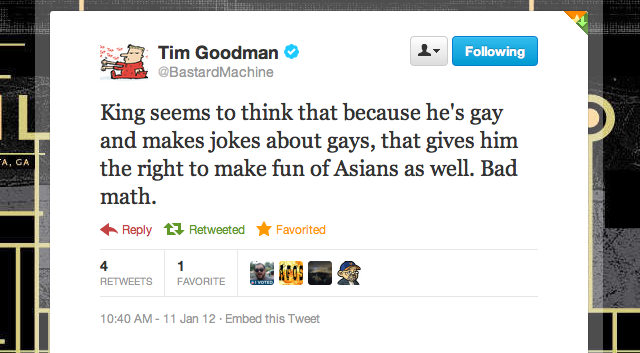
There was 2 Broke Girls showrunner Michael Patrick King's stupid defense of the racist material that's being written for the Korean Long Duk Dong on the show, or as GQ writer Lauren Bans amusingly calls the openly gay King's brand of humor, "gaycism":
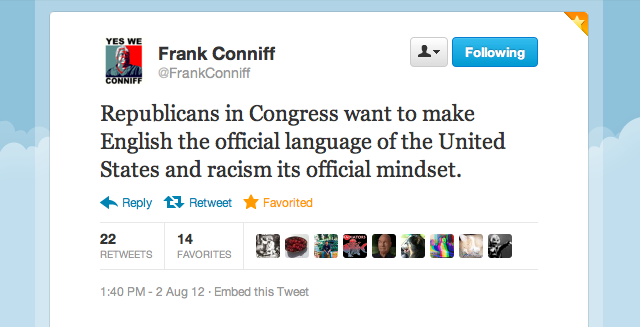
Ignorance came not just from sitcom joke writers but also from TV stars and, as usual, the far right:
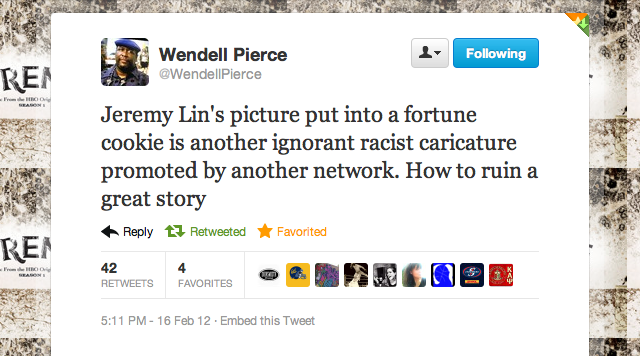
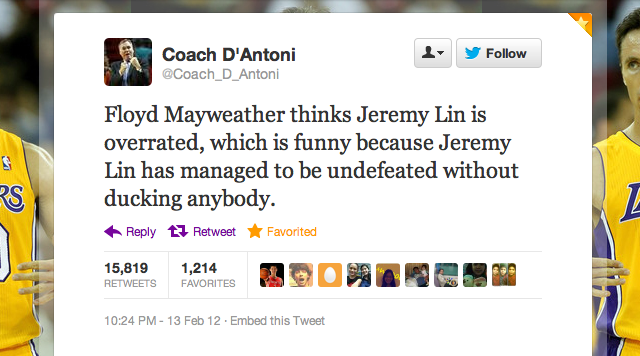
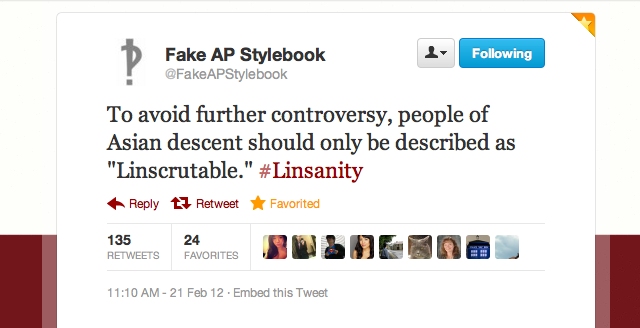
There was Linsanity (and the inevitable and stupid racial slurs in response to the rise of the NBA's first Asian American star player):