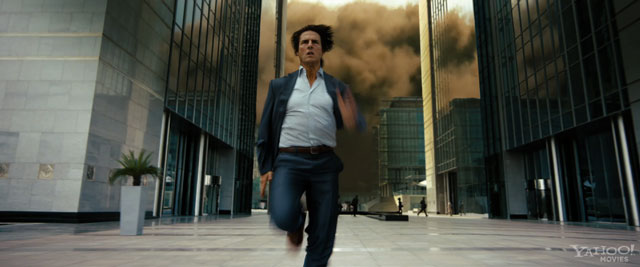
I have a theory that the Mission: Impossible movies got better once Tom Cruise stopped being touchy about his short stature and allowed his character to be put in situations that emphasized how short he actually is. (It took this long for Cruise to become slightly less vain, which is so unlike Agents of S.H.I.E.L.D. star Clark Gregg, who has awesomely never given a shit about sharing the screen with Marvel Cinematic Universe actresses who tower over him, whether that actress is Gwyneth Paltrow or Mallory Jansen. On the first day on the S.H.I.E.L.D. set, Gregg, a veteran of so many David Mamet projects, must have said something Mametian like "Fuck these fucking apple boxes you want me to stand on.")
That creative resurgence for the Impossible movie franchise (Ghost Protocol and Rogue Nation turned out to be the best Impossible movies since the first one) began right at the start of Ghost Protocol, when Cruise was surrounded by prison thugs who were a foot taller than him, and the creative resurgence continued when Cruise, for the first time ever in the series, sighed and rolled his eyes like a too-old-for-this-shit, Rockford Files-era James Garner while getting knocked on his ass by an even taller enemy agent in Rogue Nation's terrific opera house assassination attempt sequence. That's another thing about the weird late-period resurgence of the Impossible movie franchise (which will come out with a sixth installment next year): the addition of more humor to these movies has resulted in Ethan Hunt becoming a slightly more likable and relatable protagonist, except the humor never feels forced or overly campy.
"Light the Fuse," the opening title theme Michael Giacchino, Ghost Protocol's composer, arranged for the fourth Impossible movie, is a stunning symphonic reinterpretation of Lalo Schifrin's main title theme from the '60s Impossible. The extra spit and polish Giacchino brought to an old (and kind of overplayed) Schifrin tune are why I chose "Light the Fuse" as the very first track for "Incognito I," the first of three mixes of spy movie/TV show score cues I assembled for the AFOS Mixcloud page. The oldest score cue during the three mixes is John Barry's Ipcress File main title theme from 1965, while the newest score cues during the mixes are from the Epix espionage drama Berlin Station and xXx: Return of Xander Cage. Below these three mixes is a repost of my July 30, 2015 discussion of both Giacchino's score from Ghost Protocol and the Ghost Protocol movie itself, a series-revitalizing installment that's on a par with what Fast Five did really late in the game as a creative boost to the Fast and the Furious franchise.
I wasn't alive when the original Mission: Impossible first aired on CBS, and I didn't watch any of the Mission: Impossible reruns until I saw FX's badly butchered versions of them back when the future home of Vic Mackey and SAMCRO started out as a low-rent Nick at Nite, so I don't have an attachment to Jim Phelps like I do to other characters from shows I'm much more fond of, like, say, Yemana from Barney Miller or anybody from the Greendale gang who's not Pierce. When Brian De Palma's 1996 Mission: Impossible reboot picked Jon Voight to take over the Peter Graves role of Phelps, the cool-headed (and rather bland) leader of the Impossible Missions Force and the hero of both the '60s and '80s versions of the show, and the movie reimagined Phelps as a traitor who had his fellow IMF agents killed, I didn't hiss "Blasphemy!" at the screen or angrily storm out of the theater in the middle of the feature presentation like Graves' old Mission: Impossible co-star Greg Morris did when he watched De Palma's movie. I actually dug the shocking plot twist.
Action film reviewer Outlaw Vern perfectly described why the twist remains an intriguing one in his recent reassessment of De Palma's Mission: Impossible. A master of paranoid thrillers who proved to be the perfect filmmaker to revive and re-energize Mission: Impossible for these post-Cold War times, De Palma "doesn't look fawningly at the cloak and dagger Cold War fun of the ['60s] series... Using the original show's hero as the villain is not only a surprising plot twist, it's a statement." Vern added, "Back then spy shit was fun and glamorous, now we're more aware of the messes it causes, and the consequences of training people with deadly skills and then running out of things for them to do. The guy that was the hero back then is now willing to betray everyone because he's not getting paid enough. Times are tough."
While I found the first Mission: Impossible movie that Tom Cruise both starred in and co-produced to be genuinely thrilling and clever--the beauty of that classic Langley break-in sequence is mostly due to its use of silence, which was De Palma's way of critiquing the noisy storytelling of most summer blockbusters--the villainization of Phelps, which actually made Phelps slightly more interesting as a character, wasn't what bugged me about the movie. What bugged me was Cruise's de-emphasis on teamwork in the movie's third act so that his Ethan Hunt character saved the day on his own and everyone else on Hunt's makeshift team was ancillary. The emphasis on a team of specialists from different fields was what made both the '60s and '80s incarnations of Mission: Impossible stand out from other spy shows, besides the enticing concept of what was essentially a one-hour heist movie every week. If you're going to revive Mission: Impossible on the big screen, it ought to be the espionage equivalent of Seven Samurai or Ocean's Eleven like the old show was, or else why call it Mission: Impossible? Without an ensemble, it's nothing more than 007 as a two-hour shampoo commercial--which was basically what John Woo's abysmal Mission: Impossible II was.
The Star Wars franchise had quite an artistic comeback last winter. Not everyone was over the moon of Yavin about The Force Awakens, but when even my former colleague Richard von Busack--the Metro Newspapers film critic who prefers the Bond movies and Alexander Salkind's Superman movies over the Star Wars franchise as '70s and '80s tentpole entertainment and has found the Star Wars flicks to be too much like bad '70s Sid and Marty Krofft kids' shows--considered parts of The Force Awakens to be genuinely moving and more akin to something like Robin and Marian rather than a Krofft show, you know it's an above-average Star Wars installment.
I found The Force Awakens to be satisfying as well, even though the film totally wasted Gwendoline Christie (Game of Thrones reduced her screen time as Brienne of Tarth last season for this, a role where she never says anything memorable and never takes off her helmet?) and Raid stars Yayan Ruhian and Iko Uwais. You don't hire Mad Dog and Rama to just stand around and become people-shaped snacks for a giant space monster two minutes later. You hire them to smash people's noggins in with their knees and break motherfuckers' legs with their bare hands.
Now it's Star Trek's turn to experience an artistic comeback as a sci-fi multimedia franchise after a major low point, and the timing for its potential comeback is perfect because 2016 marks the 50th anniversary of the original Star Trek's premiere on NBC. I don't know why Paramount doesn't acknowledge 1964 as Star Trek's birth year: that was when Lucille Ball, who was breaking ground as the female head of an indie TV studio, took a chance on Star Trek, and Ball's Desilu studio, writer/producer Gene Roddenberry and director Robert Butler began filming "The Cage," the first of two pilot episodes for Star Trek. So Star Trek is actually 52 years old, but who's counting--aside from Poindexter in a basement somewhere in Yonkers, who claims to be the world's only expert on the exact time and date when Roddenberry first started typing up the "Cage" writer's bible about "Captain Robert M. April"?
Paramount has two major Star Trek projects on the horizon: Justin Lin's Star Trek Beyond in July and an hour-long Star Trek anthology show from Hannibal showrunner Bryan Fuller for the CBS All Access streaming service in 2017. I'm a fan of the episodes Lin directed for Community and the Lin movies Better Luck Tomorrow and Fast Five, so I have some faith that Star Trek Beyond won't be atrocious, especially when--in addition to a director who grew up watching the original Star Trek on KCOP and isn't going to turn Trek into godawful 9/11 truther propaganda--the threequel is co-written by cast member Simon Pegg, whose past writing credits include the terrific Cornetto trilogy. The current J.J. Abrams-produced Trek movies appear to be echoing the path of the Mission: Impossible movies: the first one is a highly entertaining action flick, unless you're a hardcore fan of the source material who can't stand the changes that have been made to the material; the totally dumbed-down second one sucks ass; and the threequel appears to be a soft reboot after nobody--not even a lot of the more casual fans of the franchise--would admit to liking the second one, despite the second one making a shitload of money.
Star Trek Beyond (Photo source: Wired)
But I'm more enthusiastic about Trek's return to TV--the medium where Trek can be as cerebral as it wants to be and it doesn't have to dumb itself down in order to satisfy international audiences, who have always been indifferent to Trek movies--because Nicholas Meyer, the director of two of the best Trek flicks, The Wrath of Khan and The Undiscovered Country, is attached to the project. Also, Fuller--who wrote for both Deep Space Nine and Voyager before going on to create several short-lived and weird but enjoyable shows and envisioning, as he was working on those cult favorites, a nicely progressive take on Trek in which Angela Bassett would get to be the captain and Rosario Dawson would be her first officer--is the perfect person to be at the helm.
I like three of the seven Star Wars movies and Genndy Tartakovsky's Star Wars: Clone Wars animated shorts, but my heart belongs to Trek because at its best, Trek has a lot more on its mind than just action sequences and space battles, and it cast Asian actors in major, non-stereotypical roles, long before Star Wars did the same this year when it cast newcomer Kelly Marie Tran in a leading role for the eighth installment. Though I like Trek slightly more than Wars, I don't believe in pitting these two sci-fi franchises--or any other pair of sci-fi franchises--against each other as if they're Drake and Meek Mill, which is why I've rolled my eyes when Scrubs star Donald Faison, a Wars nerd, publicly bashes Trek to create beef between the Wars contingent and the Trek heads, or when Kevin Church, a writer who runs They Boldly Went, a Tumblr about the '60s Trek, uses his Tumblr to bash Doctor Who. A person can like both Wars and Trek at the same time (or Trek and Who at the same time), just like how someone doesn't have to be a Nas person or a Jay Z person. Can't a motherfucker be both? Nas and Hov are about the same quality-wise. They've both had the same amount of above-average material and lousy material. The same is true about Wars and Trek.
That being said, Trek, its first three spinoffs and nine of its first 10 films are also home to some of the ugliest futuristic clothes ever stitched together in Hollywood (the outlier out of the 10 films is First Contact, which marked the first time when, thanks to Deborah Everton, the costume designer for The Craft, Trek's ideas of futuristic attire looked sensible and GQ-ish for a change and they didn't suck). Trek costume designer William Ware Theiss' offbeat work on the '60s show isn't totally ugly. I'm a red-blooded male--I like looking at the female guest stars slinking around in skin-baring costumes created by Theiss. Those costumes are the highlights of Theiss' work. But the uniform tops Theiss designed for Starfleet, especially the male officers, don't look like uniform tops made for a futuristic space Navy. They look more like softball ringer T-shirts. I keep expecting to see Spock run out a bunt. The brightly colored Starfleet uniforms were intended to capitalize on the rise of color TV and showcase NBC's visual advances as the self-proclaimed "Full Color Network," but in 2016, the cartoony and cheap-looking velour shirts just look strange and can occasionally take attention away from the drama during a dead-serious, non-campy and exemplary episode like "Balance of Terror."
At least the '60s uniforms aren't as hideous as costume designer Robert Fletcher's Starfleet uniform redesigns in Star Trek: The Motion Picture. Sure, it's great that female officers finally got to wear pants again, 13 years after "The Corbomite Maneuver" threw away their pants and required them to wear only miniskirts, but otherwise, the Star Trek: TMP outfits are the ugliest clothes in all of Trek. Entertainment Weekly's Darren Franich, who's been reassessing each of the Trek movies because of the franchise's 50th anniversary, came up with a great description for the epic fail that was the TMP revamp of both the uniforms and the Enterprise set design color schemes: the beige, gray, light brown and off-white clothes look like furniture, and the furniture looks like clothes.
Usually on Throwback Thursday, I pull out from my desk cabinet--with my eyes closed--a movie ticket stub I didn't throw away, and then I discuss the movie on the ticket and maybe a little bit of its score, which might be now streaming on AFOS. Today, instead of drawing some random ticket, I'm going to focus today's TBT piece on Mission: Impossible--Ghost Protocol, due to this week's release of Rogue Nation, the latest Mission: Impossible installment.
I wasn't alive when the original Mission: Impossible first aired on CBS, and I didn't watch any of the Mission: Impossible reruns until I saw FX's badly butchered versions of them back when the future home of Vic Mackey and SAMCRO started out as a low-rent Nick at Nite, so I don't have an attachment to Jim Phelps like I do to other characters from shows I'm much more fond of, like, say, Yemana from Barney Miller or anybody from the Greendale gang who's not Pierce. When Brian De Palma's 1996 Mission: Impossible reboot picked Jon Voight to take over the Peter Graves role of Phelps, the cool-headed (and rather bland) leader of the Impossible Missions Force and the hero of both the '60s and '80s versions of the show, and the movie reimagined Phelps as a traitor who had his fellow IMF agents killed, I didn't hiss "Blasphemy!" at the screen or angrily storm out of the theater in the middle of the feature presentation like Graves' old Mission: Impossible co-star Greg Morris did when he watched De Palma's movie. I actually dug the shocking plot twist.
Action film reviewer Outlaw Vern perfectly described why the twist remains an intriguing one in his recent reassessment of De Palma's Mission: Impossible. A master of paranoid thrillers who proved to be the perfect filmmaker to revive and re-energize Mission: Impossible for these post-Cold War times, De Palma "doesn't look fawningly at the cloak and dagger Cold War fun of the ['60s] series... Using the original show's hero as the villain is not only a surprising plot twist, it's a statement." Vern added, "Back then spy shit was fun and glamorous, now we're more aware of the messes it causes, and the consequences of training people with deadly skills and then running out of things for them to do. The guy that was the hero back then is now willing to betray everyone because he's not getting paid enough. Times are tough."
While I found the first Mission: Impossible movie that Tom Cruise both starred in and co-produced to be genuinely thrilling and clever--the beauty of that classic Langley break-in sequence is mostly due to its use of silence, which was De Palma's way of critiquing the noisy storytelling of most summer blockbusters--the villainization of Phelps, which actually made Phelps slightly more interesting as a character, wasn't what bugged me about the movie. What bugged me was Cruise's de-emphasis on teamwork in the movie's third act so that his Ethan Hunt character saved the day on his own and everyone else on Hunt's makeshift team was ancillary. The emphasis on a team of specialists from different fields was what made both the '60s and '80s incarnations of Mission: Impossible stand out from other spy shows, besides the enticing concept of what was essentially a one-hour heist movie every week. If you're going to revive Mission: Impossible on the big screen, it ought to be the espionage equivalent of Seven Samurai or Ocean's Eleven like the old show was, or else why call it Mission: Impossible? Without an ensemble, it's nothing more than 007 as a two-hour shampoo commercial--which was basically what John Woo's abysmal Mission: Impossible II was.
The J.J. Abrams-directed Mission: Impossible III attempted to be more of an ensemble piece than Mission: Impossible Woo, but in the end, the threequel turned into yet another Cruise-saves-the-day-alone installment. It was also too much of a remake of Alias, with Cruise in the role of Sydney Bristow, Simon Pegg in the role of Marshall Flinkman and yet another guest appearance by the old Alias storytelling device of in medias res. Meanwhile, the grifter show Hustle and the caper show Leverage (as well as way before Hustle or Leverage and in the interval between the first and second Mission: Impossible movies, a lesser-known vigilante/private eye show called Vengeance Unlimited, in which Michael Madsen subjected the tormentors of his clients to mind games that owed a lot to the mind games of the small-screen IMF) were doing a better job of channeling the old Mission: Impossible than the actual Mission: Impossible movies themselves--until Mission: Impossible--Ghost Protocol came along in 2011.
Written by former Alias writer/producers Josh Appelbaum and André Nemec, Ghost Protocol recycles the premise of Hunt being falsely accused of wrongdoings and going on the run (this time to Dubai and Mumbai, after he and his team are framed for bombing the Kremlin) while trying to clear his name, which is starting to get old after two of the three previous movies featured the same thing. By now, Hunt ought to be asking himself, "How can the same shit happen to the same guy thrice?" However, the fourth installment is the closest the Cruise movies have gotten to capturing the ensemble spirit of the old show. It's clear from the start of Ghost Protocol that animator Brad Bird, directing his first live-action film, is an even bigger fan of the old show than either Cruise or Abrams have claimed to be, because Bird reverts to the show's practice of spoiling clips from the mission to come during the opening titles to get viewers excited and pumped (a practice later emulated by '60s Mission: Impossible alums Martin Landau and Barbara Bain's sci-fi show Space: 1999 and the Battlestar Galactica reboot). The only other Mission: Impossible movie to do that was the first one. You can tell someone's a millennial or teen who never watched both the old show and the 1996 movie whenever they tweet (or post in a comments section) a complaint about Ghost Protocol's opening titles containing too many spoilers.
I like to pretend Bird took Cruise aside and persuaded him to give his ego a rest to bring back the ensemble spirit of the show Bird grew up watching. The result is the most generosity we've seen from Cruise as a star and co-producer in the entire franchise (in fact, the film was originally intended to be a passing of the torch from Hunt, who was semi-retired in Mission: Impossible III, to Jeremy Renner's new character William Brandt). It explains why Jane Carter (Paula Patton), instead of Hunt, becomes the first Mission: Impossible character to light the fuse on-screen for the opening titles since Phelps in the '80s Mission: Impossible opening titles, and why the climax ends not with Hunt stopping the villainous Cobalt (Michael Nyqvist) by himself but with the teammates, despite being separated from each other, combining their efforts to stop the Swedish terrorist and his nuclear threat. Critics like to complain about how boring Ghost Protocol gets whenever it pauses from the action to dip into the angst of both Carter, who wants revenge for the killing of her lover and teammate Hanaway (Josh Holloway), and Brandt, who feels guilty for failing to protect Hunt's wife Julia (Michelle Monaghan, briefly reprising her Mission: Impossible III role to help wrap up a character arc that clearly turned into Cruise's way of coming to terms with the dissolution of his then-marriage to Katie Holmes), but thanks to Bird's skills with pacing, it's not boring. It makes Carter and Brandt more fully realized characters than Jonathan Rhys-Meyers and Maggie Q's forgettable (aside from Maggie Q's sultry entrance in a red evening gown) IMF agent characters in Mission: Impossible III.
As Ghost Protocol's female lead, Carter is an improvement over the damsel-in-distress roles written for the female leads in the second and third Mission: Impossible installments, which isn't surprising when Bird's the director, because of the assertiveness and agency he and his animators brought to Elastigirl in The Incredibles and Colette in Ratatouille. Carter's thirst for revenge also feels like Bird's comment on what went wrong with Mission: Impossible II and what caused Mission: Impossible III to take a turn for the generic in its third act. When Carter defies Hunt's orders to keep alive Sabine Moreau (Léa Seydoux), the assassin who killed Hanaway, for intel purposes and kills her instead, her act jeopardizes the mission. It's as if Bird's saying, "When you take teamwork out of the equation and have the characters act on their own, it's no longer the Mission: Impossible I used to enjoy on TV."
One of the most appealing elements of Ghost Protocol is the sight of Carter and the other agents making mistakes. It freshens up the franchise in the same way that De Palma brought his "all bets are off" stamp to Mission: Impossible by starting his movie out as a traditional Mission: Impossible episode where everything seems to go according to plan and then blindsiding the audience by killing off nearly all the agents the movie introduced only a few minutes before. In Ghost Protocol, Hunt and Pegg's Benji Dunn, left without the backing of the government due to ghost protocol going into effect and the IMF being disavowed and shut down, are forced to deal with gadgets that become unreliable without the resources to fix them, a storytelling thread Shane Black appeared to have borrowed somewhat when he opted for a similar back-to-basics, on-the-lam story for Tony Stark in Iron Man Three. Before the Kremlin disaster that triggers ghost protocol, Hunt receives his mission instructions from a recording that conks out and fails to self-destruct, so Hunt has to give the old Russian pay phone that was playing the recording a Fonzie-style whack to get the message to self-destruct. Then after the Kremlin disaster, the mask-building gadget the IMF has relied on since Mission: Impossible III breaks down, which deprives the team of the state-of-the-art masks that have become such a staple of the Cruise movies. During the much-talked-about Burj Khalifa climbing sequence where, like in the rest of Ghost Protocol, Cruise's brand of crazy is Jackie Chan crazy (he insisted on doing his own climbing stunts again) as opposed to Scientology crazy, one of Hunt's suction gloves malfunctions and turns into Hunt's worst enemy.
These gags are organic to Ghost Protocol's story in a way that the forced running gags about the Enterprise-A's ineffectiveness as a new ship were not during Star Trek V: The Final Frontier. The tech mishaps both raise the stakes of Ghost Protocol and act as a clever metaphor for the anxieties the Mission: Impossible producers must be having about maintaining the durability of a movie franchise that's now pushing 20, whereas all those Enterprise-A malfunction gags were there for no reason, other than because '70s Mission: Impossible alum Leonard Nimoy's Star Trek IV: The Voyage Home conquered the box office after adding more humor and both Paramount and William Shatner wanted another Star Trek IV without exactly understanding why the humor in Nimoy's directorial effort worked.
In fact, Ghost Protocol does several other things better than other movies do, whether that movie is Star Trek V or Hudson Hawk. Benji's playing of "Ain't That a Kick in the Head" to time Hunt's prison break at the start of Ghost Protocol appears to have been lifted from Bruce Willis and Danny Aiello's use of pop standards to time their heists in Hudson Hawk, but according to sci-fi author Christopher L. Bennett, a Mission: Impossible geek, it echoes "the use of carnival music to time a prison break in season 1's 'Old Man Out.'" Bird's background in animated storytelling explains why he's better at writing and directing humor than Shatner and maybe Michael Lehmann (I'm aware that Hudson Hawk has become as much of a cult favorite as Lehmann's earlier flick, the classic anti-John Hughes teen movie Heathers, in the decades since its disastrous release, but all I've watched of Lehmann's Hudson Hawk is the "Swinging on a Star" heist scene).
Bird's animation background also lends a lot of visual snap to Ghost Protocol's massively scaled set pieces, particularly the sequences in Dubai and the climactic Mumbai parking garage fight between Hunt and Cobalt. The strong visual sense Bird brought to Ghost Protocol is timeless in ways that the speed-ramping and second-rate CGI throughout Die Another Day, the fourth entry in Pierce Brosnan's run as 007 just like how Ghost Protocol is fourth in Cruise's franchise, are not. Those were a couple of attempts to visually transition 007 into the early '00s, but they ended up instantly dating Die Another Day and giving it a whiff of desperation (Bird's visual sense is also preferable over the fondness for shaky-cam both Abrams, who stayed on as co-producer on both Ghost Protocol and the new Rogue Nation, and his Star Trek and Star Wars cinematographer Dan Mindel brought over to Mission: Impossible III after Abrams made the camera wobble throughout Alias and the first season of Lost). It's a bit of a shame that Paramount denied Ghost Protocol fans the option on Blu-ray of rewatching Ghost Protocol's IMAX sequences in their original aspect ratio so that they can re-experience the awe of seeing Cruise and the other actors dwarfed by such tall surroundings, like during the Kremlin explosion and the Dubai sandstorm sequence.
The lack of an IMAX viewing option also kind of waters down the great visual joke of Bird and cinematographer Robert Elswit framing Cruise in certain shots so that he looks like little Remy scampering through the kitchen and the streets of Paris during Ratatouille. Both that 2007 Pixar flick and The Incredibles concluded with inventive title sequences that were worth staying in the theater for a few more minutes to enjoy, but the opening title sequence Kyle Cooper's Prologue Films company created for Ghost Protocol is easily the most entertaining title sequence in a Bird movie, especially when it's in full IMAX, which adds more frustration to the Ghost Protocol Blu-ray's lack of an IMAX option. The old imagery of the Mission: Impossible fuse passing through sneak peeks at future scenes nicely receives a more immersive, 3-D-inspired spin from Prologue, which follows the fuse as it zooms and plummets like a roller coaster through those yet-to-come scenes, shot from angles that are completely different from how we later see them in full.
Ghost Protocol's opening title sequence is a great marriage of visuals and music. Mission: Impossible III composer Michael Giacchino's reunion with Bird, whom he wrote outstanding score music for during The Incredibles and Ratatouille, seemed to have amped up Giacchino during Ghost Protocol, because he came up with my favorite modern arrangement of Lalo Schifrin's Mission: Impossible opening title theme, outshining even Danny Elfman's loving reinterpretations of the theme in the first movie. I love how the rhythm of Giacchino's "Light the Fuse" responds to the clips of Benji's modification of a hotel room number, the Hunt/Brandt gun snatch scene and the Indian dancers during the opening titles. But the best element of Giacchino's Ghost Protocol revamp of the Schifrin theme has to be his rearrangement of the strings. In a 2011 interview, Giacchino said, "Traditionally in that [Schifrin] tune the strings are used in a very specific way. You have the low strings doing the obvious 'Bom, Bom, Bom-Bom,' and then you have the upper strings following along with the woodwinds playing the melody... One of the things I wanted to do was not necessarily have the strings play any of the melody, just give us the energy behind the melody. That's why they are just going 'Bop-pa-pa, Bop-pa-pa...'" Giacchino also came up with my favorite movie theme written for a skyscraper, the epic "A Man, a Plan, a Code, Dubai" cue that introduces the Burj Khalifa.
"The Plot," the march theme Schifrin first created for the Mission: Impossible pilot episode to represent the professionalism of the IMF agents while under enormous pressure, resurfaces in Giacchino's Ghost Protocol score, and its return appearance lends credence to my theory that the more a Mission: Impossible movie uses "The Plot," the more enjoyable the installment. Elfman included "The Plot" in his score for the first movie. Giacchino previously referenced "The Plot" in his Mission: Impossible III score. Rogue Nation composer Joe Kraemer, who regularly collaborates with Rogue Nation director Christopher McQuarrie, makes use of "The Plot" even more than Giacchino does, which is a sign that Rogue Nation might not be terrible. Meanwhile, Hans Zimmer never featured "The Plot" in his Mission: Impossible II score. Mammoth box-office grosses aside, we know how that sequel turned out.
But even if Giacchino didn't use "The Plot" at all, Ghost Protocol would still tower over the second and third Mission: Impossible movies like the Burj Khalifa looming over Dubai, simply because of Bird's ability to find the perfect balance of spectacle, suspense and humor while fully restoring the most missed element of the old Mission: Impossible: the teamwork. Sure, Ghost Protocol lacks a villain as intimidating and perfectly realized as the late Philip Seymour Hoffman was in Mission: Impossible III. Nyqvist is too much of a non-entity as Cobalt. Despite having such minimal dialogue, Seydoux makes so much of an impression as an adversary--with her sexy pouts and Beyoncé hair--that I wish Ghost Protocol contained a Ra's Al Ghul-style twist where Cobalt turned out to be a decoy for the real mastermind behind the nuclear threat, Sabine, which would have given the Blue Is the Warmest Color star more screen time. But otherwise, Bird understands that Mission: Impossible stories work best as what the A.V. Club's A.A. Dowd describes as "tributes to process, when they're observing the detail-oriented business of breaking into an impregnable fortress or pulling a technology-abetted heist." It would be a crime if the franchise were to disavow any knowledge of that.
Selections from Giacchino's Ghost Protocol score are in rotation during both "AFOS Prime" and "AFOS Incognito."
The late, great Leonard Nimoy, who once wrote a book called I Am Not Spock and a follow-up called I Am Spock, should have written a third autobiography called I Am More Than Just Spock. To me, a fan of Star Trek ever since watching the Nimoy-directed Star Trek IV: The Voyage Home when it first warped into theaters, as well as someone who often enjoyed seeing most of the original cast members in roles outside of Star Trek, Nimoy was more than just Spock. He was also Dr. William Bell, the king of Atlantis, the host of the creepy In Search Of (gah, that synthy and cheesy theme music still gives me the heebie jeebies!) and the director of likable but often disposable comedies like Three Men and a Baby and Holy Matrimony, which was hardly the success that Three Man and a Baby was but is noteworthy for featuring a funny performance by a young, pre-3rd Rock Joseph Gordon-Levitt as an Amish kid who's forced to marry trashy, True Romance-era Patricia Arquette.
But of course, Nimoy's work as the half-Vulcan, half-human Spock, the show's breakout character, featured a lot of his most sublime moments as an actor. Perhaps the biggest challenge in playing Spock--other than the makeup that was applied to the ears to make them pointy--was conveying empathy and inner conflict (and even some dry wit) in the role of an alien who was raised in a culture that suppresses its emotions, and Nimoy was more than up to the task. His work was one of several key dramatic elements of the original Star Trek that distinguished it from the mostly hackneyed and two-dimensional space operas that critics from Variety and TV Guidestupidly lumped it in with when it first aired in the '60s. Thanks mostly to Nimoy, Spock's experiences as an outsider and a misfit resonated with Star Trek fans, and they continue to do so with new generations of fans, whether they're mixed-race viewers or children of immigrants who relate to Spock being caught between two different cultures.
Nimoy's character was so badass on the '60s show that I dressed up as Spock on Halloween later on in that year when I first saw Star Trek IV. Just like how young Chris Rock's mom Rochelle sewed together her son's Prince costume in a classic '80s Halloween episode of Everybody Hates Chris, my mom, who was taught how to sew by her father, the town tailor back in the Philippines, sewed together my Spock costume. She based my uniform on both a 1974 Mego action figure of Dr. McCoy that my older brother used to play with (he didn't have a Spock action figure, but fortunately, Bones and Spock wore the same uniform color on the '60s show, so that made it easier to recreate the uniform) and Starfleet uniform blueprints I showed to her from the pages of either the 1987 Star Trek tie-in book Mr. Scott's Guide to the Enterprise or some other Star Trek book (I can't remember which book it was). I still have the photos of myself as a kid cosplaying as Spock, complete with pointy ears and Vulcan eyebrows, but I'm not in the mood to post any of them right now. In fact, I don't think I'll ever be in the mood to post any of them right now. Aw, rats.
The Brian De Palma flick Femme Fatale, which opened on November 6, 2002 in America, is like a heist movie in reverse. The big set piece that's usually the second act or the climax takes place first, and the 20-minute sequence--a jewel heist at the Cannes Film Festival--is on a par with De Palma's classic CIA headquarters break-in sequence from the first Mission: Impossible film.
Femme Fatale's Cannes heist involves steamy girl-on-girl action between Rebecca Romijn and Rie Rasmussen in the ladies' room and the impeccably timed disruption of a screening of an actual film, director Régis Wargnier's soapy and not-so-great 1999 epic East-West (Wargnier makes a cameo as himself at the festival, along with East-West star Sandrine Bonnaire). Both De Palma's masterful direction of the Cannes heist and the impressive bolero cue Ryuichi Sakamoto composed for the sequence--"Bolerish," which lasts about 14 minutes long on the Femme Fatale score album--are why I added "Bolerish" to "AFOS Prime" rotation on AFOS last year. (It's still in rotation.)
What De Palma does with the story after the Cannes heist remains brilliant and bold, and it hasn't lost the ability to surprise, even while watching Femme Fatale for the second time, which I recently did--about 11 years after first viewing it--while embarking on another one of my many heist movie DVD marathons. Femme Fatale is also the best Catwoman movie that doesn't feature Catwoman in costume. Just pretend that Romijn--who, as Slant's Ed Gonzalez once wrote of her performance in Femme Fatale, challenges the way men perceive women and uses that awareness to devour and spit out her men--is playing Selina Kyle without the cat-eared aviator helmet and under a different name to throw off Interpol. It's as if De Palma brought to the screen one of Ed Brubaker's beloved Catwoman comics. Retcon the Halle Berry Catwoman fiasco from your memory and act as if this was the Catwoman spinoff movie Warner Bros. released instead.
Paramount is a studio full of huge missteps like Richard Gere dancing around in a diaper and the stupidly whitewashed live-action adaptation of its sister company Nickelodeon's animated Avatar: The Last Airbender franchise. It's also a studio that's responsible for many of my favorite movies (Star Trek II: The Wrath of Khan, 1999's Election).
All year long, Paramount has been celebrating its 100th anniversary. Because the Saturday after next is the date when one of Paramount's most popular properties, Star Trek, made its debut on NBC (46 years ago, to be exact), I'm posting a 100th anniversary playlist consisting of original themes from my favorite Paramount movies and shows (Star Trek: First Contact, Taxi) and original themes I like that come from Paramount movies I've never seen (Fear Is the Key, Three Tough Guys) or Paramount movies I don't care for (the late Tony Scott's Top Gun).
I'm glad that Spotify carries Paramount Pictures' 90th Anniversary Memorable Scores, an impressive 2002 Sony Classical comp, even though it contains cues from Forrest Gump and Titanic, two other Paramount smash hits I don't care for. However, I'm a little bummed that Spotify doesn't carry the songs from South Park: Bigger, Longer & Uncut or the scores from Face/Off, Election, Zodiac, Vertigo, Psycho, the original Italian Job, Once Upon a Time in the West, Star Trek II and the first J.J. Abrams Trek movie. Spotify carries re-recordings of Bernard Herrmann's Vertigo and Psycho pieces, The Italian Job's "Getta Bloomin' Move On," Ennio Morricone's Once Upon a Time in the West themes, James Horner's Trek II cues, Michael Giacchino's Trek cues, Dave Grusin's Three Days of the Condor theme and Neal Hefti's enjoyably loungy theme from the Odd Couple movie and TV series, but I'm not using them. I hate most film and TV score re-recordings.
Almost all these score re-recordings on Spotify are tinnily performed on cheap synthesizers, they come from labels I've never heard of and they suck gigantic J.J. Abrams red balls. That's why there are no re-recordings on this three-hour "Paramount: 100 Years of Crazy Juice" playlist, even though Billy May's cover of the Odd Couple theme isn't bad because it's, well, Billy May.
The playlist goes in chronological order from 1958 to the present day, but it kicks off with a '90s piece: one of my all-time favorite joints, Eric B. and Rakim's "Juice (Know the Ledge)" from Paramount's 1992 Tupac Shakur movie Juice, the first directorial effort from former Spike Lee cinematographer and frequent episodic cable TV director Ernest Dickerson. Juice's Hank Shocklee-produced soundtrack is a terrific snapshot of hip-hop and R&B in the early '90s (when Shocklee and his Bomb Squad were in their prime as beatmakers) and has aged remarkably well. The film itself isn't quite a masterpiece. It would probably be a more intriguing film if I watched it again, but in black-and-white instead of color, a trick I learned from rapper Prometheus Brown.
"I gave Juice the homemade noir treatment and discovered a whole nother film underneath the film's already muted colors. Stripped down to monochrome, New York becomes Gotham. Tupac's dark portrayal of Bishop is intensified," wrote Geo back when he used to write at length about movies on his blog (I wish Prometheus hadn't abandoned film criticism because we need more film critics of color, but between his touring schedule and balancing two bands at the same time, it's understandable).
"The DJ battle scenes in the club no longer look like a 90s MTV dance show but more like a classic rap video," continued Prometheus in his Juice post. "Omar Epps's scratching, however, remains artificial. Can't desaturate that."
Every Wednesday at 10am and 4pm and every Friday at 11am, A Fistful of Soundtracks streams the most recent additions to the station's "AFOS Prime" library for an hour-long block entitled "New Cue Revue." This is what the "New Cue Revue" playlist looked like back in November 2011. Here now is what's currently on the playlist.
1. Marc Streitenfeld, "A Planet" (from Prometheus)
Epic.
2. Michael Giacchino, "Out for a Run" (from Mission: Impossible--Ghost Protocol) Stormy.
3. Howard Shore & Metric, "Long to Live" (from Cosmopolis)
Haines-y.
4. Danny Elfman, "Main Titles" (from Men in Black 3)
Biker-y.
Whether it's an episode from the Martin Landau/Barbara Bach era or an episode from the Leonard Nimoy era, each time you catch the original Mission: Impossible, you're guaranteed five things.
1. Lalo Schifrin's swinging main title theme while the opening title sequence gives huge spoilers of the episode to come.
2. Exposition delivered by some doohickey called a tape ("Your mission, should you choose to accept it, is to...").
3. Said tape self-destructing.
4. A scenery-chewing moment from the main guest star where his villainous character loses his mind thanks to the skills of the IMF.
5. "The Plot."
"The Plot"? That's the other musical staple of the original Mission: Impossible. It was Schifrin's march theme for the IMF. "The Plot" is also one of the few elements Tom Cruise's Mission: Impossible movies retained from the late '60s/early '70s show, which was influenced by the heist flick Topkapi and then wound up influencing Alias and shows outside the espionage genre like TNT's Leverage and BBC's Hustle (one of Hustle's funniest moments was both a shout-out to the old show and a sight gag that played around with non-diegetic music: Hustle needle-dropped the Mission: Impossible main title theme while Marc Warren's Danny practiced his moves for a future heist, and then what we thought was non-diegetic music turned out to be a CD of the Mission: Impossible theme that Danny likes to play while he practices).
Many critics have said that the best Mission: Impossible movies are the ones that are closest in spirit to the show. True that, but I've also noticed that the more the film uses "The Plot," the more enjoyable the film. Danny Elfman included "The Plot" in his score for the first film. Michael Giacchino referenced "The Plot" in his Mission: Impossible III score and used it more than once during Mission: Impossible--Ghost Protocol, the best of the four feature films. Hans Zimmer never featured "The Plot" in his Mission: Impossible II score, a badly dated mash-up of Zimmer's Gladiator sound (Zimmer worked on both Gladiator and Mission: Impossible II in the same year) and nu metal (nothing says the year 2000 like the presence of mega-douchey Limp Bizkit on the soundtrack). Not exactly one of John Woo's finest moments, Mission: Impossible II retained the fewest elements from the show (hey Cruise, where did the ensemble go?) and ended up being the weakest installment in the film franchise.
I'm not a musicologist, so I can't explain why "The Plot" works as a theme. Like the skills of each IMF agent during any mission masterminded by Dan Briggs or Jim Phelps (specifically, the Jim Phelps who probably likes movies about gladiators, not the traitorous douchenozzle of the same name played by Jon Voight in the 1996 movie), the suspenseful strings and militaristic percussion of "The Plot" just come together well, and I love it when a plan comes together. Woops, wrong ensemble action show.
Throughout this year, I'm posting older material--like non-Blogspot posts from a few years ago, unpublished writing I've kept hidden in my computer and transcripts of Q&As from A Fistful of Soundtracks' terrestrial radio years.
Because it's Asian Pacific American Heritage Month, I've dug up a 1998 article that I wrote for the UC Santa Cruz publication Primer to celebrate what was then the 25th anniversary of a pivotal movie in the history of Asian American cinema, as well as one of the few martial arts flicks I like (just because I'm Asian doesn't mean I have to be a fan of the martial arts genre). Some hardcore martial arts genre fans will argue that Enter the Dragon shortchanges Bruce Lee or that it's too Hollywood and too derivative of the 007 franchise, but because I'm not a hardcore martial arts fan, I don't have the same gripes as they do.
Okay, maybe I'm with them on the "What the hell is John Saxon doing here?" thing. ("America had no idea that [Saxon] was also a practicing martial artist... He first became involved in the martial arts when he was 15 years old, initially studying judo and then taking up karate," wrote author John Little in the Enter the Dragon: The Making of a Classic Motion Picture book that Warner Home Video included in the 1998 Enter the Dragon VHS and DVD gift sets.) But otherwise, Enter the Dragon never fails to entertain, and it features the most badass score ever written for an Asian American action hero: the frequently sampled score by Lalo Schifrin, whose Mission: Impossible theme was one of Lee's favorite pieces of workout music.
*****
Ain't that a kick in the head: Bruce Lee and Enter the Dragon still amaze after 25 years
By Jimmy J. Aquino
Bruce Lee made only five films and the then-unfinished Game of Death before he died from a mysterious swelling of the brain (or died from a curse or was assassinated, if you believe the conspiracy theorists) in Hong Kong on July 20, 1973, but 25 years later, fans are still flocking to his movies and kneeling at the church of jeet kune do, Lee's revolutionary kung fu technique emphasizing "the way of the intercepting fist."
Lee's female admirers make pilgrimages to Hong Kong. Men of all colors want to be like Lee, who taught martial arts to students of all races, creeds, genders and backgrounds, unlike his kung fu teacher elders, who were opposed to teaching students who weren't Chinese.
The first martial arts superstar, Lee was a genuine fighter and a charismatic actor (I'm not saying Lee was De Niro, but his "emotional content" speech in Enter the Dragon has more soul and passion than what passes for acting in Jean-Claude Van Damme and Steven Seagal movies). Not even charismatically challenged poseurs like Van Damme, the faded Seagal and David Carradine could erase the memory of the lightning-quick legend nicknamed the Dragon, a pioneer in Asian American cinema who sought stardom on his own when racist Hollywood spurned him because producers didn't think an Asian man could sell tickets or rack up Nielsens. (Van Damme, the post-Under Siege Seagal and Carradine are to martial arts what Vanilla Ice was to hip-hop. Put these has-beens in a room with Lee, and he'd automatically win the throwdown, with moves like the 13 punches he could throw in half a second.)
Enter the Dragon made Hollywood put its foot in its mouth. Released a few weeks after Lee's death, the film was his most popular work, and it made him the first Asian male sex symbol. (Bruce's son Brandon also found stardom posthumously, with 1994's The Crow.) To mark its 25th anniversary, Warner Bros. re-released Enter the Dragon in Lee's birthplace, San Francisco, and put out a highly anticipated DVD. The movie still holds up well today. The script is standard kung fu B-movie material, but Lee is at his most charismatic, the production values are stunning and the martial arts choreography is legendary. As SF Weekly's Michael Sragow said, Lee makes his choreographed moves look spontaneous. Lee's fighting style is, as his character describes it in the film, "the art of fighting without fighting."
Primer dedicates this page to the man who once said, "The end of heroes is the same as ordinary men. They all die and gradually fade away in the memory of man." Famous last words from someone whose memory has hardly faded at all. (To the managers of the Nickelodeon or the Rio, if you're reading this, please bring Enter the Dragon to Santa Cruz or we're gonna have to get kung fu on your asses!)
SoundtrackNet has posted an early review of Hans Zimmer's Simpsons Movie score. The reviewer says the score is one of the year's most enjoyable ones. Though I can't wait to hear Danny Elfman's opening theme reinterpreted by an orchestra much bigger than the one that performs the music on the show, it's a bit disappointing that TV show score veteran Alf Clausen, the series' clever musical director, got passed over for the Crimson Tide composer, whom producer James L. Brooks has relied on for his film projects. (Some of the NoHomers.net fans are especially pissed.)
Maclean's staff writer and blogger Jaime J. Weinman wonders if there's any validity to the notion that a composer with more film experience like Zimmer is better suited for The Simpsons Movie than Clausen, who's worked more often for TV:
Is it right to assume that a feature film needs someone with "feature experience"? With movies based on TV shows, the truth may be the other way around. Sometimes movie composers can't match the style of the original series; the movie version of Mission: Impossible wrecked the famous theme song by arranging it in the wrong time signature. How Zimmer will do on the Simpsons movie remains to be seen, but his music may not sound Simpsons-esque, because Clausen's music has already defined what's right for the characters and the setting.
But The Simpsons Movie has a problem that most movies don't: its characters are in syndication several times a day. The use of a big-name movie composer may be a way of giving audiences something they can't get for free in syndication.
Weinman is referring to U2 members Larry Mullen and Adam Clayton and their much-maligned end credits version of Lalo Schifrin's Mission: Impossible theme in a 4/4 beat instead of Schifrin's original 5/4, not Danny Elfman's version of the theme, which was faithful to the original. Elfman's score is one of the best scores from a feature film based on a TV show because he paid tribute to Schifrin's jazzy music, which was like a sixth character on the old show (Elfman even brought back Schifrin's bongoes), and he did so without sacrificing his own style.
One fact about Zimmer that Weinman overlooked is that in 2000, Zimmer wrote the score to the extreme sports-ish sequel Mission: Impossible 2. Unlike Elfman, Zimmer mangled Schifrin's timeless theme in a nu metal version that's aged badly, one of the few missteps in Zimmer's career. I can't hear Zimmer's nu metal Mission: Impossible 2 theme without thinking of the "Extreme!" dorks from Harold & Kumar.
Zimmer may have wrecked the Mission: Impossible theme seven years ago, but I think it's unlikely that he's bungled this new assignment. Unlike all those Comic Book Guys out there who have already formed their opinions on the Simpsons fan forums without hearing a single note of the score, I'm a wait-and-see guy (or rather, wait-and-hear guy), so I'll say what I think of this score after I see the movie. The fact that Zimmer wrote a large-scale choral rendition of Homer's "Spider-Pig" theme may be a sign that he gets The Simpsons.