Showing posts with label Hans Zimmer. Show all posts
Friday, February 24, 2017
Nobody says "Huh?" like Denzel
This is the second of 12 or 13 blog posts that are being posted on a monthly basis from January 2017 until this blog's final post in December 2017.
Once upon a time, I ran an Internet radio station that streamed film and TV score music. I don't really miss running it. The audience for it dwindled over the years, and even though Live365, the Bay Area company that powered the station before the end of the Webcaster Settlement Act led to Live365's demise early last year, is being resuscitated, I don't have any plans to bring back the station.
But I've kept the station alive on Mixcloud, where I've archived a few hours of old station content and posted lots of new one-to-two-hour mixes of music from original scores. The most popular of those mixes has been a mix of Kyle Dixon/Michael Stein score cues from the first season of Netflix's unexpectedly popular Stranger Things. It's called "Where's Barb?"
Late last year, the score albums for the Magnificent Seven remake and the film version of Fences, which both star Denzel Washington, were sent to my inbox, and that made me want to edit together an entire mix of score cues from Denzel movies. Denzel has been one of my favorite actors, ever since he stole the 1989 white savior movie Glory (and won an Oscar for stealing it) in the same way Don Cheadle would later steal Devil in a Blue Dress from Denzel. In Glory, he was basically the Toshiro Mifune character from Seven Samurai: the shit-talking troublemaker and outsider who learns to channel his anger and penchant for self-destruction into a worthy cause and then (SPOILER!) dies a hero.
The late James Horner's score from that 1989 Civil War movie, Terence Blanchard's 1992 Malcolm X score and Hans Zimmer's 1995 Crimson Tide score are a trifecta of Denzel-related instrumental badassery. Put those three scores together in either a mix or an hour of radio programming, and that hour of music is automatically going to sound as rousing and badass as a Denzel speech. Procrastinating on a writing project or that load of laundry? Put on the badass "Fruit of Islam" from Malcolm X's classic hospital march sequence. Immediately after hearing "Fruit of Islam," shit is going to be done. Laundry is going to be washed.
This month is the perfect time to post a mix of score cues from Denzel flicks. Several of Denzel's most highly regarded movies are frequently recommended during Black History Month by the likes of film critics and librarians, and Fences, Denzel's third big-screen directorial effort, is up for a few Oscars this weekend. Viola Davis, who reprised a role she had alongside Denzel in one of the various stage versions of Fences, is the frontrunner for the Best Supporting Actress trophy.
Throughout the Mixcloud mixes, I like to drop audio clips from the movies or TV shows that I've selected for score cue airplay. For this Denzel mix, I could have gone with audio from Denzel speeches as the connective tissue between each Denzel movie score cue, but I decided to go with something even more brash as connective tissue: clips from the very funny Earwolf podcast Denzel Washington Is the Greatest Actor of All Time Period, hosted by stand-ups W. Kamau Bell, the host of the CNN documentary series United Shades of America, and Kevin Avery, a writer for Last Week Tonight.
Bell, Avery and a special guest Denzealot, whether it's another comedian, a black filmmaker or one of Denzel's previous co-stars, dissect the work of their favorite charismatic actor, with lots of humor and occasional jabs at things like Virtuosity (the poorly received 1995 Denzel cyber-thriller that pitted 'Zel against a murderous A.I. played by a pre-L.A. Confidential Russell Crowe) and Denzel's visible discomfort during Much Ado About Nothing's frolicking scenes. Denzel himself is aware of the podcast's existence. But I highly doubt he's ever going to be a guest on this podcast that both celebrates his many triumphs as an actor (as well as a director of both episodic TV and small-scale feature films) and dredges up Virtuosity-esque career missteps, and Denzel's recent Fences press junket comment about not wanting to live in the past confirmed it. The podcast doesn't just live in Denzel's big-screen (and small-screen) past. It raises kids and builds a whole garden of gladioli in his past.
Labels:
Crimson Tide,
Denzel Washington,
DJ AFOS,
film music,
Flight,
Glory,
Hans Zimmer,
James Horner,
Kevin Avery,
Malcolm X,
Oscars,
podcasts,
Spike Lee,
Terence Blanchard,
The Magnificent Seven,
W. Kamau Bell
Monday, December 5, 2016
AFOS Blog Rewind: Not everyone's a critic, which was why Fox's enormously funny The Critic didn't last
Last week, Uproxx posted a lengthy and enjoyable interview with longtime writing partners Al Jean and Mike Reiss about their short-lived but well-remembered creation, the '90s animated show The Critic. The show centered around Jay Sherman, a persnickety film critic nobody likes, except for Marty, Jay's 13-year-old son, and Margo, Jay's teenage foster sister, who both look up to Jay, and Jeremy Hawke, an easygoing Aussie B-movie star who considers Jay his best friend ever since he was the only critic who didn't trash his first movie. In the Uproxx article, Jean and Reiss recalled the main reason why The Critic lasted from only 1993 to 1995 (the new Fox network president at the time hated it) and the challenges of attempting to give Jay and the other Critic characters the same kind of revival Family Guy and Futurama experienced after they were cancelled by Fox too (three of The Critic's regular voice actors are no longer alive, and Reiss also points out that "Siskel and Ebert are dead and those kinds of shows don't exist anymore. Movie critics used to be all over TV and they used to wield great influence and they just don't"). So from March 18, 2008, here's a post about The Critic, originally posted under the title "'Now who wants to boogie with Baby '37?'"
This weekend, I was surprised to find an eight-hour ReelzChannel marathon of the short-lived animated series The Critic, James L. Brooks' second foray into animation after the success of The Simpsons. Created by Simpsons writers Al Jean and Mike Reiss, The Critic aired on ABC during its first season (1993-94) and then for its second and final season (1994-95), it went to die on Fox (where the show's "Hey! We're on Fox" gags were amusing, while on a non-Fox channel in reruns years later, uh... not so much). The show, which comes complete with Simpsonian catchphrases that never took off ("It stinks!," "Hotchie motchie!," the Chuck McCann-referencing "Hi guy!"), later enjoyed a cultish afterlife in webisode form and on both DVD and Comedy Central's animation lineup.
Labels:
30 Rock,
Al Jean,
Gene Siskel,
Hans Zimmer,
IFC,
Jaime J. Weinman,
James L. Brooks,
Jon Lovitz,
Matt Groening,
Mike Reiss,
Roger Ebert,
scripted TV,
Shows I Miss,
The Critic,
The Simpsons,
TV music,
TV themes
Thursday, May 28, 2015
Throwback Thursday: The Dark Knight Rises (with guest blogger Hardeep Aujla from Word Is Bond)
Every Throwback Thursday, I randomly pull out from my desk cabinet--with my eyes closed--a movie ticket I saved, and then I discuss the movie on the ticket. This time I've gotten Hardeep Aujla, an editor from a U.K.-based hip-hop blog I've contributed pieces to, Word Is Bond, to come back after his guest TBT post about The Signal and discuss the movie on the ticket I drew.
I've noticed that the strongest Christopher Nolan movies contain the least amount of scenes of male actors crying, while the least satisfying Nolan movies are the ones with the most male cry-face scenes. Following? I haven't watched that one yet. Memento and Insomnia? Barely any male weeping scenes in those standout Nolan thrillers. Batman Begins, The Dark Knight and Inception? Slightly more male blubbering. But it was kept to a minimum--just three or four male crying scenes in the first two Batman films--and in each of those two films, one of those three or four scenes proved how much of an asset Gary Oldman, who's great at crying scenes and didn't overdo it in those films, was to Nolan's Batman trilogy. I can't remember if Hugh Jackman or Christian Bale were ever in need of one of those magician's hankies for more than just a magic trick in The Prestige, but I believe the crying was also kept to a minimum in that one.
As for The Dark Knight Rises and Interstellar, Michael Caine had to cry in every single scene of his in The Dark Knight Rises, and he did it in that anguished voice I can't ever hear again without thinking of Steve Coogan and Rob Brydon's hilarious impressions of later-period Caine sounding like he's yodeling during emotional scenes, while 70% of Interstellar's nearly three-hour running time consisted of Matthew McConaughey blubbering exactly like Jon Hamm in the SNL auto-tuned crying sketch. The Dark Knight Rises and Interstellar have turned out to be two of Nolan's least satisfying blockbusters, although I'll take The Dark Knight Rises over the Joel Schumacher version of Batman any day. So Mr. Nolan, if you want to win back some of the critics who weren't impressed with Interstellar, maybe you should try relying less on making several of your stars cry-talk like Felicity on Arrow all last season. Meanwhile, Hardeep enjoyed The Dark Knight Rises more than I did. He explains why.--JJA
The Dark Knight Rises
By Hardeep Aujla
Bob Kane thought the cake-bomb-pondering Batman of the 60's was an enjoyable farce, but that wasn't the character he had in mind when pencilling his way to a 6000% pay-rise in 1939. Such was the success of Batman. But it wasn't all enjoyable for the one-time kid who just wanted to draw goofballs like Popeye when he grew up. If things went south when he slapped the first sketches on DC editor Vince Sullivan's desk, he would have gladly gone back to drawing funnies. "I received more pleasure from drawing them than I ever did from drawing Batman", wrote Kane in his '89 auto-biography Batman and Me. And that's kinda the point of Batman; we're supposed to feel uneasy about being in the company of this character who at first glance looks like he reps the villainous axis. Furthermore, Batman is alluded to be a personal projection of Kane's; it's right there in the bio's title, the coalescence of a beat-down he took as a kid whilst pretending to be Zorro and rum-running-era New York. Roger Ebert found Tim Burton's noir-laden Batman (1989) to be "a depressing experience". Then many viewers deemed Christopher Nolan's recent trilogy, particularly the concluding entry Dark Knight Rises, to be sullen and overwrought, which was vindication in the ears of others who were on board with Bob's (and writer/character flesher-outer Bill Finger's) intimate, dark vision and had waited years to see it return to the screen.
Sure, the films might not bring a whole lot of new ideas to the table that the many weekly rags and hardback "graphic novels" have given us over the decades, but if you asked Bob Kane, nothing else ever did after Superman and Batman bookended the continuum of all superhero possibilities. Regardless, it's probably fair to say that Bob and Bill would've approved of Nolan's submersion of Batman back into the dark and his eagerness to use him as a device to speak to audiences on a different level. And I have enjoyed how Nolan speaks about contemporary issues pervading our times in these films.
In The Dark Knight Rises, Selina Kyle, covertly anomalous (or perhaps not entirely given the crowd) during a ballroom thing, whispers to Bruce Wayne, "You'll wonder how you ever lived so large and left so little for the rest of us..." While this does echo contemporary economic injustices and does unsettle Bruce in a similar way it probably unsettles the real-life financial "elite" in the West who are somehow surprised that billions in the East would like the same standard of living as them, this film doesn't have a neo-imperialist agenda just like The Dark Knight didn't have a pro-George Bush agenda, despite how many opinions would have you otherwise believe. Instead we have Bane, whose character is conveyed superbly, overriding the need for facial expressions with a menacing mask and subtly expressive body language, from placing the back of his hand on someone's shoulder to an unflinching walk despite the surprise revelation of the Bat-Glider: small touches that spoke volumes. Bane attacks a city we are shown to be undeserving of pity or protection primarily, again, through the indignation of Selina Kyle, who observes how the rich show no austerity and resorts to cat-burglary out of inevitability in an unjust city: a product of Gotham (a character in its own right in this film) as much as Batman or his supervillains are. Bane's storm on the stock exchange is therefore a not-so-subtle device to this end, and from there on in we get a few big plot holes and, more importantly, a Tale Of Two Cities-style discourse which Nolan openly footnotes the entire film with via a direct quote at the end.
![]() |
| Fan-made poster |
But like he did in The Dark Knight with the ferry climax, Nolan counters villainy with the kind of virtuous responses that all great comic books often do (Raimi also struck gold with the same idea during the train sequence in Spider-Man 2). This time Batman must re-live his genesis following a beat-down of his own that would've had Bob Kane flashing back. Spurred on by the words of his late-father that've echoed throughout the entire trilogy, he rises once again from defeat but this time things are noticeably different. Most striking cinematically is that his final punch-up with Bane is in broad daylight, a departure from pretty much every major fight scene in the series. He no longer relies on the shadows as an accomplice; his mission now is not to strike fear into the enemy but to inspire Gotham's oppressed inhabitants. The classic formalities of narrative dictate that Batman too must perish with the darkness of the city that created him, and his sacrifice at the end achieves this whilst also redeeming him from the long-standing dishonour established at the end of The Dark Knight. In this regard, The Dark Knight Rises has a much more positive and conclusive ending than many attribute it with: a story that shows Bruce Wayne won't always be a victim of both the city and himself, and a story that Bob and Bill, at least, might've taken professional and personal comfort from.
Hardeep Aujla writes and edits album reviews for Word Is Bond in Leicester, England. Selections from Hans Zimmer's Dark Knight Rises score can be heard during the AFOS blocks "AFOS Prime" and "Hall H."
Thursday, February 19, 2015
Throwback Thursday: Hanna
Every Throwback Thursday, I randomly pull out from my desk cabinet--with my eyes closed--a movie ticket I saved. Then I discuss the movie on the ticket and maybe a little bit of its score, which might be now streaming on AFOS.
Cate Blanchett is a terrific actress--I've enjoyed much of the Australian star's screen work ever since Elizabeth, the story of Fred Sanford's dead wife--but her attempt at a Southern accent in the 2011 teen assassin thriller Hanna is horrendous. British or Australian actors who mangle American accents have been a pet peeve of mine for a long time. The onslaught of these actors starring as American icons (Martin Luther King) or superheroes (the current Superman is a Brit, and so were the last cinematic Batman and the last pre-Marvel Cinematic Universe-era Spider-Man) is kind of worrisome because most of them really cannot do an American accent. The sight of many American roles in film and TV getting outsourced to white actors from other countries particularly bugs me because there are tons of Asian American or African American actors who are far better qualified at sounding American than those British or Aussie performers, and they're not getting those parts.
There's always one single word during a British or Aussie actor's performance as an American character that trips them up or brings their whole façade crashing down. Most often, that word is "anything." They tend to pronounce it as "en-nuh-thin"--Scottish star Karen Gillan's otherwise flawless American accent would slip during Selfie whenever she said "ennathin'"--instead of the American way: "en-nee-thing." During John Boyega's performance as a falsely accused American drone pilot on last summer's 24: Live Another Day, that word was "missile." Boyega pronounced it the U.K. way: "mis-eyel," as in making it rhyme with "aisle." The believability of Aussie actor Guy Pearce's performance as an ambitious '50s LAPD detective in L.A. Confidential was ruined at the very end of the film by Pearce's pronunciation of "Angeles" as "an-juh-lees"--a non-American way of saying it--instead of "an-juh-lehs." In Hanna, the word that trips up Blanchett is the movie's goddamn title! Her evil, 1998 Gillian Anderson-haired CIA agent character refers to the titular heroine she's chasing as "Hahn-uh." Yeah, that's not exactly the Southern way to pronounce it.
It's not like Blanchett can't do a Southern accent at all. She actually mastered it once before as a Georgia fortune teller with genuine psychic powers in the 2000 Sam Raimi thriller The Gift (dig the musicality Blanchett brings to the line where her psychic character, who's being threatened by a customer's scummy redneck husband, explains to her son why she's grabbed a baseball bat: "Don't worry, honey, I'm just working on my swing"). Blanchett shouldn't really be blamed for an accent that's so all over the map Google Maps would throw up its hands in frustration and mutter, "I fucking give up. You're on your own." The blame should fall on the dialect coach Hanna director Joe Wright hired for Blanchett. It's clearly not the same dialect coach who helped Blanchett speak during the filming of The Gift. The Hanna dialect coach should be kidnapped, locked in that punishment cabin from the summer camp in Addams Family Values and forced to watch Hillbilly Handfishin' on a loop. (And then the casting director who told Wright that it would be a good idea to hire the whitest actress to star as Tiger Lily in this summer's Pan should be dropped off in an Indian reservation and forced to live there without money and a smartphone for a month.)
Did they really need to make Agent Marissa Wiegler an American, along with all the other CIA agents in Hanna who are unconvincingly portrayed by British actors? It's not like everyone in that agency's personnel is American. There are foreigners who work there. Take, for example, the funniest CIA agent of them all: Avery Bullock, the deranged agency boss Patrick Stewart voices on American Dad. He's a Brit. I would have rather had seen Wright and screenwriters Seth Lochhead and David Farr shoehorn into Hanna some little backstory that Wiegler isn't American--like how Schwarzenegger flicks used to always squeeze in some dialogue about the hero's Austrian roots to explain what an American supercop is doing walking around with a thick Austrian accent--instead of the unintentionally funny attempt to pass Wiegler off as a Southerner. And that's not the only over-the-top and theatrical-sounding accent in Hanna. In fact, everyone in the film--who's not a member of the family of ordinary British tourists Hanna befriends while she's on the lam, that is--has a bizarre accent. There's the campy fake German accent Tom Hollander uses while he steals parts of the film as Wiegler's sadistic German associate Isaacs. But that accent somehow works. Meanwhile, Blanchett's campy fake Southern accent does not.
Her lousy accent fails to bring down a solid first action movie from a director who was previously known for period costume dramas like Atonement and Anna Karenina, just like how Wiegler fails to bring down this tough little German girl she wants to eliminate. Hanna is Saoirse Ronan's movie all the way, a remarkable coming-out party for the Atonement star's action side. Since Hanna, Ronan's starred in another art-house teen assassin flick, Violet & Daisy, and the Stephenie Meyer YA sci-fi adaptation The Host. Like in The Host, Ronan did all her own stunts as Hanna. She received martial arts training from legendary Bruce Lee protégé Dan Inosanto, and her verisimilitude as an action heroine--not once can you detect shitty CGI that pastes Ronan's eyebrowless face over some 42-year-old double's body--lends the film a certain edge and raggedy energy, whether she's leaping over shipping containers in an epic chase scene or simply snapping the pretty neck of Downton Abbey star Michelle Dockery, who briefly appears as one of Hanna's first human kills.
It's not just a strong physical performance. It's a really good dramatic one too. Ronan skillfully balances Hanna's fierce killing machine side with her vulnerable, innocent and curious child side. Wright frequently said he envisioned Hanna as a modern-day Grimm fairy tale--this one has an espionage backdrop and a dental hygiene-obsessed CIA scumbag as the evil witch--but I always interpreted Hanna as less of a fairy tale and more like an alien-on-Earth story a la The Iron Giant. Just replace the sentient robot soldier who discovers the wonders of Earth and decides that he doesn't want to be a gun with a home-schooled, feral and genetically engineered German teen who gets a taste of the world outside her wilderness classroom and realizes she wants no part of the kind of life her ex-CIA associate dad (Eric Bana, also working with a campy German accent) trained her for.
And how about that futuristic original score by the Chemical Brothers? It's like a fifth character in the movie, but it's definitely my favorite character, even more so than Hanna herself. The Hanna score, which can be heard during both "AFOS Prime" and the new AFOS espionage score music block "AFOS Incognito," is a remarkable aural achievement from a duo that never scored a film before. The tongue-in-cheek and creepy melody they wrote for Isaacs to whistle repeatedly--it's known on the score album as "The Devil Is in the Details"--is an all-time great villain theme.
Part of why the Chemical Brothers' propulsive score will stand the test of time is because the Chemical Brothers were simply allowed to be the Chemical Brothers, and they didn't acquiesce to the ubiquitous Inception foghorn from old Love Boat episodes--which was popular then and is still all over action film score music--or any other Hans Zimmer-esque flourish like the ones that are evidence of John Powell's roots as a member of Zimmer's Media Ventures collective during Powell's scores for the Bourne movies. Sure, the equally beloved Daft Punk/Joseph Trapanese score from 2010's Tron: Legacy contains some "BRAHM!," but it works for that video game-inspired gladiator movie. It wouldn't have worked for either Hanna or what the Chemical Brothers were aiming for, and that was to sound as alien as Hanna herself. "BRAHM!" would have stuck out like a really bad Southern accent.
Cate Blanchett is a terrific actress--I've enjoyed much of the Australian star's screen work ever since Elizabeth, the story of Fred Sanford's dead wife--but her attempt at a Southern accent in the 2011 teen assassin thriller Hanna is horrendous. British or Australian actors who mangle American accents have been a pet peeve of mine for a long time. The onslaught of these actors starring as American icons (Martin Luther King) or superheroes (the current Superman is a Brit, and so were the last cinematic Batman and the last pre-Marvel Cinematic Universe-era Spider-Man) is kind of worrisome because most of them really cannot do an American accent. The sight of many American roles in film and TV getting outsourced to white actors from other countries particularly bugs me because there are tons of Asian American or African American actors who are far better qualified at sounding American than those British or Aussie performers, and they're not getting those parts.
There's always one single word during a British or Aussie actor's performance as an American character that trips them up or brings their whole façade crashing down. Most often, that word is "anything." They tend to pronounce it as "en-nuh-thin"--Scottish star Karen Gillan's otherwise flawless American accent would slip during Selfie whenever she said "ennathin'"--instead of the American way: "en-nee-thing." During John Boyega's performance as a falsely accused American drone pilot on last summer's 24: Live Another Day, that word was "missile." Boyega pronounced it the U.K. way: "mis-eyel," as in making it rhyme with "aisle." The believability of Aussie actor Guy Pearce's performance as an ambitious '50s LAPD detective in L.A. Confidential was ruined at the very end of the film by Pearce's pronunciation of "Angeles" as "an-juh-lees"--a non-American way of saying it--instead of "an-juh-lehs." In Hanna, the word that trips up Blanchett is the movie's goddamn title! Her evil, 1998 Gillian Anderson-haired CIA agent character refers to the titular heroine she's chasing as "Hahn-uh." Yeah, that's not exactly the Southern way to pronounce it.
It's not like Blanchett can't do a Southern accent at all. She actually mastered it once before as a Georgia fortune teller with genuine psychic powers in the 2000 Sam Raimi thriller The Gift (dig the musicality Blanchett brings to the line where her psychic character, who's being threatened by a customer's scummy redneck husband, explains to her son why she's grabbed a baseball bat: "Don't worry, honey, I'm just working on my swing"). Blanchett shouldn't really be blamed for an accent that's so all over the map Google Maps would throw up its hands in frustration and mutter, "I fucking give up. You're on your own." The blame should fall on the dialect coach Hanna director Joe Wright hired for Blanchett. It's clearly not the same dialect coach who helped Blanchett speak during the filming of The Gift. The Hanna dialect coach should be kidnapped, locked in that punishment cabin from the summer camp in Addams Family Values and forced to watch Hillbilly Handfishin' on a loop. (And then the casting director who told Wright that it would be a good idea to hire the whitest actress to star as Tiger Lily in this summer's Pan should be dropped off in an Indian reservation and forced to live there without money and a smartphone for a month.)
Did they really need to make Agent Marissa Wiegler an American, along with all the other CIA agents in Hanna who are unconvincingly portrayed by British actors? It's not like everyone in that agency's personnel is American. There are foreigners who work there. Take, for example, the funniest CIA agent of them all: Avery Bullock, the deranged agency boss Patrick Stewart voices on American Dad. He's a Brit. I would have rather had seen Wright and screenwriters Seth Lochhead and David Farr shoehorn into Hanna some little backstory that Wiegler isn't American--like how Schwarzenegger flicks used to always squeeze in some dialogue about the hero's Austrian roots to explain what an American supercop is doing walking around with a thick Austrian accent--instead of the unintentionally funny attempt to pass Wiegler off as a Southerner. And that's not the only over-the-top and theatrical-sounding accent in Hanna. In fact, everyone in the film--who's not a member of the family of ordinary British tourists Hanna befriends while she's on the lam, that is--has a bizarre accent. There's the campy fake German accent Tom Hollander uses while he steals parts of the film as Wiegler's sadistic German associate Isaacs. But that accent somehow works. Meanwhile, Blanchett's campy fake Southern accent does not.
Her lousy accent fails to bring down a solid first action movie from a director who was previously known for period costume dramas like Atonement and Anna Karenina, just like how Wiegler fails to bring down this tough little German girl she wants to eliminate. Hanna is Saoirse Ronan's movie all the way, a remarkable coming-out party for the Atonement star's action side. Since Hanna, Ronan's starred in another art-house teen assassin flick, Violet & Daisy, and the Stephenie Meyer YA sci-fi adaptation The Host. Like in The Host, Ronan did all her own stunts as Hanna. She received martial arts training from legendary Bruce Lee protégé Dan Inosanto, and her verisimilitude as an action heroine--not once can you detect shitty CGI that pastes Ronan's eyebrowless face over some 42-year-old double's body--lends the film a certain edge and raggedy energy, whether she's leaping over shipping containers in an epic chase scene or simply snapping the pretty neck of Downton Abbey star Michelle Dockery, who briefly appears as one of Hanna's first human kills.
It's not just a strong physical performance. It's a really good dramatic one too. Ronan skillfully balances Hanna's fierce killing machine side with her vulnerable, innocent and curious child side. Wright frequently said he envisioned Hanna as a modern-day Grimm fairy tale--this one has an espionage backdrop and a dental hygiene-obsessed CIA scumbag as the evil witch--but I always interpreted Hanna as less of a fairy tale and more like an alien-on-Earth story a la The Iron Giant. Just replace the sentient robot soldier who discovers the wonders of Earth and decides that he doesn't want to be a gun with a home-schooled, feral and genetically engineered German teen who gets a taste of the world outside her wilderness classroom and realizes she wants no part of the kind of life her ex-CIA associate dad (Eric Bana, also working with a campy German accent) trained her for.
And how about that futuristic original score by the Chemical Brothers? It's like a fifth character in the movie, but it's definitely my favorite character, even more so than Hanna herself. The Hanna score, which can be heard during both "AFOS Prime" and the new AFOS espionage score music block "AFOS Incognito," is a remarkable aural achievement from a duo that never scored a film before. The tongue-in-cheek and creepy melody they wrote for Isaacs to whistle repeatedly--it's known on the score album as "The Devil Is in the Details"--is an all-time great villain theme.
Part of why the Chemical Brothers' propulsive score will stand the test of time is because the Chemical Brothers were simply allowed to be the Chemical Brothers, and they didn't acquiesce to the ubiquitous Inception foghorn from old Love Boat episodes--which was popular then and is still all over action film score music--or any other Hans Zimmer-esque flourish like the ones that are evidence of John Powell's roots as a member of Zimmer's Media Ventures collective during Powell's scores for the Bourne movies. Sure, the equally beloved Daft Punk/Joseph Trapanese score from 2010's Tron: Legacy contains some "BRAHM!," but it works for that video game-inspired gladiator movie. It wouldn't have worked for either Hanna or what the Chemical Brothers were aiming for, and that was to sound as alien as Hanna herself. "BRAHM!" would have stuck out like a really bad Southern accent.
Thursday, January 1, 2015
Throwback Thursday: The Simpsons Movie
Throwback Thursday begins today, the first day of the new year, on the AFOS blog. Every Thursday in 2015, I'll be randomly pulling out from my desk cabinet--with my eyes closed--a movie ticket I saved. Then I'll discuss the movie on the ticket and maybe a little bit of its score, which might be now streaming on AFOS.
Much of why 2007's The Simpsons Movie succeeds as both a Simpsons story and a movie is because the movie's writers, a murderers' row of veteran Simpsons scribes (including reclusive former Simpsons writer John Swartzwelder), didn't recycle too much material from its TV counterpart like one of the first genuine blockbusters based on a TV show, 1979's Star Trek: The Motion Picture, so boringly did. Sure, longtime Simpsons gags like Homer choking Bart, the chalkboard gag during the TV version's opening titles and Mr. Burns releasing the hounds are revisited in the movie, as is the light drama of the marital challenges Marge must deal with while living with the perpetually lazy man-child that is Homer, a thread that's been a part of the long-running animated show since 1990's "Life on the Fast Lane." But not once does The Simpsons Movie feel like a tired rehash of the show's greatest hits in the same way that Star Trek: TMP was a rehash of Kirk's battle of wits with a rogue space probe in the classic Trek episode "The Changeling"--or that many Simpsons episodes after season 8 (the show's last consistently great season) have been rehashes of plots from earlier episodes.
It helps that the story in The Simpsons Movie, which FXX included as part of the unprecedented 12-day Simpsons marathon that revived media interest in the show last summer, is both a story that The Simpsons, despite its post-season 8 habits of repetition and derivativeness, hadn't previously done and an ideal one for the scope of the big screen: Homer's clueless treatment of the environment gets Springfield into trouble with the EPA. But when the agency intervenes and makes an already crummy town an even crummier existence for the town's citizens--Simpsons creator Matt Groening and his fellow Simpsons Movie screenwriters enclosed an entire town in a giant dome two years before Stephen King did the same in his novel Under the Dome, which King actually first tried to write back in the '70s--an exiled, on-the-lam Homer must undo the damage he's done and save Springfield. Another bit of storytelling in the movie that the show hadn't done before was a surprisingly affecting subplot where Bart, tired once again of Homer's antics, considers adopting the kindly and deeply religious Flanders as his new father figure. Screw all those Squishees, Buzz Colas and Duff energy drinks Simpsons fans flocked to 7-Eleven for when the convenience store chain temporarily converted some of its stores into Kwik-E-Marts to promote The Simpsons Movie. What I really wanted more than any of those items was the cup of cocoa Flanders makes for Bart.
Both longtime Simpsons episode director David Silverman, who directed The Simpsons Movie, and the movie's writers clearly wanted to craft a large-scale comedic blockbuster in the mold of The Incredibles, Galaxy Quest and Ghostbusters (in fact, The Simpsons Movie's chief villain, voiced by frequent Simpsons guest star Albert Brooks, is an EPA employee, much like the main antagonist in Ghostbusters). They largely succeeded at crafting such a blockbuster. They went bigger and bolder with the action and the humor (many of my favorite sight gags in the movie, like the wide shot of the churchgoers in Rev. Lovejoy's parish and the customers in Moe's Tavern switching places, make clever use of the widescreen, thanks to Silverman being inspired by the widescreen compositions of It's a Mad, Mad, Mad, Mad World and Bad Day at Black Rock), but without neglecting the irreverence and sharp social satire of many of the show's funniest half-hours, whether it's 1997's "The Itchy & Scratchy & Poochie Show" or "Homer Badman," the 1994 episode that, in one of my favorite Simpsons sight gags, turned Gentle Ben into a daytime talk show host. A great example of The Simpsons Movie's sharp social satire is an eerily prescient gag about NSA surveillance of phone calls, which is especially eerie and funny nowadays due to the NSA scandal.
Moments like that NSA scene or the church and bar gag bring us back to why we fell in love with The Simpsons in the first place and why we still catch the show on Fox from time to time, despite its many post-season 8 missteps, whether it's the show inanely revealing Principal Skinner to be an imposter or more recently, the Comic Book Guy getting married to a one-dimensional, clichéd-as-fuck Japanese geek girl (an ugly and unattractive white guy hooking up with a hot Asian woman: yeah, I haven't seen that before) or the show's bizarre attachment to Hank Azaria's increasingly dated character of Apu. That character really ought to be retired from the show ever since Simpsons fan Hari Kondabolu sparked an insightful discussion about why The Simpsons' primary Indian character is a tiresome stereotype and a "weird relic from another era" when his humorous Totally Biased with W. Kamau Bell rant about Apu went viral ("A white guy doing an impression of a white guy making fun of my father! If I saw Hank Azaria do that voice at a party, I would kick the shit out of him!"), and Azaria surprisingly agreed with Kondabolu's criticisms.
The Simpsons Movie is as close as Simpsons co-executive producer James L. Brooks--who, outside of The Simpsons, is best known for smaller-scale, character-driven fare like The Mary Tyler Moore Show, Taxi, Broadcast News and As Good as It Gets--has gotten to making a crowd-pleasing action comedy. Brooks had more creative input in The Simpsons Movie than in more recent seasons of the show: for instance, he chose Hans Zimmer, his musical collaborator from the 1994 fiasco I'll Do Anything, As Good as It Gets and Spanglish, over longtime Simpsons series composer Alf Clausen for the task of composing the movie's score. Zimmer took Danny Elfman's Simpsons theme and etched out of it a charming new motif for Homer, the movie's most significant and memorable composition that's not "Spider-Pig." While I would have wanted to hear Clausen work his usual magic on The Simpsons Movie, Zimmer did a solid job musically bringing the characters to the big screen. (By the way, one Simpsons character who didn't make that jump to the big screen and should have was Rainier Wolfcastle, the star of the hilariously over-the-top McBain action flicks the Simpsons were frequently seen watching in the show's earlier seasons. The absence of McBain, a character I would have loved to have seen on the big screen, is the movie's biggest misstep. Rainier was replaced in the movie by a presidential version of the action star Rainier was a parody of, Arnold Schwarzenegger, voiced not by the former Cully-forn-ya governor himself but by Rainier's usual alter ego Harry Shearer.)
Brooks also directed the movie's voice actor recording sessions, something he hadn't done since The Simpsons' earlier seasons. His input, which veteran Simpsons writer Jon Vitti once noted was crucial in making the beloved 1991 episode "Lisa's Substitute" resonate with viewers, is most evident in the movie's most emotional moments, particularly a videotaped farewell message from Julie Kavner's quietly anguished Marge to Homer. "We were really trying to get to a woman who is completely broken and her spirit is defeated. I got there I guess by breaking the actress' spirit. She worked so hard at it and she wanted it to be as good and that's also a big impact Jim had on that whole scene," said Simpsons Movie co-writer Mike Scully to the Canadian site MoviesOnline in 2007. Kavner reportedly did between 100 and 150 takes for Marge's video message scene. The take that was used in the movie is perhaps her most sublime moment as a voice actor.
The perfectionism Silverman, Brooks and the writers aimed for in The Simpsons Movie's voice acting was also evident in the movie's outstanding animation work, which was divided among four different studios, including Film Roman, the primary animation studio for The Simpsons since its fourth season. Groening grumbled in 2013 that "[the movie] took us four years [to make] and it killed us." So it's unlikely we'll ever get that Simpsons Movie sequel Maggie was hinting at in the movie's end credits. But if the Simpsons characters' appearances on the big screen are limited to terrific theatrical shorts like 2012's Oscar-nominated Maggie solo short "The Longest Daycare," which Silverman also directed, then I don't mind the lack of a second Simpsons feature film.
"I can't believe we're paying to see something we get on TV for free. If you ask me, everybody in this theater is a giant sucker, especially you!," says Homer from his movie theater seat as he breaks the fourth wall at the start of the movie. Yes, Homer, you're a bit right. All of us who flocked to The Simpsons Movie in the theaters back in the summer of 2007 were giant suckers. But the still-funny Simpsons Movie is hardly a sham.
Selections from Hans Zimmer's Simpsons Movie score can be heard during the animation music block "Brokedown Merry-Go-Round," weekdays at 2pm Pacific on AFOS.
Much of why 2007's The Simpsons Movie succeeds as both a Simpsons story and a movie is because the movie's writers, a murderers' row of veteran Simpsons scribes (including reclusive former Simpsons writer John Swartzwelder), didn't recycle too much material from its TV counterpart like one of the first genuine blockbusters based on a TV show, 1979's Star Trek: The Motion Picture, so boringly did. Sure, longtime Simpsons gags like Homer choking Bart, the chalkboard gag during the TV version's opening titles and Mr. Burns releasing the hounds are revisited in the movie, as is the light drama of the marital challenges Marge must deal with while living with the perpetually lazy man-child that is Homer, a thread that's been a part of the long-running animated show since 1990's "Life on the Fast Lane." But not once does The Simpsons Movie feel like a tired rehash of the show's greatest hits in the same way that Star Trek: TMP was a rehash of Kirk's battle of wits with a rogue space probe in the classic Trek episode "The Changeling"--or that many Simpsons episodes after season 8 (the show's last consistently great season) have been rehashes of plots from earlier episodes.
It helps that the story in The Simpsons Movie, which FXX included as part of the unprecedented 12-day Simpsons marathon that revived media interest in the show last summer, is both a story that The Simpsons, despite its post-season 8 habits of repetition and derivativeness, hadn't previously done and an ideal one for the scope of the big screen: Homer's clueless treatment of the environment gets Springfield into trouble with the EPA. But when the agency intervenes and makes an already crummy town an even crummier existence for the town's citizens--Simpsons creator Matt Groening and his fellow Simpsons Movie screenwriters enclosed an entire town in a giant dome two years before Stephen King did the same in his novel Under the Dome, which King actually first tried to write back in the '70s--an exiled, on-the-lam Homer must undo the damage he's done and save Springfield. Another bit of storytelling in the movie that the show hadn't done before was a surprisingly affecting subplot where Bart, tired once again of Homer's antics, considers adopting the kindly and deeply religious Flanders as his new father figure. Screw all those Squishees, Buzz Colas and Duff energy drinks Simpsons fans flocked to 7-Eleven for when the convenience store chain temporarily converted some of its stores into Kwik-E-Marts to promote The Simpsons Movie. What I really wanted more than any of those items was the cup of cocoa Flanders makes for Bart.
Both longtime Simpsons episode director David Silverman, who directed The Simpsons Movie, and the movie's writers clearly wanted to craft a large-scale comedic blockbuster in the mold of The Incredibles, Galaxy Quest and Ghostbusters (in fact, The Simpsons Movie's chief villain, voiced by frequent Simpsons guest star Albert Brooks, is an EPA employee, much like the main antagonist in Ghostbusters). They largely succeeded at crafting such a blockbuster. They went bigger and bolder with the action and the humor (many of my favorite sight gags in the movie, like the wide shot of the churchgoers in Rev. Lovejoy's parish and the customers in Moe's Tavern switching places, make clever use of the widescreen, thanks to Silverman being inspired by the widescreen compositions of It's a Mad, Mad, Mad, Mad World and Bad Day at Black Rock), but without neglecting the irreverence and sharp social satire of many of the show's funniest half-hours, whether it's 1997's "The Itchy & Scratchy & Poochie Show" or "Homer Badman," the 1994 episode that, in one of my favorite Simpsons sight gags, turned Gentle Ben into a daytime talk show host. A great example of The Simpsons Movie's sharp social satire is an eerily prescient gag about NSA surveillance of phone calls, which is especially eerie and funny nowadays due to the NSA scandal.
Moments like that NSA scene or the church and bar gag bring us back to why we fell in love with The Simpsons in the first place and why we still catch the show on Fox from time to time, despite its many post-season 8 missteps, whether it's the show inanely revealing Principal Skinner to be an imposter or more recently, the Comic Book Guy getting married to a one-dimensional, clichéd-as-fuck Japanese geek girl (an ugly and unattractive white guy hooking up with a hot Asian woman: yeah, I haven't seen that before) or the show's bizarre attachment to Hank Azaria's increasingly dated character of Apu. That character really ought to be retired from the show ever since Simpsons fan Hari Kondabolu sparked an insightful discussion about why The Simpsons' primary Indian character is a tiresome stereotype and a "weird relic from another era" when his humorous Totally Biased with W. Kamau Bell rant about Apu went viral ("A white guy doing an impression of a white guy making fun of my father! If I saw Hank Azaria do that voice at a party, I would kick the shit out of him!"), and Azaria surprisingly agreed with Kondabolu's criticisms.The Simpsons Movie is as close as Simpsons co-executive producer James L. Brooks--who, outside of The Simpsons, is best known for smaller-scale, character-driven fare like The Mary Tyler Moore Show, Taxi, Broadcast News and As Good as It Gets--has gotten to making a crowd-pleasing action comedy. Brooks had more creative input in The Simpsons Movie than in more recent seasons of the show: for instance, he chose Hans Zimmer, his musical collaborator from the 1994 fiasco I'll Do Anything, As Good as It Gets and Spanglish, over longtime Simpsons series composer Alf Clausen for the task of composing the movie's score. Zimmer took Danny Elfman's Simpsons theme and etched out of it a charming new motif for Homer, the movie's most significant and memorable composition that's not "Spider-Pig." While I would have wanted to hear Clausen work his usual magic on The Simpsons Movie, Zimmer did a solid job musically bringing the characters to the big screen. (By the way, one Simpsons character who didn't make that jump to the big screen and should have was Rainier Wolfcastle, the star of the hilariously over-the-top McBain action flicks the Simpsons were frequently seen watching in the show's earlier seasons. The absence of McBain, a character I would have loved to have seen on the big screen, is the movie's biggest misstep. Rainier was replaced in the movie by a presidential version of the action star Rainier was a parody of, Arnold Schwarzenegger, voiced not by the former Cully-forn-ya governor himself but by Rainier's usual alter ego Harry Shearer.)
Brooks also directed the movie's voice actor recording sessions, something he hadn't done since The Simpsons' earlier seasons. His input, which veteran Simpsons writer Jon Vitti once noted was crucial in making the beloved 1991 episode "Lisa's Substitute" resonate with viewers, is most evident in the movie's most emotional moments, particularly a videotaped farewell message from Julie Kavner's quietly anguished Marge to Homer. "We were really trying to get to a woman who is completely broken and her spirit is defeated. I got there I guess by breaking the actress' spirit. She worked so hard at it and she wanted it to be as good and that's also a big impact Jim had on that whole scene," said Simpsons Movie co-writer Mike Scully to the Canadian site MoviesOnline in 2007. Kavner reportedly did between 100 and 150 takes for Marge's video message scene. The take that was used in the movie is perhaps her most sublime moment as a voice actor.
The perfectionism Silverman, Brooks and the writers aimed for in The Simpsons Movie's voice acting was also evident in the movie's outstanding animation work, which was divided among four different studios, including Film Roman, the primary animation studio for The Simpsons since its fourth season. Groening grumbled in 2013 that "[the movie] took us four years [to make] and it killed us." So it's unlikely we'll ever get that Simpsons Movie sequel Maggie was hinting at in the movie's end credits. But if the Simpsons characters' appearances on the big screen are limited to terrific theatrical shorts like 2012's Oscar-nominated Maggie solo short "The Longest Daycare," which Silverman also directed, then I don't mind the lack of a second Simpsons feature film.
"I can't believe we're paying to see something we get on TV for free. If you ask me, everybody in this theater is a giant sucker, especially you!," says Homer from his movie theater seat as he breaks the fourth wall at the start of the movie. Yes, Homer, you're a bit right. All of us who flocked to The Simpsons Movie in the theaters back in the summer of 2007 were giant suckers. But the still-funny Simpsons Movie is hardly a sham.
Selections from Hans Zimmer's Simpsons Movie score can be heard during the animation music block "Brokedown Merry-Go-Round," weekdays at 2pm Pacific on AFOS.
Thursday, November 20, 2014
The Wolf of Pop Street: Paul Scheer's new pop culture-themed podcast network introduces a pair of movie talk shows that are worth your time
Midroll Media's Wolfpop is a new sister network to the Earwolf podcast network, and its aim is to bring both plenty of production polish and big names (from the worlds of comedy, publishing and entertainment reporting) to a type of podcast format that's been around since podcasting's not-so-polished-sounding beginnings: pop culture talk. On November 4, Wolfpop--which is being curated by Paul Scheer, star of The League and co-host of his own movie talk podcast, Earwolf's How Did This Get Made?--launched 563,000 different pop culture podcasts. Even though I'm unemployed, I don't have time to listen to all 563,000 of them, but there are two Wolfpop shows that immediately caught my attention because of both the talent involved and the intriguing film-related subjects of their shows.
Maltin on Movies pairs up Leonard Maltin with comedian Baron Vaughn and gives the duo a different film-related topic to discuss each week (for example, episode 2 was about the unexpected rise of the McConaissance). Meanwhile, former Totally Biased host W. Kamau Bell and his fellow Totally Biased staff writer (and old Bay Area roommate) Kevin Avery make a case for why Denzel Washington is the illest on the succinctly titled Denzel Washington Is the Greatest Actor of All Time Period.
Vaughn, Bell and Avery are terrific choices for Wolfpop show hosts. Besides the conversational skills they've honed as hosts of previous podcasts (Vaughn hosted the All Things Comedy network's Deep Shit, while Bell did a podcast with Living Colour's Vernon Reid and had another movie talk podcast with Avery, Siskel & Negro, before they reteamed for the new Wolfpop show), it's also always wonderful to hear comedians of color hosting weekly podcasts. Sure, there's also Aisha Tyler (Girl on Guy), Margaret Cho (Monsters of Talk) and Kumail Nanjiani (The Indoor Kids, The X-Files Files), but, um, that's about it. The L.A. comedy podcast community is so lily-white it pours mayo into its tacos. It's so white it thinks Dilla was that lady who used to always tell jokes about her husband Fang on Carson. It's so white it has sex to Mumford & Sons. It's so white...
As an animation historian and an expert on older periods of film, Maltin is phenomenal. When I was a kid, I loved leafing through Of Mice and Magic, Maltin's thick tome about the history of American animation, so much that I would repeatedly renew it at the public library. But as a reviewer of live-action American films, the former Entertainment Tonight film critic isn't exactly one of my favorites. He gave only two (or two and a half) stars to Taxi Driver, The Long Goodbye, Kiss Kiss Bang Bang, Dead Men Don't Wear Plaid and Miller's Crossing, all movies I love. As long as Maltin doesn't talk about either Taxi Driver, The Long Goodbye, Kiss Kiss Bang Bang, Dead Men Don't Wear Plaid or Miller's Crossing on this new podcast, Maltin on Movies is worth a listen each week.
Despite some of his tastes in live-action films, Maltin is--like he's always been during his appearances on other podcasts--likable and level-headed in many of the same ways that the late Roger Ebert was. He may not agree with you about an unconventional indie flick you might adore, but at least he's not going to be a dick about it. He's never going to say something racist about your Korean friend like Rex Reed would do, and he's never going to boo you off the stage like Armond White rudely does to actors and directors he incomprehensibly dislikes.
Maltin's friendliness and approachability ("The friendliest film critic I know," says DVD Savant author Glenn Erickson) must have been why Joe Dante let bygones be bygones after he was disappointed with Maltin's negative review of his first Gremlins movie, and he got Maltin to appear during Gremlins 2: The New Batch in a cameo as himself--delivering that same negative review of Gremlins. It's also why the L.A. comedy community likes to hang out with Maltin. Sarah Silverman memorably got him to pretend to be her date in the audience during her parody of award show acceptance speeches on Comedy Central's Night of Too Many Stars autism telethon ("Richard Roeper cannot hold a candle to you as a film critic or as an oral lover"), and Doug Benson frequently has Maltin on as a guest on Doug Loves Movies, which uses the Leonard Maltin Movie Guide app on Benson's phone to run the show's Leonard Maltin Game.
But does that same congeniality make for lively and entertaining discussions about film like the frequently contentious pairing of Siskel and Ebert did? Not very often. So this is where Baron Vaughn--who's actually as knowledgeable about modern-day cinema as Maltin but isn't quite as familiar with older periods of film like him--comes in. Vaughn's light banter with Maltin and his ability to keep their conversations engaging are why he's an ideal partner for Maltin. They're not contentious like the Sneak Previews and At the Movies hosts used to be, but fortunately, Vaughn and Maltin's congruent opinions about the three films they select for discussion each week (the first film is one they highly recommend, the second film is one they agree is an artistic failure and the third is a lesser-known title that they both wish had received more shine) haven't resulted in boring talk.
For the first time in his long career as a reviewer (and host of various film talk shows where, unlike in podcasts, the conversations have to be much shorter and snappier and completely edited down), Maltin is as interesting a conversationalist as either Siskel or Ebert, thanks to Vaughn. He's brought out some great stories from Maltin, like his recollection of the first time he taped a press-junket interview with the late Robin Williams, a famously energetic and laugh-inducing interviewee, for Entertainment Tonight.
Denzel Washington Is the Greatest is a less serious movie talk show than Maltin on Movies, but it's equally worthwhile. I was a fan of W. Kamau Bell's late, lamented Totally Biased and its progressive brand of humor about race (Totally Biased was as close as we got to a weekly TV version of one of my all-time favorite humor books, ego trip's Big Book of Racism!), so it's comforting to have a piece of that show back, even if it's just in the form of a podcast about Denzel movies starring two of its writers.
"Denzealots" Bell and Kevin Avery intend to analyze a different Denzel movie each week--I can't wait until they reach either Crimson Tide or Malcolm X, which are neck and neck as my favorite Denzel movie--and rate it in terms of "Denzelishness," like how often "Denzel does that thing with his lip." Because Washington has starred in so many movies since his big-screen debut in Carbon Copy, a 1981 comedy where George Segal co-starred as his newly discovered biological father, the size of his filmography is making me wonder if the run of Bell and Avery's new podcast will be as long as the decade-long run that's been estimated for Mission Log, the Roddenberry Entertainment podcast that's been reviewing every single episode of each screen incarnation of Star Trek in chronological order.
Whatever the case, I'm excited about where this Denzel podcast is going to go, especially because Bell says he wants to have guests on the show. I can't think of a more ideal guest than either Slate's Aisha Harris, who wrote a good piece about Washington's recent Liam Neeson-style career turns as a "geriaction" hero; stand-up comic Reggie Reg, who does the best Denzel impression anywhere; or Bronson Pinchot, who once said he hated working with Washington during the filming of Courage Under Fire--and due to Avery's current stint as a writer for the incredible Last Week Tonight with John Oliver, that has me crossing my fingers for Oliver himself to show up one day on Washington Is the Greatest. (That's mainly because Washington played a British military vet in 1988's For Queen & Country, and I want to hear Oliver evaluate Washington's accent in that film.)
Bell and Avery's entertaining podcast has also made me look back on the huge amount of terrific soundtracks or original scores in Washington's filmography, from Terence Blanchard's rousing Malcolm X score to Elmer Bernstein's work on Devil in a Blue Dress. Speaking of which, Bernstein's "Theme from Devil in a Blue Dress" and the Branford Marsalis Quartet's "Mo' Better Blues" can currently be enjoyed during "The Whitest Block Ever" on AFOS, while Hans Zimmer's "Roll Tide" from Crimson Tide and selections from Blanchard's Malcolm X score can be heard during "AFOS Prime." "Chaiyya Chaiyya," A.R. Rahman's classic tune from the 1998 Hindi film Dil Se, which is also part of "AFOS Prime" rotation, wasn't written for Inside Man, but that Spike Lee/Denzel collabo is the first place where most American moviegoers like myself vibed out to it (although in a slightly modified form with added trumpet riffs by Blanchard and newly recorded guest verses by Panjabi MC).
Best of all, Bell and Avery's discussions of why black people often leave movie screenings so early (Bell points out that it's most likely because they have to pick up their kids from school) or why Bell considers historical dramas like A Soldier's Story (Avery refers to the 1984 movie as "the thing that red-alerted a lot of black women to Denzel Washington") and Glory to be "black people homework" are imbued with the same insight and hilarious observations about life as a person of color that made Totally Biased such a keeper during its short life span. Here's hoping Wolfpop doesn't front on Washington Is the Greatest and abruptly put an end to it like FXX did to Totally Biased.
Monday, July 21, 2014
So about that night when Sony Korea accidentally posted all of The Amazing Spider-Man 2 on YouTube…
![]() |
| (Photo source: Gamma Squad; photo by Russell McGovern) |
Someone at Sony Korea is definitely getting both a J. Jonah Jameson-style tongue-lashing and their walking papers for this.
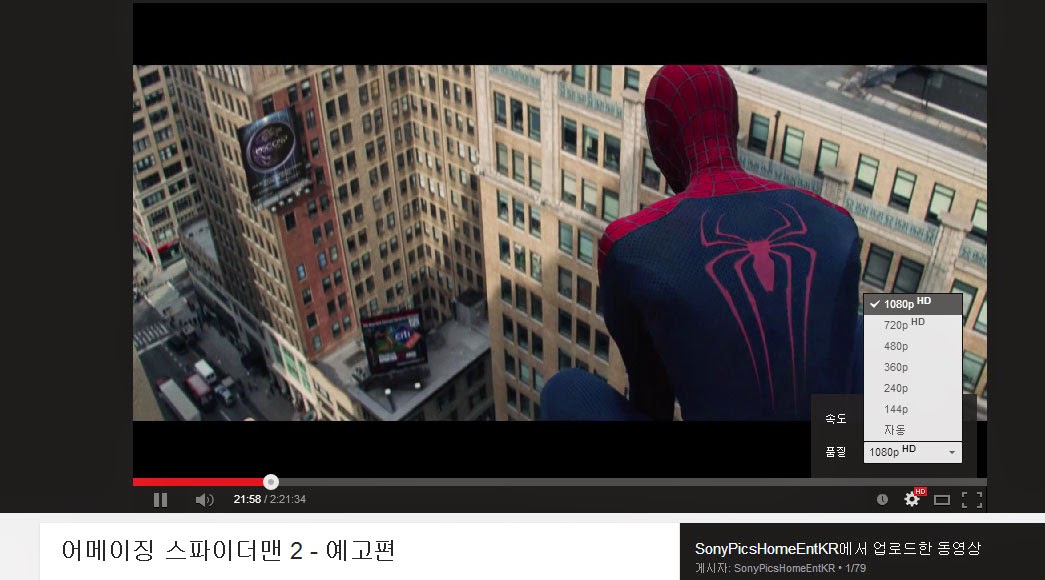
On Saturday night, podcaster and Portland Mercury blogger Bobby Roberts and a bunch of others pointed out on their Twitter feeds that Sony Korea's YouTube account accidentally posted The Amazing Spider-Man 2 in its entirety for free. Well, not all of the movie. The full upload, which Sony Korea immediately removed from YouTube once they realized the screw-up, was missing the mid-credits ad for X-Men: Days of Future Past. Amazing Spider-Man 2 director Marc Webb had to slip the Days of Future Past ad into his film's end credits in order to fulfill an obligation to his contract with Sony rival and Days of Future Past distributor 20th Century Fox.
![]() |
| (Photo source: OneHallyu) |
The Amazing Spider-Man 2 was an overstuffed and disjointed mess that was difficult to sit through for much of its bloated running time of two hours and 22 minutes, so I was in no mood to rewatch the entire movie right below Roberts' tweet, which he deleted when Sony Korea removed their accidental upload. And nope, not even skimming through the upload of Amazing 2 to revisit only my favorite scenes (and a few of my least favorite) improved the movie, which has become Sony's lowest-grossing Spider-Man movie in America (Sony studio execs' dissatisfaction with the sequel's U.S. box-office performance has caused them to put the kibosh on the studio's plans to do both a threequel and supervillain spinoff movies centering on the Sinister Six and Venom). This second (and this time, only partial) viewing of this extremely corporate product (as ScreenCrush's Britt Hayes tweeted, the movie "looks like it was made to sell pinball machines") failed to erase its flaws (SPOILERS), including...
The two Webb movies' misguided decision to make Peter Parker the Chosen One
Much of the original appeal of the character stemmed from Peter becoming a superhero by accident. When you make Peter a predestined hero like Harry Potter or Superman, you make him less of a relatable everyman. And who cares about all the boring new material about Peter's attempt to uncover the truth about both his dead but could-be-alive scientist/secret agent dad (Campbell Scott), who experimented on Peter and planted the seed for Peter receiving his powers, and his extremely dead secret agent mom (Embeth Davidtz)? (Why do I feel like Amazing 2 co-screenwriter Roberto Orci's bizarre adoration of Dubya the pampered Bush son was responsible for this shit, even though it was carried over from The Amazing Spider-Man, which Orci didn't co-write?)
Sony's inane attempts to build its own Marvel Cinematic Universe out of Webb's movies
Amazing Spider-Man movie universe, you may think you're the Marvel Cinematic Universe, but Amazing Spider-Man movie universe, you're no Marvel Cinematic Universe. Sony's postponement of the threequel and those baffling Sinister Six and Venom projects makes me hope that the postponement takes so long it causes Sony to lose the movie rights to Spidey and hand them over to Marvel Studios. For starters, Amazing Spider-Man movie universe, you have to have interesting villains on a par with Tom Hiddleston's charismatic Loki, which you don't. Speaking of which...
The overabundance of supervillains
Amazing 2 actually isn't a bad movie--that is if some nerd with a lot of time on his hands assembles a "Phantom Edit" of the movie and digitally replaces Jamie Foxx's obsessed Spidey fan character with Foxx's equally beaten-down but much less cartoonish character from Collateral. An even better "Phantom Edit" would be the removal of all material about Electro, Oscorp, the Green Goblin, that Michael Massee character who dresses like all those douches who always wore fedoras in high school and that Marton Csokas mad scientist character who's like a reject from Joel Schumacher's terrible Batman movies. Superhero movie writers and directors still haven't learned anything from the mistakes of those Schumacher Batman movies and other equally overcrowded and excessive superhero movies like Iron Man 2, X-Men Origins: Wolverine and of course, Spider-Man 3.
Part of why Sam Raimi's first two Spidey movies are superior to Webb's is because of their tautness: they pitted Spidey against only one villain in each movie. Like I've said before, Spidey's rogues gallery really pales in comparison to Batman's. I'll take psychotic comedians/showmen (Joker and Harley) and psychologically complex criminals (the Batman: The Animated Series version of Two-Face) over boring, one-dimensional monsters like the Lizard and Electro any day. So why did Sony have to subject us to five of those boring antagonists like they did when they awkwardly shoehorned an equal amount of antagonists into Spider-Man 3? Again, they learned nothing.
The inability to be moved by Gwen Stacy's death
Webb, the director of (500) Days of Summer and countless music videos (who has been, as Devin Faraci wrote, "toiling behind the scenes trying to make these movies good, and he's getting blocked at every turn by Avi Arad and Sony suits"), excels at two things in these Amazing Spider-Man movies. One of them is any moment where Spidey, whom I'm glad to see has regained his sense of humor after Tobey Maguire's less quippy portrayal, interacts with other New Yorkers, particularly the bullied little kid whose science fair project Spidey takes a shine to. (Spidey's scenes with kids he rescues are where Andrew Garfield--who's oddly derided for not being dorky enough by Spidey comics readers who have somehow developed amnesia about Brian Michael Bendis and Mark Bagley's depiction of a modernized, '60s sweater vest-less Peter in their acclaimed Ultimate Spider-Man comics--is at his best as Spidey. The fact that Garfield would like to see Miles Morales--who famously caused the repugnant Lou Dobbs to soil his Depends because of his biracial heritage and is the second Spidey of color in the comics--suiting up as Spidey in live-action form makes me like Garfield even more.)
The other thing Webb excels at is the romance between Peter and Gwen, a more entertaining on-screen relationship than the one between Peter and Mary Jane in the Raimi movies. Amazing 2's unsatisfying story isn't the only reason why its B.O. grosses are lower than those of other Spidey movies. Killing off Emma Stone, the most likable and interesting cast member in Webb's reboot, has a lot to do with its underwhelming B.O. as well. The moment when Gwen's back and head hit the floor made me wince, mostly due to its brutal sound FX, yet this classic angsty moment from the comics that was supposed to raise the reboot franchise's dramatic stakes and shock the audience ended up hampering post-opening weekend word-of-mouth and was oddly unmoving. As Kyle Buchanan noted in Vulture, the film's decision to rush through Peter's depression after failing to save Gwen robs her death of its dramatic impact, whereas Stoick's death and the impact it has on everyone else--not just his son Hiccup and his wife Valka--are better handled in How to Train Your Dragon 2 and therefore, far more moving.
I'm a cold fish. I don't cry during sad movies. But How to Train Your Dragon 2 got me emotional. Dammit, How to Train Your Dragon 2! Instead of weeping and tearing up, my bottom lip tends to tremble like Clint Eastwood's in his "I could have taken that shot" crying scene during In the Line of Fire. When How to Train Your Dragon 2 cut to Hiccup and Astrid's friends mourning Stoick at his Viking funeral and being genuinely serious instead of being their usual comic relief selves, my bottom lip went crazy. The lip didn't quiver once during the cemetary sequence in Amazing 2.
The cheesy "Itsy Bitsy Spider" scene
The most Spider-Man 3-ish--and Schumacher-ish--part of Amazing 2 has to be the source cue by Hans Zimmer and "the Magnificent Six" (a collective that included Pharrell Williams and Johnny Marr) for when Electro plays "Itsy Bitsy Spider" on giant Tesla coils while battling Spidey. It results in the Garfield one-liner that's most reminiscent of the terribly written comedic bits from Disney XD's Ultimate Spider-Man animated series ("I hate this song!"). The other cheesy element of the Zimmer/Magnificent Six score is...
Electro's equally cheesy theme
The nu metal chanting that's supposed to represent Electro's inner dialogue ("He lied to me/He shot at me/He hates on me/He's using me/Fragility/Electricity/He's dead to me") brings back memories of Zimmer's horribly dated, Limp Bizkit-inspired nu metal score to 2000's Mission: Impossible II. (And then that M:I-2 score brings back memories of Will Sasso's brutal impression of Fred Durst on MADtv.)
The Zimmer/Magnificent Six score is a mixed bag, but it also contains the best thing to come out of Amazing 2: "It's On Again," the surprisingly good original theme by Zimmer, the Magnificent Six, Alicia Keys and Kendrick Lamar. Kendrick goes hard in his verse. It's one of many tremendous guest verses from Kendrick.
"It's On Again" marks the first time that an end credits tune in a Spidey movie doesn't suck (and man, has this franchise suffered from such atrocious-sounding pieces of music). The Zimmer/Pharrell/Alicia/Kendrick tune deserves to conclude a better movie, like the one with Miles--and not Peter--in the Spidey suit that's currently playing in my head or the one with an Asian hero in the suit that's also currently playing in my head.
Monday, May 19, 2014
"I'm making a motion picture, not a jukebox": Excerpts from the five best recent articles involving film music
The following recent articles related to film music are must-reads.
"Pick Flick: An Oral History of Election, 15 Years Later" by Matthew Jacobs (May 7, 2014)
"[Alexander] Payne and [writing partner Jim] Taylor manage to fully develop their characters without sacrificing the cynicism and venom of their satire," I wrote back when Payne's 1999 cult classic Election was first released (Wayback Machine, I'm not going to like it, but take my ass back to an age of ugly HTML design!). Payne recalls battling with MTV Films to keep some of Rolfe Kent's original score from being ousted from Election, as part of a fascinating HuffPo oral history about the making of the Matthew Broderick/Reese Witherspoon political satire, still one of my favorite movies from the legendary movie year of 1999.
"I wanted some degree of Morricone in that score, and indeed we used some actual Morricone. Tracy's mental scream is stolen from a spaghetti Western. Even Quentin Tarantino told me later, 'Oh, I always wanted to use actual spaghetti-Western music.' You hear stolen spaghetti-Western music earlier than you do in any Tarantino film. I got there first. But it was a bit of a difficult situation with the record company that gave us a bunch of the rock songs that are in the film. Between MTV and the record label, they wanted a lot more. I remember the fight I had to go through to have the opening credits have score, not a rock song. It was de rigueur for movies to have some kind of rock song in the opening credits and end credits. I had to tell them I'm making a motion picture, not a jukebox."
"How indie musicians are reinventing film music" by David Ehrlich (May 12, 2014)
Over at The Dissolve, David Ehrlich deftly examines the growing wave of indie musicians bringing their talents to film scoring, and how it's resulted in either remarkable, experimental-sounding work (Daniel Hart's Ain't Them Bodies Saints score and Mica Levi's truly alien-sounding Under the Skin score) or unhappy work experiences like the Oblivion score, a collabo between Tron: Uprising composer Joseph Trapanese and a reportedly dissatisfied Anthony Gonzalez of M83. But I don't think the Oblivion score sounds as terrible as Ehrlich makes it out to be. Selections from the Oblivion score can be heard on "AFOS Prime" and "Hall H" on AFOS.
"Movies are challenging musicians to rethink how they write their music, and musicians are challenging movies to rethink how they use it. Now that projectors in most theaters hum with a quiet digital buzz rather than the stampeding clatter of celluloid, it sounds as if scores have finally begun to embrace a new purpose."
"Richard Ayoade's The Double, Amazing Spider-Man 2 and Movie Music That Cranks Up the Crazy" by Matt Patches (May 2, 2014)
Another smartly written piece of film writing praises recent cutting-edge score music, but this time, the article emanates from an unlikely source: the sexy sex advice site Nerve.com. Matt Patches explains at length why composer Andrew Hewitt's score for The Double, actor Richard Ayoade's latest directorial effort, excels at taking risks musically. Then Patches briefly points out why a similarly risky approach that Hans Zimmer and "the Magnificent Six" (a collective that included Pharrell Williams and Johnny Marr) brought to the Amazing Spider-Man 2 score doesn't succeed as effectively as Hewitt's effort does.
The risky element of the ASM2 score I'm referring to isn't the Kendrick Lamar guest verse at the start of "It's On Again," the sequel's Zimmer/Pharrell/Alicia Keys end title theme, a Kendrick guest feature I like, of course, because I'm a Kendrick fan. I'm referring to the love-it-or-hate-it, kind of dumb-sounding Electro chanting ("He lied to me/He shot at me"). But Patches gives the Magnificent Six some credit for trying something different.
"Zimmer's attempts to enliven the background with vocalization ultimately fails. Movies need more of failures like that. Spastic horror movies with hyper-editing and lighting of every color prove audiences can stomach directors maximizing each element of filmmaking. So why not music? The 21st century deserves cinematic tunes worth obsessing over (and if they're turned into disco tracks, so be it)."
"10 Things I Learned: Thief" by Curtis Tsui (January 14, 2014)
Ever wondered why at the end of Michael Mann's Thief, one-man killing machine James Caan mows down a bunch of mobsters to the tune of a ripoff of Pink Floyd's "Comfortably Numb"? Mann wanted to use "Comfortably Numb" but was unable to clear it, so he asked composer Craig Safan, who later became best known for writing the Last Starfighter score and all the incidental music on Cheers, to write and record a "Comfortably Numb" soundalike (it's called "Confrontation" on Tangerine Dream's Thief soundtrack album). The shootout music tidbit is one of 10 pieces of trivia about the making of the classic 1981 crime flick that Criterion Collection disc producer Curtis Tsui posted in a slideshow article to promote Criterion's recent Blu-ray release of Thief.
I hate slideshow articles, but I dig Thief so much that the slideshow format didn't bother me this time.
"As iconic as Tangerine Dream's electronic score has become, Mann himself still sometimes wonders whether it was the right choice for the film. He appreciates the abstraction of the music from a formal perspective, but his more intuitive inclination was toward the blues."
"John Powell on Five of His Notable Scores" by Steve Chagollan / "Billion Dollar Composer: John Powell Ranges from Action to Animation" by Jon Burlingame / "John Powell Plans Sabbatical from Movie Music" by Burlingame (April 23, 2014)
John Powell, who wrote perhaps his best score for How to Train Your Dragon (which can be heard on AFOS) and recently returned to DreamWorks Animation's popular franchise to score the upcoming How to Train Your Dragon 2, was the recent subject of a huge Variety profile. He recalled to the magazine why the score to John Woo's still-entertaining Face/Off, his first major credit, was both a good experience for him as a then-newcomer to Hollywood and one of his five favorite film music projects.
"The premiere was at the Mann Chinese; Hans (Zimmer) got me a limo. There was a big crowd, and as I got out of the limo, there was this sigh of disappointment when they realized that it wasn't John Travolta. I recommend this to all Hollywood composers. Within a small group of people, we may be well known, but it's not why people go to the movies."
"Pick Flick: An Oral History of Election, 15 Years Later" by Matthew Jacobs (May 7, 2014)
"[Alexander] Payne and [writing partner Jim] Taylor manage to fully develop their characters without sacrificing the cynicism and venom of their satire," I wrote back when Payne's 1999 cult classic Election was first released (Wayback Machine, I'm not going to like it, but take my ass back to an age of ugly HTML design!). Payne recalls battling with MTV Films to keep some of Rolfe Kent's original score from being ousted from Election, as part of a fascinating HuffPo oral history about the making of the Matthew Broderick/Reese Witherspoon political satire, still one of my favorite movies from the legendary movie year of 1999.
"I wanted some degree of Morricone in that score, and indeed we used some actual Morricone. Tracy's mental scream is stolen from a spaghetti Western. Even Quentin Tarantino told me later, 'Oh, I always wanted to use actual spaghetti-Western music.' You hear stolen spaghetti-Western music earlier than you do in any Tarantino film. I got there first. But it was a bit of a difficult situation with the record company that gave us a bunch of the rock songs that are in the film. Between MTV and the record label, they wanted a lot more. I remember the fight I had to go through to have the opening credits have score, not a rock song. It was de rigueur for movies to have some kind of rock song in the opening credits and end credits. I had to tell them I'm making a motion picture, not a jukebox."
***
"How indie musicians are reinventing film music" by David Ehrlich (May 12, 2014)
Over at The Dissolve, David Ehrlich deftly examines the growing wave of indie musicians bringing their talents to film scoring, and how it's resulted in either remarkable, experimental-sounding work (Daniel Hart's Ain't Them Bodies Saints score and Mica Levi's truly alien-sounding Under the Skin score) or unhappy work experiences like the Oblivion score, a collabo between Tron: Uprising composer Joseph Trapanese and a reportedly dissatisfied Anthony Gonzalez of M83. But I don't think the Oblivion score sounds as terrible as Ehrlich makes it out to be. Selections from the Oblivion score can be heard on "AFOS Prime" and "Hall H" on AFOS.
"Movies are challenging musicians to rethink how they write their music, and musicians are challenging movies to rethink how they use it. Now that projectors in most theaters hum with a quiet digital buzz rather than the stampeding clatter of celluloid, it sounds as if scores have finally begun to embrace a new purpose."
***
"Richard Ayoade's The Double, Amazing Spider-Man 2 and Movie Music That Cranks Up the Crazy" by Matt Patches (May 2, 2014)
Another smartly written piece of film writing praises recent cutting-edge score music, but this time, the article emanates from an unlikely source: the sexy sex advice site Nerve.com. Matt Patches explains at length why composer Andrew Hewitt's score for The Double, actor Richard Ayoade's latest directorial effort, excels at taking risks musically. Then Patches briefly points out why a similarly risky approach that Hans Zimmer and "the Magnificent Six" (a collective that included Pharrell Williams and Johnny Marr) brought to the Amazing Spider-Man 2 score doesn't succeed as effectively as Hewitt's effort does.
The risky element of the ASM2 score I'm referring to isn't the Kendrick Lamar guest verse at the start of "It's On Again," the sequel's Zimmer/Pharrell/Alicia Keys end title theme, a Kendrick guest feature I like, of course, because I'm a Kendrick fan. I'm referring to the love-it-or-hate-it, kind of dumb-sounding Electro chanting ("He lied to me/He shot at me"). But Patches gives the Magnificent Six some credit for trying something different.
"Zimmer's attempts to enliven the background with vocalization ultimately fails. Movies need more of failures like that. Spastic horror movies with hyper-editing and lighting of every color prove audiences can stomach directors maximizing each element of filmmaking. So why not music? The 21st century deserves cinematic tunes worth obsessing over (and if they're turned into disco tracks, so be it)."
***
"10 Things I Learned: Thief" by Curtis Tsui (January 14, 2014)
Ever wondered why at the end of Michael Mann's Thief, one-man killing machine James Caan mows down a bunch of mobsters to the tune of a ripoff of Pink Floyd's "Comfortably Numb"? Mann wanted to use "Comfortably Numb" but was unable to clear it, so he asked composer Craig Safan, who later became best known for writing the Last Starfighter score and all the incidental music on Cheers, to write and record a "Comfortably Numb" soundalike (it's called "Confrontation" on Tangerine Dream's Thief soundtrack album). The shootout music tidbit is one of 10 pieces of trivia about the making of the classic 1981 crime flick that Criterion Collection disc producer Curtis Tsui posted in a slideshow article to promote Criterion's recent Blu-ray release of Thief.
I hate slideshow articles, but I dig Thief so much that the slideshow format didn't bother me this time.
"As iconic as Tangerine Dream's electronic score has become, Mann himself still sometimes wonders whether it was the right choice for the film. He appreciates the abstraction of the music from a formal perspective, but his more intuitive inclination was toward the blues."
***
"John Powell on Five of His Notable Scores" by Steve Chagollan / "Billion Dollar Composer: John Powell Ranges from Action to Animation" by Jon Burlingame / "John Powell Plans Sabbatical from Movie Music" by Burlingame (April 23, 2014)
John Powell, who wrote perhaps his best score for How to Train Your Dragon (which can be heard on AFOS) and recently returned to DreamWorks Animation's popular franchise to score the upcoming How to Train Your Dragon 2, was the recent subject of a huge Variety profile. He recalled to the magazine why the score to John Woo's still-entertaining Face/Off, his first major credit, was both a good experience for him as a then-newcomer to Hollywood and one of his five favorite film music projects.
"The premiere was at the Mann Chinese; Hans (Zimmer) got me a limo. There was a big crowd, and as I got out of the limo, there was this sigh of disappointment when they realized that it wasn't John Travolta. I recommend this to all Hollywood composers. Within a small group of people, we may be well known, but it's not why people go to the movies."
Monday, October 15, 2012
The spy who spoofed me
![]() |
| Deadlier Than the Male |
I've been looking for an excuse to post Smokey Robinson & The Miracles' theme from the obscure 1967 spy comedy Come Spy with Me, and I've finally found one. I've loved that Miracles track ever since I first heard it on YouTube while I was searching for Sammy Davis Jr.'s catchy theme from The Second Best Secret Agent in the Whole Wide World because the Circus employees sang along to the Davis record in last year's Tinker Tailor Soldier Spy. There's one other spy movie theme that was recorded by a Motown act. It's The Supremes' theme from Dr. Goldfoot and the Bikini Machine, but it's not as good as the Miracles tune.
Spotify has the Supremes track, but unfortunately, it doesn't have the Davis track (Spotify is also devoid of any themes from Get Smart or the Derek Flint and Austin Powers franchises that are to my liking). Despite the Davis tune's absence, the playlist's title is copped from one of Davis' lyrics: "He's every bit as good as what's-his-name/With a dame, any dame." "What's-his-name" refers to, of course, that baller named Bond.
![]() |
| OSS 117: Cairo, Nest of Spies |
![]() |
| Fathom |
1. Smokey Robinson & The Miracles, "Come Spy with Me"
2. Vikki Carr, "The Silencers"
3. Nancy Sinatra, "The Last of the Secret Agents"
4. John Dankworth, "Modesty Blaise - Main Theme"
5. Shirley Bassey, "The Liquidator"
6. The Lovin' Spoonful, "Pow" (from What's Up, Tiger Lily?)
7. The Walker Brothers, "Deadlier Than the Male"
8. John Dankworth, "Fathom's Theme" (from Fathom)
9. Steve Allen, "The Swingin' Dagger Theme" (from A Man Called Dagger)
10. Joe Simon, "Theme from Cleopatra Jones"
11. Robbie Williams, "A Man for All Seasons" (from Johnny English)
12. Alexa Vega, "Game Over" (from Spy Kids 3-D: Game Over)
13. Ludovic Bource, "Le Caire, nid d'espions" (from OSS 117: Cairo, Nest of Spies)
14. Adrian Younge featuring LaVan Davis, "Black Dynamite Theme"
Subscribe to:
Posts (Atom)