Showing posts with label Motown. Show all posts
Monday, April 20, 2015
When enjoyable scores are attached to terrible movies, or why I feel kind of awful about adding Wild Wild West score music to "AFOS Incognito" rotation
I don't care for Madonna and her cultural-appropriating ass, but I've always liked the music of William Orbit. The Drake-scaring pop star's hit single from the summer of 1999, "Beautiful Stranger," a '60s-pop-flavored tune she recorded for Austin Powers: The Spy Who Shagged Me, is my favorite pop song Orbit has produced because it's Orbit at his most playful-sounding, from the Ron Burgundy flute funk to the harpsichord riffs (the harpsichord is also integral to why my favorite Michael Jackson tune is "I Wanna Be Where You Are"). "Beautiful Stranger" is featured in The Spy Who Shagged Me for like only 30 seconds, during a non-comedic scene where the titular '60s spy mourns the loss of his mojo. Because of "Beautiful Stranger," I would have been interested in what Madonna and Orbit would have recorded together for Guy Ritchie's upcoming remake of The Man from U.N.C.L.E., had Ritchie and Madonna never split.
"Beautiful Stranger" is pitch-perfect for the breezy, psychedelic, Laugh-In-esque and Derek Flint-inspired Austin Powers franchise, whereas Madonna's other original spy movie theme, the Mirwais-produced electroclash tune "Die Another Day," doesn't quite work for 007 (it would have worked for some other spy franchise: maybe Totally Spies?). The Die Another Day theme makes you wonder if Madonna or Mirwais ever even watched an actual 007 movie beforehand, even though she claimed that the Die Another Day screenplay influenced the lyrics she wrote (the orchestral string riffs during "Die Another Day" came not from Die Another Day score composer David Arnold but from Madonna's "Don't Tell Me" collaborator, the late New Jack City score composer Michel Colombier, and I would have enjoyed Colombier's string riffs a little more if they had at least some ounce of thematic connection to anything Arnold wrote for his score).
I fell in love with "Beautiful Stranger" again a few weeks ago while overhearing it being played on some store PA during a round of book-shopping or grocery-shopping (I can't remember which kind of shopping it was). So that's why I'm adding "Beautiful Stranger" to the playlist for the espionage genre music block "AFOS Incognito," where it can be enjoyed without having to be subjected to any visuals directed by Brett Ratner, Mondays through Thursdays at midnight Pacific on AFOS.
There's one other piece of music from a 1999 spy comedy that I'm adding to "AFOS Incognito," and this spy comedy isn't exactly as beloved as The Spy Who Shagged Me was back in 1999. It's from the second and final film in Warner Bros.' late '90s mission to ruin your favorite TV shows, Wild Wild West, the Will Smith/Kevin Kline blockbuster loosely based on the '60s spy show/proto-steampunk western of nearly the same name (the show was called The Wild Wild West, while the movie omitted "The" from the title).
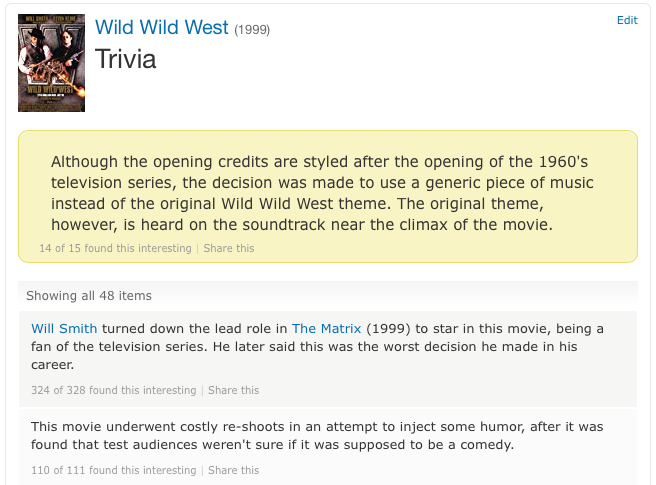
Fortunately, the selected piece of music isn't the ubiquitous-on-the-1999-airwaves Will Smith/Dru Hill theme tune that was never worthy of sampling Stevie Wonder's "I Wish." It's the other memorable piece of music from Wild Wild West: the rousing main title theme by a legendary composer who wrote a million rousing themes for westerns, the late Magnificent Seven score composer Elmer Bernstein. That Bernstein main title theme is the only thing I like about Wild Wild West. IMDb is wrong: it's not "a generic piece of music." It's classic Bernstein western music, faithful in spirit to Richard Markowitz's equally rousing '60s Wild Wild West theme tune, which either the filmmakers couldn't get the full rights to or were too dunderheaded to use more often in the film because of their hubris and contempt for the source material (although I wouldn't consider The Wild Wild West a perfect show: it suffers from that old '60s and '70s spy show staple of stupidly putting white actors in yellowface or brownface). The theme is too good for such a hackily written steaming pile and such a chemistry-deficient buddy action flick.
Speaking of chemistry, this might have improved the movie: instead of casting Kline, whom Smith had no chemistry with, as Artemus Gordon, Alfonso Ribeiro, whom Smith had a shitload of chemistry with from 1990 to 1996, should have been cast as Artemus. And instead of the movie's lame depiction of Artemus as this never-convincing master of disguise Kline looked as embarrassed to be portraying as Kline's washed-up Soapdish actor character looked when he had to play Willy Loman in front of confused and senile dinner theater customers, I would have written Ribeiro's short and black Artemus as an excellent master of disguise who--because both the Wild Wild West TV show and movie never gave a shit about being authentic to the period--came up with the most effective and ludicrous-for-any-period prosthetic makeup technology for altering his looks, as well as his height, race or gender. Plus it would have been amusing to have a black guy walk around with the name Artemus.
Anyway, like Stevie Wonder, I wish that theme (BLAM!) was (BLAM!) written for a different score. There lies my problem with adding to AFOS rotation enjoyable score cues from movies that are so terrible. It's so difficult to erase those movies' wretchedness from your mind when you hear these score cues that are the only redeeming elements of those movies. So to enjoy the Bernstein score cue a little more, you just have to pretend it's not from Wild Wild West.
Man, why do post-Blazing Saddles, pre-Django Unchained westerns with black heroes have such a lousy track record? Why do sci-fi westerns that are neither the '60s Wild Wild West nor the cult favorite Brisco County Jr. have such a lousy track record? Smith and his Men in Black director Barry Sonnenfeld clearly wanted to turn Wild Wild West into a Blazing Saddles for the '90s and with splashier action sequences, except Blazing Saddles knew how to be funny.
Blazing Saddles also didn't need a $170 million budget to land its jokes. The Nostalgia Chick pointed out that Shane Black, the writer and director of one of my favorite movies, Kiss Kiss Bang Bang--a buddy comedy that, like Blazing Saddles, was able to dazzle despite a limited budget--was attached to an earlier attempt to make a Wild Wild West movie. It's one of the most interesting parts of the Nostalgia Chick's 17-minute discussion of the many things that went wrong with Sonnenfeld's Razzie sensation, including Smith rejecting the role of Neo in The Matrix and choosing to play such an unlikable and overly cocky spy.
See? This is why Ribeiro would have been a great big-screen partner for Smith: unlike Kline's snooty and stiff Artemus, the equally snooty but more underdog-ish Ribeiro--due to his chemistry with Smith--would have been able to make Smith's overly cocky Agent West more likable and relatable when they interacted with each other. It would have been like how halfway through its run, the small-town lawyer sitcom Ed gave Michael Ian Black's annoying and overly cocky Phil Stubbs character a new bowling alley boss he grew to despise, in the form of the more level-headed Eli Goggins, played by the always charismatic Daryl "Chill" Mitchell. As both Phil's foil and a character who, unlike Tom Cavanagh's rather timid Ed, had the guts to challenge Phil and bring him back down to Earth whenever Phil's antics grated on everyone's nerves, including the viewer's, Eli made Phil the myopic and self-absorbed schemer a much less annoying and one-note character for the rest of the show's run.
I also wish I were in the universe where Will and Carlton reunited on the big screen as West and Artemus. Yeah, maybe it would have been too much of a rehash of the Will/Carlton dynamic from The Fresh Prince of Bel-Air for some moviegoers, but Ribeiro would have given Smith something more interesting to play against than whatever hacky shit Kline was doing. However, a completely different universe where Black's Wild Wild West got made instead is an even more enticing alternate universe. Now that is a version of Wild Wild West that would be worthy of Bernstein's main title theme. How many screenwriters did Wild Wild West have? Black's screenwriting work all by himself is frequently superior to the combined results of the 20,000 screenwriters who tried to polish the turd called Wild Wild West.
Many things doomed The Fresh Prince of Hot-Air, from its constant reshoots to skinny-pantsed '60s Wild Wild West star Robert Conrad's dissatisfaction with the script when Sonnenfeld offered him a cameo and he refused. The original Jim West bad-mouthing a reboot of his show and not giving it his blessing is like if the original Spock, when he was alive, tweeted, "I hope this new Star Trek crashes and burns," or if Michael Keaton stepped out and said, "My son showed me that new Batman trailer. Why is Ben Affleck being such a saggy diaper that leaks?" That doesn't bode well for your reboot. But when your film's key art is basically inverted key art from the 1993 megaflop Super Mario Bros., your film's really doomed.
When the only person who benefited from some part of the film is producer Jon Peters--that giant mechanical spider the extremely weird Peters kept threatening to squeeze into aborted movie versions of '90s Superman comic book storylines and Sandman finally made it into one of his productions--that's how terrible the film is. You know Patton Oswalt's six-minute distillation of the wretchedness and bloatedness of Wild Wild West (while he was being interviewed by the comedy news site/stand-up comedy record label A Special Thing)? It's six times more entertaining than Wild Wild West itself.
Labels:
007,
1999,
A Fistful of Soundtracks,
Austin Powers,
Blazing Saddles,
Elmer Bernstein,
film music,
Madonna,
Michael Jackson,
Motown,
Patton Oswalt,
Shane Black,
Stevie Wonder,
Will Smith,
William Orbit
Thursday, April 2, 2015
Shows I Miss: An update on Sounding Out the City (the show's selector responds!)
![]() |
| (Photo source: No Curves) |
Sometimes I'm just in awe of some of the people who read this blog. For instance, Edgar Wright stumbled last week into my Throwback Thursday discussion of the brilliance of The World's End as both an anti-gentrification satire and a midlife crisis comedy and retweeted it to his fans. And I know that writers from Bob's Burgers and the short-lived Motorcity, two animated shows I greatly admire, have read this blog because they've thanked me on Twitter for what I've written over here about their shows.
A Bob's Burgers writer is as amazing to me as, say, Rick Ross (ruh!) is amazing to some female fan who faints over getting his autograph. Now I wouldn't faint in the presence of either the controversial MMG impresario or a Bob's Burgers staffer--and I wouldn't say I'd get "the feels" around either of them because I'm over 21, and if you're over 21 and you go around telling people that you get "the feels," miss me with that asinine-sounding shit--but around that Bob's Burgers staffer, I'd be like, "So in episode S05E04, was H. Jon Benjamin actually blotto when he ad-libbed that turkey baster monologue? Was he? Huh, huh, huh, huh, huh?"
In another instance, I once blogged about regretting not buying when I was a kid an issue of Billy Nguyen, Private Eye, a largely forgotten indie comic book that remarkably featured an Asian American P.I. as the protag. My post caught the attention of Billy Nguyen artist Stan Shaw. Stan and I exchanged a few e-mails about Billy Nguyen (Stan turned out to also be an AFOS listener), and months later, he sent me in the mail a gift I'll always treasure: an issue of Billy Nguyen.
About a couple of months ago, I wrote about a now-defunct Canadian DJ mix podcast I miss hearing, Sounding Out the City. It was where I first encountered the late Amy Winehouse's "Valerie," and it was also where I first took notice of Mayer Hawthorne and TOKiMONSTA. The TOKiMONSTA track I heard on Sounding Out the City was "The World Is Ours," which flipped a classic Marvin Gaye/Tammi Terrell duet and is a tune TOKiMONSTA says she loves so much that she's never released it officially.
Back when I had a day job in the racist and misogynist shithole called the Silicon Valley tech world, Sounding Out the City helped make getting through that job, which I started to get bored with about four years into it, a hell of a lot easier. Sounding Out the City selector Rob Fragoso saw my post about his podcast and is now the latest person whose work I've admired to surprise me with an appreciative comment that made my day.
It turned out not to be the Ernestine Anderson "Love for Sale" that Rob featured on his podcast in 2009, but a completely different jam of the same name by Bay Area singer Lillian Alexander, as Rob realized several hours later. Come back to the ones and twos, Rob, we need you! Or if you're actually still mixing, the podcastosphere needs you! Some currently miserable Silicon Valley or Silicon Alley worker who's basically me eight years ago might need you!
Monday, February 24, 2014
13 black artists' covers of white artists' music that surpass the originals (to close out Black History Month)
![]() |
| Quincy Jones and Sarah Vaughan (Photo source: Jazzinphoto) |
The following list was inspired by both Harry Allen the Media Assassin's irritated response to the latest of Jimmy Fallon and Justin Timberlake's "History of Rap" medleys during the first week of The Tonight Show Starring Jimmy Fallon...
... and Andrew Ti's similar response to the "History of Rap" medleys.
1. Sarah Vaughan, "Peter Gunn" (both Vaughan's 1965 version and the dope Max Sedgley remix)
"According to the liner notes, we can thank Quincy Jones for the recording. Hank Mancini says he never thought the song would work with lyrics, but Jones kept pestering him to try it. So, Jay Livingston and Ray Evans wrote some lyrics and Bill Holman arranged the song. Vaughan provided the fireworks. Vaughan infuses the song with the same kind of slinkiness found on Peggy Lee's 'Fever,' but Vaughan manages to sound sultry at a much faster tempo."--Cahl's Juke Joint, 2008
2. The Skatalites, "Guns of Navarone"
"The song itself is an adaptation of the theme song to the 1961 film of the same name, and there are in fact two different versions of The Skatalites interpretation. With one clocking in at more than six minutes, it is the shorter, two and a half minute version that exemplifies everything that makes ska so fantastic."--The Daily Guru, 2010
3. Earth, Wind & Fire, "Got to Get You Into My Life"
"In 1978, Earth Wind & Fire appeared in another motion picture, the Beatles movie tribute Sgt. Pepper's Lonely Hearts Club Band. In the film, the band played themselves, performing 'Got To Get You Into My Life' at a concert hall. The film itself was a commercial bomb... Yet despite musical performances on the soundtrack from Aerosmith, Peter Frampton, the Bee Gees and Alice Cooper, Earth Wind & Fire's remake of the Beatles classic was the highest charting pop single from the soundtrack. 'Once more, we had a movie that flopped on us,' said Maurice White, 'but we had a #1 hit out of it... We actually recorded our parts on the set.'"--Goldmine magazine's profile of Earth, Wind & Fire, 1997
"Robert Stigwood called us and asked if we wanted to be in a movie... We said okay, it could be interesting. At that particular time, you didn't see a lot of musical blacks in movies--there was The Wiz, but that was a horrible movie. We had three songs to choose from--'Got To Get You Into My Life' and two ballads. We just did the song Chicago-style. Some people thought George Martin produced the song, but Maurice produced it."--Verdine White, Goldmine, 1997
4. Stevie Wonder, "We Can Work It Out"
"... it's worth mentioning that Stevie's soulful reworking of the original--no doubt powerful in its own glory--makes it sound more searing; indeed, converting it into a freedom song/black power amalgamation. In short, Stevie Wonder's version of 'We Can Work It Out' is nothing short of a magnificent transformation. And to a certain degree, you could say that Stevie Wonder 'flipped' the Beatles original. Does that mean that Stevie Wonder's version of 'We Can Work It' is better than the original? I'm not sure if that's a question worth entertaining."--Amir Said, 2010
Uh, it's a question I'm willing to tackle: hell yes, Wonder's version trounces the original.
Thursday, February 20, 2014
What ever happened to Babyface?: These are among the tracks I've added to AFOS rotation this month
Babyface featuring Toni Braxton, "Give U My Heart (Upscale R&B Remix)," and Toni Braxton, "Love Shoulda Brought You Home" (both from Boomerang; now playing during "The Whitest Block Ever")
Love, Marriage & Divorce, the new album "starring" Toni Braxton and Babyface, is the first time I've paid attention to new music by either one of them in like 13 years (when Babyface tried to update his sound and recruited the Neptunes to produce "There She Goes," to be exact). The project--a collection of tunes about rocky relationships (where the fighting often leads to sex), infidelity, divorce and post-divorce reconciliation that stem from Braxton and Babyface's experiences with divorce--plays to each of their strengths as artists: Braxton's terrific contralto, especially when she sings a blistering kiss-off to an ex like Love, Marriage & Divorce's "I Wish," and Babyface's skills as a craftsman of New Jack-era, pre-Jodeci/R. Kelly R&B of the baby-making kind.
There's a scene early in Boomerang where a heavy-handed--and enthusiastic, of course, because he's played by Geoffrey "No Caffeine: Never Had It, Never Will" Holder--TV ad director presents Eddie Murphy's skirt-chasing ad exec Marcus Graham with a rough cut of a hilariously unsubtle lipstick ad, which is full of shots of supermodels wagging their tongues between pairs of cherries and sucking on bananas. Marcus' response to the footage is "I like the orange, and I like the ice cream. You gotta get rid of the cherries and lose the banana... That's a little too overt, you know? We should go a little more subtle... At least there wasn't no sausages in this one." His preference for classing things up also best sums up why most of Babyface's hits still hold up today and you can sing along to them without snickering, while the much lewder slow jams that followed Babyface's string of hits--like, for example, Silk's "Freak Me"--come off as unintentionally funny when you re-encounter them these days, mostly because their lyrics have been parodied so often by the likes of Murphy's Boomerang co-star Chris Rock ("Suck Your Big Toe"), Dave Chappelle ("Piss on You") and The Lonely Island ("Dick in a Box").
It's nice to hear Braxton and Babyface singing together again because I remember very well when I first heard them together: the duet "Give U My Heart," which Babyface produced for the Boomerang soundtrack. That album, which represented the best in mainstream R&B at the time, dominated the R&B airwaves in 1992 (you couldn't hide from the mammoth radio hit that was Boyz II Men's "End of the Road," which is the very last song featured in the film's end credits). "Give U My Heart," a New Jack tune that still holds up today, made me think, "Who's this chick with the smoky voice? She's like a younger Anita Baker. I'd like to hear more from her." And five months later, we did get to hear more from her when the Boomerang soundtrack hit us with the single "Love Shoulda Brought You Home," which, in fact, was written for Baker, but she declined to record it because she was pregnant at the time, so she suggested to Babyface and L.A. Reid that they give the song to the girl who sang its demo version: Braxton.
The release of Love, Marriage & Divorce isn't just why "Love Shoulda Brought You Home," which Angela (Halle Berry) quotes from when she breaks up with Marcus in Boomerang, and the film version of "Give U My Heart," known as the "Upscale R&B Remix," have been added to "Whitest Block Ever" rotation. It's Black History Month, and I think Boomerang is just as important and vital a film for directors and moviegoers of color as, say, the box office hit Lee Daniels' The Butler and 12 Years a Slave. In 1992, there wasn't a film like director Reginald Hudlin's Boomerang. "Part of the appeal of Boomerang for the Hudlins was that the film's subject matter--a brazen look at the battle of the sexes--had never been explored in a black film with multimillion-dollar production values," said the Philadelphia Inquirer in its 1992 profile of Hudlin and his producer brother Warrington Hudlin, who were fresh off the success of House Party.
The Hudlins' 1992 hit paved the way for the current hot streak of black, or as USA Today likes to say, "race-themed," rom-coms: Think Like a Man (soon to be followed this summer by Think Like a Man Too), The Best Man Holiday and Kevin Hart's About Last Night. That's why Boomerang, which I just saw for the very first time, is worth another look. It's also a damn good comedy (peep its ensemble cast--there are so many funny performances throughout Boomerang) and one of Murphy's best, even though, like Odie Henderson says in his post about the film, it sort of falls apart at the end. (That's due to the Hudlins rewriting the film at the last minute so that Marcus wins back Angela instead of winding up without either Angela or Jacqueline, the marketing department boss--and freak in the bed--played by Robin Givens. It was supposed to originally end with that shot of the Empire State Building lighting up behind Murphy, his future Life co-star Martin Lawrence and David Alan Grier hugging each other--again, that cast!--on the rooftop.)
![]() |
| (Photo source: Brian Orndorf) |
Comedy movies like Boomerang get slept on simply because they're comedies, and we know how well the Oscar crowd treats comedy movies. The Butler and 12 Years a Slave garner lots of accolades (particularly for dramatizing tumultuous moments of African American history not from a white audience surrogate's point of view or the oppressor's point of view but from a black point of view) but are dismissed by some black moviegoers for being "misery porn." Armond White is a crazy old troll who hasn't written anything coherent or worth taking seriously in 13 years (the last White article I remember enjoying reading was his angry takedown of SNL's first post-9/11 episode because all the cops, firefighters and city workers Lorne Michaels brought out on-stage for Paul Simon's opening musical number were middle-aged white men), and White's heckling of 12 Years a Slave director Steve McQueen at the New York Film Critics Circle awards dinner was just plain rude and stupid, but I understand where he's coming from when he disses 12 Years a Slave for being "torture porn."
There's an interesting Tumblr exchange about this very subject between David Brothers from Image Comics, who's similarly said that he's had it up to here with misery porn, and another African American comics blogger, cartoonist Darryl Ayo. "I do feel like the [black-driven movies] that come across my desk tend to be what you describe--something about how much it sucks or sucked to be black, instead of just movies about people," wrote Brothers to Ayo. "The Butler, the Help, 12 Years a Slave, Django Unchained, Precious, The Blind Side, all these movies traffick [sic] in black misery. I feel like Hollywood's black people, outside of what feels like exceptions, have just a couple ideas as to what black folks are all about, and keep going to the misery well because it has a built-in triumphant narrative if you look at it right... I'm over feeling sad about being black."
Boomerang--which I watched on Netflix Instant because I was in the mood for a film with black stars that was neither somber Oscar bait nor a corny Tyler Perry film--may be a throwback to His Girl Friday, one of Hudlin's favorite movies and an influence on the Murphy film, or any one of those '50s and '60s ad exec rom-coms with Rock Hudson or Tony Randall, but one thing that keeps Boomerang remaining vital all these years is the humor based in political consciousness that Hudlin said he and his brother wanted to inject into House Party and Boomerang in that Philly Inquirer piece. Several of my favorite scenes in House Party involve awkward interactions between black folks and white authority figures, from the school principal who thinks the head bully called Kid's dead mom a garden tool to the inept cops who toss the not-exactly-thuggish Kid in jail and get their comeuppance at the end.
The Hudlins did the same thing in Boomerang, throwing in a little scene where Marcus and his friends, despite their Manhattan ad agency cachet, are racially profiled while browsing around a menswear store (Marcus' comedic handling of the racist clerk brings back a little bit of the fire Murphy brought to the scene that Roger Ebert memorably said was the moment that made Murphy a movie star, the 48 Hrs. redneck bar scene), as well as another bit where Berry says good night to Grier in fake Korean and jokes that it means "I'm sorry I shot you, but I thought you were robbing my store." It's the Hudlins' way of saying, "Sure, this is the same opulent and insular ad agency world from those Rock Hudson and Tony Randall rom-coms, but because our characters are black, these things that are unfortunately everyday to us--like racial profiling--are as much a part of this world as the tuxes, gowns and lavish product premiere parties." And in House Party and Boomerang, the Hudlins preferred to ridicule the racist assholes who keep these problems alive instead of building Oscar-bait dramas around these problems or speechifying about them, an approach I'd like to see more often from filmmakers of color. It's laughing to keep from crying (hey, that's the title of a Tyler Perry play).
Another thing that's made Boomerang age well is the ensemble, and unlike some other Murphy films in that pre-family-movie period of his career (particularly 1994's Beverly Hills Cop III, where, according to Bronson Pinchot, Murphy was so disengaged with the lame material that John Landis told him, "Just rest, Eddie, and I'll do the scene with Bronson," and he shot Pinchot's scenes with Murphy without Murphy), you can tell Murphy enjoyed being there because of the cast he was surrounded with. During one of the business meeting scenes, he looks like he's about to break character and corpse when the ponytail on Grace Jones' hat hits him in the face, and he looks like he's about to do the same thing too when John Witherspoon explains why "you got to coordinate" in a quotable scene Ludacris once referenced. In a later scene where Angela tries to cheer up a depressed Marcus by bringing him along to a kids' art class she teaches, the interplay between Murphy and the kids appears to be ad-libbed, and his amusement over interacting with those child actors brings to mind how much fun he clearly had watching Pinchot hilariously ad-lib in the first Beverly Hills Cop.
Everyone in that Boomerang cast gets a chance to shine, even bit players like the actor who plays the butler for Eartha Kitt's Lady Eloise character, plus there are three cast members who appeared in Bond movies (Holder was in Live and Let Die, Jones showed up in A View to a Kill and Berry later starred in Die Another Day) and the two black Catwomen (Kitt and Berry). Berry would have been an okay Catwoman had the idiots behind Berry's Catwoman fiasco adapted Ed Brubaker's Catwoman comics instead of inserting all that Patience Phillips/Egyptian superpowers shit. On the other hand, her romantic rival Givens would have been a great Catwoman. Peep how Givens dominates her sex scenes with Murphy. It's very Selina Kyle.
That willingness to take a brief break from the heroism of Reggie Hammond and Axel Foley to play such an emasculated character (who, at one point in one of his sex scenes with Givens, starts sucking his thumb) and win back women who hated the misogyny of Raw and wanted more of Murphy's Coming to America rom-com side--plus hitching his wagons to Black New Wave filmmakers--were good career moves for Murphy. Early '90s "Hammer Time in her shoe" line aside, Boomerang stands the test of time, thanks to the Hudlins, the cast they assembled ("I remember talking to one of the producers at the time and saying, 'Ten years from now, people won't believe we had all these people in the same cast,'" recalled Hudlin to Blackfilm) and a soundtrack that still slaps.
| (Photo source: Big Media Vandalism) |
Wednesday, May 29, 2013
"'Kid' spelled backwards describes you best": A look at each track in the newest "Whitest Block Ever" playlist on AFOS
"The Whitest Block Ever," a new AFOS block that I added to the station schedule as a way to mark Asian American and Pacific Islander Heritage Month (the block will remain on the schedule after May), is actually made up of five different one-hour playlists (and hopefully six, if Live365 hard drive space will allow it, and perhaps with an original track from Furious 6). All five playlists contain original themes and score cues from films done by Asian American directors and other filmmakers of color who have worked on films or TV series episodes I've dug or admired. "The Whitest Block Ever" airs every weekday at 10am-noon on AFOS.
Last week, I finished assembling the fifth playlist, a.k.a. "TheWhitestBlockEver05" (all the tracks in "TheWhitestBlockEver05" are streamed only during the "Whitest Block Ever" block and nowhere else on the station schedule, in order to reduce repetition). I enjoyed reading the replies Edgar Wright and "Whitest Block Ever" playlist fixture Robert Rodriguez gave to Empire magazine about their favorite score cues or soundtrack albums in the magazine's soundtrack tribute issue, so in a fashion similar to what Wright and Rodriguez did for Empire, here are descriptions of each of the 13 tracks in "TheWhitestBlockEver05."
1. Elmer Bernstein, "Prologue" (from Hoodlum)
Man, Bernstein could do it all: from slapstick vehicles for SNL alums like Trading Places and Ghostbusters to Harlem period pieces like the Bill Duke films A Rage in Harlem and Hoodlum. The ondes Martenot, an electronic instrument that Bernstein utilized most memorably in his Ghostbusters score and can easily be mistaken for a theremin, pops up in "Prologue" too and was used to great effect to represent an era of Harlem gone by.
2. Keisa Brown, "Five on the Black Hand Side" (from Five on the Black Hand Side)
I've seen only bits and pieces of this 1973 film, which has an enjoyable opening theme penned by legendary Capitol Records soul arranger H.B. Barnum and an equally enjoyable shot-on-a-shoestring trailer. The marketing for Five on the Black Hand Side brashly asserted that the film, an adaptation of a comedic stage play about the clash between Afrocentricism and black conservatives, was an alternative to the violent blaxploitation fare that was popular at the time of the film's release. "You've been Coffy-tized, Blacula-rized and Superfly-ed. You've been Mack-ed, Hammer-ed, Slaughter-ed and Shaft-ed. Now we wanna turn you on to some brand new jive," proclaims Fun Loving (Tchaka Almoravids) in the trailer. "You're gonna be glorified, unified and filled with pride when you see Five on the Black Hand Side."
3. Kid 'N Play, "Kid vs. Play (The Battle)" (from House Party)
I wish the Obama/Romney and Biden/Ryan debates were more like the freestyle battle scenes in 8 Mile and House Party.
4. Mader, "Rhumba (End Credits)" (from The Wedding Banquet)
Gentle-humored comedies about generational discord within families (or survival dramas about orphans who find unlikely surrogate families in the form of tigers) are where Taiwanese-born Ang Lee, this year's Best Director Oscar winner for Life of Pi, works best, not action material that calls for a nimbler touch from someone like Tsui Hark or Joss Whedon, like Lee's 2003 misfire Hulk. (As Stop Smiling said in its amusing evisceration of the two pre-Mark Ruffalo Hulk movies, "Lee shouldn’t do pop; his attempts to 'enliven' the material and make it more like a comic book with screen panels and visible page breaks was the cinematic equivalent of Karl Rove dancing.") Over a decade before he won his first Oscar for directing Brokeback Mountain, Lee tackled LGBT characters in The Wedding Banquet, a standout piece of Asian American indie cinema about Wai-Tung (Winston Chao), a Taiwanese American landlord who, with the prodding of his boyfriend Simon (Mitchell Lichtenstein), marries Wei-Wei (May Chin), a struggling Chinese artist, to enable her to get a green card and to satisfy his traditionalist parents from Taiwan. I feel like The Wedding Banquet has kind of been overlooked during this Brokeback/Life of Pi period of Lee's career, despite having been the most profitable film of 1993, even more so than Jurassic Park (it also went on to spawn a stage musical version in 2003). On paper, The Wedding Banquet reads like a shitty sitcom. But the film is far from being such a thing, thanks to Lee's thoughtful and low-key direction, which is aided by French-born composer Mader's equally low-key score, a mishmash of Chinese and Latin sounds that (spoilers!) mirrors how the future child of Wai-Tung, Simon and Wei-Wei will grow up to be a mishmash of various cultural influences.
5. Melba Moore, "Black Enough" (from Cotton Comes to Harlem)
I had no idea Galt MacDermot, one of the most frequently sampled composers in hip-hop, scored Cotton Comes to Harlem until recently. I've seen the Ossie Davis-directed adaptation of the Chester Himes novel of the same name two or three times, but that was before I became interested in finding out where beatmakers copped so many of their illest samples from (it's also kind of hard to notice MacDermot's musical trademarks during Cotton Comes to Harlem when all your 19-year-old self can think about is the film's T&A, like Judy Pace's T&A when she ducks out of being kept under watch by a dumb white cop by craftily tricking him into bed without sleeping with him). One of my favorite MacDermot samples takes place during 9th Wonder & Buckshot's "Shinin' Y'all," which loops "Sunlight Shining," a tune that happens to come from Cotton Comes to Harlem. I'd like to see some beathead make use of another Cotton Comes to Harlem joint, "Black Enough," the film's opening theme, which, like "Sunlight Shining," is filled with soothing strings and classic MacDermot beats.
6. Michael Jackson, "On the Line" (from Get on the Bus)
It's been a few years since I watched Spike Lee's Million Man March-themed Get on the Bus, so I forgot that Michael Jackson sung the film's opening title theme, which contains lyrics about overcoming self-hatred that bring to mind the Five on the Black Hand Side theme (and the Jackson theme was produced by Babyface too!). "On the Line" is, along with "Butterflies" and maybe the Teddy Riley-produced "Remember the Time," one of the few tunes from Jackson's post-Bad, extremely treacly "won't someone think of the children?" era that I actually like. The fact that "On the Line" is--like Everybody Loves Raymond used to say at the start of each episode--not really about the kids also helps.
Monday, March 25, 2013
Can a really dumb, two-year-old tweet get you bounced off the "AFOS Prime" playlist? Hell yes
![]() |
| (Photo source: The Playlist) |
I never really cared for Skrillex's music, but I thought a couple of the score cues that the EDM DJ/producer composed for Spring Breakers were decent (the film also features score cues by the always terrific Cliff Martinez, who worked on Drive). I added one of the Skrillex cues to "AFOS Prime" rotation last week. And then while enjoying Jezebel's guide to hipster racism, a post from last year that I've seen a few blogs mention but I've never gotten around to actually reading until now, I encountered this:
Uh, no, you're not "aloud" to use that word at all, Skrillex.
This Milli Vanilli-haired shithead's off the playlist.
He's being replaced by the never-before-released score cues from Trouble Man, which are bonus tracks on the Trouble Man soundtrack's recent 40th anniversary reissue and were composed by someone who'd probably beat the shit out of Skrillex if he heard him use that word.
Monday, October 15, 2012
The spy who spoofed me
![]() |
| Deadlier Than the Male |
I've been looking for an excuse to post Smokey Robinson & The Miracles' theme from the obscure 1967 spy comedy Come Spy with Me, and I've finally found one. I've loved that Miracles track ever since I first heard it on YouTube while I was searching for Sammy Davis Jr.'s catchy theme from The Second Best Secret Agent in the Whole Wide World because the Circus employees sang along to the Davis record in last year's Tinker Tailor Soldier Spy. There's one other spy movie theme that was recorded by a Motown act. It's The Supremes' theme from Dr. Goldfoot and the Bikini Machine, but it's not as good as the Miracles tune.
Spotify has the Supremes track, but unfortunately, it doesn't have the Davis track (Spotify is also devoid of any themes from Get Smart or the Derek Flint and Austin Powers franchises that are to my liking). Despite the Davis tune's absence, the playlist's title is copped from one of Davis' lyrics: "He's every bit as good as what's-his-name/With a dame, any dame." "What's-his-name" refers to, of course, that baller named Bond.
![]() |
| OSS 117: Cairo, Nest of Spies |
![]() |
| Fathom |
1. Smokey Robinson & The Miracles, "Come Spy with Me"
2. Vikki Carr, "The Silencers"
3. Nancy Sinatra, "The Last of the Secret Agents"
4. John Dankworth, "Modesty Blaise - Main Theme"
5. Shirley Bassey, "The Liquidator"
6. The Lovin' Spoonful, "Pow" (from What's Up, Tiger Lily?)
7. The Walker Brothers, "Deadlier Than the Male"
8. John Dankworth, "Fathom's Theme" (from Fathom)
9. Steve Allen, "The Swingin' Dagger Theme" (from A Man Called Dagger)
10. Joe Simon, "Theme from Cleopatra Jones"
11. Robbie Williams, "A Man for All Seasons" (from Johnny English)
12. Alexa Vega, "Game Over" (from Spy Kids 3-D: Game Over)
13. Ludovic Bource, "Le Caire, nid d'espions" (from OSS 117: Cairo, Nest of Spies)
14. Adrian Younge featuring LaVan Davis, "Black Dynamite Theme"
Monday, July 11, 2011
The dopest part of DJ Jazzy Jeff and Mick Boogie's Summertime 2 mixtape: The unexpected appearance of Stevie Wonder's "Love Light in Flight"
![]() |
| (Photo source: Tommer G) |
Thanks to the High Fidelity scene in which Jack Black disses the sappy and overplayed Woman in Red theme "I Just Called to Say I Love You," Stevie Wonder's Woman in Red soundtrack has become a punchline, much like Prince's Batman song soundtrack, which was the subject of a similar gag in Shaun of the Dead. Another thing that both those '80s song soundtracks have in common is that though those albums aren't exactly career highlights for either artist, they aren't exactly awful either. They're redeemed by two or three underappreciated tracks.
"Love Light in Flight" is one of those tracks, and it's a song I hadn't heard since 1984 or 1985--until I recently stumbled into it during DJ Jazzy Jeff and Mick Boogie's Summertime 2 mixtape and instantly smiled, which is why I just added "Love Light in Flight" to A Fistful of Soundtracks' '80s block "Soda and Pie" (Fridays, Saturdays and Sundays at noon).
![]() |
| "Drums, please!" |
"Oh man," I thought to myself while bumping Summertime 2, "I remember 'Love Light in Flight.' It so takes me back to when I was a Ghostbusters-loving kid in '84!" It's such a damn smooth track--plus it's full of aviation imagery, which would have made it perfect for the flight-themed "Up, Up and Away" episode of the terrestrial radio incarnation of A Fistful of Soundtracks that I aired on July 22, 2001.
![]() |
| Suddenly, Gene Wilder is faced with a crippling decision: Kelly LeBrock or the sheep that's waiting for him at home? |
"Love Light in Flight" is the one hit song from The Woman in Red that's neither overplayed nor preachy (that would be the well-meaning but clunkily written "Don't Drive Drunk"). Camille Paglia may be a pretentious, Sarah Palin-loving weirdo (her Salon Oscar telecast recaps were always worthy of an Onion parody), but she's right that "Love Light in Flight" is a sublime tune.
Monday, March 28, 2011
14 favorite elements of songs I currently have on rotation while I create artwork for my own book
1. The cinematic-sounding French horn lines during Kanye West's "All of the Lights"
Ye is a modern-day Mozart--as in batshit crazy, but a total musical genius.
2. The military drums during Pusha T's "My God"
3. The piano sample during Trebles and Blues' "The Tempo"
4. The handclaps during The New Pornographers' "Sweet Talk, Sweet Talk"
5. The bloops that open The Chemical Brothers' "Car Chase (Arp Worship)" from the Hanna score
6. The bass line of Lyrics Born and Sam Sparro's "Coulda Woulda Shoulda"
7. The really tight brass section during The Heavy's live 2010 performance of "That Kind of Man" for KEXP
8. The "Love You Save"-esque beat of Dennis Coffey and Mayer Hawthorne's "All Your Goodies Are Gone"
9. Dres' flow during the Black Sheep track "Elevation"
10. Bambu's delivery of "I used to sit in church and look at the stained glass and wonder why none of them look like me" during "Misused"
11. The electronic bass line of Daft Punk's Tron: Legacy end credits cue "Solar Sailer"
12. Ernie Isley's smokin' guitar solo at the end of The Isley Brothers' "Summer Breeze"
I only listen to that cover of sappy Seals and Crofts just to get to that guitar solo.
13. Teena Marie (R.I.P.) leading the female half of the Long Beach audience in a playful battle of the sexes with Rick James over which gender is louder during the live 1981 version of "I'm a Sucker for Love" that's on the deluxe edition CD of Street Songs
14. "The Michael McDonald of the rap game," Nate Dogg (R.I.P.), proving he wasn't your father's Michael McDonald when he crooned "And you even licked my balls" during Snoop Dogg's "Ain't No Fun (If the Homies Can't Have None)"
Ye is a modern-day Mozart--as in batshit crazy, but a total musical genius.
2. The military drums during Pusha T's "My God"
![]() |
| (Photo source: Trebles and Blues) |
4. The handclaps during The New Pornographers' "Sweet Talk, Sweet Talk"
5. The bloops that open The Chemical Brothers' "Car Chase (Arp Worship)" from the Hanna score
6. The bass line of Lyrics Born and Sam Sparro's "Coulda Woulda Shoulda"
7. The really tight brass section during The Heavy's live 2010 performance of "That Kind of Man" for KEXP
8. The "Love You Save"-esque beat of Dennis Coffey and Mayer Hawthorne's "All Your Goodies Are Gone"
9. Dres' flow during the Black Sheep track "Elevation"
10. Bambu's delivery of "I used to sit in church and look at the stained glass and wonder why none of them look like me" during "Misused"
11. The electronic bass line of Daft Punk's Tron: Legacy end credits cue "Solar Sailer"
12. Ernie Isley's smokin' guitar solo at the end of The Isley Brothers' "Summer Breeze"
I only listen to that cover of sappy Seals and Crofts just to get to that guitar solo.
13. Teena Marie (R.I.P.) leading the female half of the Long Beach audience in a playful battle of the sexes with Rick James over which gender is louder during the live 1981 version of "I'm a Sucker for Love" that's on the deluxe edition CD of Street Songs
14. "The Michael McDonald of the rap game," Nate Dogg (R.I.P.), proving he wasn't your father's Michael McDonald when he crooned "And you even licked my balls" during Snoop Dogg's "Ain't No Fun (If the Homies Can't Have None)"
Labels:
Bambu,
Daft Punk,
David Letterman,
Dennis Coffey,
film music,
Hanna,
hip-hop,
Kanye West,
live music footage,
Motown,
The Chemical Brothers,
The Heavy,
Trebles and Blues,
Tron: Legacy
Tuesday, March 15, 2011
Coffey is the color
To promote the upcoming self-titled album by legendary and frequently sampled Motown guitarist Dennis Coffey, Strut Records recently dropped a fantastic 45-minute mix of old Coffey tunes, hip-hop tracks that sampled Coffey's work and new material from the April 26 release. The instrumental jam "7th Galaxy," a new joint from Coffey's Strut album, starts at 04:55 in the "Constellations" mix, which was assembled by DJ House Shoes. "7th Galaxy" needs to turn up as chase music in a TV show or movie pronto.
The mix includes one of my all-time favorite movie themes, Coffey's Black Belt Jones theme, and another blaxploitation soundtrack tune that features Coffey's guitar work, Edwin Starr's "Easin' In" from Hell Up in Harlem. I was first exposed to "Easin' In" via "Nickel Bags" by Digable Planets, while LL Cool J's "Jingling Baby" introduced me to the Black Belt Jones theme.
I once saw a TCM featurette that pointed out that the Magnificent Seven montage of Yul Brynner and his crew journeying on horseback to the Mexican villagers looked really lethargic and unexciting without Elmer Bernstein's energetic main theme. The Black Belt Jones opening title sequence takes place in the dullest of settings, an L.A. parking lot--not exactly the most dynamic location to showcase the martial arts skills ofBushido Brown Jim Kelly. I guess director Robert Clouse had much less dough to work with than he did on his previous movie with Kelly, the Hong Kong-based Enter the Dragon. Like Bernstein's theme during the Magnificent Seven montage, Coffey's funky theme helps distract you from how shabby the opening title sequence looks despite the fisticuffs (ComicsAlliance editor Chris Sims noted on his Invincible Super-Blog that even the fisticuffs look compromised too: "It may SEEM like Black Belt Jones is moving slow, and that the guys he's fighting are drunk, but I assure you that's not the case. In order to get an 'R' rating they actually had to slow the film down because audiences in the Seventies could not handle that much brutal action.").
YouTube comments sections are too often full of inane or racist junk, but there was one comment below the video of the Black Belt Jones opening credits that amused me and caused me to do something I've never done before in a YouTube comments section, and that's click on "thumbs up":
"Obama should enter Congress with this theme and kick some Republican butt."
Word.
There are so many hot beats in Strut's Coffey mix, which concludes with "All Your Goodies Are Gone," a terrific blue-eyed soul collabo with Mayer Hawthorne from the new album, a release that Strut hopes will introduce Coffey to a new generation of beatheads. I particularly enjoyed the mix's juxtapositions of "Jingling Baby" with the Black Belt Jones breakbeat and "Easin' In" with "Nickel Bags."
Constellations - The A to Z of Dennis Coffey: A Mix By House Shoes by Strut
[Via Potholes in My Blog]
The mix includes one of my all-time favorite movie themes, Coffey's Black Belt Jones theme, and another blaxploitation soundtrack tune that features Coffey's guitar work, Edwin Starr's "Easin' In" from Hell Up in Harlem. I was first exposed to "Easin' In" via "Nickel Bags" by Digable Planets, while LL Cool J's "Jingling Baby" introduced me to the Black Belt Jones theme.
I once saw a TCM featurette that pointed out that the Magnificent Seven montage of Yul Brynner and his crew journeying on horseback to the Mexican villagers looked really lethargic and unexciting without Elmer Bernstein's energetic main theme. The Black Belt Jones opening title sequence takes place in the dullest of settings, an L.A. parking lot--not exactly the most dynamic location to showcase the martial arts skills of
![]() |
| (Photo source: Cinema is Dope/Museum of Cinema) |
YouTube comments sections are too often full of inane or racist junk, but there was one comment below the video of the Black Belt Jones opening credits that amused me and caused me to do something I've never done before in a YouTube comments section, and that's click on "thumbs up":
"Obama should enter Congress with this theme and kick some Republican butt."
Word.
There are so many hot beats in Strut's Coffey mix, which concludes with "All Your Goodies Are Gone," a terrific blue-eyed soul collabo with Mayer Hawthorne from the new album, a release that Strut hopes will introduce Coffey to a new generation of beatheads. I particularly enjoyed the mix's juxtapositions of "Jingling Baby" with the Black Belt Jones breakbeat and "Easin' In" with "Nickel Bags."
Constellations - The A to Z of Dennis Coffey: A Mix By House Shoes by Strut
[Via Potholes in My Blog]
Labels:
Barack Obama,
Black Belt Jones,
Dennis Coffey,
Elmer Bernstein,
film music,
Hell Up in Harlem,
hip-hop,
House Shoes,
Jim Kelly,
Motown,
sampling,
Strut Records,
The Magnificent Seven,
YouTube
Monday, February 14, 2011
"Rock Box" Track of the Day: The Jackson 5, "Never Can Say Goodbye"
Song: "Never Can Say Goodbye" by The Jackson 5
Released: 1971
Why's it part of the "Rock Box" playlist?: It was featured in 1994's Crooklyn, one of my favorite Spike Lee Joints. In an A.V. Club "Random Roles" piece that was posted last week, Crooklyn star Delroy Lindo said his film, which flopped at the box office, found its fans on video:
Crooklyn is where I first heard "Never Can Say Goodbye," which was written by actor/minister Clifton Davis of That's My Mama and Amen fame. Thank you, Spike, for introducing me to so many fantastic pieces of music like the original version of "Never Can Say Goodbye" and "Chaiyya Chaiyya."
You know those Kidz Bop cover versions of pop hits? I'm looking forward to hearing the Kidz Bop crew take a stab at Cee Lo Green's "Fuck You."
Kidz Bop covers of songs like "Since U Been Gone" make no sense because they have kids sing about relationship baggage they haven't experienced yet. You don't have to be Lorne from Angel to be able to detect that in their soulless delivery. I can't take seriously a tune about relationship woes if it's sung by someone who still eats paste.
"Never Can Say Goodbye" should have been just as nonsensical because little Michael Jackson was also singing about adult heartache, but his voice in that tune is the opposite of soulless (it's also devoid of the showboating that a whole future generation of American Idol contestants is so fond of). I have no idea which moment from his effed-up childhood Jackson was recalling in order to embody the angsty character in "Never Can Say Goodbye"--Alex, I'm gonna go with "What is heartache over a rat he lost?"--but whatever it was, it fueled one hell of a performance during "Never Can Say Goodbye." That's what separates young Michael Jackson from whatever Village of the Damned they pluck those Kidz Bop studio singers from.
Released: 1971
Why's it part of the "Rock Box" playlist?: It was featured in 1994's Crooklyn, one of my favorite Spike Lee Joints. In an A.V. Club "Random Roles" piece that was posted last week, Crooklyn star Delroy Lindo said his film, which flopped at the box office, found its fans on video:
One of the things that's been interesting about the legacy of the film is that I can't tell you how often I'm walking down the street and somebody will come up to me and say something like, "My daughter loves that film," "My daughter knows every scene in that film," "My daughter went through a period where she would come home from school and put in the VHS of Crooklyn." I mean, I hear that a lot, or people saying, "Oh my God, that was my family." And not just African-Americans. I've had white people say "You know what, I'm from Brooklyn, that was my film; that's so evocative for me of my family, of my past."Which moment in Crooklyn does "Never Can Say Goodbye" appear?: The sequence where Troy (Zelda Harris) heads back to Brooklyn and says goodbye to both her Virginia-based cousin and compressed anamorphic widescreen (to the relief of viewers who were annoyed by the way Spike intentionally distorted the film's images to convey Troy's discomfort in Virginia).
Crooklyn is where I first heard "Never Can Say Goodbye," which was written by actor/minister Clifton Davis of That's My Mama and Amen fame. Thank you, Spike, for introducing me to so many fantastic pieces of music like the original version of "Never Can Say Goodbye" and "Chaiyya Chaiyya."
You know those Kidz Bop cover versions of pop hits? I'm looking forward to hearing the Kidz Bop crew take a stab at Cee Lo Green's "Fuck You."
Kidz Bop covers of songs like "Since U Been Gone" make no sense because they have kids sing about relationship baggage they haven't experienced yet. You don't have to be Lorne from Angel to be able to detect that in their soulless delivery. I can't take seriously a tune about relationship woes if it's sung by someone who still eats paste.
"Never Can Say Goodbye" should have been just as nonsensical because little Michael Jackson was also singing about adult heartache, but his voice in that tune is the opposite of soulless (it's also devoid of the showboating that a whole future generation of American Idol contestants is so fond of). I have no idea which moment from his effed-up childhood Jackson was recalling in order to embody the angsty character in "Never Can Say Goodbye"--Alex, I'm gonna go with "What is heartache over a rat he lost?"--but whatever it was, it fueled one hell of a performance during "Never Can Say Goodbye." That's what separates young Michael Jackson from whatever Village of the Damned they pluck those Kidz Bop studio singers from.
Thursday, January 13, 2011
"Rock Box" Track of the Day: Stevie Wonder, "I Believe (When I Fall in Love It Will Be Forever)"
Song: "I Believe (When I Fall in Love It Will Be Forever)" by Stevie Wonder
Released: 1972
Why's it part of the "Rock Box" playlist?: It's featured in High Fidelity, which was where I first heard this overlooked Wonder tune.
Which moment in High Fidelity does it appear?: The closing credits, which are a special treat for fontophiles like myself. Mmm, Stencil...
Mmm, Eurostile...
The characters' hatred of Wonder's '80s and '90s output was the subject of one of Jack Black's key scenes ("Rob, 'Top Five Musical Crimes Perpetrated by Stevie Wonder in the '80s and '90s.' Go."), so it's no surprise that Rob (John Cusack) opted for 1972's "I Believe" while making a mixtape for Laura (Iben Hjejle). "I Believe" is the closing track on Wonder's Talking Book album. In 2005's 1001 Albums You Must Hear Before You Die, Stevie Chick wrote that "'I Believe' finds Stevie's heart broken, but his belief in love still intact"--much like Rob at the end of the film.
Subscribe to:
Posts (Atom)