Showing posts with label graphic design. Show all posts

Wednesday, May 11, 2016

Rest in power, the Minority Militant, a.k.a. Keon Enoy Munedouang

Keon Enoy Munedouang (1980-2016)

NOTE: A few more remembrances of the Minority Militant have surfaced online, in addition to the remembrances I linked to in my post below. One of his three sisters says goodbye to him and writes that "You lived your life through your convictions and didn't care what anyone thought of you. I had no idea, the extent in which your writing impacted the Asian American community." Slant Eye for the Round Eye's Adam Chau, who once made a guest appearance on this blog, has posted substantial excerpts from the best of the Minority Militant's cordoned-off Blogspot blog. Over at Reappropriate, Jenn Fang points out that though "TMM occupied a corner of the Asian American blogosphere that had little overlap with my own" and "we may not know one another offline," the Asian American blogosphere is close-knit, and his passing affects everyone in our community.

If you regularly read several blogs written by Asian American authors or you're active in the Asian American blogosphere, you're going to be hearing a lot in the next few days about a reclusive political blogger who wrote under the alias of the Minority Militant. From 2008 to 2010, the Chicago-based Keon Enoy Munedouang, a Laotian American military vet who was found dead last week in Montrose Harbor at the way-too-young age of 35, was one of my favorite Asian American bloggers, whether he was criticizing self-hating Asians who stupidly undergo plastic surgery to look more white, describing right-wing moron Michelle Malkin as a pundit who is "so far right she fell off the edge of a stoop and landed in a pile of jizz after a conservative gangbang convention" or mocking old Vietnamese American Republicans who supported the presidential campaign of Arizona senator John McCain, who had no qualms about continuing to refer to the Vietnamese in public as "gooks" due to the torture he experienced as a Vietnam War P.O.W.

While Phil Yu over at the much more popular blog Angry Asian Man was trying to make "That's racist!" a thing, Keon's favorite catchphrase over at TMM had him consigning the likes of Malkin, or as I like to call her, Uncle Ruckus, and extremely corny Iron Chef America host Mark Dacascos to "the chicken coop." Ken Jeong and former Entourage regular Rex Lee would have wanted to put a foot in Keon's ass for the negative things he wrote on his blog about the comedic (and sometimes controversial in Asian American circles) characters they've played. Jo Koy, a favorite stand-up of Keon's who agreed to a selfie with Keon after one of his shows, clearly didn't know what to make of Keon and ran as far the fuck away from Keon as he could when he requested to do an interview with him for his blog. Keon's drunken appearance at a panel for a 2009 Asian American blogger conference known as BANANA, an embryonic version of the annual L.A. digital media conference that's known today as V3con, alienated some of the other panelists and people in the USC campus audience who weren't familiar with his blog.

Keon's writing wasn't for everybody. It was highly opinionated and outspoken writing (he once wrote, "I am relentless about racism. I cuss like a foul-mouthed sailor"), and he was much more outspoken than Phil, who--while there's no disputing that Phil's a legend in the Asian American blogosphere who has done a lot of good in terms of Asian American representation, speaking out against Asian-bashing and promoting the work of other Asian American authors--has never really been as enjoyably scathing or as in-depth a writer as Keon (or someone like Emily Yoshida over at The Verge or my current favorite Asian American blogger, playwright Philip W. Chung over at YOMYOMF).

I never got to meet Keon face-to-face. All of our brief conversations took place only in comments sections and via e-mail. But I was a regular part of Keon's blog. I drew and designed the header that appeared every day at the top of his posts, back when I was in the middle of an ultimately unsuccessful phase in which I attempted to become a cartoonist and graphic designer. Keon was my only graphic design client.

The logo Keon commissioned me to draw for his blog

Keon was a fan of the webcomic I drew and posted for a couple of years over on this blog. In fact, he was the only fan of the webcomic. Not even I'm a fan of my own webcomic. In fact, I've been considering deleting almost all of the webcomic's installments from my blog. They're that embarrassing. But Keon was the only person--other than my parents and an online friend of mine, current DC Comics letterer Janice Chiang--who believed in my artwork at the time, and I'll always be grateful for that. While some asshole from the discontinued Asian American Movement blog was bashing some of my Minority Militant artwork over in some now-forgotten comments section somewhere, Keon always stood by my artwork.

I never agreed with Keon's choice for his blog header though. He wanted me to draw him wearing a hoodie emblazoned with "TMM," and out of all the header options I designed for him, he liked the one with him in a hoodie the most, but I never really cared for that one. I made Keon look too much like a Jules Feiffer cartoon. A header he rejected, in which I inserted a photo of a bruised and beaten Uncle Sam, was, to me, much more effective at reflecting the pugnaciousness and candidness of Keon's writing than the header he picked.

An unused header for Keon's blog

Wednesday, September 4, 2013

5-Piece Cartoon Dinner Extra: Back to the Futurama past (with former Futurama assistant director A.L. Baroza)

Leela and Fry watch the skies--and the Nielsen ratings results.
Tonight, Futurama, which premiered on March 28, 1999 on Fox, airs its final episode on Comedy Central, the network that--to the delight of fans of the animated cult favorite and its direct-to-video, post-Fox cancellation spinoff movies--brought Futurama back to series form in 2010. For those who have been frozen in a cryogenic tube in the last few years, Futurama is about a 20th century pizza delivery boy named Fry (Billy West), a stranger in a strange land called the 31st century.

Helping Fry to continually adjust to 31st century life after his awakening from an accidental cryogenic sleep are his 173-year-old descendant, the unsurprisingly exposition-y Professor Farnsworth (also West), a boozy robot roommate named Bender (John DiMaggio) and Leela (Katey Sagal), a one-eyed, karate-chopping delivery ship captain who was raised in an "orphanarium." Several things have kept Futurama from being a lame retread of The Jetsons, which it appeared to be at first: the misanthropic brand of humor of Life in Hell and Simpsons mastermind Matt Groening, who co-created the show with writer David X. Cohen, gorgeous state-of-the-art animation and some brilliantly written episodes that, in addition to being genuinely funny, also hold up as solid and cerebral sci-fi, particularly "Godfellas," "The Late Philip J. Fry" and the surprisingly moving "Jurassic Bark."

And then there are episodes that are just plain funny from start to finish, like "Where No Fan Has Gone Before." An homage to Fry's favorite show, the original Star Trek, 2002's "Where No Fan" somehow managed to get the voices of nearly all the surviving (and still-bickering) '60s Trek cast members together in the same episode, if not the same recording booth (the only surviving cast member who sat out the episode was the late James Doohan, whose refusal to participate resulted in a couple of great gags about a Doohan replacement named Welshie).

I've seen the head of that smiley-face robot that's lying behind the Rocky IV robot's head before, and it's fucking bugging me that I can't remember where that robot's from!
In the recent Futurama episode "Assie Come Home," a robot chop shop is strewn with pieces of the Iron Giant; C3P0; Muffit II from the '70s Battlestar Galactica; Rosie the Robot Maid from The Jetsons; Octus from Sym-Bionic Titan; Robo Bill and Robo Ted from Bill & Ted's Bogus Journey; Alpha 5 from Mighty Morphin Power Rangers; Gigantor; Paulie's robot from Rocky IV; a Dalek; and a Cylon. (Photo source: Sexy Machine)
Animated comedy shows aren't exactly known for bringing great change and upheaval to their characters' lives and making such a thing permanent (for instance, you'll never see Bart, Lisa and Maggie age, unless it's a DC Elseworlds-style Simpsons episode about an alternate future), and Futurama was no exception. Even through all the countless body (or brain) transformations and deaths they've experienced, the Planet Express crew has remained fundamentally the same: Fry's still lazy, Bender always looks out for number one, Leela's always more sensible than the other two, Amy Wong (Lauren Tom) bangs anything that moves, as long as they're not Asian (a young Asian woman on a white show who's scripted to bone everybody except Asian guys--how surprising!), and so on.

But there's one story thread on Futurama that's evolved over the years, and it's the relationship between Fry and his fellow misfit Leela. Their gradual romance (which became an official thing in the Comedy Central years) was the focus of what was thought to have been the final Futurama episode when the series aired on Fox, and it's once again the focus of the this-time-for-real series finale. Many Futurama viewers think the show has lost some of its luster writing-wise--which often happens to shows that go past five seasons--so tonight, will Futurama go out in high style and win back those viewers?

Shortly before Futurama takes its bow for the third and most likely final time, I got A.L. Baroza, an assistant director and storyboard artist on the show during its Comedy Central run, to recall to me his five favorite Futurama episodes that he worked on. Not surprisingly, one of them involved an elaborate mechanical killing machine sequence that also happens to be one of my favorite pieces of animation the show has ever done. After Futurama wrapped up production, A.L. has moved on to storyboarding Fox's Axe Cop, based on the Nicolle brothers' completely nonsensical superhero comic of the same name.

This new Futurama coloring book is surprisingly boring.
(Photo source: The Infosphere)
"The Tip of the Zoidberg" (season 6, episode production number 6ACV18; aired August 18, 2011)
"In the earlier episode 'The Duh-Vinci Code,' I storyboarded this Rube Goldberg sequence where Fry and the Prof get launched into space from the Parthenon. I guess the Futurama powers-that-be must have liked it since in 'Tip,' I got the Murderlator sequence, which is a Rube Goldberg machine that pretty much took up an entire act of the script. It was the hardest storyboard sequence to board in my entire animation career. Although it was a somewhat painful experience, it was worth it, in no small part due to the CGI crew at Rough Draft Glendale, who modeled some (but not all!) of the Murderlator sequence. And the episode was nominated for an Emmy!"

Wow, NBC shelled out a shitload of cash for the challenges on American Ninja Warrior.

"Overclockwise" (season 6, episode production number 6ACV25; aired September 1, 2011)
"I enjoyed doing the Cosmically Aware Bender stuff where I could bring all my years of reading Jack Kirby and Jim Starlin comics to good use. Alternately, I loved doing the extended take of Fry and Leela that closed out the episode, just two characters acting and reacting silently. I love doing scenes that give viewers the feels, as the kids call it these days."

'Shoo, Fry, don't bother me!'... is a line that's not in this scene.

In panel 5, Leela slaps Fry and then in panel 6, Fry slaps Leela back. Without the animation or any slap visual FX, it looks like Fry is about to puke from bad shellfish and then Leela is about to do the same too.
(Photo source: Sexy Machine)

Thursday, February 21, 2013

AFOS Blog Rewind: Do the Right Thing (Part 4 of 5)

It's Black History Month, so all this week, I'm reposting every single past AFOS blog post about one of my favorite films, Do the Right Thing, the timeless and still-bracing 1989 Spike Lee Joint. You can hear original score (or original song) selections from Do the Right Thing on AFOS.

(Previously on AFOS: The Blog: Parts 1, 2 and 3. The following is from August 25, 2009.)

Fireside Books' Do the Right Thing cover
After posting a bunch of interesting Batman concept drawings and set photos from the 20-year-old blockbuster's official movie souvenir magazine, I'm doing the same thing with a similar tie-in for summer 1989's other landmark film, Do the Right Thing. But instead of an official movie mag, the Spike Lee Joint spawned a now-out-of-print Fireside/Simon & Schuster companion book that Lee wrote with the assistance of ex-girlfriend Lisa Jones. The director has done several companion books for his films. Each of these books contain behind-the-scenes photos, the film's script and Lee's own production journal (some of the Do the Right Thing journal passages are like tweets with better spelling: "Haven't written in a couple of days. I've been busy trying to save School Daze from being dogged.").

Wynn Thomas' sketch of Do the Right Thing's two most pivotal sets, We Love Radio and Sal's Famous Pizzeria
I've discussed before why Do the Right Thing is one of my favorite films and why writers of color like myself cite it as an influence. One aspect of the film that I don't think gets enough props is the terrific production design by Wynn Thomas, who drew this sketch of the We Love Radio and Sal's Famous Pizzeria set exteriors. Using an old Coney Island pizzeria as the basis for Sal's, the film's crew built it from scratch on an empty Bed-Stuy lot. "The ultimate compliment was when real people would walk off the street and try and buy a slice," said Thomas in an L.A. Times oral history about the movie. Thomas later created nifty-looking sets for Mars Attacks! and brought CONTROL Headquarters into the 21st century for Steve Carell's Get Smart.

Thursday, March 29, 2012

March Madness March of the Day: "Theme from Human Target" by Bear McCreary

Coming soon: Hunan Target, the all-Chinese version about badass security expert Christopher Chan.
"Bear McCreary's Christopher Chance theme is as important to that character as the Raiders March is to Indiana Jones, the Imperial March to Darth Vader, or Jerry Goldsmith's 'It's A Long Road' theme for the Rambo character," said a Human Target fan in an online petition where he called for Fox to bring back Jonathan E. Steinberg and the Walking Dead scorer as the showrunner/composer duo on Human Target during its second and unsurprisingly final season.

Although it bore little resemblance to the terrific and psychologically complex Vertigo master-of-disguise comic it was based on, the much more straightforward TV version of Human Target, particularly in its first and best season, was an enjoyable action drama in the vein of Burn Notice and Leverage. But it was far more globally minded than the confined-to-Miami Burn Notice (shot on location in Miami) and the confined-to-Boston Leverage (shot in Portland, Oregon, which poses as Boston and other cities, much like how Human Target's Vancouver homebase was disguised--a la the comic book version of Chance--as San Francisco and other locales). So in the music department, Steinberg, who once said his globetrotting and martial arts-heavy version of Human Target was built out of the DNA of the Star Wars, Star Trek and Indiana Jones films he grew up watching, encouraged McCreary to think big and epic.

Mark Valley is living every guy's dream: being handcuffed to Emmanuelle Vaugier.
"The real thrill of scoring Human Target comes from the unprecedented creative freedom I’ve been given to create the kind of sweeping, thematic and adventurous score largely absent from both the small and large screen in recent years. And while the heart of the score is old school, its [sic] not a throwback or a parody," wrote McCreary in his blog post about working on Human Target's pilot episode. "My goal was to create a continuation of classic orchestral scores, not a regurgitation of them."

McCreary's score music, from the 33-second main title march that trumpeted Chance's heroics to the themes he wrote for each love interest or villain, sounded superb. It was reminiscent of the dashing-sounding work of the late Shirley Walker, whom McCreary idolizes, and her staff of composers on Batman: The Animated Series, and it was accomplished on an amazingly large scale, despite a limited network TV budget (snowy Vancouver as not-exactly-snowy SF... again?!). Human Target's first season featured music performed by a 60-piece orchestra or larger, like in the series highlight "Christopher Chance," both the last episode before Steinberg and McCreary's exit and the last good episode (other than a Steinberg-penned second-season ep that reunited Mark Valley's eccentric and remorseful assassin-turned-bodyguard with Lennie James' unrepentant thug Baptiste, his ally-turned-nemesis-turned-ally).

Mark Valley makes an appearance at what ended up being Bear McCreary's final Human Target recording session and offers to teach the dorkiest violinists in the studio some krav maga moves.
One thing I enjoyed about the first-season Human Target opening title sequence, which evoked Human Target's comic book roots and was produced by the highly esteemed Imaginary Forces title design studio of Mad Men fame and directed by Karin Fong, was how it was animated and edited to the rhythms of McCreary's classy and cinematic-sounding march.

"This perfect timing between music and images was achieved because I actually wrote the music first, months in advance, and delivered it to the animators as a guideline," wrote McCreary at the beginning of his Human Target stint. "This combination of imagery and ballsy orchestral music make [sic] a bold statement, that this series is going to be something special. Chance is not your typical action hero and his music is not your typical electronica-inspired TV scoring. The title promises that you are about to watch a movie."


The ballsy orchestral sound lasted only one season. This was due to Human Target becoming a victim of showrunner musical chairs, one of many aspects of the TV industry I'll never fully understand. Tim Jones did decent work as the original score composer for one of Human Target producer McG's other action shows, the more comedic and soapy Chuck, but when Jones replaced McCreary on Human Target, his efforts paled in comparison to McCreary's. Jones' much less epic Chuck sound was wrong for Human Target, as was the whole Chuck-ification of Valley's show that was spearheaded by Steinberg's replacement, Chuck veteran Matt Miller, in Human Target's second season (why do the words "if it ain't broke, don't fix it" come to mind?).

In Human Target's second-season opening titles, Jones' theme briefly references McCreary's Chance theme at the beginning, but it morphs into this strange and unengaging beast that doesn't match the movements of the mostly unchanged opening title graphics. It's emblematic of Jones' less epic approach, which was the opposite of what McCreary said he wanted to achieve with his music for Chance.

Jones' theme is so out-of-place in the opening titles that "Human Touch" by Rick Springfield--who starred as Chance in an earlier and much more short-lived TV incarnation of Human Target--would have been a better replacement.

Tuesday, March 6, 2012

March Madness March of the Day: "The Imperial March (Darth Vader's Theme)" from The Empire Strikes Back by John Williams

Today on Maury, our guest, fighter pilot Luke, is about to find out on this stage... 'Who's His Daddy'!

In the liner notes of RCA Victor's 1997 two-CD reissue of the Empire Strikes Back score, reissue editor Michael Matessino referred to "The Imperial March" (terrifically mashed up with The Chemical Brothers and Q-Tip's "Galvanize" by Party Ben) as "a dark, but fun musical depiction of the might of the Empire which serves as a malevolent 'Hail to the Chief' for its principal figure, Darth Vader(*)."

Back in the age before MTV (where, in 1983, the "Lapti Nek" song from the sequence at Jabba the Hutt's palace in Return of the Jedi was added to rotation to promote the Star Wars threequel, and then in 1999, The Phantom Menace's "Duel of the Fates" debuted as a music video), "The Imperial March" made its first substantial appearance not on TV, but during John Williams' first official concert as Boston Pops Orchestra conductor on April 29, 1980, three weeks before The Empire Strikes Back's premiere.

Thirty-two years (and countless appearances in sports arenas and advertising) later, Ron Paul used the bombastic Star Wars villain theme as New Hampshire Republican primary victory music. Ron Paul looks like a Paul Coker Jr. drawing of a jolly old grandfather who hates black people.

Speaking of strange fucking conservatives who want to take over the White House, why does Mitt Romney talk to his constituents like he's Lieutenant Commander Data practicing how to better socialize with his human shipmates?


(*) Speaking of Vader, illustrator Ralph McQuarrie, who designed Vader's suit in 1975 and whose character designs and concept art helped shape the look of Star Wars, passed away over the weekend. You Offend Me You Offend My Family posted an obit full of McQuarrie's still-remarkable-looking Star Wars and Empire Strikes Back concept art. Below is a 1979 teaser trailer for The Empire Strikes Back that showcases McQuarrie's artwork. R.I.P.

Monday, February 27, 2012

An irresistible impulse to play it again and again: Anatomy of a Murder, which just got Criterion-ized, featured the first Hollywood film score by a black composer

Lee can feel it all oooover.
Anatomy of a Murder star Lee Remick, Duke Ellington and bassist Jimmy Woode
Otto Preminger's 1959 film Anatomy of a Murder, which finally received the Criterion Collection treatment last week, is a classic of the courtroom genre. Every time Anatomy of a Murder turns up on TCM, I get an irresistible impulse a la the late Ben Gazzara's hotheaded soldier client character to stop whatever I'm doing and revisit the entire (and rather lengthy) film or at least a chunk of it.

Criterion posted three reasons why AOAM continues to shine, especially in a bothersome age of right-leaning, constantly-parodied-during-NTSF:SD:SUV:: procedurals, or as I like to call them, "Dad shows."


I second those reasons, but I'd combine reasons #1 and #3 so that it's "It gets the law right and it's not all black and white" and give the reason #3 slot to Duke Ellington's sensational, Grammy-winning score. It captures well both the tranquil Sunday-morning-stroll-through-the-town-square side (like in "Sunswept Sunday" and "Low Key Lightly") and the seamy white-trash side of the film's small-town Michigan backdrop (some, like Wynton Marsalis, think that the score is poorly edited into the film, a gripe that Marsalis expressed while discussing Ellington's score in the liner notes of Sony Legacy's 1999 AOAM CD reissue, which can be heard during the "AFOS Prime" block on A Fistful of Soundtracks).

Lee Remick lets loose her hair in my favorite Lee Remick scene from Anatomy of a Boner, er, I mean, Murder.
Besides introducing then-controversial words like "intercourse," "contraceptive," "spermatogenesis" and "panties" into movie houses where conservatives reacted to hearing those words by crapping said panties, AOAM is notable for containing the first original score for a Hollywood film written by an African American composer. (A year before Ellington's effort, Miles Davis contributed a score to a French film, Louis Malle's Elevator to the Gallows, a.k.a. Ascenseur pour l'échafaud.) It's fitting that Criterion drops the AOAM Blu-ray during Black History Month because of that milestone.

The first Hollywood score by an African American is distinguished by a catchy theme Ellington described as "gutbucket." Written for the bass and first known as "Pie Eye's Blues," the composition wasn't originally intended to be the film's main theme. It was supposed to represent Pie Eye, the roadhouse bandleader character played by Ellington during his cameo in AOAM (in South Africa, Ellington's scene with Jimmy Stewart was banned from the film because interracial two-man piano playing was apparently too disturbing for them). But then someone in the AOAM crew changed the order of the cues ("Was this Duke's idea?," wondered CD reissue producer Phil Schaap in the reissue liner notes) and must have found "Pie Eye's Blues" to be the perfect fit with those jazzy and striking Saul Bass opening titles, and the rest is history.


Then Sir Duke handed AOAM's main theme over to Peggy Lee, who added lyrics to the melody in her cover version, which was titled "I'm Gonna Go Fishin'," a nice reference to the film it originated from and its main character's love of fishing.


After Ellington's AOAM score, in walked Quincy Jones (who had an impressive hot streak of crime or comedy film and TV series scores from the '60s to the '70s) and then the slightly less prolific blaxploitation-era likes of Isaac Hayes, Curtis Mayfield, Johnny Pate and J.J. Johnson (while over on the Asian American side, Japanese American composer Paul Chihara contributed scores to Death Race 2000 and Prince of the City). Then in the '90s, Stanley Clarke, the still-active Terence Blanchard (who did a cover of the AOAM main title theme for his 1999 Jazz in Film album) and even RZA followed in Ellington and Jones' footsteps. They all penned great original scores, but there needs to be more film and TV composers of color besides those maestros.

Court's adjourned.

Monday, January 23, 2012

The biggest Shaft of all in the illest retro CD packaging of all

The word on the street is There's Something About Mary originally had a poster where Ben Stiller posed just like Richard Roundtree, except he was holding his peen instead of a walking stick. 20th Century Fox scrapped the poster for being too lewd and fluids-y.
Honey, someone shrunk the Shaft LP.

Because I changed the title of A Fistful of Soundtracks' default block from "Assorted Fistful" to "AFOS Prime" last week, I've had to painstakingly search through the "AFOS Prime" mp3 library for every single track that contains an "Assorted Fistful" sweeper and delete each of them from "AFOS Prime." Then I've had to go back into my CD collection, re-rip many of the tracks I deleted from "AFOS Prime," replace the parts of the tracks that were previously occupied by "Assorted Fistful" sweepers with new intros (most of them are just movie or TV trailer audio clips) and re-upload those tracks to "AFOS Prime."

And I'm having a blast! Seriously, no, I'm not.

So far, the only thing about the above tasks that's been nice is revisiting Hip-O Select/Geffen's now-out-of-print Shaft in Africa soundtrack CD because I dig its retro packaging (Hip-O Select/Geffen packaged their 2004 reissue of the Willie Dynamite soundtrack in the same fashion as well). I had to pull out the Shaft in Africa CD from the cabinets where I store my soundtrack CDs because the tracks that I ripped a few years ago from that disc, including Johnny Pate's "Shaft in Africa (Addis)," which was most memorably sampled by Just Blaze in Jay-Z's "Show Me What You Got," contain now-outdated sweepers.

In 2005, the 1973 LP for the threequel that MGM declared "The biggest Shaft of all in the hottest place of all" made its debut on CD as part of the limited-edition Hip-O Select series of Universal Music Group-owned album reissues that are available only through Hip-O's site. The CD packaging was simple and not-so-flashy but inspired. Instead of sticking the CD in a jewel case, Hip-O recreated the LP packaging--they didn't mess with the Shaft in Africa cover's original typefaces or its ABC Records emblems or its washed-out-looking color scheme and they even brought back the inner sleeve--and shrunk the cardboard sleeve and inner sleeve to CD size. It looks like something I unearthed during a crate-digging session at the used LP section of a CD store, except it somehow wound up in a washer and dryer that were being used incorrectly like in some bad sitcom or an old cartoon, and it shrunk along with all the other clothes.

The "CD-Sized Album Replica" packaging appears to be eco-friendly too. Why don't more labels package their reissues on CD like this?

Vinyl is awesome, but I hate how much space vinyl takes up (my music collection currently consists of only CDs, mp3s or AACs). I'm like an anti-hoarder. I try to make my carbon footprint as small as possible, so I rejoiced when albums became downloadable. I love how music, movie and TV show formats have gotten smaller and smaller so that the content on those formats can be carried around in your pockets now.

I've been thinking lately about venturing into club or lounge DJing. Ever since I got myself my first MacBook last month, I've been adding onto its iTunes so many mixes, including Paul Nice's Do You Pick Your Feet in Poughkeepsie? mixtape and DJ sets from props, SFNY and Sweater Funk. Listening to those mixes nonstop on my MacBook Pro has made me want to someday become a DJ like Nice, props, his SFNY cohorts and the Sweater Funk members. If I end up doing that kind of DJing, I'm so going to enjoy carrying around all those damn records.

Monday, December 12, 2011

"Mr. Sunshine, yay": The five best original TV themes of 2011

Winterfell is currently embroiled in a feud with the neighboring kingdom of Normanfell, ruled by King Stanley Roper, who keeps mugging in front of an unseen camera for some reason.
(Photo source: The Art of the Title Sequence)
5. Mr. Sunshine (Rob Cairns? Matthew Perry's musician dad? Anyone? Anyone? Bueller?)
The broadcast networks' elimination of theme songs from most of their programming is a trend that depresses veteran TV theme composers like Happy Days and Wonder Woman theme maestro Charles Fox, who briefly expressed his displeasure during a recent interview on the podcast TV Confidential. But when a quick and minimalist theme like the one that opened Matthew Perry's short-lived single-camera comedy Mr. Sunshine makes every one of its five seconds count--it sublimely nailed the sardonic tone of the title character in just three words--maybe these skimpy themes on the broadcast networks aren't so awful (plus non-commercial HBO, which doesn't have to worry about the advertisers that are partially to blame for theme songs becoming an endangered species, is keeping the art form alive, as you'll see later).


4. Lights Out (Thwak! Music)
I'm glad the crew behind this short-lived FX boxing drama didn't go with "Lights Out" by Santigold (a sweet tune, by the way, but it would have been too on-the-nose) and opted for something original and appropriately brash and brassy a la The J.B.'s to open their show.


3. American Horror Story (César Dávila-Irizarry and Charlie Clouser)
If creepy old-timey photos of long-dead babies and creepier split-second images of pickled remains of dead babies or fetuses are your thing, then you're going to get a kick out of the American Horror Story opening title sequence by famed Se7en title designer Kyle Cooper. The rest of us find the titles unsettling to watch. I actually often turn my head away from the screen when the titles begin. They're accompanied by an eerie and effective industrial theme by sound designer César Dávila-Irizarry and Saw series composer and former Nine Inch Nails member Charlie Clouser. Together, the titles and the Dávila-Irizarry/Clouser theme are the only genuinely scary part of American Horror Story.

Friday, February 11, 2011

"Rock Box" Track of the Day: Neil Richardson, "The Riviera Affair"

Ocean's thirteen? What's he doing for his thirteenth birthday? Have his pubes shown up yet?
Song: "The Riviera Affair" by Neil Richardson
Released: 1970
Why's it part of the "Rock Box" playlist?: When I first saw Ocean's Thirteen, I dug the old-sounding Warner Bros./Village Roadshow logo music.


I wasn't aware that the logo graphics and music were a reference to '70s and '80s TV, in keeping with the film's nostalgia for things like '60s and '70s caper flicks and the camaraderie of the Rat Packers who starred in the original version of Ocean's Eleven (as heard in "You shook Sinatra's hand," the film's frequently repeated line to Al Pacino's villainous character about how much of a backstabbing asshole he's become). I didn't grow up in New York, so I learned on YouTube that the swanky Ocean's Thirteen logo music--"The Riviera Affair," a library music cue written by British composer Neil Richardson, who died in October at the age of 80--was the same instrumental that used to open and close the "4 O'Clock Movie" broadcasts on New York's WOR.


Steven Soderbergh's shout-out to the WOR movie broadcast graphics is the director's way of saying, "Ocean's Thirteen is just like those old, breezy caper flicks that used to turn up at 4:00 on WOR."

Neil Richardson (1930-2010)
Richardson's instrumental was left off the Ocean's Thirteen soundtrack album, but it's part of 1996's Sound Gallery '60s and '70s library music instrumental compilation. An Amazon.com user review of The Sound Gallery sums up "The Riviera Affair" well. "Picture David Janssen and Diana Rigg cruising in a turquoise convertible along the open highway with the wind in their hair and the glorious possibilities of the future before them," says the reviewer. "This will give you just a small idea of how glorious and transcendent this tune is!!"

True, although when I hear "The Riviera Affair" and picture nearly the same thing--a relaxed playa cruising in a turquoise convertible along the open highway with his woman by his side--the twitchy star of the original Fugitive TV series doesn't exactly come to mind.

In 2009, another one of Richardson's loungy library music instrumentals was used to great effect when director Michel Hazanavicius gave ample screen time to Richardson's "Rio Magic" in the French spy spoof sequel OSS 117: Lost In Rio.

All the other "Rock Box" Tracks of the Day from this week:
Iggy and the Stooges, "Search and Destroy"
Raekwon feat. Inspectah Deck, Ghostface Killah and GZA, "Guillotine (Swordz)"
Dinah Washington, "This Bitter Earth"
Earth, Wind & Fire, "Reasons"

Thursday, January 13, 2011

"Rock Box" Track of the Day: Stevie Wonder, "I Believe (When I Fall in Love It Will Be Forever)"

They forgot to add Most Valuable Player to Kathy Nelson's on-screen credit.

Song: "I Believe (When I Fall in Love It Will Be Forever)" by Stevie Wonder
Released: 1972
Why's it part of the "Rock Box" playlist?: It's featured in High Fidelity, which was where I first heard this overlooked Wonder tune.
Which moment in High Fidelity does it appear?: The closing credits, which are a special treat for fontophiles like myself. Mmm, Stencil...

About a Boy, another great Nick Hornby adaptation from the early '00s, attempted to do for Skechers what High Fidelity did for The Beta Band.

Mmm, Eurostile...

Euro my steez.

The characters' hatred of Wonder's '80s and '90s output was the subject of one of Jack Black's key scenes ("Rob, 'Top Five Musical Crimes Perpetrated by Stevie Wonder in the '80s and '90s.' Go."), so it's no surprise that Rob (John Cusack) opted for 1972's "I Believe" while making a mixtape for Laura (Iben Hjejle). "I Believe" is the closing track on Wonder's Talking Book album. In 2005's 1001 Albums You Must Hear Before You Die, Stevie Chick wrote that "'I Believe' finds Stevie's heart broken, but his belief in love still intact"--much like Rob at the end of the film.

Wednesday, April 28, 2010

And my soul has been Geocities-ized

Comic Sans: the Chevy Vega of fonts
A Fistful of Soundtracks: The Blog gets put through the Geocities-izer.

If Twitter existed back in 1996, then I would have been able to live-tweet Empire Records first-run instead of over a decade later on DVD, and this is what the live-tweet would have looked like. The eloquent word that could best describe the way it would have looked is 'shitty.'
Renee Zellweger is traumatized by the ugly site design.

Yeah, when I think A Fistful of Soundtracks, the first thing that comes to mind is the 7-Up dot.
Nothing says late '90s like the Dancing Abortion in a Diaper.

[Via the Geocities-izer (via Krishna M. Sadasivam)]

Tuesday, April 6, 2010

Alternate Posterama 2: Electric Boogaloo

Inglourious Basterds by David Choe
Inglourious Basterds by David Choe.

Inglourious Basterds by Estevan Oriol
Basterds by photographer Estevan Oriol (the Choe and Oriol posters were part of a Basterds-inspired art show that raised money for Haiti earthquake relief at L.A.'s Upper Playground Art Gallery).

Arrested Development vs. Star Wars
Arrested Development/Star Wars mash-up. [Via The Live Feed]

Mythbusters vs. 007
Mythbusters/007 mash-up. [Via The Live Feed]

Antichrist vs. Fantastic Mr. Fox
Antichrist/Fantastic Mr. Fox mash-up by SamsMyth.

'Oh no! Not the tape! Not the tape! Aaaaahhhhh! Oh, my eyes! My eyes! Aaaahhhhh! Aaaaagghhh!'
Bad Lieutenant: Port of Call New Orleans by Alan Hynes. [Via Super Punch]

Friday, April 2, 2010

Alternate movie posterama

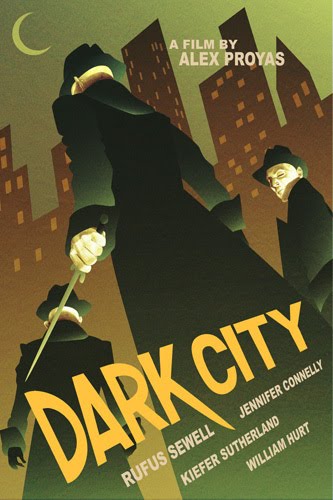
Dark City by Kevin Wada
Another alternate movie poster that's nicer-looking than the original: Kevin Wada's retro Dark City poster, which emphasizes the Strangers, the film's creepy adversaries. [Via Super Punch]

Whitewashed Better Luck Tomorrow by You Offend Me You Offend My Family
The You Offend Me You Offend My Family blog sticks it to Hollywood's tendency to whitewash movies based on source material in which Asians played a central role by whitewashing Better Luck Tomorrow, which starred You Offend Me bloggers Roger Fan and Sung Kang and was directed by their fellow You Offend Me team member Justin Lin. [Via You Offend Me]

Dr. T & the Women II by a Fark.com contributor
A Fark.com "unneeded sequel" entry that imagines a second Dr. T & the Women movie. [Via Super Punch]

Seven Samurai by Grinning-Oni
Seven Samurai by Grinning-Oni.

'Kara Thrace will lead the human race to its end.'
Brandon Schaefer's poster for an advance theatrical screening of the made-for-DVD Battlestar Galactica: Razor in 2007.

Predator by Made by Mat
Predator by Made by Mat. (Wow, that Predators trailer actually doesn't suck. I love how Danny Trejo, Cletus Van Damme and a yakuza are among the human predators. But what's Eric Forman doing in the cast? One of these things is not like the other.) [Via Super Punch]

The Birds by Laz Marquez
The Birds by Laz Marquez. [Via /Film]

Thursday, March 11, 2010

From hell

I'd love to hear what Paul Mooney would have to say about a TV studio logo that scared millions of white folks shitless.

Like Sam Rockwell during a memorable moment in one of my favorite movies from last year, the indie sci-fi flick Moon, I've been checking out some Bewitched reruns lately (damn, sitcoms are so much better written and produced nowadays than they were in the '60s, thanks to showrunners who have smartened up and realized the canned laughter that filled Bewitched and countless other single-camera sitcoms is so lame and annoying). Bewitched reruns conclude with a certain TV studio logo jingle that's the subject of an amusing mockumentary short, "The S from Hell," which I stumbled into on Scrubbles.net. The short was made by music video director and Ping Pong Playa storyboard artist Rodney Ascher, who screened it at Sundance earlier this year. The jingle that scarred for life the littlest viewers of Screen Gems productions like Bewitched and I Dream of Jeannie was composed by Eric Siday in 1965.

Any person who shits their pants because of a logo jingle is a wuss. The mockumentary pokes fun at that wussiness by interspersing soundbites of actual interviewees discussing their phobia of Siday's logo music with silly footage of a giant S from Hell chasing a little girl (the French-made "Logorama," which nabbed a Best Animated Short trophy at the Oscars earlier this week, also unleashes the evil side of another corporate logo that's known for creeping out kids--Ronald McDonald).

The synthesized jingle for the Screen Gems and mid-'70s Columbia Pictures Television logos is scary? It's not scary. It's just weird-sounding, like that Dominic Frontiere-penned '60s Paramount Television logo jingle known as "The Closet Killer," which sounds less like a fanfare for a stately mountain and more like music for a scene in which a man discovers his wangus has just been chopped off.

These days, the Screen Gems logo opens the Resident Evil flicks and movies like First Sunday and Armored, which are targeted to young black moviegoers who would laugh their asses off if they found out the Screen Gems logo used to give white kids nightmares.

Tuesday, September 8, 2009

Font memories

Font memories
As part of his transition to HD last week, Craig Ferguson finally updated his show's opening title sequence, which used to be such a creaky-looking, misleading opening sequence (it made it look like The Late Late Show was all sketch comedy, when the sketches really only comprise two percent of the show--that's like if SNL opened with credits that consisted of nothing but shots of Seth Meyers reading the fake news).

The Late Late Show logo also experienced a makeover, which has been lesser-liked than the spiffy new opening ("The old logo was fun and distinctive, but the new one is somewhat bland"), while fontophiles have been more harsh towards the Ikea catalog's font switch from Futura to Verdana, according to a Gray Lady article that letterer Janice Chiang forwarded me. Branding is everything, which is why my picky self has constantly changed my radio station's textual logo over the years. I first used the Fistful of Soundtracks logo on flyers I made for AFOS the college radio program and then placed it on the AFOS sites, the covers of CD copies of episodes I burned for friends and the Microsoft Word files of the home-recorded program's episode scripts. Like what TrekMovie.com did in March with the many different Star Trek opening title fonts from 1966 to 2009, here's a brief history of AFOS fonts.

1997 A Fistful of Soundtracks logo
1997-1999: I wanted a dope font that both screamed "spaghetti western" and looked like something that came from poster art for a '60s or '70s European movie that was scored by Ennio Morricone, whose non-Sergio Leone '60s and '70s scores were among the scores I was discovering for the first time on CD back in 1997. I found that kind of font in Wharmby. I liked how it resembled the Morricone-scored Untouchables opening titles. Of course, after a couple of years, I get tired of the same old thing, so...

1999 A Fistful of Soundtracks logo
1999-2000: I chose another font that I thought screamed "spaghetti western," Wide Latin. Graphic designer Matt Hinrichs of Scrubbles.net used Wide Latin for the previous incarnation of his blog's logo. This was the first logo I featured on the program's then-new site. I forgot Wide Latin was the same font that was used in the Kung Fu opening credits. I didn't want anything to do with a font that, to me, represented an annoying show that starred yet another white guy who tried to pass himself off as Asian (I know PopeyePete loves that show, but I have issues with it), so...

2000 A Fistful of Soundtracks logo
2000-2001: At the time, I was crazy about the italicized opening title fonts from the Pierce Brosnan 007 flicks, the Mission: Impossible feature films and the Kyle Cooper-designed Lost in Space titles.

2001 A Fistful of Soundtracks logo
2001-2008: I felt like switching to a font that better conveyed speed and futurism. I stuck with this font the longest. This was the last of the logos to appear at the top of the scripts I typed for myself to record because in 2008, I switched from typing the scripts on Word to typing them on the more stripped-down Notepad, where the text is presented in only one font.

2006 A Fistful of Soundtracks logo
2006-2009: I was in the mood for a font that crossed Cowboy Bebop with those banjo-scored '70s Sesame Street "sand letter" interstitials.

2009 A Fistful of Soundtracks logo
2009-?: I wanted a return to the station name's spaghetti western roots because some people still don't understand that the name's a reference to Morricone's classic collabos with Leone.

The best result of the Morricone/Leone partnership was Once Upon a Time in the West, one of my favorite flicks since high school (I first saw it letterboxed and uncut on Bravo, back when the channel was actually watchable and wasn't a dumpster for irritating reality shows and Criminal Intent reruns). OUATITW was unique for having Morricone finish recording the score before filming began so that Leone could play it aloud on the set to help get the actors into character and to synchronize camera movements to the tempo of the music.

The 1968 epic is a still-misunderstood film (here's a reason why I don't like the city I live in and can't wait to leave it: when I rewatched OUATITW in a local theater, everyone there gradually walked out until I was the only one left because these downtown assclowns who were clearly raised on Michael Bay were expecting a shoot-'em-up, and that's not what the film is, though it contains a couple of kickass action sequences, particularly the Jason Robards shootout on the train). OUATITW is also a great union of music and image, and because the score was completed before a single frame of film was shot, it's very listenable outside the context of the movie, which is why I frequently played it on my college radio program and then on my Internet radio station.

I'm glad someone suggested A Fistful of Soundtracks as the title of my program in 1997 because Once Upon a Time in Soundtracks doesn't roll off the tongue as easily.

Tuesday, August 25, 2009

Extra mozzarella: Do the Right Thing concept art and behind-the-scenes photos from Spike Lee's companion book

Fireside Books' Do the Right Thing cover
After posting a bunch of interesting Batman concept drawings and set photos from the 20-year-old blockbuster's official movie souvenir magazine, I'm doing the same thing with a similar tie-in for summer 1989's other landmark film, Do the Right Thing. But instead of an official movie mag, the Spike Lee Joint spawned a now-out-of-print Fireside/Simon & Schuster companion book that Lee wrote with the assistance of ex-girlfriend Lisa Jones. The director has done several companion books for his films. Each of these books contain behind-the-scenes photos, the film's script and Lee's own production journal (some of the Do the Right Thing journal passages are like tweets with better spelling: "Haven't written in a couple of days. I've been busy trying to save School Daze from being dogged.").

(WARNING: Spoilers ahead. Yes, there are people out there who still haven't watched Do the Right Thing yet. They're like people who never saw Ghostbusters. They're weirdos.)

Wynn Thomas' sketch of Do the Right Thing's two most pivotal sets, We Love Radio and Sal's Famous Pizzeria
I've discussed before why Do the Right Thing is one of my favorite films and why writers of color like myself cite it as an influence. One aspect of the film that I don't think gets enough props is the terrific production design by Wynn Thomas, who drew this sketch of the We Love Radio and Sal's Famous Pizzeria set exteriors. Using an old Coney Island pizzeria as the basis for Sal's, the film's crew built it from scratch on an empty Bed-Stuy lot. "The ultimate compliment was when real people would walk off the street and try and buy a slice," said Thomas in an L.A. Times oral history about the movie. Thomas later created nifty-looking sets for Mars Attacks! and brought CONTROL Headquarters into the 21st century for Steve Carell's Get Smart.