Showing posts with label Stevie Wonder. Show all posts
Monday, April 20, 2015
When enjoyable scores are attached to terrible movies, or why I feel kind of awful about adding Wild Wild West score music to "AFOS Incognito" rotation
I don't care for Madonna and her cultural-appropriating ass, but I've always liked the music of William Orbit. The Drake-scaring pop star's hit single from the summer of 1999, "Beautiful Stranger," a '60s-pop-flavored tune she recorded for Austin Powers: The Spy Who Shagged Me, is my favorite pop song Orbit has produced because it's Orbit at his most playful-sounding, from the Ron Burgundy flute funk to the harpsichord riffs (the harpsichord is also integral to why my favorite Michael Jackson tune is "I Wanna Be Where You Are"). "Beautiful Stranger" is featured in The Spy Who Shagged Me for like only 30 seconds, during a non-comedic scene where the titular '60s spy mourns the loss of his mojo. Because of "Beautiful Stranger," I would have been interested in what Madonna and Orbit would have recorded together for Guy Ritchie's upcoming remake of The Man from U.N.C.L.E., had Ritchie and Madonna never split.
"Beautiful Stranger" is pitch-perfect for the breezy, psychedelic, Laugh-In-esque and Derek Flint-inspired Austin Powers franchise, whereas Madonna's other original spy movie theme, the Mirwais-produced electroclash tune "Die Another Day," doesn't quite work for 007 (it would have worked for some other spy franchise: maybe Totally Spies?). The Die Another Day theme makes you wonder if Madonna or Mirwais ever even watched an actual 007 movie beforehand, even though she claimed that the Die Another Day screenplay influenced the lyrics she wrote (the orchestral string riffs during "Die Another Day" came not from Die Another Day score composer David Arnold but from Madonna's "Don't Tell Me" collaborator, the late New Jack City score composer Michel Colombier, and I would have enjoyed Colombier's string riffs a little more if they had at least some ounce of thematic connection to anything Arnold wrote for his score).
I fell in love with "Beautiful Stranger" again a few weeks ago while overhearing it being played on some store PA during a round of book-shopping or grocery-shopping (I can't remember which kind of shopping it was). So that's why I'm adding "Beautiful Stranger" to the playlist for the espionage genre music block "AFOS Incognito," where it can be enjoyed without having to be subjected to any visuals directed by Brett Ratner, Mondays through Thursdays at midnight Pacific on AFOS.
There's one other piece of music from a 1999 spy comedy that I'm adding to "AFOS Incognito," and this spy comedy isn't exactly as beloved as The Spy Who Shagged Me was back in 1999. It's from the second and final film in Warner Bros.' late '90s mission to ruin your favorite TV shows, Wild Wild West, the Will Smith/Kevin Kline blockbuster loosely based on the '60s spy show/proto-steampunk western of nearly the same name (the show was called The Wild Wild West, while the movie omitted "The" from the title).
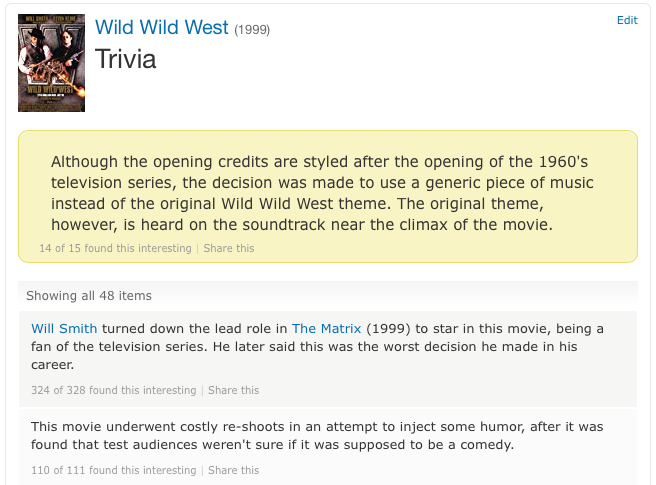
Fortunately, the selected piece of music isn't the ubiquitous-on-the-1999-airwaves Will Smith/Dru Hill theme tune that was never worthy of sampling Stevie Wonder's "I Wish." It's the other memorable piece of music from Wild Wild West: the rousing main title theme by a legendary composer who wrote a million rousing themes for westerns, the late Magnificent Seven score composer Elmer Bernstein. That Bernstein main title theme is the only thing I like about Wild Wild West. IMDb is wrong: it's not "a generic piece of music." It's classic Bernstein western music, faithful in spirit to Richard Markowitz's equally rousing '60s Wild Wild West theme tune, which either the filmmakers couldn't get the full rights to or were too dunderheaded to use more often in the film because of their hubris and contempt for the source material (although I wouldn't consider The Wild Wild West a perfect show: it suffers from that old '60s and '70s spy show staple of stupidly putting white actors in yellowface or brownface). The theme is too good for such a hackily written steaming pile and such a chemistry-deficient buddy action flick.
Speaking of chemistry, this might have improved the movie: instead of casting Kline, whom Smith had no chemistry with, as Artemus Gordon, Alfonso Ribeiro, whom Smith had a shitload of chemistry with from 1990 to 1996, should have been cast as Artemus. And instead of the movie's lame depiction of Artemus as this never-convincing master of disguise Kline looked as embarrassed to be portraying as Kline's washed-up Soapdish actor character looked when he had to play Willy Loman in front of confused and senile dinner theater customers, I would have written Ribeiro's short and black Artemus as an excellent master of disguise who--because both the Wild Wild West TV show and movie never gave a shit about being authentic to the period--came up with the most effective and ludicrous-for-any-period prosthetic makeup technology for altering his looks, as well as his height, race or gender. Plus it would have been amusing to have a black guy walk around with the name Artemus.
Anyway, like Stevie Wonder, I wish that theme (BLAM!) was (BLAM!) written for a different score. There lies my problem with adding to AFOS rotation enjoyable score cues from movies that are so terrible. It's so difficult to erase those movies' wretchedness from your mind when you hear these score cues that are the only redeeming elements of those movies. So to enjoy the Bernstein score cue a little more, you just have to pretend it's not from Wild Wild West.
Man, why do post-Blazing Saddles, pre-Django Unchained westerns with black heroes have such a lousy track record? Why do sci-fi westerns that are neither the '60s Wild Wild West nor the cult favorite Brisco County Jr. have such a lousy track record? Smith and his Men in Black director Barry Sonnenfeld clearly wanted to turn Wild Wild West into a Blazing Saddles for the '90s and with splashier action sequences, except Blazing Saddles knew how to be funny.
Blazing Saddles also didn't need a $170 million budget to land its jokes. The Nostalgia Chick pointed out that Shane Black, the writer and director of one of my favorite movies, Kiss Kiss Bang Bang--a buddy comedy that, like Blazing Saddles, was able to dazzle despite a limited budget--was attached to an earlier attempt to make a Wild Wild West movie. It's one of the most interesting parts of the Nostalgia Chick's 17-minute discussion of the many things that went wrong with Sonnenfeld's Razzie sensation, including Smith rejecting the role of Neo in The Matrix and choosing to play such an unlikable and overly cocky spy.
See? This is why Ribeiro would have been a great big-screen partner for Smith: unlike Kline's snooty and stiff Artemus, the equally snooty but more underdog-ish Ribeiro--due to his chemistry with Smith--would have been able to make Smith's overly cocky Agent West more likable and relatable when they interacted with each other. It would have been like how halfway through its run, the small-town lawyer sitcom Ed gave Michael Ian Black's annoying and overly cocky Phil Stubbs character a new bowling alley boss he grew to despise, in the form of the more level-headed Eli Goggins, played by the always charismatic Daryl "Chill" Mitchell. As both Phil's foil and a character who, unlike Tom Cavanagh's rather timid Ed, had the guts to challenge Phil and bring him back down to Earth whenever Phil's antics grated on everyone's nerves, including the viewer's, Eli made Phil the myopic and self-absorbed schemer a much less annoying and one-note character for the rest of the show's run.
I also wish I were in the universe where Will and Carlton reunited on the big screen as West and Artemus. Yeah, maybe it would have been too much of a rehash of the Will/Carlton dynamic from The Fresh Prince of Bel-Air for some moviegoers, but Ribeiro would have given Smith something more interesting to play against than whatever hacky shit Kline was doing. However, a completely different universe where Black's Wild Wild West got made instead is an even more enticing alternate universe. Now that is a version of Wild Wild West that would be worthy of Bernstein's main title theme. How many screenwriters did Wild Wild West have? Black's screenwriting work all by himself is frequently superior to the combined results of the 20,000 screenwriters who tried to polish the turd called Wild Wild West.
Many things doomed The Fresh Prince of Hot-Air, from its constant reshoots to skinny-pantsed '60s Wild Wild West star Robert Conrad's dissatisfaction with the script when Sonnenfeld offered him a cameo and he refused. The original Jim West bad-mouthing a reboot of his show and not giving it his blessing is like if the original Spock, when he was alive, tweeted, "I hope this new Star Trek crashes and burns," or if Michael Keaton stepped out and said, "My son showed me that new Batman trailer. Why is Ben Affleck being such a saggy diaper that leaks?" That doesn't bode well for your reboot. But when your film's key art is basically inverted key art from the 1993 megaflop Super Mario Bros., your film's really doomed.
When the only person who benefited from some part of the film is producer Jon Peters--that giant mechanical spider the extremely weird Peters kept threatening to squeeze into aborted movie versions of '90s Superman comic book storylines and Sandman finally made it into one of his productions--that's how terrible the film is. You know Patton Oswalt's six-minute distillation of the wretchedness and bloatedness of Wild Wild West (while he was being interviewed by the comedy news site/stand-up comedy record label A Special Thing)? It's six times more entertaining than Wild Wild West itself.
Labels:
007,
1999,
A Fistful of Soundtracks,
Austin Powers,
Blazing Saddles,
Elmer Bernstein,
film music,
Madonna,
Michael Jackson,
Motown,
Patton Oswalt,
Shane Black,
Stevie Wonder,
Will Smith,
William Orbit
Monday, February 24, 2014
13 black artists' covers of white artists' music that surpass the originals (to close out Black History Month)
![]() |
| Quincy Jones and Sarah Vaughan (Photo source: Jazzinphoto) |
The following list was inspired by both Harry Allen the Media Assassin's irritated response to the latest of Jimmy Fallon and Justin Timberlake's "History of Rap" medleys during the first week of The Tonight Show Starring Jimmy Fallon...
... and Andrew Ti's similar response to the "History of Rap" medleys.
1. Sarah Vaughan, "Peter Gunn" (both Vaughan's 1965 version and the dope Max Sedgley remix)
"According to the liner notes, we can thank Quincy Jones for the recording. Hank Mancini says he never thought the song would work with lyrics, but Jones kept pestering him to try it. So, Jay Livingston and Ray Evans wrote some lyrics and Bill Holman arranged the song. Vaughan provided the fireworks. Vaughan infuses the song with the same kind of slinkiness found on Peggy Lee's 'Fever,' but Vaughan manages to sound sultry at a much faster tempo."--Cahl's Juke Joint, 2008
2. The Skatalites, "Guns of Navarone"
"The song itself is an adaptation of the theme song to the 1961 film of the same name, and there are in fact two different versions of The Skatalites interpretation. With one clocking in at more than six minutes, it is the shorter, two and a half minute version that exemplifies everything that makes ska so fantastic."--The Daily Guru, 2010
3. Earth, Wind & Fire, "Got to Get You Into My Life"
"In 1978, Earth Wind & Fire appeared in another motion picture, the Beatles movie tribute Sgt. Pepper's Lonely Hearts Club Band. In the film, the band played themselves, performing 'Got To Get You Into My Life' at a concert hall. The film itself was a commercial bomb... Yet despite musical performances on the soundtrack from Aerosmith, Peter Frampton, the Bee Gees and Alice Cooper, Earth Wind & Fire's remake of the Beatles classic was the highest charting pop single from the soundtrack. 'Once more, we had a movie that flopped on us,' said Maurice White, 'but we had a #1 hit out of it... We actually recorded our parts on the set.'"--Goldmine magazine's profile of Earth, Wind & Fire, 1997
"Robert Stigwood called us and asked if we wanted to be in a movie... We said okay, it could be interesting. At that particular time, you didn't see a lot of musical blacks in movies--there was The Wiz, but that was a horrible movie. We had three songs to choose from--'Got To Get You Into My Life' and two ballads. We just did the song Chicago-style. Some people thought George Martin produced the song, but Maurice produced it."--Verdine White, Goldmine, 1997
4. Stevie Wonder, "We Can Work It Out"
"... it's worth mentioning that Stevie's soulful reworking of the original--no doubt powerful in its own glory--makes it sound more searing; indeed, converting it into a freedom song/black power amalgamation. In short, Stevie Wonder's version of 'We Can Work It Out' is nothing short of a magnificent transformation. And to a certain degree, you could say that Stevie Wonder 'flipped' the Beatles original. Does that mean that Stevie Wonder's version of 'We Can Work It' is better than the original? I'm not sure if that's a question worth entertaining."--Amir Said, 2010
Uh, it's a question I'm willing to tackle: hell yes, Wonder's version trounces the original.
Wednesday, February 1, 2012
Life should just be a nonstop Soul Train line
Though it stopped airing in first-run syndication in 2006, Soul Train, whose influential creator and longtime host Don Cornelius died earlier today, will never stop rolling, thanks to YouTube.
The news of Cornelius' death made me go look up clips of Soul Train lines on YouTube. Goddamn, there are so many clips. No wonder Spike Lee concluded his bittersweet 1994 coming-of-age film Crooklyn with a montage of vintage Soul Train line clips. The fly dance moves in those clips can really cheer you up when you're down. (You can also trace the history of African American dance and fashion in those clips.)
I usually avoid posting several YouTube videos at once because I never know when one of them is going to be removed from the site, and then your post looks stupid when it's left with this rotting carcass of a dead embed. Below are several of my favorite Soul Train clips that I've run into today, and they're presented in chronological order, from the '70s to the '90s. Many of these videos have been on YouTube for awhile, so hopefully, there won't be one that will vanish.
Interspersed between the clips are two of the show's various original themes. Those two chunes are the Soul Train themes I remember the most from my childhood: O'Bryan's "Soul Train's a Comin'" and George Duke's "TSOP '87," a cover of a previous Soul Train theme, MFSB's "TSOP (The Sound of Philadelphia)."
The Soul Train dancers get down to Curtis Mayfield's "Get Down," so that means this clip comes from the show's first season in syndication (1971-72).
In 1972, special guest Stevie Wonder made up a song on the spot about Soul Train. He would have been an awesome in-house musician on Whose Line Is It Anyway?
There's video footage of Wonder's "Soul Train" song on YouTube, but too bad it's attached to Wonder's lip-synched performance of "Superstition." If there's one thing I dislike about Soul Train, it's Cornelius' Dick Clark-style requirement that the musical guests had to lip-synch their tracks (as I've said before, lip-synching on a music show looks so dumb). But Cornelius allowed Wonder to break that rule for this one number that's more genuine and exhilarating than most Soul Train performances simply because it's sung live and improvised.
New York magazine's Nitsuh Abebe called Wonder's improvised number "One of the warmest moments I've ever seen on television... it'd make as beautiful a eulogy [for Cornelius] as anyone could ask for."
The track during this Soul Train line is Earth, Wind & Fire's "Mighty Mighty," which places this clip in 1974. Hey, guy in the Afro and gray tux at 1:35, duck!
During this Soul Train line to The O'Jays' 1975 hit "I Love Music," YouTube commenters claim that they can see Jody Watley, who started out as a regular Soul Train dancer, at 0:17 and President Obama at 2:17.
Electronic R&B from the '80s rules. O'Bryan's "Soul Train's a Comin'" is my favorite of the many original themes that opened Soul Train.
The news of Cornelius' death made me go look up clips of Soul Train lines on YouTube. Goddamn, there are so many clips. No wonder Spike Lee concluded his bittersweet 1994 coming-of-age film Crooklyn with a montage of vintage Soul Train line clips. The fly dance moves in those clips can really cheer you up when you're down. (You can also trace the history of African American dance and fashion in those clips.)
I usually avoid posting several YouTube videos at once because I never know when one of them is going to be removed from the site, and then your post looks stupid when it's left with this rotting carcass of a dead embed. Below are several of my favorite Soul Train clips that I've run into today, and they're presented in chronological order, from the '70s to the '90s. Many of these videos have been on YouTube for awhile, so hopefully, there won't be one that will vanish.
Interspersed between the clips are two of the show's various original themes. Those two chunes are the Soul Train themes I remember the most from my childhood: O'Bryan's "Soul Train's a Comin'" and George Duke's "TSOP '87," a cover of a previous Soul Train theme, MFSB's "TSOP (The Sound of Philadelphia)."
The Soul Train dancers get down to Curtis Mayfield's "Get Down," so that means this clip comes from the show's first season in syndication (1971-72).
In 1972, special guest Stevie Wonder made up a song on the spot about Soul Train. He would have been an awesome in-house musician on Whose Line Is It Anyway?
There's video footage of Wonder's "Soul Train" song on YouTube, but too bad it's attached to Wonder's lip-synched performance of "Superstition." If there's one thing I dislike about Soul Train, it's Cornelius' Dick Clark-style requirement that the musical guests had to lip-synch their tracks (as I've said before, lip-synching on a music show looks so dumb). But Cornelius allowed Wonder to break that rule for this one number that's more genuine and exhilarating than most Soul Train performances simply because it's sung live and improvised.
New York magazine's Nitsuh Abebe called Wonder's improvised number "One of the warmest moments I've ever seen on television... it'd make as beautiful a eulogy [for Cornelius] as anyone could ask for."
The track during this Soul Train line is Earth, Wind & Fire's "Mighty Mighty," which places this clip in 1974. Hey, guy in the Afro and gray tux at 1:35, duck!
During this Soul Train line to The O'Jays' 1975 hit "I Love Music," YouTube commenters claim that they can see Jody Watley, who started out as a regular Soul Train dancer, at 0:17 and President Obama at 2:17.
Electronic R&B from the '80s rules. O'Bryan's "Soul Train's a Comin'" is my favorite of the many original themes that opened Soul Train.
Monday, July 11, 2011
The dopest part of DJ Jazzy Jeff and Mick Boogie's Summertime 2 mixtape: The unexpected appearance of Stevie Wonder's "Love Light in Flight"
![]() |
| (Photo source: Tommer G) |
Thanks to the High Fidelity scene in which Jack Black disses the sappy and overplayed Woman in Red theme "I Just Called to Say I Love You," Stevie Wonder's Woman in Red soundtrack has become a punchline, much like Prince's Batman song soundtrack, which was the subject of a similar gag in Shaun of the Dead. Another thing that both those '80s song soundtracks have in common is that though those albums aren't exactly career highlights for either artist, they aren't exactly awful either. They're redeemed by two or three underappreciated tracks.
"Love Light in Flight" is one of those tracks, and it's a song I hadn't heard since 1984 or 1985--until I recently stumbled into it during DJ Jazzy Jeff and Mick Boogie's Summertime 2 mixtape and instantly smiled, which is why I just added "Love Light in Flight" to A Fistful of Soundtracks' '80s block "Soda and Pie" (Fridays, Saturdays and Sundays at noon).
![]() |
| "Drums, please!" |
"Oh man," I thought to myself while bumping Summertime 2, "I remember 'Love Light in Flight.' It so takes me back to when I was a Ghostbusters-loving kid in '84!" It's such a damn smooth track--plus it's full of aviation imagery, which would have made it perfect for the flight-themed "Up, Up and Away" episode of the terrestrial radio incarnation of A Fistful of Soundtracks that I aired on July 22, 2001.
![]() |
| Suddenly, Gene Wilder is faced with a crippling decision: Kelly LeBrock or the sheep that's waiting for him at home? |
"Love Light in Flight" is the one hit song from The Woman in Red that's neither overplayed nor preachy (that would be the well-meaning but clunkily written "Don't Drive Drunk"). Camille Paglia may be a pretentious, Sarah Palin-loving weirdo (her Salon Oscar telecast recaps were always worthy of an Onion parody), but she's right that "Love Light in Flight" is a sublime tune.
Thursday, January 13, 2011
"Rock Box" Track of the Day: Stevie Wonder, "I Believe (When I Fall in Love It Will Be Forever)"
Song: "I Believe (When I Fall in Love It Will Be Forever)" by Stevie Wonder
Released: 1972
Why's it part of the "Rock Box" playlist?: It's featured in High Fidelity, which was where I first heard this overlooked Wonder tune.
Which moment in High Fidelity does it appear?: The closing credits, which are a special treat for fontophiles like myself. Mmm, Stencil...
Mmm, Eurostile...
The characters' hatred of Wonder's '80s and '90s output was the subject of one of Jack Black's key scenes ("Rob, 'Top Five Musical Crimes Perpetrated by Stevie Wonder in the '80s and '90s.' Go."), so it's no surprise that Rob (John Cusack) opted for 1972's "I Believe" while making a mixtape for Laura (Iben Hjejle). "I Believe" is the closing track on Wonder's Talking Book album. In 2005's 1001 Albums You Must Hear Before You Die, Stevie Chick wrote that "'I Believe' finds Stevie's heart broken, but his belief in love still intact"--much like Rob at the end of the film.
Friday, December 25, 2009
Memorable quotes from commentary tracks #5

James Brown died three years ago today on the day when Santa Claus goes straight to the ghetto (as he once sang), so below is a very lengthy excerpt about the Hardest-Working Man in Show Business from writer/director Larry Cohen's highly entertaining commentrak for MGM's 2001 DVD release of Black Caesar.
When Public Enemies came out on DVD earlier this month, I arranged my Netflix queue so that I could be treated to a festival of gangster flicks I always wanted to watch but kept putting off watching: Public Enemies, Hoodlum, American Gangster and Black Caesar. During the Black Caesar commentrak, Cohen told an interesting story I'd never heard or read before about the Godfather of Soul's short-lived side job as film scorer. Brown's stint resulted in a terrific soundtrack that's been frequently sampled by rappers like Ice-T, Das EFX, Nas and Jin and frequently streamed by me on the Fistful of Soundtracks channel.

"The first choice to do the music was Stevie Wonder, so I was told that we were going to run the movie for Stevie Wonder in the rough cut. I thought, 'Well, how was this guy gonna watch a movie?' But he came in with an entourage and sat in the projection room, and they ran the movie, and he listened to the movie, and then he asked some questions afterwards, and I thought we had a shot at getting Stevie Won... All he asked me was what my birth sign was. He was interested in what sign of the zodiac I was. I think he thought it was too violent for him. James Brown didn't have that trouble.
"But James had never scored a picture before, and it was interesting that this was his first job as a composer for a motion picture, and we went over the whole project with him and his manager Charles Bobbit, and I think Bobbit is with Michael Jackson today. So we gave him a 16mm or 35mm black-and-white dupe of the movie so they could have the movie. This was way before videocassettes. So he had a copy of the movie. We gave him the timing sheets of each scene, and James went off to do the music. Of course, motion picture makers are more at the mercy of composers than anybody because by the time you hear the music, it's already been recorded, it's done and the money's been spent, and if you don't like it, there really isn't too much you can do except go have the music done over again and spend your money twice.
"So James' music sounded great when he came in. He'd written some terrific songs like 'Pay the Cost to Be Boss' and 'Your Mama's Dead' and 'Down and Out in New York City,' which was actually written by Barry De Vorzon, but James recorded it. The only problem was that when James brought the music in, if it was a four-minute scene, James wrote seven minutes of music. Or if it was a three-minute scene, James wrote five minutes of music. Or if it was an eight-minute scene, he wrote 11 or 12 minutes of music. So I called Bobbit up. I said, 'Charles, this doesn't make any sense. It's too much music.' He says, 'Well, the man gave you more than enough.' They didn't have any cognizance that the songs, the music's supposed to fit the length of the sequence...
"I had to take all those long cues and cut them down to fit the scenes that they were in, and we cut the scenes pretty well and made them work. We had to slide the music forward, slide the music back, have some dissolves and segues, but we managed to make the music fit the picture, and American International was so delighted that they went and hired James Brown to do another picture for them. When he did Slaughter's Rip-Off, they went into shock 'cause he delivered the same kind of music, only they weren't equipped to do what I did, which is make it work. They just got infuriated with James Brown and told him that they'd never work with him again, and then when I wanted to make the second Black Caesar picture, Hell Up in Harlem, AIP would not let me hire James Brown to do the music. They said, 'He screwed us on Slaughter's Rip-Off, and we'll never work for him again.' I said, 'He screwed us on Black Caesar, but I made it work, and there's no reason why we can't make it work again 'cause James will give us a great score.'
"So I went back to Bobbit, and I said, 'Mr. Bobbit, the only way American International would consider letting James do the music is if he did it on spec--if he went out, wrote the music and recorded it himself at his own expense and gave us the tapes--and if they like the music, they'll use the music. If they don't like the music, it belongs to you.' And a day later, I got a call from Bobbit. He said, 'The man accepts the challenge! James will write the music and record it as his own expense and bring it to you.' And he did. Unbelievable. Big name like him. And I played the music. It sounded pretty good to me. But I took it to AIP. They said, 'Oh no no no. We got a deal with Motown to do the music on this picture, and Motown's gonna supply us with some big-name artists, and we don't wanna work with James Brown again, and we don't care for the music anyway.' So I had to go back to Bobbit and say, 'Charles, I'm sorry, but AIP has rejected it, and there's nothing I can do about it. This is one area where they're insisting to have their way.' And he said, 'No hard feelings. We'll do what we can with this music.'
"And he put the music out as an album, and it was James Brown's most successful album. It was called The Payback, and that music is used over and over again in movies today. It was in a movie called Lock, Stock and Smoking Barrels. It was used as music on the TV series New York Undercover. And it's some of James Brown's most famous cuts, and it should have been in Hell Up in Harlem. Kinda breaks my heart. But that was my James Brown story."--Black Caesar writer/director Larry Cohen
Related links:
-The Deuce's Black Caesar soundtrack page
-Cohen's recent Trailers from Hell commentrak for the Black Caesar trailer
-World of Hurt webcomic creator Jay Potts' witty Black Caesar liveblog ("The kid playing a young Tommy Gibbs... looks a bit too much like Chris Brown for me to root for him wholeheartedly.")
Subscribe to:
Posts (Atom)