Showing posts with label Curtis Mayfield. Show all posts

Monday, December 22, 2014

Dear White People, whose score can be heard on AFOS, resonates not just for black millennials, but for any person of color whose hair has been subject to getting creepily touched by white people

I wish I could believe they're trying to be helpful and are checking for lice, but yeah, touching people of color's hair without their permission is still--and will always be--wack as fuck.

In late October, Japan's DJ Muro, whom I remember from the Super Disco Friends mix he assembled with Dimitri from Paris in 2005, put together for Stussy Clothing a mostly terrific Curtis Mayfield mix that includes frequently sampled selections from the soundtracks Mayfield produced and performed for the '70s films Superfly and Short Eyes (a few of the Superfly songs can be heard during "AFOS Prime" and "Beat Box" on AFOS). It also includes a Mayfield tune I never heard before and have become taken with, "Make Me Believe in You" from 1974's Sweet Exorcist album (it starts at 1:01:19 in the mix). That song knocks.

I've listened to Muro's Mayfield holiday 2014 mix repeatedly after Stussy released it, and it's a delicious mix--up until the last seven minutes. Those last seven minutes, where the mix segues into 1980's "Love Me, Love Me Now" and then closes out with 1978's "You Are, You Are," are pretty fucking dire. Let's just say disco and Mayfield were not a good combination.


I would replace those last seven minutes with the seven-minute "(Don't Worry) If There's a Hell Below, We're All Going to Go." How can anyone ignore that classic 1970 Mayfield tune, especially when--"Nixon talking about don't worry" lyric aside--it's so relevant in this period of Michael Brown and Eric Garner not getting justice? There are two pieces of music that have been on my mind as people across the country peacefully protest the treatment of Brown and Garner (and are now getting cruelly subjected to counter-protests--really?): "Fuck the Police" by the late J Dilla ("On the count of three, say...") and "(Don't Worry) If There's a Hell Below, We're All Going to Go."

I always hear complaints about how R&B or hip-hop has gotten too mindless and it isn't as thoughtful as it used to be. But there are a few artists out there who are making thoughtful music. Like I've said before, you just have to know where to look. So who in R&B today is the modern-day equivalent of the type of insightful and socially conscious (but not-so-preachy) songwriting Mayfield in his prime was known for? It's most definitely either any of these artists The FADER's Aimee Cliff praises in her essay about the inanity of the "alternative R&B" tag, The Roots or D'Angelo, whose first album in 14 years, Black Messiah, which was occasionally co-produced by Roots member Questlove, finally dropped last week and lived up to everyone's high expectations, including my own.

And who this year has been the cinematic equivalent of the modern-day R&B equivalent of Mayfield--in other words, they're bringing complicated points of view to their work that aren't just either "the Tyler Perry black movie" or "ooh, it's the more incendiary Spike Lee black movie"? That would be directors like British filmmaker Amma Asante, who came up with an intriguing hybrid of legal drama involving the abolitionist movement and Jane Austen-esque corset drama, last summer's sleeper hit Belle, and Justin Simien, the writer/director of the Sundance hit Dear White People, a more nuanced movie about campus racial tensions than John Singleton's unintentionally funny Higher Learning.

Simien's indie comedy is about four black university kids trying to figure out their identities in fictional Winchester University, a predominantly white Ivy League school, as well as how they deal with both microaggressions and more overt forms of racism from their white classmates ("Dear white people, the minimum requirement of black friends needed to not seem racist has just been raised to two; sorry, but your weed man Tyrone does not count"). It's like nothing else on the big screen in 2014, both material-wise and aesthetics-wise. Simien clearly admires Spike Lee's earlier work, but he's also a fan of Stanley Kubrick, Wes Anderson and Robert Altman, so he emulates the camera movements of Kubrick, Anderson and Altman. At one point, sci-fi nerd and undeclared major Lionel (Tyler James Williams), the openly gay outcast who's clearly a stand-in for Simien, even mentions his love for Altman movies, but he doesn't specify which ones. (Is Lionel a fan of only popular Altman movies like the original M*A*S*H and The Player or is he so hardcore that he's into deep cuts like Quintet, the unwatchable 1979 Altman sci-fi flick starring Paul Newman? That's what I want to know). As for the Kubrick-ian aspects of Dear White People, they're most hugely reflected in composer Kathryn Bostic's solid original score, which sometimes evokes the classical music-quoting scores in A Clockwork Orange and Barry Lyndon. You can hear for yourself how Bostic channels the music in Kubrick movies either below or during "AFOS Prime" and "The Whitest Block Ever" on AFOS.


Tuesday, September 9, 2014

Hickory dickory Dock, peep the new score by Ad-Rock

Dock Ellis: The Pre-Curler Years
The late Dock Ellis' primacy as a pitcher for the Pittsburgh Pirates was way before my time, so director Jeffrey Radice's No No: A Dockumentary does a solid job chronicling a transitional period in baseball I was never really aware of, since I'm someone who doesn't pay much attention to baseball outside of whatever gets covered in the news. Now in theaters and on VOD after well-received screenings earlier this year at Sundance and SXSW, No No interviews Ellis' surviving teammates and uses footage of both Ellis in his heyday and an interview with Ellis from towards the end of his life to recall the period when black baseball players like Ellis became the first of their profession to criticize the baseball establishment for its racial slights at the time. The outspoken Ellis' iconoclasm--he got in trouble with the MLB for wearing hair curlers on the field--coincided with the rise of the Black Panthers and the emergence of Soul Train and Shaft in pop culture.

But, of course, the part of Ellis' life in No No that's the most fascinating--even more so than Ellis' activism--to audiences at Sundance or SXSW and anyone who's renting No No on iTunes is the no-hitter Ellis threw while on acid at a 1970 Pirates vs. Padres game. Ellis was the ultimate high-functioning addict, pitching terrifically while whacked out on something, whether it was LSD or Dexamyl, a.k.a. greenies, the stimulant that's still popular among baseball players as a form of medication to get through the most physically demanding aspects of the game.


Pitching on acid for nine straight innings isn't exactly a simple thing to do, as the late Robin Williams detailed during his final HBO stand-up special Weapons of Self Destruction. A clip of Williams' Weapons of Self Destruction bit about Ellis' infamous no-no (that's baseball slang for a no-hitter, by the way) is very briefly featured at the start of No No.


But Ellis' heavy drug use eventually spiraled out of control--due to grief over the 1972 death of his friend and Pirates teammate Roberto Clemente--and it ruined his career and marriages, so after his retirement, he got sober and became a drug counselor. While No No isn't exactly an anti-drug piece--the Radice doc mocks the clumsiest tactics of the anti-drug contingent by frequently cutting away to unintentionally silly footage from Dugout, a poorly acted 1981 educational filmstrip produced by the Kroc Foundation (the charitable group founded by Joan Kroc, wife of '70s and '80s Padres owner Ray Kroc, the McDonald's tycoon) to warn kid athletes against drug use--the doc's tough-minded exploration of the consequences of addiction would have pleased Ellis, who came to view the addicts he helped get clean as an achievement that was more important to him than any of his past feats on the pitcher's mound.

Adam Horovitz is a far better Jewish rapper than 2 Live Jews.
The other part of No No I looked forward to the most before its debut on VOD last week--besides the discussion of the LSD no-hitter--was its original score by Beastie Boys member Adam Horovitz, who made his debut as a film composer when he scored The Truth About Lies, an as-of-yet unreleased Odette Annable indie comedy that was first shot in 2012. Ad-Rock's funky No No score is reminiscent of the Beasties' instrumental interludes during Check Your Head and Ill Communication (which were compiled in the first Beasties album I bought, as well as one of the earliest CDs I bought, 1996's The In Sound from Way Out). It perfectly suits the doc's segments about the brashly attired, politically conscious pitcher's '70s heyday.

The No No score is also the closest we'll ever get to a second Beasties all-instrumental album, because I doubt Ad-Rock and Mike D will continue recording as the Beasties without the late MCA (and I wouldn't blame them). Horovitz's score is used judiciously too: thankfully, there's no score cue during the doc's most emotional moment, when Radice plays archival audio of Ellis tearing up and sobbing while re-reading aloud a letter of support he received from Jackie Robinson, the legend who paved the way for Ellis' accomplishments as both a pitcher and an athlete fighting discrimination.

Outside of the doc, the Horovitz score isn't available anywhere. The closest thing to the score's wordless soulfulness is, of course, the Beasties' first and last album of original instrumentals, 2007's The Mix-Up, particularly the lava lamp swagger of "Off the Grid." To borrow the words of an old Impressions tune featured prominently during No No's appreciation of the 1971 Pirates' predominantly black roster, The Mix-Up is a winner--just like Horovitz's new score and No No: A Dockumentary itself.

Friday, December 21, 2012

This is the end

Why do they cryyyyy? Why do they cry? Why do they cry?
Because today is the last day ever, I ain't going out like no sucka. Go ahead and cry in the shower. Meanwhile, I'm posting 30 of my favorite original score cues or songs on Spotify that accompany the end credits of feature films. None of them are re-recordings (I love me some Spotify, but it's befouled by the stench of terrible re-recordings of film and TV music). All of them are the originals.

The last playlist ever kicks off with the summer of 2012's best end title theme (Alan Silvestri's "The Avengers," from an art-house film called Anna Karenina), followed by perhaps my all-time favorite original end title theme (Willie Hutch's "Brother's Gonna Work It Out," from a Dean Jones family film called The Mack). Tron: Legacy and Superman: The Movie both had end credits that ran so long they had two or three end title themes instead of one. Most of the end title themes below can be heard on AFOS, but some of them aren't in rotation because I simply don't have them in my library (Silvestri's Who Framed Roger Rabbit score is an album I always wanted to have, but I was never able to nab the score because it went out of print again before I could do so). The playlist concludes with Earl Rose's end title theme from a fascinating doc that aired on PBS in 2012: Johnny Carson: King of Late Night.

Too bad Adele's theme for Skyfall isn't featured in the film's end credits (it's also not on Spotify). I wanted to include "Skyfall" in the playlist because its Jim Morrison-esque opening lyric happens to be "This is the end," which is also the name of this playlist. In another interesting tidbit, "Skyfall" is simultaneously one of the most emotional songs to open a Bond film (the song is written from the point of view of M and is one big spoiler, and no wonder Daniel Craig cried when he first heard it--without giving too much away, it must have brought him back emotionally to the scene the song is basically about) and one of the most wry (an apocalyptic song about mortality is ironically the theme for a film that's all about revitalizing the 50-year-old Bond film franchise and keeping it going, and Adele and her producing partner Paul Epworth seemed to have written "Skyfall" so that it could also be interpreted as a tune about the 2012 apocalypse).

Goodbye, cruel world!

I'm sure Hawkeye goes into battle with Harry Nilsson's 'Me and My Arrow' blasting in his earbuds.
"This Is the End" tracklist
1. Alan Silvestri, "The Avengers," Marvel's The Avengers
2. Willie Hutch, "Brother's Gonna Work It Out," The Mack
3. Curtis Mayfield, "Superfly," Superfly
4. k.d. lang, "Surrender," Tomorrow Never Dies
5. Daft Punk, "TRON Legacy (End Titles)," Tron: Legacy
6. Daft Punk, "Solar Sailer," Tron: Legacy
7. Radiohead, "Exit Music (For a Film)," Romeo + Juliet
8. Dominic Cooper, "Jail-bait Jody," Tamara Drewe
9. Alan Silvestri, "End Title," Who Framed Roger Rabbit
10. John Williams, "The Rebel Fleet/End Title," The Empire Strikes Back
11. Alan Silvestri, "Captain America March," Captain America: The First Avenger
12. Prince, "Scandalous," Batman
13. Siouxsie and the Banshees, "Face to Face," Batman Returns
14. Hans Zimmer and James Newton Howard, "A Watchful Guardian," The Dark Knight
15. John Williams, "Finale and End Title March," Superman: The Movie
16. John Williams, "Love Theme from Superman," Superman: The Movie
17. Michael Giacchino, "The Incredits," The Incredibles
18. Michael Giacchino, "Up with End Credits," Up
19. Jerry Goldsmith, "End Credits," Star Trek: First Contact
20. Danny Elfman, "End Credits," Sleepy Hollow
21. Bruce Broughton, "End Credits," The Rescuers Down Under
22. Gladys Knight & the Pips, "Make Yours a Happy Home," Claudine
23. Mader, "Rhumba (End Credits)," The Wedding Banquet
24. Michael Giacchino, "End Creditouilles," Ratatouille
25. John Carpenter, "The Fog End Credits," The Fog
26. David Shire, "Finale and End Credits," The Conversation
27. John Williams, "Finale & End Credits," Indiana Jones and the Last Crusade
28. Earl Rose, "End Credits," Johnny Carson: King of Late Night
2014 additions
29. Alexandre Desplat, "The Heroic Weather-Conditions of the Universe, Part 7: After the Storm," Moonrise Kingdom
30. Alexandre Desplat, "Traditional Arrangement: 'Moonshine,'" The Grand Budapest Hotel
31. Michael Giacchino, "To Boldly Go," Star Trek
32. Michael Giacchino, "End Credits," Star Trek
33. M83 featuring Susanne Sundfør, "Oblivion," Oblivion
34. Ramin Djawadi featuring Tom Morello, "Pacific Rim," Pacific Rim
35. Blake Perlman featuring RZA, "Drift," Pacific Rim
36. Brian Tyler, "Can You Dig It (Iron Man 3 Main Titles)," Iron Man Three
37. Brian Tyler, "Legacy," Thor: The Dark World


BONUS TRACK: "Summer in America," DJ Blue & Chubb Rock's rousing original song from the end credits of the hilarious cult classic Wet Hot American Summer.

Monday, September 24, 2012

The best of "Beat Box" on Spotify

The sliced-off-genitals-delivered-in-a-jar sequence is the main reason why Foxy Brown will never air on The Hallmark Channel.
Foxy Brown (Photo source: Denver Westword)
On A Fistful of Soundtracks, "Beat Box" airs Mondays at 6-9am and noon-3pm, Tuesdays through Thursdays at 6-9am and 1-4pm and Fridays at 7-9am and 1-3pm. The three-hour block, which is two hours long on Fridays, contains selections from '70s film scores that have been sampled by beatmakers in hip-hop and electronica (like the late Willie Hutch's music from Foxy Brown). If you find most film music to be too staid for your tastes, then "Beat Box" is most likely for you.

Also part of the block are selections from scores that hearken back to the blaxploitation era. One such score is the 2009 Black Dynamite score by Adrian Younge, who also wrote the original music for Titmouse's animated version of Black Dynamite (which concluded its first season on Adult Swim last night with special guest star Clifton Powell voicing the sleazy preacher dad who abandoned Dynamite when he was "a children").

Meanwhile, 'Soda and Pie' will make you feel like a coked-up '80s douchenozzle.
Although some listeners feel like they're '70s macks when they tune in to "Beat Box," the playlist isn't all-'70s all the time. There are also original themes that were performed by hip-hop artists (Public Enemy's "Fight the Power" from Do the Right Thing and The Roots' "What You Want" from The Best Man) and cuts from recent scores that appeal to beatheads, like Steven Price and Basement Jaxx's excellent 2011 Attack the Block score, which Talib Kweli and Z-Trip sampled in their new Attack the Block mixtape.

This ain't the best time to shit your pants, unless the presence of human excrement is what kills the gorilla wolf muthafuckas War of the Worlds-style.
Attack the Block
On Spotify, I was surprised to find that the service carries the entire Attack the Block soundtrack album, as well as 41 other tracks that are part of the "Beat Box" playlist. Here's a sampler of "Beat Box."

Complete tracklist after the jump...

Thursday, August 16, 2012

"Oh my God, that's the funky shit!": Five hours of badass sample flips

NCIS meets N.W.A.
David McCallum and Dre, brought together through the magic of both Photoshop and a Wacom pen tablet
Dr. Dre is reportedly executive-producing a scripted TV series for FX about the connections between L.A. organized crime and the music industry. My reaction to that bit of news is "So when's Detox coming out?"

While we wait for an album that's never going to drop, I want to revisit one of Dre's greatest sample flips, off his last official album, 1999's 2001. "The Next Episode" kicks off "Kids Come Running for the Rich Taste of Samples," a five-hour playlist of my favorite sample flips. I've juxtaposed dozens of bangers with the tunes they sampled. So "The Next Episode" is followed by the piece it sampled, "The Edge," a cinematic-sounding 1966 David Axelrod instrumental performed by David McCallum, back when he was both Illya Kuryakin and a Capitol recording artist on the side (instead of trying to become a pop singer like Crockett or Tubbs, instrumental pop was McCallum's bag).

Henry Mancini's encounter with the Wu-Tang Clan would have been a helluva lot less awkward than the time Hank Kingsley tried to bond with them on The Larry Sanders Show.
Likewise with Ghostface and Henry Mancini
In some cases, I've grouped a frequently sampled work with two or three of its "descendants." I've also taken a Frankenstein's monster of a track like Redman's "Tonight's Da Night" and juxtaposed it with the tunes it was formed from (in "Tonight's Da Night"'s case, Isaac Hayes' "A Few More Kisses to Go" and the Mary Jane Girls' "All Night Long").

I always enjoy playing Spot the Sample, a game that's become much easier now thanks to a site like WhoSampled or ego trip's "Sample Flips" series of interviews where beatmakers talk at length about their favorite moments of sample wizardry by other beatsmiths. A whole section of this playlist is devoted to the work of the late J Dilla, whose way with hooks (for instance, I was never aware that he chopped up Rick James' "Give It to Me Baby" on Common's "Dooinit" until Questlove pointed it out recently on Hot 97) has been frequently spoken of with awe by the interviewees during the ego trip series.

Several of the sample sources on this playlist are movie themes (the Curtis Mayfield-produced themes from Let's Do It Again and Claudine) or re-recordings of movie themes (John Dankworth's cover of his own Modesty Blaise theme). DOOM's use of a lesser-known Henry Mancini piece (the Thief Who Came to Dinner theme) for a Ghostface Killah joint he produced was a particularly inspired choice and is, of course, part of the playlist.

If FX greenlights Dre's project, will it tank like John Ridley's UPN show Platinum, the last attempt to make a serialized drama set in the rap world (not counting The L.A. Complex)? Fake hip-hop has rarely sounded convincing on these crime shows. The Law & Order franchise does an especially terrible job coming up with fake rap or rock acts whenever an episode involves the music industry. Law & Order writers' ideas of what's popular in music are always hilariously seven or eight years behind present-day sounds, like in Criminal Intent's 2007 "Flipped" episode with Fab 5 Freddy as murdered rapper Fulla T or "Discord," the Briscoe/Logan-era mothership episode that guest-starred Fringe's Sebastian Roché as a rapey hair band idol known as C Square, whose late '80s-ish, Warrant-style sound would have barely sold any CDs in the era of grunge, which was when "Discord" first aired. The involvement of Dre on one of these shows (even if it's just as an EP and not as a showrunner) could change all that.

Take it away, Dre.

Complete tracklist after the jump...

Wednesday, February 1, 2012

Life should just be a nonstop Soul Train line

Don Cornelius (1936-2012)
Though it stopped airing in first-run syndication in 2006, Soul Train, whose influential creator and longtime host Don Cornelius died earlier today, will never stop rolling, thanks to YouTube.

The news of Cornelius' death made me go look up clips of Soul Train lines on YouTube. Goddamn, there are so many clips. No wonder Spike Lee concluded his bittersweet 1994 coming-of-age film Crooklyn with a montage of vintage Soul Train line clips. The fly dance moves in those clips can really cheer you up when you're down. (You can also trace the history of African American dance and fashion in those clips.)

I usually avoid posting several YouTube videos at once because I never know when one of them is going to be removed from the site, and then your post looks stupid when it's left with this rotting carcass of a dead embed. Below are several of my favorite Soul Train clips that I've run into today, and they're presented in chronological order, from the '70s to the '90s. Many of these videos have been on YouTube for awhile, so hopefully, there won't be one that will vanish.

Interspersed between the clips are two of the show's various original themes. Those two chunes are the Soul Train themes I remember the most from my childhood: O'Bryan's "Soul Train's a Comin'" and George Duke's "TSOP '87," a cover of a previous Soul Train theme, MFSB's "TSOP (The Sound of Philadelphia)."

The Soul Train dancers get down to Curtis Mayfield's "Get Down," so that means this clip comes from the show's first season in syndication (1971-72).


In 1972, special guest Stevie Wonder made up a song on the spot about Soul Train. He would have been an awesome in-house musician on Whose Line Is It Anyway?

There's video footage of Wonder's "Soul Train" song on YouTube, but too bad it's attached to Wonder's lip-synched performance of "Superstition." If there's one thing I dislike about Soul Train, it's Cornelius' Dick Clark-style requirement that the musical guests had to lip-synch their tracks (as I've said before, lip-synching on a music show looks so dumb). But Cornelius allowed Wonder to break that rule for this one number that's more genuine and exhilarating than most Soul Train performances simply because it's sung live and improvised.

New York magazine's Nitsuh Abebe called Wonder's improvised number "One of the warmest moments I've ever seen on television... it'd make as beautiful a eulogy [for Cornelius] as anyone could ask for."


The track during this Soul Train line is Earth, Wind & Fire's "Mighty Mighty," which places this clip in 1974. Hey, guy in the Afro and gray tux at 1:35, duck!


During this Soul Train line to The O'Jays' 1975 hit "I Love Music," YouTube commenters claim that they can see Jody Watley, who started out as a regular Soul Train dancer, at 0:17 and President Obama at 2:17.


Electronic R&B from the '80s rules. O'Bryan's "Soul Train's a Comin'" is my favorite of the many original themes that opened Soul Train.


Friday, October 28, 2011

"Rich on personality": 11 songs by fictional musicians from movies and TV that are surprisingly not terrible

I haven't seen this much guyliner since that time I plowed through a marathon of Lost episodes about Richard Alpert.

1. "This Is a Low" by Swipe (Tamara Drewe)
In High Fidelity director Stephen Frears' entertaining 2010 adaptation of Posy Simmonds' Far from the Madding Crowd-inspired comic strip-turned-graphic novel, childish drummer Ben Sergeant (Dominic Cooper) romances Gemma Arterton's title character, a London newspaper columnist and rock music journalist who, unlike most rock music journalists, looks smokin' in a red tanktop and a pair of Daisy Dukes. Ben may be what's known in the U.K. as a git, but the tunes by him and his Britpop band Swipe are pretty damn catchy, especially "This Is a Low," perhaps the catchiest song about a guy getting his ass kicked by his temperamental girlfriend ever written ("This is a call for a domestic dispute/She's got me by the collar and she's going to shoot"), which is why I've added it to the "Assorted Fistful" and "New Cue Revue" blocks on A Fistful of Soundtracks.

Not to be confused with the Blur tune of the same name, "This Is a Low" has an interesting pedigree. In the movie, the song is a source of tension between Swipe and the disgruntled Ben, who wrote "This Is a Low" and is steaming mad that the rest of the band doesn't give him enough credit for his work, but offscreen, it was actually written by Cooper's younger brother Nathan. (In another interesting tidbit, the female vocalist during "This Is a Low" is Sexy Beast star Ray Winstone's daughter Lois, who has a wordless bit part in Tamara Drewe as Ben's female bandmate and ex-girlfriend.)

Cooper's appearance as the younger version of Tony Stark's industrialist father Howard in Captain America: The First Avenger was an amusing bit of casting because in his Tamara Drewe emo garb, Cooper is a dead ringer for the effeminate partyman characters his cinematic son Robert Downey Jr. played in Weird Science and Back to School.


Ho is short for honey! Woops, wrong Black Sheep.

2. "Black Sheep" by The Clash at Demonhead (Scott Pilgrim vs. the World)
One of the best jokes in HBO's Flight of the Conchords TV series was that Bret and Jemaine were nothing like the Bret and Jemaine they imagined themselves to be in the show's fantasy sequences/musical numbers. In those sequences, Bret and Jemaine were expressive, self-confident and brimming with musical ability, while outside those sequences, Bret and Jemaine were inexpressive, socially awkward and sucky as musicians (they were always seen performing the same song, some terrible acoustic clone of Moby's "Bodyrock," and only one person liked their music, Kristen Schaal's child-like stalker Mel). That decision to make Bret and Jemaine untalented musicians that hardly anybody likes is what distinguishes Flight of the Conchords from other shows about fictional wannabe musicians that are filled with elaborate musical numbers but are worshipful of those characters, like The Monkees, Fame and Glee.

A similar joke recurs throughout Bryan Lee O'Malley's Scott Pilgrim graphic novels and Edgar Wright's film version of Pilgrim: Scott (Michael Cera) may be someone we're supposed to root for, despite his dickishness, but the Toronto band he plays bass for, Sex Bob-omb, sounds mediocre (and their Mel is Knives Chau). One of the charms of the original music in Wright's film is the way that Beck, who wrote Sex Bob-omb's material (while Metric, an actual band from Toronto, represented Sex Bob-omb's rival, The Clash at Demonhead, whose wardrobes O'Malley patterned after Metric's), purposely downgraded the quality of his own sound to capture how an amateurish band in the Toronto indie scene would sound like (that is until the climax, when Sex Bob-omb starts to gel at about the same time as Scott gains the power of self-respect).

Scott and his Sex Bob-omb bandmates view the glitzy Clash at Demonhead--led by Scott's ex-girlfriend Envy Adams (Brie Larson)--to be evil corporate sellouts, but the ironic truth is The Clash at Demonhead don't sound as mediocre as Sex Bob-omb do, as we discover during "Black Sheep," sung quite nicely by Larson in the film (while sung by Metric frontwoman Emily Haines in the album version).

"I think that it probably is poking fun at pop music and a band that's just so completely commercialized," said Larson about "Black Sheep" to Collider, "but at the same time, you can't deny that the song is the most infectious song."

No wonder "Black Sheep" was the first tune off the Pilgrim song soundtrack that was introduced to the public. And no wonder Heather Morris likes to do what I imagine are butt crunches to "Black Sheep" while she hears it on her iPod.


Yo, look, it's Cowmeo, the new supergroup formed by Reba McEntire circa 1987 and two of the guys from Cameo.

3. "Odyssey" by Andromeda (Buck Rogers in the 25th Century, "Space Rockers")
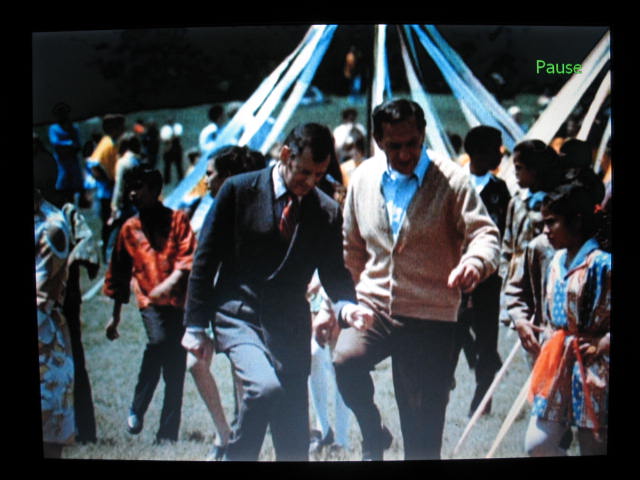
If Buck Rogers in the 25th Century is as accurate about the 25th century as I expect it to be, then in the future, we'll all be dancing with some giant rubber band/hula hoop/glowstick thing wrapped around us like we're some cross between a raver and Tony Randall and Jack Klugman awkwardly doing the Maypole dance in Central Park in the opening credits of The Odd Couple.

You haven't lived until you've heard Jack Klugman sing 'You're So Vain' during the Odd Couple Sings LP.
(Photo source: Gary Dunaier)

The dancing during the Buck Rogers "Space Rockers" episode may be on the lame side, but the music isn't. Scottish composer Johnny Harris, whose other dope contribution to film and TV music is the funktastic score to the 1970 British psychological thriller Fragment of Fear, came up with the proto-Daft Punk synth-pop instrumental sound of Andromeda, the 25th century's most popular rock band.

Bull's got hair!

Twelve years before actor/song-and-dance man Jerry Orbach took on his most famous and final role, Law & Order's Detective Lennie Briscoe (sort of a kinder, gentler version of his crooked cop character in Prince of the City), he was on the opposite side of the law as Andromeda's evil manager Lars Mangros, who plots to use the synth-pop trio's music as a form of mind control on its teen fans.

A late '70s/early '80s TV show ain't complete with a Judy Landers guest appearance. Judy Landers is the Mark Sheppard of late '70s/early '80s TV.

Besides its guest stars (in addition to Orbach, the episode also features a Landers sister and Bull Shannon, or as I prefer to remember Richard Moll because I'm a Batman: The Animated Series fan, Two-Face), "Space Rockers" is my favorite non-Princess Ardala Buck Rogers episode because of the catchy "Odyssey." The Harris instrumental experienced a bit of a resurgence in 2004 when it appeared on the playlist of the Grand Theft Auto: San Andreas funk radio station Bounce FM.

Now here's where the technology that George Lucas utilizes to fuck up his first three Star Wars movies would actually be useful. Get someone to replace the dancers in the Buck Rogers 'Space Rockers' episode with America's Best Dance Crew champions like the Jabbawockeez.

"Odyssey" is surprisingly good synth-pop that's aged well. (The opposite of "Odyssey"--a.k.a. the worst synth-pop ever--has to be that wack "I Am America" song in Herman Cain's weird and creepy cigarette-smoking campaign ad, recorded by some right-wing version of Lady Gaga.) The instrumental is ideal popping-and-locking music. Speaking of which, the Andromeda footage in "Space Rockers" would be much more badass if the Jabbawockeez were on the dance floor instead of those whitebread-looking rubber band/hula hoop/glowstick ravers because the Jabbawockeez are what 25th-century dancing will look more like.


'Let's have some action! Let's have some asses wigglin'... I want some perfection!' I know, I know, it's not a line that The Kid said, but it's my favorite line in Purple Rain.

4. "I Would Die 4 U/Baby I'm a Star" by The Kid (Purple Rain)
Actually, every song by Prince's onscreen alter ego The Kid is not terrible. But the one-two punch of "I Would Die 4 U" and "Baby I'm a Star" has to be my favorite part of both the movie's performance footage and the Purple Rain album. As Jeremy Ohmes notes in PopMatters, "If 'I Would Die 4 U' was Purple Rain's spiritually anguished yin, then 'Baby I'm a Star' was its cocky, narcissistic yang... More than any other song on Purple Rain, 'Baby I'm a Star' documents the unbridled energy and graceful sleaziness that was Prince live."

Monday, December 27, 2010

New Year's Day means changes to AFOS programming

My brother and sister like this new station logo. It was inspired by the opening Batman logo graphics in The Dark Knight.
I'm renaming one of the AFOS programming blocks. Starting January 3, "The F Zone," which focuses on "needle drops" (non-original songs during films like High Fidelity and the Harold & Kumar series and shows like Breaking Bad and Community), becomes "Rock Box." The time slots for "Rock Box" are 4-6am, 9-11am and 3-5pm on Mondays and 5-7am, 9-11am and 3-5pm on Fridays.

In November, I created a block called "New Cue Revue," which streams selections from new releases (or albums that aren't exactly new but are new to the "Assorted Fistful" playlist). It moves to Wednesdays at 10-11am and 4-5pm and Fridays at 11am-noon.

A new block called "The Street" will focus on my favorite kind of film or TV score album: the funky-sounding kind, the kind that gets frequently sampled by beatmakers. Curtis Mayfield, Isaac Hayes, David Holmes and newcomer Adrian Younge will get tons of airplay here. "The Street" airs on Mondays at 6-9am and noon-3pm, Tuesdays through Thursdays at 6-9am and 1-4pm and Fridays at 7-9am and 1-3pm.

The listeners who evaluate my playlists' tracks on Live365.com tend to give low star ratings to the funkier or more soulful-sounding ones. Live365 has listeners rate tracks because the site thinks this helps its station programmers decide which tracks to keep and which ones to get rid of. Well, it doesn't help this station programmer because I don't care about those listeners' ratings anyway. Every time someone on Live365 gives a track one and a half stars, it makes me want to find ways to stream it more often.

Whenever I upload a new track to one of my playlists, I always have to block my eyes from the ratings to keep myself from getting pissed off at a negative one. What the hell are those listeners doing hanging around AFOS anyway? I bet they want another StreamingSoundtracks or another Permanent Waves. AFOS is a little different from them. It streams certain subgenres of film or TV score music that those stations tend to ignore.

"The Street" is my three-hour middle finger to those people who give one and a half stars to classic tracks like "Pusherman." On Fridays, the block is two hours because my middle finger will get tired by the end of the week.

Sunday, November 29, 2009

The why of fly: Michael A. Gonzales' "Gangster Boogie" details the making of the Superfly soundtrack

If you still got 8-tracks lying around the house, you might be a Pinoy.
(Photo source: Michael A. Gonzales)
I got my first taste of the late Curtis Mayfield's Superfly soundtrack when I watched a tape of a faded-looking print of the 1972 blaxploitation flick in either 1996 or 1997. Three elements of the movie stood out for me: the late Ron O'Neal's Shakespearean performance as a coke dealer who wants to quit the game, Sheila Frazier's nice body during the bathtub love scene and Mayfield's exceptional original songs, which are more insightful than the screenplay itself (Elvis Mitchell noted that "Mayfield's score rebels against the movie's insidious mythologizing of Priest"). Any piece of music Mayfield wrote or produced for movies just plain sizzles, whether it's any of the tunes in Superfly, the Let's Do It Again theme he produced for the Staple Singers or the Claudine theme "On and On" by Gladys Knight & the Pips.

Superfly fan Michael A. Gonzales has written what has to be the definitive chronicle of the making of the Superfly soundtrack, "Gangster Boogie," the must-read cover story in the latest issue of Wax Poetics magazine (what an issue it is: Mayfield! David Holmes! Roc Raida! Do the Right Thing! Black Dynamite! Funkdafied '70s European library music!). The Superfly soundtrack's influence on R&B and hip-hop shows no signs of waning (I didn't notice "Little Child Runnin' Wild" was sampled in Kanye West's "Flashing Lights" until it was pointed out by The-Breaks.com).

Freddie's dead. So are oversized headlight covers.

What makes Michael's piece stand out from other writings I've read about the 1972 soundtrack is that it doesn't neglect the importance of the sidemen and arrangers who helped Mayfield craft the soundtrack. Michael has said he wanted to avoid writing about Superfly through the lens of the auteur theory like other writings about classic albums he's read, hence the substantial interviews with Superfly guitarists Craig McMullen and Phil Upchurch and arranger Johnny Pate, who composed a terrific instrumental score for Shaft in Africa after Superfly.

"Gangster Boogie" also sheds light on the tensions between rock musicians and traditional film scorers that arise from projects like Superfly. I wasn't aware of Mayfield's lawsuit against his former friend Pate, who claimed he was solely responsible for writing Superfly's "Junkie Chase" and "Think" instrumental cues. It's one of many juicy tidbits in a fly article about the flyest of '70s movie soundtracks.