Showing posts with label Black Dynamite. Show all posts

Thursday, July 23, 2015

Throwback Thursday: They Came Together

Not since Adrien Brody and Gael Garcia Bernal's Gillette ad has a Gillette ad made me stop and say, 'Whoa, didn't expect to see this person peddling razors.'
Usually on Throwback Thursday, I pull out from my desk cabinet--with my eyes closed--a movie ticket stub I didn't throw away, and then I discuss the movie on the ticket and maybe a little bit of its score, which might be now streaming on AFOS. Today, instead of drawing some random ticket, I'm going to focus today's TBT piece on a Paul Rudd/David Wain movie I actually didn't see in the theater. I'm focusing on this particular Rudd/Wain movie because of both the release of Rudd's Marvel Studios blockbuster Ant-Man and the July 31 Netflix debut of all eight episodes of Wet Hot American Summer: First Day of Camp, in which Wain uses his prequel project to poke fun at the ridiculousness of other prequels by getting Rudd and all the other Wet Hot stars to reprise their roles from the 2001 cult favorite, even though they're now 20 years too old to be playing younger versions of themselves. This 2014 Rudd/Wain movie's so hilarious that whenever I recall in my mind a scene or two from it, I can't help but laugh.

As a film and TV director, David Wain is best known for Wet Hot American Summer, the 2008 box-office hit Role Models, the webseries Wainy Days and several episodes of Rob Corddry's Childrens Hospital (the absence of an apostrophe between the N and S is intentional, by the way, because the Corddry show's titular hospital was founded by a weirdo named Arthur Childrens). But I think the quintessential Wain film--even more so than either of those works--is one that the State sketch comedy troupe alum and Stella member directed way before Wet Hot: the 1997 short film "Finishing the Novel," starring Wain and Amanda Peet. The three-minute short (think of all the plodding SNL sketches that could have been improved if they had been whittled down to just three minutes!) isn't just one of my favorite shorts of all time. It's also the kind of short I wish I had the ingenuity to come up with every few weeks instead of every few years.

In "Finishing the Novel," Wain (who can currently be seen as Riki Lindhome's very gay husband on Comedy Central's Another Period) plays the world's most inept romance novelist, prone to repeating the same mistake over the course of three years and perhaps forever. The short is basically three minutes of well-off and photogenic but really dumb New Yorkers doing the most nonsensical and surreal things over and over (the weird childlike voice Wain directed Peet, who plays his wife, to speak in also has a lot to do with the short's charms), and it's the same type of absurdist humor that permeates Wain's New York rom-com parody They Came Together and turns it into one of the funniest and cleverest spoof movies of the last few years, along with Walk Hard: The Dewey Cox Story, Black Dynamite and MacGruber ("Finishing the Novel" is also key to understanding the strange vibe of They Came Together and the much stranger vibe of both Wet Hot and Wain's 2007 sketch comedy/anthology movie hybrid The Ten).


What separates the makers of They Came Together, Walk Hard, Black Dynamite and MacGruber from the Jason Friedbergs and Aaron Seltzers and Scary Movies of the world is that even when they're taking the piss out of the hoariest Hollywood clichés, they bring to it both a genuine love for whatever genre they're spoofing--Wain and his They Came Together writing partner Michael Showalter have frequently said they're fans of rom-coms despite how brutally they make fun of them--and a sense of style. Those are two things that can't be said about the Friedberg/Seltzer factory and the Scary/Superhero/Date/Epic/Disaster/Haunted Movie template, the epitome of heartless, cynical, lazily written and indifferently produced comedy filmmaking. There's no genuine love for the genres they spoof; it's just a shapeless and pointless jumble of unfunny and already dated references to shit that has very little to do with whatever recent box-office hit they're re-creating, like the Stomp the Yard references and Paula Abdul impressions (Nicole Parker, why?!) during the 300 spoof Meet the Spartans.

Neither is there any panache or style to these ugly-looking Scary/Superhero/Date/Epic/Disaster/Haunted movies that must have cost five cents to shoot, whereas They Came Together, Walk Hard and MacGruber--and over on the small-screen side, any Key & Peele genre parody sketch like the "Sex Detective" parody of Hannibal and other similar criminal profiler shows--are all exquisitely photographed in spite of being saddled with equally low budgets. They Came Together, Walk Hard, MacGruber and Key & Peele are attempting to be visually indistinguishable from the big-budget, handsomely shot dreck they're spoofing. Tom Houghton, They Came Together's cinematographer, looks like he actually gives a fuck. The montage of Paul Rudd's Joel and Amy Poehler's Molly frolicking all over the streets and parks of Brooklyn--which hilariously transforms into a fake DVD featurette about Norah Jones recording the montage music--is so handsomely lit and genuinely pleasant to look at (just like the work of Orange Is the New Black cinematographer Yaron Orbach during the "Gretchen Mol bangs Jesus Christ" segment of The Ten) that it causes sight gags like Joel and Molly's obliviousness to a dead body in a park to pay off more effectively than if they were shot with the customary cruddiness the Friedberg/Seltzer factory brings to its product.


When Esquire staff writer Matt Patches gave Friedberg and Seltzer a chance to defend their much-maligned approach to the spoof movie in a Grantland profile of their partnership as "Hollywood's purveyors of not giving a shit," Patches wrote that "The men are only moderately concerned about shelf life; Meet the Spartans contains multiple references to shaved-head, mental-breakdown-era Britney Spears." And there you have the fundamental difference between the writing in Friedberg/Seltzer spoof movies and the writing in Wain spoof movies. Wain's more absurdist movies aren't concerned with playing "Spot the Timely Reference" with the audience, and they're as far away as possible from the laziness of "Say, if we just toss in this scene of a celebrity impersonator dressed up as a currently-in-the-headlines pop star, the test screening audience will automatically eat it up."

Like Wet Hot (which Wain actually doesn't consider to be a spoof movie, even when it parodied '80s training montages and did it brilliantly, a year before South Park did the same thing during "Asspen") and many of the Wain-directed Childrens Hospital episodes before it, They Came Together isn't too specific about the movies or shows it's parodying. Sure, Joel and Molly's mismatched business exec/small business owner romance echoes the plot of You've Got Mail, but it's more of a hodgepodge of all the clichés of every single oil-and-water coupling in a modern rom-com. The film's more concerned with mocking unnoticeable-to-a-casual-moviegoer things like badly done ADR ("Basketball, basketball, basketball...") and that old press junket line "New York is like another character" (which I'm sometimes guilty of saying too) or those clichéd moments we're familiar with from rom-coms but have difficulty remembering word-for-word (or where exactly we saw those moments) because all those rom-coms are so damn interchangeable.

Marvel fans' minds will be blown by the acrobatic sex scene between Ant-Man and Maria Hill.

One of those clichés is the way almost every heart-to-heart conversation between the lead character and a wise family member in rom-coms ends with that lead running off and then pivoting back to earnestly say thanks to the wacky sibling or grandma (the amusingly prolonged "thanks"-off between Rudd and Max Greenfield, who plays Joel's ne'er-do-well younger brother, at the end of one particular heart-to-heart conversation is classic Wain absurdism). Wain's approach to the spoof movie is, as a result, timeless and more likely to hold up to repeat viewings than bald Britney sight gags. Why do you think Wet Hot is more beloved now than when it quietly tanked at the box office back in 2001? Wet Hot's cult popularity and lasting appeal are partly due to both Wain's timeless approach and his preference for absurdist gags over "Hmm, which box-office hits and showbiz headlines from last month can we shoehorn into our next movie?"

In fact, They Came Together's two funniest moments have nothing to do with rom-coms and have everything to do with Wain and Showalter just being their usual absurdist selves and entertainingly playing around with language, whether it's to make fun of how bizarre many phone conversations sound in real life when the person on the other end of the line isn't audible or to make fun of how clunky and silly a lot of overly expositional dialogue sounds in any kind of movie, rom-com or non-rom-com. The scene that made me laugh the loudest again during the second time I watched They Came Together was not its most talked-about scene, the bar scene that's like an updated version of the old "Pete and Repeat went to the store" joke, but the brief gag where Joel's assistant (Noureen DeWulf from the 2007 sports movie spoof The Comebacks) shares on the phone saucy and intimate bedroom details with what we assume to be her BFF and instead it turns out to be her dad. I also love how Molly's sister and housemate (Childrens Hospital regular Zandy Hartig, Wain's wife) feels the need to explain to Molly who Molly's ex-husband (an uncharacteristically goofy Michael Shannon) is even though she lives under the same roof with Molly.

Is it me or is it really weird that Molly's love interest is Ant-Man, while her exes are General Zod and Bruce Wayne's murdered dad?

Some of these gags, particularly the intentionally clunky-sounding lines of exposition, are pretty subtle and can be easy to miss in an initial viewing because of how dead-on they are about by-the-numbers Hollywood dialogue, just like how when I first saw Black Dynamite, I didn't notice how one of the actors was making fun of flubbed line readings--a staple of '70s blaxploitation flicks that were so amateurishly made that nobody would notice those flubs and fix them in post--by saying aloud the stage directions along with his dialogue ("Sarcastically, I'm in charge"). Speaking of not noticing jokes, test screening audiences were confused by They Came Together. They didn't understand it was a rom-com spoof, so Wain and Showalter tacked on as a framing device a bunch of additional scenes with Joel and Molly recalling how they met while out on a double date with a younger couple (Bill Hader and Ellie Kemper), in order to remind audiences that they're watching a spoof. In an insightful They Came Together panel discussion moderated by Jeff Goldsmith for his filmmaking podcast The Q&A, Showalter defended the last-minute addition of the framing device and said, "We want people to get the joke. We don't want people to see this and feel alienated by it, which is what happened with Wet Hot. We didn't want people to hate that movie. We like that some people love it, but I personally don't like the fact that a lot of people hate it. I want everyone to get it."

During that same panel discussion, Showalter mentions that he and Wain considered opting for a "Lost Ending of It's a Wonderful Life"-style concept of "This Rudd and Poehler movie was too good to be released and we found it" as the framing device, which I think would have worked better as a framing device than Hader constantly interjecting commentary about the ridiculousness of the rom-com tropes that brought Joel and Molly together. I'm of two minds about the double date scenes. The need to explain that everything's a joke causes They Came Together to pale slightly to Wet Hot as a Wain movie, but at the same time, without the double date scenes, we wouldn't have gotten Hader's funny delivery of "You can have the pussy, just save me the hole" and this split-second, freeze-frame-worthy sight gag of Rudd pretending to drink wine before the camera cuts away:

He looks like he's making one of those faces Chevy Chase used to make behind Jane Curtin's back during Weekend Update.

Can we talk for a second about how much Rudd and Poehler elevate They Came Together? I don't care for the rom-com genre, but Rudd and Poehler's comedic skills and their ability to play things completely straight even during the most nonsensical moments are a huge part of why They Came Together is one of the few rom-coms I'll admit to liking. The two stars are, just like everyone else in the film's cast (hell, that goes for everyone else in the casts of Wain's other films as well), enjoyably game for anything, like Rudd's unapologetically tasteless moment with The Hunger Games: Catching Fire's Lynn Cohen as Joel's bubby, which has to tie with his mirror scene in Wanderlust as his craziest moment in a Wain movie. I originally thought the scene where Joel gets turned on by his bubby after she gives him love advice--and she then hops into his arms--was intended to be a riff on a really sappy and mediocre rom-com I watched on an airplane in 1992, I Don't Buy Kisses Anymore, an indie that paired up Jason Alexander (as a Jewish mama's boy who wants to lose weight) with Nia Peeples (as a really hot Italian American musician who, like all of Alexander's love interests on Seinfeld, is way out of the schlub's league). I later found out the scene is actually a riff on Crossing Delancey, forever ruining Crossing Delancey for fans of that 1988 rom-com by adding incest.

They Came Together can currently be streamed on Netflix, but the downside of They Came Together as a streaming title is that viewers are deprived of the opportunity to enjoy what has to be one of my favorite DVD/Blu-ray extras, a video recording of Rudd, Poehler and some of their future They Came Together co-stars participating in a 2012 SF Sketchfest live read of an early draft of the They Came Together script, which Wain originally intended to make for Universal as his follow-up to Wet Hot (when They Came Together fell apart at Universal, Wain, Showalter and Michael Ian Black concentrated on bringing to life the underappreciated Stella TV show). The video and audio quality for that 103-minute extra on the They Came Together Blu-ray is subpar, but the live read is worthwhile for both glimpsing the differences (and similarities) between the early draft and the final result and checking out the actors' reactions to the script as they're reading it for the first time.

They stuck Christopher Meloni way in the back because he really did shit his pants during the table read. He's so Method.
The participants of the star-studded table read of the They Came Together script at the 2012 SF Sketchfest. Back row, from left to right: Phil LaMarr, Michael Showalter, Erinn Hayes, Michael Ian Black, Christopher Meloni, Paul Rudd, David Wain, Ken Marino and Beth Dover. Front row, from left to right: Marguerite Moreau, Zandy Hartig, Rachael Harris, Joe Lo Truglio and Amy Poehler.

You get to see Wain's Wanderlust writing partner Ken Marino--who steals, no pun intended, They Came Together's basketball court scene with just his repetitive delivery of "Swish!" and is also Wain, Showalter and Black's old castmate from The State--shaking his head in silent disbelief over the weirdness of the script. You also find out which lines from the script cause Rudd to laugh so hard he winds up in tears during the live read. One of those lines is "Oh God, Bubby, I wanna fuck you so bad."

This is why I like Rudd. He now goes down in history as the first Marvel Cinematic Universe star to have ever said, "Oh God, Bubby, I wanna fuck you so bad."

None of the original songs from They Came Together are currently in rotation on AFOS, but Craig Wedren and Pink Ape's catchy "Say You Love Me" ought to be. Wedren, a childhood friend of Wain's who has scored so many of Wain's projects, including "Finishing the Novel" and Wet Hot American Summer: First Day of Camp, talks about how simpatico his musical and comedic instincts are with Wain's while plugging the score he wrote with Matt Novack for They Came Together in a lengthy but clickworthy emPOWERme.tv interview.

Friday, January 16, 2015

"Brokedown Merry-Go-Round" Show of the Week: Black Dynamite, "The Wizard of Watts," and Bob's Burgers, "Speakeasy Rider" (tie)

Black Dynamite vs. the IRS
On some Fridays, I discuss the week's best first-run animated series episode I saw. It's the "Brokedown Merry-Go-Round" Show of the Week. "Brokedown Merry-Go-Round," a two-hour block of original score tracks from animated shows or movies, airs weekdays at 2pm Pacific on AFOS.

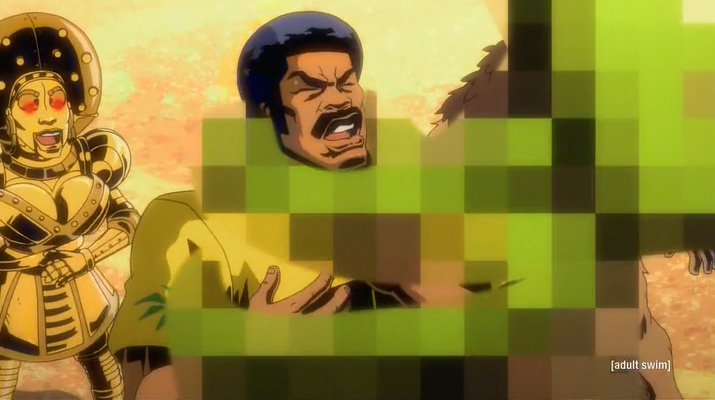
Adult Swim's animated Black Dynamite is at its weakest when it's recycling sight gags from the 2009 film of the same name (which Black Dynamite star Michael Jai White co-wrote), like when the cold open of "The Wizard of Watts," the show's ambitious second-season finale, runs into the ground the film's funny absurdist gag where Dynamite's sexual prowess is so great he's able to give multiple women in the same bed orgasms at the same time. Dynamite may be able to get half the population of '70s L.A.'s hottest honeys off, but it doesn't get the finale off to a good start.

It's a crazy gag I liked so much during the film--because it makes no anatomical sense at all--that I kept hoping the animated version would never rehash it. But it ended up rehashing it, and not just in "The Wizard of Watts," but earlier in the second season as well. That's my biggest problem with the animated Black Dynamite or any other animated small-screen version of a live-action movie: there's no need to remind viewers of all the scenes we loved in the original (hell, it's also a problem with movies that are sequels to classic comedies, which is why I was relieved when White announced that his next movie with Black Dynamite director Scott Sanders will most likely be an unrelated comedy featuring White and his Black Dynamite co-stars as new characters instead of a Black Dynamite sequel). As kids, we enjoyed The Real Ghostbusters not because of the countless times Peter Venkman would get slimed by Slimer just like in the original Ghostbusters, but because of the effective ways The Real Ghostbusters expanded upon the Ghostbusters universe, thanks to the efforts of a pre-Babylon 5 J. Michael Straczynski as the show's story editor, as well as a few genuinely funny jokes that weren't in the 1984 film, like the moment when a demon opened a thick book that listed his least favorite creatures on Earth and he flipped past a page that said "Mimes." Re-establishing the animated show's connections to the original source material is just lazy writing, when time can be better spent coming up with new comedic material, like any moment where Dynamite finds himself literally tangling with the evil '70s kids' show puppet That Frog Kurtis (J.B. Smoove), an enjoyable antagonist who makes a long-overdue reappearance in "The Wizard of Watts" and is a character that the 2009 film would have been incapable of pulling off due to both budgetary and live-action limitations.

Podrick from Game of Thrones wishes he were this well-endowed.

The rehashed multiple-orgasm gag is a glaring misstep (this show is capable of coming up with cleverer ways to depict Dynamite's month of fighting and fucking), while the rest of the hour-long "Wizard of Watts" is the animated Black Dynamite at its best, whether it's demonstrating why White, who's otherwise known as a star of straight-to-DVD action flicks like the beautifully choreographed MMA fight film Blood and Bone, is a pretty skilled comedic actor (he doesn't overplay the humor) or offering a demented comedic spin on not-so-funny subjects like Donald Sterling's racist attitudes and racially motivated police brutality. The finale was written about a year before the nationwide furor over both Ferguson and Eric Garner's death at the hands of the NYPD (showrunner and episode co-writer Carl Jones' attempt to make the episode more up-to-date by dubbing in audio of Honey Bee saying "I can't breathe" during a riot scene screams out "last-minute"). "The Wizard of Watts" has to be one of the few pieces of television that made me laugh at something so wrong: the sight of Rodney King--he's depicted here as an orphan at the Whorephanage and referred to during the episode as "Little Orphan Rodney King"--getting a beatdown from cops. If you're uncomfortable with humor being mined from the sight of children getting beat up, stay away from "The Wizard of Watts." Honey Bee's big musical number in the episode has her slapping around unruly orphans at the Whorephanage with '60s Batman-style onomatopoeia filling the screen.

"The Wizard of Watts" presents what has to be the world's first parody of the '70s Broadway hit The Wiz. (Let's just forget the unsuccessful 1978 movie version with a badly miscast Sidney Lumet and an ill-suited-to-be-director Diana Ross existed. Get it? Because Diana Ross bossed around both Universal and Motown in order to become part of... Okay, you get it.) The episode jokingly refers to its vision of Watts-as-Oz as "the black version of The Wiz" and places Dynamite in the Dorothy role, a leg-humping, foul-mouthed poodle named Broto (rapper/Loiter Squad star/extraneous comma lover Tyler, the Creator) in the Toto role and the Wicked Bitch of the Westside (Tim Blake Nelson), a pig from the LAPD who's literally a pig, in the nemesis role. The musical numbers in "The Wizard of Watts," which are riffs on both The Wiz's show tunes and '70s hits like the Sugarhill Gang's "Rapper's Delight," exemplify why second-season composer Fatin "10" Horton has been a nice addition to the show: he's like a less family-friendly Weird Al, perfect for the animated Black Dynamite's profane--and according to Jones, "socially irresponsible"--brand of humor.

My favorite numbers in this episode are the ones based on "Don't Nobody Bring Me No Bad News"--Dynamite's chicken-and-waffles chef friend Roscoe sings about both the joys of "mixing Fiddle Faddle, chitlins and fondue" and his promise to "never bring you no fucked-up food"--and "Home." Yes, White himself attempts to sing this episode's version of "Home," without the aid of Auto-Tune to make him sound on-key, and it's one of the funniest things this show has ever done. White once explained in the 2009 Black Dynamite DVD's commentary that his performance in the film was intended to parody Jim Brown's stiffness as an actor, like Brown's visible discomfort with trying to look relaxed during a simple romantic scene like going out on a date (it's easy to forget that White was portraying an injured ex-football star portraying a blaxploitation hero, and the stoic demeanor was partly due to his injured neck). On the animated Black Dynamite, White is committed to making Dynamite sound uncomfortable with any other moment where he has to show some vulnerability--is there anything more vulnerable-looking than singing in public?--and that commitment pays off hilariously here when Dynamite has to sing to get back home. This is what I mean when I say White is a skilled comedic actor. He doesn't treat the material like it's comedy. He treats it like it's any other dead-serious action flick he's starred in and lets the comedy come to him, just like how Dynamite lets the women come to him. Part of that is probably due to Jones' additional work as the show's voice director (I bet the direction Jones gave to White for Dynamite's musical number--or maybe White thought of it himself--was "Sing it like how Jim Brown would have sung it," which is perfect). Erykah Badu, who reprises her recurring role as Whorephanage employee Fatback Taffy (named after the Jill Scott jam, perhaps?) in "The Wizard of Watts," once praised Jones as a voice director and said he's an actor's director who "helps us bring the best out of our characters to leave us room to create who they are."

I was initially worried when Black Dynamite switched from Titmouse Inc. to MOI Animation for the animation work this season. But MOI ended up being a great substitute for Titmouse, and the Korean studio's work on "The Wizard of Watts" resulted in a remarkable-looking finale, a swirly, mindfucky '60s psychedelicization of a '70s Broadway musical that's being retold through 2015 eyes. The clips of past Black Dynamite episodes that are shown during Dynamite's climactic musical number lend "The Wizard of Watts" a sense of finality, not just as a last episode of the season (by the way, the episodes about Roots, Bob Marley and Bill Cosby were my favorites from this season) but as a possible last episode of the show as well. A third season for Black Dynamite hasn't been announced by Adult Swim yet, and if this is indeed the last episode of Black Dynamite, "The Wizard of Watts" is a hell of a way to go out. But part of me feels like the show still has more work to do. There are a lot more stories for Black Dynamite to tell and a lot more subjects from the forever-lampoonable '70s to lampoon or humorously tackle--or rather, a historically inaccurate version of the '70s that's as intentionally and amusingly inaccurate as Everybody Hates Chris and The Goldbergs' respective depictions of the '80s, although Jones' decision to give legendary Asian American Soul Train dancer Cheryl Song a fobby accent in the American Bandstand-vs.-Soul Train episode "American Band Standoff" really bugged me (she doesn't have an accent, bruh). I'm surprised that the show hasn't riffed on the 39-year-old Rocky franchise--which, by the way, will pair up Sylvester Stallone with Michael B. Jordan as both Apollo's grandson and Rocky's protégé in a spinoff movie tentatively titled Creed--because Tommy Davidson, who voices Cream Corn, does the best Stallone impression in the game. The way Davidson nails how white actors like Stallone shout when their characters get angry always kills me. I really wish the show found an opportunity for Davidson to trot out that comedic trump card of his.


And as long as police brutality or the microaggressions within something like New York Times TV desk moron Alessandra Stanley's treatment of Shonda Rhimes continue to be problems, we'll always be in need of satirical takes on these problems from unapologetically black shows like Black Dynamite. Towards the end of "The Wizard of Watts," Dynamite, who usually settles things with violence, finally manages to defeat the Wicked Bitch of the Westside--he melts to the ground, of course--after he chooses to handle the Wicked Bitch in a way that's completely different from how he usually handles his adversaries. Dynamite figures out that "the only way to defeat a crooked pig is to catch him on tape." The scene reminded me of "Oskar Barnack ∞ Oscar Grant," a great 2011 track about responding to police brutality by Blue Scholars (the duo of Prometheus Brown, one of hip-hop's wittiest Filipino American rappers, and producer Sabzi, who's currently killing it as the producer half of another duo, Made in Heights). "Oskar Barnack ∞ Oscar Grant" calls for regular citizens to use cameras as their weapons against racist cops ("Shoot the cops/Shoot the cops/Shoot the cops/Take your cameras out your pocket, people"), and Dynamite kind of does the same thing when he defeats the Wicked Bitch, but he arrives at that decision to use a camera without speechifying about it, which would have been beneath this show. If someone told me 10 years ago that Adult Swim would become a haven for largely experimental, sharply written and sometimes socially conscious comedy from black folks, whether it's a scene like that one between Dynamite and the Wicked Bitch or a show like Black Dynamite, Jones' previous show The Boondocks, Tyler and Odd Future's Loiter Squad, Black Jesus or The Eric Andre Show, I would have said, "Sure, when cops fly."


***

Days of Blunder
"Speakeasy Rider" is a strange case where Bob's Burgers borrows from some of the staff writers' favorite sitcoms but never once feels derivative or tired. It's also a case where the episode title recycles a pun. "Speakeasy Rider" is the second Bob's Burgers episode to play around with the title Easy Rider, after "Ear-sy Rider." Not even that is tired. It's Bob's Burgers. It can get away with it--for now.

The story of siblings becoming Williams sisters-style rivals in the same sport is a familiar one. "Lisa on Ice" is one of my favorite Simpsons episodes because of its outstanding gags about the lunacy of Springfield's citizens, represented in "Lisa on Ice" by their bloodthirsty attitudes about hockey, and its poignant look at the relationship between Bart and Lisa. "Speakeasy Rider," which centers on Tina and Louise's rivalry as go-kart racers (their racing scenes are impressively animated, under the direction of Jennifer Coyle) and was written by Rich Rinaldi, contains a tension-filled dinner table scene between the sisters that's reminiscent of the "I won't have any aggressive condiment passing in this house!" scene in "Lisa on Ice." Even the ending is similar to the outcome of Bart and Lisa's conflict on the hockey rink. And the B-story of Bob and Linda trying to sneak Teddy's surprisingly good home-brewed beer past the tenacious eyes and noses of health inspectors Hugo (Sam Seder) and Ron (Ron Lynch) is essentially one of those old Cheers stories where the bar has to pretend everything's normal while it's operating without a liquor license or the bar has to pretend it's a gay one.

But "Speakeasy Rider" is unmistakably Bob's Burgers all the way, which means it's weird, weird, weird--like when Tina has conversations with her go-kart or when H. Jon Benjamin and Robert Ben Garant ad-lib an awkward picnic moment between Bob and Garant's biker character Critter--as well as warm and affecting in the least expected of places and consistently funny. The day when Bob's Burgers stops being this consistently funny is going to be a sad one, as sad as a burger without buns, unless Loren Bouchard and his crew manage to avoid shark jumping or, to borrow some racing lingo, they end up sandbagging the competition.

Linda gets all her business ideas...

... from '30s movies on TCM.

Friday, December 19, 2014

"Brokedown Merry-Go-Round" Shows of the Year 2014

Like that whole clusterfuck with the hackers scaring Sony away from releasing The Interview, we can't look the fuck away from this.
(Photo source: Reddit)
Every Friday in "'Brokedown Merry-Go-Round' Show of the Week," I discuss the week's best first-run animated series episode I saw. It's time to look back at the biggest standouts of the episodes I discussed in 2014 (in chronological order). "Brokedown Merry-Go-Round," a two-hour block of original score tracks from animated shows or movies, airs weekdays at 2pm Pacific on AFOS. "'Brokedown Merry-Go-Round' Show of the Week" returns some time in January.

Rick and Morty, "Meeseeks and Destroy" (from January 24, 2014)

"Meeseeks and Destroy" is a great turning point for Rick and Morty. It's where several of the regular characters evolve from being cartoon characters--and mere chess pawns in the writers' crazy and increasingly imaginative plots--to human beings with wants, desires, genuine sadness and occasional compassion, much like the characters on Rick and Morty co-creator Dan Harmon's Community.

We learn that Beth (Sarah Chalke) is having regrets about her marriage to Jerry (Chris Parnell)--being pregnant with Summer (Spencer Grammer) at a young age, while putting herself through veterinarian school, was the main reason why she wedded Jerry--and she's beginning to feel stifled by her suburban existence. As for Morty (co-creator Justin Roiland), he's getting tired of being led around by Rick (also Roiland) through such dangerous adventures on other worlds. After some persuasion from Morty and agreeing to a bet with him, the cynical grandpa, who continually warns Morty that the universe is crazy and chaotic, lets his grandson be in charge of an adventure that's closer to his perception of adventure as simple and fun (somewhere on a Jack and the Beanstalk-like planet where medieval villagers are being subjugated by giants from a much more modernized section of the planet). That is until Morty realizes the hard way that Rick is right about the darkness and dangerousness of the universe, and his notion of adventure as simple and fun is destroyed in that unsettling scene every Rick and Morty viewer has been talking about on the Internet this week.

Yes, about that scene: Since episode one, Rick and Morty has been upfront about being dark-humored and adult, but never have I expected the show to go to such a dark place like it does when Morty is nearly raped by Mr. Jellybean, an anthropomorphic and seemingly benign jellybean, in the bathroom of a tavern inside a stairway on the giants' land. Nothing alters the mood of a comedy like sexual assault, and fortunately, unlike too many other adult animated shows, "Meeseeks and Destroy" doesn't play Morty's moments of terror and subsequent trauma for laughs.

"Edith's 50th Birthday," the infamous All in the Family episode where Edith escapes an attempted rape in her own home, was lauded for its treatment of sexual assault (and the late Jean Stapleton totally owned the episode), but it has also dated badly. That All in the Family episode was made at a time when all comedy on TV contained studio audience laughter or canned laughter, so you get these annoying and strange studio audience giggles during the serial rapist's attempted attack and the scenes where Edith is wracked with PTSD (I don't care for the TV version of M*A*S*H, partly because of the canned laughter, but I always liked how the M*A*S*H producers, who opposed the CBS execs' insistence on a laugh track, refused to add laughter during the surgery scenes). You wonder if maybe All in the Family would have been better off taping "Edith's 50th Birthday" without the studio audience due to the seriousness of its subject matter, but then without that live audience, you wouldn't have gotten that classic moment where the audience cheers and goes crazy when Edith smashes a burning cake into the rapist's face and escapes. The stupid laugh track is a common thing you have to put up with when rewatching all those terrible and awkward '70s and '80s Very Special Episodes (VSEs) All in the Family is responsible for unleashing. It served as a cushion of comfort for '70s and '80s viewers, reassuring them that this is a light comedy first and a drama second. There's no such audio of laughter to be found in "Meeseeks and Destroy," which is why I find it to be more effective about the horror of almost being sexually assaulted than "Edith's 50th Birthday."

The bathroom incident introduces a compassionate side of Rick, whose treatment of Morty has bordered on abusive, ever since he insisted to Morty in the premiere episode that he smuggle extraterrestrial plant seeds inside his butt as if he were a drug mule. Despite moments like that, we know Rick cares a bit for his grandson because he'd willingly blow up civilization if doing so would get Morty to score with the girl he's crushing on. That great moment where Rick sees Mr. Jellybean stumble out of the bathroom in bruises created by Morty, silently puts two and two together and gives Mr. Jellybean a steely-eyed stare is further proof that Rick cares for Morty, as is his hilarious final act in the medieval village immediately after he and Morty find out the identity of the villagers' king. Fuck with Rick's family, and you're eradicated from the universe, no matter what social standing you are.

I'm making it sound like the near-rape scene brings "Meeseeks and Destroy" to a screeching VSE halt. Fortunately, "Meeseeks and Destroy" doesn't awkwardly turn into a VSE after the incident or end with Rick and Morty breaking the fourth wall to give the number of a counseling hotline like so many VSEs would do (although it does end with Rick breaking the fourth wall, not for PSA reasons but to put a button on an intentionally lame one-liner with what he mistakenly thinks is an old Arsenio catchphrase). It just treats the near-rape like the unsettling and horrible thing it is, doesn't try to preach about the horribleness of it and moves on. It's a grown-up and sophisticated way of handling such a subject, compared to how the VSEs would poorly stitch together their serious subjects with bits of comic relief or reassuring messages.

The moment I saw that box, I thought the show was going to riff on 'Button, Button,' a.k.a. that Twilight Zone episode that became a Cameron Diaz movie, of all things.

And I haven't even talked yet about the brilliance of the B-story. The B-stories on Rick and Morty have gotten increasingly ingenious, ever since the superintelligent dogs' conquest of Earth in "Lawnmower Dog." To keep Beth, Jerry and Summer from constantly turning to him for solving their problems, Rick presents them with a Meeseeks box, which, when its button is pressed, summons a Meeseeks ("I'm Mr. Meeseeks! Look at me!"), a jolly, genie-like blue creature whose purpose in life is to solve someone else's problem, and it's their only purpose because the Meeseekses wink out of existence immediately after accomplishing their tasks. Summer's Meeseeks helps her to become the most popular girl in school, while Beth's Meeseeks helps her to become a more perfect and pretty woman, as we see in an amusing restaurant scene where, over lunch, he drops some motivational advice to Beth as if he were every single magical gay BFF in every crappy rom-com. But when relentlessly mediocre Jerry asks his Meeseeks to help him take two strokes off his golf swing, Jerry fails to fix his swing, which keeps the Meeseeks in existence longer than he expected and causes him to push the button to summon another Meeseeks to help him help Jerry. When neither of them can help Jerry, they call on more and more Meeseekses to appear until all the Meeseekses go insane and agree that the only way they can disappear is to kill Jerry.

"Existence is pain to a Meeseeks, Jerry, and we will do anything to alleviate that pain!," shouts one of the Meeseekses while holding hostage at gunpoint the customers and waiters at a restaurant where Jerry and Beth are dining. Jerry has had a rough last few episodes, from seeing his mom make out with her new and much younger lover at Christmas dinner--while his dad's bizarrely okay with it--to having what he thinks is the best sex he's ever had with Beth when he unknowingly bangs an inanimate digital clone of her. So seeing Jerry rise to the occasion for once during the hostage situation--instead of the advice of a Meeseeks, a boost of confidence from Beth is what helps him to finally perfect his swing and send all the Meeseekses away--is a nice break from his spiral of patheticness.

Jerry's triumph is also a nice break from the dark examples throughout "Meeseeks and Destroy" of why the universe is, in Rick's words, a crazy and chaotic place. Yet another dark example pops up in the post-credits tag when the village chooses to sweep Mr. Jellybean's pedophilia under the rug, which is both comedically pathetic and, as we've seen from headlines like Joe Paterno's decision to keep quiet about Jerry Sandusky, sadly all too common in this crazy and chaotic universe. The tag is one of several dark touches that have elevated Rick and Morty from a solid Adult Swim show to one of the 2013-14 season's best new comedies, live-action or animated.

The last Dirty Harry movie had a scene at a restaurant like this, where Dirty Harry gunned down a bunch of robbers with blue skin and tufts of orange hair.

Memorable quotes:
* "Hey Rick, you got some kind of hand-shaped device that can open this mayonnaise jar?"

* Attorney: "Your Honor, I'm from a tiny person's advocacy group, and I have here in my hand a motion to dismiss! These little men were never read their giant rights and are therefore, free fi to fo home." Rick: "What the hell is he talking about?" Attorney: "They're free to go is what I meant. I-I'm deconstructing o-our thing we say. For giants. Nobody got that? Whatever."

* "I can't take it anymore! I just want to die!" "We all want to die! We're Meeseeks!" "Why did you even rope me into this?" "'Cause he roped me into this!" "Well, him over there, he roped me into this!" "Well, he roped me into this!"

* "Jerry, maybe it's time I take that trip I always talk about." "Where would you go?" "I don't know, man. Italy, Greece, Argentina..." Jerry, doing a half-assed Carnac impression: "Countries known for their sexually aggressive men."

* "Wait. Destroy it. Our people will get more from the idea he represented than from the jellybean he actually was."

***

Rick's ride is a little boring-looking. A flying saucer? C'mon, you can do a lot more fucking baller than that, Rick.
Rick and Morty, "Rick Potion #9" (from January 31, 2014)

The recently renewed Rick and Morty started out as Justin Roiland's profane riff on the friendship between Doc Brown and Marty McFly in the Back to the Future movies (and now stage musical?!--why?!). With the addition of Dan Harmon to Roiland's vision, it's morphed into a dark--and unmistakably Adult Swim--take on the well-traveled heroes of both The Hitchhiker's Guide to the Galaxy, which Harmon grew up reading, and Doctor Who, which Harmon references on Community in the form of the fictional show Inspector Spacetime (even composer Ryan Elder's Rick and Morty theme tune is sort of a takeoff on Murray Gold's updated arrangement of the old Doctor Who theme during modern Doctor Who's first three seasons).

Modern Doctor Who has sometimes attempted to explore what happens when the Doctor winds up making things worse rather than making them better (like what Russell T. Davies did with the 10th Doctor during the classic bottle episode "Midnight"), but on Rick and Morty, Harmon wants to go a step further and see what it's like when you strip away the whimsy, the heroism, the ultra-competence, the pacifism and all the other comforting things that make the Doctor such a beloved part of the family-friendly half of British TV. For instance, what if Ford Prefect--who was basically a Douglas Adams clone of the Doctor--was responsible for the destruction of Earth instead of the aliens who blew it up to make way for a "hyperspace bypass" that's under construction? Or what if the Doctor was a total sociopath and instead of saving lives and trying to avoid violence as much as possible, he didn't mind resorting to murder, which is how Rick handled an alien who attempted to molest his grandson last week in "Meeseeks and Destroy"?

This week, in "Rick Potion #9," which is credited solely to Roiland, Rick and Morty does an inspired--and thanks to all the David Cronenbergian body horror imagery, delightfully grotesque--spin on "What if the Doctor's scientific expertise kept ruining everything and plunged Earth into an apocalypse?" I love how the apocalypse is the result of an experimental love potion that was lying around Rick's lab like some unread indie comic I bought at APE in Sucka Free about a half a decade ago but have never gotten around to flipping through and is gathering more dust than a "Which racial terms are not allowed to be said on the air?" manual at the offices of Fox News.

Morty uses the potion to get Jessica, the classmate whose breasteses he dreamt about caressing in the pilot, to fall for him at their school's Flu Season Dance. But of course, the potion, which Rick warns Morty not to use on her if she has the flu, goes wrong when it's combined with Jessica's flu microbes and it ends up infecting everyone else at the dance. So in addition to both female and male classmates wanting Morty's body, all the faculty members become infatuated with Morty as well. Soon the rest of the world follows suit, except for Morty's loved ones, who are immune to the effects of Rick's potion because Rick's not much of a fan of incest, whether it takes place inside Morty's math teacher's pervy dream world or at 9pm on Sundays on HBO.

Wow, the supermodels in this year's Sports Illustrated Swimsuit Issue look terrible.
Each of Rick's attempts to undo the potion's effects results in the rest of Earth's population experiencing different stages of mutations, one more horrible than the next. Rick's Cronenberging of the world gets so bad that he starts referring to all the mutated humans as "Cronenbergs." Only when the world's in complete shambles does a loser like Morty's dad Jerry get his chance to step up and take charge, and while he and his wife Beth's transformations into trigger-happy, post-apocalyptic action heroes are full of badass lines delivered with Ash from Evil Dead II-style aplomb by Chris Parnell and Sarah Chalke, it feels a little repetitive coming right after Jerry's victory with his revamped golf swing in "Meeseeks and Destroy."

"Rick Potion #9" was actually the first episode (after the pilot) that Harmon, Roiland and the other voice actors worked on, but Harmon and Roiland pushed it back to halfway through the first season because they felt it made more sense to air it at this later point. So while the change in air order results in a character who was previously established as an eternal fuck-up turning into a winner two episodes in a row, the decision to delay "Rick Potion #9" also makes the episode's downbeat final scene--soundtracked to the funereal strains of Mazzy Star's "Look on Down from the Bridge," a song that was also used on The Sopranos--much more powerful.

Rick's ultimate solution to all his previous mistakes is the kind of deus ex machina I don't think I've ever seen before in sci-fi, and it's another example of how brilliantly plotted Rick and Morty has been each week. With his portal gun, Rick simply abandons the monster-infested Earth he's inadvertently created and takes Morty with him to an alternate--and completely identical--Earth where they can start anew and replace that Earth's Rick and Morty, who died in a lab experiment without either Beth, Jerry or Summer to see them perish. Rick uses his portal technology to pinpoint the exact moment when their alternate counterparts died so that he and Morty can immediately bury their counterparts' corpses and take over their identities without Beth, Jerry and Summer noticing.

The act of burying his own horribly mangled corpse in the soil does such a number on Morty's psyche that all Morty can do afterward is sit silently in a shocked daze, not to mention the fact that he's surrounded by a family that looks and behaves exactly like the one he's spent all his life with (alt-Beth and alt-Jerry argue just like Beth and Jerry do; alt-Summer is glued to her phone just like Summer), but it isn't the same one he's spent all his life with. Meanwhile, Rick, with booze in hand, of course, nonchalantly eases his way into this alt-Earth as if he's done it a million times before. In one of the most memorable lines in GoldenEye, the Sean Bean character attempts to cut 007 down to size by telling him that he knocks back martinis to silence the screams of the men he's killed. I wouldn't be surprised if the booze similarly helps Rick to dull the remorse that Morty is now feeling and that I imagine a younger Rick must have felt too when he first encountered crazy situations like this.


This eerie and dramatic conclusion to a comedically chaotic episode would have felt heavy-handed had Adult Swim aired "Rick Potion #9" right after the pilot. But reshuffling the episode order--so that "Rick Potion #9" takes place after the Inception-esque mind-fuckery in both "Lawnmower Dog" and "M. Night Shyam-Aliens!," Morty's disgust over killing his loved ones' demonically possessed alternate reality clones and his near-brush with sexual assault inside that men's room--makes Morty's concluding expression of both despair and exhaustion resonate more. Because Rick and Morty isn't a serialized comedy, I wouldn't be surprised if the show never addresses the change in universes again and presses on as if nothing drastic happened. But that look of despair raises a bunch of questions about the rest of the season. Is Morty starting to wish for a life away from Rick? Does Rick even care about the destruction he leaves behind wherever he goes? Could he be an even bigger monster than the Cronenbergs he created back in the old universe?

By its second season, The Venture Bros. grew from being a Jonny Quest parody to something much richer. With the one-two punch of "Meeseeks and Destroy" and now "Rick Potion #9," Rick and Morty is already showing signs of doing the same thing: outgrowing its Doctor Who parody trappings to become its own animal, a lot more ferocious--and frequently funnier--than the classic that inspired it.

Memorable quotes:
* "The Flu Season Dance is about awareness, not celebration. You don't bring dead babies to Passover."

'Stay tuned for tonight's marathon of the greatest show ever made: M.A.N.T.I.S.!'
* "We interrupt Pregnant Baby with breaking news!"

* When Morty accuses Rick of being way more irresponsible than him, Rick's dismissal of love potions as being nothing more than roofies is so damn terrific: "All I wanted you to do was hand me a screwdriver, Morty. You're the one who wanted to me... wanted me to... buckle down and make you up a... roofie juice serum so you could roofie that poor girl at your school. I mean, w-w-w-w-w-a-are you kidding me, Morty? You're gonna try to take the high road on this one? Y-y-you're a little creep, Morty. Y-y-you're-you're just a little creepy creep person."

* And now, some pre-makeout banter that would never be uttered on Doctor Who: "I wish that shotgun was my penis." "If it were, you could call me Ernest Hemingway." "I don't get it, and I don't need to."

***

It's hard out here for a plant.
Space Dandy, "Plants Are Living Things Too, Baby" (from March 7, 2014)

In the preview for this week's Space Dandy episode that followed last week's episode, Dr. Gel (Unshou Ishizuka), the gorilla scientist from the Gogol Empire who's obsessed with capturing the titular alien hunter, complained off-screen about having to die at the end of every story and wasn't too thrilled to learn from his assistant Bea (Kosuke Hatakeyama) that he wouldn't appear at all in the next one. During "Plants Are Living Things Too, Baby," I didn't miss Dr. Gel at all.

Easily the most visually stunning Space Dandy episode so far, "Plants Are Living Things Too, Baby" proves once again that where Space Dandy excels is not in its slapstick or its running gags like Dr. Gel's incompetence as a villain (Dandy never notices his presence, and if the parallel universes theory regarding Space Dandy's self-contained continuity each week is true, neither do Dandy's parallel counterparts). The blundering villain who's continually unable to catch or kill the person he hates the most is a gag that's been done before, and with much funnier and cleverer results in shows like The Venture Bros. Where Space Dandy excels the most is in its willingness to experiment each week, either story-wise or visually, like general director Shinichiro Watanabe's previous shows Cowboy Bebop and Samurai Champloo often did. As I've said before, Space Dandy has the feel of an anthology, with the only constant being Dandy, QT the robot, Meow and their ship, and with a different animator taking a stab at directing each week (not to mention a different artist being assigned to design each alien world that's visited by the Aloha Oe crew).

Those of the show's haters who wrote off Space Dandy right after its premiere (because of either the fan service during the Boobies breastaurant scene or the mostly forced attempts at humor in that first episode) are missing out on some intriguing excursions into different sci-fi subgenres, whether it's the space race genre a la Redline or zombie comedy. They're also missing out on some just plain good short story writing, like in last week's uneven but enjoyable "The Lonely Pooch Planet, Baby"--which came up with a nifty explanation for the whereabouts of Laika, the ill-fated dog inside Sputnik 2 during its 1957 orbit around Earth--and in this week's episode, the first one Watanabe has written since the premiere.

Friday, November 21, 2014

"Brokedown Merry-Go-Round" Show of the Week: Black Dynamite, "Sweet Bill's Badass Singalong Song or Bill Cosby Ain't Himself"

At a reverse strip club, the dancers put their clothes back on, which is also how the Hallmark Channel broadcasts reruns of True Blood and Masters of Sex, by showing each episode backwards.
Every Friday in "'Brokedown Merry-Go-Round' Show of the Week," I discuss the week's best first-run animated series episode I saw. "Brokedown Merry-Go-Round," a two-hour block of original score tracks from animated shows or movies, airs weekdays at 2pm Pacific on AFOS.

As a kid, I loved Bill Cosby: Himself so much that other grade school classmates and I would frequently repeat to each other on the bus or on the playground several lines from that concert film, which was a fixture of so many cable channels in the '80s and '90s (including the Disney Channel, whose censors deleted Cosby's entire routine about booze and cocaine addicts from the film). The "I thought my name was Jesus Christ!" bit was particularly popular on the playground. I still do like that film. As Hannibal Buress said in a 2013 GQ piece where he and a bunch of other comedians discussed their love for Cosby's material in Himself, "It's stuff that holds up." But ever since Cosby's infamous 2004 "Pound Cake" speech, my admiration for Cosby--outside of his unquestionable skills as both "a stand-up who sat down" and a storyteller--dissipated.

It dissipated even further after reading this (scroll down to the comments section for stories of Cosby being a power-mad asshole backstage or off-camera) and this and then hearing about one Cosby rape allegation after another (with Cosby now receiving support from Rush Limbaugh--why is Bill Hicks dead while this prick Hicks used to take down so beautifully in his act is still alive?). So I enjoyed Buress' recent rant about Cosby, a routine from his current stand-up tour that went viral last month and has attracted so much media attention even Buress himself has become tired of hearing about it. In the routine, Buress, a lapsed Cosby fan, scathingly slammed both the star of Leonard Part 6 and "the fuckin' smuggest old black man public persona," a side of Cosby that has frustrated Buress and so many other people of color from the hip-hop generation. "He gets on TV, 'Pull your pants up, black people, I was on TV in the '80s! I can talk down to you because I had a successful sitcom!' Yeah, but you rape women, Bill Cosby," ranted Buress.

This whole Brown Hornets fight sequence makes the 'Burly Brawl' from The Matrix Reloaded look like a thumb wrestling match.

"Sweet Bill's Badass Singalong Song," the Black Dynamite episode that pokes fun at Cosby's "Pound Cake"-era persona by imagining his '70s self as a shrill killjoy who schemes to replace blaxploitation movies with much more family-friendly entertainment, was written about a year before the Buress rant helped to turn the public against the once-beloved entertainer and now inevitable Law & Order: SVU episode subject. That's why "Sweet Bill's Badass Singalong Song" barely acknowledges the current rape scandals, although at the very last minute, episode co-writer Carl Jones was able to squeeze a couple of rape scandal references into the final cut (unlike the low-budget South Park, the much-more-expensive-to-animate Black Dynamite doesn't have the luxury of a fast turnaround). But the episode amusingly sheds light on how irritating and hypocritical Cosby's Bill O'Reilly-ish "Pull your pants up" persona has been, and it gives Cosby a lovely comeuppance--in the form of both a scolding and another kind of punishment (which I'll get into in a few seconds) from a frequently bleeped-out Moms Mabley, who's perfectly imitated by stand-up comic Luenell (you might remember her as the prostitute Borat marries at the end of Borat).

This episode is also quite a showcase for guest voice actor Kevin Michael Richardson (outside the recording booth, he frequently stole ABC's short-lived caper comedy The Knights of Prosperity from Donal Logue, but his greatest moment as a performer remains his guest shot as both an elderly Martin Luther King and a lisping bouncer who criticizes Huey's shoes on The Boondocks). He does impressive quintuple duty as Cosby, a bunch of nameless side characters and Melvin Van Peebles, who turns to Black Dynamite, his old friend from "the days of fucking," for help when Cosby's anti-blaxploitation scheme sabotages the filming of Van Peebles' new Jim Kelly/Pam Grier/Antonio Fargas/Rudy Ray Moore movie Blackity Black Black Black and then threatens to inflict on the public both the concept of reverse strip clubs (a marquee for a new reverse strip club reads, "Throw some clothes on deez hoes!") and a poorly cast primitive version of The Cosby Show called The Huxtables (Jim Kelly as Cockroach!). If you have to see one work of television this year that ends with Richardson hilariously voicing Cosby making gargling noises while being forced to orally pleasure Moms Mabley, make sure it's "Sweet Bill's Badass Singalong Song."

Today on Fat Albert, Rudy discovers strip clubs.

Memorable quotes:
* "As you know, there have been many great black films: Black Caesar, Blacula, Black on This Sucka!, You Blacked My Mama, Who You Callin' Black?, Get Black Jack, All That Black and the very popular Some of My Best Friends Are Black."

* Rudy Ray Moore, voiced by episode co-writer Byron Minns, a.k.a. Bullhorn: "I made Godzilla suck my dick while King Kong held the balls! I whupped a skyscraper's ass and made all the London Bridges fall!"

* Moms Mabley to Black Dynamite: "Why the long face, honey? You look like you lost your dick."

* Series composer Fatin "10" Horton briefly brings back the 2009 Black Dynamite film's old gag of song lyrics that describe everything that happens, during the Bill Withers parody "It's All Fucked Up Now": "It's all fucked up now they gone/'Cause the Cos took them away..."

Friday, November 14, 2014

"Brokedown Merry-Go-Round" Show of the Week: Black Dynamite, "How Honey Bee Got Her Groove Back or Night of the Living Dickheads," and The Simpsons, "Simpsorama" (tie)

Big spliffs a gwan
Every Friday in "'Brokedown Merry-Go-Round' Show of the Week," I discuss the week's best first-run animated series episode I saw. "Brokedown Merry-Go-Round," a two-hour block of original score tracks from animated shows or movies, airs weekdays at 2pm Pacific on AFOS.

Ian Edwards, a staff writer for Black Dynamite this season, is a solid stand-up whose most hilarious moment took place not during one of his sets or his TV writing credits but on a podcast. In episode 69 of WTF with Marc Maron, Edwards was one of several guest comedians Maron interviewed on stage at Portland's Bridgetown Comedy Festival. I've brought up this 2010 WTF episode before because it's my favorite of the live WTF episodes, but to keep it succinct, Maron's conversations on WTF with black guys who aren't Wyatt Cenac (who worked alongside Maron on one of his old Air America radio programs), Chris Rock or W. Kamau Bell tend to be on the awkward side, and Maron's exchanges with Edwards at the festival were no exception. He referred to Edwards' older stand-up routines about his Jamaican background as a phase where Edwards "leaned on the Jamaican thing," which led to Edwards retorting, "You don't lean on it. You're from there. How the fuck you lean on some shit you're from, man? I don't really understand that one, Marc, but hey... You're really leaning on this white thing. I hope one day it goes away, Marc."

Maron also confused Jamaica with Haiti while bringing up the then-recent subject of Haiti earthquake relief. Edwards corrected him and then joked, "You sure you didn't send [money] to Panama or some other island? How sure are you that you sent it to Haiti? 'Addressed from Marc Maron to Black Island...'" I always laugh my ass off whenever I play back Edwards' reactions to Maron transforming into Michael Scott at the Dunder-Mifflin racial sensitivity training session right in front of a live audience.

The Edwards-penned "How Honey Bee Got Her Groove Back" doesn't quite compare to the off-the-cuff hilarity of Edwards roasting Maron alive, but I love how thick and incomprehensible almost all the Jamaican accents in this Black Dynamite episode are--I wouldn't be surprised if Edwards himself had a hand in the voice direction--and the special guest stars in this Jamaican vacation episode are quite impressive as first-time animated show voice actors. You have Chance the Rapper portraying a so-polygamous-he-could-be-half-Mormon Bob Marley, who becomes enchanted with Honey Bee (Kym Whitley) while she and her judo-trained hoes take a long-overdue, How Stella Got Her Groove Back-esque vacation away from the Whorephanage. Chance nails Marley's voice, plus you have Erykah Badu stealing the episode and bringing to life an obese and laid-back Whorephanage employee who's straight out of Chris Rock's "Fat black women don't give a fuck what you think: she goin' out on Friday night!" bit from Bigger & Blacker.

But what's even more enjoyable than the guest voice work--or the episode's admirable ballsiness in regards to not adding subtitles so that the whitest of viewers can better understand the Jamaican male hoes' dialogue--is Black Dynamite once again fearlessly taking aim at a black figure who's revered by the show's viewers, but doing so without rehashing the same old jokes about that figure. "How Honey Bee Got Her Groove Back" could have trotted out the usual jokes about Marley's love of spliffs or his accent, which Honey Bee says she barely understands (by the way, one of my favorite "what an old white shithead this British or New Zealand newscaster is" videos on YouTube is a 1979 Marley interview where the patronizing Zealand interviewer opens with a disclaimer that warns viewers of a "patois which at times is difficult to understand"). But instead, "How Honey Bee Got Her Groove Back" takes aim at the married reggae legend's history of womanizing, a part of his life I wasn't really aware of until this episode made me Google Marley's polygamy. Who'd expect Black Dynamite to be educational in addition to being funny as hell?

Memorable quotes:
* From Honey Bee's first encounter with Marley: "Well, I never heard of you. Must not be that good, but keep workin'. Who knows? One day you might be as famous as Marlon Jackson."

* Honey Bee, while she and Marley flee from assassins: "With all this damn weed, I thought this island would be way more peaceful!"
Marley: "Well, some parts are peaceful."
Honey Bee: "What parts, Bob?"
Marley: "Um, mostly the parts I'm... not in?"

* "Your cheeks togedder/Right in de palm of my hand/Don't need de rubber/Let's go raw, I know you understand/We gon' fuck/We gon' fuck/We gon' fuck/We gon' fuck/Can you feel it..."


***

Where the fuck is that country lawyer who's a chicken? I liked that character whenever he showed up on Futurama.
"Meanwhile," Futurama's this-time-for-real-it's-the-end series finale, was one of the classiest exits a long-running show has made. "Simpsorama," the Simpsons/Futurama crossover that brings back the Planet Express crew for one more on-screen adventure (while they've experienced an afterlife in print as stars of their own Bongo Comics titles), feels kind of unnecessary as an extra farewell to the Matt Groening/David X. Cohen creation on-screen. (This crossover might not even be the last farewell, if the rumors that Fox is now considering reviving Futurama for a fourth incarnation are true.) Let's put it this way: "Meanwhile" was Star Trek VI. "Simpsorama" is all the scenes with either Kirk, Scotty or Chekov during Star Trek: Generations.

But the scenes with Kirk, Scotty or Chekov were good, even though the material for Scotty and Chekov was a slightly clunky rewrite of material originally written for Spock and McCoy (the rest of Star Trek: Generations--except for the opening titles with the floating Dom Pérignon bottle and the surprisingly effective dramatic scene between Picard and Data on the Stellar Cartography deck--was atrocious). Though "Simpsorama," which was penned by J. Stewart Burns (the writer of my favorite 2010s Simpsons episode so far, "Holidays of Future Passed"), pales in comparison to "Meanwhile" or Futurama at its peak, I actually enjoyed it.

It's a far more satisfying crossover than the terrible Family Guy/Simpsons crossover (and it's non-canonical too, Simpsons fans who despise Futurama and Futurama fans who despise "Simpsorama," in case both of you camps forgot that the appearance of Kang and Kodos, the human-devouring aliens from the non-canonical "Treehouse of Horror" episodes, automatically makes "Simpsorama" a non-canonical Simpsons story). Homer (Dan Castellaneta) and Bender (John DiMaggio)--who's been sent by Professor Farnsworth (Billy West) to 21st-century Springfield to kill Homer but gets distracted from his mission because he and Homer have a lot in common--are a funnier pair than Homer and Peter Griffin, mainly because the two kindred spirits don't get into a tedious chicken fight. An even better comedic combo is Lisa (Yeardley Smith), Professor Frink (Hank Azaria) and Professor Farnsworth in the same room. The sight of an old genius like Farnsworth reverting to a jealous child over "the annoying girl" and her precociousness is a highlight of the crossover. His disdain for Lisa is so thick you could build a Parthenon with it.

Only one joke in the crossover made my eyes roll, and its wretchedness is typical of so many similar bits of fan service in post-season 8 Simpsons episodes. That would be the umpteenth reappearance of Seymour, the dead dog Fry (also West) was briefly reunited with in one of Futurama's most popular episodes, the heart-wrenching "Jurassic Bark" (and again in 2013's "Game of Tones," in which a dream-state version of Seymour, who was voiced by Seth MacFarlane, got to say one line to Fry: "Philip, have you lost weight?"). Seymour's first reappearance in the 2007 made-for-video feature film Bender's Big Score bugged me--as does his cameo in "Simpsorama"--because the film's retconning of "Jurassic Bark" felt like the Futurama writers were saying that they were ashamed of the episode's sad ending. They received hate mail from some viewers at the time of the airing of "Jurassic Bark" for ending that episode on a downbeat note, and I wish I could tell the writers, "Who gives a fuck what those viewers think? That ending was perfect." To borrow a catchphrase from a certain cantankerous Simpsons character, worst concession to irate viewers ever.

Memorable quotes:
* Mayor Quimby (Castellaneta), referring to Lisa's jazz concert in the park getting disrupted by stormy weather: "Even God hates jazz."

* Homer: "Oh... my... God... He's telling the truth. I have to take you to our civic leaders." Cut to Homer and Bender at Moe's.

Bart notices similarities between Homer and Bender, like the fact that they both started out as ripoffs of Walter Matthau.

* Homer: "Hey, uh, what's the robot version of bromance?"
Bender: "Ro-mance."
Homer: "You future guys have a word for everything... pal."

* Marge (Julie Kavner), thinking to herself: "Oh, don't mention her eye. Don't mention her eye."
Leela (Katey Sagal), thinking to herself: "Don't mention her hair. Don't mention her hair."

* Marge: "Can you please just get us out of this lousy future?"
Farnsworth: "Actually, of all probable futures, this is the worst."
Marge: "It is, 'cause my baby's not in it."
Farnsworth: "Motherly love--why did we outlaw that?"

* Farnsworth: "The only way to handle the creatures is to do what we do to each year's Super Bowl losers: shoot them into space."

* Omicronian emperor Lrrr (Maurice LaMarche) to Kang (Harry Shearer) and Kodos (Castellaneta), regarding his upset wife Ndnd (Tress MacNeille): "Uh, perhaps the one of you that is female should go console her." Both Kang and Kodos go console Ndnd, which has to be the funniest button on a concluding Simpsons scene in years.