Showing posts with label Attack the Block. Show all posts

Thursday, September 10, 2015

Throwback Thursday: Attack the Block

Invasion of the Gorilla Wolf Motherfuckers is how I would have titled this movie, just so I could hear Leonard Maltin say the word 'motherfuckers' on some uncensored movie talk podcast.

Every Throwback Thursday, I randomly pull out from my desk cabinet--with my eyes closed--a movie ticket I saved. Then I discuss the movie on the ticket and maybe a little bit of its score, which might be now streaming on AFOS.

"Folks who exasperatedly dismiss discussion of color with 'Not everything is about race,' are usually people who (unknowingly) have the privilege of being viewed as race-less (white). The race-less of course have the freedom to decide what is and isn't about race. Those that are not seen as race-less (people of color) don't. [Joe] Cornish seems to understand what many people don't want to admit, that a person's race shapes their experience in the world. Whether it should or shouldn't, it very much does. Ignoring this fact, even if well intentioned, perpetuates inequality. The boys in Block, as young men of color, are always aware of racial dynamics. So constant is this awareness, neither positive nor negative, that it becomes unconscious, like breathing. It's always there. The film takes place completely within this understanding."--Kartina Richardson (2011)

If it weren't for its teen characters' awareness of the elephant in the room called race, as well as the equally intriguing way Joe Cornish avoids being heavy-handed about it, Attack the Block--the British comedian's 2011 feature-length directorial debut--would just be an ordinary low-budget monster movie with a diverse cast instead of the above-average low-budget monster movie with a diverse cast it wound up becoming. Sure, it's always nice to see a black teen or an Asian American as the main protagonist in a sci-fi story, but what really matters in the end is how that story makes that protagonist of color come alive as a credible human being, and Attack the Block succeeds in that department.

Moses prepares to go all Ghost Dog on an alien dog.

Cornish is white, but one thing that makes him bolder than other white creators who have placed characters of color at the center of the sci-fi action is his decision to make Moses (John Boyega) a regular street kid instead of the saintly (and more palatable to older and more affluent white folks) cop or soldier of color who's usually pitted against unfriendly creatures in sci-fi. At one point, Sam (Jodie Whittaker), a 20-something white nurse who's mugged by Moses and his mostly black friends at the start of the film and evolves from despising them to relying on them for her survival, is seen suggesting to them that they turn to the police for help in protecting their South London neighborhood from bloodthirsty alien beasts that have suddenly landed in South London for mysterious reasons.

Moses and his male and female friends want nothing to do with the Five-0--"You think the police is gonna help them? They might not arrest you, but they'll arrest them," says Tia (Danielle Vitalis), a neighborhood girl with a crush on Moses, to Sam--and Moses believes the aliens were sent to South London by the same government that sics the police on black kids and is responsible for various other things in what the British call the block and what we Americans call the projects. "Government probably bred those creatures to kill black boys. First they sent drugs to the ends. Then they sent guns. Now they sent monsters to get us. They don't care, man. We ain't killing each other fast enough, so they decided to speed up the process," says Moses. Right when Tia points out to Sam the privilege she has as a white person and Moses spouts his theory about the aliens being government-made, an acknowledgement of the racism that permeates the world outside the theater or TV screen finally emerges in the dialogue of this escapist movie--rather than the movie acknowledging it through coded dialogue from white characters like one lady's earlier view of Moses and the hoodies as "fucking monsters"--and Attack the Block, which was co-executive-produced by Edgar Wright, becomes something truly special and alive as escapist entertainment.

At that moment, this sci-fi story that takes place in the projects declares that, for once, it's not going to shy away from race and hide behind silly sci-fi metaphors to address race or naively attempt to put a Band-Aid on racism (the teens' frankness about the ignorant attitudes of the police in blocks like Moses and Sam's makes this film continue to resonate, especially during the rise of #BlackLivesMatter and the stupidity of #AllLivesMatter, a hashtag that could only come from the minds of privileged dolts). Also at around that point in the story, Attack the Block makes it clear that a cop won't be the hero of the narrative like he or she often is. Instead, the misunderstood kid who frequently gets harassed or cuffed (or killed) by such cops becomes the hero here, and though he's tougher than the other hoodies and will outlive some of them, he's extremely human, thanks to Cornish's writing for Moses and Boyega's ability to balance toughness with vulnerability. It's no wonder Boyega was cast in the J.J. Abrams-directed Star Wars: The Force Awakens: he's great at reacting to the mayhem surrounding him, just like how his Force Awakens co-star Harrison Ford was terrific at reacting to mayhem in action classics like Raiders of the Lost Ark and The Fugitive.


While being interviewed by Esquire about the upcoming 007 movie Spectre, Daniel Craig said he admires Ford's performance in Raiders because "he's so fallible, to the point of comedy. You know at any time he might fuck up, and that adds to the danger and the excitement and the joy of it." That's also the key to why Boyega's performance in Attack the Block is equally enjoyable. There's a scene where you expect Moses to have a grand action hero moment and save Tia and her best friends from aliens who have invaded Tia's flat, but his katana gets stuck in a wall behind him, and Sam ends up having to save him. Meanwhile, Tia and Dimples (Paige Meade) don't really need Moses' help and are doing quite okay on their own, thanks to their fighting skills with whatever item they can get their hands on. Fuck Matt Damon. These ice skate-wielding South London girls should be the stars of Damon's next Bourne movie. Later on, when Moses gets his opportunity to finally blow each and every alien to smithereens with his lighter, his hands start to shake out of nervousness.

A lesser filmmaker would write Moses as being badass and flawless all the time, but Cornish prefers to make his protagonist a bit more complicated. He's as flawed as the Park siblings from the Bong Joon-ho masterpiece The Host (a double feature of Attack the Block and The Host, by the way, would be like the illest double feature ever) and is perhaps even more thoughtless than either of the Parks because in addition to mugging Sam, he's made the mistake of getting into business with an impulsive, murks-anybody-who-looks-at-him-wrong neighborhood drug lord named Hi-Hatz (Jumayn Hunter) and has made the additional mistake of murking the female alien whose pheromone summons all the male "gorilla wolf motherfuckers" to South London. In Predator, Arnold Schwarzenegger wasn't responsible for bringing to the jungle the titular hunter from outer space, whereas in Attack the Block, our hero is the cause of all the bloodshed and the losses of some of his friends. So when it's up to Moses to fix what he started and decide what kind of adult he wants the block to remember him as, the climax of Attack the Block takes on an unexpected power, aided by both slow motion that doesn't look clichéd and silly for once and "Moses vs. the Monsters," a pulsating score cue by composer Steven Price and Basement Jaxx partners Felix Buxton and Simon Ratcliffe ("Moses vs. the Monsters" is in rotation during the AFOS blocks "Beat Box," "Hall H" and "AFOS Prime").

Ultra Brite gets them noticed!

One other thing makes Cornish bolder than other white writers who are outsiders looking in on ethnic settings they've chosen to write about: the wide range of black teen characters Sam encounters as the alien invasion forces her out of her comfort zone. (Had Attack the Block been a mainstream hit in America, it would have caused that racist old moron Lou Dobbs to get his panties in a bunch over the kinds of characters it chooses to sympathize with.) A lesser white writer would probably make every black teen character interchangeable and as sullen and parentless as Moses or as hotheaded as Dennis (Franz Drameh), whereas each of Moses' friends is distinctive in background (Moses is the only one who comes from a broken home, and the closest thing he has to a parent is an uncle who's never there) and temperament. For instance, Biggz (Simon Howard) has a white mom and is less willing than the others to get himself into dangerous situations; Tia and Dimples are similarly disdainful about Moses' flirtation with a criminal lifestyle. This also ties into how Attack the Block doubles as a thankfully non-preachy critique of the demonization of the working class in England.

Cornish was a one-time mugging victim who wanted to better understand his muggers and their everyday lives instead of being resentful of them (the mugging of Sam, who's clearly a stand-in for Cornish, was based on the incident Cornish experienced), so he takes working-class kids like the kindly and dorky Jerome (Leeon Jones) and the dorkier Biggz, who spends most of the film hiding in a trash bin, and he fleshes out those characters to prove the irrationality of demonizing and simplifying the underclass. One minute, they're mugging somebody and not enjoying it at all (they later admit to being scared while doing the mugging), and the next, they're chatting with Mum or Grandmum on their phones like typical 13-to-15-year-olds trying to make it home in time for dinner.

What also makes Attack the Block stand out is the much-welcome absence of CGI ("We used CGI a little to enhance, but mainly to remove details," said Cornish to GQ in 2011). The creature FX work in Cornish's film is largely practical. The alien attacks are fast and brutal, and this is a rare case where the fast-cutting that so many film critics complain about when they critique contemporary action movies is absolutely necessary. The fast-cutting prevents us from noticing how low-budget the monsters are: they're essentially just stuntmen--led by the great Terry Notary, one of the motion-capture performers who starred as the apes in the last two Planet of the Apes movies and a movement coach for those movies, by the way--inside eyeless gorilla suits outfitted with neon green teeth. But because the Attack the Block aliens aren't CG, there's a formidability and weighty presence to them that's missing from most CG creatures.

On one of Attack the Block's Blu-ray audio commentaries, Cornish says the inability to afford extensive CG FX allowed him to get authentic reactions from his child actors since the monsters were physically there on the set. The performances of the kids--who hadn't been in the acting game long enough to receive training on how to look like you're not pretending during a job that requires you to pretend things that aren't there are actually there--wouldn't have been the same if they had to react to a tennis ball on a stick. Attack the Block is more of a sci-fi actioner than a genuinely scary horror flick--The Walking Dead contains 10 times more gore each week--but the film contains one horrific moment: the child actors may have been way more terrified of the aliens than us adult viewers are, but the split-second shot of a mutilated Hi-Hatz looking like a black Voldemort makes you finally understand the kids' genuine fear.

Just let your Skull Glo!

The year 2011 saw four different Steven Spielberg-produced projects about alien invasions emerge in the same summer: the Abrams-directed Super 8, Transformers: Dark of the Moon, Cowboys & Aliens and the TNT original drama Falling Skies, which just recently ended its run. I barely remember any of them, aside from Elle Fanning's amusing transformation into a zombie for Super 8's movie-within-a-movie and the troublemaking antics of Colin Cunningham's biker character Pope during Falling Skies' first season, whereas Attack the Block, which was made for much less and details an invasion that's on a much smaller scale, is a film that's still on my mind. Its potent mix of monster movie thrills and nuanced, non-preachy social commentary about both racial inequality and white privilege makes it a film I keep revisiting. Attack the Block murks them all.

Steven Price and Basement Jaxx's outstanding score cues from Attack the Block can currently be heard during the AFOS blocks "Beat Box," "Hall H" and "AFOS Prime." The 1993 KRS-One classic "Sound of da Police" and Richie Spice's "Youth Dem Cold," the two most memorable existing songs during Attack the Block, cannot be heard on AFOS, but they would have been part of the now-defunct AFOS block "Rock Box," which was discontinued in 2012 due to limited station hard drive space and the elimination from rotation of anything that wasn't original score material.

Thursday, February 12, 2015

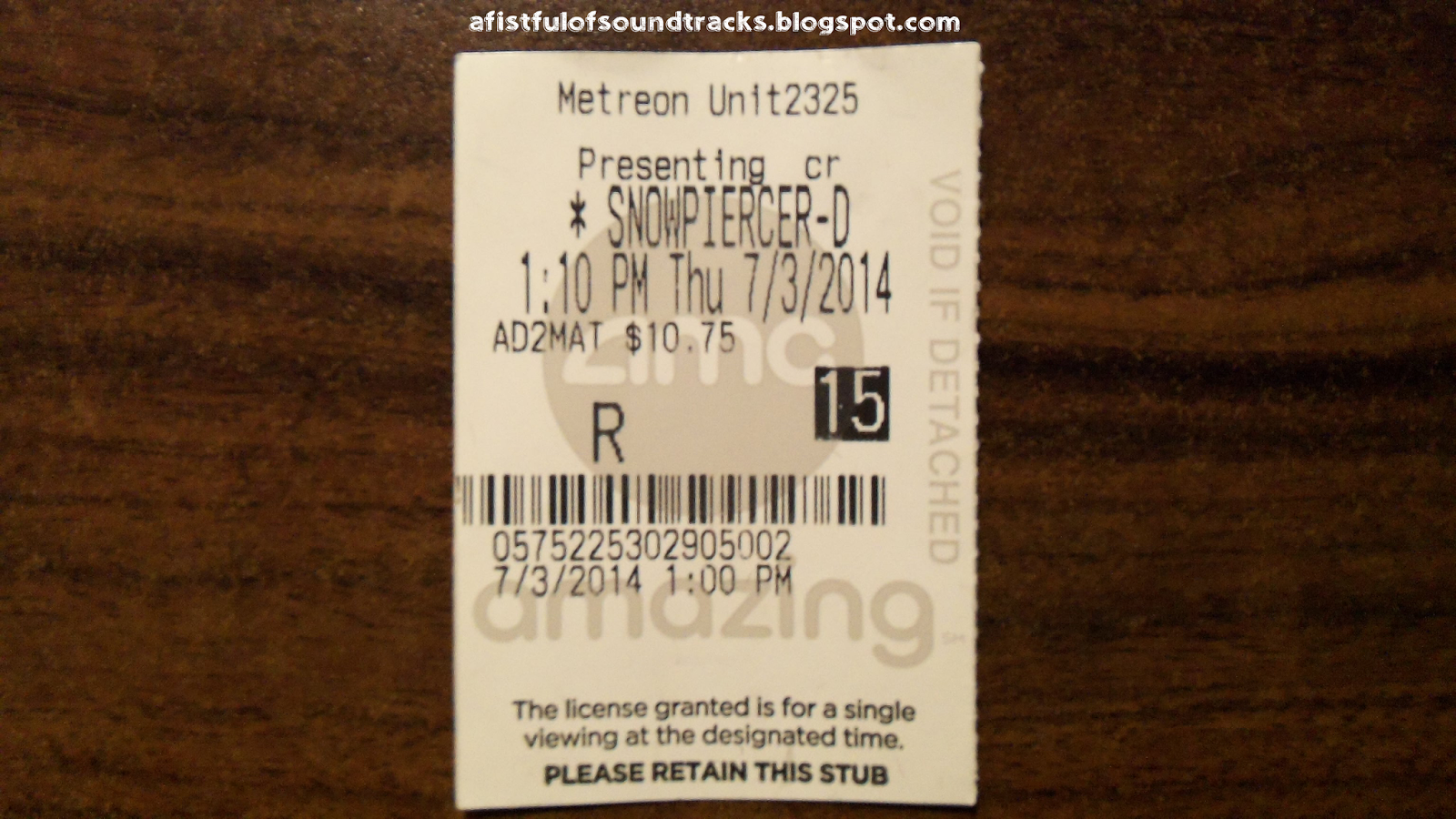
Throwback Thursday: Snowpiercer

Those protein block snacks during Snowpiercer are fouler than the Tilda Swinton character's teeth.

Every Throwback Thursday, I randomly pull out from my desk cabinet--with my eyes closed--a movie ticket I saved. Then I discuss the movie on the ticket. The following was previously posted on September 5, 2014, under the title "Jezebel says summer 2014 was too depressing to deserve a song of the summer, but it's definitely earned a movie of the summer."

Every time the summer wraps up, music or entertainment news orgs come out with their annual think pieces or listicles about the song of the summer, and the end of the summer last week was no exception. But Jezebel makes the bold argument that we shouldn't be talking about a song of the summer, especially after a summer of Ferguson, various other kinds of civil rights abuses, Elliot Rodger, the missile attack on the Malaysian Airlines jet, the Israel-Gaza conflict, ebola and Robin Williams' suicide. "There wasn't a 'song of summer' that defined these months, like 'Call Me Maybe' did in 2012 and 'Hot In Herre' does every summer. But this summer doesn't fucking deserve its own song. It hasn't earned it," wrote Erin Gloria Ryan at Jezebel.

In addition to a dismal three months of world news, the candidates that showbiz reporters have brought up as the possible song of summer 2014 are pretty dire. "Fancy" by Iggy Azalea, cultural appropriation's newest star? Fuck that song. (I don't like picking songs of the summer, and I agree that summer 2014 doesn't deserve one, but "Bom Bom Fiya" by Slimkid3 & DJ Nu-Mark, "Always Winnin" by Shad, "Remedy" by All About She, "Klapp Klapp" by Little Dragon and "Sup Bruce," a tribute to Bruce Lee by The Bar, were all pretty damn good, especially "Bom Bom Fiya.")

Ah-sung Ko and Chris Evans attempt to avoid slipping on fish.

However, summer 2014 has definitely earned a movie of the summer. I can't think of any other recent movie right now that speaks to summer 2014's feelings of unrest quite like director Bong Joon-ho's dystopian sci-fi blockbuster Snowpiercer does. That and many other reasons are why Snowpiercer is my favorite movie of summer 2014, as well as why selections from Marco Beltrami's score to the movie, in which Beltrami used instruments like the cimbalom to establish "a sound of antiquity" during Bong's futuristic tale of class conflict, are now playing on "AFOS Prime" and "New Cue Revue" on AFOS.

As much as I like Guardians of the Galaxy, the year's highest-grossing movie so far and one of the summer's most favorably received blockbusters in critics' circles (as well as a movie with a score that's also now being streamed on AFOS), Guardians suffers from a dull lead villain (what was his name again?). Snowpiercer doesn't have that problem. It features one of the year's most entertaining and well-drawn antagonists, in the snaggle-toothed form of Minister Mason, Tilda Swinton's Thatcher-ish politician/spokesperson character ("I am a hat. You are a shoe. I belong on the head. You belong on the foot... Know your place. Keep your place. Be a shoe."). Like Guardians, Snowpiercer is based on an obscure comic--the 1982 French graphic novel Le Transperceneige by Jacques Lob, Benjamin Legrand and Jean-Marc Rochette--but unlike Guardians, it's set in a rather depressing milieu. The Bong movie, which actually came out last year in Korea, Japan and Europe before hitting American theaters in June, centers on a violent revolt aboard the Snowpiercer, a state-of-the-art train that's circling the world and carrying the last remaining survivors of a failed and disastrous attempt to prevent global warming. The cramped train is, of course, a metaphor for our current world, and as Bong said when he told The Mary Sue about why Le Transperceneige intrigued him, the train exemplifies his observation that "No matter what situation we find ourselves in, there's no peace."

The Wilford song that this classroom of kids is about to sing would make for a great ringtone that, like all other ringtones, costs way more than it's actually worth.

Do the Right Thing, Attack the Block and now Snowpiercer are the best kind of summer movie: darkly funny, bleak (even though Moses defeats the aliens at the end of Attack the Block, he still winds up as another black man in prison), sequel-proof, racially diverse and a Fox News viewer's nightmare, due to both their political views and their diverse casts (sorry, Dawn of the Planet of the Apes, but you're lacking in the well-drawn female character department, and your version of San Francisco is implausibly devoid of Asians for some weird goddamn reason). I like escapist popcorn fare during the summer months like everybody else, but I prefer much of that kind of fare to carry some sort of weight or meaning and be reflective of some of the real-world madness outside the theater. Many tentpole blockbusters that use tiresome 9/11 imagery to attempt to raise the dramatic stakes are especially terrible at this, whereas the smaller-scale action movies Attack the Block and Snowpiercer don't play the 9/11 card and find other ways to make their material relevant and pungent. For Bong, one of those ways is the economic inequality in Korea, which appears to form much of the basis for Snowpiercer's class conflict.

Snowpiercer and The Lego Movie, which enraged Fox News' comrade in right-wing bullshit, Fox Business, would make for a terrific double bill of humorous films about the evils of big business. At the same time though, Snowpiercer, despite its disdain for big business in the form of the Wilford Corporation, doesn't opt for a simplistic "the left will ultimately prevail" narrative. It doesn't provide easy and comforting answers for the left, much like how Do the Right Thing doesn't provide answers on how to effectively deal with racism. Snowpiercer's (spoiler!) late twist that Chris Evans' lead revolutionary character Curtis was, without him realizing it, being groomed to inherit the corporation he was fighting against conveys Bong's bleak point that even when revolutionaries try their hardest, the corrupt system they're fighting will never be broken. That point is also conveyed by the harrowing confession Curtis makes to Namgoong Minsu, frequent Bong film star Song Kang-ho's perpetually stoned security expert character, about--without giving too much away--how even a revolutionary like himself, when he was younger, wasn't immune to the worst kind of behavior encouraged by the system.

If you're enraged by the police lately because of the situation in Ferguson, check out Snowpiercer, as well as Bong's other movies from South Korea, if you haven't done so; Bong feels your disdain for the police. The fact-based 2003 procedural Memories of Murder and the great 2006 monster movie The Host--where, just like in Snowpiercer, Song and Ah-sung Ko star as a father-and-daughter duo--also carry a huge disdain for authority and institutions at their most incompetent (in "Reverse Trip: Charting the History of Bong Joon-ho's Snowpiercer," RogerEbert.com's Scout Tafoya writes that Korean New Wave films like Snowpiercer reflect their directors' frustrations with corruption and bureaucratic incompetence in their own homeland). Even the 2009 thriller Mother, the Bong feature film with the least amount of social commentary, is tinged with that same distrust of authority.

Wow, Octavia Spencer's new Halfway Home cast reunion movie looks depressing as fuck.

From Memories of Murder to Snowpiercer, Bong has emerged as one of the sharpest satirical minds working in film today. I can't think of another current director who juggles various tones as unusually and effectively as Bong does. Like the grieving scene in the gym during The Host, Mason's speech to the lower-class Snowpiercer passengers early on in the movie is classic Bong: satire, slapstick and drama are going on all at once. The minister hilariously bumbles through her "Be a shoe" speech (she gets disrupted by clumsy translators and a tray that falls loudly on the ground, which wasn't in the script and was a blooper that Bong liked so much that he kept it in the film) while a torture scene ensues behind her, and we don't know whether to laugh or be disturbed over the bizarre punishment the goofy-looking Ewen Bremner character receives on his arm (it gets frozen and then amputated).

The "Be a shoe" speech/torture scene is one of many Bong moments where you, the viewer, are experiencing several things at once: anger over the cruelty of authority figures, laughter over their incompetence and silly behavior, sympathy for the mistreated protagonists and disappointment with those same protagonists because of mistakes they could have easily avoided (Bong's protags are never perfect and flawless saints). Bong explained his approach to these moments to The Mary Sue by saying, "These types of moments are generally kind of awkward for the audience, and I like that, because I think life is like that. It's not like something happens and everyone knows 'Oh, this is a funny moment,' or 'Oh, this is a sad moment.' It's not really divided like that."

Alison Pill's only scene in Snowpiercer greatly makes up for all the horseshit she had to act out in that one season of The Newsroom I sat through.

That sort of tonal weirdness--other examples include Curtis slipping on a fish on the floor in the middle of a serious fight scene and Alison Pill's one great scene as a cheery and psychotic schoolteacher--is an endearing part of Snowpiercer and Bong's other films, but I see why it can be challenging and off-putting for some moviegoers ("People didn't know if [The Host] was supposed to be funny--if they were supposed to laugh--or if they were supposed to be sad," said Bong about the confused reactions many Japanese moviegoers had to The Host). However, tinkering with Bong's idiosyncratic brand of filmmaking--which is exactly what Harvey Weinstein, the bullying studio chief with a history of getting his sausage-fingered hands on perfectly fine Asian movies and then butchering them, attempted to do when he wanted to shorten the running time of the American release of Snowpiercer--is just the worst way to make Bong's work attract moviegoers who aren't fans of his filmmaking. Bong opposed Weinstein's attempt to trim Snowpiercer and got into a war of words with The Weinstein Company that mirrored Curtis and the lower-class passengers' attempt to overthrow the upper class.

Fortunately, Bong won the battle, and although Weinstein cut down the amount of theaters he originally planned for Snowpiercer's American release in what comes across to me as a petty form of payback for Bong getting his way, Snowpiercer ultimately found its audience, not in theaters as a midnight-movie sensation but on VOD. We have Radius-TWC, The Weinstein Company's own boutique division, to thank for rescuing Snowpiercer in America and helping to turn it into a hit on iTunes two weeks after debuting in theaters.

"A lot of people come back to this movie a second, third, fourth, fifth time [on VOD]. I think the immediacy of that and how it shows up in social media speak directly to what the themes of this movie are," said Radius-TWC co-president Tom Quinn when he discussed the experimental distribution strategy that led to Snowpiercer's VOD success on KCRW's The Business.

That VOD success is also why Snowpiercer is the movie of the summer: it represents an interesting future for a certain kind of blockbuster that's neither a superhero movie nor a movie for kids, where an above-average action movie that, for some reason, would have had a difficult time finding an audience in theaters can succeed via this new platform--or where a movie that's receiving good word-of-mouth but isn't being released in smaller markets is now easily accessible to moviegoers from those markets who want to see it. Thanks to VOD, they can watch it now with just one click. As Josh Levin said in his Slate post about his enthusiasm over being able to catch Snowpiercer on demand, "We should embrace and celebrate the fact that we can now watch great movies on TV the same day they're in theaters."

As someone who's becoming increasingly less enamored with going to the theater to watch movies--I keep wanting to punch the lights out of younger moviegoers whenever they get unruly or start playing with their smartphones (this is why theaters need to start hiring bouncers)--I've been all for the rise of VOD ever since Radius-TWC made its first splash with the multi-platform release of the indie comedy Bachelorette in 2012. Though I saw Snowpiercer in the theater instead of on demand, that old saying of "Support this little film by buying a ticket to see it"--a line I frequently heard when Asian American college students and supporters of Asian American indie movies tried to get members of various Asian American subcommunities to see Better Luck Tomorrow in theaters in 2003--is just going to sound silly and outdated when three or four more Snowpiercers or They Came Togethers take off on VOD or when that inevitable day comes when Asian American content creators who have been successful on YouTube start releasing feature films on iTunes.

I shudder to think about what would have happened if Bong lost the power of final cut to Weinstein and a truncated version of Snowpiercer wound up on VOD instead. Snowpiercer already has several bleak endings. Why does it need another? Plus the sight of Bong's vision being compromised would have added to making the past three months--which, headline-wise, were as dismal as the living conditions and black protein block food the lower-class Snowpiercer passengers are forced to put up with--a tad more dismal. The fact that Snowpiercer was able to arrive in America with all of its scenes intact--plus the fact that the film turned out to be so damn good and is yet another work in Bong's filmography that's both enjoyable and so dead-on about the fucked-up real world outside the theater--are, to borrow the words of Raymond Carver, a small, good thing in a time like this.

Selections from the score to Snowpiercer can currently be heard during "AFOS Prime" on AFOS.

Friday, September 5, 2014

Jezebel says summer 2014 was too depressing to deserve a song of the summer, but it's definitely earned a movie of the summer

Ah-sung Ko and Chris Evans attempt to avoid slipping on fish.

Every time the summer wraps up, music or entertainment news orgs come out with their annual think pieces or listicles about the song of the summer, and the end of the summer last week was no exception. But Jezebel makes the bold argument that we shouldn't be talking about a song of the summer, especially after a summer of Ferguson, various other kinds of civil rights abuses, Elliot Rodger, the missile attack on the Malaysian Airlines jet, the Israel-Gaza conflict, ebola and Robin Williams' suicide. "There wasn't a 'song of summer' that defined these months, like 'Call Me Maybe' did in 2012 and 'Hot In Herre' does every summer. But this summer doesn't fucking deserve its own song. It hasn't earned it," wrote Erin Gloria Ryan at Jezebel.

In addition to a dismal three months of world news, the candidates that showbiz reporters have brought up as the possible song of summer 2014 are pretty dire. "Fancy" by Iggy Azalea, cultural appropriation's newest star? Fuck that song. (I don't like picking songs of the summer, and I agree that summer 2014 doesn't deserve one, but "Bom Bom Fiya" by Slimkid3 & DJ Nu-Mark, "Always Winnin" by Shad, "Remedy" by All About She, "Klapp Klapp" by Little Dragon and "Sup Bruce," a tribute to Bruce Lee by The Bar, were all pretty damn good, especially "Bom Bom Fiya.")

However, summer 2014 has definitely earned a movie of the summer. I can't think of any other recent movie right now that speaks to summer 2014's feelings of unrest quite like director Bong Joon-ho's dystopian sci-fi blockbuster Snowpiercer does. That and many other reasons are why Snowpiercer is my favorite movie of summer 2014, as well as why selections from Marco Beltrami's score to the movie, in which Beltrami used instruments like the cimbalom to establish "a sound of antiquity" during Bong's futuristic tale of class conflict, are now playing on "AFOS Prime" and "New Cue Revue" on AFOS.

The Wilford song that this classroom of kids is about to sing would make for a great ringtone that, like all other ringtones, costs way more than it's actually worth.

As much as I like Guardians of the Galaxy, the year's highest-grossing movie so far and one of the summer's most favorably received blockbusters in critics' circles (as well as a movie with a score that's also now being streamed on AFOS), Guardians suffers from a dull lead villain (what was his name again?). Snowpiercer doesn't have that problem. It features one of the year's most entertaining and well-drawn antagonists, in the snaggle-toothed form of Minister Mason, Tilda Swinton's Thatcher-ish politician/spokesperson character ("I am a hat. You are a shoe. I belong on the head. You belong on the foot... Know your place. Keep your place. Be a shoe."). Like Guardians, Snowpiercer is based on an obscure comic--the 1982 French graphic novel Le Transperceneige by Jacques Lob, Benjamin Legrand and Jean-Marc Rochette--but unlike Guardians, it's set in a rather depressing milieu. The Bong movie, which actually came out last year in Korea, Japan and Europe before hitting American theaters in June, centers on a violent revolt aboard the Snowpiercer, a state-of-the-art train that's circling the world and carrying the last remaining survivors of a failed and disastrous attempt to prevent global warming. The cramped train is, of course, a metaphor for our current world, and as Bong said when he told The Mary Sue about why Le Transperceneige intrigued him, the train exemplifies his observation that "No matter what situation we find ourselves in, there's no peace."

Do the Right Thing, Attack the Block and now Snowpiercer are the best kind of summer movie: darkly funny, bleak (even though Moses defeats the aliens at the end of Attack the Block, he still winds up as another black man in prison), sequel-proof, racially diverse and a Fox News viewer's nightmare, due to both their political views and their diverse casts (sorry, Dawn of the Planet of the Apes, but you're lacking in the well-drawn female character department, and your version of San Francisco is implausibly devoid of Asians for some weird goddamn reason). I like escapist popcorn fare during the summer months like everybody else, but I prefer much of that kind of fare to carry some sort of weight or meaning and be reflective of some of the real-world madness outside the theater. Many tentpole blockbusters that use tiresome 9/11 imagery to attempt to raise the dramatic stakes are especially terrible at this, whereas the smaller-scale action movies Attack the Block and Snowpiercer don't play the 9/11 card and find other ways to make their material relevant and pungent. For Bong, one of those ways is the economic inequality in Korea, which appears to form much of the basis for Snowpiercer's class conflict.

Wow, Octavia Spencer's new Halfway Home cast reunion movie looks depressing as fuck.

Snowpiercer and The Lego Movie, which enraged Fox News' comrade in right-wing bullshit, Fox Business, would make for a terrific double bill of humorous films about the evils of big business. At the same time though, Snowpiercer, despite its disdain for big business in the form of the Wilford Corporation, doesn't opt for a simplistic "the left will ultimately prevail" narrative. It doesn't provide easy and comforting answers for the left, much like how Do the Right Thing doesn't provide answers on how to effectively deal with racism. Snowpiercer's (spoiler!) late twist that Chris Evans' lead revolutionary character Curtis was, without him realizing it, being groomed to inherit the corporation he was fighting against conveys Bong's bleak point that even when revolutionaries try their hardest, the corrupt system they're fighting will never be broken. That point is also conveyed by the harrowing confession Curtis makes to Namgoong Minsu, frequent Bong film star Song Kang-ho's perpetually stoned security expert character, about--without giving too much away--how even a revolutionary like himself, when he was younger, wasn't immune to the worst kind of behavior encouraged by the system.

If you're enraged by the police lately because of the situation in Ferguson, check out Snowpiercer, as well as Bong's other movies from South Korea, if you haven't done so; Bong feels your disdain for the police. The fact-based 2003 procedural Memories of Murder and the great 2006 monster movie The Host--where, just like in Snowpiercer, Song and Ah-sung Ko star as a father-and-daughter duo--also carry a huge disdain for authority and institutions at their most incompetent (in "Reverse Trip: Charting the History of Bong Joon-ho's Snowpiercer," RogerEbert.com's Scout Tafoya writes that Korean New Wave films like Snowpiercer reflect their directors' frustrations with corruption and bureaucratic incompetence in their own homeland). Even the 2009 thriller Mother, the Bong feature film with the least amount of social commentary, is tinged with that same distrust of authority.

From Memories of Murder to Snowpiercer, Bong has emerged as one of the sharpest satirical minds working in film today. I can't think of another current director who juggles various tones as unusually and effectively as Bong does. Like the grieving scene in the gym during The Host, Mason's speech to the lower-class Snowpiercer passengers early on in the movie is classic Bong: satire, slapstick and drama are going on all at once. The minister hilariously bumbles through her "Be a shoe" speech (she gets disrupted by clumsy translators and a tray that falls loudly on the ground, which wasn't in the script and was a blooper that Bong liked so much that he kept it in the film) while a torture scene ensues behind her, and we don't know whether to laugh or be disturbed over the bizarre punishment the goofy-looking Ewen Bremner character receives on his arm (it gets frozen and then amputated).

The "Be a shoe" speech/torture scene is one of many Bong moments where you, the viewer, are experiencing several things at once: anger over the cruelty of authority figures, laughter over their incompetence and silly behavior, sympathy for the mistreated protagonists and disappointment with those same protagonists because of mistakes they could have easily avoided (Bong's protags are never perfect and flawless saints). Bong explained his approach to these moments to The Mary Sue by saying, "These types of moments are generally kind of awkward for the audience, and I like that, because I think life is like that. It's not like something happens and everyone knows 'Oh, this is a funny moment,' or 'Oh, this is a sad moment.' It's not really divided like that."

Alison Pill's only scene in Snowpiercer greatly makes up for all the horseshit she had to act out in that one season of The Newsroom I sat through.

That sort of tonal weirdness--other examples include Curtis slipping on a fish on the floor in the middle of a serious fight scene and Alison Pill's one great scene as a cheery and psychotic schoolteacher--is an endearing part of Snowpiercer and Bong's other films, but I see why it can be challenging and off-putting for some moviegoers ("People didn't know if [The Host] was supposed to be funny--if they were supposed to laugh--or if they were supposed to be sad," said Bong about the confused reactions many Japanese moviegoers had to The Host). However, tinkering with Bong's idiosyncratic brand of filmmaking--which is exactly what Harvey Weinstein, the bullying studio chief with a history of getting his sausage-fingered hands on perfectly fine Asian movies and then butchering them, attempted to do when he wanted to shorten the running time of the American release of Snowpiercer--is just the worst way to make Bong's work attract moviegoers who aren't fans of his filmmaking. Bong opposed Weinstein's attempt to trim Snowpiercer and got into a war of words with The Weinstein Company that mirrored Curtis and the lower-class passengers' attempt to overthrow the upper class.

Fortunately, Bong won the battle, and although Weinstein cut down the amount of theaters he originally planned for Snowpiercer's American release in what comes across to me as a petty form of payback for Bong getting his way, Snowpiercer ultimately found its audience, not in theaters as a midnight-movie sensation but on VOD. We have Radius-TWC, The Weinstein Company's own boutique division, to thank for rescuing Snowpiercer in America and helping to turn it into a hit on iTunes two weeks after debuting in theaters.

"A lot of people come back to this movie a second, third, fourth, fifth time [on VOD]. I think the immediacy of that and how it shows up in social media speak directly to what the themes of this movie are," said Radius-TWC co-president Tom Quinn when he discussed the experimental distribution strategy that led to Snowpiercer's VOD success on KCRW's The Business.

That VOD success is also why Snowpiercer is the movie of the summer: it represents an interesting future for a certain kind of blockbuster that's neither a superhero movie nor a movie for kids, where an above-average action movie that, for some reason, would have had a difficult time finding an audience in theaters can succeed via this new platform--or where a movie that's receiving good word-of-mouth but isn't being released in smaller markets is now easily accessible to moviegoers from those markets who want to see it. Thanks to VOD, they can watch it now with just one click. As Josh Levin said in his Slate post about his enthusiasm over being able to catch Snowpiercer on demand, "We should embrace and celebrate the fact that we can now watch great movies on TV the same day they're in theaters."

As someone who's becoming increasingly less enamored with going to the theater to watch movies--I keep wanting to punch the lights out of younger moviegoers whenever they get unruly or start playing with their smartphones (this is why theaters need to start hiring bouncers)--I've been all for the rise of VOD ever since Radius-TWC made its first splash with the multi-platform release of the indie comedy Bachelorette in 2012. Though I saw Snowpiercer in the theater instead of on demand, that old saying of "Support this little film by buying a ticket to see it"--a line I frequently heard when Asian American college students and supporters of Asian American indie movies tried to get members of various Asian American subcommunities to see Better Luck Tomorrow in theaters in 2003--is just going to sound silly and outdated when three or four more Snowpiercers or They Came Togethers take off on VOD or when that inevitable day comes when Asian American content creators who have been successful on YouTube start releasing feature films on iTunes.

I shudder to think about what would have happened if Bong lost the power of final cut to Weinstein and a truncated version of Snowpiercer wound up on VOD instead. Snowpiercer already has several bleak endings. Why does it need another? Plus the sight of Bong's vision being compromised would have added to making the past three months--which, headline-wise, were as dismal as the living conditions and black protein block food the lower-class Snowpiercer passengers are forced to put up with--a tad more dismal. The fact that Snowpiercer was able to arrive in America with all of its scenes intact--plus the fact that the film turned out to be so damn good and is yet another work in Bong's filmography that's both enjoyable and so dead-on about the fucked-up real world outside the theater--are, to borrow the words of Raymond Carver, a small, good thing in a time like this.

Wednesday, April 30, 2014

The casting of John Boyega and Oscar Isaac boosts Star Wars: Episode VII from "Why is this being made?" to "Shit done got interesting"

More flare than a waiter from Office Space
(Photo source: Tor)
"I'm not going to play Luke again. He's over. He had a beginning, a middle and an end," said Mark Hamill to me in a phone interview we recorded on a late Sunday night in 1998 for a Batman: The Animated Series-related episode of the terrestrial radio incarnation of A Fistful of Soundtracks.

Flash forward to 2014. Disney has finally confirmed--after about a year of "Lucasfilm's been talking to us"-type comments to the press from the original Star Wars trilogy stars--that Hamill will reunite with Harrison Ford, Carrie Fisher, Peter Mayhew (Chewbacca), Anthony Daniels (C3P0) and Kenny Baker (R2D2) for J.J. Abrams' tentatively titled Star Wars: Episode VII.

So much for "I'm not going to play Luke again."

Wow, this new two-color Instagram filter sucks.
A Star Wars: Episode VII cast read-through at Pinewood Studios
I'm what you call a lapsed Star Wars fan. I love the first two Star Wars films. That's about it. I don't care for the rest of the franchise, although Genndy Tartakovsky's cel-animated Clone Wars shorts from the early 2000s were pretty solid and way more satisfying than George Lucas' dreadful and woodenly executed prequel trilogy (as is Matthew Haley and David Walker's fake Blackstar Warrior trailer, which I still wish would be made into an actual movie). So when Hamill, Ford and Fisher started giving hints to the press about reprising their roles in Episode VII, I was both glad for their return and skeptical about it because the last time Ford reunited with a former co-star for a Lucasfilm project, it resulted in another post-1989 Lucasfilm sequel I'd like to have Lacuna'd from my memory: Indiana Jones and the Kingdom of the Crystal Skull.

One of the reasons why Crystal Pepsi was underwhelming was because Crystal Gravy was badly in need of a rewrite from Lawrence Kasdan, who co-wrote Raiders of the Lost Ark, The Empire Strikes Back and Return of the Jedi (Kasdan, who, along with Ford, wanted Han Solo to be killed off in that threequel but were both overruled, isn't to blame for the problems of that film). Abrams' recruitment of Kasdan for the Episode VII screenplay was the first good sign about Episode VII. (However, I'm still concerned about Abrams as a director: are we getting the Abrams who directed both the still-excellent Lost pilot and the first and best Chris Pine Star Trek film--and also got a great villainous performance out of the late Philip Seymour Hoffman in Mission: Impossible III--or the Abrams who directed the mediocre, Khan-whitewashing Star Trek Into Darkness?)

An equally promising sign of things to come is this week's confirmed casting of John Boyega, the British star of one of my favorite sci-fi flicks of the last 10 years, Attack the Block, and Oscar Isaac, who was terrific as a dickish '60s folk singer in the Coen Brothers' Inside Llewyn Davis, as two of the new Star Wars leads. (With Isaac's Llewyn co-star Adam Driver on board in a villain role, it'll be especially fun to see Isaac go from crashing on Driver's couch to firing ion cannons at him. And with Max von Sydow playing what I assume to be Driver's Sith master too? Sweet.)

I've noticed that Boyega, who received accolades at Sundance this year for his performance as a South Central L.A. ex-con in Imperial Dreams (a film that, by the way, was scored by the talented Flying Lotus, who ought to be scoring more films), is first billed in the non-alphabetical cast list in Disney's Episode VII casting announcement. Is this a hint that this trilogy under Abrams' direction will be the first Star Wars trilogy with a person of color as the lead? As someone who wants to see more diversity in, well, everything, I sincerely hope so. As early as Attack the Block, Boyega proved that he's capable of the gravitas that's required to spearhead a sci-fi/fantasy franchise like Star Wars.

John Boyega prepares to go all Ghost Dog on an alien dog.
John Boyega in Attack the Block
"Moses' trajectory from irresponsible thug to adult who decides to own up to his mistakes... is believable and compelling, thanks to Boyega," I wrote back in 2011, when I first saw Attack the Block. "He has a couple of intriguing little moments where the badass and authoritative gang leader façade disappears, and with some great acting by Boyega with just his eyes, we see a scared kid who's in over his head and whom the film later reveals--in one of its best scenes--to be much younger than he appears to be."

Now envision Boyega bringing all those moments of believability and vulnerability to a Jedi who's learning the ways of the Force, under the direction of a filmmaker who didn't take a 22-year break from directing that resulted in his storytelling skills becoming as rusty as the chassis of a Gonk droid. Perhaps my lapsed faith in Star Wars will finally be restored.

I have no idea who she is. Maybe some Downton Abbey nerd can tell me.
British newcomer Daisy Ridley will help keep Star Wars: Episode VII from turning into a sausage fest.

Hear the music of Star Wars during "AFOS Prime" and "Hall H" on AFOS. Star Wars is represented in both those blocks by the Empire Strikes Back score cues "The Battle of Hoth" and "The Rebel Fleet/End Title," by John Williams, who's returning to score Episode VII.


Monday, October 7, 2013

"Welcome to hell, motherfuckers!": Tune in to "Buckets of Score" on Halloween on AFOS and sample either one of the following 11 thrillers if horror's not your thing

Cleanup on Aisle 666.
On Thursday, October 31, from 5pm to 11pm, AFOS will once again be streaming original music that's suited for Halloween. The "Buckets of Score" block will be full of score cues from movies like the original Halloween, 2007's Trick 'r Treat and Attack the Block. I don't like horror movies, but I'm crazy about '70s and '80s John Carpenter and the following works, which are great horror movies for peeps who don't like horror movies. Some of them contain music that will be streamed during "Buckets of Score."

Attack the Block
Set in a rough South London neighborhood attacked by "gorilla wolf muthafuckas" from outer space, the 2011 Edgar Wright-produced cult favorite Attack the Block is inventive sci-fi with a youth of color as the lead for a change. Hoodie leader Moses (John Boyega) and his crew find themselves dealing with alien invaders, as well as two much more typical South End threats: the Five-0 and a trigger-happy drug lord named Hi-Hatz (Jumayn Hunter). The film doubles as an inspired, non-preachy critique of the demonization of the working class in the U.K. A one-time mugging victim who wanted to better understand his muggers and their lives instead of being resentful and fearful of them, writer/director Joe Cornish takes working-class kids like Moses and the brainy Jerome (Leeon Jones) (their mugging of Jodie Whittaker's nurse character Sam at the start of the film was based on the incident Cornish experienced) and fleshes out those characters to prove the irrationality of demonizing the underclass. (Had Attack the Block been a much bigger hit in America, it would have caused that racist dickcheese Lou Dobbs to get his panties in a bunch over the kinds of characters it chooses to sympathize with.) What also makes Attack the Block stand out is the absence of CGI. All the creature FX in Cornish's film are practical. The alien attacks are fast and brutal, and this is a case where the fast-cutting that so many critics complain about when they see present-day action movies is absolutely necessary because here, it prevents us from noticing how cheap-looking the monsters are--they're essentially just stuntmen leaping around in eyeless and coal-black bear suits outfitted with ginormous blue neon teeth. But because the Attack the Block aliens aren't CG, there's a realness and formidability to them that's missing from most CG creatures. Attack the Block is more of a sci-fi actioner than a genuinely scary horror film, although it contains one horrific moment: the split-second shot of a mutilated Hi-Hatz doing his best impression of Voldemort.

Just let your Skull Glo!


Dawn of the Dead (1978)
Danny Boyle's 28 Days Later was my gateway to the zombie genre when the Boyle film first hit DVD, and it led me to check out for the first time George Romero's 1978 follow-up to his breakthrough zombie film Night of the Living Dead. The 1968 film was straightforward apocalyptic horror, while Dawn of the Dead, which centers on a pack of zombie attack survivors who hole up in a Pennsylvania shopping mall, throws satire into the mix. The mall backdrop and the survivors' gradual immersion into mall culture while biding their time both serve as a clever commentary on the downside of consumerism. The sequence where zombies turn an unlucky biker gang into a SAMCROnut buffet still holds up as grisly horror makeup FX wizardry. What doesn't hold up so well are a few non-FX-related elements that are a result of the film's low budget, like a really terrible, Mr. Peabody & Sherman-esque library music cue that drops when lead hero Ken Foree reconsiders killing himself and shoots and punches his way out of the mall.

Dawn of the Dead (2004)
Zack Snyder's first feature film still remains his best directorial effort. Duplicating the satire of the original Romero film would have been a pointless effort, so Snyder focused more on the action side of the material, and that's the one aspect where this remake outdoes the original. The Romero version is stronger as a satirical horror film, while the Snyder film is much better at action and suspense (the film's first few minutes, in which Sarah Polley watches the zombie apocalypse erupt, are still a corker). The Snyder version isn't without a humorous side though: the rooftop sequence where the survivors assign celebrity nicknames to zombies they use as target practice is genuinely funny, as is a pre-Modern Family Ty Burrell as the douchiest of the survivors.


Evil Dead II
Groovy.

The Fury
The original Carrie is a far better Brian De Palma horror flick. But the lesser-known 1978 De Palma bloodbath The Fury, which was three years ahead of David Cronenberg's Scanners as a hybrid of espionage thriller and psychokinetic horror flick, has its charms, like crazy gore FX by Rick Baker and William Tuttle, an intense John Williams score, a villainous turn by John Cassavetes and the sight of one of the greatest pioneers of indie cinema exploding into several pieces, still my favorite movie ending ever.

Cleanup on Aisle Who-Gives-a-Fuck.


Monday, September 24, 2012

The best of "Beat Box" on Spotify

The sliced-off-genitals-delivered-in-a-jar sequence is the main reason why Foxy Brown will never air on The Hallmark Channel.
Foxy Brown (Photo source: Denver Westword)
On A Fistful of Soundtracks, "Beat Box" airs Mondays at 6-9am and noon-3pm, Tuesdays through Thursdays at 6-9am and 1-4pm and Fridays at 7-9am and 1-3pm. The three-hour block, which is two hours long on Fridays, contains selections from '70s film scores that have been sampled by beatmakers in hip-hop and electronica (like the late Willie Hutch's music from Foxy Brown). If you find most film music to be too staid for your tastes, then "Beat Box" is most likely for you.

Also part of the block are selections from scores that hearken back to the blaxploitation era. One such score is the 2009 Black Dynamite score by Adrian Younge, who also wrote the original music for Titmouse's animated version of Black Dynamite (which concluded its first season on Adult Swim last night with special guest star Clifton Powell voicing the sleazy preacher dad who abandoned Dynamite when he was "a children").

Meanwhile, 'Soda and Pie' will make you feel like a coked-up '80s douchenozzle.
Although some listeners feel like they're '70s macks when they tune in to "Beat Box," the playlist isn't all-'70s all the time. There are also original themes that were performed by hip-hop artists (Public Enemy's "Fight the Power" from Do the Right Thing and The Roots' "What You Want" from The Best Man) and cuts from recent scores that appeal to beatheads, like Steven Price and Basement Jaxx's excellent 2011 Attack the Block score, which Talib Kweli and Z-Trip sampled in their new Attack the Block mixtape.

This ain't the best time to shit your pants, unless the presence of human excrement is what kills the gorilla wolf muthafuckas War of the Worlds-style.
Attack the Block
On Spotify, I was surprised to find that the service carries the entire Attack the Block soundtrack album, as well as 41 other tracks that are part of the "Beat Box" playlist. Here's a sampler of "Beat Box."

Complete tracklist after the jump...

Monday, January 9, 2012

The AFOS block "The Street" will be renamed "Beat Box" this Wednesday

Attack the Block by Deadlydelmundo
(Photo source: Deadlydelmundo)

I got tired of calling it "The Street."

The playlist is staying the same. The only thing that's changing is the block title. The weekday block's time slots are Mondays at 6-9am and noon-3pm, Tuesdays through Thursdays at 6-9am and 1-4pm and Fridays at 7-9am and 1-3pm.

I really should have done this on January 2. Five days after New Year's Day, I realized I didn't like "The Street" as a block title anymore, so I chose January 11 to implement the title change because date-wise, January 11 kind of looks like January 1.

The playlist contains selections from '60s, '70s and '80s film scores with funk, synth or jazz sounds that have been sampled or referenced by beatmakers in their music, as well as cuts from more recent scores with funk, synth or hip-hop sounds--like the Attack the Block score (dig the ATB fan art above)--that were composed by those same beatmakers or their peers. One of these newer composers who are featured during the block that's soon to be formerly known as "The Street" is Adrian Younge, who wrote and performed the original music for both the hilarious Black Dynamite and the upcoming animated series of the same name.

Last month, Younge, who's also a resident DJ at the Verdugo Bar's monthly "Rendezvous!" night in L.A., was behind the ones and twos for a spectacular "Rendezvous!" DJ set. DJ Alfonso, who runs "Rendezvous!" and shares with Younge the same tastes in '60s and '70s Italian and French film scores, posted the results from that night.

Younge threw in "It's Me" from his own album Something About April, a track that I assume is a Joe Bataan joint, a cover of The Dramatics' "In the Rain" I've never heard before and instantly dug, bits of giallo-era Morricone (hello again, The Forbidden Photos of a Lady Above Suspicion [at 40:13, to be exact]), a 007 triple-shot, some Moog-y cover of Nino Rota's "The Godfather Waltz" and an even Moog-ier instrumental cover of "Walk on By" that sounds like something straight out of the out-of-print Cinemaphonic: Electro Soul library music collection that was compiled by Black Dynamite and Megas XLR music supervisor David Hollander.

ADRIAN YOUNGE DJ SET by djalfonso

Tuesday, December 27, 2011

The Academy's snub of the Attack the Block score is such bollocks, innit?

In ghettos like the blocks of South London, all that running away from Five-0 will make you better prepared for running away from gorilla wolf muthafuckas.
HitFix's Kristopher Tapley considers the Attack the Block score by Steven Price and Basement Jaxx to be the year's best original film score and is bummed that it's not one of the 97 scores that are eligible for consideration in this year's Best Original Score category. I'm bummed too--the cutting-edge score from British comedian/filmmaker Joe Cornish's enjoyable inner-city-vs.-outer-space thriller is one of my favorites of 2011--but I'm not surprised that the Academy would exclude it.

The Academy rarely nominates the scores I like the most (not one bloody nod for any of Irish DJ/composer David Holmes' Ocean's scores during the '00s?). Plus, Price and Basement Jaxx's (and Holmes') sounds aren't middlebrow and tweedy enough for the Academy. Trent Reznor and Atticus Ross aside, cutting-edge things tend to frighten and confuse them.

There's one upside to the snub: I don't have to be subjected to a lame interpretive dance to "The Ends" from Attack the Block.

Tuesday, November 29, 2011

A track-by-track rundown of the current "New Cue Revue" playlist on A Fistful of Soundtracks

Shahrukh Khan and Kareena Kapoor pose with Akon at the premiere of Automan, uh, I mean, Ra.One.
Every Wednesday at 10am and 4pm and every Friday at 11am, A Fistful of Soundtracks streams the most recent additions to the station's "Assorted Fistful" library (or in the case of Akon & Hamskia Iyer's "Chammak Challo," the "Chai Noon" library) for an hour-long block entitled "New Cue Revue." Here's what's currently on the "New Cue Revue" playlist.

1. Akon & Hamsika Iyer, "Chammak Challo" (from Ra.One)
Ever since it was announced in 2010 that R&B artist Akon, best known for "Smack That," "I Wanna Love You" and the hilarious Lonely Island/SNL digital short "I Just Had Sex," was lending his pipes to an original song for a Bollywood film (like another non-Indian singer, Kylie Minogue, had done for the imaginatively titled 2009 Into the Blue clone Blue), I've been dying to hear the Akon track. The end result, "Chammak Challo" from Bollywood star Shahrukh Khan's recently released superhero movie Ra.One, finally dropped in September and is a smash hit in India. (In this latest round of one of my favorite games, Guess the American Movie or TV Show That This Bollywood Film Is a Bizarre Clone Of, Ra.One, which features Khan in the dual role of a dorky video game designer and a heroic character from his game who enters the real world, appears to be a clone of the largely forgotten '80s superhero show Automan.)

Akon acquits himself nicely as he alternates between English and Hindi during "Chammak Challo" (the song title is basically "nice-looking shawty" in Hindi slang). The catchy "Chammak Challo" proves that it's much better when Bollywood soundtrack composers enlist actual R&B or rap artists from America to do their thing on their soundtracks than when they attempt to rap or ape current American R&B trends on their own. The latter has led to several theme tunes that are as painful-sounding as the time when Prince stopped being a hater of hip-hop and attempted to incorporate rap into his Diamonds and Pearls album--for instance, go YouTube "Desi Boyz." Or maybe you're better off if you don't.


2. Howard Shore, "The Thief" (from Hugo)
The former SNL bandleader and Oscar-winning Lord of the Rings trilogy composer nicely apes the rhythms of a clock for Martin Scorsese's clock imagery-filled tribute to silent-era filmmakers like Georges Méliès (played during Hugo by Ben Kingsley).

3. Alberto Iglesias, "George Smiley" (from Tinker Tailor Soldier Spy)
The lonely trumpet during Alberto Iglesias' effective score for the latest screen adaptation of John le Carré's 1974 spy novel Tinker Tailor Soldier Spy announces that "This ain't Bond. This is le Carré. No bloody invisible cars or steel-toothed thugs here."

4. Mike Skinner, "Fernando's Theme" (from The Inbetweeners Movie)
British rapper Mike Skinner has retired his stage name The Streets and entered the world of film scoring with his original music for the film version of The Inbetweeners, the Britcom about a group of Superbad-style dorky teens whose anthem would be the aforementioned "I Just Had Sex." The clubby "Fernando's Theme" is the best example of "Wow, I never knew this pasty white guy had a Latin side and maybe he should express it more often" since Michael Giacchino wrote the awesome "Spanish Heist" for the TV series Alias.

5. Alan Silvestri, "Howling Commando's Montage" (from Captain America: The First Avenger)
This cue accompanies a sequence in Captain America: The First Avenger that's a bit too short: a montage of Cap on his missions with the Howling Commandos. Will the Captain America sequel be a flashback to one of those missions with the Howling Commandos that The First Avenger glossed over? As someone who wanted to see more Howling Commando scenes in the film, I hope so.

6. Quincy Jones featuring Little Richard, "Money Runner/Money Is (Medley)" (from $ [Dollars])
As I've said before, say the following five words--"caper movie score by Q"--and I'm there, baby. This funky theme from the 1971 Warren Beatty/Goldie Hawn heist flick $ (Dollars) would fit right in with the Occupy era, except "Inflation in the nation don't bother me" would have to be changed to "Recession in the nation don't bother me."

7. Ludovic Bource, "1927 A Russian Affair" (from The Artist)
After the arrivals of The Artist and Hugo, is silent cinema making a comeback? This better not mean a return to white people stealing Asian roles from Asian perform... d'oh!

Thursday, October 20, 2011

Occupy anti-Halloween conservatism with A Fistful of Soundtracks' "Buckets of Score"

Cleanup on Aisle 666.
Do you have a conservative neighbor or two who are part of the anti-Halloween camp and are trying to recruit people to their cause? On October 31, show those opponents of Halloween how much you feel about their hatred of fun by paying them a visit and then taking out your phone and blasting A Fistful of Soundtracks' "Buckets of Score" block in their faces.

From 5pm to 11pm on Halloween, AFOS will be streaming for the second Halloween in a row original music written for the horror, thriller and paranormal genres. The playlist--which is full of Goblin tracks, cues from Elmer Bernstein's out-of-print score to Ghostbusters and original music from either non-glittery vampire flicks (The Omega Man, From Dusk Till Dawn) or supernatural genre shows (Buffy, Angel)--will be joined this year by selections from Alan Howarth and Larry Hopkins' new re-recording of the mostly synthesized cues Ennio Morricone and John Carpenter separately composed for the 1982 version of The Thing.

Howarth, who collaborated with the filmmaker/composer on the scores to such classic Carpenter flicks as Escape from New York, Big Trouble in Little China and They Live, recreated with Hopkins the tracks from the long-out-of-print Thing soundtrack album (with some help from the Digital Orchestra Toolbox) and re-sequenced them so that they're in the chronological order of the 1982 film. The re-recording is being released by the record label wing of BuySoundtrax (a site I once had such a lousy mail-order experience with--and I'm relieved to see I'm not alone--that every time I receive an e-mail from BuySoundtrax, I angrily delete it without reading it).

Julia Roberts in a jolly moment from Eat Pray Love
(Photo source: Alex Pardee)
Also added to "Buckets of Score" this year are selections from Steven Price and Basement Jaxx's terrific, if-Carpenter-were-a-dubstepper score to the recent inner city-vs.-outer space thriller Attack the Block, a film that's now on Blu-ray (I disagree with the opinion that Attack the Block loses much of its entertainment value on the small screen and is a less interesting film if you don't watch it with an amped-up crowd in the theater--I saw Attack the Block in an empty theater and still enjoyed it).

"If you like your beats on the monstrous side, you've come to the right place," wrote Attack the Block writer/director Joe Cornish in the Attack the Block soundtrack liner notes. "We wanted the Attack the Block score to do the things that film scores used to do. To be as exciting and escapist as a John Williams adventure, and as gritty and percussive as the great John Carpenter's electronic scores."

Price and the Jaxx duo's score lives up to Cornish's intentions. As the hoodies in Attack the Block would say, believe it, bruv.