Showing posts with label The Bar. Show all posts
Friday, November 6, 2015
AFOS Blog Rewind: "What's your favorite score?" is not a question I like to be asked
Today's post totally repurposes shit from August 26, 2014, except for one sentence, which is in bold.
I've been asked twice or thrice "What's your favorite score?" My answer to that will always be "55-10, Niners over Broncos."
I don't have one favorite score. I have lots of favorite scores, but there are too many out there to name. I've listened to thousands of them since my college radio programming days. It's impossible to pick one that's the best. It's like asking a parent who his or her favorite kid is.
Plus my answer to that "favorite score" question would change every other minute. One minute, it would be "Out of Sight by David Holmes," and then the next minute, it would be "An Oversimplification of Her Beauty by Flying Lotus." Then that would change to "the frequently rapped-along-to Samurai Champloo by the late, great Nujabes, Fat Jon, Force of Nature and Tsutchie." And so on.
The same thing applies to "favorite hip-hop album." It'll ping-pong back and forth between "De La Soul Is Dead," "good kid, m.A.A.d. city," "Barkada" and "whatever I bumped in its entirety last week."
But one thing I do know is that Drive composer Cliff Martinez's anachronistic score music to Cinemax's 1900s medical drama The Knick is a sublime piece of work. I've added Knick season 2 score selections to "AFOS Prime" rotation on AFOS, in addition to the season 1 score selections that are still in rotation. Martinez's Knick episode scores are the automatic winner of "best score to a TV show I'll never watch because I hate watching extremely graphic medical procedures."
Labels:
Cliff Martinez,
David Holmes,
De La Soul,
film music,
Flying Lotus,
Force of Nature,
hip-hop,
Kendrick Lamar,
Nujabes,
Portlandia,
Samurai Champloo,
scripted TV,
Shinichiro Watanabe,
The Bar,
The Knick,
TV music
Thursday, February 12, 2015
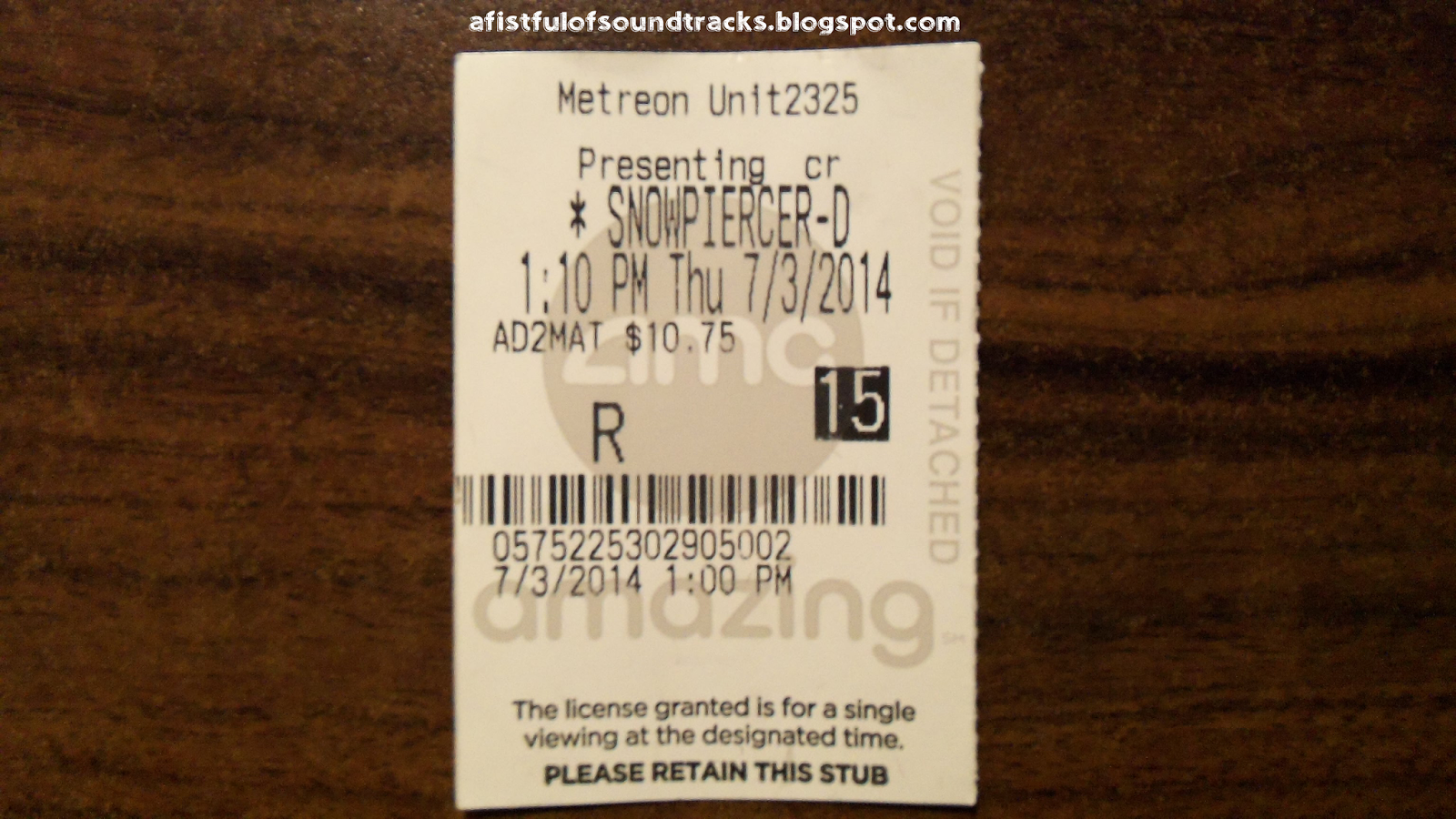
Throwback Thursday: Snowpiercer
Every Throwback Thursday, I randomly pull out from my desk cabinet--with my eyes closed--a movie ticket I saved. Then I discuss the movie on the ticket. The following was previously posted on September 5, 2014, under the title "Jezebel says summer 2014 was too depressing to deserve a song of the summer, but it's definitely earned a movie of the summer."
Every time the summer wraps up, music or entertainment news orgs come out with their annual think pieces or listicles about the song of the summer, and the end of the summer last week was no exception. But Jezebel makes the bold argument that we shouldn't be talking about a song of the summer, especially after a summer of Ferguson, various other kinds of civil rights abuses, Elliot Rodger, the missile attack on the Malaysian Airlines jet, the Israel-Gaza conflict, ebola and Robin Williams' suicide. "There wasn't a 'song of summer' that defined these months, like 'Call Me Maybe' did in 2012 and 'Hot In Herre' does every summer. But this summer doesn't fucking deserve its own song. It hasn't earned it," wrote Erin Gloria Ryan at Jezebel.
In addition to a dismal three months of world news, the candidates that showbiz reporters have brought up as the possible song of summer 2014 are pretty dire. "Fancy" by Iggy Azalea, cultural appropriation's newest star? Fuck that song. (I don't like picking songs of the summer, and I agree that summer 2014 doesn't deserve one, but "Bom Bom Fiya" by Slimkid3 & DJ Nu-Mark, "Always Winnin" by Shad, "Remedy" by All About She, "Klapp Klapp" by Little Dragon and "Sup Bruce," a tribute to Bruce Lee by The Bar, were all pretty damn good, especially "Bom Bom Fiya.")
However, summer 2014 has definitely earned a movie of the summer. I can't think of any other recent movie right now that speaks to summer 2014's feelings of unrest quite like director Bong Joon-ho's dystopian sci-fi blockbuster Snowpiercer does. That and many other reasons are why Snowpiercer is my favorite movie of summer 2014, as well as why selections from Marco Beltrami's score to the movie, in which Beltrami used instruments like the cimbalom to establish "a sound of antiquity" during Bong's futuristic tale of class conflict, are now playing on "AFOS Prime" and "New Cue Revue" on AFOS.
As much as I like Guardians of the Galaxy, the year's highest-grossing movie so far and one of the summer's most favorably received blockbusters in critics' circles (as well as a movie with a score that's also now being streamed on AFOS), Guardians suffers from a dull lead villain (what was his name again?). Snowpiercer doesn't have that problem. It features one of the year's most entertaining and well-drawn antagonists, in the snaggle-toothed form of Minister Mason, Tilda Swinton's Thatcher-ish politician/spokesperson character ("I am a hat. You are a shoe. I belong on the head. You belong on the foot... Know your place. Keep your place. Be a shoe."). Like Guardians, Snowpiercer is based on an obscure comic--the 1982 French graphic novel Le Transperceneige by Jacques Lob, Benjamin Legrand and Jean-Marc Rochette--but unlike Guardians, it's set in a rather depressing milieu. The Bong movie, which actually came out last year in Korea, Japan and Europe before hitting American theaters in June, centers on a violent revolt aboard the Snowpiercer, a state-of-the-art train that's circling the world and carrying the last remaining survivors of a failed and disastrous attempt to prevent global warming. The cramped train is, of course, a metaphor for our current world, and as Bong said when he told The Mary Sue about why Le Transperceneige intrigued him, the train exemplifies his observation that "No matter what situation we find ourselves in, there's no peace."
Do the Right Thing, Attack the Block and now Snowpiercer are the best kind of summer movie: darkly funny, bleak (even though Moses defeats the aliens at the end of Attack the Block, he still winds up as another black man in prison), sequel-proof, racially diverse and a Fox News viewer's nightmare, due to both their political views and their diverse casts (sorry, Dawn of the Planet of the Apes, but you're lacking in the well-drawn female character department, and your version of San Francisco is implausibly devoid of Asians for some weird goddamn reason). I like escapist popcorn fare during the summer months like everybody else, but I prefer much of that kind of fare to carry some sort of weight or meaning and be reflective of some of the real-world madness outside the theater. Many tentpole blockbusters that use tiresome 9/11 imagery to attempt to raise the dramatic stakes are especially terrible at this, whereas the smaller-scale action movies Attack the Block and Snowpiercer don't play the 9/11 card and find other ways to make their material relevant and pungent. For Bong, one of those ways is the economic inequality in Korea, which appears to form much of the basis for Snowpiercer's class conflict.
Snowpiercer and The Lego Movie, which enraged Fox News' comrade in right-wing bullshit, Fox Business, would make for a terrific double bill of humorous films about the evils of big business. At the same time though, Snowpiercer, despite its disdain for big business in the form of the Wilford Corporation, doesn't opt for a simplistic "the left will ultimately prevail" narrative. It doesn't provide easy and comforting answers for the left, much like how Do the Right Thing doesn't provide answers on how to effectively deal with racism. Snowpiercer's (spoiler!) late twist that Chris Evans' lead revolutionary character Curtis was, without him realizing it, being groomed to inherit the corporation he was fighting against conveys Bong's bleak point that even when revolutionaries try their hardest, the corrupt system they're fighting will never be broken. That point is also conveyed by the harrowing confession Curtis makes to Namgoong Minsu, frequent Bong film star Song Kang-ho's perpetually stoned security expert character, about--without giving too much away--how even a revolutionary like himself, when he was younger, wasn't immune to the worst kind of behavior encouraged by the system.
If you're enraged by the police lately because of the situation in Ferguson, check out Snowpiercer, as well as Bong's other movies from South Korea, if you haven't done so; Bong feels your disdain for the police. The fact-based 2003 procedural Memories of Murder and the great 2006 monster movie The Host--where, just like in Snowpiercer, Song and Ah-sung Ko star as a father-and-daughter duo--also carry a huge disdain for authority and institutions at their most incompetent (in "Reverse Trip: Charting the History of Bong Joon-ho's Snowpiercer," RogerEbert.com's Scout Tafoya writes that Korean New Wave films like Snowpiercer reflect their directors' frustrations with corruption and bureaucratic incompetence in their own homeland). Even the 2009 thriller Mother, the Bong feature film with the least amount of social commentary, is tinged with that same distrust of authority.
From Memories of Murder to Snowpiercer, Bong has emerged as one of the sharpest satirical minds working in film today. I can't think of another current director who juggles various tones as unusually and effectively as Bong does. Like the grieving scene in the gym during The Host, Mason's speech to the lower-class Snowpiercer passengers early on in the movie is classic Bong: satire, slapstick and drama are going on all at once. The minister hilariously bumbles through her "Be a shoe" speech (she gets disrupted by clumsy translators and a tray that falls loudly on the ground, which wasn't in the script and was a blooper that Bong liked so much that he kept it in the film) while a torture scene ensues behind her, and we don't know whether to laugh or be disturbed over the bizarre punishment the goofy-looking Ewen Bremner character receives on his arm (it gets frozen and then amputated).
The "Be a shoe" speech/torture scene is one of many Bong moments where you, the viewer, are experiencing several things at once: anger over the cruelty of authority figures, laughter over their incompetence and silly behavior, sympathy for the mistreated protagonists and disappointment with those same protagonists because of mistakes they could have easily avoided (Bong's protags are never perfect and flawless saints). Bong explained his approach to these moments to The Mary Sue by saying, "These types of moments are generally kind of awkward for the audience, and I like that, because I think life is like that. It's not like something happens and everyone knows 'Oh, this is a funny moment,' or 'Oh, this is a sad moment.' It's not really divided like that."
That sort of tonal weirdness--other examples include Curtis slipping on a fish on the floor in the middle of a serious fight scene and Alison Pill's one great scene as a cheery and psychotic schoolteacher--is an endearing part of Snowpiercer and Bong's other films, but I see why it can be challenging and off-putting for some moviegoers ("People didn't know if [The Host] was supposed to be funny--if they were supposed to laugh--or if they were supposed to be sad," said Bong about the confused reactions many Japanese moviegoers had to The Host). However, tinkering with Bong's idiosyncratic brand of filmmaking--which is exactly what Harvey Weinstein, the bullying studio chief with a history of getting his sausage-fingered hands on perfectly fine Asian movies and then butchering them, attempted to do when he wanted to shorten the running time of the American release of Snowpiercer--is just the worst way to make Bong's work attract moviegoers who aren't fans of his filmmaking. Bong opposed Weinstein's attempt to trim Snowpiercer and got into a war of words with The Weinstein Company that mirrored Curtis and the lower-class passengers' attempt to overthrow the upper class.
Fortunately, Bong won the battle, and although Weinstein cut down the amount of theaters he originally planned for Snowpiercer's American release in what comes across to me as a petty form of payback for Bong getting his way, Snowpiercer ultimately found its audience, not in theaters as a midnight-movie sensation but on VOD. We have Radius-TWC, The Weinstein Company's own boutique division, to thank for rescuing Snowpiercer in America and helping to turn it into a hit on iTunes two weeks after debuting in theaters.
"A lot of people come back to this movie a second, third, fourth, fifth time [on VOD]. I think the immediacy of that and how it shows up in social media speak directly to what the themes of this movie are," said Radius-TWC co-president Tom Quinn when he discussed the experimental distribution strategy that led to Snowpiercer's VOD success on KCRW's The Business.
That VOD success is also why Snowpiercer is the movie of the summer: it represents an interesting future for a certain kind of blockbuster that's neither a superhero movie nor a movie for kids, where an above-average action movie that, for some reason, would have had a difficult time finding an audience in theaters can succeed via this new platform--or where a movie that's receiving good word-of-mouth but isn't being released in smaller markets is now easily accessible to moviegoers from those markets who want to see it. Thanks to VOD, they can watch it now with just one click. As Josh Levin said in his Slate post about his enthusiasm over being able to catch Snowpiercer on demand, "We should embrace and celebrate the fact that we can now watch great movies on TV the same day they're in theaters."
As someone who's becoming increasingly less enamored with going to the theater to watch movies--I keep wanting to punch the lights out of younger moviegoers whenever they get unruly or start playing with their smartphones (this is why theaters need to start hiring bouncers)--I've been all for the rise of VOD ever since Radius-TWC made its first splash with the multi-platform release of the indie comedy Bachelorette in 2012. Though I saw Snowpiercer in the theater instead of on demand, that old saying of "Support this little film by buying a ticket to see it"--a line I frequently heard when Asian American college students and supporters of Asian American indie movies tried to get members of various Asian American subcommunities to see Better Luck Tomorrow in theaters in 2003--is just going to sound silly and outdated when three or four more Snowpiercers or They Came Togethers take off on VOD or when that inevitable day comes when Asian American content creators who have been successful on YouTube start releasing feature films on iTunes.
I shudder to think about what would have happened if Bong lost the power of final cut to Weinstein and a truncated version of Snowpiercer wound up on VOD instead. Snowpiercer already has several bleak endings. Why does it need another? Plus the sight of Bong's vision being compromised would have added to making the past three months--which, headline-wise, were as dismal as the living conditions and black protein block food the lower-class Snowpiercer passengers are forced to put up with--a tad more dismal. The fact that Snowpiercer was able to arrive in America with all of its scenes intact--plus the fact that the film turned out to be so damn good and is yet another work in Bong's filmography that's both enjoyable and so dead-on about the fucked-up real world outside the theater--are, to borrow the words of Raymond Carver, a small, good thing in a time like this.
Selections from the score to Snowpiercer can currently be heard during "AFOS Prime" on AFOS.
Friday, September 5, 2014
Jezebel says summer 2014 was too depressing to deserve a song of the summer, but it's definitely earned a movie of the summer
Every time the summer wraps up, music or entertainment news orgs come out with their annual think pieces or listicles about the song of the summer, and the end of the summer last week was no exception. But Jezebel makes the bold argument that we shouldn't be talking about a song of the summer, especially after a summer of Ferguson, various other kinds of civil rights abuses, Elliot Rodger, the missile attack on the Malaysian Airlines jet, the Israel-Gaza conflict, ebola and Robin Williams' suicide. "There wasn't a 'song of summer' that defined these months, like 'Call Me Maybe' did in 2012 and 'Hot In Herre' does every summer. But this summer doesn't fucking deserve its own song. It hasn't earned it," wrote Erin Gloria Ryan at Jezebel.
In addition to a dismal three months of world news, the candidates that showbiz reporters have brought up as the possible song of summer 2014 are pretty dire. "Fancy" by Iggy Azalea, cultural appropriation's newest star? Fuck that song. (I don't like picking songs of the summer, and I agree that summer 2014 doesn't deserve one, but "Bom Bom Fiya" by Slimkid3 & DJ Nu-Mark, "Always Winnin" by Shad, "Remedy" by All About She, "Klapp Klapp" by Little Dragon and "Sup Bruce," a tribute to Bruce Lee by The Bar, were all pretty damn good, especially "Bom Bom Fiya.")
However, summer 2014 has definitely earned a movie of the summer. I can't think of any other recent movie right now that speaks to summer 2014's feelings of unrest quite like director Bong Joon-ho's dystopian sci-fi blockbuster Snowpiercer does. That and many other reasons are why Snowpiercer is my favorite movie of summer 2014, as well as why selections from Marco Beltrami's score to the movie, in which Beltrami used instruments like the cimbalom to establish "a sound of antiquity" during Bong's futuristic tale of class conflict, are now playing on "AFOS Prime" and "New Cue Revue" on AFOS.
As much as I like Guardians of the Galaxy, the year's highest-grossing movie so far and one of the summer's most favorably received blockbusters in critics' circles (as well as a movie with a score that's also now being streamed on AFOS), Guardians suffers from a dull lead villain (what was his name again?). Snowpiercer doesn't have that problem. It features one of the year's most entertaining and well-drawn antagonists, in the snaggle-toothed form of Minister Mason, Tilda Swinton's Thatcher-ish politician/spokesperson character ("I am a hat. You are a shoe. I belong on the head. You belong on the foot... Know your place. Keep your place. Be a shoe."). Like Guardians, Snowpiercer is based on an obscure comic--the 1982 French graphic novel Le Transperceneige by Jacques Lob, Benjamin Legrand and Jean-Marc Rochette--but unlike Guardians, it's set in a rather depressing milieu. The Bong movie, which actually came out last year in Korea, Japan and Europe before hitting American theaters in June, centers on a violent revolt aboard the Snowpiercer, a state-of-the-art train that's circling the world and carrying the last remaining survivors of a failed and disastrous attempt to prevent global warming. The cramped train is, of course, a metaphor for our current world, and as Bong said when he told The Mary Sue about why Le Transperceneige intrigued him, the train exemplifies his observation that "No matter what situation we find ourselves in, there's no peace."
Do the Right Thing, Attack the Block and now Snowpiercer are the best kind of summer movie: darkly funny, bleak (even though Moses defeats the aliens at the end of Attack the Block, he still winds up as another black man in prison), sequel-proof, racially diverse and a Fox News viewer's nightmare, due to both their political views and their diverse casts (sorry, Dawn of the Planet of the Apes, but you're lacking in the well-drawn female character department, and your version of San Francisco is implausibly devoid of Asians for some weird goddamn reason). I like escapist popcorn fare during the summer months like everybody else, but I prefer much of that kind of fare to carry some sort of weight or meaning and be reflective of some of the real-world madness outside the theater. Many tentpole blockbusters that use tiresome 9/11 imagery to attempt to raise the dramatic stakes are especially terrible at this, whereas the smaller-scale action movies Attack the Block and Snowpiercer don't play the 9/11 card and find other ways to make their material relevant and pungent. For Bong, one of those ways is the economic inequality in Korea, which appears to form much of the basis for Snowpiercer's class conflict.
Snowpiercer and The Lego Movie, which enraged Fox News' comrade in right-wing bullshit, Fox Business, would make for a terrific double bill of humorous films about the evils of big business. At the same time though, Snowpiercer, despite its disdain for big business in the form of the Wilford Corporation, doesn't opt for a simplistic "the left will ultimately prevail" narrative. It doesn't provide easy and comforting answers for the left, much like how Do the Right Thing doesn't provide answers on how to effectively deal with racism. Snowpiercer's (spoiler!) late twist that Chris Evans' lead revolutionary character Curtis was, without him realizing it, being groomed to inherit the corporation he was fighting against conveys Bong's bleak point that even when revolutionaries try their hardest, the corrupt system they're fighting will never be broken. That point is also conveyed by the harrowing confession Curtis makes to Namgoong Minsu, frequent Bong film star Song Kang-ho's perpetually stoned security expert character, about--without giving too much away--how even a revolutionary like himself, when he was younger, wasn't immune to the worst kind of behavior encouraged by the system.
If you're enraged by the police lately because of the situation in Ferguson, check out Snowpiercer, as well as Bong's other movies from South Korea, if you haven't done so; Bong feels your disdain for the police. The fact-based 2003 procedural Memories of Murder and the great 2006 monster movie The Host--where, just like in Snowpiercer, Song and Ah-sung Ko star as a father-and-daughter duo--also carry a huge disdain for authority and institutions at their most incompetent (in "Reverse Trip: Charting the History of Bong Joon-ho's Snowpiercer," RogerEbert.com's Scout Tafoya writes that Korean New Wave films like Snowpiercer reflect their directors' frustrations with corruption and bureaucratic incompetence in their own homeland). Even the 2009 thriller Mother, the Bong feature film with the least amount of social commentary, is tinged with that same distrust of authority.
From Memories of Murder to Snowpiercer, Bong has emerged as one of the sharpest satirical minds working in film today. I can't think of another current director who juggles various tones as unusually and effectively as Bong does. Like the grieving scene in the gym during The Host, Mason's speech to the lower-class Snowpiercer passengers early on in the movie is classic Bong: satire, slapstick and drama are going on all at once. The minister hilariously bumbles through her "Be a shoe" speech (she gets disrupted by clumsy translators and a tray that falls loudly on the ground, which wasn't in the script and was a blooper that Bong liked so much that he kept it in the film) while a torture scene ensues behind her, and we don't know whether to laugh or be disturbed over the bizarre punishment the goofy-looking Ewen Bremner character receives on his arm (it gets frozen and then amputated).
The "Be a shoe" speech/torture scene is one of many Bong moments where you, the viewer, are experiencing several things at once: anger over the cruelty of authority figures, laughter over their incompetence and silly behavior, sympathy for the mistreated protagonists and disappointment with those same protagonists because of mistakes they could have easily avoided (Bong's protags are never perfect and flawless saints). Bong explained his approach to these moments to The Mary Sue by saying, "These types of moments are generally kind of awkward for the audience, and I like that, because I think life is like that. It's not like something happens and everyone knows 'Oh, this is a funny moment,' or 'Oh, this is a sad moment.' It's not really divided like that."
That sort of tonal weirdness--other examples include Curtis slipping on a fish on the floor in the middle of a serious fight scene and Alison Pill's one great scene as a cheery and psychotic schoolteacher--is an endearing part of Snowpiercer and Bong's other films, but I see why it can be challenging and off-putting for some moviegoers ("People didn't know if [The Host] was supposed to be funny--if they were supposed to laugh--or if they were supposed to be sad," said Bong about the confused reactions many Japanese moviegoers had to The Host). However, tinkering with Bong's idiosyncratic brand of filmmaking--which is exactly what Harvey Weinstein, the bullying studio chief with a history of getting his sausage-fingered hands on perfectly fine Asian movies and then butchering them, attempted to do when he wanted to shorten the running time of the American release of Snowpiercer--is just the worst way to make Bong's work attract moviegoers who aren't fans of his filmmaking. Bong opposed Weinstein's attempt to trim Snowpiercer and got into a war of words with The Weinstein Company that mirrored Curtis and the lower-class passengers' attempt to overthrow the upper class.
Fortunately, Bong won the battle, and although Weinstein cut down the amount of theaters he originally planned for Snowpiercer's American release in what comes across to me as a petty form of payback for Bong getting his way, Snowpiercer ultimately found its audience, not in theaters as a midnight-movie sensation but on VOD. We have Radius-TWC, The Weinstein Company's own boutique division, to thank for rescuing Snowpiercer in America and helping to turn it into a hit on iTunes two weeks after debuting in theaters.
"A lot of people come back to this movie a second, third, fourth, fifth time [on VOD]. I think the immediacy of that and how it shows up in social media speak directly to what the themes of this movie are," said Radius-TWC co-president Tom Quinn when he discussed the experimental distribution strategy that led to Snowpiercer's VOD success on KCRW's The Business.
That VOD success is also why Snowpiercer is the movie of the summer: it represents an interesting future for a certain kind of blockbuster that's neither a superhero movie nor a movie for kids, where an above-average action movie that, for some reason, would have had a difficult time finding an audience in theaters can succeed via this new platform--or where a movie that's receiving good word-of-mouth but isn't being released in smaller markets is now easily accessible to moviegoers from those markets who want to see it. Thanks to VOD, they can watch it now with just one click. As Josh Levin said in his Slate post about his enthusiasm over being able to catch Snowpiercer on demand, "We should embrace and celebrate the fact that we can now watch great movies on TV the same day they're in theaters."
As someone who's becoming increasingly less enamored with going to the theater to watch movies--I keep wanting to punch the lights out of younger moviegoers whenever they get unruly or start playing with their smartphones (this is why theaters need to start hiring bouncers)--I've been all for the rise of VOD ever since Radius-TWC made its first splash with the multi-platform release of the indie comedy Bachelorette in 2012. Though I saw Snowpiercer in the theater instead of on demand, that old saying of "Support this little film by buying a ticket to see it"--a line I frequently heard when Asian American college students and supporters of Asian American indie movies tried to get members of various Asian American subcommunities to see Better Luck Tomorrow in theaters in 2003--is just going to sound silly and outdated when three or four more Snowpiercers or They Came Togethers take off on VOD or when that inevitable day comes when Asian American content creators who have been successful on YouTube start releasing feature films on iTunes.
I shudder to think about what would have happened if Bong lost the power of final cut to Weinstein and a truncated version of Snowpiercer wound up on VOD instead. Snowpiercer already has several bleak endings. Why does it need another? Plus the sight of Bong's vision being compromised would have added to making the past three months--which, headline-wise, were as dismal as the living conditions and black protein block food the lower-class Snowpiercer passengers are forced to put up with--a tad more dismal. The fact that Snowpiercer was able to arrive in America with all of its scenes intact--plus the fact that the film turned out to be so damn good and is yet another work in Bong's filmography that's both enjoyable and so dead-on about the fucked-up real world outside the theater--are, to borrow the words of Raymond Carver, a small, good thing in a time like this.
Tuesday, August 26, 2014
"What's your favorite score?" is not a question I like to be asked
![]() |
| (Photo source: Katwalla) |
I've been asked twice or thrice "What's your favorite score?" My answer to that will always be "55-10, Niners over Broncos."
I don't have one favorite score. I have lots of favorite scores, but there are too many out there to name. I've listened to thousands of them since my college radio programming days. It's impossible to pick one that's the best. It's like asking a parent who his or her favorite kid is.
Plus my answer to that "favorite score" question would change every other minute. One minute, it would be "Out of Sight by David Holmes," and then the next minute, it would be "An Oversimplification of Her Beauty by Flying Lotus." Then that would change to "the frequently rapped-along-to Samurai Champloo by the late, great Nujabes, Fat Jon, Force of Nature and Tsutchie." And so on.
The same thing applies to "favorite hip-hop album." It'll ping-pong back and forth between "De La Soul Is Dead," "good kid, m.A.A.d. city," "Barkada" and "whatever I bumped in its entirety last week."
But one thing I do know is that Drive composer Cliff Martinez's anachronistic score music to Cinemax's 1900s medical drama The Knick is a sublime piece of work. I've added Knick score selections like "Son of Placenta Previa" to "AFOS Prime" rotation on AFOS. Martinez's Knick episode scores are the automatic winner of "best score to a TV show I'll never watch because I hate watching extremely graphic medical procedures."
Labels:
Cliff Martinez,
David Holmes,
De La Soul,
film music,
Flying Lotus,
Force of Nature,
hip-hop,
Kendrick Lamar,
Nujabes,
Portlandia,
Samurai Champloo,
scripted TV,
Shinichiro Watanabe,
The Bar,
The Knick,
TV music
Thursday, December 26, 2013
The last five things I've written over at Word Is Bond
![]() |
| Rocky Rivera (pictured with her "GRLZ" and "Ain't No Way" collaborators DJ Roza and Irie Eyez) is one of the artists whose albums I most recently reviewed for Word Is Bond. I'm glad to have been made a part of WIB's review team in 2013. |
"Top it off with a well-chosen Jay Z sample hook and you have another tuneful banger along the lines of 2010's 'Rose Garden,' which was produced by returning beatmaker DJ T Lo, as well as one of many highlights of Flying Colours. Good thing Shad and Skratch Bastid sampled one of Hov's verses from the enjoyable 'Otis' instead of Hov's really imaginative 'Cake cake cake cake cake cake' verse from Drake's 'Pound Cake.'"
Rocky Rivera, Gangster of Love (November 12, 2013)
"As usual, executive producer and Beatrock label founder Fatgums works his production magic on another solid-sounding Beatrock album, which is also an album we need right now: a fierce antidote to what author Jeff Chang referred to as a painful summer for racial justice, the summer of such delightful moments as the Zimmerman acquittal and Levy Tran's 'Asian Girlz' debacle. Rocky is one Asian girl--or rather, woman--who doesn't play that 'I love your sticky rice' shit."
"10 Hilarious Rapper Impressions" (November 25, 2013)
"Whether it's Pharoah's impression of Kendrick's flow, which seems to have been inspired by K.Dot's killer guest verse on DJ Khaled's 'They Ready,' or former MADtv regular Aries Spears turning DMX into Sally whenever she orders food in When Harry Met Sally, these impressions are so entertaining that for a few minutes, they've made me briefly forget about the dual heartbreak of the creative stagnancy of a late-night show I grew up watching and the unjust demise of a late-night show that could have become a game-changer for progressively minded comedians of color."
![]() |
| Rapsody introduces a little anarchy in her video for "Dark Knights." |
"'Footnote: Kendrick ain't mention no females! Rapsody, we gotta change that!,' says DJ Drama during the Raleigh spitter's 2013 mixtape. With bangers like 'Lonely Thoughts,' which features a laugh-out-loud funny guest verse by Chance the Rapper, and the Dark Knight Rises-inspired 'Dark Knights,' which has Rapsody and Wale dropping the nerdiest Batman references outside of nerdcore, Rapsody proves she belongs on Kendrick's infamous 'Control' list of the game's most skilled MCs."
"Music Videos That Stood Out In 2013" (December 25, 2013)
"Director Patricio Ginelsa picks up on the tune's fake '90s vibe and surrounds Bambu and Geo with animated graphics straight out of Rob Base & DJ E-Z Rock's 'It Takes Two' video and backup dancers with moves from old Queen Latifah videos. You keep thinking, 'Yo, is Blossom gonna Cabbage Patch her way onto the set at some point?' The 'Books' video could have just consisted of the '90s R&B throwback material, and it would have been a decent video. But no, Ginelsa had to throw in footage of Bambu and Geo starring in a fake sitcom about an undocumented Filipino immigrant called Tago ng Tago (it's Tagalog for 'always hiding'), and that turned a decent video into a great one."
Labels:
Bambu,
Batman,
hip-hop,
Jay Pharoah,
Jay-Z,
Kendrick Lamar,
Prometheus Brown,
Rapsody,
Rocky Rivera,
Shad,
SNL,
The Bar,
The Dark Knight,
The Dark Knight Rises,
Trayvon Martin,
Word Is Bond
Monday, October 15, 2012
Young, gifted and brown: A Filipino American Heritage Month playlist
![]() |
| Bambu (left) and Prometheus Brown (right) are The Bar. (Photo source: Prometheus Brown) |
Bambu's best track, the Jackson 5-sampling "Misused" from 2008's … exact change…, is addressed to his son (who was two years old at the time Bambu was interviewed here), and it boldly decries the Catholic Church--the church of choice for most Filipinos who weren't born here in America--for its Eurocentricism. He teamed up with the Seattle-based Geo to form The Bar in last year's outstanding Prometheus Brown & Bambu Walk Into a Bar. So many conscious rappers tend to be humorless, which can be a chore to listen to, but the pairing of Bambu and Geo proves not all of them are humorless, especially during "Rashida Jones," The Bar's ode to the lovely Parks and Rec star and now Celeste and Jesse Forever screenwriter.
The Pixies' "Vamos" is full of delightfully batshit crazy guitar work by Joey Santiago. On the instrumental side, I wish Spotify contained "The Role Traversal" by the now-defunct post-rock band From Monument to Masses. I'd love to use "The Role Traversal" at the end of a film if I ever direct one someday. In that track's place is From Monument to Masses' Noam Chomsky-sampling "Sharpshooter."
I'm not a fan of Bruno Mars or the power ballad sound that he and other Pinoy performers like current Journey lead singer Arnel Pineda and several female American Idol contestants are known for, but Mars' new single "Locked Out of Heaven" doesn't sound too bad and appears to be a slight shift from the power ballad sound. Also, I'm glad that this week, the half-Pinoy writer of Cee Lo Green's "Fuck You" will be the first Pinoy guest host in SNL history (interestingly, this will take place a week after SNL performed yet another cringeworthy sketch that brings to light a problem that's plagued this show long before I started watching it in the late '80s: the lack of diversity in the cast, even though this iPhone 5 sketch, in which mistreated and snarky Chinese Foxconn laborers were played by non-Chinese actors, sided with the Chinese characters instead of making them the butt of the joke). Mars' SNL milestone happens to occur during Filipino American Heritage Month, which is funny because we Filipinos aren't usually known for our impeccable timing.
Complete tracklist after the jump...
Friday, May 11, 2012
Slept-On in Seattle: Sunday Night Sound Session focuses on the most underrated or least hackneyed hip-hop and soul tracks
Sunday Night Sound Session--a Seattle terrestrial radio show I just discovered via Seattle's own Prometheus Brown after he linked to his SNSS guest appearance with another Pinoy rapper, the L.A.-based Bambu, who formed with Prometheus the new duo The Bar--is currently restoring my faith in hip-hop and making me realize that maybe two percent of terrestrial radio ain't so bad. I recently said, "[The] proclamation that conscious hip-hop is dead was premature. It's still out there. You just have to know where to look." Declared by the Seattle Post-Intelligencer in 2010 as "The best radio show you've never heard," despite airing on "a corporate behemoth with a playlist as deep as a puddle" (the Clear Channel-owned Seattle hip-hop/R&B station KUBE 93), hosts DJ Hyphen and J. Moore's program, which turns seven years old this month, is one such spot that's giving exposure to conscious hip-hop.
One particular conscious hip-hop track during SNSS that got my attention was Reef the Lost Cauze's "The Prey (For Trayvon Martin & My Son)," a powerful Menace II Society-sampling track in which the unsigned Philly rapper wonders about what he has to tell his one and a half-year-old son as he raises him in a society still marred by racial violence ("People are gonna hate your skin and try to ruin you/And now I gotta tell him that they just might shoot at you").
![]() |
| Sunday Night Sound Session co-hosts DJ Hyphen (left) and J. Moore (right) |
SNSS also bumps alt-R&B (the Pharrell Williams-produced "Live Your Life" by up-and-coming Malaysian singer Yuna is a recent SNSS playlist favorite, as well as a new favorite of mine, thanks to SNSS) and the best in mainstream hip-hop. But as the Seattle P-I notes, "You won't hear the latest from 50 Cent here; instead Hyphen and Moore focus on artists that generally aren't part of the everyday KUBE lineup." They're also not afraid to say a less-than-favorable thing or two about a mainstream track that's a bit commercial-sounding for their tastes or point out a hook or a producer's touch from a "Throwback of the Week" (a chune from the '90s or early '00s) that hasn't quite aged well.
I've been catching up to SNSS via archived episodes on Hyphen's The Audacity of Dope site. The show's so tight I don't even mind the Clear Channel-mandated audio dropouts to censor profanity or clunky-sounding radio edits of singles a la "This town like a great big chicken jus' waiting to get plucked."
UPDATE: I almost forgot that Hyphen once concluded an SNSS episode with French electro-house musician Kavinsky's excellent 2010 track "Nightcall" because the song grabbed his attention during the opening credits of Drive. Hyphen amusingly introed "Nightcall" with, "Turn it up. Ride out to this. Don't re-enact the movie Drive though." The appearance of the Drive opening title theme and Hyphen's Drive joke are a couple more reasons to love SNSS.
Subscribe to:
Posts (Atom)