Showing posts with label Snowpiercer. Show all posts

Monday, July 3, 2017

Okja is two hours of Bong Joon-ho's usual boldness, plus Jake Gyllenhaal doing an odd Marvin Tikvah impression


This is the seventh of 12 or 13 all-new blog posts that are being posted on a monthly basis until this blog's final post in December 2017.

I love the work of Korean filmmaker Bong Joon-ho. Based on a real-life serial-killer case that remains unsolved, 2003's Memories of Murder, the second feature film from "Director Bong," intriguingly takes the standard "grisly serial-killer case psychologically damages the detectives on the case" thriller and expands its scope so that it morphs into a dark comedy about the ineptitude of institutions like the police, and it's so critical of institutions you'd expect David Simon to have had a hand in writing it. The Host, Bong's 2006 follow-up to Memories of Murder, became South Korea's biggest box-office hit ever by effectively mashing up the monster movie genre with dysfunctional family comedy and trenchant satire about both Korean and American institutions. Mother, Bong's 2009 whodunit about a mentally challenged prime suspect in a small-town murder case, is a worthy addition to the pantheon of twisted movies to watch on Mother's Day like Psycho and Serial Mom. Snowpiercer, a rare dystopian sci-fi flick that takes place in perpetual snowfall rather than being drenched in acid rain or set against orange desert landscapes, is both an inventive take on class warfare and 2014's most mesmerizing blockbuster starring a white guy named Chris.

These are all darkly comic films with a recurring disdain for either broken institutions or corporate malfeasance. So I was prepared to dislike the made-for-Netflix Okja, a globetrotting fantasy film that finds Bong venturing into Free Willy territory for a story about a Korean farm kid's bond with a genetically modified female "superpig"--an empathetic creature that behaves less like a pig and more like a dog/hippo hybrid--she wants to save from the slaughterhouse. Has Bong the sharp satirist gone all soft and cuddly on us?

Nah, not really. For his first family-friendly film since The Host (its R rating in America is, by the way, overblown--the original Gremlins is grislier than The Host--and I think its bittersweet ending had a lot to do with it being slapped with an R), Bong takes on the GMO industry and two-faced corporate culture, and his satirical vision of a feud between animal rights activists and Mirando, a Monsanto-style corporation with a deceptively sunny disposition, is slightly darker than I expected from a film that spends much of the first half-hour in idyllic, nearly dialogue-less rural splendor that's visually inspired by My Neighbor Totoro.


My Neighbor Totoro

Oh yeah, I almost forgot about the amount of F-bombs freely tossed around by Steven Yeun and Daniel Henshall--who play members of a Paul Dano-led "Animal Liberation Front"--as well as by Jake Gyllenhaal and Snowpiercer star (and Okja co-producer) Tilda Swinton, who's given this time by Bong a dual role as a pair of twin sisters who run Mirando (and have differing approaches to handling the corporation's crusade against world hunger). Bong has an awesome interpretation of "family-friendly."

Monday, June 1, 2015

Trevor Noah is taking the reins of The Daily Show, not the "reigns"

Jon Stewart has visibly aged so much since the year 1999 that he now looks like he could be the granddad of Howard, the dorky announcer from his '90s MTV talk show days.

After I watch any movie, whether on Netflix or in the theater, I like to read the reviews it received or the think pieces it spawned, if it's a movie that has left or is leaving an impact on the zeitgeist. Since its release, Avengers: Age of Ultron has been the subject of many think pieces about either robot sci-fi; the ways innocent bystanders are portrayed in superhero movies; the fear that the Marvel Cinematic Universe will lead to the infantilization of cinema; the lack of female leads in MCU movies (which shows how badly the MCU--the film division, that is, not the TV division behind Agent Carter and A.K.A. Jessica Jones, both projects anchored by female leads and spearheaded by female showrunners--is lagging behind the progressiveness and diversity of current Marvel superheroine comic books like Ms. Marvel, the Marvel Now! revamp of X-Men, the gender-swapped Thor, Spider-Gwen, Silk and A-Force); feminism on social media; or the fact that people on social media really need to take a breath and siddown, relax, have a sandwich, drink a glass of milk, do some fuckin' thing, will ya?

Age of Ultron's connection to the last two items is due to female Marvel geeks' Twitter rants about their frustrations with the film and Age of Ultron director Joss Whedon's departure from Twitter after he encountered so much Twitter vitriol from a not-so-civil segment of those female geeks. I planned to watch this blockbuster that caused these lapsed Whedon fans to Hulk out on Twitter--and broke Whedon's spirit "a little bit" while he worked on it--about three or four weeks after its crowded opening weekend, which is when the crowds for these tentpole blockbusters usually dwindle completely, as does the possibility of having your morning or afternoon movie screening be ruined by an imbecile who brings his tablet to the theater and keeps switching on his tablet during the feature presentation (that, by the way, happened during Kingsman: The Secret Service). Trying not to click to any of the Age of Ultron think pieces during those three weeks before I saw the movie was quite a challenge. I was interested in what the writers of these pieces were talking about, but at the same time, these pieces gave away much of the movie, and I hadn't watched it yet. So it was a relief to finally be able to read them after watching Age of Ultron.

For Age of Ultron and other summer blockbusters, YOMYOMF likes to take several of their writers and have them give roundtable discussions of those blockbusters. I'm often interested in what YOMYOMF has to say in these discussions, even if it results in an inane moment like one of their writers giving director Bong Joon-ho's terrific Snowpiercer--a Chris Evans-led comic book adaptation that, as a movie, is superior to even any of the MCU comic book adaptations that either feature Evans or don't--only one out of four stars (actually, YOMYOMF uses bananas instead of stars for their movie rating system). So I went over to YOMYOMF's discussion of Age of Ultron, and the most interesting part of the discussion has to be the spelling of "take over the reins" as "take over the reigns." Yeah, that's not how you spell it.

YOMYOMF

It's a common mistake. "Reigns" and "reins" are both homonyms related to control and dominance, so they can be easily mixed up. I don't want to single out YOMYOMF because everyone does it. Even newspapers like the New York Observer misspell "reins" as "reigns" too, like when the Observer brought up South African stand-up comic Trevor Noah's controversial--and, of course, just like in the case of Age of Ultron, led-to-an-outcry-on-Twitter--promotion from Daily Show correspondent to Daily Show host.

New York Observer

It should be "Mr. Noah will officially take the reins on September 28," not "Mr. Noah will officially take the reigns on September 28." The reign of "reigns" over "reins" continues elsewhere.

KCET

Racialicious

Double O Section

Daily Mail

No Room for Democracy: The Triumph of Ego Over Common Sense by Richard M. Rosenbaum and ‎Henry Kissinger

'Psst, Wiiiilbur, I am really the Devil! Tonight, bring me the body of that nosy neeeeigh-bor of yours, and you will rule beside me in the kingdom of hell!'

Like Ann Peebles said, I can't stand the "reigns" against my window. Here's how I differentiate "reigns" from "reins" and avoid misspelling one or the other: yes, both words are related to control and dominance, but "reign," when used as a noun, means the time period when someone--or a team like the Golden State Warriors--is in charge or is dominant. "Rein," as a noun, means either a restraint, as in Tobey Maguire pulling on Seabiscuit's reins to slow the horse down, or a metaphorical steering wheel ("Mr. Noah will officially take the reins").

In verb form, to "reign" means to rule as a king or to conquer like one ("Marvel may currently reign supreme at the box office"), and to "rein" means to restrain, but unlike "reign," "rein" must always be accompanied by "in" or "back" (two such sentences are two of the above sentences with circled typos, which should be spelled as "It reined in character development!" and "The Wild Wild West reined itself in with Season 3"). Another difference between "reign" and "rein" when they're verbs is that "reign" is an intransitive verb, which means it doesn't take an object, while "rein" is more often a transitive verb, which means it needs an object ("character development," "itself"). Here's a fun way to remember how to differentiate "reign" from "rein": "reign" is the verb that prefers to be alone at the top, while "rein" is the verb that doesn't like being alone. It's the Al Green of verbs.

Now that they've stopped making Hawkeye so boring and have given him more juicy dialogue, this team needs a new boring character with no useful talents. Where's Rick Jones when you need him?

So on August 6, Jon Stewart will cause Daily Show fans' living rooms to get dusty when he vamooses his exhausted dad-bod out of Comedy Central and hands over the reins of his show to Noah, not the "reigns." Meanwhile, at the end of Age of Ultron, Danny Elfman temporarily takes over the musical reins from the film's other composer, Brian Tyler, and restates for the last time in the film his "New Avengers" theme, a straight-out-of-vintage-Elfman-circa-1990 update of Alan Silvestri's main theme from the first Avengers. Also at the end of Age of Ultron, Joss lets the Russo brothers take the reins of the Avengers movie franchise and is now probably giggling to himself the following: "They are gonna be so exhausted halfway through the making of Infinity War Part I."

Thursday, February 12, 2015

Throwback Thursday: Snowpiercer

Those protein block snacks during Snowpiercer are fouler than the Tilda Swinton character's teeth.

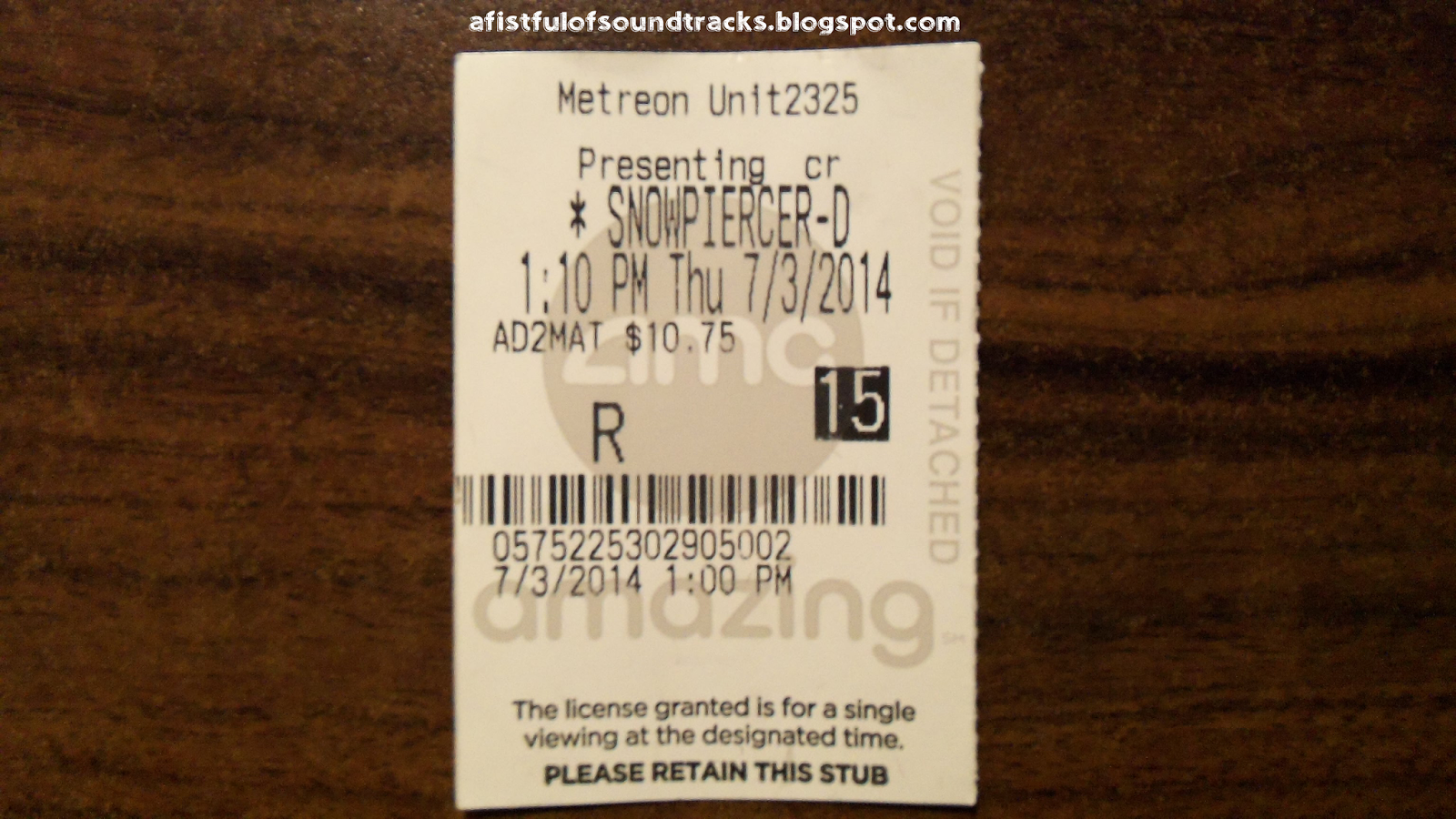
Every Throwback Thursday, I randomly pull out from my desk cabinet--with my eyes closed--a movie ticket I saved. Then I discuss the movie on the ticket. The following was previously posted on September 5, 2014, under the title "Jezebel says summer 2014 was too depressing to deserve a song of the summer, but it's definitely earned a movie of the summer."

Every time the summer wraps up, music or entertainment news orgs come out with their annual think pieces or listicles about the song of the summer, and the end of the summer last week was no exception. But Jezebel makes the bold argument that we shouldn't be talking about a song of the summer, especially after a summer of Ferguson, various other kinds of civil rights abuses, Elliot Rodger, the missile attack on the Malaysian Airlines jet, the Israel-Gaza conflict, ebola and Robin Williams' suicide. "There wasn't a 'song of summer' that defined these months, like 'Call Me Maybe' did in 2012 and 'Hot In Herre' does every summer. But this summer doesn't fucking deserve its own song. It hasn't earned it," wrote Erin Gloria Ryan at Jezebel.

In addition to a dismal three months of world news, the candidates that showbiz reporters have brought up as the possible song of summer 2014 are pretty dire. "Fancy" by Iggy Azalea, cultural appropriation's newest star? Fuck that song. (I don't like picking songs of the summer, and I agree that summer 2014 doesn't deserve one, but "Bom Bom Fiya" by Slimkid3 & DJ Nu-Mark, "Always Winnin" by Shad, "Remedy" by All About She, "Klapp Klapp" by Little Dragon and "Sup Bruce," a tribute to Bruce Lee by The Bar, were all pretty damn good, especially "Bom Bom Fiya.")

Ah-sung Ko and Chris Evans attempt to avoid slipping on fish.

However, summer 2014 has definitely earned a movie of the summer. I can't think of any other recent movie right now that speaks to summer 2014's feelings of unrest quite like director Bong Joon-ho's dystopian sci-fi blockbuster Snowpiercer does. That and many other reasons are why Snowpiercer is my favorite movie of summer 2014, as well as why selections from Marco Beltrami's score to the movie, in which Beltrami used instruments like the cimbalom to establish "a sound of antiquity" during Bong's futuristic tale of class conflict, are now playing on "AFOS Prime" and "New Cue Revue" on AFOS.

As much as I like Guardians of the Galaxy, the year's highest-grossing movie so far and one of the summer's most favorably received blockbusters in critics' circles (as well as a movie with a score that's also now being streamed on AFOS), Guardians suffers from a dull lead villain (what was his name again?). Snowpiercer doesn't have that problem. It features one of the year's most entertaining and well-drawn antagonists, in the snaggle-toothed form of Minister Mason, Tilda Swinton's Thatcher-ish politician/spokesperson character ("I am a hat. You are a shoe. I belong on the head. You belong on the foot... Know your place. Keep your place. Be a shoe."). Like Guardians, Snowpiercer is based on an obscure comic--the 1982 French graphic novel Le Transperceneige by Jacques Lob, Benjamin Legrand and Jean-Marc Rochette--but unlike Guardians, it's set in a rather depressing milieu. The Bong movie, which actually came out last year in Korea, Japan and Europe before hitting American theaters in June, centers on a violent revolt aboard the Snowpiercer, a state-of-the-art train that's circling the world and carrying the last remaining survivors of a failed and disastrous attempt to prevent global warming. The cramped train is, of course, a metaphor for our current world, and as Bong said when he told The Mary Sue about why Le Transperceneige intrigued him, the train exemplifies his observation that "No matter what situation we find ourselves in, there's no peace."

The Wilford song that this classroom of kids is about to sing would make for a great ringtone that, like all other ringtones, costs way more than it's actually worth.

Do the Right Thing, Attack the Block and now Snowpiercer are the best kind of summer movie: darkly funny, bleak (even though Moses defeats the aliens at the end of Attack the Block, he still winds up as another black man in prison), sequel-proof, racially diverse and a Fox News viewer's nightmare, due to both their political views and their diverse casts (sorry, Dawn of the Planet of the Apes, but you're lacking in the well-drawn female character department, and your version of San Francisco is implausibly devoid of Asians for some weird goddamn reason). I like escapist popcorn fare during the summer months like everybody else, but I prefer much of that kind of fare to carry some sort of weight or meaning and be reflective of some of the real-world madness outside the theater. Many tentpole blockbusters that use tiresome 9/11 imagery to attempt to raise the dramatic stakes are especially terrible at this, whereas the smaller-scale action movies Attack the Block and Snowpiercer don't play the 9/11 card and find other ways to make their material relevant and pungent. For Bong, one of those ways is the economic inequality in Korea, which appears to form much of the basis for Snowpiercer's class conflict.

Snowpiercer and The Lego Movie, which enraged Fox News' comrade in right-wing bullshit, Fox Business, would make for a terrific double bill of humorous films about the evils of big business. At the same time though, Snowpiercer, despite its disdain for big business in the form of the Wilford Corporation, doesn't opt for a simplistic "the left will ultimately prevail" narrative. It doesn't provide easy and comforting answers for the left, much like how Do the Right Thing doesn't provide answers on how to effectively deal with racism. Snowpiercer's (spoiler!) late twist that Chris Evans' lead revolutionary character Curtis was, without him realizing it, being groomed to inherit the corporation he was fighting against conveys Bong's bleak point that even when revolutionaries try their hardest, the corrupt system they're fighting will never be broken. That point is also conveyed by the harrowing confession Curtis makes to Namgoong Minsu, frequent Bong film star Song Kang-ho's perpetually stoned security expert character, about--without giving too much away--how even a revolutionary like himself, when he was younger, wasn't immune to the worst kind of behavior encouraged by the system.

If you're enraged by the police lately because of the situation in Ferguson, check out Snowpiercer, as well as Bong's other movies from South Korea, if you haven't done so; Bong feels your disdain for the police. The fact-based 2003 procedural Memories of Murder and the great 2006 monster movie The Host--where, just like in Snowpiercer, Song and Ah-sung Ko star as a father-and-daughter duo--also carry a huge disdain for authority and institutions at their most incompetent (in "Reverse Trip: Charting the History of Bong Joon-ho's Snowpiercer," RogerEbert.com's Scout Tafoya writes that Korean New Wave films like Snowpiercer reflect their directors' frustrations with corruption and bureaucratic incompetence in their own homeland). Even the 2009 thriller Mother, the Bong feature film with the least amount of social commentary, is tinged with that same distrust of authority.

Wow, Octavia Spencer's new Halfway Home cast reunion movie looks depressing as fuck.

From Memories of Murder to Snowpiercer, Bong has emerged as one of the sharpest satirical minds working in film today. I can't think of another current director who juggles various tones as unusually and effectively as Bong does. Like the grieving scene in the gym during The Host, Mason's speech to the lower-class Snowpiercer passengers early on in the movie is classic Bong: satire, slapstick and drama are going on all at once. The minister hilariously bumbles through her "Be a shoe" speech (she gets disrupted by clumsy translators and a tray that falls loudly on the ground, which wasn't in the script and was a blooper that Bong liked so much that he kept it in the film) while a torture scene ensues behind her, and we don't know whether to laugh or be disturbed over the bizarre punishment the goofy-looking Ewen Bremner character receives on his arm (it gets frozen and then amputated).

The "Be a shoe" speech/torture scene is one of many Bong moments where you, the viewer, are experiencing several things at once: anger over the cruelty of authority figures, laughter over their incompetence and silly behavior, sympathy for the mistreated protagonists and disappointment with those same protagonists because of mistakes they could have easily avoided (Bong's protags are never perfect and flawless saints). Bong explained his approach to these moments to The Mary Sue by saying, "These types of moments are generally kind of awkward for the audience, and I like that, because I think life is like that. It's not like something happens and everyone knows 'Oh, this is a funny moment,' or 'Oh, this is a sad moment.' It's not really divided like that."

Alison Pill's only scene in Snowpiercer greatly makes up for all the horseshit she had to act out in that one season of The Newsroom I sat through.

That sort of tonal weirdness--other examples include Curtis slipping on a fish on the floor in the middle of a serious fight scene and Alison Pill's one great scene as a cheery and psychotic schoolteacher--is an endearing part of Snowpiercer and Bong's other films, but I see why it can be challenging and off-putting for some moviegoers ("People didn't know if [The Host] was supposed to be funny--if they were supposed to laugh--or if they were supposed to be sad," said Bong about the confused reactions many Japanese moviegoers had to The Host). However, tinkering with Bong's idiosyncratic brand of filmmaking--which is exactly what Harvey Weinstein, the bullying studio chief with a history of getting his sausage-fingered hands on perfectly fine Asian movies and then butchering them, attempted to do when he wanted to shorten the running time of the American release of Snowpiercer--is just the worst way to make Bong's work attract moviegoers who aren't fans of his filmmaking. Bong opposed Weinstein's attempt to trim Snowpiercer and got into a war of words with The Weinstein Company that mirrored Curtis and the lower-class passengers' attempt to overthrow the upper class.

Fortunately, Bong won the battle, and although Weinstein cut down the amount of theaters he originally planned for Snowpiercer's American release in what comes across to me as a petty form of payback for Bong getting his way, Snowpiercer ultimately found its audience, not in theaters as a midnight-movie sensation but on VOD. We have Radius-TWC, The Weinstein Company's own boutique division, to thank for rescuing Snowpiercer in America and helping to turn it into a hit on iTunes two weeks after debuting in theaters.

"A lot of people come back to this movie a second, third, fourth, fifth time [on VOD]. I think the immediacy of that and how it shows up in social media speak directly to what the themes of this movie are," said Radius-TWC co-president Tom Quinn when he discussed the experimental distribution strategy that led to Snowpiercer's VOD success on KCRW's The Business.

That VOD success is also why Snowpiercer is the movie of the summer: it represents an interesting future for a certain kind of blockbuster that's neither a superhero movie nor a movie for kids, where an above-average action movie that, for some reason, would have had a difficult time finding an audience in theaters can succeed via this new platform--or where a movie that's receiving good word-of-mouth but isn't being released in smaller markets is now easily accessible to moviegoers from those markets who want to see it. Thanks to VOD, they can watch it now with just one click. As Josh Levin said in his Slate post about his enthusiasm over being able to catch Snowpiercer on demand, "We should embrace and celebrate the fact that we can now watch great movies on TV the same day they're in theaters."

As someone who's becoming increasingly less enamored with going to the theater to watch movies--I keep wanting to punch the lights out of younger moviegoers whenever they get unruly or start playing with their smartphones (this is why theaters need to start hiring bouncers)--I've been all for the rise of VOD ever since Radius-TWC made its first splash with the multi-platform release of the indie comedy Bachelorette in 2012. Though I saw Snowpiercer in the theater instead of on demand, that old saying of "Support this little film by buying a ticket to see it"--a line I frequently heard when Asian American college students and supporters of Asian American indie movies tried to get members of various Asian American subcommunities to see Better Luck Tomorrow in theaters in 2003--is just going to sound silly and outdated when three or four more Snowpiercers or They Came Togethers take off on VOD or when that inevitable day comes when Asian American content creators who have been successful on YouTube start releasing feature films on iTunes.

I shudder to think about what would have happened if Bong lost the power of final cut to Weinstein and a truncated version of Snowpiercer wound up on VOD instead. Snowpiercer already has several bleak endings. Why does it need another? Plus the sight of Bong's vision being compromised would have added to making the past three months--which, headline-wise, were as dismal as the living conditions and black protein block food the lower-class Snowpiercer passengers are forced to put up with--a tad more dismal. The fact that Snowpiercer was able to arrive in America with all of its scenes intact--plus the fact that the film turned out to be so damn good and is yet another work in Bong's filmography that's both enjoyable and so dead-on about the fucked-up real world outside the theater--are, to borrow the words of Raymond Carver, a small, good thing in a time like this.

Selections from the score to Snowpiercer can currently be heard during "AFOS Prime" on AFOS.

Friday, September 5, 2014

Jezebel says summer 2014 was too depressing to deserve a song of the summer, but it's definitely earned a movie of the summer

Ah-sung Ko and Chris Evans attempt to avoid slipping on fish.

Every time the summer wraps up, music or entertainment news orgs come out with their annual think pieces or listicles about the song of the summer, and the end of the summer last week was no exception. But Jezebel makes the bold argument that we shouldn't be talking about a song of the summer, especially after a summer of Ferguson, various other kinds of civil rights abuses, Elliot Rodger, the missile attack on the Malaysian Airlines jet, the Israel-Gaza conflict, ebola and Robin Williams' suicide. "There wasn't a 'song of summer' that defined these months, like 'Call Me Maybe' did in 2012 and 'Hot In Herre' does every summer. But this summer doesn't fucking deserve its own song. It hasn't earned it," wrote Erin Gloria Ryan at Jezebel.

In addition to a dismal three months of world news, the candidates that showbiz reporters have brought up as the possible song of summer 2014 are pretty dire. "Fancy" by Iggy Azalea, cultural appropriation's newest star? Fuck that song. (I don't like picking songs of the summer, and I agree that summer 2014 doesn't deserve one, but "Bom Bom Fiya" by Slimkid3 & DJ Nu-Mark, "Always Winnin" by Shad, "Remedy" by All About She, "Klapp Klapp" by Little Dragon and "Sup Bruce," a tribute to Bruce Lee by The Bar, were all pretty damn good, especially "Bom Bom Fiya.")

However, summer 2014 has definitely earned a movie of the summer. I can't think of any other recent movie right now that speaks to summer 2014's feelings of unrest quite like director Bong Joon-ho's dystopian sci-fi blockbuster Snowpiercer does. That and many other reasons are why Snowpiercer is my favorite movie of summer 2014, as well as why selections from Marco Beltrami's score to the movie, in which Beltrami used instruments like the cimbalom to establish "a sound of antiquity" during Bong's futuristic tale of class conflict, are now playing on "AFOS Prime" and "New Cue Revue" on AFOS.

The Wilford song that this classroom of kids is about to sing would make for a great ringtone that, like all other ringtones, costs way more than it's actually worth.

As much as I like Guardians of the Galaxy, the year's highest-grossing movie so far and one of the summer's most favorably received blockbusters in critics' circles (as well as a movie with a score that's also now being streamed on AFOS), Guardians suffers from a dull lead villain (what was his name again?). Snowpiercer doesn't have that problem. It features one of the year's most entertaining and well-drawn antagonists, in the snaggle-toothed form of Minister Mason, Tilda Swinton's Thatcher-ish politician/spokesperson character ("I am a hat. You are a shoe. I belong on the head. You belong on the foot... Know your place. Keep your place. Be a shoe."). Like Guardians, Snowpiercer is based on an obscure comic--the 1982 French graphic novel Le Transperceneige by Jacques Lob, Benjamin Legrand and Jean-Marc Rochette--but unlike Guardians, it's set in a rather depressing milieu. The Bong movie, which actually came out last year in Korea, Japan and Europe before hitting American theaters in June, centers on a violent revolt aboard the Snowpiercer, a state-of-the-art train that's circling the world and carrying the last remaining survivors of a failed and disastrous attempt to prevent global warming. The cramped train is, of course, a metaphor for our current world, and as Bong said when he told The Mary Sue about why Le Transperceneige intrigued him, the train exemplifies his observation that "No matter what situation we find ourselves in, there's no peace."

Do the Right Thing, Attack the Block and now Snowpiercer are the best kind of summer movie: darkly funny, bleak (even though Moses defeats the aliens at the end of Attack the Block, he still winds up as another black man in prison), sequel-proof, racially diverse and a Fox News viewer's nightmare, due to both their political views and their diverse casts (sorry, Dawn of the Planet of the Apes, but you're lacking in the well-drawn female character department, and your version of San Francisco is implausibly devoid of Asians for some weird goddamn reason). I like escapist popcorn fare during the summer months like everybody else, but I prefer much of that kind of fare to carry some sort of weight or meaning and be reflective of some of the real-world madness outside the theater. Many tentpole blockbusters that use tiresome 9/11 imagery to attempt to raise the dramatic stakes are especially terrible at this, whereas the smaller-scale action movies Attack the Block and Snowpiercer don't play the 9/11 card and find other ways to make their material relevant and pungent. For Bong, one of those ways is the economic inequality in Korea, which appears to form much of the basis for Snowpiercer's class conflict.

Wow, Octavia Spencer's new Halfway Home cast reunion movie looks depressing as fuck.

Snowpiercer and The Lego Movie, which enraged Fox News' comrade in right-wing bullshit, Fox Business, would make for a terrific double bill of humorous films about the evils of big business. At the same time though, Snowpiercer, despite its disdain for big business in the form of the Wilford Corporation, doesn't opt for a simplistic "the left will ultimately prevail" narrative. It doesn't provide easy and comforting answers for the left, much like how Do the Right Thing doesn't provide answers on how to effectively deal with racism. Snowpiercer's (spoiler!) late twist that Chris Evans' lead revolutionary character Curtis was, without him realizing it, being groomed to inherit the corporation he was fighting against conveys Bong's bleak point that even when revolutionaries try their hardest, the corrupt system they're fighting will never be broken. That point is also conveyed by the harrowing confession Curtis makes to Namgoong Minsu, frequent Bong film star Song Kang-ho's perpetually stoned security expert character, about--without giving too much away--how even a revolutionary like himself, when he was younger, wasn't immune to the worst kind of behavior encouraged by the system.

If you're enraged by the police lately because of the situation in Ferguson, check out Snowpiercer, as well as Bong's other movies from South Korea, if you haven't done so; Bong feels your disdain for the police. The fact-based 2003 procedural Memories of Murder and the great 2006 monster movie The Host--where, just like in Snowpiercer, Song and Ah-sung Ko star as a father-and-daughter duo--also carry a huge disdain for authority and institutions at their most incompetent (in "Reverse Trip: Charting the History of Bong Joon-ho's Snowpiercer," RogerEbert.com's Scout Tafoya writes that Korean New Wave films like Snowpiercer reflect their directors' frustrations with corruption and bureaucratic incompetence in their own homeland). Even the 2009 thriller Mother, the Bong feature film with the least amount of social commentary, is tinged with that same distrust of authority.

From Memories of Murder to Snowpiercer, Bong has emerged as one of the sharpest satirical minds working in film today. I can't think of another current director who juggles various tones as unusually and effectively as Bong does. Like the grieving scene in the gym during The Host, Mason's speech to the lower-class Snowpiercer passengers early on in the movie is classic Bong: satire, slapstick and drama are going on all at once. The minister hilariously bumbles through her "Be a shoe" speech (she gets disrupted by clumsy translators and a tray that falls loudly on the ground, which wasn't in the script and was a blooper that Bong liked so much that he kept it in the film) while a torture scene ensues behind her, and we don't know whether to laugh or be disturbed over the bizarre punishment the goofy-looking Ewen Bremner character receives on his arm (it gets frozen and then amputated).

The "Be a shoe" speech/torture scene is one of many Bong moments where you, the viewer, are experiencing several things at once: anger over the cruelty of authority figures, laughter over their incompetence and silly behavior, sympathy for the mistreated protagonists and disappointment with those same protagonists because of mistakes they could have easily avoided (Bong's protags are never perfect and flawless saints). Bong explained his approach to these moments to The Mary Sue by saying, "These types of moments are generally kind of awkward for the audience, and I like that, because I think life is like that. It's not like something happens and everyone knows 'Oh, this is a funny moment,' or 'Oh, this is a sad moment.' It's not really divided like that."

Alison Pill's only scene in Snowpiercer greatly makes up for all the horseshit she had to act out in that one season of The Newsroom I sat through.

That sort of tonal weirdness--other examples include Curtis slipping on a fish on the floor in the middle of a serious fight scene and Alison Pill's one great scene as a cheery and psychotic schoolteacher--is an endearing part of Snowpiercer and Bong's other films, but I see why it can be challenging and off-putting for some moviegoers ("People didn't know if [The Host] was supposed to be funny--if they were supposed to laugh--or if they were supposed to be sad," said Bong about the confused reactions many Japanese moviegoers had to The Host). However, tinkering with Bong's idiosyncratic brand of filmmaking--which is exactly what Harvey Weinstein, the bullying studio chief with a history of getting his sausage-fingered hands on perfectly fine Asian movies and then butchering them, attempted to do when he wanted to shorten the running time of the American release of Snowpiercer--is just the worst way to make Bong's work attract moviegoers who aren't fans of his filmmaking. Bong opposed Weinstein's attempt to trim Snowpiercer and got into a war of words with The Weinstein Company that mirrored Curtis and the lower-class passengers' attempt to overthrow the upper class.

Fortunately, Bong won the battle, and although Weinstein cut down the amount of theaters he originally planned for Snowpiercer's American release in what comes across to me as a petty form of payback for Bong getting his way, Snowpiercer ultimately found its audience, not in theaters as a midnight-movie sensation but on VOD. We have Radius-TWC, The Weinstein Company's own boutique division, to thank for rescuing Snowpiercer in America and helping to turn it into a hit on iTunes two weeks after debuting in theaters.

"A lot of people come back to this movie a second, third, fourth, fifth time [on VOD]. I think the immediacy of that and how it shows up in social media speak directly to what the themes of this movie are," said Radius-TWC co-president Tom Quinn when he discussed the experimental distribution strategy that led to Snowpiercer's VOD success on KCRW's The Business.

That VOD success is also why Snowpiercer is the movie of the summer: it represents an interesting future for a certain kind of blockbuster that's neither a superhero movie nor a movie for kids, where an above-average action movie that, for some reason, would have had a difficult time finding an audience in theaters can succeed via this new platform--or where a movie that's receiving good word-of-mouth but isn't being released in smaller markets is now easily accessible to moviegoers from those markets who want to see it. Thanks to VOD, they can watch it now with just one click. As Josh Levin said in his Slate post about his enthusiasm over being able to catch Snowpiercer on demand, "We should embrace and celebrate the fact that we can now watch great movies on TV the same day they're in theaters."

As someone who's becoming increasingly less enamored with going to the theater to watch movies--I keep wanting to punch the lights out of younger moviegoers whenever they get unruly or start playing with their smartphones (this is why theaters need to start hiring bouncers)--I've been all for the rise of VOD ever since Radius-TWC made its first splash with the multi-platform release of the indie comedy Bachelorette in 2012. Though I saw Snowpiercer in the theater instead of on demand, that old saying of "Support this little film by buying a ticket to see it"--a line I frequently heard when Asian American college students and supporters of Asian American indie movies tried to get members of various Asian American subcommunities to see Better Luck Tomorrow in theaters in 2003--is just going to sound silly and outdated when three or four more Snowpiercers or They Came Togethers take off on VOD or when that inevitable day comes when Asian American content creators who have been successful on YouTube start releasing feature films on iTunes.

I shudder to think about what would have happened if Bong lost the power of final cut to Weinstein and a truncated version of Snowpiercer wound up on VOD instead. Snowpiercer already has several bleak endings. Why does it need another? Plus the sight of Bong's vision being compromised would have added to making the past three months--which, headline-wise, were as dismal as the living conditions and black protein block food the lower-class Snowpiercer passengers are forced to put up with--a tad more dismal. The fact that Snowpiercer was able to arrive in America with all of its scenes intact--plus the fact that the film turned out to be so damn good and is yet another work in Bong's filmography that's both enjoyable and so dead-on about the fucked-up real world outside the theater--are, to borrow the words of Raymond Carver, a small, good thing in a time like this.