Showing posts with label Hayao Miyazaki. Show all posts

Monday, July 3, 2017

Okja is two hours of Bong Joon-ho's usual boldness, plus Jake Gyllenhaal doing an odd Marvin Tikvah impression


This is the seventh of 12 or 13 all-new blog posts that are being posted on a monthly basis until this blog's final post in December 2017.

I love the work of Korean filmmaker Bong Joon-ho. Based on a real-life serial-killer case that remains unsolved, 2003's Memories of Murder, the second feature film from "Director Bong," intriguingly takes the standard "grisly serial-killer case psychologically damages the detectives on the case" thriller and expands its scope so that it morphs into a dark comedy about the ineptitude of institutions like the police, and it's so critical of institutions you'd expect David Simon to have had a hand in writing it. The Host, Bong's 2006 follow-up to Memories of Murder, became South Korea's biggest box-office hit ever by effectively mashing up the monster movie genre with dysfunctional family comedy and trenchant satire about both Korean and American institutions. Mother, Bong's 2009 whodunit about a mentally challenged prime suspect in a small-town murder case, is a worthy addition to the pantheon of twisted movies to watch on Mother's Day like Psycho and Serial Mom. Snowpiercer, a rare dystopian sci-fi flick that takes place in perpetual snowfall rather than being drenched in acid rain or set against orange desert landscapes, is both an inventive take on class warfare and 2014's most mesmerizing blockbuster starring a white guy named Chris.

These are all darkly comic films with a recurring disdain for either broken institutions or corporate malfeasance. So I was prepared to dislike the made-for-Netflix Okja, a globetrotting fantasy film that finds Bong venturing into Free Willy territory for a story about a Korean farm kid's bond with a genetically modified female "superpig"--an empathetic creature that behaves less like a pig and more like a dog/hippo hybrid--she wants to save from the slaughterhouse. Has Bong the sharp satirist gone all soft and cuddly on us?

Nah, not really. For his first family-friendly film since The Host (its R rating in America is, by the way, overblown--the original Gremlins is grislier than The Host--and I think its bittersweet ending had a lot to do with it being slapped with an R), Bong takes on the GMO industry and two-faced corporate culture, and his satirical vision of a feud between animal rights activists and Mirando, a Monsanto-style corporation with a deceptively sunny disposition, is slightly darker than I expected from a film that spends much of the first half-hour in idyllic, nearly dialogue-less rural splendor that's visually inspired by My Neighbor Totoro.


My Neighbor Totoro

Oh yeah, I almost forgot about the amount of F-bombs freely tossed around by Steven Yeun and Daniel Henshall--who play members of a Paul Dano-led "Animal Liberation Front"--as well as by Jake Gyllenhaal and Snowpiercer star (and Okja co-producer) Tilda Swinton, who's given this time by Bong a dual role as a pair of twin sisters who run Mirando (and have differing approaches to handling the corporation's crusade against world hunger). Bong has an awesome interpretation of "family-friendly."

Friday, August 8, 2014

"Brokedown Merry-Go-Round" Show of the Week: Space Dandy, "The Big Fish Is Huge, Baby"

'Next time on Fishing with John here on the Independent Film Channel...'
Every Friday in "'Brokedown Merry-Go-Round' Show of the Week," I discuss the week's best first-run animated series episode I saw. "Brokedown Merry-Go-Round," a two-hour block of original score tracks from animated shows or movies, airs weekdays at 2pm Pacific on AFOS.

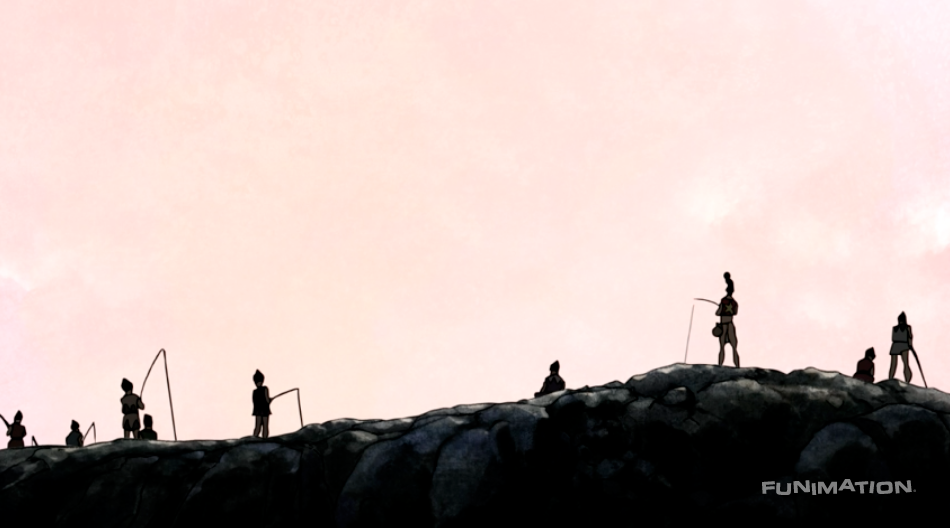
Story-wise, "The Big Fish Is Huge, Baby" is one of the most straightforward episodes in Space Dandy's run. The plot can be easily summarized in just 15 words or less (Dandy and a bunch of fishermen try to catch a highly prized big fish); Dandy-chasing Dr. Gel never shows up to try to complicate things; and the settings are confined to just the lake in both the cold open and the conclusion, the Aloha Oe and the pre-industrial fishermen's planet of Kayu, so there are no cutaways to Dr. Gel's ship, the Boobies restaurant, the Alien Registration Center or some other wacky dimension.

The simplicity and relaxed nature of this redundantly titled episode initially takes some getting used to. But once the episode starts rolling an enjoyable montage of mostly inanimate stills of Dandy's various fishing trips with his little girl sidekick Erssime (Seiran Kobayashi) to nab the elusive Munagi, which appears once every 3600 years, "The Big Fish Is Huge, Baby" sets its hooks in you, no pun intended. It's also perhaps the least sci-fi-inflected Space Dandy episode, save for the twist of Kayu's giant fish turning out to have been inhabitants of a comet that returns to pick them up and presumably drop them off on some other planet, where they'll hopefully devour the entire cast of Hillbilly Handfishin'.

Dandy spends the entire episode fishing in a thong. Somewhere, some crazy fuck's putting together an AMV of clips from this episode mixed with 'Thong Song' by Sisqo.
After several high-concept outings--like the season premiere's chaotic collision of parallel Dandys, which was basically an excuse for the animators to do a "Don't Touch That Dial"-esque spoof of a bunch of anime franchises that are way more popular than Space Dandy currently is in Japan, or last week's singing-and-dancing installment--it's nice to get to relax a little and be subjected to an idyllic and less narratively busy Dandy adventure. And I can't believe it's taken me 18 episodes to realize this, but all the shots of Dandy getting drenched in mud or floating around in the air or sea during "The Big Fish Is Huge, Baby" made me notice that Dandy, who sometimes resembles the extremely punchable Jeffrey Wells, is more of a dead ringer for the greaser in Schoolhouse Rock's "A Victim of Gravity" short.


At times, the laid-back feel of "The Big Fish Is Huge, Baby" is reminiscent of the "Ed gets reunited with her long-lost dad" episode of Cowboy Bebop, Space Dandy general director Shinichiro Watanabe's earlier show. But the odd beauty of both Kayu's muddy and overcast landscapes and the episode itself is unmistakably Studio Ghibli-esque. It's no surprise that the special guest director of "The Big Fish Is Huge, Baby" is Kiyotaka Oshiyama, who did key animation for the Ghibli films The Secret World of Arrietty and The Wind Rises (he also designed the mecha in "Even Vacuum Cleaners Fall in Love, Baby").

Ghibli is known for taking things like mud and grime and making them look beauteous and remarkable, which is what "The Big Fish Is Huge, Baby" does as well. The studio has also been in the news lately because of rumors that it will stop producing animation following Ghibli co-founder Hayao Miyazaki's recent retirement, and the heartbreak over Ghibli's possible demise casts a bit of a grim pall over "The Big Fish Is Huge, Baby." It's like hearing that Titmouse Inc. suddenly decided to call it a day or receiving news that Pixar will close up shop. A world without Ghibli is like a world without any fish to catch, which is what happens to Kayu at the end of "The Big Fish Is Huge, Baby." What is the world to do now?

Thursday, September 12, 2013

Hayao Miyazaki's retirement means no more sublime moments of animation like my favorite food scene in The Castle of Cagliostro

Jigen and Lupin give as much a fuck about carbs as they do about the law.

I've been co-writing an article about YouTube videos that have fused anime footage with hip-hop joints (the piece will appear over at Word Is Bond). While working on that, I binge-watched on Hulu the entire single-season run of last year's animated caper show Lupin the Third: The Woman Called Fujiko Mine, a raunchy, not-for-kids prequel to the Lupin the Third franchise, after I saw comic book critic David Brothers recommend Fujiko Mine in one of his Tumblr posts. Both the in-the-works article and Fujiko Mine got me to revisit the much-revered caper flick The Castle of Cagliostro, a 1979 theatrical spinoff of the late '70s Lupin TV series and a film I hadn't seen in 20 years.

I enjoyed rewatching set pieces like the mountainside car chase and the clock tower climax, which director Kevin Altieri memorably paid tribute to in the climax of Batman: The Animated Series' first Clock King episode ("That movie is what got me into animation," said Altieri in a 1993 Cinefantastique magazine interview where he also noted that even though Cagliostro was done with limited animation, it tells "a real story with real emotion"). But during this rewatch, I also noticed something equally sublime that I didn't quite pay attention to when I watched Cagliostro on VHS as an action scene-loving kid: the food scenes.

After the car chase, Lupin and his sidekick Jigen stop for a bite to eat and share what has to be the most delicious-looking plate of spaghetti and meatballs ever drawn in animation (it's so delicious-looking that fans of the film have attempted to recreate the same-looking dish in their kitchens). That little dining scene caught my attention this time out because spaghetti is one of the few meals I know how to cook.

Jigen what?
(Photo source: Fanpop)

It's also because the way Lupin and Jigen grab the pasta with their forks is as dynamically realized as the car chase and the clock tower fight. Again, the animation is limited, yet it's a scene that's imbued with personality and great character details, something that can't be said about the limited animation and frequently recycled shots in the Filmation Saturday morning cartoons that were being made in America at the time. Also, Lupin and Jigen's enjoyment of their meal isn't done in a comedically exaggerated way, like whenever everybody's favorite potheads Warner Bros. Animation will never admit are potheads, Shaggy and Scooby, are shown devouring submarine sandwiches (although later in the film, an injured and famished Lupin's attempt to get back in the game by binging on chicken and entire blocks of cheese is a very Shaggy and Scooby-esque bit of slapstick).

Cagliostro was the first film I ever saw that was directed by legendary animator Hayao Miyazaki, so I wasn't aware of his trademark touches as a filmmaker. Since that first viewing of Cagliostro, which also happened to be the first feature Miyazaki directed, I've peeped most of his other films, and I've noticed he and his Studio Ghibli animators draw and animate food like nobody else. For instance, in Howl's Moving Castle, bacon actually looks like bacon, not unappealing sticks of Topps baseball card gum (although in the film, the bacon is served with sunny-side-up eggs, which makes the bacon slightly less appetizing for me because I hate eggs--except when they're in omelet form). Miyazaki objectifies food instead of women, which makes him the least pervy of Japanese animators (both that and his knack for writing interesting and fully dimensional female characters are why women love his films). His live-action equivalents in the foodie movie department are Ang Lee and Martin Scorsese, whose 1974 documentary short Italianamerican and famously food-obsessed GoodFellas shouldn't be watched when you're hungry.

Those little cuisine-related moments are an example of what Emily Yoshida describes in Grantland as "his intimate understanding of the most mundane human phenomena," and that understanding is what I'll probably miss the most about Miyazaki, who happened to announce his retirement from directing as I was revisiting Cagliostro. For his final directorial effort, the 126-minute The Wind Rises, which was received quite well at its Toronto International Film Festival premiere earlier this week and is slated for American release in February, Miyazaki chose to do a historical drama about Japanese aircraft designer Jiro Horikoshi, making this his most grounded and least fantasy-driven directorial effort since Cagliostro. I don't know if there will be any tantalizing shots of food in The Wind Rises like there are in Cagliostro or Spirited Away, but if he has somehow managed to make the much quieter drama of the ambivalence over building weapons for war as interesting as those food scenes, The Wind Rises will be a solid closer to the mostly satisfying full-course dinner that has been Miyazaki's filmography.

Themes from Lupin the Third, including the 1980 Lupin main title theme, which was used as an action theme in Cagliostro, as well as selections from scores to other Miyazaki movies (Princess Mononoke, Spirited Away and Howl's Moving Castle), all can be heard during the "Brokedown Merry-Go-Round" block, weekdays at 2pm Pacific on AFOS.