Showing posts with label YOMYOMF. Show all posts

Thursday, October 19, 2017

I Can't Believe I've Never Seen It Till Now!: House (1977)


An updated-in-2020 version of the following blog post can be found in If You Haven't Seen It, It's New to You: The Movies and TV Shows Some of Us Regretted Not Catching Until Later. The 2020 book was written and self-published by yours truly. Get the paperback edition of If You Haven't Seen It, It's New to You now!

***

This is the 13th of 15 all-new blog posts that are being posted on a monthly basis until this blog's final post in December 2017. I know I said "monthly basis" all through 2017, and instead, there ended up being two posts this October and three back in August, but I guess I discovered that in August and now October, I found plenty of shit I wanted to write about before I call it quits. "I Can't Believe I've Never Seen It Till Now!" is a series of posts in which I reveal that I never watched a certain popular or really old movie until very recently, and that's largely because I'm Filipino, we're always late to the party and that's how we do.

Director Nobuhiko Obayashi's 1977 Japanese box-office hit House is the kind of film that, had it been made in 2017, would have ended up being the subject of various audience reaction videos by YouTubers who want to show how confused and bewildered the audience members look while trying to process the extremely weird shit they're watching. Not to be confused with the 1985 American horror comedy of the same name and the long-running Hugh Laurie vehicle of the same name, Obayashi's J-horror oddity was largely unknown in America until 2010, when Janus Films introduced the Toho Studios flick in theaters to American film geeks and the Criterion Collection released it on Blu-ray. Both a Phil Chung blog post for YOMYOMF (his post is basically "I don't know what the fuck I saw, but I loved it!") and a Trailers from Hell commentary track for the film's 1977 trailer made me want to see House.


House is definitely the most unconventional haunted-house movie I've ever seen. I was expecting a Riki-Oh: The Story of Ricky-type bloodbath with a bit of a Battle Royale-style attitude about not giving a fuck about brutally killing off so many innocent-looking Japanese teens.

What I got instead was something stranger than Riki-Oh. I believe I have a clip of myself reacting to every scene in House:


Thursday, March 24, 2016

The best thing about Pee-wee's Big Holiday is that it will introduce a new generation of viewers to Faster, Pussycat! Kill! Kill!


"You ever been in a fight?," wonders Joe Manganiello--who stars as himself in the new Netflix original movie Pee-wee's Big Holiday--to Pee-wee Herman (Paul Reubens), the Magic Mike star's new best friend, as Joe realizes Pee-wee has never left his hometown of Fairville and has basically lived an uneventful life.

"No," replies Pee-wee.

"You ever broken a rule?"

"No."

"You ever had two women fight over you?"

But this time Pee-wee has to pause for a couple of beats to try to remember. If you've been down with Pee-wee since the classic 1985 Tim Burton movie Pee-wee's Big Adventure (or maybe even as far back as The Pee-wee Herman Show, Reubens' early '80s L.A. stage show at the Roxy, which the Groundlings alum revived on Broadway to much success in 2010), you might recall that the bow-tied man-child had to choose between the affections of a really hot Italian trapeze artist played by Valeria Golino--her hotness is the most rewatchable part of 1988's poorly received Big Top Pee-wee, the last Pee-wee flick--and a schoolteacher played by Penelope Ann Miller during Big Top. In this age of meta-humor permeating everything from Rick and Morty to Deadpool, you'd expect Pee-wee to break the fourth wall, wink at the audience and make a reference to that love triangle from 28 years ago.

But Pee-wee doesn't do so. He instead replies with "Have I? No." Or maybe Reubens is indeed referencing the last movie, and the brief pause is his way of saying, "Yeah, the public was right: Big Top Pee-wee was kind of a mistake. But enough about that movie!"


Whatever the case, Pee-wee movies aren't known for being constantly self-aware and meta like the Muppet movies. Pee-wee's Big Holiday, which centers on Pee-wee's cross-country odyssey to attend Joe's star-studded birthday party at his Manhattan penthouse, doesn't really acknowledge any of the events from the prior Pee-wee movies because it actually takes place in its own separate continuity, just like how the Randal Kleiser-directed Big Top doesn't take place in the same continuity as Pee-wee's Big Adventure's. Certain traits of Pee-wee's will always remain constant--the red bow tie, the too-small gray suit, the white shoes, the mischievous giggling, the Rube Goldberg gadgets, the weird animal sidekicks (whether they're puppets or actual animals)--but Reubens has interestingly always rebooted his own character in each Pee-wee project, including the beloved and timeless Pee-wee's Playhouse. Even after 38 years of man-child antics, Pee-wee's basically still a work-in-progress.

You know the amiable Pee-wee who hosted a Saturday morning kids' show that was meant for all ages--aside from an occasional double entendre related to Miss Yvonne, the most beautiful woman in Puppetland, or an L.A. Law-era Jimmy Smits cameoing as a repairman who catches Miss Yvonne's eye and suggestively talks about his "tools" and knowing how to use them? That Pee-wee was quite different from the more devilish Pee-wee who attached mirrors to his shoes to peek at girls' panties in the not-for-kids Pee-wee Herman Show, which was a parody of the type of old-fashioned, Howdy Doody-ish kids' show Pee-wee's Playhouse would later channel in a much less parodic fashion that was also still somehow subversive, due mostly to the presence of then-unprecedented-on-American-TV characters like a black cowboy and an animated Latino superhero who speaks only in unsubtitled Spanish.


One of the funniest running jokes in Pee-wee's Big Adventure centers on Pee-wee's obliviousness to how much Dottie (future legendary voice actor E.G. Daily), the pretty bike shop employee who tries to cajole him into taking her out to the drive-in, is in love with him. He's more in love with his bike. It's a riff on the weird behavior of little boys who think the opposite sex is yucky and haven't quite figured out yet that the opposite sex--or whatever sex they'll later become attracted to--isn't really so yucky. In another bit of soft rebooting way before the term existed, Big Top rebooted the "Ew, girls are gross" Pee-wee as a slightly more mature Pee-wee who juggles two women and gets laid off-screen.

Big Top turned Pee-wee into yet another conventional rom-com lead, and it wasn't what the public wanted from Reubens at the time. They weren't interested in a more sensitive and lovey-dovey Pee-wee (they also clearly wanted to see the playhouse itself make the jump to the big screen, not Pee-wee in some '50s circus movie). The public was right: Big Top's elimination of one of Big Adventure's best running jokes ended up sapping Pee-wee of a lot of the comic anarchy that made Big Adventure so enjoyable and endlessly rewatchable.

But Reubens' refusal to repeat himself in Big Top, even when it results in artistic failure, is also one of the most admirable things about the Pee-wee movies as a comedy franchise in a world of comedy franchises that misguidedly believe that constantly rehashing jokes is a wise creative move. When the audience wanted Pee-wee to remain asexual, Reubens pushed against that. Or when the audience was itching for the immensely popular likes of Chairy, Pterri and Conky 2000 to share the big screen with Pee-wee, Reubens gave them a talking pig instead.

Monday, June 1, 2015

Trevor Noah is taking the reins of The Daily Show, not the "reigns"

Jon Stewart has visibly aged so much since the year 1999 that he now looks like he could be the granddad of Howard, the dorky announcer from his '90s MTV talk show days.

After I watch any movie, whether on Netflix or in the theater, I like to read the reviews it received or the think pieces it spawned, if it's a movie that has left or is leaving an impact on the zeitgeist. Since its release, Avengers: Age of Ultron has been the subject of many think pieces about either robot sci-fi; the ways innocent bystanders are portrayed in superhero movies; the fear that the Marvel Cinematic Universe will lead to the infantilization of cinema; the lack of female leads in MCU movies (which shows how badly the MCU--the film division, that is, not the TV division behind Agent Carter and A.K.A. Jessica Jones, both projects anchored by female leads and spearheaded by female showrunners--is lagging behind the progressiveness and diversity of current Marvel superheroine comic books like Ms. Marvel, the Marvel Now! revamp of X-Men, the gender-swapped Thor, Spider-Gwen, Silk and A-Force); feminism on social media; or the fact that people on social media really need to take a breath and siddown, relax, have a sandwich, drink a glass of milk, do some fuckin' thing, will ya?

Age of Ultron's connection to the last two items is due to female Marvel geeks' Twitter rants about their frustrations with the film and Age of Ultron director Joss Whedon's departure from Twitter after he encountered so much Twitter vitriol from a not-so-civil segment of those female geeks. I planned to watch this blockbuster that caused these lapsed Whedon fans to Hulk out on Twitter--and broke Whedon's spirit "a little bit" while he worked on it--about three or four weeks after its crowded opening weekend, which is when the crowds for these tentpole blockbusters usually dwindle completely, as does the possibility of having your morning or afternoon movie screening be ruined by an imbecile who brings his tablet to the theater and keeps switching on his tablet during the feature presentation (that, by the way, happened during Kingsman: The Secret Service). Trying not to click to any of the Age of Ultron think pieces during those three weeks before I saw the movie was quite a challenge. I was interested in what the writers of these pieces were talking about, but at the same time, these pieces gave away much of the movie, and I hadn't watched it yet. So it was a relief to finally be able to read them after watching Age of Ultron.

For Age of Ultron and other summer blockbusters, YOMYOMF likes to take several of their writers and have them give roundtable discussions of those blockbusters. I'm often interested in what YOMYOMF has to say in these discussions, even if it results in an inane moment like one of their writers giving director Bong Joon-ho's terrific Snowpiercer--a Chris Evans-led comic book adaptation that, as a movie, is superior to even any of the MCU comic book adaptations that either feature Evans or don't--only one out of four stars (actually, YOMYOMF uses bananas instead of stars for their movie rating system). So I went over to YOMYOMF's discussion of Age of Ultron, and the most interesting part of the discussion has to be the spelling of "take over the reins" as "take over the reigns." Yeah, that's not how you spell it.

YOMYOMF

It's a common mistake. "Reigns" and "reins" are both homonyms related to control and dominance, so they can be easily mixed up. I don't want to single out YOMYOMF because everyone does it. Even newspapers like the New York Observer misspell "reins" as "reigns" too, like when the Observer brought up South African stand-up comic Trevor Noah's controversial--and, of course, just like in the case of Age of Ultron, led-to-an-outcry-on-Twitter--promotion from Daily Show correspondent to Daily Show host.

New York Observer

It should be "Mr. Noah will officially take the reins on September 28," not "Mr. Noah will officially take the reigns on September 28." The reign of "reigns" over "reins" continues elsewhere.

KCET

Racialicious

Double O Section

Daily Mail

No Room for Democracy: The Triumph of Ego Over Common Sense by Richard M. Rosenbaum and ‎Henry Kissinger

'Psst, Wiiiilbur, I am really the Devil! Tonight, bring me the body of that nosy neeeeigh-bor of yours, and you will rule beside me in the kingdom of hell!'

Like Ann Peebles said, I can't stand the "reigns" against my window. Here's how I differentiate "reigns" from "reins" and avoid misspelling one or the other: yes, both words are related to control and dominance, but "reign," when used as a noun, means the time period when someone--or a team like the Golden State Warriors--is in charge or is dominant. "Rein," as a noun, means either a restraint, as in Tobey Maguire pulling on Seabiscuit's reins to slow the horse down, or a metaphorical steering wheel ("Mr. Noah will officially take the reins").

In verb form, to "reign" means to rule as a king or to conquer like one ("Marvel may currently reign supreme at the box office"), and to "rein" means to restrain, but unlike "reign," "rein" must always be accompanied by "in" or "back" (two such sentences are two of the above sentences with circled typos, which should be spelled as "It reined in character development!" and "The Wild Wild West reined itself in with Season 3"). Another difference between "reign" and "rein" when they're verbs is that "reign" is an intransitive verb, which means it doesn't take an object, while "rein" is more often a transitive verb, which means it needs an object ("character development," "itself"). Here's a fun way to remember how to differentiate "reign" from "rein": "reign" is the verb that prefers to be alone at the top, while "rein" is the verb that doesn't like being alone. It's the Al Green of verbs.

Now that they've stopped making Hawkeye so boring and have given him more juicy dialogue, this team needs a new boring character with no useful talents. Where's Rick Jones when you need him?

So on August 6, Jon Stewart will cause Daily Show fans' living rooms to get dusty when he vamooses his exhausted dad-bod out of Comedy Central and hands over the reins of his show to Noah, not the "reigns." Meanwhile, at the end of Age of Ultron, Danny Elfman temporarily takes over the musical reins from the film's other composer, Brian Tyler, and restates for the last time in the film his "New Avengers" theme, a straight-out-of-vintage-Elfman-circa-1990 update of Alan Silvestri's main theme from the first Avengers. Also at the end of Age of Ultron, Joss lets the Russo brothers take the reins of the Avengers movie franchise and is now probably giggling to himself the following: "They are gonna be so exhausted halfway through the making of Infinity War Part I."

Thursday, August 14, 2014

Tip-Top Quotables: "Attention aspiring George Zimmermans," plus a few other great lines this week

'Payday loan industry, don't you ever again lie to me like I'm Montel Williams. I am not Montel Williams. I am not Montel Williams!'
My favorite monthly section in old Source magazine issues was "Hip-Hop Quotables," in which the Source editors printed out their favorite new rap verse of the month, from the first bar to the last. "Tip-Top Quotables," which I've named after that Source section, is a collection of my favorite quotes of the week from anywhere, whether it's a recent TV show or a new rap verse. "TTQ" won't appear on this blog every week. It'll appear whenever the fuck I feel like it.

(Photo source: Hari Kondabolu)

* "The show needed him as much as he needed it. As scripted, Brisco's infallibility has the potential to read as smug and overbearing, and there are moments early in the run where even Campbell's charms can't quite overcome the 'oh thank God the white man is here to save us' vibe. But the clear pleasure the actor takes in everything he does on screen comes through, and keeps the hero from turning into a bland, square-jawed twerp. Typically Campbell plays lovable blowhards and larger-than-life buffoons, but here, he's called on to be a largely traditional leading man, and he delivers a mixture of steadfast decency, optimism, and perpetual bemusement that is just about perfect."--the A.V. Club's Zack Handlen, recalling the one-season wonder The Adventures of Brisco County Jr., which remains rewatchable despite its "oh thank God the white man is here to save us" vibe

* "That's right: some payday lenders are currently dressing themselves up as Native Americans. I thought only Johnny Depp was allowed to do that!"--Last Week Tonight's John Oliver


* "Perfectly placed in a set at a bar's dance night, it will just about burn the place down as sweaty drunk people go absolutely fucking nuts over the Purple One's coos and weird chatter about that 'Electric word, life.' And while Prince is certainly not perfect, though he might think he is, 'Let's Go Crazy,' well, it's as perfect as a song can be."--the A.V. Club's Marah Eakin on "Let's Go Crazy" from Purple Rain


(Photo source: David Roth)

(Photo source: Desus)

(Photo source: Desus)

* "And it is a hip-hop generation that is being stopped and harassed. They are being targeted and forced to carry the weight of assumptions heaped onto them. Just because the music they listen to carries violent themes doesn't mean that they do."--Stephen A. Crockett Jr., The Root, "Rage Is the Right Response to What Happened in Ferguson"

Comedian/performance artist Kristina Wong trolls the SketchFactor app, after racist SketchFactor users posted warnings about ethnic neighborhoods that they deem as "sketchy" (Photo source: Wong)

(Photo source: Wong)

(Photo source: Wong)

(Photo source: Wong)

* "When corporations refuse to protect their employees from harassment through cultural, bureaucratic, and technological failures, they not only enable this sort of specialized abuse but contribute to it. It would be easy—too easy—for people to dismiss this sexist-trolling of Jezebel as the same problems and roadblocks dealt with by any other Gawker site. But, no, the reality is that this abuse is not the same. If companies that publish the writing of authors who disproportionately experience hatred and harassment want to address those issues ethically and according to need, they cannot do so simply by addressing them 'equally'—by asking them, as Jezebel has tacitly been asked, to work within a technological framework that taxes and punishes them significantly more."--Laura Hudson, Wired, "How Indifferent Corporations Help Sexist Internet Trolls Thrive"

* "Bacall is terrified of her first movie role. She can barely hold a match to light her cigarette without trembling like a leaf. In take after take, she tilts her chin downward, burying it into her chest to steady her nerves, while lifting her eyes up—a pose that manages to convey both sexiness and street smarts. It will later be called 'The Look.' Watching the movie, you would never guess she is anything other than defiant and confident. She’s hypnotic."--EW film critic Chris Nashawaty, discussing the late Lauren Bacall's breakout performance in To Have and Have Not

* "We watched the show together every week. And for those thirty minutes, my grandmother and I communicated in a way we couldn't otherwise—through our shared laughter and understanding that what we were witnessing was a phenomenal talent who transcended things like language and culture."--playwright Philip W. Chung, recalling how the late Robin Williams' antics on Mork & Mindy broke the language barrier between his grandmother, who spoke no English, and himself (he spoke barely any Korean)

* "You know, Alan Menken wrote a beautiful score for Aladdin, and he wrote score for the Genie's bits, too. But here's what happened: When we got on the dubbing stage, Alan realized that the score fought Robin's comedy rhythms. It was like two sets of rhythms that you were trying to listen to. So in many cases, we diminished that score when Robin was going to town—or just didn't have it altogether—and instead let his voice provide the rhythm. Comedy is a very delicate thing a lot of the time, and a factor like that can make a huge difference as to whether or not you're laughing."--Aladdin animator Eric Goldberg, recalling the trickiness of finding the right kind of score music to accompany Williams' voice work

* "Comedians can be a sad bunch, you know. You know what's the saying? Ignorance is bliss. So if ignorance is bliss, what's the opposite of ignorance? Must not be bliss. And your job as a comedian, you know, is basically to notice everything. And the better the comedian, the more aware he or she is of the world around them. So you know, it can be not a happy place. Sometimes you can have too much information. Sometimes you can know too much. So no, I was not, I'm never shocked at a comedian dealing with depression."--Chris Rock, explaining to ABC News why he thinks so many comedians suffer from severe depression, which Williams struggled with

(Photo source: Daily Show staff writer Travon Free)

* "It's a role that showcases Williams' underappreciated capacity for nuance — the scene in which he's being comforted by a total stranger and can't stop himself from giggling at the absurdity, a reaction the woman he's talking to keeps mistaking for tears, passing him tissues. Or like this scene from the end (mild spoilers!), in which his face conveys such a quicksilver mix of sadness, regret, resignation, and the slightest touch of mischief. That clip doesn't include the lines that follow, in voiceover, as the soundtrack kicks off the perfect song and a callback to earlier in the film: 'I used to think the worst thing in life was to end up all alone. It's not. The worse thing in life is ending up with people who make you feel all alone.' It's an observation to break your heart, but the sequence that it's a part of is filled with such complex but exhilarated joy and mourning all at once. It's the kind of role Williams could pull off so well. God, he'll be missed."--film writer Alison Willmore, explaining why the 2009 indie World's Greatest Dad contains her favorite Williams performance (it also happens to be my favorite non-genie performance of his)

* "There will be much celebration, in the coming weeks and months, of Robin Williams' life and career. But perhaps the best tribute to him would be if we all reached out to the troubled people in our lives and let them know that we are here for them. Because Robin Williams was there for us."--Paul F. Tompkins

Friday, April 26, 2013

"The Whitest Block Ever," a new AFOS weekday block, begins Monday, April 29

Yo, Spike, You Don't Need To Capitalize Every Single Word In Your Tweets. I Love Most Of Your Films, But That Upper Caps Shit On Twitter Is Fucking Weird-Looking.

The start of Asian Pacific American Heritage Month is the perfect time to introduce AFOS' new late morning block, which will consist of original themes and score cues from films done by Asian American directors and other filmmakers of color (like Spike Lee, pictured above with frequent musical collaborator Terence Blanchard during a Miracle at St. Anna scoring session) who have worked on films or TV series episodes I've admired or enjoyed. I'm calling this block "The Whitest Block Ever."

Saw director James Wan is taking over the Fast and Furious franchise from Justin Lin because what these street racing movies need is a lot more severed fingers.

Justin Lin, a co-founder of the much-buzzed-about YOMYOMF Network and director of the upcoming Fast & Furious 6 (which was scored by Lucas Vidal instead of Brian Tyler, who's pictured above with Lin), will be represented on the "Whitest Block Ever" playlist by Tyler's scores from Finishing the Game and Fast Five and Akiko Carver and DJ Ropstyle's original music from Better Luck Tomorrow, particularly "Eat with Your Eyes."


And if you tune in to "The Whitest Block Ever" and wonder why hip-hop producer CHOPS' "Chinese School" is on the playlist, "Chinese School," the opening title theme for the 2007 sports comedy Ping Pong Playa, is on there to represent the work of Jessica Yu, who directed Ping Pong Playa and is best remembered for her 1997 Oscar acceptance speech, in which she joked about her Oscar outfit costing more than the documentary she won for. The decision to censor characters' F-bombs with basketball dribble sound FX in Ping Pong Playa sort of ruined that film for me. (Remember the original Bad News Bears? Now imagine that flick with some of the shit-talking covered up by baseball bat crack sound FX--that's how dumb the decision to self-censor the dialogue in Ping Pong Playa was.) But I enjoyed both CHOPS' original tunes during Ping Pong Playa and a lot of Yu's other works, like the West Wing episodes she directed, the 1992 short film Sour Death Balls and the 2012 short doc Meet Mr. Toilet.


The current generation of Asian American YouTube content producers will also be represented during "The Whitest Block Ever" by some of George Shaw's score from the 2010 Wong Fu Productions/Ryan Higa collabo Agents of Secret Stuff. "The Whitest Block Ever," which celebrates the efforts of both these YouTube stars and the filmmakers of color who must have inspired them (and in the case of Lin, are now partnering up with them as part of YOMYOMF), airs at 10am-noon on AFOS every weekday, starting Monday.

Here's one more little taste of "The Whitest Block Ever": the Robert Rodriguez/Tito & Tarantula theme from both Grindhouse's fake Machete trailer and Rodriguez's first Machete movie (Machete returns to entertainingly piss off much of the far right again in Machete Kills on September 13).

Wednesday, April 25, 2012

And now, something interesting someone else wrote about a work that's represented in my "Ask for Babs" mix: Fast Five

'Over here, Vin. That's the dude from lighting. He's the one who keeps mistaking me for the Chinese delivery guy. Go pop a cap in his ass.'
Director Justin Lin and Vin Diesel on the set of Fast Five.

Last May, playwright Philip W. Chung of the You Offend Me You Offend My Family blog (and upcoming YouTube channel) reflected on the box-office success of director (and You Offend Me founder) Justin Lin's Fast Five and what it could mean for future films directed by Asian Americans. Since Fast Five's release, another Asian American director, Step Up 2 the Streets helmer Jon M. Chu, was also handed the reins of an action movie franchise, Paramount's G.I. Joe, which had a mediocre first installment (The Rise of Cobra from Mummy director Stephen Sommers). Now we'll just wait and see if G.I. Joe: Retaliation, which is directed by someone who grew up with G.I. Joe and wanted to make the second installment more closely resemble the beloved '80s G.I. Joe comics and cartoon, will live up to its exciting trailers and outstrip its predecessor in the same way that Star Trek II: The Wrath of Khan compensated big-time for the mistakes of Star Trek: The Motion Picture.

Most sequels that are the fifth installment of a film franchise show signs of creative fatigue. But thanks to a bigger emphasis on the heist flick elements of the original Fast and the Furious and perhaps additional star power (Dwayne Johnson, who, between Fast Five and G.I. Joe: Retaliation, has turned into Hollywood's go-to guy for rescuing critically drubbed action franchises), the fourth Fast and the Furious sequel became one of the few fifth installments to receive better reviews than the first film and perform so well at the box office:
Hollywood has always been behind the rest of the arts when it comes to reflecting the world in which we live. You look at other fields like music where out and proud Asian Americans like our friends Far East Movement and Bruno Mars are at the top of their game and it’s clear it’s only a matter of time before the movies have to start reflecting that reality too or it’ll go the way of fax machines, VHS and CDs. Hopefully, the success of something like Fast Five will give Hollywood a big push in the right direction. 
But where this reality is truly reflected is online where the young and Asian American generation of YouTube stars like Wong Fu, KevJumba and Ryan Higa are already the rock stars and pioneers… 
It reminds me of the early days of Hollywood when most people dismissed the new medium of motion pictures as a fad and something that was beneath them (sound familiar?). It was Jewish immigrants (or children of Jewish immigrants) who became the pioneers and leaders in what would become one of the largest industries in the world because they got involved from the beginning when no one else would and saw the potential that others didn’t. 
Well, we’re in the same place today with YouTube and new media and Asian Americans are the new Jews—we were able to see and utilize the potential in this new form before others did and now we have the power to really create a new model that can potentially transform the business. The only difference is that back then, the Jews who ran the studios had to “hide” their cultural identity and make films that did the same because they didn’t think the mass audience would be supportive (and they were most likely correct). But this new generation of Asian Americans are proud of their identity and they know their multicultural audience is ready and willing to embrace that too. And that’s a very good thing. 
So let me proclaim right here that it might just be the most exciting time to be an Asian American in this crazy business. To see the success of a film like Fast Five, to see the FM boys move up the charts with each new song, to see these young YouTube guys being greeted with Beatles-like fandom wherever they go, to see so many TV pilots this season featuring Asian characters—it does feel like a perfect storm is brewing and it’s fucking exciting! Don’t let anyone tell you otherwise. 
Am I saying everything is perfect and we’ve made it? Of course not. No one knows more than those of us in the trenches the real obstacles we face everyday (Yes, Justin still gets mistaken for the Chinese delivery guy on the sets of his own movies), but I think no one else also knows better that the world is such that we now have the power to affect real change. We have to get out of this 20th Century mentality of victimhood—boo hoo, Hollywood doesn’t care about us. So fucking what? It’s the 21st Century now. It’s time to move beyond that. We’ve been on the defensive for too long. It’s time to play some kick ass offense and we now have the players to do that.

Tuesday, March 6, 2012

March Madness March of the Day: "The Imperial March (Darth Vader's Theme)" from The Empire Strikes Back by John Williams

Today on Maury, our guest, fighter pilot Luke, is about to find out on this stage... 'Who's His Daddy'!

In the liner notes of RCA Victor's 1997 two-CD reissue of the Empire Strikes Back score, reissue editor Michael Matessino referred to "The Imperial March" (terrifically mashed up with The Chemical Brothers and Q-Tip's "Galvanize" by Party Ben) as "a dark, but fun musical depiction of the might of the Empire which serves as a malevolent 'Hail to the Chief' for its principal figure, Darth Vader(*)."

Back in the age before MTV (where, in 1983, the "Lapti Nek" song from the sequence at Jabba the Hutt's palace in Return of the Jedi was added to rotation to promote the Star Wars threequel, and then in 1999, The Phantom Menace's "Duel of the Fates" debuted as a music video), "The Imperial March" made its first substantial appearance not on TV, but during John Williams' first official concert as Boston Pops Orchestra conductor on April 29, 1980, three weeks before The Empire Strikes Back's premiere.

Thirty-two years (and countless appearances in sports arenas and advertising) later, Ron Paul used the bombastic Star Wars villain theme as New Hampshire Republican primary victory music. Ron Paul looks like a Paul Coker Jr. drawing of a jolly old grandfather who hates black people.

Speaking of strange fucking conservatives who want to take over the White House, why does Mitt Romney talk to his constituents like he's Lieutenant Commander Data practicing how to better socialize with his human shipmates?


(*) Speaking of Vader, illustrator Ralph McQuarrie, who designed Vader's suit in 1975 and whose character designs and concept art helped shape the look of Star Wars, passed away over the weekend. You Offend Me You Offend My Family posted an obit full of McQuarrie's still-remarkable-looking Star Wars and Empire Strikes Back concept art. Below is a 1979 teaser trailer for The Empire Strikes Back that showcases McQuarrie's artwork. R.I.P.

Tuesday, November 22, 2011

Amen to "Asian American Jesus"

Her slam poetry's so wack the Vogon poets from The Hitchhiker's Guide to the Galaxy wanted to commit suicide while hearing it.

I've never heard of either playwright/comedian Samantha Chanse or filmmaker Yasmine Gomez before. But now I'm interested in whatever other short films either of them will make after filmmaker and You Offend Me You Offend My Family blogger Quentin Lee posted Chanse and Gomez's amusing mockumentary short "Asian American Jesus," about the making of an Ethnic Studies class project on "Asian Americans and the Arts."

I was Googling any blog posts I could find about comedic Bay Area-based shorts made by Asian Americans--because I'm considering writing and maybe directing my own comedic short, even though my only experience with camerawork and video editing has been through vlogging--when I stumbled into "Asian American Jesus" while reading Lee's post about the theory that YouTube may be more beneficial for Asian American-made shorts like "Jesus" than the film festival circuit.

"From Yasmine, I've also learned that the short, as brilliant as I thought it was, faced some rejections from Asian American film festivals," wrote Lee. "Is Youtube our future? Perhaps Yasmine has done the right thing by putting her short on Youtube whose most bankable personality is nonetheless the Asian American Ryan Higa of Niga Higa fame."

As someone who's had to sit through a lot of Asian American poetry that's so bad Leonard Pinth-Garnell would love those poems, I got a kick out of the Gomez short's dead-on parody of crappy Asian American spoken-word artists through its pretentious slam poet character Truth Is Real, one of six characters Chanse plays in "Jesus." But my favorite of Chanse's characters is Suzette, the artsy Bay Area student who interviews Truth Is Real. Maybe it's because the lisping Suzette sounds like Drew Barrymore.

Saturday, June 26, 2010

Party Down, "Constance Carmell Wedding": "The Holo-what?"

Blond and blonder

This weekend's second-season finale of one of my current favorite shows, the Starz single-camera comedy Party Down, is rumored to be the series finale. The show's chances of being renewed by Starz have dimmed because it was a project that was nurtured by higher-ups who are no longer part of the channel staff, and they've been made even more dim by sucky ratings, as well as Party Down star and co-producer Adam Scott's decision to not return for another season (he became a regular on Parks and Recreation) and the decreasing availability of some of Scott's co-stars due to more stable employment opportunities that have emerged from pilot season. If Friday's finale was the last we see of the losers at Party Down Catering, it was a nice way to go out.

If you've never seen the underwatched Party Down, it's an uproarious and cynical portrayal of dog-eat-dog Hollywood, told through the eyes of cater-waiters who moonlight as actors, stage moms or underemployed screenwriters when they're not serving hors d'oeuvres to douchey showbiz bigwigs or the "blonde-haired nobodies with perky tits and bad skin" that Patton Oswalt encountered in one of the greatest things he ever wrote, a blog post about his miserable experience at an L.A. gifting suite (which I luckily saved to my computer before it was deleted from his blog). In other words, Party Down is the anti-Entourage. It's the darkest and funniest sitcom about not making it since Taxi.

The You Offend Me You Offend My Family blog does a wonderful series of posts called "Movies That Should Have Starred Asians." Party Down isn't a movie, but it belongs on that list. It's about failure and underemployment in Hollywood, and nobody's had it harder in that town than Asian American male actors, who have been stuck with some of the most demeaning roles in the biz. The one question I've had about Party Down throughout its run has been "Why is this group of struggling actors and screenwriters missing an Asian guy?" Now that the regular cast is without Scott (who's been terrific as Henry the lost soul and disillusioned actor who can't escape being recognized for his beer commercial catchphrase "Are we having fun yet?") and possibly Ryan Hansen, I'd be pissed if Party Down's yet-to-be-determined third season doesn't fill one of those empty spots with an Asian guy. (John Cho's without a TV series again. He'd be perfect on this show.)

Viewers who hate inside-showbiz sitcoms like Entourage or are tired of them will be relieved to know that not every episode of Party Down is about Hollywood (when HBO was initially interested in picking up Party Down, they pushed the creators, who include Paul Rudd--yes, that Paul Rudd--and Veronica Mars mastermind Rob Thomas, to make the project more of an inside-showbiz sitcom like so many other HBO shows, and the creators balked at having to recycle that exhausted genre, so Party Down ended up at Starz instead). In some eps, bumbling team leader Ron (Ken Marino, who along with Hansen, is one of many Veronica Mars alums who reteamed with their old boss on the new show) and his cater-waiters have found themselves working non-Hollywood functions like a young Republican club meeting or a college football star's NFL draft day party.

The show's versatile settings (and the rich material that arises from the waiters' reactions to each different setting and their encounters with the strangers they would mingle with) are among my favorite aspects of Party Down. The fact that the changing settings are really the soul of Party Down also means the show can never go stale, and it can survive the departure of a regular like Scott or Jane Lynch, who was an invaluable part of Party Down until she had to leave to join the cast of the surprise hit Glee. (Lynch's shoes have been ably filled this season by Megan Mullally as Lydia, an always cheery stage mom from outside of Hollywood whose lack of knowledge about the industry, pop culture or sexual slang like "cougars" and "bears" have resulted in some great reactions from her youngest co-workers, Martin Starr's self-described "hard sci-fi" screenwriter Roman and stand-up comic Casey, played by Lizzy Caplan, whose unexpected farewell to clothing in True Blood is the only reason to watch that show.)

Roger Meyers Jr., Coach Sue and Megan Mullally. Sorry, I didn't watch Will & Grace too often and can't remember the Mullally character's name on that show.

In "Constance Carmell Wedding," Lynch reprises her role as Constance--a '70s/'80s starlet whom you might barely remember from such Skinemax mainstays as Scream Weaver, Walnuts and Dingleberries--and who's now a client instead of one of the waiters of Party Down Catering, which she hires to cater her wedding to an elderly movie producer (an initially unrecognizable and sickly-looking Alex Rocco from The Godfather and The Friends of Eddie Coyle). The inevitable meeting between Constance and her replacement Lydia does not disappoint. Seeing Lynch and Mullally share the screen while their characters compete for attention from the Party Downers is like watching one of those Doctor Who eps that unite the current actor who stars as the Doctor with a previous actor who played him, except the Doctor now has a vagina.

The element I missed the most during season two due to Lynch's absence was the dynamic between Constance and Hansen's not-too-bright actor/supermodel/skirt-chaser/wannabe emo rocker character Kyle, whom Constance was often seen giving muddled showbiz advice to. Constance's interaction with this male version of her younger self--they look alike, and at times, they even think alike!--made Kyle the seemingly douchey pretty boy an even more likable character than bitter nerd Roman, whom we were tricked into sympathizing with early on in the series until we realized, "Damn, Roman is a worse asshole than the assholes he snarks about." (In a couple of nicely underplayed dramatic moments during a first-season ep, Kyle saw a group of potential drinking buddies ridicule Constance behind her back, and then he ditched them to hang out with Constance, an applause-worthy move that's a great example of the show's unpredictable and nuanced writing and must have won over viewers who thought Kyle would be a rehash of Hansen's douchey Veronica Mars character Dick Casablancas.) The finale revisits this dynamic in a hilarious wedding reception scene where Kyle and his emo band perform a song about struggle that could have been the perfect Party Down opening theme if it weren't for certain lyrics. Kyle doesn't realize his lyrics are repulsing Constance's older Jewish guests ("Yeah, they brand you a star/Put you on the midnight train/Going very far/Line you up and give you a number/Shoot you down/Throw you away/We will not surrender!") until Constance has to interrupt him to point out the questionable imagery, to which Kyle replies, "The Holo-what?"


The finale also reaches a pivotal point in the arc of a duo that's even more interesting to watch than Yoda and Luke Runwaywalker, mostly because of the chemistry between Scott and Caplan: Henry and his equally sharp-witted, on-again/off-again girlfriend Casey, who landed a bit part in a Judd Apatow movie and has been attempting to pull Henry out of his disillusionment with acting. Since it's Scott's final ep as a regular (or if the show gets axed, it's the final ep for everybody), this often downbeat show ends with a rarely seen ray of hope when Casey becomes so distraught over getting deleted from the final cut of the Apatow flick that she... nah, if you have a PC and a Netflix account, you have to go stream the finale now to see for yourself.

Friday, April 2, 2010

Alternate movie posterama

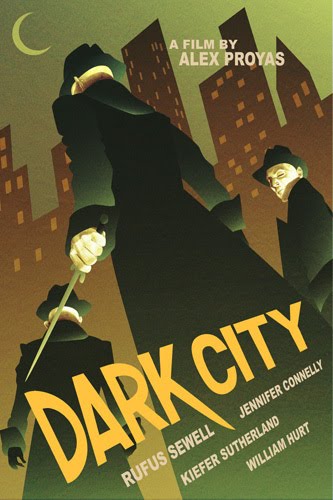
Dark City by Kevin Wada
Another alternate movie poster that's nicer-looking than the original: Kevin Wada's retro Dark City poster, which emphasizes the Strangers, the film's creepy adversaries. [Via Super Punch]

Whitewashed Better Luck Tomorrow by You Offend Me You Offend My Family
The You Offend Me You Offend My Family blog sticks it to Hollywood's tendency to whitewash movies based on source material in which Asians played a central role by whitewashing Better Luck Tomorrow, which starred You Offend Me bloggers Roger Fan and Sung Kang and was directed by their fellow You Offend Me team member Justin Lin. [Via You Offend Me]

Dr. T & the Women II by a Fark.com contributor
A Fark.com "unneeded sequel" entry that imagines a second Dr. T & the Women movie. [Via Super Punch]

Seven Samurai by Grinning-Oni
Seven Samurai by Grinning-Oni.

'Kara Thrace will lead the human race to its end.'
Brandon Schaefer's poster for an advance theatrical screening of the made-for-DVD Battlestar Galactica: Razor in 2007.

Predator by Made by Mat
Predator by Made by Mat. (Wow, that Predators trailer actually doesn't suck. I love how Danny Trejo, Cletus Van Damme and a yakuza are among the human predators. But what's Eric Forman doing in the cast? One of these things is not like the other.) [Via Super Punch]

The Birds by Laz Marquez
The Birds by Laz Marquez. [Via /Film]

Friday, September 4, 2009

Let's do it to them before they do it to us (again): My obligatory thoughts on You Offend Me You Offend My Family's post

June Park of 'Sampler,' created by Jimmy J. Aquino and illustrated by Erwin Haya

You Offend Me You Offend My Family is a blog that was originally conceived to promote Finishing the Game, director Justin Lin's 2007 mockumentary about the obstacles Asian American male actors have to put up with in Hollywood. The blog name is derived from an Enter the Dragon line that the actor characters in Finishing the Game are asked to perform during auditions (the actual line is "You have offended my family, and you have offended the Shaolin Temple"). The people who worked on Finishing the Game recently became the talk of the Asian American blogosphere due to a You Offend Me post that points out the ineffectiveness of the Japanese American Citizens League's protests against a lame gag involving the beating of an Asian American used car salesman in ex-Chappelle's Show writer Neal Brennan's The Goods: Live Hard, Sell Hard (because hate crimes are funny!). Ken Jeong is a hilarious stand-up whom I've seen perform live, and I love his performance in Role Models, but what the hell was he thinking when he agreed to do that scene?

(If Silver Streak-era Richard Pryor were asked to do a scene like that, he would have walked off the set and caused the shoot to be halted so that the scene would have to be changed. That's exactly what Pryor did during the making of Silver Streak when he was uncomfortable with how the white writers scripted a sequence in which characters are fooled by Gene Wilder's lousy disguise as a black man. Pryor's angry protest resulted in a more believably written reaction to Wilder's disguise--the gag was changed to a black shoe shiner who sees his disguise and doesn't buy it at all--and the revision helped make the bathroom sequence the funniest part of Silver Streak.)

In "Hollywood and Asians: Why Protests Alone Won't Change Anything," the You Offend Me blogger suggests that instead of protesting like the JACL, what frustrated Asian Americans ought to do is concentrate their energy on supporting Asian American filmmakers and seeing their movies (easier said than done--the Asian American community is so fragmented and divided, and there are so many different sub-communities, from Chinese American to Filipino American, that it's impossible to get all these sub-communities to flock to these films). Many Asian American bloggers agree with You Offend Me's post, while a lone dissenter, my occasional boss TMM, has been fuming about it.

I don't have much to say on this subject other than the You Offend Me guy is mostly right, and the Angry Black Woman and Byron Wong have best articulated my thoughts on the subject.

First, the Angry Black Woman's thoughts:
But until Asian Americans as a whole are willing to put down our money to support the work of our Asian American filmmakers—nothing will change.

It’s a good point. But something about it bugs me.

Because it assumes something that I’m not sure is true, and feeds into a bigger problem. What Phillip suggests is that if Asian Americans just go and view more Asian American films, this will show Hollywood there’s a significant demand for positive portrayals. The same reasoning, IMO, underlies African Americans’ patronization of black films (and African American Interest books, and so on) — we’ve taken to heart the racist rationalization that if we don’t make it ourselves, and go see it ourselves, we can’t expect the mainstream to follow suit.

Except… African Americans have been making it ourselves, since the Sixties. We’ve been going to see those films, too, enough to create several blockbusters, catapult several African American filmmakers to auteur status, and launch a few subcultural film/theater movements.

But has all this success — all this proof that we will support our own — really changed anything in Hollywood?...

We’ve got to support the positive portrayals that are already out there. And that includes work by other PoC, because all this stuff feeds into each other. We’ll get more successful black actors in Hollywood once we prove that Latinos/as will go and see them. We’ll get more Asian actors when we can prove they appeal to black audiences. We’ll see fewer pretendians when audiences start going to see real Indians. And so on.
And now, Byron's thoughts:
I agree that things won’t change until we start paying, and I agree with his statement that a lot that comes from independent Asian American media “sucks.” ... The Debut was horrible. Yellow was beyond horrible. I couldn’t even finish One Hundred Percent, despite the fact that Tamlyn was in it. I’ve financially supported all of these...

I’ve said this from day one... the problem is the writing. If we improve the writing, if we work to improve our depth of vision by studying and developing writing, everything else will fall into place.
Good God, Yellow blew. That moment in The Limey when the otherwise understated Terence Stamp snaps and snarls, "Tell him I'm fucking comiiiiing!," with a deranged look on his face? Great shouty acting. The perpetually cranky and one-note lead actor in Yellow? The worst shouty acting I've ever seen.

I prefer not to march outside movie studios, multiplexes or--and this was really dumb--the Disney Store (huh?). Protests and letterwriting campaigns accomplish very little. In response to the JACL's furor, Paramount removed the Asian-bashing sight gag from the Goods commercials. So what? The scene is still in the movie. Yay, JACL.

A few months ago, I finished writing a two-week arc of my webcomic The Palace that's about the subject of grassroots protests against movies that are whitewashed remakes or are racially offensive, but I haven't illustrated the arc yet. In my script, the main character says to a classmate who's protesting against an Avatar: The Last Airbender-like martial arts flick, "Aren't there more important things to protest?... The way to fight Hollywood is not to keep organizing protests... but to go make your own fucking movies."

Personally, I think the best way to rob these racially offensive movies of their power is to publicly ridicule them and rip them and their creators to shreds through humor (hence the Hill Street Blues catchphrase that's part of the title of this post--I want to see more Asian American comedians be verbally aggressive towards our enemies and emulate the attitude in Sgt. Jablonski's morning battle cry). We need to do the same things that one of my comedy idols, Paul Mooney, did to Driving Miss Daisy and horror flicks that keep killing off white women or having them sleep with monsters and vampires in both his stand-up act and his 1993 album Race, one of my favorite examples of activism through comedy. To me, there's nothing more powerful than the comedic smackdown Mooney gave to mainstream Hollywood during Race.

Mooney's ridicule of Driving Miss Daisy ("I'll take a bagel and beat the shit out of Miss Daisy") and much less funny but equally dead-on comments about the inane 1989 Best Picture Oscar winner from black celebrities like Spike Lee did more to tarnish the reputation of that movie than any protest would have done. As Lee said to New York magazine about Do the Right Thing's impact in comparison to the Jessica Tandy/Morgan Freeman movie's impact, "No one's talking about Driving Miss Daisy now." When AFI announced its list of the 100 greatest American movies of all time, Driving Miss Daisy didn't make it. Do the Right Thing landed spot #96.

I'd love to see an Asian American comedian or actor ruin the box office grosses of an upcoming racist movie by snarking about that film while being interviewed by a talk show host or magazine writer. I wish that was the reason why The Goods tanked at the box office and quickly disappeared from theaters.

Bottom line? Let's take a cue from Byron and concentrate on improving our writing skills so that there can be more movies from us that people will remember far more than the Live Hard, Sell Hards and Driving Miss Daisys of the industry.