 |
| The annual Oscar luncheon attended by all the acting nominees will be so white this year the menu will experience an 80 percent increase in mayonnaise. (Photo source: YOMYOMF) |
The AFOS weekday morning block name
"The Whitest Block Ever" is supposed to be a joke. The block is far from the whitest thing ever. It consists of
original themes and score cues from films and TV shows directed by Asian American filmmakers and other directors of color. Jokey name aside, the two-hour 10am block is a way to celebrate these directors' efforts to break into and succeed (or in the case of Asian American YouTube content creators like Wong Fu Productions, to persevere on their own) in a largely white--and often discriminatory--industry that sadly doesn't reflect how most of the rest of America is
headed towards becoming a more diverse place.
Bear McCreary's "Courthouse Brawl" and "Stop Running" from
Human Target are part of the "Whitest Block Ever" playlist because African American director Kevin Hooks directed the
Human Target episode that contains those cues, and the
Fresh Prince of Bel-Air theme is in there because Debbie Allen directed the
Fresh Prince pilot. Black, Latino and Asian directors aren't the only directors who are celebrated in "The Whitest Block Ever." BC Smith and ULALI's "Forgive Our Fathers Suite" from Native American director
Chris Eyre's 1998 work
Smoke Signals is part of the playlist, so Native American directors are celebrated as well.
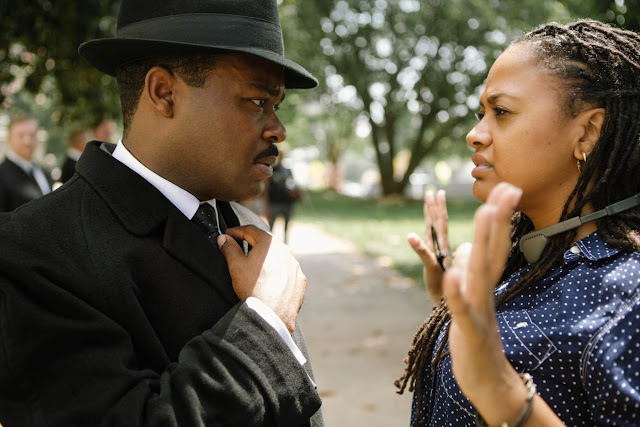 |
| David Oyelowo and his Selma director Ava DuVernay |
But when no actors of color were nominated for this year's Oscars--an overly long-winded award show I stopped caring about years ago because of how frustrating its annual snubs are--and it resulted in the 2015 Oscar acting categories literally being the whitest block ever, the name "The Whitest Block Ever" isn't so amusing anymore. In fact, it's become rather depressing. David Oyelowo's quietly powerful performance as Dr. Martin Luther King during his non-oratorial moments in
Selma was overlooked by the
94 percent white, 77 percent male Academy, as was director Ava DuVernay's work on that riveting historical drama, which received from the Academy only Best Picture and Best Original Song nominations. Had DuVernay been nominated for Best Director, she would have been the first black female director to be nominated in that category. I like what
Selma co-star Wendell Pierce
said about moviegoers' frustrations with the snubs: "The people's reaction speaks for itself. To me, it's what the reaction would have been had Marlon Brando not been nominated for
Godfather, if Rod Steiger had not been nominated for
The Pawnbroker, if De Niro hadn't been nominated for
Taxi Driver. That's what you felt this morning when David Oyelowo was not nominated for an Oscar."
Also, the time for a name change for "The Whitest Block Ever" has been long overdue. So because of those two reasons, I'm dumping the "Whitest Block Ever" name and renaming the 10am block. "Color Box" begins life under its new name with a new addition to the playlist. That addition is the song from the film that's the very thing on the minds of those who have trended #OscarsSoWhite, a tune that won the Golden Globe for Best Original Song last Sunday and is now up for an Oscar: "Glory," the anthemic
Selma end title theme that ties the activism in Selma and
Montgomery together with the activism in Ferguson and reteamed
Selma cast member
Common with John Legend, his guest vocalist from one of my favorite Common tracks, "They Say."
You can call it what you want to: "Oh, the
Selma snubs were because of the negative publicity created by the smear campaign by LBJ's camp about
Selma's portrayal of LBJ" or "Oh, it's because
Paramount bungled Selma's Oscar campaign and didn't time it so well." But the
Selma snubs are simply industry ignorance about anyone who's neither white nor male. The snubs are one of several ways that white Hollywood basically sends a message that writers and directors of color and their stories--especially stories that are told from the points of view of people of color for a change and aren't marred by the presence of a white savior character to misguidedly make the stories more palatable to white audiences--matter little to them.
It's the same kind of industry ignorance that causes a so-called reporter at the Television Critics Association winter press tour to
ask both Eddie Huang--the celebrity chef whose book about growing up in a Taiwanese family,
Fresh Off the Boat, has been adapted into an eagerly anticipated and promising-looking ABC sitcom where he provides voiceovers as the off-screen narrator--and the
Fresh Off the Boat cast the following question: "I love the Asian culture. And I was just talking about the chopsticks, and I just love all that. Will I get to see that? Or will it be more Americanized?" I would have loved for Huang, who proved twice that he's not one for mincing his words, first in a
Vulture tell-all piece about his frustrations with ABC's sitcom version of his own childhood and then again later on in that same TCA panel, to have replied with "That's a stupid fucking question" or--had that person in the audience not been female--"You love chopsticks, right? How about you go shove one up your ass? You'd love that, right, B?"
So let's set aside those two depressing headlines from last week for now and look at where the new AFOS block name "Color Box" comes from. I named "Beat Box," the 7am AFOS block, after an Art of Noise track. That's why it's spelled "Beat Box," not "Beatbox." The "Beat Box" name continues an AFOS block name template that began with
"Rock Box," a now-defunct AFOS block that consisted of existing songs that were used in movies by the likes of Martin Scorsese and Edgar Wright and shows ranging from
The Wire to
The Boondocks. "Beat Box" has double meaning: there's the connection to the Art of Noise instrumental and then there's the fact that the block is literally a box of beats on the Live365 Broadcast Scheduler grid. "Color Box," another continuation of the station's "Blablabla Box" name template, also has double meaning: it refers to both the directors of color whose works are being represented from 10am to noon on AFOS and the color boxes in
Photoshop and Windows XP, which contain as much diversity as
the "Color Box" playlist.
What else is in the future for "Color Box"? I'm adding a musical number from
The Book of Life, Mexican animator Jorge R. Gutierrez's recent 3D-animated feature film about Día de los Muertos, to "Color Box" rotation later this month. And if Justin Lin--who's represented on the "Color Box" playlist by Semiautomatic's original music from
Better Luck Tomorrow, Brian Tyler's score cues from
Finishing the Game, Ludwig Göransson's score cues from the Lin-directed
Community episode "Modern Warfare" and a few themes from
Fast Five and
Furious 6--doesn't end up exiting the 2016
Star Trek threequel that Bad Robot beamed him up to direct after Roberto Orci was kicked out of the captain's chair, maybe some
Star Trek score cues will be added to "Color Box" some time in the future. What would be especially cool is having those cues sit beside the
Fresh Prince theme, Eric B. & Rakim's
Juice theme and Dre and Snoop's
Deep Cover theme.
Sure, I love it whenever a person of color like Lin directs
Star Trek (before the hiring of Lin,
Next Generation regular LeVar Burton and
Voyager regular Roxann Dawson both got their starts as TV directors helming episodes of their respective shows). But after the
empty-headed Star Trek Into Darkness, a misfire that proved how ill-suited the Bad Robot version of
Star Trek is in handling terrorism and war, two subjects
Deep Space Nine previously tackled with much more nuance,
Star Trek needs to be cerebral again. Bad Robot's own show
Fringe, which had its protagonists constantly thinking their way through the sci-fi predicament of the week, was closer to the cerebral and exploratory spirit of the '60s
Trek and its spinoff shows than Bad Robot's
Trek movies themselves have been. I like Lin as both a director and an Asian American creative mind who's both conscious of and candid about industry racism, but his signature movies have been a high-school gangster melodrama with an action-flick aesthetic (
Better Luck Tomorrow, still my favorite movie of his) and four action flicks that were sometimes flavored with gangster-melodrama elements (the
Fast and the Furious sequels). The latter isn't exactly the cerebral direction I've been wanting
Trek to return to. I'd be more thrilled about
Hannibal showrunner and former
Voyager writer
Bryan Fuller--who always wanted to cast Angela Bassett as a starship captain and Rosario Dawson as her first officer, which I'd watch in a heartbeat--getting the chance to helm a new
Trek project for TV, the medium where
Trek works best. But we shall see what happens with this
Trek threequel. At least Lin--who would be reunited with his
Better Luck Tomorrow cast member
John Cho--in the director's chair is far better than allowing Orci the crazy 9/11 truther to direct. I'm glad Paramount basically said, "Beam us up, Scotty. There's no intelligent life on Orci's planet."


