Showing posts with label Chris Evans. Show all posts
Wednesday, September 7, 2016
AFOS Blog Rewind: Scott Pilgrim vs. the World
Oscar-winning Room star Brie Larson has had a killer year as a dramatic performer, so it's time to revisit my March 5, 2015 discussion of an offbeat cult movie in which Larson got to revisit her little-known past as a teenage pop singer, as well as experience a taste of her future. In this 2010 movie, Larson briefly dabbled in the same kind of pulpy material she'll be tackling soon as the star of the forthcoming tentpole blockbusters Kong: Skull Island and Captain Marvel. This 2010 movie has also been on its director's mind lately. When it aired on Channel 4 in the U.K. last month, the director live-tweeted a bunch of crazy behind-the-scenes details about the movie.
The 2010 coming-of-age flick Scott Pilgrim vs. the World is an interesting anomaly in the work of Edgar Wright, the great British director behind the innovative sitcom Spaced and the irreverent Cornetto trilogy with Spaced stars Simon Pegg and Nick Frost (Shaun of the Dead, Hot Fuzz and The World's End). It's his only adaptation of someone else's creation so far, it doesn't take place in England, neither Pegg nor Frost are in the cast and it was his first studio movie, so that meant he had to deal with the often absurd American test screening process.
I recently listened to Wright discuss gauging audience reactions in his Blu-ray audio commentary for Scott Pilgrim's deleted scenes, which include the film's original ending before it was reshot (should Scott have ended up with Knives Chau or Ramona Flowers?: I think the film should have ended either with Scott being single or Scott, Knives and Ramona becoming a threesome because a fight like the ones they had versus Gideon Graves is bound to make everyone horny). Something during that commentary didn't sit right with me. A brilliant and unique comedic filmmaker like Wright should not have to make decisions based on test screenings, even though he has said he considers it "a good thing to do because you see where the laughs are and where you can change things by half a second to get a bigger laugh."
Aside from comments from test screening audience members to DreamWorks Animation that Hiccup should be left disabled at the end of the first How to Train Your Dragon movie, have those test screenings ever been really useful? If Martin Scorsese tried to win back the 40 GoodFellas test screening audience members who walked out after the movie's first 10 minutes, GoodFellas wouldn't have been the GoodFellas we know and love. Unless I'm mistaken, neither of Wright's Cornetto flicks were tweaked due to test screening reactions (in fact, when Hot Fuzz did go through the test screening process in America, Wright defied a suggestion to change Hot Fuzz's title). I hear those movies turned out okay.
While Wright has said he's proud of Scott Pilgrim's final cut, that first experience of trying to please studio execs during the making of that movie had to have colored his heartbreaking decision to quit directing his longtime pet project, this summer's adaptation of Marvel's Ant-Man, where Wright was replaced by Bring It On director Peyton Reed. While squabbling with Marvel Studios execs over the direction of Ant-Man, I'm sure Wright was thinking, "How can the same shit happen to the same guy twice?"
Thursday, March 5, 2015
Throwback Thursday: Scott Pilgrim vs. the World
Every Throwback Thursday, I randomly pull out from my desk cabinet--with my eyes closed--a movie ticket I saved. Then I discuss the movie on the ticket and maybe a little bit of its score, which might be now streaming on AFOS.
The 2010 coming-of-age flick Scott Pilgrim vs. the World is an interesting anomaly in the work of Edgar Wright, the great British director behind the innovative sitcom Spaced and the irreverent Cornetto trilogy with Spaced stars Simon Pegg and Nick Frost (Shaun of the Dead, Hot Fuzz and The World's End). It's his only adaptation of someone else's creation so far, it doesn't take place in England, neither Pegg nor Frost are in the cast and it was his first studio movie, so that meant he had to deal with the often absurd American test screening process.
I recently listened to Wright discuss gauging audience reactions in his Blu-ray audio commentary for Scott Pilgrim's deleted scenes, which include the film's original ending before it was reshot (should Scott have ended up with Knives Chau or Ramona Flowers?: I think the film should have ended either with Scott being single or Scott, Knives and Ramona becoming a threesome because a fight like the ones they had versus Gideon Graves is bound to make everyone horny). Something during that commentary didn't sit right with me. A brilliant and unique comedic filmmaker like Wright should not have to make decisions based on test screenings, even though he has said he considers it "a good thing to do because you see where the laughs are and where you can change things by half a second to get a bigger laugh."
Aside from comments from test screening audience members to DreamWorks Animation that Hiccup should be left disabled at the end of the first How to Train Your Dragon movie, have those test screenings ever been really useful? If Martin Scorsese tried to win back the 40 GoodFellas test screening audience members who walked out after the movie's first 10 minutes, GoodFellas wouldn't have been the GoodFellas we know and love. Unless I'm mistaken, neither of Wright's Cornetto flicks were tweaked due to test screening reactions (in fact, when Hot Fuzz did go through the test screening process in America, Wright defied a suggestion to change Hot Fuzz's title). I hear those movies turned out okay.
While Wright has said he's proud of Scott Pilgrim's final cut, that first experience of trying to please studio execs during the making of that movie had to have colored his heartbreaking decision to quit directing his longtime pet project, this summer's adaptation of Marvel's Ant-Man, where Wright was replaced by Bring It On director Peyton Reed. While squabbling with Marvel Studios execs over the direction of Ant-Man, I'm sure Wright was thinking, "How can the same shit happen to the same guy twice?"
It's remarkable that a movie as inventive as Scott Pilgrim survived such a maddening process where the comments from test audiences and studio execs often win out over what the filmmakers want--and did so with all its inventiveness intact. Scott Pilgrim is such a perfect marriage of source material and filmmaker. Bryan Lee O'Malley's original Scott Pilgrim graphic novels feel like a Toronto indie rock scene version of Spaced. Scott and his roommate Wallace are basically Tim and Mike, except Wallace isn't obsessed with joining the military and is aware he's gay. While Spaced imagines that time when you're trying to navigate yourself both professionally and romantically through your 20s as silly fan film-ish versions of either Star Wars, Hong Kong gun fu, a George Romero flick or The A-Team, Scott Pilgrim cleverly envisions relationship drama as both Kung Fu Hustle and an 8-bit Nintendo game. Wright's film really gets video games like the 8-bit ones I grew up playing. (Speaking of 8-bit, Radiohead producer Nigel Godrich's original score for the film, which can be heard during both "Hall H" on AFOS and "AFOS Prime," effectively combines 8-bit with orchestra, especially during the "Boss Battle" cue for the climactic moment when Gideon is handed his ass, and it goes completely 8-bit at times, like during that amusing cover of Jerry Goldsmith's Universal logo music at the start of the movie or the source cue Dan the Automator created for Scott and Knives' Ninja Ninja Revolution video game.) Along with Run Lola Run, The Raid: Redemption, Edge of Tomorrow and maybe Dredd, Scott Pilgrim is one of the best video game-style movies not based on an actual game.
Wright's understanding of another kind of visual language, that of comic books like O'Malley's Scott Pilgrim novels--and his ability to figure out which parts of that visual language work on screen and which ones don't--fortunately turn the Scott Pilgrim film into the opposite of Ang Lee's lead-footed overstuffing of 2003's Hulk with screen panels and visible page breaks, or as Stop Smiling magazine's Justin Stewart described the screen panels and page breaks in my favorite takedown of Lee's Hulk, "the cinematic equivalent of Karl Rove dancing." Also, thanks to action filmmaking skills he previously demonstrated in Shaun of the Dead, Hot Fuzz and even a few Spaced episodes, Wright makes convincing fight scene combatants out of the least likely actors you'd ever imagine to be in a fight scene, whether it's Michael Cera as Scott, Mae Whitman as Roxy Richter or Jason Schwartzman as Gideon the girlfriend-beating music producer douche (Wright went on to do the same with Nick Frost during his fight scenes in The World's End, transforming him into the most agile rotund action star who's not Sammo Hung).
As believable as Cera is in his fight scenes, he's overshadowed in his own movie (it was supposed to turn the gawky and conservatively dressed teen from Arrested Development and Superbad into a bigger movie star, but nobody outside of Scott Pilgrim novel fans flocked to the movie in the summer of 2010) by funny turns by Ellen Wong as Knives, Kieran Culkin as Wallace and Brandon Routh as dim-witted vegan bassist Todd Ingram, one of the Evil Exes who used to date Ramona (Mary Elizabeth Winstead) and are now challenging Scott to a duel. Scott Pilgrim proves that Routh, who brooded through all of his passable impression of Christopher Reeve in Superman Returns, is at his best as a light comedic actor, which is why I'm glad Arrow's current season is having him tap into those comedic gifts again as the Atom (it's refreshing to see a revenge-minded superhero--Ray Palmer's in the game to avenge his wife's murder--who's not brooding all the time).
As Knives, the clingy, too-young-for-Scott schoolgirl who doesn't take being dumped by Scott very well, Wong is a real find, and she deserves to go on to bigger and better things (since Scott Pilgrim, she's been a cast member on both the Canadian-made 2011 Afghanistan medical drama Combat Hospital and The Carrie Diaries). Part of me wishes the Scott Pilgrim graphic novels and movie version were mainly about Knives instead of Scott. It's interesting to read Asian moviegoers' varied reactions to Wong's performance as Knives five years after the movie's release. They were as divided about the Knives character as black moviegoers were divided about Denzel Washington's heel turn in Flight in 2012.
Writers from YOMYOMF would say things like "Ellen Wong alone was worth watching the film. She was freakin' ADORABLE. Dolls should be made of her," and Asian American Scott Pilgrim fans dug Knives so much that they've cosplayed as her. Meanwhile, a discontinued Asian Canadian collective of bloggers that called itself "the invazn" felt that "It's kind of sad to see Asian women be the 'exotic in-between' girlfriends who aren't even real girlfriends, but pure ego boosters for the main character's lack of masculinity" (someone should have told them O'Malley himself is half-Asian and not some white graphic novelist writing from the outside about people of color he's never interacted with), although the blog's reviewer enjoyed seeing Knives take charge towards the end of the movie and battle both Ramona and Gideon.
"I was just super-proud that I had created a plum role for someone like Ellen Wong, who otherwise may never have been in a major movie, just by being born Asian and Canadian," wrote O'Malley in a fascinating 2013 Tumblr post. He admitted in that post that the cast of mostly white characters and a few Asian characters in the original novels reflected an unenlightened attitude towards race he had for the first 20 years of his life, and he ended up being appalled by how white the movie looked. His willingness to admit those things must have taken as much guts as it does for Scott to admit to his exes Knives and Kim Pine (Alison Pill), the snarky and sullen drummer in Scott's band Sex Bob-omb (notice how all the drummers in the movie are female), that he shouldn't have been so careless about how he treated them when he dated them. Scott Pilgrim gets some flack for being an overly noisy and hyperactive movie that doesn't take enough time to breathe and be more naturalistic, but that scene where Kim briefly sets aside her snarky and sullen demeanor and wordlessly accepts Scott's apology is one of several human touches in the movie that make Scott Pilgrim more human than the average video game-inspired movie. It's also an example of how great an actor Pill is (watch her also command the screen in a much more broadly played way during her one scene as a fascist schoolteacher in Snowpiercer).
Scott Pilgrim does so many things well as a video game movie, a comic book adaptation and a coming-of-age farce that it's easy to forget what it also accomplishes as a movie about small-time rock bands. I knew Scott Pilgrim would be a solid battle-of-the-bands movie right when it had characters attempting to talk to each other inside a club, and they couldn't hear each other, a typical aspect of modern-day nightlife Hollywood rarely gets right. The running joke of the unenthusiastic MC who's as excited about introducing musical acts as Robert De Niro is about sitting through a press junket is another funny, straight-out-of-real-life touch during the movie's band scenes, as is the way that Beck, who wrote and recorded Sex Bob-omb's material, purposely downgraded the quality of his own sound to capture what a not-so-great band in the Toronto indie scene would sound like. Scott and his bandmates view the glitzy Clash at Demonhead--led by Scott's hot ex-girlfriend Envy Adams (Brie Larson)--to be evil corporate sellouts, but the ironic truth is Envy and her band don't sound as mediocre as Sex Bob-omb do, as we discover during "Black Sheep," sung quite nicely by Larson very briefly in the film (while it's sung on the Scott Pilgrim ABKCO song album by Metric frontwoman Emily Haines, whose Toronto-based band provided material for The Clash at Demonhead and whose fashions O'Malley used as the basis for Envy's in the novels). I wish the regular release of the ABKCO song album included the Larson version of "Black Sheep" as a bonus track, but fortunately, it can be heard in its entirety as a Blu-ray extra or right below.
You also have to be in lesbians with a movie that riffs on Goldsmith's Universal logo music not once but twice. While rewatching Scott Pilgrim in preparation for today's edition of Throwback Thursday, I completely forgot about Chris Evans cracking his neck to the pounding drums of the Universal logo music and laughed my ass off. What other movie has done a sight gag like that? It's also a moment where you're so relieved that those meddling kids from the test screening audiences who have attempted to ruin so many perfectly decent movies didn't get to intervene.
Selections from the Scott Pilgrim vs. the World score can be heard during the AFOS blocks "AFOS Prime" and "Hall H."
The 2010 coming-of-age flick Scott Pilgrim vs. the World is an interesting anomaly in the work of Edgar Wright, the great British director behind the innovative sitcom Spaced and the irreverent Cornetto trilogy with Spaced stars Simon Pegg and Nick Frost (Shaun of the Dead, Hot Fuzz and The World's End). It's his only adaptation of someone else's creation so far, it doesn't take place in England, neither Pegg nor Frost are in the cast and it was his first studio movie, so that meant he had to deal with the often absurd American test screening process.
I recently listened to Wright discuss gauging audience reactions in his Blu-ray audio commentary for Scott Pilgrim's deleted scenes, which include the film's original ending before it was reshot (should Scott have ended up with Knives Chau or Ramona Flowers?: I think the film should have ended either with Scott being single or Scott, Knives and Ramona becoming a threesome because a fight like the ones they had versus Gideon Graves is bound to make everyone horny). Something during that commentary didn't sit right with me. A brilliant and unique comedic filmmaker like Wright should not have to make decisions based on test screenings, even though he has said he considers it "a good thing to do because you see where the laughs are and where you can change things by half a second to get a bigger laugh."
Aside from comments from test screening audience members to DreamWorks Animation that Hiccup should be left disabled at the end of the first How to Train Your Dragon movie, have those test screenings ever been really useful? If Martin Scorsese tried to win back the 40 GoodFellas test screening audience members who walked out after the movie's first 10 minutes, GoodFellas wouldn't have been the GoodFellas we know and love. Unless I'm mistaken, neither of Wright's Cornetto flicks were tweaked due to test screening reactions (in fact, when Hot Fuzz did go through the test screening process in America, Wright defied a suggestion to change Hot Fuzz's title). I hear those movies turned out okay.
While Wright has said he's proud of Scott Pilgrim's final cut, that first experience of trying to please studio execs during the making of that movie had to have colored his heartbreaking decision to quit directing his longtime pet project, this summer's adaptation of Marvel's Ant-Man, where Wright was replaced by Bring It On director Peyton Reed. While squabbling with Marvel Studios execs over the direction of Ant-Man, I'm sure Wright was thinking, "How can the same shit happen to the same guy twice?"
It's remarkable that a movie as inventive as Scott Pilgrim survived such a maddening process where the comments from test audiences and studio execs often win out over what the filmmakers want--and did so with all its inventiveness intact. Scott Pilgrim is such a perfect marriage of source material and filmmaker. Bryan Lee O'Malley's original Scott Pilgrim graphic novels feel like a Toronto indie rock scene version of Spaced. Scott and his roommate Wallace are basically Tim and Mike, except Wallace isn't obsessed with joining the military and is aware he's gay. While Spaced imagines that time when you're trying to navigate yourself both professionally and romantically through your 20s as silly fan film-ish versions of either Star Wars, Hong Kong gun fu, a George Romero flick or The A-Team, Scott Pilgrim cleverly envisions relationship drama as both Kung Fu Hustle and an 8-bit Nintendo game. Wright's film really gets video games like the 8-bit ones I grew up playing. (Speaking of 8-bit, Radiohead producer Nigel Godrich's original score for the film, which can be heard during both "Hall H" on AFOS and "AFOS Prime," effectively combines 8-bit with orchestra, especially during the "Boss Battle" cue for the climactic moment when Gideon is handed his ass, and it goes completely 8-bit at times, like during that amusing cover of Jerry Goldsmith's Universal logo music at the start of the movie or the source cue Dan the Automator created for Scott and Knives' Ninja Ninja Revolution video game.) Along with Run Lola Run, The Raid: Redemption, Edge of Tomorrow and maybe Dredd, Scott Pilgrim is one of the best video game-style movies not based on an actual game.
Wright's understanding of another kind of visual language, that of comic books like O'Malley's Scott Pilgrim novels--and his ability to figure out which parts of that visual language work on screen and which ones don't--fortunately turn the Scott Pilgrim film into the opposite of Ang Lee's lead-footed overstuffing of 2003's Hulk with screen panels and visible page breaks, or as Stop Smiling magazine's Justin Stewart described the screen panels and page breaks in my favorite takedown of Lee's Hulk, "the cinematic equivalent of Karl Rove dancing." Also, thanks to action filmmaking skills he previously demonstrated in Shaun of the Dead, Hot Fuzz and even a few Spaced episodes, Wright makes convincing fight scene combatants out of the least likely actors you'd ever imagine to be in a fight scene, whether it's Michael Cera as Scott, Mae Whitman as Roxy Richter or Jason Schwartzman as Gideon the girlfriend-beating music producer douche (Wright went on to do the same with Nick Frost during his fight scenes in The World's End, transforming him into the most agile rotund action star who's not Sammo Hung).
As believable as Cera is in his fight scenes, he's overshadowed in his own movie (it was supposed to turn the gawky and conservatively dressed teen from Arrested Development and Superbad into a bigger movie star, but nobody outside of Scott Pilgrim novel fans flocked to the movie in the summer of 2010) by funny turns by Ellen Wong as Knives, Kieran Culkin as Wallace and Brandon Routh as dim-witted vegan bassist Todd Ingram, one of the Evil Exes who used to date Ramona (Mary Elizabeth Winstead) and are now challenging Scott to a duel. Scott Pilgrim proves that Routh, who brooded through all of his passable impression of Christopher Reeve in Superman Returns, is at his best as a light comedic actor, which is why I'm glad Arrow's current season is having him tap into those comedic gifts again as the Atom (it's refreshing to see a revenge-minded superhero--Ray Palmer's in the game to avenge his wife's murder--who's not brooding all the time).
As Knives, the clingy, too-young-for-Scott schoolgirl who doesn't take being dumped by Scott very well, Wong is a real find, and she deserves to go on to bigger and better things (since Scott Pilgrim, she's been a cast member on both the Canadian-made 2011 Afghanistan medical drama Combat Hospital and The Carrie Diaries). Part of me wishes the Scott Pilgrim graphic novels and movie version were mainly about Knives instead of Scott. It's interesting to read Asian moviegoers' varied reactions to Wong's performance as Knives five years after the movie's release. They were as divided about the Knives character as black moviegoers were divided about Denzel Washington's heel turn in Flight in 2012.
Writers from YOMYOMF would say things like "Ellen Wong alone was worth watching the film. She was freakin' ADORABLE. Dolls should be made of her," and Asian American Scott Pilgrim fans dug Knives so much that they've cosplayed as her. Meanwhile, a discontinued Asian Canadian collective of bloggers that called itself "the invazn" felt that "It's kind of sad to see Asian women be the 'exotic in-between' girlfriends who aren't even real girlfriends, but pure ego boosters for the main character's lack of masculinity" (someone should have told them O'Malley himself is half-Asian and not some white graphic novelist writing from the outside about people of color he's never interacted with), although the blog's reviewer enjoyed seeing Knives take charge towards the end of the movie and battle both Ramona and Gideon.
"I was just super-proud that I had created a plum role for someone like Ellen Wong, who otherwise may never have been in a major movie, just by being born Asian and Canadian," wrote O'Malley in a fascinating 2013 Tumblr post. He admitted in that post that the cast of mostly white characters and a few Asian characters in the original novels reflected an unenlightened attitude towards race he had for the first 20 years of his life, and he ended up being appalled by how white the movie looked. His willingness to admit those things must have taken as much guts as it does for Scott to admit to his exes Knives and Kim Pine (Alison Pill), the snarky and sullen drummer in Scott's band Sex Bob-omb (notice how all the drummers in the movie are female), that he shouldn't have been so careless about how he treated them when he dated them. Scott Pilgrim gets some flack for being an overly noisy and hyperactive movie that doesn't take enough time to breathe and be more naturalistic, but that scene where Kim briefly sets aside her snarky and sullen demeanor and wordlessly accepts Scott's apology is one of several human touches in the movie that make Scott Pilgrim more human than the average video game-inspired movie. It's also an example of how great an actor Pill is (watch her also command the screen in a much more broadly played way during her one scene as a fascist schoolteacher in Snowpiercer).
Scott Pilgrim does so many things well as a video game movie, a comic book adaptation and a coming-of-age farce that it's easy to forget what it also accomplishes as a movie about small-time rock bands. I knew Scott Pilgrim would be a solid battle-of-the-bands movie right when it had characters attempting to talk to each other inside a club, and they couldn't hear each other, a typical aspect of modern-day nightlife Hollywood rarely gets right. The running joke of the unenthusiastic MC who's as excited about introducing musical acts as Robert De Niro is about sitting through a press junket is another funny, straight-out-of-real-life touch during the movie's band scenes, as is the way that Beck, who wrote and recorded Sex Bob-omb's material, purposely downgraded the quality of his own sound to capture what a not-so-great band in the Toronto indie scene would sound like. Scott and his bandmates view the glitzy Clash at Demonhead--led by Scott's hot ex-girlfriend Envy Adams (Brie Larson)--to be evil corporate sellouts, but the ironic truth is Envy and her band don't sound as mediocre as Sex Bob-omb do, as we discover during "Black Sheep," sung quite nicely by Larson very briefly in the film (while it's sung on the Scott Pilgrim ABKCO song album by Metric frontwoman Emily Haines, whose Toronto-based band provided material for The Clash at Demonhead and whose fashions O'Malley used as the basis for Envy's in the novels). I wish the regular release of the ABKCO song album included the Larson version of "Black Sheep" as a bonus track, but fortunately, it can be heard in its entirety as a Blu-ray extra or right below.
You also have to be in lesbians with a movie that riffs on Goldsmith's Universal logo music not once but twice. While rewatching Scott Pilgrim in preparation for today's edition of Throwback Thursday, I completely forgot about Chris Evans cracking his neck to the pounding drums of the Universal logo music and laughed my ass off. What other movie has done a sight gag like that? It's also a moment where you're so relieved that those meddling kids from the test screening audiences who have attempted to ruin so many perfectly decent movies didn't get to intervene.
Selections from the Scott Pilgrim vs. the World score can be heard during the AFOS blocks "AFOS Prime" and "Hall H."
Thursday, February 12, 2015
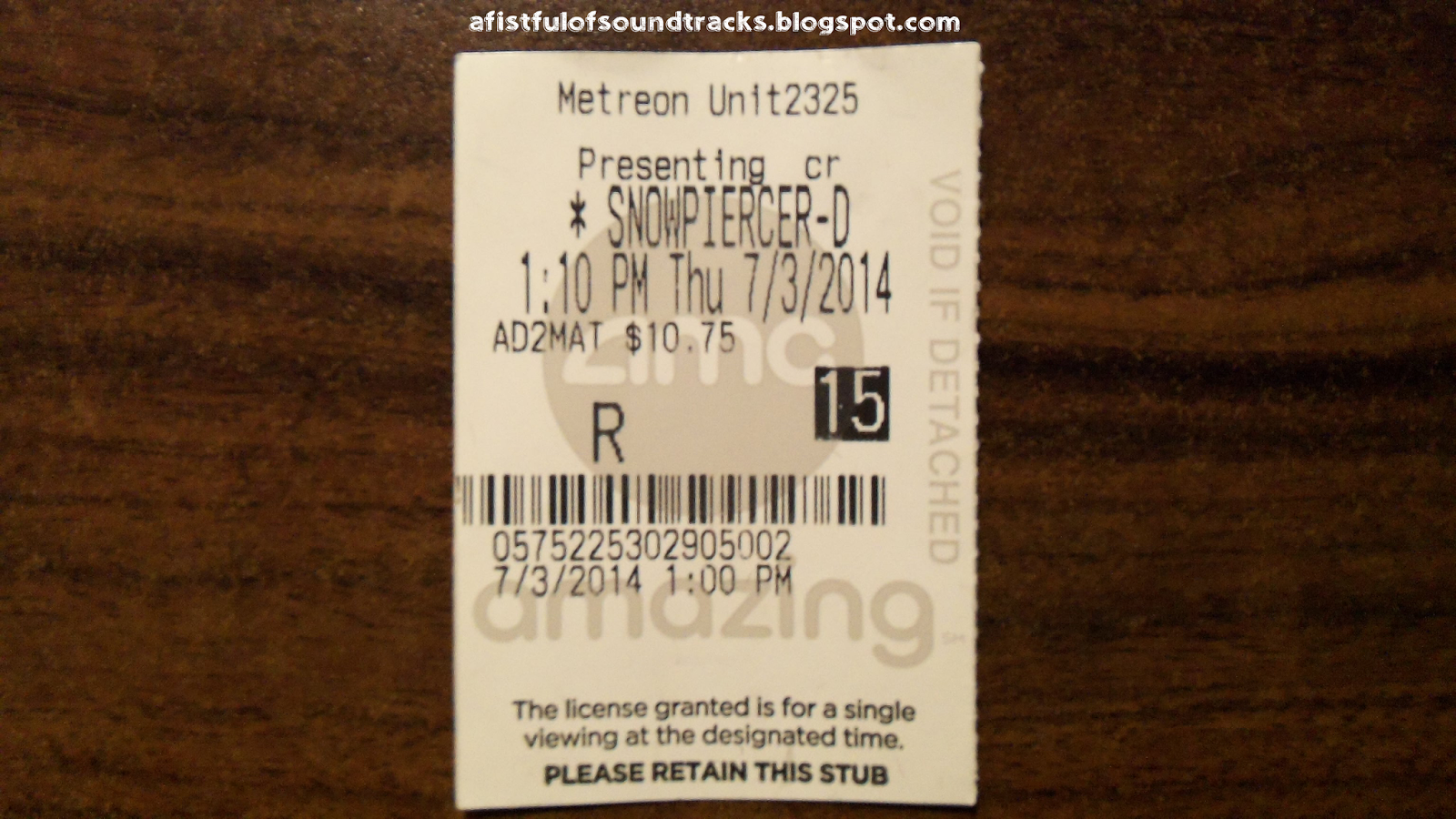
Throwback Thursday: Snowpiercer
Every Throwback Thursday, I randomly pull out from my desk cabinet--with my eyes closed--a movie ticket I saved. Then I discuss the movie on the ticket. The following was previously posted on September 5, 2014, under the title "Jezebel says summer 2014 was too depressing to deserve a song of the summer, but it's definitely earned a movie of the summer."
Every time the summer wraps up, music or entertainment news orgs come out with their annual think pieces or listicles about the song of the summer, and the end of the summer last week was no exception. But Jezebel makes the bold argument that we shouldn't be talking about a song of the summer, especially after a summer of Ferguson, various other kinds of civil rights abuses, Elliot Rodger, the missile attack on the Malaysian Airlines jet, the Israel-Gaza conflict, ebola and Robin Williams' suicide. "There wasn't a 'song of summer' that defined these months, like 'Call Me Maybe' did in 2012 and 'Hot In Herre' does every summer. But this summer doesn't fucking deserve its own song. It hasn't earned it," wrote Erin Gloria Ryan at Jezebel.
In addition to a dismal three months of world news, the candidates that showbiz reporters have brought up as the possible song of summer 2014 are pretty dire. "Fancy" by Iggy Azalea, cultural appropriation's newest star? Fuck that song. (I don't like picking songs of the summer, and I agree that summer 2014 doesn't deserve one, but "Bom Bom Fiya" by Slimkid3 & DJ Nu-Mark, "Always Winnin" by Shad, "Remedy" by All About She, "Klapp Klapp" by Little Dragon and "Sup Bruce," a tribute to Bruce Lee by The Bar, were all pretty damn good, especially "Bom Bom Fiya.")
However, summer 2014 has definitely earned a movie of the summer. I can't think of any other recent movie right now that speaks to summer 2014's feelings of unrest quite like director Bong Joon-ho's dystopian sci-fi blockbuster Snowpiercer does. That and many other reasons are why Snowpiercer is my favorite movie of summer 2014, as well as why selections from Marco Beltrami's score to the movie, in which Beltrami used instruments like the cimbalom to establish "a sound of antiquity" during Bong's futuristic tale of class conflict, are now playing on "AFOS Prime" and "New Cue Revue" on AFOS.
As much as I like Guardians of the Galaxy, the year's highest-grossing movie so far and one of the summer's most favorably received blockbusters in critics' circles (as well as a movie with a score that's also now being streamed on AFOS), Guardians suffers from a dull lead villain (what was his name again?). Snowpiercer doesn't have that problem. It features one of the year's most entertaining and well-drawn antagonists, in the snaggle-toothed form of Minister Mason, Tilda Swinton's Thatcher-ish politician/spokesperson character ("I am a hat. You are a shoe. I belong on the head. You belong on the foot... Know your place. Keep your place. Be a shoe."). Like Guardians, Snowpiercer is based on an obscure comic--the 1982 French graphic novel Le Transperceneige by Jacques Lob, Benjamin Legrand and Jean-Marc Rochette--but unlike Guardians, it's set in a rather depressing milieu. The Bong movie, which actually came out last year in Korea, Japan and Europe before hitting American theaters in June, centers on a violent revolt aboard the Snowpiercer, a state-of-the-art train that's circling the world and carrying the last remaining survivors of a failed and disastrous attempt to prevent global warming. The cramped train is, of course, a metaphor for our current world, and as Bong said when he told The Mary Sue about why Le Transperceneige intrigued him, the train exemplifies his observation that "No matter what situation we find ourselves in, there's no peace."
Do the Right Thing, Attack the Block and now Snowpiercer are the best kind of summer movie: darkly funny, bleak (even though Moses defeats the aliens at the end of Attack the Block, he still winds up as another black man in prison), sequel-proof, racially diverse and a Fox News viewer's nightmare, due to both their political views and their diverse casts (sorry, Dawn of the Planet of the Apes, but you're lacking in the well-drawn female character department, and your version of San Francisco is implausibly devoid of Asians for some weird goddamn reason). I like escapist popcorn fare during the summer months like everybody else, but I prefer much of that kind of fare to carry some sort of weight or meaning and be reflective of some of the real-world madness outside the theater. Many tentpole blockbusters that use tiresome 9/11 imagery to attempt to raise the dramatic stakes are especially terrible at this, whereas the smaller-scale action movies Attack the Block and Snowpiercer don't play the 9/11 card and find other ways to make their material relevant and pungent. For Bong, one of those ways is the economic inequality in Korea, which appears to form much of the basis for Snowpiercer's class conflict.
Snowpiercer and The Lego Movie, which enraged Fox News' comrade in right-wing bullshit, Fox Business, would make for a terrific double bill of humorous films about the evils of big business. At the same time though, Snowpiercer, despite its disdain for big business in the form of the Wilford Corporation, doesn't opt for a simplistic "the left will ultimately prevail" narrative. It doesn't provide easy and comforting answers for the left, much like how Do the Right Thing doesn't provide answers on how to effectively deal with racism. Snowpiercer's (spoiler!) late twist that Chris Evans' lead revolutionary character Curtis was, without him realizing it, being groomed to inherit the corporation he was fighting against conveys Bong's bleak point that even when revolutionaries try their hardest, the corrupt system they're fighting will never be broken. That point is also conveyed by the harrowing confession Curtis makes to Namgoong Minsu, frequent Bong film star Song Kang-ho's perpetually stoned security expert character, about--without giving too much away--how even a revolutionary like himself, when he was younger, wasn't immune to the worst kind of behavior encouraged by the system.
If you're enraged by the police lately because of the situation in Ferguson, check out Snowpiercer, as well as Bong's other movies from South Korea, if you haven't done so; Bong feels your disdain for the police. The fact-based 2003 procedural Memories of Murder and the great 2006 monster movie The Host--where, just like in Snowpiercer, Song and Ah-sung Ko star as a father-and-daughter duo--also carry a huge disdain for authority and institutions at their most incompetent (in "Reverse Trip: Charting the History of Bong Joon-ho's Snowpiercer," RogerEbert.com's Scout Tafoya writes that Korean New Wave films like Snowpiercer reflect their directors' frustrations with corruption and bureaucratic incompetence in their own homeland). Even the 2009 thriller Mother, the Bong feature film with the least amount of social commentary, is tinged with that same distrust of authority.
From Memories of Murder to Snowpiercer, Bong has emerged as one of the sharpest satirical minds working in film today. I can't think of another current director who juggles various tones as unusually and effectively as Bong does. Like the grieving scene in the gym during The Host, Mason's speech to the lower-class Snowpiercer passengers early on in the movie is classic Bong: satire, slapstick and drama are going on all at once. The minister hilariously bumbles through her "Be a shoe" speech (she gets disrupted by clumsy translators and a tray that falls loudly on the ground, which wasn't in the script and was a blooper that Bong liked so much that he kept it in the film) while a torture scene ensues behind her, and we don't know whether to laugh or be disturbed over the bizarre punishment the goofy-looking Ewen Bremner character receives on his arm (it gets frozen and then amputated).
The "Be a shoe" speech/torture scene is one of many Bong moments where you, the viewer, are experiencing several things at once: anger over the cruelty of authority figures, laughter over their incompetence and silly behavior, sympathy for the mistreated protagonists and disappointment with those same protagonists because of mistakes they could have easily avoided (Bong's protags are never perfect and flawless saints). Bong explained his approach to these moments to The Mary Sue by saying, "These types of moments are generally kind of awkward for the audience, and I like that, because I think life is like that. It's not like something happens and everyone knows 'Oh, this is a funny moment,' or 'Oh, this is a sad moment.' It's not really divided like that."
That sort of tonal weirdness--other examples include Curtis slipping on a fish on the floor in the middle of a serious fight scene and Alison Pill's one great scene as a cheery and psychotic schoolteacher--is an endearing part of Snowpiercer and Bong's other films, but I see why it can be challenging and off-putting for some moviegoers ("People didn't know if [The Host] was supposed to be funny--if they were supposed to laugh--or if they were supposed to be sad," said Bong about the confused reactions many Japanese moviegoers had to The Host). However, tinkering with Bong's idiosyncratic brand of filmmaking--which is exactly what Harvey Weinstein, the bullying studio chief with a history of getting his sausage-fingered hands on perfectly fine Asian movies and then butchering them, attempted to do when he wanted to shorten the running time of the American release of Snowpiercer--is just the worst way to make Bong's work attract moviegoers who aren't fans of his filmmaking. Bong opposed Weinstein's attempt to trim Snowpiercer and got into a war of words with The Weinstein Company that mirrored Curtis and the lower-class passengers' attempt to overthrow the upper class.
Fortunately, Bong won the battle, and although Weinstein cut down the amount of theaters he originally planned for Snowpiercer's American release in what comes across to me as a petty form of payback for Bong getting his way, Snowpiercer ultimately found its audience, not in theaters as a midnight-movie sensation but on VOD. We have Radius-TWC, The Weinstein Company's own boutique division, to thank for rescuing Snowpiercer in America and helping to turn it into a hit on iTunes two weeks after debuting in theaters.
"A lot of people come back to this movie a second, third, fourth, fifth time [on VOD]. I think the immediacy of that and how it shows up in social media speak directly to what the themes of this movie are," said Radius-TWC co-president Tom Quinn when he discussed the experimental distribution strategy that led to Snowpiercer's VOD success on KCRW's The Business.
That VOD success is also why Snowpiercer is the movie of the summer: it represents an interesting future for a certain kind of blockbuster that's neither a superhero movie nor a movie for kids, where an above-average action movie that, for some reason, would have had a difficult time finding an audience in theaters can succeed via this new platform--or where a movie that's receiving good word-of-mouth but isn't being released in smaller markets is now easily accessible to moviegoers from those markets who want to see it. Thanks to VOD, they can watch it now with just one click. As Josh Levin said in his Slate post about his enthusiasm over being able to catch Snowpiercer on demand, "We should embrace and celebrate the fact that we can now watch great movies on TV the same day they're in theaters."
As someone who's becoming increasingly less enamored with going to the theater to watch movies--I keep wanting to punch the lights out of younger moviegoers whenever they get unruly or start playing with their smartphones (this is why theaters need to start hiring bouncers)--I've been all for the rise of VOD ever since Radius-TWC made its first splash with the multi-platform release of the indie comedy Bachelorette in 2012. Though I saw Snowpiercer in the theater instead of on demand, that old saying of "Support this little film by buying a ticket to see it"--a line I frequently heard when Asian American college students and supporters of Asian American indie movies tried to get members of various Asian American subcommunities to see Better Luck Tomorrow in theaters in 2003--is just going to sound silly and outdated when three or four more Snowpiercers or They Came Togethers take off on VOD or when that inevitable day comes when Asian American content creators who have been successful on YouTube start releasing feature films on iTunes.
I shudder to think about what would have happened if Bong lost the power of final cut to Weinstein and a truncated version of Snowpiercer wound up on VOD instead. Snowpiercer already has several bleak endings. Why does it need another? Plus the sight of Bong's vision being compromised would have added to making the past three months--which, headline-wise, were as dismal as the living conditions and black protein block food the lower-class Snowpiercer passengers are forced to put up with--a tad more dismal. The fact that Snowpiercer was able to arrive in America with all of its scenes intact--plus the fact that the film turned out to be so damn good and is yet another work in Bong's filmography that's both enjoyable and so dead-on about the fucked-up real world outside the theater--are, to borrow the words of Raymond Carver, a small, good thing in a time like this.
Selections from the score to Snowpiercer can currently be heard during "AFOS Prime" on AFOS.
Thursday, January 8, 2015
Throwback Thursday: Captain America: The First Avenger
Every Throwback Thursday, I randomly pull out from my desk cabinet--with my eyes closed--a movie ticket I saved. Then I discuss the movie on the ticket and maybe a little bit of its score, which might be now streaming on AFOS.
What I wrote about Captain America: The First Avenger here on the AFOS blog back in 2012:
I remember watching the Marvel Comics float during NBC's coverage of the Macy's Thanksgiving Day Parade as a kid and thinking, "This fake battle between the Marvel heroes and villains looks so cheesy, and the music from Back to the Future's not really helping."
That was back when the Marvel characters had a lousy track record on both the big and small screens, outside of animation. (Sure, The Incredible Hulk landed a few Emmy nominations back in the day and actually won one of them, but have you watched it lately? Its formulaic and Fugitive-inspired premise wears thin quickly, despite showrunner Kenneth Johnson's mostly serious treatment of the material and Bill Bixby's best efforts as the renamed-due-to-homophobia David Banner in standout episodes like "Dark Side," where both Banner and his Hulk self turn evil and pervy due to a serum experiment gone wrong.) In the years between the Marvel Thanksgiving Parade float and the breakout success of the first Blade movie, the first Marvel-inspired feature film that both the mainstream and the comics crowd liked, I thought, "Having the Marvel heroes run around and strike a pose to Alan Silvestri's Back to the Future theme was corny as hell, but wouldn't it be sweet if someday, someone like Silvestri wrote music for a Marvel character that was on a par with something like Silvestri's work for Back to the Future and Predator? Oh yeah, and a quality screenplay for that character would be dope too."
In 2011, both those things actually happened after Silvestri got recruited for a Marvel Studios project where screenwriting partners Christopher Markus and Stephen McFeely skillfully brought to life one of Marvel's oldest properties--a character I never really cared for, even when one of my favorite comics authors, Ed Brubaker, gave him an ambitious relaunch in print.
The first things that would come to mind whenever I'd hear the name "Captain America" were Glenn Miller, LaSalles, bobby socks and Japanese internment camps. Even though a comic shop owner who knew I was a fan of the Brubaker titles Gotham Central and Sleeper insisted that Brubaker was doing a bang-up job and making Captain America more of an espionage comic than a superhero comic, I still couldn't get past issue 1 and see the appeal of this whitebread Boy Scout in the silly jingoistic costume, the star of the lame Thanksgiving Parade production number above. He was never as interesting to me as the prejudice-fighting X-Men, Spider-Man the angsty and quippy New Yorker or Spidey's West Coast counterparts, the younger and much more anti-establishment Runaways.
In Captain America: The First Avenger, Markus, McFeely, an uncredited Joss Whedon and director Joe Johnston, armed with the same sense of style he brought to The Rocketeer, all found ways to keep Steve Rogers (Chris Evans) from coming off as antiquated and banal while still confining his character to a period setting. One of those ways was to say "Screw it" and embrace Steve's do-gooder nature, but to make that eagerness to do good relatable and appealing (with the help of a subdued performance by Evans, removing all traces of his one-note, probably-bathes-his-dick-in-Axe-body-spray Johnny Storm character from the Fantastic Four movies and his smarmy action movie star character from Scott Pilgrim vs. the World). That's best embodied in the frail but courageous Steve's response when a scientist (a German-accented Stanley Tucci) asks him if he wants to kill Nazis: "I don't want to kill anyone. I don't like bullies. I don't care where they're from."
The First Avenger supplies this guy who doesn't like bullies with two outstanding original marches. "Star Spangled Man," penned by Disney musical songsmiths Alan Menken and David Zippel, is an amusing fake '40s show tune that accompanies the newly buffed-up Steve when the military doesn't consider him experienced enough for combat, so they sideline him to performing at a USO tour as a war bonds-promoting mascot, clad in a costume as shabby-looking as the tights worn by the stuntman who played Captain America on the '80s Marvel float. The USO tour is a clever device that helps make Steve's offstage heroism pay off beautifully in the film's second act.
The other march, which is much less comedic than "Star Spangled Man," is provided by Silvestri, who, while writing the First Avenger score, found time to give a concert with the Video Game Orchestra at his alma mater, Boston's Berklee College of Music, where he told an interviewer from Berklee that Steve's humble quality was what particularly appealed to him about The First Avenger. Silvestri tapped into that quality throughout his First Avenger themes, which is a reason why they work so well.
Silvestri's suitably old-school First Avenger score is truly on a par with his work for the Back to the Future and Predator films. It's like the score that should have accompanied that cheesy Marvel float back in the '80s. (Like Steve during the USO montage, the vigorous end title rendition of the "Captain America March" got sidelined, specifically to bonus track status on the iTunes edition of the First Avenger soundtrack album, which frustrated consumers who already bought the end title theme-less First Avenger CD.)
Man, I would love to hear Cap's march in a live setting, but this will do.
What I think about The First Avenger in 2015:
It holds up. Hayley Atwell's breakout performance as Agent Carter is one of the highlights of The First Avenger, and I'm glad for the continual presence of Atwell's character in the Marvel Cinematic Universe (this week's solid two-hour premiere of Atwell's Agent Carter miniseries on ABC makes me wish for Agent Carter to become a regular series, although I'd prefer it to be in the eight-episodes-per-season format that's closer to British TV, instead of the increasingly outdated and unwieldy 22-a-season format). But the Winter Soldier sequel, which drew inspiration from much of the acclaimed Brubaker revamp of the Captain America comics, is even more impressive than The First Avenger as a Marvel Cinematic Universe movie, showing "some surprising depth in its depiction of an unchecked intelligence agency and a U.S. government that executes enemies without trial," as Jamelle Bouie wrote in Slate. Hail HYDRA fighta.
Selections from the Captain America: The First Avenger score can be heard during the AFOS blocks "AFOS Prime" and "Hall H."
What I wrote about Captain America: The First Avenger here on the AFOS blog back in 2012:
I remember watching the Marvel Comics float during NBC's coverage of the Macy's Thanksgiving Day Parade as a kid and thinking, "This fake battle between the Marvel heroes and villains looks so cheesy, and the music from Back to the Future's not really helping."
That was back when the Marvel characters had a lousy track record on both the big and small screens, outside of animation. (Sure, The Incredible Hulk landed a few Emmy nominations back in the day and actually won one of them, but have you watched it lately? Its formulaic and Fugitive-inspired premise wears thin quickly, despite showrunner Kenneth Johnson's mostly serious treatment of the material and Bill Bixby's best efforts as the renamed-due-to-homophobia David Banner in standout episodes like "Dark Side," where both Banner and his Hulk self turn evil and pervy due to a serum experiment gone wrong.) In the years between the Marvel Thanksgiving Parade float and the breakout success of the first Blade movie, the first Marvel-inspired feature film that both the mainstream and the comics crowd liked, I thought, "Having the Marvel heroes run around and strike a pose to Alan Silvestri's Back to the Future theme was corny as hell, but wouldn't it be sweet if someday, someone like Silvestri wrote music for a Marvel character that was on a par with something like Silvestri's work for Back to the Future and Predator? Oh yeah, and a quality screenplay for that character would be dope too."
In 2011, both those things actually happened after Silvestri got recruited for a Marvel Studios project where screenwriting partners Christopher Markus and Stephen McFeely skillfully brought to life one of Marvel's oldest properties--a character I never really cared for, even when one of my favorite comics authors, Ed Brubaker, gave him an ambitious relaunch in print.
The first things that would come to mind whenever I'd hear the name "Captain America" were Glenn Miller, LaSalles, bobby socks and Japanese internment camps. Even though a comic shop owner who knew I was a fan of the Brubaker titles Gotham Central and Sleeper insisted that Brubaker was doing a bang-up job and making Captain America more of an espionage comic than a superhero comic, I still couldn't get past issue 1 and see the appeal of this whitebread Boy Scout in the silly jingoistic costume, the star of the lame Thanksgiving Parade production number above. He was never as interesting to me as the prejudice-fighting X-Men, Spider-Man the angsty and quippy New Yorker or Spidey's West Coast counterparts, the younger and much more anti-establishment Runaways.
In Captain America: The First Avenger, Markus, McFeely, an uncredited Joss Whedon and director Joe Johnston, armed with the same sense of style he brought to The Rocketeer, all found ways to keep Steve Rogers (Chris Evans) from coming off as antiquated and banal while still confining his character to a period setting. One of those ways was to say "Screw it" and embrace Steve's do-gooder nature, but to make that eagerness to do good relatable and appealing (with the help of a subdued performance by Evans, removing all traces of his one-note, probably-bathes-his-dick-in-Axe-body-spray Johnny Storm character from the Fantastic Four movies and his smarmy action movie star character from Scott Pilgrim vs. the World). That's best embodied in the frail but courageous Steve's response when a scientist (a German-accented Stanley Tucci) asks him if he wants to kill Nazis: "I don't want to kill anyone. I don't like bullies. I don't care where they're from."
The First Avenger supplies this guy who doesn't like bullies with two outstanding original marches. "Star Spangled Man," penned by Disney musical songsmiths Alan Menken and David Zippel, is an amusing fake '40s show tune that accompanies the newly buffed-up Steve when the military doesn't consider him experienced enough for combat, so they sideline him to performing at a USO tour as a war bonds-promoting mascot, clad in a costume as shabby-looking as the tights worn by the stuntman who played Captain America on the '80s Marvel float. The USO tour is a clever device that helps make Steve's offstage heroism pay off beautifully in the film's second act.
The other march, which is much less comedic than "Star Spangled Man," is provided by Silvestri, who, while writing the First Avenger score, found time to give a concert with the Video Game Orchestra at his alma mater, Boston's Berklee College of Music, where he told an interviewer from Berklee that Steve's humble quality was what particularly appealed to him about The First Avenger. Silvestri tapped into that quality throughout his First Avenger themes, which is a reason why they work so well.
Silvestri's suitably old-school First Avenger score is truly on a par with his work for the Back to the Future and Predator films. It's like the score that should have accompanied that cheesy Marvel float back in the '80s. (Like Steve during the USO montage, the vigorous end title rendition of the "Captain America March" got sidelined, specifically to bonus track status on the iTunes edition of the First Avenger soundtrack album, which frustrated consumers who already bought the end title theme-less First Avenger CD.)
Man, I would love to hear Cap's march in a live setting, but this will do.
What I think about The First Avenger in 2015:
It holds up. Hayley Atwell's breakout performance as Agent Carter is one of the highlights of The First Avenger, and I'm glad for the continual presence of Atwell's character in the Marvel Cinematic Universe (this week's solid two-hour premiere of Atwell's Agent Carter miniseries on ABC makes me wish for Agent Carter to become a regular series, although I'd prefer it to be in the eight-episodes-per-season format that's closer to British TV, instead of the increasingly outdated and unwieldy 22-a-season format). But the Winter Soldier sequel, which drew inspiration from much of the acclaimed Brubaker revamp of the Captain America comics, is even more impressive than The First Avenger as a Marvel Cinematic Universe movie, showing "some surprising depth in its depiction of an unchecked intelligence agency and a U.S. government that executes enemies without trial," as Jamelle Bouie wrote in Slate. Hail HYDRA fighta.
Selections from the Captain America: The First Avenger score can be heard during the AFOS blocks "AFOS Prime" and "Hall H."
Friday, September 5, 2014
Jezebel says summer 2014 was too depressing to deserve a song of the summer, but it's definitely earned a movie of the summer
Every time the summer wraps up, music or entertainment news orgs come out with their annual think pieces or listicles about the song of the summer, and the end of the summer last week was no exception. But Jezebel makes the bold argument that we shouldn't be talking about a song of the summer, especially after a summer of Ferguson, various other kinds of civil rights abuses, Elliot Rodger, the missile attack on the Malaysian Airlines jet, the Israel-Gaza conflict, ebola and Robin Williams' suicide. "There wasn't a 'song of summer' that defined these months, like 'Call Me Maybe' did in 2012 and 'Hot In Herre' does every summer. But this summer doesn't fucking deserve its own song. It hasn't earned it," wrote Erin Gloria Ryan at Jezebel.
In addition to a dismal three months of world news, the candidates that showbiz reporters have brought up as the possible song of summer 2014 are pretty dire. "Fancy" by Iggy Azalea, cultural appropriation's newest star? Fuck that song. (I don't like picking songs of the summer, and I agree that summer 2014 doesn't deserve one, but "Bom Bom Fiya" by Slimkid3 & DJ Nu-Mark, "Always Winnin" by Shad, "Remedy" by All About She, "Klapp Klapp" by Little Dragon and "Sup Bruce," a tribute to Bruce Lee by The Bar, were all pretty damn good, especially "Bom Bom Fiya.")
However, summer 2014 has definitely earned a movie of the summer. I can't think of any other recent movie right now that speaks to summer 2014's feelings of unrest quite like director Bong Joon-ho's dystopian sci-fi blockbuster Snowpiercer does. That and many other reasons are why Snowpiercer is my favorite movie of summer 2014, as well as why selections from Marco Beltrami's score to the movie, in which Beltrami used instruments like the cimbalom to establish "a sound of antiquity" during Bong's futuristic tale of class conflict, are now playing on "AFOS Prime" and "New Cue Revue" on AFOS.
As much as I like Guardians of the Galaxy, the year's highest-grossing movie so far and one of the summer's most favorably received blockbusters in critics' circles (as well as a movie with a score that's also now being streamed on AFOS), Guardians suffers from a dull lead villain (what was his name again?). Snowpiercer doesn't have that problem. It features one of the year's most entertaining and well-drawn antagonists, in the snaggle-toothed form of Minister Mason, Tilda Swinton's Thatcher-ish politician/spokesperson character ("I am a hat. You are a shoe. I belong on the head. You belong on the foot... Know your place. Keep your place. Be a shoe."). Like Guardians, Snowpiercer is based on an obscure comic--the 1982 French graphic novel Le Transperceneige by Jacques Lob, Benjamin Legrand and Jean-Marc Rochette--but unlike Guardians, it's set in a rather depressing milieu. The Bong movie, which actually came out last year in Korea, Japan and Europe before hitting American theaters in June, centers on a violent revolt aboard the Snowpiercer, a state-of-the-art train that's circling the world and carrying the last remaining survivors of a failed and disastrous attempt to prevent global warming. The cramped train is, of course, a metaphor for our current world, and as Bong said when he told The Mary Sue about why Le Transperceneige intrigued him, the train exemplifies his observation that "No matter what situation we find ourselves in, there's no peace."
Do the Right Thing, Attack the Block and now Snowpiercer are the best kind of summer movie: darkly funny, bleak (even though Moses defeats the aliens at the end of Attack the Block, he still winds up as another black man in prison), sequel-proof, racially diverse and a Fox News viewer's nightmare, due to both their political views and their diverse casts (sorry, Dawn of the Planet of the Apes, but you're lacking in the well-drawn female character department, and your version of San Francisco is implausibly devoid of Asians for some weird goddamn reason). I like escapist popcorn fare during the summer months like everybody else, but I prefer much of that kind of fare to carry some sort of weight or meaning and be reflective of some of the real-world madness outside the theater. Many tentpole blockbusters that use tiresome 9/11 imagery to attempt to raise the dramatic stakes are especially terrible at this, whereas the smaller-scale action movies Attack the Block and Snowpiercer don't play the 9/11 card and find other ways to make their material relevant and pungent. For Bong, one of those ways is the economic inequality in Korea, which appears to form much of the basis for Snowpiercer's class conflict.
Snowpiercer and The Lego Movie, which enraged Fox News' comrade in right-wing bullshit, Fox Business, would make for a terrific double bill of humorous films about the evils of big business. At the same time though, Snowpiercer, despite its disdain for big business in the form of the Wilford Corporation, doesn't opt for a simplistic "the left will ultimately prevail" narrative. It doesn't provide easy and comforting answers for the left, much like how Do the Right Thing doesn't provide answers on how to effectively deal with racism. Snowpiercer's (spoiler!) late twist that Chris Evans' lead revolutionary character Curtis was, without him realizing it, being groomed to inherit the corporation he was fighting against conveys Bong's bleak point that even when revolutionaries try their hardest, the corrupt system they're fighting will never be broken. That point is also conveyed by the harrowing confession Curtis makes to Namgoong Minsu, frequent Bong film star Song Kang-ho's perpetually stoned security expert character, about--without giving too much away--how even a revolutionary like himself, when he was younger, wasn't immune to the worst kind of behavior encouraged by the system.
If you're enraged by the police lately because of the situation in Ferguson, check out Snowpiercer, as well as Bong's other movies from South Korea, if you haven't done so; Bong feels your disdain for the police. The fact-based 2003 procedural Memories of Murder and the great 2006 monster movie The Host--where, just like in Snowpiercer, Song and Ah-sung Ko star as a father-and-daughter duo--also carry a huge disdain for authority and institutions at their most incompetent (in "Reverse Trip: Charting the History of Bong Joon-ho's Snowpiercer," RogerEbert.com's Scout Tafoya writes that Korean New Wave films like Snowpiercer reflect their directors' frustrations with corruption and bureaucratic incompetence in their own homeland). Even the 2009 thriller Mother, the Bong feature film with the least amount of social commentary, is tinged with that same distrust of authority.
From Memories of Murder to Snowpiercer, Bong has emerged as one of the sharpest satirical minds working in film today. I can't think of another current director who juggles various tones as unusually and effectively as Bong does. Like the grieving scene in the gym during The Host, Mason's speech to the lower-class Snowpiercer passengers early on in the movie is classic Bong: satire, slapstick and drama are going on all at once. The minister hilariously bumbles through her "Be a shoe" speech (she gets disrupted by clumsy translators and a tray that falls loudly on the ground, which wasn't in the script and was a blooper that Bong liked so much that he kept it in the film) while a torture scene ensues behind her, and we don't know whether to laugh or be disturbed over the bizarre punishment the goofy-looking Ewen Bremner character receives on his arm (it gets frozen and then amputated).
The "Be a shoe" speech/torture scene is one of many Bong moments where you, the viewer, are experiencing several things at once: anger over the cruelty of authority figures, laughter over their incompetence and silly behavior, sympathy for the mistreated protagonists and disappointment with those same protagonists because of mistakes they could have easily avoided (Bong's protags are never perfect and flawless saints). Bong explained his approach to these moments to The Mary Sue by saying, "These types of moments are generally kind of awkward for the audience, and I like that, because I think life is like that. It's not like something happens and everyone knows 'Oh, this is a funny moment,' or 'Oh, this is a sad moment.' It's not really divided like that."
That sort of tonal weirdness--other examples include Curtis slipping on a fish on the floor in the middle of a serious fight scene and Alison Pill's one great scene as a cheery and psychotic schoolteacher--is an endearing part of Snowpiercer and Bong's other films, but I see why it can be challenging and off-putting for some moviegoers ("People didn't know if [The Host] was supposed to be funny--if they were supposed to laugh--or if they were supposed to be sad," said Bong about the confused reactions many Japanese moviegoers had to The Host). However, tinkering with Bong's idiosyncratic brand of filmmaking--which is exactly what Harvey Weinstein, the bullying studio chief with a history of getting his sausage-fingered hands on perfectly fine Asian movies and then butchering them, attempted to do when he wanted to shorten the running time of the American release of Snowpiercer--is just the worst way to make Bong's work attract moviegoers who aren't fans of his filmmaking. Bong opposed Weinstein's attempt to trim Snowpiercer and got into a war of words with The Weinstein Company that mirrored Curtis and the lower-class passengers' attempt to overthrow the upper class.
Fortunately, Bong won the battle, and although Weinstein cut down the amount of theaters he originally planned for Snowpiercer's American release in what comes across to me as a petty form of payback for Bong getting his way, Snowpiercer ultimately found its audience, not in theaters as a midnight-movie sensation but on VOD. We have Radius-TWC, The Weinstein Company's own boutique division, to thank for rescuing Snowpiercer in America and helping to turn it into a hit on iTunes two weeks after debuting in theaters.
"A lot of people come back to this movie a second, third, fourth, fifth time [on VOD]. I think the immediacy of that and how it shows up in social media speak directly to what the themes of this movie are," said Radius-TWC co-president Tom Quinn when he discussed the experimental distribution strategy that led to Snowpiercer's VOD success on KCRW's The Business.
That VOD success is also why Snowpiercer is the movie of the summer: it represents an interesting future for a certain kind of blockbuster that's neither a superhero movie nor a movie for kids, where an above-average action movie that, for some reason, would have had a difficult time finding an audience in theaters can succeed via this new platform--or where a movie that's receiving good word-of-mouth but isn't being released in smaller markets is now easily accessible to moviegoers from those markets who want to see it. Thanks to VOD, they can watch it now with just one click. As Josh Levin said in his Slate post about his enthusiasm over being able to catch Snowpiercer on demand, "We should embrace and celebrate the fact that we can now watch great movies on TV the same day they're in theaters."
As someone who's becoming increasingly less enamored with going to the theater to watch movies--I keep wanting to punch the lights out of younger moviegoers whenever they get unruly or start playing with their smartphones (this is why theaters need to start hiring bouncers)--I've been all for the rise of VOD ever since Radius-TWC made its first splash with the multi-platform release of the indie comedy Bachelorette in 2012. Though I saw Snowpiercer in the theater instead of on demand, that old saying of "Support this little film by buying a ticket to see it"--a line I frequently heard when Asian American college students and supporters of Asian American indie movies tried to get members of various Asian American subcommunities to see Better Luck Tomorrow in theaters in 2003--is just going to sound silly and outdated when three or four more Snowpiercers or They Came Togethers take off on VOD or when that inevitable day comes when Asian American content creators who have been successful on YouTube start releasing feature films on iTunes.
I shudder to think about what would have happened if Bong lost the power of final cut to Weinstein and a truncated version of Snowpiercer wound up on VOD instead. Snowpiercer already has several bleak endings. Why does it need another? Plus the sight of Bong's vision being compromised would have added to making the past three months--which, headline-wise, were as dismal as the living conditions and black protein block food the lower-class Snowpiercer passengers are forced to put up with--a tad more dismal. The fact that Snowpiercer was able to arrive in America with all of its scenes intact--plus the fact that the film turned out to be so damn good and is yet another work in Bong's filmography that's both enjoyable and so dead-on about the fucked-up real world outside the theater--are, to borrow the words of Raymond Carver, a small, good thing in a time like this.
Monday, March 26, 2012
March Madness March of the Day: "Captain America March" from Captain America: The First Avenger by Alan Silvestri
I remember watching the Marvel Comics float during NBC's coverage of the Macy's Thanksgiving Day Parade as a kid and thinking, "This fake battle between the Marvel heroes and villains looks so cheesy, and the music from Back to the Future's not really helping."
That was back when the Marvel characters had a lousy track record on both the big and small screens, outside of animation. (Sure, The Incredible Hulk landed a few Emmy nominations back in the day and actually won one of them, but have you watched it lately? Its formulaic and Fugitive-inspired premise wears thin quickly, despite showrunner Kenneth Johnson's mostly serious treatment of the material and Bill Bixby's best efforts as the renamed-due-to-homophobia David Banner in standout episodes like "Dark Side," where both Banner and his Hulk self turn evil and pervy due to a serum experiment gone wrong.) In the years between the Marvel Thanksgiving Parade float and the breakout success of the first Blade movie, the first Marvel-inspired feature film that both the mainstream and the comics crowd liked, I thought, "Having the Marvel heroes run around and strike a pose to Alan Silvestri's Back to the Future theme was corny as hell, but wouldn't it be sweet if someday, someone like Silvestri wrote music for a Marvel character that was on a par with something like Silvestri's work for Back to the Future and Predator? Oh yeah, and a quality screenplay for that character would be dope too."
In 2011, both those things actually happened after Silvestri got recruited for a Marvel Studios project where screenwriting partners Christopher Markus and Stephen McFeely skillfully brought to life one of Marvel's oldest properties--a character I never really cared for, even when one of my favorite comics authors, Ed Brubaker, gave him an ambitious relaunch in print.
The first things that would come to mind whenever I'd hear the name "Captain America" were Glenn Miller, LaSalles, bobby socks and Japanese internment camps. Even though a comic shop owner who knew I was a fan of the Brubaker titles Gotham Central and Sleeper insisted that Brubaker was doing a bang-up job and making Captain America more of an espionage comic than a superhero comic, I still couldn't get past issue 1 and see the appeal of this whitebread Boy Scout in the silly jingoistic costume, the star of the lame Thanksgiving Parade production number above. He was never as interesting to me as the prejudice-fighting X-Men, Spider-Man the angsty and quippy New Yorker or Spidey's West Coast counterparts, the younger and much more anti-establishment Runaways.
In Captain America: The First Avenger, Markus, McFeely, an uncredited Joss Whedon and director Joe Johnston, armed with the same sense of style he brought to The Rocketeer, all found ways to keep Steve Rogers (Chris Evans) from coming off as antiquated and banal while still confining his character to a period setting. One of those ways was to say "Screw it" and embrace Steve's do-gooder nature, but to make that eagerness to do good relatable and appealing (with the help of a subdued performance by Evans, removing all traces of his one-note, probably-bathes-his-dick-in-Axe-body-spray Johnny Storm character from the Fantastic Four movies and his smarmy action movie star character from Scott Pilgrim vs. the World). That's best embodied in the frail but courageous Steve's response when a scientist (a German-accented Stanley Tucci) asks him if he wants to kill Nazis: "I don't want to kill anyone. I don't like bullies. I don't care where they're from."
The First Avenger supplies this guy who doesn't like bullies with two outstanding original marches. "Star Spangled Man," penned by Disney musical songsmiths Alan Menken and David Zippel, is an amusing fake '40s show tune that accompanies the newly buffed-up Steve when the military doesn't consider him experienced enough for combat, so they sideline him to performing at a USO tour as a war bonds-promoting mascot, clad in a costume as shabby-looking as the tights worn by the stuntman who played Captain America on the '80s Marvel float. The USO tour is a clever device that helps make Steve's offstage heroism pay off beautifully in the film's second act.
The other march, which is much less comedic than "Star Spangled Man," is provided by Silvestri, who, while writing the First Avenger score, found time to give a concert with the Video Game Orchestra at his alma mater, Boston's Berklee College of Music, where he told an interviewer from Berklee that Steve's humble quality was what particularly appealed to him about The First Avenger. Silvestri tapped into that quality throughout his First Avenger themes, which is a reason why they work so well.
Silvestri's suitably old-school First Avenger score is truly on a par with his work for the Back to the Future and Predator films. It's like the score that should have accompanied that cheesy Marvel float back in the '80s. (Like Steve during the USO montage, the vigorous end title rendition of the "Captain America March" got sidelined, specifically to bonus track status on the iTunes edition of the First Avenger soundtrack album, which frustrated consumers who already bought the end title theme-less First Avenger CD.)
Man, I would love to hear Cap's march in a live setting, but this will do.
That was back when the Marvel characters had a lousy track record on both the big and small screens, outside of animation. (Sure, The Incredible Hulk landed a few Emmy nominations back in the day and actually won one of them, but have you watched it lately? Its formulaic and Fugitive-inspired premise wears thin quickly, despite showrunner Kenneth Johnson's mostly serious treatment of the material and Bill Bixby's best efforts as the renamed-due-to-homophobia David Banner in standout episodes like "Dark Side," where both Banner and his Hulk self turn evil and pervy due to a serum experiment gone wrong.) In the years between the Marvel Thanksgiving Parade float and the breakout success of the first Blade movie, the first Marvel-inspired feature film that both the mainstream and the comics crowd liked, I thought, "Having the Marvel heroes run around and strike a pose to Alan Silvestri's Back to the Future theme was corny as hell, but wouldn't it be sweet if someday, someone like Silvestri wrote music for a Marvel character that was on a par with something like Silvestri's work for Back to the Future and Predator? Oh yeah, and a quality screenplay for that character would be dope too."
In 2011, both those things actually happened after Silvestri got recruited for a Marvel Studios project where screenwriting partners Christopher Markus and Stephen McFeely skillfully brought to life one of Marvel's oldest properties--a character I never really cared for, even when one of my favorite comics authors, Ed Brubaker, gave him an ambitious relaunch in print.
The first things that would come to mind whenever I'd hear the name "Captain America" were Glenn Miller, LaSalles, bobby socks and Japanese internment camps. Even though a comic shop owner who knew I was a fan of the Brubaker titles Gotham Central and Sleeper insisted that Brubaker was doing a bang-up job and making Captain America more of an espionage comic than a superhero comic, I still couldn't get past issue 1 and see the appeal of this whitebread Boy Scout in the silly jingoistic costume, the star of the lame Thanksgiving Parade production number above. He was never as interesting to me as the prejudice-fighting X-Men, Spider-Man the angsty and quippy New Yorker or Spidey's West Coast counterparts, the younger and much more anti-establishment Runaways.
In Captain America: The First Avenger, Markus, McFeely, an uncredited Joss Whedon and director Joe Johnston, armed with the same sense of style he brought to The Rocketeer, all found ways to keep Steve Rogers (Chris Evans) from coming off as antiquated and banal while still confining his character to a period setting. One of those ways was to say "Screw it" and embrace Steve's do-gooder nature, but to make that eagerness to do good relatable and appealing (with the help of a subdued performance by Evans, removing all traces of his one-note, probably-bathes-his-dick-in-Axe-body-spray Johnny Storm character from the Fantastic Four movies and his smarmy action movie star character from Scott Pilgrim vs. the World). That's best embodied in the frail but courageous Steve's response when a scientist (a German-accented Stanley Tucci) asks him if he wants to kill Nazis: "I don't want to kill anyone. I don't like bullies. I don't care where they're from."
The First Avenger supplies this guy who doesn't like bullies with two outstanding original marches. "Star Spangled Man," penned by Disney musical songsmiths Alan Menken and David Zippel, is an amusing fake '40s show tune that accompanies the newly buffed-up Steve when the military doesn't consider him experienced enough for combat, so they sideline him to performing at a USO tour as a war bonds-promoting mascot, clad in a costume as shabby-looking as the tights worn by the stuntman who played Captain America on the '80s Marvel float. The USO tour is a clever device that helps make Steve's offstage heroism pay off beautifully in the film's second act.
The other march, which is much less comedic than "Star Spangled Man," is provided by Silvestri, who, while writing the First Avenger score, found time to give a concert with the Video Game Orchestra at his alma mater, Boston's Berklee College of Music, where he told an interviewer from Berklee that Steve's humble quality was what particularly appealed to him about The First Avenger. Silvestri tapped into that quality throughout his First Avenger themes, which is a reason why they work so well.
Silvestri's suitably old-school First Avenger score is truly on a par with his work for the Back to the Future and Predator films. It's like the score that should have accompanied that cheesy Marvel float back in the '80s. (Like Steve during the USO montage, the vigorous end title rendition of the "Captain America March" got sidelined, specifically to bonus track status on the iTunes edition of the First Avenger soundtrack album, which frustrated consumers who already bought the end title theme-less First Avenger CD.)
Man, I would love to hear Cap's march in a live setting, but this will do.
Subscribe to:
Posts (Atom)