Showing posts with label Shane Black. Show all posts

Monday, April 20, 2015

When enjoyable scores are attached to terrible movies, or why I feel kind of awful about adding Wild Wild West score music to "AFOS Incognito" rotation

Hanging by a little thread: Boredom the Spider...

I don't care for Madonna and her cultural-appropriating ass, but I've always liked the music of William Orbit. The Drake-scaring pop star's hit single from the summer of 1999, "Beautiful Stranger," a '60s-pop-flavored tune she recorded for Austin Powers: The Spy Who Shagged Me, is my favorite pop song Orbit has produced because it's Orbit at his most playful-sounding, from the Ron Burgundy flute funk to the harpsichord riffs (the harpsichord is also integral to why my favorite Michael Jackson tune is "I Wanna Be Where You Are"). "Beautiful Stranger" is featured in The Spy Who Shagged Me for like only 30 seconds, during a non-comedic scene where the titular '60s spy mourns the loss of his mojo. Because of "Beautiful Stranger," I would have been interested in what Madonna and Orbit would have recorded together for Guy Ritchie's upcoming remake of The Man from U.N.C.L.E., had Ritchie and Madonna never split.

"Beautiful Stranger" is pitch-perfect for the breezy, psychedelic, Laugh-In-esque and Derek Flint-inspired Austin Powers franchise, whereas Madonna's other original spy movie theme, the Mirwais-produced electroclash tune "Die Another Day," doesn't quite work for 007 (it would have worked for some other spy franchise: maybe Totally Spies?). The Die Another Day theme makes you wonder if Madonna or Mirwais ever even watched an actual 007 movie beforehand, even though she claimed that the Die Another Day screenplay influenced the lyrics she wrote (the orchestral string riffs during "Die Another Day" came not from Die Another Day score composer David Arnold but from Madonna's "Don't Tell Me" collaborator, the late New Jack City score composer Michel Colombier, and I would have enjoyed Colombier's string riffs a little more if they had at least some ounce of thematic connection to anything Arnold wrote for his score).

I fell in love with "Beautiful Stranger" again a few weeks ago while overhearing it being played on some store PA during a round of book-shopping or grocery-shopping (I can't remember which kind of shopping it was). So that's why I'm adding "Beautiful Stranger" to the playlist for the espionage genre music block "AFOS Incognito," where it can be enjoyed without having to be subjected to any visuals directed by Brett Ratner, Mondays through Thursdays at midnight Pacific on AFOS.


There's one other piece of music from a 1999 spy comedy that I'm adding to "AFOS Incognito," and this spy comedy isn't exactly as beloved as The Spy Who Shagged Me was back in 1999. It's from the second and final film in Warner Bros.' late '90s mission to ruin your favorite TV shows, Wild Wild West, the Will Smith/Kevin Kline blockbuster loosely based on the '60s spy show/proto-steampunk western of nearly the same name (the show was called The Wild Wild West, while the movie omitted "The" from the title).

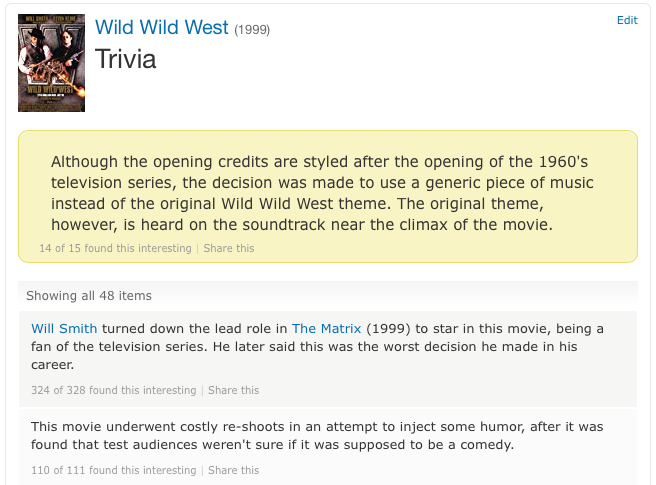
Fortunately, the selected piece of music isn't the ubiquitous-on-the-1999-airwaves Will Smith/Dru Hill theme tune that was never worthy of sampling Stevie Wonder's "I Wish." It's the other memorable piece of music from Wild Wild West: the rousing main title theme by a legendary composer who wrote a million rousing themes for westerns, the late Magnificent Seven score composer Elmer Bernstein. That Bernstein main title theme is the only thing I like about Wild Wild West. IMDb is wrong: it's not "a generic piece of music." It's classic Bernstein western music, faithful in spirit to Richard Markowitz's equally rousing '60s Wild Wild West theme tune, which either the filmmakers couldn't get the full rights to or were too dunderheaded to use more often in the film because of their hubris and contempt for the source material (although I wouldn't consider The Wild Wild West a perfect show: it suffers from that old '60s and '70s spy show staple of stupidly putting white actors in yellowface or brownface). The theme is too good for such a hackily written steaming pile and such a chemistry-deficient buddy action flick.

The words 'from dusk till dawn' could also perfectly describe how long it felt to watch Wild Wild West in the theater.

Speaking of chemistry, this might have improved the movie: instead of casting Kline, whom Smith had no chemistry with, as Artemus Gordon, Alfonso Ribeiro, whom Smith had a shitload of chemistry with from 1990 to 1996, should have been cast as Artemus. And instead of the movie's lame depiction of Artemus as this never-convincing master of disguise Kline looked as embarrassed to be portraying as Kline's washed-up Soapdish actor character looked when he had to play Willy Loman in front of confused and senile dinner theater customers, I would have written Ribeiro's short and black Artemus as an excellent master of disguise who--because both the Wild Wild West TV show and movie never gave a shit about being authentic to the period--came up with the most effective and ludicrous-for-any-period prosthetic makeup technology for altering his looks, as well as his height, race or gender. Plus it would have been amusing to have a black guy walk around with the name Artemus.

Anyway, like Stevie Wonder, I wish that theme (BLAM!) was (BLAM!) written for a different score. There lies my problem with adding to AFOS rotation enjoyable score cues from movies that are so terrible. It's so difficult to erase those movies' wretchedness from your mind when you hear these score cues that are the only redeeming elements of those movies. So to enjoy the Bernstein score cue a little more, you just have to pretend it's not from Wild Wild West.


Man, why do post-Blazing Saddles, pre-Django Unchained westerns with black heroes have such a lousy track record? Why do sci-fi westerns that are neither the '60s Wild Wild West nor the cult favorite Brisco County Jr. have such a lousy track record? Smith and his Men in Black director Barry Sonnenfeld clearly wanted to turn Wild Wild West into a Blazing Saddles for the '90s and with splashier action sequences, except Blazing Saddles knew how to be funny.

Blazing Saddles also didn't need a $170 million budget to land its jokes. The Nostalgia Chick pointed out that Shane Black, the writer and director of one of my favorite movies, Kiss Kiss Bang Bang--a buddy comedy that, like Blazing Saddles, was able to dazzle despite a limited budget--was attached to an earlier attempt to make a Wild Wild West movie. It's one of the most interesting parts of the Nostalgia Chick's 17-minute discussion of the many things that went wrong with Sonnenfeld's Razzie sensation, including Smith rejecting the role of Neo in The Matrix and choosing to play such an unlikable and overly cocky spy.

See? This is why Ribeiro would have been a great big-screen partner for Smith: unlike Kline's snooty and stiff Artemus, the equally snooty but more underdog-ish Ribeiro--due to his chemistry with Smith--would have been able to make Smith's overly cocky Agent West more likable and relatable when they interacted with each other. It would have been like how halfway through its run, the small-town lawyer sitcom Ed gave Michael Ian Black's annoying and overly cocky Phil Stubbs character a new bowling alley boss he grew to despise, in the form of the more level-headed Eli Goggins, played by the always charismatic Daryl "Chill" Mitchell. As both Phil's foil and a character who, unlike Tom Cavanagh's rather timid Ed, had the guts to challenge Phil and bring him back down to Earth whenever Phil's antics grated on everyone's nerves, including the viewer's, Eli made Phil the myopic and self-absorbed schemer a much less annoying and one-note character for the rest of the show's run.

I also wish I were in the universe where Will and Carlton reunited on the big screen as West and Artemus. Yeah, maybe it would have been too much of a rehash of the Will/Carlton dynamic from The Fresh Prince of Bel-Air for some moviegoers, but Ribeiro would have given Smith something more interesting to play against than whatever hacky shit Kline was doing. However, a completely different universe where Black's Wild Wild West got made instead is an even more enticing alternate universe. Now that is a version of Wild Wild West that would be worthy of Bernstein's main title theme. How many screenwriters did Wild Wild West have? Black's screenwriting work all by himself is frequently superior to the combined results of the 20,000 screenwriters who tried to polish the turd called Wild Wild West.

Many things doomed The Fresh Prince of Hot-Air, from its constant reshoots to skinny-pantsed '60s Wild Wild West star Robert Conrad's dissatisfaction with the script when Sonnenfeld offered him a cameo and he refused. The original Jim West bad-mouthing a reboot of his show and not giving it his blessing is like if the original Spock, when he was alive, tweeted, "I hope this new Star Trek crashes and burns," or if Michael Keaton stepped out and said, "My son showed me that new Batman trailer. Why is Ben Affleck being such a saggy diaper that leaks?" That doesn't bode well for your reboot. But when your film's key art is basically inverted key art from the 1993 megaflop Super Mario Bros., your film's really doomed.

I'm sure the late Bob Hoskins always wished he could do to all copies of the Super Mario Bros. movie the same exact thing that the IRA does to Bob Hoskins at the end of The Long Good Friday.

When the only person who benefited from some part of the film is producer Jon Peters--that giant mechanical spider the extremely weird Peters kept threatening to squeeze into aborted movie versions of '90s Superman comic book storylines and Sandman finally made it into one of his productions--that's how terrible the film is. You know Patton Oswalt's six-minute distillation of the wretchedness and bloatedness of Wild Wild West (while he was being interviewed by the comedy news site/stand-up comedy record label A Special Thing)? It's six times more entertaining than Wild Wild West itself.

Monday, April 13, 2015

Marvel one-shot: Netflix's Daredevil contains the greatest fight scene in MCU history

If Francis Dolarhyde from Manhunter were a Goth
Over the weekend, I marathoned all 13 episodes of Netflix's Daredevil after the streaming service unveiled all 13 on Friday. I don't call it "binge-watching." It makes watching TV sound like an eating disorder, and I don't believe in "binging" shows. TV should be savored gradually, in one- or two-episode viewings, with breaks for a meal or living life in between, instead of some extremely weird 780-minute, all-in-one-sitting session where the couch potato never showers or changes his underwear. I prefer the term "marathoning" over "binge-watching" because it sounds more proactive and productive, and it makes you feel like you've accomplished something special, like sitting through three days and two hours of Ted Mosby's obnoxiousness without ever trying to stick your head in the oven.

Daredevil follows the spy shows Agents of S.H.I.E.L.D. and Agent Carter as the third Marvel Studios TV show that takes place in the Marvel Cinematic Universe and is the first in a bunch of interconnected Netflix original shows that will culminate in Marvel Studios' introduction of a superteam called the Defenders to the MCU. I've never read the Daredevil comics, even though I'm a lapsed Catholic like blind lawyer/vigilante Matt Murdock, whose issues with his faith fuel much of the drama of the comics and have turned Daredevil into the most intriguing crime show about Catholic guilt since Wiseguy. I never watched either of 20th Century Fox's two pre-MCU movies featuring the Daredevil characters because the negative reviews drove me away from wasting my time with them (but I did see as a kid the not-so-good 1989 TV-movie The Trial of the Incredible Hulk, starring Rex Smith as Matt and John Rhys-Davies as Wilson Fisk, a.k.a. the Kingpin). One of those negative reviews included one of my favorite putdowns from Bay Area film critic Richard von Busack, a fan of the Frank Miller-era Daredevil comics. He wrote, "Playing blind was perfect for [Ben] Affleck, as it allowed for his customary inability to express feeling through his eyes."

Despite never seeing a single minute of Affleck's version of Daredevil, I knew early on that British actor Charlie Cox is far more nuanced and expressive than previous portrayers of Matt in this MCU version of Daredevil. There's a scene in one of the earlier Daredevil episodes where Matt, his business partner Foggy (Elden Henson) and their secretary Karen (Deborah Ann Woll, who, together with Henson, helps keep this dark show from becoming a relentlessly humorless slog) have a meeting at their struggling law firm with mob consigliere Wesley Owen Welch (Toby Leonard Moore). Cox remarkably expresses Matt's distrust of Wesley, even though his eyes are shrouded in Matt's trademark red-tinted glasses, he doesn't have any dialogue and the conversation doesn't contain any of the elaborate sound FX the show frequently relies on the rest of the time to depict Matt's heightened senses. He conveys Matt's distrust in just the way he breathes, a great early example of how genuinely mature--as opposed to Zack Snyder's idea of mature--and nuanced Daredevil is as a street-level and more grounded MCU show, as well as how surprisingly compelling Daredevil is as a legal drama, in addition to being a solid introduction to a comic book character I've never warmed up to.

Netflix has Daredevil and the Marvel Cinematic Universe shows, while Overstock.com will be streaming episodes of the Super Fuzz reboot.

Agents of S.H.I.E.L.D. has often suffered from being generic-looking-as-fuck, but that's been starting to change in its second and current season, due to the increasing involvement of Kevin Tancharoen, showrunner of the not-so-generic-looking webseries Mortal Kombat: Legacy and younger brother of S.H.I.E.L.D. co-showrunner Maurissa Tancharoen, as episode director. He directed the standout S.H.I.E.L.D. episode where Agent May and an imposter posing as May fight each other. That May-vs.-May fight remains the show's best fight scene. But even the May-vs.-May showdown and the surprisingly impressive Batroc-vs.-Steve fight in Captain America: The Winter Soldier are conventional in comparison to what Cabin in the Woods director/co-writer Drew Goddard (Daredevil's showrunner for just the first couple of episodes, before Spartacus veteran Steven S. DeKnight took over), director Phil Abraham, a Sopranos cinematographer who's directed several Mad Men episodes, and stunt coordinator Philip J. Silvera pulled off for three minutes at the end of Daredevil's second episode, "Cut Man."

The single-take fight scene has been done before, but the novelty value of the single-take fight scene at the end of "Cut Man" stems from seeing it within the context of a superhero genre piece. The strengths of the MCU movies have never really been the action sequences or the fight choreography. Their strengths have always been the character writing, the snappy dialogue and the charismatic, "this is why I'm a movie star" performances from the likes of Robert Downey Jr. However, Marvel Studios seems to be starting to respond to criticisms that MCU action filmmaking is too generic and assembly-line, as exemplified by the creative freedom they gave to Shane Black for Iron Man Three (before they Britta'd things up with Edgar Wright)--Black's involvement in the MCU resulted in my favorite MCU action sequence that doesn't involve any combat, the Air Force One passenger rescue sequence--and the aforementioned Kevin Tancharoen episodes of S.H.I.E.L.D. And now along comes Daredevil, which proves in the one-shot fight scene--a moment I don't think will be up on YouTube in its entirety for too long--that it won't be another superhero genre piece where the filmmakers purposely avoid clarity during the fight scenes and let the editors and CGI FX technicians do all the work. That's the same exact complaint DVD Savant author Glenn Erickson had about the fights in The Bourne Ultimatum, which he said are "the equivalent of the dances in Chicago (2002), where every musical number is splintered into so many shots, we can't really tell if the performers can dance."

Daredevil shows this Russian thug how he do-si-dos.

Matt Murdock: the most badass Child Protective Services agent ever.

By opting for the single-take approach, Daredevil wants to show that the performers can dance, which makes the hallway fight scene so riveting to watch. "It was always scripted that this scene was going to be a one-shot," said Silvera in a New York Observer Q&A about his fight choreography for Matt and the Russian crew of child traffickers he takes down all by himself (and with the help of an unplugged microwave at one amusing point). The scene isn't just style for style's sake. The single-take approach also advances character and perfectly reflects the intensity and single-mindedness of Matt in his mission to clean up his home turf of Hell's Kitchen, as well as the difficulty of his mission (the TV-MA-rated Daredevil--which allows its characters to curse but won't allow them to say "fuck," so it'd be perfect for FX's prime-time schedule--is the first MCU project to not shy away from showing in graphic detail the wounds and battle scars its primary hero experiences). The single-take "Cut Man" fight is the show's most clever way of establishing a mission statement, and it's far better as a mission statement than any of the standard-issue "this is my city" dialogue the writers give Matt to say in later episodes.

It's great to see an MCU project taking some cues from Asian action cinema of the past 15 years. The Daredevil hallway fight is like the love child of the single-take hallway fight from another equally dark and ultraviolent comic book adaptation, director Park Chan-wook's Oldboy, and The Protector's single-take restaurant sequence, and it might remind premium-cable drama fans of the crazy six-minute tracking shot Cary Fukunaga orchestrated for True Detective last season. Fight scenes where characters are never seen getting tired and winded often bug me. That's why almost all my favorite fight scenes--whether it's the Oldboy hallway fight, the showdown in the streets between Dan Dority and the Captain on Deadwood, the brutal brawl between Lucas Hood and an MMA rapist on Banshee or the unprecedented 1970 Darker Than Amber fight where the blood all over Rod Taylor was reportedly real--are ones that emphasize the physical exhaustion of the combatants. The Daredevil hallway fight automatically shoots itself to the top of the pantheon of MCU action sequences by showing how tired Matt, who hasn't fully recovered from the injuries he sustained earlier in "Cut Man," gets while he fights his way to rescue a kidnapped boy.


Daredevil isn't a perfect show. Some feminist Marvel geeks have found most of the show's female roles to be underwhelming, even when Rosario Dawson is portraying a modernized version of Night Nurse in an intriguing nod to that non-superhero Marvel comic, and later episodes (spoilers) aren't going to impress viewers of color who complain about how the MCU shows have a tendency to opt for the POC equivalent of "women being fridged" to increase the heroes' angst. But you can't deny how Daredevil, like Arrow and The Flash's enjoyable-so-far Eobard Thawne arc before it, proves that serialized TV, when it's done right, is a better fit than a 103- or 152-minute movie for the kind of ambitious and sophisticated storytelling Clouds of Sils Maria director Olivier Assayas admires about superhero comics but has found to be lacking in superhero movies ("The movies are ultimately an oversimplification of those comic books," notes Assayas), and you can't deny the power and effectiveness of Daredevil's single-take fight. That riveting scene is an encouraging early sign of how more shades of gray are finally being introduced into the previously family-friendly and brightly lit MCU, first with the arrival of Daredevil last Friday and then with the premiere of A.K.A. Jessica Jones, the forthcoming Marvel/Netflix adaptation of Brian Michael Bendis' for-mature-readers private eye comic Alias. Now if only Daredevil had an opening title theme that's as cool and batshit--or rather, devil-may-care--as CHiPs season 1 theme composer John Parker's opening title theme for Darker Than Amber.