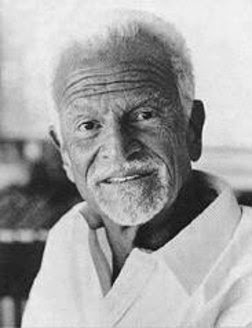
In his stand-up act, Dana Gould hilariously envisioned the composer of the Spock bass guitar theme from the original
Star Trek as a tortured drug addict cursing loudly at four in the morning like a junkie version of Don Music from
Sesame Street while trying to come up with the perfect theme for Spock. The calm and genial Gerald Fried--the now-retired TV and film composer who penned both Spock's theme and Kirk's frequently spoofed fight theme for
Star Trek's 1967 "Amok Time" episode--isn't exactly Don Music on smack.
As I await both J.J. Abrams' new
Star Trek feature film and its Michael Giacchino score--which I've refused to hear excerpts from until I see the film itself--I thought it would be the perfect time to transcribe half of a phoner I recorded with Fried (pronounced "freed") for the terrestrial radio incarnation of
A Fistful of Soundtracks in 1999. (Almost all the pre-2000 broadcasts of
A Fistful of Soundtracks were pre-recorded on audiocassette, and I don't have the equipment to transfer audiocassette content to computer--the audio quality would suck anyway--so I'd rather just post text of the interview below.)
During our conversation, Fried promoted the 1999 Silva Screen Records release
Dr. Strangelove: Music from the Films of Stanley Kubrick, which contained re-recordings of themes Fried composed for the first few films of his childhood friend Kubrick. But what I was most interested in was Fried's TV work, which he loved doing despite the rushed schedules and older TV's tendency to recycle score music to cut costs ("As a composer, it's disturbing to hear music I wrote for one scene appear somewhere else," said Fried in a 1991
Starlog magazine interview). I particularly enjoyed talking with Fried about his scores for the
Roots miniseries, which I first caught when the Family Channel (now ABC Family) reran it while I was in high school, and the original
Star Trek, which I grew up watching and is now being relaunched by Abrams on the big screen.
 |
| (Photo source: TrekCore) |
Jimmy J. Aquino: Now Jerry Goldsmith wrote the theme to
The Man from U.N.C.L.E. Lalo Schifrin wrote the theme to
Mission: Impossible. Alexander Courage wrote the theme to
Star Trek. When you worked on those shows, were you ordered by the producers to compose in their styles or were you allowed artistic freedom?
Gerald Fried: We had to refer to the theme, which was okay with me. I think both those themes... The Sandy Courage thing, you know, that female voice--that was kind of stupid to me. Jerry's theme and Lalo's theme from
Mission: Impossible are just fine. I had no problem using them.
As far as style goes, the first year, Jerry Goldsmith, I think, scored most of the
Man from U.N.C.L.E.s, and it was a kind of symphonic style. Then they brought me in the second year, and Lalo also did a few of them, and we were the ones who changed it into a kind of Latino jazz... you know, the... [Hums his faster-paced arrangement of Goldsmith's
U.N.C.L.E. main title theme.] That was my kind of contribution. They wanted style change from Jerry's style, and then it stuck pretty much like that for the next two or three years, however long the series ran.
JJA: Yeah, when it changed to color, they got campier and less serious.
GF: Yeah, which was part of the joy of doing it.
JJA: Now I want to talk about what I remember you the most for, your work for
Star Trek. You did a total of five episodes: "Shore Leave," "Amok Time" I remember most fondly, as well as "Catspaw," "Friday's Child" and "The Paradise Syndrome." Was
Star Trek taken seriously in the industry when it initially aired on NBC like it was by the sci-fi community or did everybody you know in the industry dismiss it as, you know, shallow,
Flash Gordon-type hokum?
GF: Somewhere in between. They had no idea that it would become part of Americana. But neither did they see it as a piece of junk. You got some pretty classy writers--Harlan Ellison and some of the big sci-fi writers--so I think it was respected, and Gene Roddenberry was kind of an impressive guy. But certainly, they had no idea that it was going to take hold as it did.
JJA: I remember reading reviews from the '60s when it premiered, and
Variety and
TV Guide dismissed it as being shallow and just another space opera.
GF: Heh! Okay. I hope Gene Roddenberry is enjoying that statistic wherever he is.
JJA: He got the last laugh.
GF: Yes, he sure did.
JJA: Now for "Shore Leave," you wrote two unforgettable themes: the love theme for when Kirk is reunited with Ruth, his first love, and the Irish tune for Finnegan, Kirk's bully from his academy days. Tell me about writing those themes.
GF: Well, the love theme--the flute solo--was just kind of a movie-type pop thing, which I thought was appropriate and immediately accessible. The other one--I figured, well, how do you do it? It was an opportunity to write something special, kind of like an epic Irish fistfight. Remember the movie
The Quiet Man? Something like that. To keep it Irish and keep it large and keep it insouciant like the Finnegan character was. So it seemed like a jig would be a good idea, and I was nervous about it because whenever you take a gamble, you're always in danger of having some conservative person throw it out. Well, [Bob] Justman and Roddenberry did not throw it out. But you do get nervous when you take chances like that, which I always do because I think any good composer... Jerry Goldsmith is the greatest chance-taker, probably of all time, and Elmer Bernstein... Yeah, I love them for that, for letting me do something with some kind of left-field imagination.
JJA: Now in "Amok Time," you created a theme for Spock for bass guitar. Let's talk about that. Why a bass guitar for Spock?
GF: Spock had a lot of trouble with emotion. If he did have any, he hardly knew how to get it out. Now if you try to play a lyrical line on a big thumpy bass guitar, you're gonna have trouble sounding lyrical, so I thought it would be a match to write a lyrical theme but put it on the bass guitar. It somehow parallels Spock's trouble and confusion with emotion.
JJA: Who played the bass guitar?
GF: Barney Kessel.
JJA: What were some of his previous credits? Did he work with you before?
GF: Yeah, he was a studio guitarist by the time I came to him, but before that, he was one of the half-dozen greatest jazz guitarists in history. You'll find him on records like with Art Tatum and Earl "Father" Hines. He's right up on the top. In fact, he, Herb Ellis, Joe Pass, Kenny Burrell, Eddie Lang and Charlie Christian--I just named to you the half-dozen great guitar players of all time.
JJA: Before you wrote the scores for the
Star Trek episodes, were you handed the script or did you watch the episode first? The dailies?
GF: Yeah, there were no videocassettes in those days, so you get a chance to see... no, not the dailies. They called it then a workprint, and that was usually like about 10 or 12 days before airtime, so it was very scary. You just go home and work practically 22 hours a day for an intensive five or six days. You see it once. At first, Bob Justman--and maybe even Roddenberry for the first one--sit there with you and then we talk about where the music should go. The last few, they were so busy and so tired and so worried about the next show that I just thought by myself with the music editor in the room and just chose where the music goes and what I should do by myself.
 JJA:
JJA: Now your music for the Kirk/Spock fight scene in "Amok Time" has been called the greatest fight music ever written for television. It's even been quoted in parodies of
Star Trek.
GF: Oh yeah. [Laughs.]
JJA: For instance, the characters on
Mystery Science Theater 3000 would hum the fight music whenever they saw a B-movie fight scene.
GF: [Laughs.] That's funny. I know. I get royalties from
The Simpsons and
The Cable Guy. I know it was used there.
JJA: Do fans at the
Star Trek cons come up to you and hum the fight music?
GF: Yeah, I actually attended two or three of those
Star Trek conventions. There was a program. I made a suite of all my main themes from
Star Trek into sort of a concerto for oboe, which I played myself. I'm still an oboe player. Yeah, some people would come up and talk mostly about those specifically.
JJA: I know that in television, like you said before, composers don't have much time to work with. Do you feel your music is better when it's written in such a limited amount of time or do you feel the opposite?
GF: I had only one opportunity to find out because 100 percent has been on a rushed schedule. The exception is the documentary
Birds Do It, Bees Do It. I had lots of time for that. That was my one and only Oscar nomination, so maybe there is a correlation. Except for that, I have no way of knowing!
JJA: Now themes from your
Star Trek scores would be recycled in many episodes. Were you flattered by this or did you find that practice inappropriate?
GF: Well, if I were to give a speech on the aesthetics of film composing, I'm sure I would rant and rave about "music must be composed specifically for this and that." But when you get your music, for one thing, played on network television, you've got a helluva lot of money, and that kind of tempers your thinking... It doesn't temper your thinking. It tempers your mouth, so I didn't do any public complaining. Sometimes, I thought it was ludicrous what they did, and sometimes, I think, "Well yeah, alright, it sort of works." But generally, I'd like to go down in the books as saying it's a bad policy. It makes a product out of movie and TV stuff. I still like to consider it a great art form, so with that high road in mind, I come down against it.
JJA: So how do you feel when people come up to you and say, "Oh, I like that love theme from 'This Side of Paradise,'" but it was the love theme from "Shore Leave"?
GF: Yeah. [Laughs.] I smile. What are you gonna do? Read them a lecture on cinematic aesthetics?
JJA: Anybody who has worked on the original
Star Trek, whether they're an actor, a writer or a composer, is always stopped on the street and remembered for their contribution even if it was only a guest stint. Why do you think
Star Trek has been so popular?
GF: I think the intent and quality of the writing and the concept of it, to try and comment on earthly problems in terms of outer space... The dynamics of jealousy, rage, envy, power, lust and all those things were commented on intelligently and fairly. I think they reflected--as all good writing does--on the conditions of all the people down here on Earth, and I think that came through.
JJA: Any advice for anybody who took one listen to your music from
Star Trek and said, "I wanna do that too"?
GF: [Laughs.] Yeah, it's possible. There will always be music for movies and television. It's hard to get into because a lot of people want to do it, but if there's a major motivation, and the person is willing to do the work and the research and become an all-around person in music... The days of having specialists are over. Producers need to hire a composer who they know has enough range, so that they can handle whatever problem might come up. Yeah, my advice is go for it.


