Mathilda May does her impression of me halfway through a Blu-ray of an '80s Cannon Films action movie in a scene from the big-budget 1985 Cannon flick Lifeforce.
This is the sixth of 12 or 13 all-new blog posts that are being posted on a monthly basis until this blog's final post in December 2017. It has taken me since January 2016 to finish writing this post about Cannon Films. I don't know why. Writer's block can really fuck you up sometimes. This is why I can't wait to leave this blog behind so that Accidental Star Trek Cosplay will become my only ongoing blog. After December, the only writer's block I'll have to worry about will be the block that keeps trying to prevent me from finishing my novel manuscript.
You've seen MacGruber, right? Now imagine if MacGruber wasn't a comedy. That's basically what an '80s Cannon Films action movie is like.
MacGruber is a Cannon movie played completely straight, except for a couple of big things: the profane update of MacGruber's old theme song (a tune from his days as an SNL character) and the intentionally offbeat dialogue that comes out of the mouths of Val Kilmer, Kristen Wiig and Will Forte, who weepingly delivers the least dignified and most sob-filled monologue in action movie history ("Just join my team. I'll suck your dick!"). Everyone else in MacGruber, whether the actor is Ryan Phillippe or the late Powers Boothe, is interestingly directed by Lonely Island troupe member Jorma Taccone to take the proceedings completely seriously, including even Maya Rudolph, aside from her silly sex noises while her dead character's ghost bangs MacGruber in a cemetary.
Phillippe and Boothe react to MacGruber's pantsless moment of desperation in the military office as if this were Michael Clayton or Spotlight instead of an Inspector Clouseau flick (or any other farce where everyone, including the straight man, gives a big and broad performance). Their underplayed seriousness actually increases the hilarity quotient of MacGruber's abnormal behavior.
Taccone's movie is a terrific parody of the schlocky Cannon house style, from the strange one-liners that sound like they were written by a 57-year-old Israeli movie producer ("Shut your butt!") to the ultraviolent heroes who, in real life, would be locked up in an insane asylum for their psychotic behavior (see MacGruber's "KFBR392" scene). If you took the dour and unintentionally funny 1986 Cannon movie Cobra, which I never watched until I rented it on YouTube a week ago, and you turned it into a comedy about how the behavior of matchstick-chewing supercop Marion Cobretti, the only person in the world who cuts pieces off his slices of pizza with a pair of scissors, actually looks to the world outside the narcissistic-at-the-time brain of Cobra star/screenwriter Sylvester Stallone, it would probably resemble MacGruber.
The first Deadpool flick makes a Cobra reference I wasn't aware of until Outlaw Vern pointed it out (it's the scene when Ryan Reynolds quips about the matchstick between Gina Carano's lips and wonders aloud if she's a Stallone fan). Taccone and Deadpool screenwriters Rhett Reese and Paul Wernick all clearly watched Cannon movies like Cobra when they were kids, just like how I was subjected to a few Cannon cheapies as an '80s kid.
One of those movies was 1987's Allan Quatermain and the Lost City of Gold, which was one of Cannon's two attempts to update the then-100-year-old Quatermain novels in the wake of Indiana Jones, and I still remember how dreadful the production values in Lost City of Gold were (it should have been called Lost City of Plastic). Currently streamable on Netflix, Electric Boogaloo: The Wild, Untold Story of Cannon Films, an Australian-made 2014 documentary directed by Aussie filmmaker Mark Hartley, is the highly entertaining story of why during the '80s and early '90s, a name like Cannon meant it had to be not-so-good. It's hard to dislike any documentary that devotes five minutes to the lambada movie war of 1990.
Cannon was, of course, embroiled in that vicious war over who could first rush into release a movie about a dirty dancing craze from Brazil that was barely sweeping the nation. Nobody won the war between Warner Bros./Cannon's Lambada and Columbia Pictures/21st Century Film Corporation's The Forbidden Dance. The only winners were quippy film critics who got a kick out of tearing apart terrible movies. For five silly minutes, Electric Boogaloo recounts how obsessed Menahem Golan (pronounced "muh-nawk-um go-lawn"), the aforementioned 50-something Israeli movie producer, was with trying to get The Forbidden Dance completed in time for its spring 1990 release date, while Yoram Globus, one of the producers of Lambada, and his collaborators toiled over their rival project. Golan and Globus were not just former business partners who ran Cannon (into the ground). They also happened to be cousins.
Occasionally on Friday, I discuss the week's best first-run animated series episode I saw. The 130th edition of the "Brokedown Merry-Go-Round" Show of the Week happens to focus on the final episode of a show that will be back with new episodes someday, but when? Oh yeah, and stream "Brokedown Merry-Go-Round," my one-hour mix of original score tracks from animated shows or movies, right now, or don't. Barely anybody has.
Somewhere, there's a crazy parallel universe where Clancy Brown is an international movie star, in addition to being a great character actor, and he--not Liam Neeson--starred as the retired CIA agent who tears apart Paris to rescue his kidnapped daughter in Taken. "Red Means Stop," the Venture Bros. sixth-season finale, presents a glimpse of that parallel universe during the moment when Brown gets to parody Neeson's famous "I don't have money, but what I do have are a very particular set of skills" speech from Taken. The episode makes me wish some creepy Akira kid with extra-sensory powers or someone like the Rufus Sewell character from Dark City could will that universe into existence.
The imposing Brown is best known for his villainous roles in Highlander (his guest shot in "Red Means Stop" makes it an interesting episode to be airing right after the Christopher Lambert subplot of "A Party for Tarzan") and on both the short-lived HBO cult favorite Carnivàle and Superman: The Animated Series. He was so perfect as the voice of Lex Luthor that whenever I flip open Grant Morrison and Frank Quitely's All-Star Superman, it's Brown's voice I hear in my brain when I'm reading Luthor's dialogue, not Gene Hackman's, not Kevin Spacey's, not Michael Rosenbaum's and certainly not Jesse Eisenberg's.
Brown would have been terrific as Bryan Mills in Taken. He can convincingly shift between being intimidating to someone his character's about to kill and being kind to whoever's playing his wife or daughter (like on, for example, Fox's Sleepy Hollow, where he had a rare good guy role as Abbie and Jenny's deceased surrogate dad). So that makes Brown the perfect guest star to voice the cloaked Red Death, a terrifying-looking, Red Skull-style arch who strikes fear into the hearts of his victims atop a flying satanic horse one moment and is sweet to his wife (Cristin Milioti, voicing a character who's much closer to her Fargo housewife role this time, instead of a gangster's bratty teen daughter) or his preschooler daughter the next. In fact, that's where we first meet the Red Death: he's at the park, looking after his daughter Lila, who doesn't have any skin like her dad, while his sweater's hilariously tied around his neck.
It's been such a long time since I've written enthusiastically about a short film that I've forgotten how my own blog style guide's policy goes for when I have to type out titles of short films. So I've had to go back to older material from my blog and verify that policy. It turns out that I'm supposed to bookend titles of short films with quotation marks instead of italicizing them, just like with titles of short stories or TV series episodes.
Stop-motion animator Timothy Reckart's 2012 short Head Ov... "Head Over Heels," which Reckart just recently made available to watch in its entirety online for free, is so good I kind of wish it won the Best Animated Short Oscar in 2013 instead of Disney's "Paperman." (In 2013, "Head Over Heels" and "Paperman" also happened to be up against the Simpsons theatrical short "The Longest Daycare," which I love for both its jab at Ayn Rand and the adversary "Longest Daycare" writers James L. Brooks, Matt Groening, Al Jean, David Mirkin, Michael Price and Joel H. Cohen chose to pit Maggie against.) Like "Head Over Heels," "Paperman" is a clever short about a man struggling to communicate his feelings to a woman he adores. But "Head Over Heels" is about adult problems--like how do you salvage a long-term relationship that has lost its spark, and how do you do that when so many obstacles to communication are in the way?--and that makes it the more intriguing of the two Oscar-nominated 2012 romantic shorts.
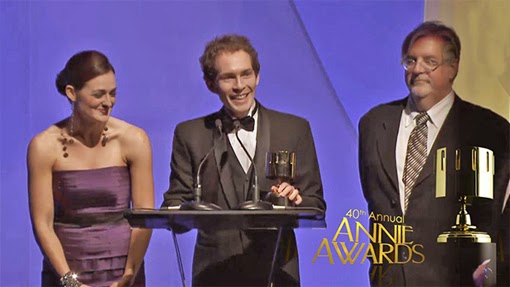
Timothy Reckart, accepting his Annie Award for "Head Over Heels" (Photo source: Animation Magazine)
An Annie Award winner for Best Student Project (it was made at the National Film and Television School in the U.K.), Reckart's 10-minute film is both a dialogue-less and surprisingly affecting comedy about a strained marriage and a nifty sci-fi short story set in a bizarre and unexplained reality where the laws of physics are different from our world's laws of physics. So because of the reality the short takes place in, the biggest obstacle to communication between middle-aged Walter and his ex-ballet dancer wife Madge isn't the increasingly common problem of smartphone addiction. Instead, it's gravity.
Walter and Madge live in a floating house where Walter's ceiling is Madge's floor and her ceiling is his floor. We don't know what exactly caused their marriage to become strained or why they no longer share the same gravity. All we do know is that it's entertaining to watch them go about their day as if everything's normal in their topsy-turvy world.
Meanwhile, in our topsy-turvy world where special features, which, for a long time, have been the best part of a DVD or Blu-ray, are unfortunately becoming an endangered species because younger viewers prefer to stream movies instead of watching bonus-filled physical copies of them, Reckart's strategy of getting viewers to watch his short online is noteworthy. It's not just because of his wish to keep special features alive by treating viewers to a bunch of fascinating little extras about the making of "Head Over Heels" ("On the one hand, the death of DVD is great, because the physical production of DVDs has been a barrier to entry for short filmmakers like me. On the other hand, what happened to special features?," says Reckart). It's also because one of those bonuses is an audio-only featurette about film scoring--and it's almost three times longer than "Head Over Heels" itself, like how the documentary about the making of Superman Returns is much longer than Superman Returns itself (and a slightly more enjoyable film too, simply because of the moment when Kevin Spacey cracks up the film's crew with his Brando impression while audio of Brando as Jor-El is being played aloud on the set).
Any featurette about the film scoring process is worthwhile to me because I put strictly film and TV score music into rotation on my radio station, and I'm always interested in hearing about how that kind of music gets made. Film and TV scoring is a process not a lot of people understand or are aware of, even after the release of Forgetting Sarah Marshall, whose main character was a struggling (and way-too-frequently-naked) TV composer, so the audience saw a few scenes of him at work. Featurettes like the scoring discussion Reckart recorded with Jered Sorkin, his short's composer, are invaluable because they get those outsiders to understand the process.
I had only five questions for Reckart--whose prior stop-motion shorts include 2009's "Token Hunchback," a mockumentary about a Hollywood actor born with a hunchback--when I interviewed him over e-mail. That's because in the extras or in other interviews, he goes into so much detail about the animation process and the music that he basically answers all the other questions I had about the making of "Head Over Heels."
Every Throwback Thursday, I randomly pull out from my desk cabinet--with my eyes closed--a movie ticket I saved. Then I discuss the movie on the ticket and maybe a little bit of its score, which might be now streaming on AFOS.
British director Edgar Wright is at the peak of his comedic filmmaking powers in 2013's The World's End, the third and final film in the Cornetto trilogy he co-wrote with Simon Pegg, the star of Wright's groundbreaking sitcom Spaced. Each film in the trilogy is a standalone piece--none of them take place in the same universe--but they all have a bunch of things in common: a Cornetto ice cream treat (a favorite hangover cure of Wright's) always makes a cameo appearance, hence the trilogy's unofficial name Cornetto; Wright reuses several actors; Pegg and his old Spaced co-star Nick Frost always play a pair of friends who are grappling with either the fear of losing their identity or being forced to let go of their adolescence; a fence jump always goes awry; and a seemingly tired genre gets revitalized in the inventive hands of Pegg and Wright each time.
The first Cornetto film, 2004's Shaun of the Dead, expanded upon Pegg and Wright's obsession with George Romero flicks from an early Spaced episode, and the result--a Romero flick with bumbling, hungover Crouch End blokes as the heroes--is still my favorite zombie movie ever. The second Cornetto film, 2007's Hot Fuzz, took Joel Silver and Jerry Bruckheimer cop flicks from America and amusingly tried to wedge the much more mundane reality of British policing into the body of one of those over-the-top cop flicks. Frequently described as "Lethal Weapon in Somerset," Hot Fuzz is not like any other action genre spoof. It's full of humor about fascism, conformity (a theme that resurfaces in The World's End), British genteelness and Grand Guignol violence that's often smarter than the average hacky "hey, let's just reference this recent movie and that recent movie and then call it a day" Friedberg/Seltzer spoof film. Hot Fuzz's genuine affection for American action flicks also elevates Wright's film above action genre spoofs that harbor contempt for the films they're parodying, much like how Shaun's affection for Romero flicks was key to making that film so appealing.
The World's End is more ambitious than the other two Cornetto films and juggles several ideas at once: it's a school reunion comedy about the dangers of nostalgia (set not at an actual class reunion but at a pub crawl Gary King, Pegg's immature alcoholic character, failed to finish as a teen and wants to finally finish with his estranged, now-teetotal friends), an addiction drama, an alien invasion flick and a critique of gentrification, or as Paddy Considine's character calls it, "Starbucking." In lesser hands, this all could have turned into a hot mess--an unwieldy, overly busy third movie that, like so many other third movies in a series, strains to juggle all the ideas running through Pegg and Wright's heads--but like the other two Cornetto films, The World's End is so tightly constructed by Pegg and Wright that the disparate components mesh beautifully and the seams never show.
When the comedic sci-fi action gives way for a scene straight out of an addiction drama, the dramatic scene doesn't feel out of place. Speaking of which, The World's End and Flight would make for a great double bill about alcoholics in denial. But why do the on-the-nose existing songs--particularly Saint Etienne's "Join Our Club" and The Doors' "Alabama Song (Whisky Bar)" in one great marriage of song and scene, due to the actors walking in step and drinking in time to the Doors tune as it was being blasted on the set--work so well for The World's End, while the on-the-nose existing songs don't work as well for Flight? That's because with the exception of the Soup Dragons' overplayed and annoying cover of the Rolling Stones' "I'm Free" and Primal Scream's '90s advertising staple "Loaded," neither of Wright and music supervisor Nick Angel's selections, which are mostly from the late '80s/early '90s era of Britrock, are tunes I've heard a million times before in movies or on TV, like Flight's overplayed choices of "Gimme Shelter" and "Sympathy for the Devil."
The original score by Gravity composer Steven Price is equally effective. My favorite moments of Price's score, which can be heard during the AFOS weekend block "Hall H" and "AFOS Prime," are textural rather than tuneful. They all involve cell phone interference sound FX, which represents the Network, the extraterrestrial collective of gentrifiers behind the gradual robot invasion of the friends' former hometown of Newton Haven, as well as all the technological advances on Earth from the early '90s to 2013 (that means Steve Jobs was a robot, which explains all those black-turtleneck-and-mom-jeans ensembles), and those advances are a huge part of the Network's strategy of seducing the smartphone zombies of the human population into getting rid of their humanity and becoming robots, or "blanks." The interference audio first appears in Price's score when Gary accidentally decapitates the teenage blank in the restroom. Never has cell phone interference sounded so menacing. After Black Mirror and the Network scenes in The World's End, the British are proving to be the craftiest satirists when it comes to material about how smartphone or tablet addiction is causing society to become even more soulless than it was before.
The result of Pegg and Wright's skills with meshing disparate components--and making inspired use of little things like mobile interference audio--is the most entertaining and clever critique of gentrification ever made. It's also the only gentrification satire to involve rousing and dazzlingly staged fight scenes where humans decapitate with their bare hands their blank adversaries and pulverize them with whatever weapon they can find, whether it's a pair of pub stools or the blanks' own torn-off limbs (the terrific World's End fight choreography was done by Scott Pilgrim vs. the World and Kingsman: The Secret Service stunt coordinator Brad Allan, a.k.a. the short white guy Jackie Chan fought during Gorgeous).
The film is so packed with detail that you pick up something new in each viewing. For instance, while watching The World's End for the fourth time in preparation for today's edition of Throwback Thursday, I switched on Pegg and Wright's Blu-ray audio commentary and learned that the film's school disco sequence--in which the Network attempts to lure Gary and his friends into becoming blanks by bringing back a trio of hot girls they liked who were known collectively as "the Marmalade Sandwich" and have eerily not aged a day--is based on an actual clubbing phenomenon. I didn't even know this was a thing in England--women get paid to dance in schoolgirl uniforms, which Pegg and Wright both find to be rather creepy as a male fantasy--and after listening to the commentrak, I received a crash course in school discos from a 2002 Guardian article about the then-new "formula of uniforms, booze and tacky tunes."
The grand entrance of "the Marmalade Sandwich" in The World's End
Sophie Evans (Marmalade Sandwich girl Becky Salt), out of uniform (Photo source: Wales Online)
In The World's End, Wright didn't just revitalize the old sci-fi trope of your friends and neighbors getting replaced by creepy duplicates by brilliantly linking it to the horrors of gentrification. He also revitalized the midlife crisis comedy, taking it back from the Wild Hogses and Old Dogses of the world. A pre-Gone Girl Rosamund Pike does wonders with what little screen time she has--she was pregnant during filming--in the role of Sam, the lone female in Gary's circle of friends (both Pike's delivery of "What happened to you?" to Pegg in the bathroom and her comedic gasp after first seeing Pegg decapitate a female blank are sublime bits of acting), while Pegg and Frost, who switched the roles they had in Shaun and Fuzz so that Frost played the more responsible half of the duo this time, show remarkable range when their characters' respective midlife crises take a turn for the dramatic. Speaking of midlife crisis movies, why do so many SNL alums, whether it's Billy Crystal or Adam Sandler, star in the same old goddamn movie about a middle-aged guy who has to learn to be a better dad? It's why my favorite Billy Crystal movie remains the not-so-maudlin Running Scared, and it's also partly why Anchorman 2, with its "Ron needs to be a better dad" subplot, isn't as consistently funny as its predecessor.
Looking back lately on the artistic triumphs that resulted from Wright revitalizing weather-beaten genres for his Cornetto projects has made Wright's decision to walk away from the movie version of Ant-Man all the more heartbreaking (he had enough of getting into creative disagreements with Marvel Studios). Think of what Wright could have accomplished in revitalizing the superhero movie, a genre that's lately been showing signs of repetition, whether it's pointless and clumsy world-building or tiresome destruction porn. (Speaking of which, I love the shade Pegg once threw at the ways Man of Steel handled its destruction porn: "At the end, they're all at the Daily Planet office just going, 'Hey! Let's go see the Dodgers!' Isn't everyone dead? Isn't New York flat? What do you mean, go see the Dodgers?!" Pegg's involvement in the writing of the next Star Trek movie makes me more hopeful about the Trek movie franchise's return to quality after the mistakes that were made during Star Trek Into Darkness, and one of those mistakes was the same type of destruction porn Pegg was critiquing.) I wouldn't be surprised if Wright, who's kept mum about his tumultuous working experiences with Marvel, quit Ant-Man because what its studio execs wanted to do with his vision for the movie was too reminiscent of the Starbucking he so astutely skewered--or rather, decapitated--in The World's End, a rare third film that doesn't suck.
Every Throwback Thursday, I randomly pull out from my desk cabinet--with my eyes closed--a movie ticket I saved. Then I discuss the movie on the ticket and maybe a little bit of its score, which might be now streaming on AFOS. This week, I pulled out the ticket that said "Man of Steel." But I don't want to write about that goddamn movie, so instead, I'm going to sing the praises of a low-budget movie I saw last week in the theater. In America, it has probably grossed only less than a tenth of what Man of Steel grossed at the box office, but it's 10 times more entertaining than Man of Steel.
One of my favorite SNL sketches that Yahoo's "complete SNL archive" currently doesn't carry is a 1989 Dracula sketch written by Jack Handey and James Downey, who told interviewer Mike Sacks in his 2014 book Poking a Dead Frog: Conversations with Today's Top Comedy Writers that a few other SNL writers disliked his sketch when they first heard about its premise because they thought it sounded hacky: "What if Dracula were AIDS-aware?" The sketch, which featured James Woods as an inquisitive Dracula who asks his potential victims about their medical histories (one of whom was played by the late, great Jan Hooks), turned out to be funny anyway, and it's a shame that Yahoo doesn't have it. If you do fondly remember that James Woods Dracula sketch, then you're bound to get a kick out of the similar "old-world vampire who's had to adapt to the modern world" humor of co-stars/co-directors Jemaine Clement and Taika Waititi's clever 2014 mockumentary What We Do in the Shadows.
At only 86 minutes, What We Do in the Shadows doesn't wear out its welcome. It ends before it can exhaust any of its gags about vampire housemates who are hardly as suave as the stars of True Blood and bicker over household chores or fashion choices, fussy werewolves, chatty and verbose zombies and a modern-day Renfield who's more like a personal assistant than a spider-eating mental patient. If Christopher Guest or the geniuses at Aardman Animations ever wanted to make a mockumentary where all the main characters are famous movie monsters, the result would probably resemble What We Do in the Shadows.
The film, which takes place mostly in an apartment in Wellington, New Zealand that's shared by a group of vampire friends, could have been a one-joke mockumentary. But thanks to the rich screenplay and capable direction by Clement, the bespectacled half of Flight of the Conchords, and Waititi, a fellow New Zealand comedian who directed Clement in the 2007 film Eagle vs. Shark and a few Flight of the Conchords episodes, What We Do in the Shadows is packed with so many effective jokes that it's difficult to catch them all in a single viewing, which makes it a film worth watching again and again.
It's also got a tender side underneath the comedic gore--you're as insane as Renfield if you're expecting What We Do in the Shadows to be a bloodless affair--and the gags about vampire genre clichés. Much of that tender side involves Waititi's character Viago, a 379-year-old aristocrat who traveled to New Zealand in a coffin to marry his girlfriend, but thanks to a coffin postage error, he wound up lost at sea and she married someone else instead. Viago's pining for his lost love is handled beautifully: it's sad, but it's also tinged with some raunchy humor (I've seen tons of TV shows and movies where people fuck each other in coffins, but I've never seen a moment where someone masturbates from inside a coffin, until What We Do in the Shadows came along), which keeps that side of the movie from turning unbearably sappy.
The nicely drawn characters created by Clement and Waititi are a plus, but what's even more enjoyable about What We Do in the Shadows is how its vampire universe is more enticing than most vampire universes from other genre works because it's so amusingly mundane and lived-in. I love the offbeat rules and customs Clement and Waititi came up with for their vampire world, like the bloodsuckers' inability to eat French fries or the little bit of business where they have to draw on notepads to each other how they look in outfits they're trying out because they can't see themselves in mirrors. By emphasizing the mundane, whether it's in those little details or the humorous neuroses of either Viago, his housemates or their werewolf rivals (whose leader is played by Clement's old Conchords co-star Rhys Darby), What We Do in the Shadows takes back the vampire genre from the detestable and banal Twilight and makes vampires relatable--and human--again.
Every Friday in "'Brokedown Merry-Go-Round' Show of the Week," I discuss the week's best first-run animated series episode I saw. "Brokedown Merry-Go-Round," a two-hour block of original score tracks from animated shows or movies, airs weekdays at 2pm Pacific on AFOS.
If The Tick was the Seinfeld of the superhero comedy genre (as was the hangout sitcom No Heroics during its brief run in the U.K.), then The Awesomes is the Get Smart of the genre: each week, the bumbling lead character manages to save the day despite his ineptitude, and often due to the help of his work family. But while Maxwell Smart's bumbling ways stemmed from his arrogance and ego, the physically frail Professor Dr. Jeremy Awesome's bumbling ways (as a combatant and an actual superhero, that is, not as a leader/strategist, which he's far better at doing) are due to a low self-esteem instilled by an unsupportive and distant father. If Prock had taught himself to be more assertive towards the currently absent-from-Earth and retired Mr. Awesome (Steve Higgins), who spent much of his time as a dad supporting his protégé Perfect Man (Josh Meyers) and belittling Prock (either due to Prock not being as perfect as Perfect Man or Prock not listening to his doctors' warnings to not use his secret time-freezing superpower because it gives him nosebleeds within seconds), you can damn well bet that Prock would be frequently Zack Morrising the world to move frozen people and objects around (like he did on Earth 4 during "It's a Mad Mad Mad Parallel World") instead of using that power only to talk to himself.
Manipulating time is a power anyone, including myself, would want to have, which is why Prock's inability to appreciate his ability and figure out how to make proper use of it (or how to work around the pain chronokinesis gives him) is both amusing and infuriating. So when Prock's mentor-turned-nemesis Dr. Terfenpeltz (Bobby Moynihan) points out to Prock that he's not using his time-freezing power to its fullest potential in "Euro-Awesomes," I thought to myself, "Word." The evil scientist is basically voicing the frustrations of Awesomes viewers like myself who can think of a million things to do with time-freezing if it were possible and also wish that Prock would be a little less intimidated by his own chronokinetic power, even though it does turn his nose into a Ragú ad.
Prock finally figures out how to use that power to defeat somebody: in this case, Dr. Terfenpeltz, who wants to collect superheroes' powers to conquer the world (Prock tricks Dr. Terfenpeltz by allowing him to absorb his chronokinetic power and then withholding from him the caveat that chronokinesis is painful). While it's nice to see some progress in Prock's struggles with time-freezing, it'd be wise for The Awesomes to continue having Prock learn something new about his powers every once in a while (his other power is the ability to block Dr. Malocchio's mind control) because Prock wouldn't be as interesting anymore if he became more like Perfect Man, who, by the way, has been far from perfect lately (both having to hide at Awesome Mountain from the law and being unable to do superhero things out in the streets like he used to do are driving Perfect Man crazy and causing him to talk to basketballs as if they were Wilson the volleyball from Cast Away). Much of what made The Greatest American Hero unique--as well as, frankly, more enjoyable than the character of Superman, whom a rather deluded-at-the-time DC Comics thought The Greatest American Hero was ripping off--was Ralph Hinkley's often klutzy attempts to be a hero without the supersuit instruction manual he kept losing. As we see during DVD or Hulu rewatches of that old Stephen J. Cannell show and now the storylines for both Prock and the disheveled Perfect Man in "Euro-Awesomes," a hero who's imperfect or always learning makes for better storytelling than a super-perfect man who's always got it together.
There's also some progress in Prock's love life during "Euro-Awesomes," as he realizes his current girlfriend Jaclyn Stone (Amy Poehler) is no Hotwire (Rashida Jones), and both he and Hotwire, who developed feelings for Prock during her time as a mole working for her evil dad Malocchio, finally get the guts to kiss each other. While it's good that The Awesomes doesn't have to prolong Hotwire's Metal Fella arc anymore now that everyone on the team finally knows she's alive and has been pretending to be Metal Fella because of her guilt over betraying them, I'll miss her terrible impression of a male superhero because it gave Jones more to play than just the sexy mole/love interest.
Even though The Awesomes is a comedy, it takes its action scenes seriously, just like the original Get Smart did (despite Max's klutziness and what has to be the whitest white-guy walk in TV history, Don Adams--or his occasional stunt double--did an awful lot of hitting and running and jumping and clinging to the tops of cars). The climactic battle where Dr. Terfenpeltz's giant mecha absorbs the powers of both the Awesomes and their European counterparts is nicely visualized and reminiscent of the Super-Skrulls from various Marvel titles and The Avengers: Earth's Mightiest Heroes.
Another treat in "Euro-Awesomes," which was written by DC Comics veteran and Awesomes staff writer Judd Winick, is its gags about Euro superteams like Justice League Europe and Excalibur (a British offshoot of the X-Men), which are the most Judd Winick-y part of the episode. The cleverest creation out of all the Euro counterparts Winick and the other writers came up with has to be Mademoiselle Hunchback, an icy French beauty who transforms into Quasimodo from The Hunchback of Notre Dame when she Hulks out and plays hard to get in front of a smitten Impresario when she's in her more conventionally feminine form. You got to love how of all the superhuman forms she could have taken, like maybe a She-Hulk physique, a crystalline-armored body or a wolf, she prefers to change into Charles Laughton.
Mr. Awesome let Prock down as a parent, and now Dr. Terfenpeltz, the father figure who, unlike Mr. Awesome, could have helped Prock to become the genuine superhero he'd prefer to be instead of a mere lawyer/doctor/thinker/delegator, has let him down too. "Euro-Awesomes" doesn't brood over these father figures who keep disappointing Prock, but this history of underwhelming father figures is kind of depressing when you think about it, and it's where The Awesomes gets unexpectedly sad (and maybe even tragic) in a way that Get Smart couldn't because '60s sitcoms were incapable of depth and dark humor (aside from that one time when KAOS murdered a secretary by drowning her in a phone booth, which struck me as really dark back when I was a kid discovering Get Smart reruns in the '80s). My advice to Prock?: Stop looking for a father figure. That "Ask Dad, He Knows" cigarette ad sign young George Bailey saw in It's a Wonderful Life got it half-wrong. Dad doesn't always fucking know. Maybe the newly reformed Hotwire will be that long-sought-after figure who boosts Prock's self-esteem about his abilities and won't let him down like Mr. Awesome and Dr. Terfenpeltz did. A smart guy is nothing without a 99 by his side.
Every Friday in "'Brokedown Merry-Go-Round' Show of the Week," I discuss the week's best first-run animated series episode I saw. By "the week," I mean from late Thursday at midnight to the following late Thursday at 11:59pm. Today's Show of the Week has a bizarre and difficult-to-pin-down posting schedule, but its latest episode debuted online last Friday morning. "Brokedown Merry-Go-Round," a two-hour block of original score tracks from animated shows or movies, doesn't have a schedule that's as difficult to pin down. It airs weekdays at 2pm Pacific on AFOS.
Starz Digital Media's How It Should Have Ended series/channel is always reliable for a few grins or light chuckles over its short parodies of laughable plot holes and denouements from recent Hollywood blockbusters. In its latest installment, HISHE tackles Gareth Edwards' Godzilla reboot, and HISHE writers/voice actors Tina Alexander and Daniel Baxter get in a few good digs about the collateral damage caused in the Edwards film by Godzilla's battles against the MUTOs (Massive Unidentified Terrestrial Organisms).
"Oh, sure, when Godzilla destroys half the city and kills the unstoppable threat to save the world, everyone cheers. But when I do it, everyone gets all grouchy and judgmental," whines the Henry Cavill version of Superman during "How Godzilla Should Have Ended." He shows up in MUTO battle-ravaged San Francisco to shame both Godzilla and the unusually cheery survivors and is still butt-hurt over Superman comics readers' negative responses to the violence in Zack Snyder's Man of Steel. (I'm starting to realize that the reason why the 2004 Dawn of the Dead remake remains Snyder's most satisfying movie is mainly because of the screenplay by Guardians of the Galaxy director James Gunn, and not so much because of the contributions of the simple-minded neo-con that is Snyder. Have you ever listened to Snyder speak? All he says during interviews or commentraks is "Awesome" or "Blablabla's such a rock star.")
The animus towards Man of Steel is mostly because your latest film was such a goddamn slog, Supes, whereas Godzilla's isn't, although it's marred by Aaron Gray-Stanford-Brown-Whatever-the-Fuck's two-hour-long impression of a block of wood. As The Daily Dot astutely noted, Godzilla suffers from a boring white guy problem and is part of a long line of Hollywood tentpole blockbusters that opt for the least interesting characters as their leads. Out of a cast that includes Ken Watanabe, Bryan Cranston, Elizabeth Olsen, David Strathairn, Sally Hawkins and Godzilla, Edwards chose to center the film around the individual with the least charisma or personality? This is the same problem I had with Edwards' previous sci-fi film, his 2010 indie breakthrough Monsters. It's a film about Mexico experiencing first contact with giant alien creatures, and it's told not through the eyes of any of its citizens but through the eyes of the most annoying white hipsters since those douches who gentrified the barrio side of Arlen and slipped salmon into Enrique's fish tacos?
I wish "How Godzilla Should Have Ended" (which, like all other HISHE installments, boasts some impressive background art by Otis Frampton) focused on the Edwards reboot's boring white guy problem. But any HISHE short that has some fun at the expense of the tiresome 9/11 imagery in tentpole blockbusters like Man of Steel and Godzilla--and pits Gipsy Danger from Pacific Rim against Zilla in an amusing one-sided battle--is fine by me.
The best person to describe the most influential (and most imitated) superhero movie theme ever would be the man who wrote it.
"Although commonly called a march, Williams himself did not consider it such at the time of its creation. 'I put 'Superman March' on it perhaps after the fact in an arrangement done for performance. Certainly it was not a march per se in my mind when doing it for the film. I think what that says about it is that it has a certain tempo, and a certain forward motion to it in its rhythmic design that ultimately had become a march. We're resolved to the fact that it became a kind of march, although you wouldn't strictly march to it, I don't think... But that's one aspect of it that seemed to me to be needing to be there, that is, the notion of a certain tempo and drive and energy and a hero's theme... At the time we were doing it, certainly I couldn't have predicted that people would remember it. But if, as in any film, if I or another colleague can create a melodic identification for a character or a film that sticks, that connects with people and represents the film to them--I'll just put it this way, it represents one of the great opportunities that a composer can have in doing a film."
--from the liner notes of the Film Score Monthly label's enormongous Superman: The Music box set
Superman: The Animated Series once pitted super-fast Superman against the equally super-fast Flash in a charity footrace that got interrupted by a supervillain's plot to make the sky rain cats and dogs or some shit. When Supes and The Flash resumed their around-the-world race after saving the weather together, the episode left the race unresolved. Nerds everywhere must have hurled their Hot Pockets at the TV screen in frustration--this must have been their equivalent of the famously infuriating Sopranos series finale ending (pre-Battlestar Galactica/Lost, of course)--but I thought concluding the race on an ambiguous note was a brilliant, post-show-discussion-sparking move.
Soul Train's recent re-emergence as a trending topic due to Don Cornelius' death has got me thinking which lovable TV show mascot from my youth would win a Supes-vs.-The Flash-style railroad race: the animated Soul Train itself or Mister Rogers' Neighborhood Trolley?
For a locomotive, the Soul Train moves kind of slow, like the similar-looking Batmobile in the 1989 Batman with Michael Keaton (who happened to start out on Mister Rogers' Neighborhood as an assistant whose tasks included helping the crew with the Trolley). It's kind of difficult to build up speed when your chassis is swaying back and forth to O'Bryan or Shalamar.
Because it's much smaller and it doesn't dance (that inability to dance, even during its own piano theme music, means it must be really white), the Trolley is faster.
Even though the Trolley would win and everyone in the Neighborhood of Make-Believe would lose their minds, I'd still root for the Soul Train. I'd rather root for the not-so-white underdog who can't resist grooving to Shalamar.
Shit yeah, Cheryl Song! Represent!
And this concludes this edition of "Watch What Happens When I Sound Like a Discussion Someone Had with a Housemate While Sharing Some Indo at 2am."
Because it's Asian Pacific American Heritage Month, here are five recordings from my laptop's various playlists that are all by Asian American musicians who don't play the Tiger Mom-enforced violin.
The Morning Benders, "Cold War (Nice Clean Fight)"
I first took notice of this terrific little timpani-driven cut about relationship disagreements during Sklarbro Country, of all shows. Good lookin' out, St. Louis Sklardinals. My only beef with "Cold War" is that it's way too short.
The Morning Benders, "Cold War (Star Slinger Remix)"
This dope remix Kanye-ifies Morning Benders frontman Christopher Chu's voice and is part of the Bay Area band's Japan Echo EP release to aid Japanese disaster relief.
The CounterParts, Appetizer EP
It's cool to see T-Know's hip-hop career take off. I knew T-Know briefly when we were UCSC students.
The Skyflakes, "sci-fi as lit."
This is a pretty clever Star Trek-inspired song. The Fil-Am indie rock band's "sci-fi as lit." refers to events from the Next Generation episode "Tapestry," in which Q grants Picard his wish to go back in time and change a pivotal moment from his days as a vert-around-the-gills Starfleet Academy cadet. You don't have to be a Trekkie to dig "sci-fi as lit." because unlike the music of Trek-inspired novelty bands like No Kill I and Warp 11, the track never mentions any Trek characters by name, so it could refer to anyone who's ever wanted to redo a key moment in their past--something everyone can identify with.
Blue Scholars, "John DeLorean"
Another Pinoy musician expresses an obsession with time travel. This track, which contains Back to the Future references (hence the title "John DeLorean"), arose from a discussion Blue Scholars beatmaker Sabzi once had with Scholars MC Geo in which they wondered, "If you could have just one super power, what would it be?" Geo picked time travel because with that ability, "you actually have the capacity to secure any other super power you wanted. For example, if you wanted to fly, you could just travel to a future time where personal flying technology was developed and bring it back."
Has Geo ever considered writing sci-fi or superhero comics as a second career? What Geo said about powers in the "John DeLorean" single download's liner notes had 10 times more clarity and sense than the writing in last Friday's Smallvilleseries finally.
I wish A Fistful of Soundtracks had more Asian American listeners. On my station, I stream a lot of '70s scores that Asian American beatheads would get a kick out of (as a longtime beathead, it's impossible to resist the themes from say, for example, the original Assault on Precinct 13 or Superfly, which are in rotation on AFOS of course). I think I know why film and TV score music doesn't appeal to many Asian American listeners, besides the fact that it can be an acquired taste for listeners of any color. It's because there are barely any Asian American film composers for listeners like the folks from the Boston Progress Radio crowd to follow and support in the same way they follow the API hip-hop, spoken word and indie pop artists who get airplay on BPR.
The world of American film and TV music is a very white world. So it's always wonderful news for us aspiring writers or filmmakers of color (who want to see more diversity behind the scenes) whenever an up-and-coming film composer of color comes along, and he's really good at it. George Shaw is one such composer, so I've added some of his score cues to "Assorted Fistful" rotation. I've only seen one feature film George wrote score music for (the James Kyson Lee rom-com Asian Stories), but I've heard his cues from low-budget thrillers like J-ok'el and Marcus and enjoyed those pieces. "J-ok'el" and "The Search" from J-ok'el and the Black Christmas-esque Marcus cue "Carol of Death" can now be heard during "Assorted Fistful" on AFOS.
I can count on one hand all the Asian American film music heads who are active on the blogosphere. There's me... and George. He's such a huge John Williams fan that he made a brief shout-out to Williams' Superman: The Movie score during a moment when an actor referenced the Superman character in J-ok'el.
There are a few things I regret about my absence from BANANA (I'm glad I'm not the only blogger who thinks the event name makes little sense--that's like if a panel of African American bloggers called their event "HOUSENEGRO"(*)--or maybe Lac Su and Steve Nguyen were being wry). One of those things is not getting to meet George face-to-face. I'm sure we would have talked about politics (we share the same political views) and film music. Here's George discussing the craft of film music:
(*) "Banana" is slang for an Asian American Uncle/Auntie Tom, and none of the panelists who were there are Michelle Malkin-style Toms.
I bet George will someday overtake Gary Chang as the most prominent Asian American film composer. He's that talented.
My sampling of what I've been up to on Twitter continues.
Previously on A Fistful of Soundtracks: The Blog: Parts 1, 2 and 3.
---------------------------------------
@aots I'm dying to know the reason for Richard Alpert's agelessness. I bet it has to do with that guyliner he's always wearing. 11:18 AM May 13th from web in reply to aots
A FISTFUL OF SOUNDTRACKS: THE BLOG: An old G.I. Joe comic has some eerie parallels to Laura Ling's ordeal: http://tinyurl.com/otblwr 12:42 PM May 15th from web
Maya Rudolph admits her Michelle Obama sucked. Now if only someone can get the otherwise funny Fred Armisen to admit his Fauxbama sucks too. 5:25 PM May 16th from web
@gcdb Kevin Smith on Superman Returns: "Shouldn't [Lois'] first question to [Supes] be 'When did you rape me?'": http://tinyurl.com/242kjp 11:33 AM May 17th from web in reply to gcdb
@gcdb I would have had Supes come back to find Lex is President of the U.S. instead of rehashing Lex's real estate plot from the '78 film. 11:38 AM May 17th from web in reply to gcdb
Saw Far from Heaven for the 1st time on IFC. Man, I miss Elmer Bernstein. Ghostbusters made me fall in love w/ NYC and Bernstein's scores. 8:26 PM May 17th from web
@ALBaroza I'm finding out the L.A. quake was 4.7. On March 30, I woke up to a 5.6 shaker up here in San Jose. Beat that, Angelenos. 8:56 PM May 17th from web in reply to ALBaroza
@ALBaroza @JavierHernandez 6.7, huh? Well, say hello to... my 6.9. The same 6.9 that made Al Michaels shit his pants on live TV. 9:22 PM May 17th from web in reply to ALBaroza
Why did Michael Mann shoot Public Enemies on digital video? It worked for Collateral, but I'm not sure if DV would work for a period piece. 11:52 AM May 19th from web
Digital video makes the fedora-clad Depp, Bale and Crudup look like they're in a very low-budget gay porno gangster movie (Pubic Enemies?). 11:53 AM May 19th from web
But if there's any director who can make digital video not look shitty, it's definitely Michael Mann. 11:54 AM May 19th from web
I mentioned earlier that Elmer Bernstein was a key reason why I enjoyed Ghostbusters. Ghostbusters II wasn't the same without him... 4:50 PM May 19th from web
... and I'm not sure if Ghostbusters III will measure up without Elmer Bernstein either: http://tinyurl.com/o58nby 4:50 PM May 19th from web
Dushku as a Ghostbuster? I'm so there--though NY is a far different NY from the '80s NY. Will GBIII be less funny in a kinder, gentler NY? 4:52 PM May 19th from web
@gcdb I wonder why you hate Mann's Miami Vice film. I've never seen it because Colin Farrell as Crockett was such a dealbreaker for me. 4:54 PM May 19th from web
@gcdb Farrell as Crockett: one of the worst cases of miscasting ever. Josh Holloway, a.k.a. Sawyer, should have been cast as Crockett. 4:55 PM May 19th from web
R.I.P. Frankenstein. http://bit.ly/x3tSf. (Frankenstein in Death Race 2000 is my favorite Carradine role.) 11:32 AM Jun 4th from web
A FISTFUL OF SOUNDTRACKS: THE BLOG: Jimmy J. Aquino's Lacuna Matata: MIGHTY MOUSE: THE NEW ADVENTURES: http://bit.ly/19n2wg 4:20 PM Jun 5th from web
One Million B.C. + Pertwee-era Doctor Who + Jonny Quest - the xenophobia and the neo-Nazi scriptwriters = '70s version of Land of the Lost 6:54 PM Jun 6th from web
'70s version of Land of the Lost - the drugs Sid and Marty Krofft were on + a hot cave-chick = '90s version of Land of the Lost 6:55 PM Jun 6th from web
Scrubs - everyone except Carla + House's pill addiction + the twist ending of Mad Men's pilot episode = Nurse Jackie's pilot episode 4:10 PM Jun 7th from web
A FISTFUL OF SOUNDTRACKS: THE BLOG: I got a basketball jones, oh baby, ooooo. Favorite b'ball movie scores: http://bit.ly/4UPwR 4:26 AM Jun 8th from web
A FISTFUL OF SOUNDTRACKS: THE BLOG: Jimmy J. Aquino's Lacuna Matata: BLACK TIE AFFAIR starring Bradley Whitford: http://bit.ly/kdqni 4:27 AM Jun 8th from web
Why did they put a cover of "Dancing w/ Myself" in ads for Eddie Murphy's latest kids' movie? That's a song about masturbation, you sillies! 1:12 PM Jun 9th from web
Didn't expect to crack up so much during a rerun of the Married... with Children 2-parter in which Al fights the cancellation of Psycho Dad. 5:30 PM Jun 14th from web
"I Want My Psycho Dad" has great jabs at Washington DC, the DC murder rate and lame '90s sitcoms (Blossom, Full House, Saved by the Bell). 5:30 PM Jun 14th from web
"Uh, close your eyes first, Dad, 'cause there's still a few minutes left of Saved By the Bell: The Prison Years." 5:31 PM Jun 14th from web
Out of all the comic book cons I've been to, I prefer San Francisco's WonderCon because it's more laid-back than the other cons and Moscone Center South isn't so packed. And yes, there are TV show and movie panels like the Chuck panel with cast members Zachary Levi, Yvonne Strahovski (above), Adam Baldwin and Joshua Gomez and series co-creators Josh Schwartz and Chris Fedak, but there aren't so many TV and movie panels that they cause the programming schedule to be overcrowded, so that gives me more time to talk shop with people and check out their comics. Plus, WonderCon is right across the street from Jollibee and Red Ribbon. Automatic win.
I remember first becoming a fan of Late Night with Conan O'Brien--despite its tired gags about docile Asian (or rather, gaysian) male hookers--back when Conan and Andy did a clever series of shows called "Time Travel Week," and during a reenactment of a Civil War battle on Civil War Night, they brought out ultra-frail Civil War veteran Carl "Oldy" Olsen (a character who was retired in 1998 after the actor who played him died). That's how old of a Conan viewer I am.
Everyone's chiming in with their favorite memories of Conan's Late Night run (the Masturbating Bear, Triumph at the Attack of the Clones line, the Walker, Texas Ranger Lever, the writers' strike shows), and sure, those are all amusing moments, but I'm more fond of the weirder, lesser-known bits that haven't been featured in any of the clip montages that Conan has shown during his final Late Night week, like "Time Travel Week" and the following:
- The Hunky Newcomer, an O.C.-ish intern who squints his eyes and pouts to the accompaniment of Simple Plan's "Welcome to My Life."
- Conan experiments with having an all-kid studio audience for an entire show. Whenever the testy six- to eight-year-olds express their boredom with guests Dave Foley and Myron Kandel from CNN, Conan either brings out the Boredom Monster to entertain the kids or gets the CNN financial expert to stand up and do the Chicken Dance.
- "Max on Max," a porno video of a naked Max Weinberg humping a naked Max Weinberg.
- A lengthy parody of Led Zeppelin's The Song Remains the Same and its dream sequences, in which the pale Late Night host proceeds to blind viewers' eyes by unbuttoning his shirt and imitating Robert Plant.
- Conan and Andy can barely keep their composure while a robot shits into a toilet during one of their "Staring Contests."
- Conan realizes the stupidity of his campaign for a 10th anniversary rerelease of Dirty Dancing after he plays back Jennifer Grey and Jerry Orbach's unintentionally funny crying scene (which Conan later reenacted with Orbach when he guested on the show).
- The search for Grady from Sanford & Son.
- Andy's little sister Stacy, who's obsessed with Conan. (She was played by a pre-SNL Amy Poehler.)
- The audience's horrified responses to Mick Jagger and Uma Thurman's "If They Mated" baby. The kid has such a disgusting-looking face it makes the V lizard baby look adorable.
- Years before Conan found comedy gold in the immensely popular Walker Lever, Polly the NBC Peacock shows Conan a clip of a badly aging Chuck Norris as part of a jab at craggy old CBS. The elderly Norris impersonator's fighting moves are priceless.
- Wrist Hulk.
- After a sketch in which Superman flies home to find Lois Lane in bed with her lesbian lover and he starts to masturbate, the camera cuts back to the actor who's playing Superman. He's still rubbing his chest long after the sketch ended, and a mock-disgusted Conan runs over to stop him.
- Conan and Andy watch a clip of the new Ninja Turtles ripoff Embryonic Rockabilly Polka-Dotted Fighter Pilots.
- Conan shows a blooper montage of Mr. T cracking up during the taping of a classic remote in which they went on an apple-picking field trip. T's pig-snort laugh is so bizarre and hilarious that viewers ask Conan to air the blooper montage again.
- The day after a fire chases Late Night out of Studio 6A, Conan tapes an entire show outside the building, near the Rockefeller Center skating rink. Left without a clip to plug guest Samuel L. Jackson's The Long Kiss Goodnight, Conan has to rely instead on a flipbook of the scene they were going to show. Then when people walk onto the makeshift set without realizing Conan and Andy are taping, Conan says, "It doesn't get any crappier than this."
- Though a 2003 New York blackout forces 30 Rock to turn to reserve power, Conan and announcer Joel Godard attempt to do the show with only flashlights to light the studio. But after about 15 minutes, they give up, turn off their flashlights and cut to a rerun.
- A forgotten uncomfortable moment, and it's not exactly funny or a favorite moment, but it's interesting because it shows how closely tied Conan is to SNL, which gave him his big break as a TV writer: in 1998, he asked Chris Rock about his upcoming projects, and Rock joked, "I'll be in Lethal Weapon 4, starring Brynn Hartman." Then the audience booed. (Brynn Hartman was Phil Hartman's wife. She killed her husband and then herself a few months before Rock made the joke.) Conan tried to defuse the situation by saying, "It's okay. We knew them. We can joke about it."
- "Clutch Cargo" Bob Dole (voiced by Robert Smigel) longs for his previous life as a pirate: "Oh, how I miss Squawky."
Oh, how I miss Late Night with Conan O'Brien already.