Showing posts with label Bill Murray. Show all posts

Monday, April 14, 2014

TCM celebrates 20 years of being more than just a channel full of old American movies only old white people like

T-800 River
(Photo source: The Branding Source)
Turner Classic Movies first launched on April 14, 1994 with Robert Osborne as its host, so the channel turns 20 years old today. I don't have cable anymore, but I was able to hold onto hours and hours of unwatched programming in my DVR (whattup, Pacquiao/Clottey fight), and I DVR'd so many movies off TCM it was as if I still had access to TCM long after I lost all those channels. I don't like really old things--especially old racist movies--and TCM airs a lot of old racist movies. Yet it remains one of my favorite channels because it does much more than air the usual old racist movies. (Most of its audience is also surprisingly young. Two-thirds of the channel's estimated 62 million viewers each month are ages 18 to 49, according to the New York Times' 2013 piece on TCM.)

During Asian Pacific American Heritage Month, Hispanic Heritage Month and Black History Month, TCM devotes hours of programming to works featuring actors of color (or made by filmmakers of color) and gets film historians of color to sit with Osborne and provide their input on those films. It's aired cult favorites and obscure gems like The Crimson Kimono and Killer of Sheep that I was dying to see and weren't available on DVD when they aired (before a manufactured-on-demand service like Warner Archive came along to rescue many of those titles from unavailability) or were difficult to get access to on Netflix because they'd get stamped with that dreaded "Very long wait" status. The channel frequently exposes you to marathons of works by filmmakers you wish you were more familiar with. TCM is like film school without the outrageous tuition fees.

I missed Spike's TCM night, but I assume his TCM segments were filled with lots of 'Do you know? Do you know? Do you know?'
Ted Turner's movie channel isn't the first basic cable channel to broadcast movies uncut, commercial-free and in their original aspect ratios, but as competitors like TCM's precursor AMC, IFC and FXM succumbed to censoring their movies and inserting commercials to stay afloat, TCM has stubbornly stuck to its principles of never laying a finger on its movies (if a movie from the '70s, '80s or '90s is full of profanities, TCM airs it only late at night). Instead of ads, TCM makes a profit through experiential marketing, or as the Times explains that lofty term, "a guided tour of New York movie sites and sights on a sightseeing bus, to be offered by TCM and On Location Tours three days a week, beginning on Thursday; an annual Hollywood film festival in April; a yearly TCM Classic Cruise in December; an auction of movie memorabilia, planned for November, in partnership with Bonhams; screenings of movies like Frankenstein and To Kill a Mockingbird in theaters around the country; and DVD collections sold online and by retailers." As Osborne told the Times, all those things are "anything we can do to keep the company making enough of a profit so we don’t have to have commercials, sell underarm deodorants and all that."

Isn't Osborne just the coolest host? He's the anti-Rex Reed, as in he knows what he's talking about and he isn't a racist douchebag. And when he interviews older movie stars or filmmakers, he's the anti-James Lipton, as in he's respectful to them without coming off as creepy and he doesn't do that stupid "I'd like you to respond as your character from blankety-blank" thing. It's amazing that Osborne's still the face of TCM, even though he's started cutting back on his on-air time due to his age and recent health problems. The day when he either completely retires or dies is going to be a very sad one for TCM. I'm grateful to TCM for the following 20 moments in the channel's history (16 of them are movies I first saw on TCM and the rest of them are either special programming events or activities outside the channel schedule).

Victoria Shaw and the fucking mack
The Crimson Kimono
Asian America loves it when a young Asian American actor gets to defy Hollywood's tendency to emasculate Asian guys and play the romantic lead on TV for once, whether it's John Cho hooking up with Gabrielle Union on FlashForward or currently, Steven Yeun romancing Lauren Cohan on The Walking Dead. But decades before Cho or Yeun, James Shigeta actually got the girl in Samuel Fuller's amazing 1959 noir The Crimson Kimono. As Philip W. Chung wrote in YOMYOMF, "Now Fuller wasn't perfect. His House of Bamboo (1955) was a typical white man in Asia action thriller, and in China Gate (1957), he couldn't resist putting Angie Dickinson in yellow face, but overall, his films were pretty progressive." And The Crimson Kimono is a great example of Fuller's progressiveness, as Shigeta's Nisei homicide detective Joe Kojaku falls for art expert Christine Downs (Victoria Shaw) while he and his partner (James Corbett) investigate a stripper's murder in Little Tokyo, a part of L.A. that receives a remarkably non-stereotypical treatment from Fuller's film. As Ryan Reft said in his piece on The Crimson Kimono for KCET, "Fuller attempts to distinguish Little Tokyo, but not in any exoticized way; these are just normal Americans going about their business." The Crimson Kimono is one of several Fuller films I was introduced to by TCM, and it's made me want to see more of his works.

Jason Bourne stole his moves from these Watts kids.
Killer of Sheep
A black-and-white 1977 gem that UCLA grad student Charles Burnett made about the working class in Watts, Killer of Sheep wasn't released theatrically until 2007 and is a landmark achievement in both African American cinema and indie cinema I was first exposed to through a TCM marathon of Burnett works hosted by Burnett and Osborne. Too many contemporary American films that are centered on communities of color are heavy on the speechifying or pandering and do more telling than showing. Killer of Sheep simply shows. At one point, Burnett's camera captures a little girl (dog mask-wearing Angela Burnett, the director's daughter) playing with her doll and clapping and mumble-singing along to Earth, Wind & Fire's "Reasons." The kid's off-key sing-along and a wordless slow dance between her parents to Dinah Washington's "This Bitter Earth" are examples of how Killer of Sheep establishes the film's setting and mood more effectively than any piece of lengthy dialogue or voiceover ever could. Another moment along those lines is the visual of kids leaping from rooftop to rooftop--hey, they're the first parkourers--and it's such a striking shot that it's no wonder Mos Def turned it into the cover of his 2009 album The Ecstatic.

Three Days of the Condor
I first caught Three Days of the Condor back-to-back with Marathon Man as part of a TCM night of '70s political thrillers, one of the channel's countless, cleverly programmed theme nights. Long before Robert Redford gave one of the best performances in a Marvel Studios blockbuster in Captain America: The Winter Soldier, he was attempting to outwit assassins hired by his own CIA employers to snuff him out in this enjoyable 1975 conspiracy thriller that heavily influenced the Russo brothers when they directed The Winter Soldier. While Chris Evans is joined in his crusade against HYDRA by a nicely diverse cast of allies (Scarlett Johansson, Anthony Mackie, Samuel L. Jackson and Cobie Smulders), Redford, the lone survivor of a CIA office massacre, has only his wits to keep him alive. The silliest part of Three Days of the Condor is that Redford's supposed to be playing a book nerd, and when you think "book nerd," you don't picture Redford. You picture sickly Steve Rogers before the super-soldier serum transformed him into Captain America. But it's a testament to Redford's skills as an actor that he makes you buy his character's nerdiness and inexperience in the field despite his movie-star looks.

Godzilla searches for a bathroom after eating so much Chipotle.
Godzilla (1954)
If your idea of Godzilla is that it's a cheesy and campy franchise, prepare to be surprised by how dark and suffused with post-Hiroshima/Nagasaki paranoia the first and most serious of the Toho Godzilla films really is. Monsters director Gareth Edwards' upcoming Godzilla remake is reportedly modeled after the 1954 Godzilla, so if you're turnt up by the recent Godzilla trailer footage, check out the 1954 film to get a taste of what Edwards intends to accomplish with his gritty remake. The version of the 1954 film I saw on TCM was the original Japanese version, so if you wind up with the version where Perry Mason is frequently seen interrupting Zilla's rampage, get the hell rid of it.

Dersu Uzala
My journalism teacher Conn Hallinan once recommended Dersu Uzala to me in class while we were discussing a capsule I wrote in the campus paper about the video release of one of my favorite films, Akira Kurosawa's Seven Samurai. So when the 1975 Kurosawa film turned up on TCM 17 years after he first mentioned it to me, I finally saw it and was particularly impressed by the nail-biting sequence where Russian explorer Arseniev (Yuri Solomin) and his Siberian guide (Maksim Munzuk), the titular woodsman, battle both the harsh winter winds and their own physical exhaustion to build a straw hut in order to save themselves. It's one of my favorite sequences in a Kurosawa film.

Sophia Loren's striptease is a great argument for why Hollywood under the Hays Code sucked.
(Photo source: DVD Beaver)
Yesterday, Today and Tomorrow
Like Kurosawa, Vittorio De Sica, the director of Bicycle Thieves, is another foreign filmmaker whose works I got to see on TCM. I don't think I've ever seen a film like De Sica's Yesterday, Today and Tomorrow, a 1963 triptych of stories each set in a different part of Italy, with Sophia Loren and Marcello Mastroianni starring as a different couple in each one. Loren's striptease towards the end of the film still sizzles despite its chasteness.

Juggernaut
Why do the only good disaster movies--Juggernaut and A Night to Remember--both come from the U.K.?

Lord Love a Duck
Roddy McDowall is the least convincing high-schooler ever. When McDowall did Lord Love a Duck, he was 90210 years old.

Friday, March 21, 2014

"Brokedown Merry-Go-Round" Show of the Week: Rick and Morty, "Rixty Minutes"

Rick changes the channel to a Back to the Future marathon and is shocked to realize he's just a ripoff of Doc Brown.
Every Friday in "'Brokedown Merry-Go-Round' Show of the Week," I discuss the week's best first-run animated series episode I saw. "Brokedown Merry-Go-Round," a two-hour block of original score tracks from animated shows or movies, airs weekdays at 2pm Pacific on AFOS.

With "Rixty Minutes," Rick and Morty made both TV history and social media history last weekend as the first cable or broadcast network show to ever premiere an entire episode on Instagram (Adult Swim posted the episode in clips that totaled more than 100 and were each 15 seconds long, due to the clip size limits of Instagram's video-sharing feature). Like the troubled launch of the Veronica Mars movie on Flixster/Ultraviolet, which infuriated the movie's Kickstarter donors that same weekend, Rick and Morty's nutty Instagram experiment/stunt wasn't without glitches, although they weren't as big of a pain in the ass as the Veronica Mars clusterfuck: some clips wouldn't play after I clicked on the "next clip" arrow icon on the video window, so I had to close the window and go back to the Rick and Morty account's thumbnail menu to reactivate the clip that wouldn't play.

At the Smiths' house, technology is hardly as glitchy as Instagram's video clip feature or Flixster, thanks to the genius of Rick Sanchez, who despises the insipid Bachelor episode that his daughter Beth and her family are watching together and has discovered a way to make ordinary TV much more entertaining. Rick rejiggers the Smiths' cable box so that it can pick up cable TV from any parallel universe ("How about Showtime Extreme in a world where man evolved from corn?"). Then he tosses to Beth, Jerry and Summer a pair of VR goggles that allows them to see what the parallel versions of themselves are like, through the eyes of their parallel counterparts (it's the same kind of goggles Rick used in "Rick Potion #9" to locate the parallel universe he and Morty fled to and currently call home), just so that he and Morty can have the newly upgraded TV all to themselves. The way that Rick's half of the episode is structured--after the cold open, he spends nearly all of his screen time parked in front of the TV, flipping through weird program after weird program--is why "Rixty Minutes" is the perfect Rick and Morty episode for Instagram's 15-seconds-per-clip format instead of a more narratively busy episode like "M. Night Shyam-Aliens!" or last week's "Raising Gazorpazorp."

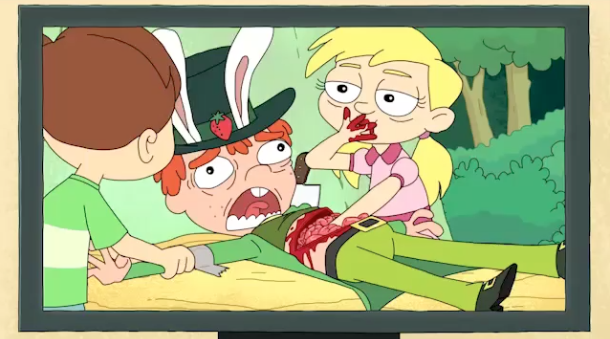
To make the programs and commercials in "Rixty Minutes" as weird and nonsensical as possible, co-creators Justin Roiland and Dan Harmon ad-libbed the dialogue for almost all of them (and then the animators worked from there). It's like a drunken Axe Cop, fueled not by the imagination of some cartoonist's baby brother but by the imagination of a couple of grown-up comedy writers improvising in a recording studio (one of whom isn't shy about his love of booze while performing or working, and you can even hear him slurring his words while voicing the police captain in a cop show spoof about a detective with baby legs). At the end of his voiceover during the trailer for an action movie starring a Dwayne Johnson lookalike, Harmon can be heard laughing over the title he came up with for the movie (Two Brothers), and at the end of the clip of a Garfield parody called Gazorpazorpfield, Roiland cracks up too while pretending to be Lorenzo Music doing the voice of Gazorpazorpfield (by the way, Rick and Morty's discussion of the weirdness of both the late Music voicing Bill Murray's Ghostbusters character on The Real Ghostbusters and Murray later voicing Music's old Garfield role in the Garfield movies made the day of this Murray fan and former Real Ghostbusters viewer).

Roiland and Harmon corpsing is funnier than the actual bits themselves. In fact, most of these fake shows and ads aren't really all that funny, although the fake cereal commercial--think a Lucky Charms ad reimagined by Tom Savini--is a delightfully sick and twisted riff on how sociopathic the kids often used to be in animated General Mills cereal ads. And I especially like the jabs at Chris Parnell's old SNL stomping grounds and the way that the SNL cast can get so oversized and unwieldy in certain seasons during the scene where Rick stumbles into SNL from another reality ("It's Saturday Night Live! Starring a piece of toast! Two guys with handlebar mustaches! A man painted silver who makes robot noises!"). Sadly, just like SNL in our reality, their reality's SNL would rather add a piece of toast and a silver man who makes robot noises to its cast than an Asian American comedian.

There once was an episode of Davey and Goliath that ended just like this.

I don't know why Dany's there when she's never been seen interacting with the Lannisters, but who gives a fuck?

As amusing as some of the parallel-universe TV clips are (dig the split-second shot of alt-Game of Thrones), the "drunken Axe Cop" half of "Rixty Minutes" is overshadowed by Beth, Jerry and Summer's B-story, which, unlike last week's episode, addresses some of the ramifications of Rick and Morty's actions at the end of "Rick Potion #9." The B-story also proves that Roiland and Harmon can shift from humor to seriousness in an animated show as masterfully as the latter showrunner does in live-action form whenever he handles the darkest or most serious moments of Community.

The discoveries Beth and Jerry make about their lives in other realities (Beth learns she's the wealthy and respected hospital surgeon she always wanted to be instead of merely being an animal surgeon, while Jerry learns he's a movie star who's banging Kristen Stewart) cause them to become further disappointed in their present lives and their strained marriage. Harsh words are once again exchanged between Beth and Jerry, and out spills the truth they've tried to keep hidden from Summer, who's been wondering why she can't find any parallel versions of herself in Rick's interdimensional goggles: Beth wanted to have an abortion when she learned she was pregnant with Summer, whereas in the other realities that Beth and Jerry are starting to wish they lived in, they never had kids. Summer takes it well and decides to run away from home.

What follows is the best non-comedic scene Rick and Morty has done since the eerie, Mazzy Star-soundtracked conclusion of "Rick Potion #9." Morty, who's never really been seen bonding with his big sister, yet he doesn't want her to leave (possibly because he's been through enough craziness and upheaval in his life already), attempts to stop her from running away by revealing to her something as equally screwed-up as her situation. That, of course, is fleeing his badly Cronenberged reality to assume the identity of the deceased Morty in this reality and then burying his counterpart's corpse in the backyard.

They chose a really weird moment to do a Dell product placement.
(Photo source: Morty and Rick)
"And every morning, Summer, I eat breakfast 20 yards away from my own rotting corpse," confesses Morty.

"So you're not my brother?," says Summer.

"I'm better than your brother. I'm a version of your brother you can trust when he says, 'Don't run.' Nobody exists on purpose. Nobody belongs anywhere. Everybody's gonna die. Come watch TV," says Morty.

It's Morty's way of saying "I don't want you to leave because you're my big sister and I've been through enough" without using those cheesy words. It also marks a fascinating shift in Morty's once-weak-willed character. He's starting to adopt Rick's nihilist worldview (as exemplified in the pilot by Rick's breakfast table line that "There is no God, Summer. You gotta rip that Band-Aid off now."), except he's way more compassionate about it than Rick. We got hints of this compassion while he was trying to raise Morty Jr. to be less homicidal and more civilized in "Raising Gazorpazorp," and I can't wait to see what happens when this conscience of his re-emerges when he stands up to Rick at his worst, at some point later in the season, according to Roiland.

And Morty gets Summer to stay without giving her a godawful Miller-Boyett sitcom hug (while Beth and Jerry's teary reconciliation--right after they're both moved by seeing their parallel counterparts find their way back to each other--borders on Miller-Boyett-y, but fortunately, it's soundtracked by Belly's 1995 song "Seal My Fate," which is hardly as excruciating as typical Miller-Boyett hugging scene music). I'm so proud of Morty, and I'm so proud of this goddamn show.


Stray observations/other memorable quotes:
* Sarah Chalke, who was cast as Beth because of her ability to burp on cue, finally gets to make use of this talent when Beth belches just like her drunken dad while she knocks back wine by herself in the kitchen with the interdimensional goggles on.

* Check out the Afro puffs on the B.A. Baracus counterpart in the A-Team-inspired Ball Fondlers.

I take it he's a Lady of Rage fan.

* "You know, me and Morty are having a blast. We just discovered a show called Ball Fondlers. I mean, I don't wanna rub it in or anything, but you guys clearly backed the wrong conceptual horse."

* "I'm gonna... move to the Southwest, and... I don't know, do something with turquoise!"

* "And returning for his 25th consecutive year, Bobby Moynihaaaaaaaaaaan!"

* This has to be a Harmon line, because it references both his own Community feud with Chevy Chase and Chase's behind-the-scenes SNL confrontations with Bill Murray and everyone else who worked on the show: "Interesting fun fact: uh, Moynihan and Piece of Toast hate each other. Apparently, they've got some real creative differences."

* Here's yet another sign that we're far from sappy, clean-cut Miller-Boyett territory: The post-credits tag of "Rixty Minutes" is a photo montage of the Smiths on vacation in a universe where hamsters live in people's butts.

Because she's a doctor, Beth isn't thinking, 'This is fun.' She's thinking, 'Is this shit even sanitary?'
(Photo source: Reddit)

Thursday, March 15, 2012

March Madness March of the Day: "Stripes March" by Elmer Bernstein

Quien es mas sexy? P.J. Soles o Sean Young?
There are two fantastic pieces of music that director Ivan Reitman's 1981 military comedy Stripes introduced to me. One is "Do Wah Diddy Diddy," a song from way before my time that soldiers adopted as a marching cadence after watching Bill Murray and Harold Ramis choose it as their cadence in Stripes ("The first time we screened this for a real movie audience, people started applauding as soon as they started singing 'Do Wah Diddy,'" recalled Reitman during the Stripes DVD commentary). The other is the spirited "Stripes March" by Elmer Bernstein, whose iconic Great Escape score Reitman utilized to temp-track Stripes before Bernstein recorded the Stripes score.


That march is so tied to the misfit likes of John Winger (Murray), Russell Ziskey (Ramis), Ox (John Candy), Cruiser (John Diehl) and Elmo (Judge Reinhold) that when it wound up as trailer music for another military comedy, 1994's Renaissance Man, I thought, "Hey, that belongs to Stripes, man! Don't be claiming that. That's like if the Beetlejuice TV ads copped Ray Parker Jr.'s 'Ghostbusters.' Get your own soundalike shit!"

The cinema blog Radiator Heaven posted a really good overview of Stripes a few years ago. It pointed out how superb all the major players in the film's cast were, from the perfectly cast Warren Oates as drill instructor Sergeant Hulka to Murray. His Second City training was put to great effect, like in the film's first few minutes, in which a cab-driving Winger has to put up with a snooty old socialite (Fran Ryan) who's his fare, or the improvised scene where Hulka (who, as we realize in this scene, isn't the film's villain--that would be John Larroquette as incompetent Captain Stillman) has Winger and the other recruits introduce themselves ("Chicks dig me because I rarely wear underwear, and when I do, it's usually something unusual").

The Radiator Heaven post doesn't mention Bernstein's catchy Stripes march, but it does acknowledge how effective Bernstein's score is during an early scene that straddles the line between comedy and drama ("Bernstein’s first musical cue appears and it is a slightly sad, whimsical tune"). Winger--whom Community(*) creator Dan Harmon named Joel McHale's study group leader character Jeff Winger after as a shout-out to both Murray and a film that must have influenced how Harmon sometimes has Community bravely and effectively straddle the line between comedy and drama--is dumped by his girlfriend (Roberta Leighton) right after quitting his cabbie job. He's then forced to deal with the fact that the lack of purpose in his life has driven away his girlfriend and is the reason for the rut he's in. "Interestingly," noted Radiator Heaven's J.D., "no music plays during this scene so that the gravitas of the scene, if you will, is not undermined by manipulative music. Bernstein’s whimsical score only returns when Russell arrives and the two banter back and forth."

J.D. also noted that Stripes' anti-authoritarian-misfits-in-an-authoritarian-setting template "would prove to be so successful that it was exploited in films like Police Academy." Sure, Michael Winslow's beatboxing and sound effects gags always elicit a chuckle, but everything else the Police Academy movies did, Stripes did it better. And that includes the soundtrack.

(*) Hell yeah, Community's back on the air tonight!

Monday, August 29, 2011

"If I wanted Chekhov, I'd have worn my polo neck": The best existing songs that are theme music for shows you've probably never heard of

For a creepy time, call Andy Dick.

1. "Somebody Start a Fight or Something" by TISM (The Green Room with Paul Provenza)
This rousing 2004 track by the Aussie alt-rock band TISM delivers a message of "Drop your pretentious airs and start keeping it real" ("Listen, motherfucker, let me make this clear/I've had your fucking poetry up to here... If I wanted Chekhov, I'd have worn my polo neck"), so it's the perfect theme music for a frank and uncensored Showtime stand-up comic panel show that's the anti-Comics Unleashed with Byron Allen.

In other words, the stand-ups are required to have an actual conversation with each other, instead of pretending they're having a conversation when what they're really doing is just reciting their routines. Moderator Paul Provenza's anti-Comics Unleashed format has resulted in lively and thought-provoking discussions like the one Provenza, Bill Burr, Lizz Winstead, Russell Peters, Colin Quinn, Caroline Rhea and Tony Clifton (!) had about Tracy Morgan's apologies for his homophobic jokes during a recent episode that took place at Montreal's Just for Laughs festival. (Also in that same episode, Peters, an Indian Canadian comic, gives the funniest description of what porn flicks are like in a country where its movie stars can't even kiss onscreen. I can't do Peters' Indian porn joke any justice if I attempt to repeat it, so I won't attempt to.)

During an interview to promote The Green Room, Provenza said one of the purposes of his show is to get stand-ups who are always "on" to leave behind their one-liner comfort zones or stage personas and just be themselves. The frequent archness of the present-day stand-up world is a trend he dislikes:

Many comedians these days "take on characters. It's a lot of winking and nodding. Some comedians almost even apologize for the fact that they're working in the form of comedy, and they make fun of the form as they're doing it. That's the overriding trend. So what you get is people who are not actually talking from the heart. They're always putting some layer of detachment from their real, you know, emotional and intellectual passions."

In other words, he wants them to pull no punches, whether it's onstage or on The Green Room. Somebody start a fight or something.


2. "Yalili Ya Aini" by Jah Wobble's Invaders of the Heart (The Smartest Man in the World)
I first heard this hypnotic 1994 track by former Public Image Ltd bassist Jah Wobble, his band Invaders of the Heart and singer Natacha Atlas (Allmusic calls it "one of the best bits of sexy, North African lurch that Wobble and [guitarist Justin] Adams have ever set to tape") while tuning in to SomaFM's Secret Agent, which has it on constant rotation. So when it wound up as the theme music for comedian Greg Proops' stream-of-consciousness podcast The Smartest Man in the World, I thought, "Sweet! It's that Arabian-sounding chillout joint from Secret Agent with the title that always escapes me."