Even though it's been nearly a year since the demise of Pitchfork Media's smartly written film discussion site The Dissolve, the now-defunct site's animated short about PG-13's negative effect on the quality of American movies continues to resonate. From May 8, 2015, here's a repost of my discussion of "A Brief History of PG-13."
The Pitchfork.tv webseries Frames takes musicians' NSFW anecdotes and reinterprets them in animated form. For example, Detroit rapper Danny Brown's tales of his days as a drug dealer were transformed by Frames into the Hanna-Barbera cartoon I always dreamed of. All that was missing from Frames' Danny Brown episode was Don Messick voicing a Philly blunt that talks and greets Danny Brown with "What up doe?" Now Frames director Mack Williams has taken "The ongoing failure of the PG-13 rating," an excellent 2014 article Chris Klimek wrote for Pitchfork's sister site The Dissolve, and given it the animated treatment for Pitchfork.tv as well. In only two minutes full of genuinely funny sight gags by Williams and the animators at the Brooklyn studio Pig Apple (my favorite sight gag has to be the MPAA disrupting the duo from Once), "A Brief History of PG-13" amusingly elucidates how much the MPAA rating system is bullshit.
As narrator Radam Pooman says in "A Brief History of PG-13," the MPAA created PG-13 in 1984 as a response to the outcry from parents over the violence or intense moments in blockbusters Steven Spielberg either produced or directed. The subversive dark comedy Gremlins, which Spielberg produced and Joe Dante directed, and Indiana Jones and the Temple of Doom (and to a lesser extent, the Spielberg-produced, credited-solely-to-Tobe-Hooper-but-Spielberg-actually-did-a-shitload-of-the-directing-too original version of Poltergeist in 1982) were too graphic and harrowing as PG films. But they also weren't R enough--or rather, as Bullhorn pronounces it in the ad campaign for the original Black Dynamite, R-uh enough--to be stamped with R-uh. In fact, Temple of Doom's posters and ads got stamped with a box that said, "This film may be too intense for younger children." The Dissolve article points out that Spielberg himself approached the MPAA with an idea for a rating between PG and R-uh. So PG-13 was born, crawling out of the MPAA's slimy sac like Stripe in Gremlins, but while Stripe caused small-town mayhem, PG-13 has done something far worse in the years since its inception.
"It makes movies more generic and less adventurous," wrote Andrew Whalen in a 2014 iDigitalTimes article that, just like the Dissolve piece and the Pitchfork.tv animated short, decries the damage PG-13 has done to American filmmaking and the overall brokenness of the rating system. "It was meant to provide more flexibility to filmmakers, not less. It failed because it soon became clear that the PG-13 rating hit the sweet spot for putting butts in seats: not too mature that a family can't attend together, edgy enough that teens don't look down their noses at it."
When film critics like Matt Zoller Seitz complain about a certain sameness in present-day, live-action superhero movies and their lack of inventive filmmaking or even human personality (the fact that the animated superhero movies The Incredibles, Big Hero 6 and Batman: Mask of the Phantasm have more personality in their filmmaking than most of their live-action counterparts is proof that animation is where the superhero genre works best), PG-13 is mostly to blame for those things. In trying to conform to a PG-13, the directors of these movies have ended up stifling their own creativity (or maybe they never had it to begin with). Does anybody ever wonder why Paul Verhoeven, at one time the king of hard R, returned to the Netherlands? It has to be because a film like his hard-R original version of RoboCop--the kind of subversive and offbeat superhero movie the likes of Seitz must be longing to see more of these days--couldn't get made today by a major Hollywood studio. Those studios are too busy chasing PG-13s. In fact, that's exactly what happened to RoboCop when Elite Squad director José Padilha rebooted the former Orion Pictures franchise last year for Sony. It spawned a bland-as-fuck PG-13 remake. When Gremlins gets remade too, that version's bound to get a PG-13 as well, but I wouldn't be surprised if it turns out to be blander than the PG-rated Dante version.
Speaking of which, PG-13 has also led to strange contradictions. As "A Brief History of PG-13" points out, affection between gay characters in Love Is Strange and F-bombs in Once landed those inoffensive and non-violent indies an R. Meanwhile, the exploding head in the 1989 Bond flick Licence to Kill--an example of graphic violence neither "A Brief History of PG-13" nor the Dissolve essay mentions, as well as the most gruesome moment in the Bond franchise, before Daniel Craig's nads came into contact with a carpet beater in Casino Royale--merited only a PG-13. And what did Casino Royale also receive, in spite of that brutal torture scene, the gore and the 22-person body count? Yep: a PG-13.
"A Brief History of PG-13" is such a good animated short that I'd like to see Williams do more animated tie-ins with The Dissolve. The site's discussions of Midnight Run with Adam Scott and Running Scared with Paul Scheer are crying out for the animated treatment, as is Noel Murray's essay "Why great comics don't always make great movies." If there's one thing that's missing from "A Brief History of PG-13," it's an idea for a solution that's better than PG-13. But what would that idea be? /Film's David Chen was onto something when he implied that the MPAA should be dismantled.
"We're heading towards an age when we don't need a mommy-like organization to dictate what our delicate sensibilities can and can't be exposed to," wrote Chen in 2010. "I deeply hope that the MPAA's irrelevance is imminent."
Every Throwback Thursday, I randomly pull out from my desk cabinet--with my eyes closed--a movie ticket I saved. Then I discuss the movie on the ticket and maybe a little bit of its score, which might be now streaming on AFOS.
"Folks who exasperatedly dismiss discussion of color with 'Not everything is about race,' are usually people who (unknowingly) have the privilege of being viewed as race-less (white). The race-less of course have the freedom to decide what is and isn't about race. Those that are not seen as race-less (people of color) don't. [Joe] Cornish seems to understand what many people don't want to admit, that a person's race shapes their experience in the world. Whether it should or shouldn't, it very much does. Ignoring this fact, even if well intentioned, perpetuates inequality. The boys in Block, as young men of color, are always aware of racial dynamics. So constant is this awareness, neither positive nor negative, that it becomes unconscious, like breathing. It's always there. The film takes place completely within this understanding."--Kartina Richardson (2011)
If it weren't for its teen characters' awareness of the elephant in the room called race, as well as the equally intriguing way Joe Cornish avoids being heavy-handed about it, Attack the Block--the British comedian's 2011 feature-length directorial debut--would just be an ordinary low-budget monster movie with a diverse cast instead of the above-average low-budget monster movie with a diverse cast it wound up becoming. Sure, it's always nice to see a black teen or an Asian American as the main protagonist in a sci-fi story, but what really matters in the end is how that story makes that protagonist of color come alive as a credible human being, and Attack the Block succeeds in that department.
Cornish is white, but one thing that makes him bolder than other white creators who have placed characters of color at the center of the sci-fi action is his decision to make Moses (John Boyega) a regular street kid instead of the saintly (and more palatable to older and more affluent white folks) cop or soldier of color who's usually pitted against unfriendly creatures in sci-fi. At one point, Sam (Jodie Whittaker), a 20-something white nurse who's mugged by Moses and his mostly black friends at the start of the film and evolves from despising them to relying on them for her survival, is seen suggesting to them that they turn to the police for help in protecting their South London neighborhood from bloodthirsty alien beasts that have suddenly landed in South London for mysterious reasons.
Moses and his male and female friends want nothing to do with the Five-0--"You think the police is gonna help them? They might not arrest you, but they'll arrest them," says Tia (Danielle Vitalis), a neighborhood girl with a crush on Moses, to Sam--and Moses believes the aliens were sent to South London by the same government that sics the police on black kids and is responsible for various other things in what the British call the block and what we Americans call the projects. "Government probably bred those creatures to kill black boys. First they sent drugs to the ends. Then they sent guns. Now they sent monsters to get us. They don't care, man. We ain't killing each other fast enough, so they decided to speed up the process," says Moses. Right when Tia points out to Sam the privilege she has as a white person and Moses spouts his theory about the aliens being government-made, an acknowledgement of the racism that permeates the world outside the theater or TV screen finally emerges in the dialogue of this escapist movie--rather than the movie acknowledging it through coded dialogue from white characters like one lady's earlier view of Moses and the hoodies as "fucking monsters"--and Attack the Block, which was co-executive-produced by Edgar Wright, becomes something truly special and alive as escapist entertainment.
At that moment, this sci-fi story that takes place in the projects declares that, for once, it's not going to shy away from race and hide behind silly sci-fi metaphors to address race or naively attempt to put a Band-Aid on racism (the teens' frankness about the ignorant attitudes of the police in blocks like Moses and Sam's makes this film continue to resonate, especially during the rise of #BlackLivesMatter and the stupidity of #AllLivesMatter, a hashtag that could only come from the minds of privileged dolts). Also at around that point in the story, Attack the Block makes it clear that a cop won't be the hero of the narrative like he or she often is. Instead, the misunderstood kid who frequently gets harassed or cuffed (or killed) by such cops becomes the hero here, and though he's tougher than the other hoodies and will outlive some of them, he's extremely human, thanks to Cornish's writing for Moses and Boyega's ability to balance toughness with vulnerability. It's no wonder Boyega was cast in the J.J. Abrams-directed Star Wars: The Force Awakens: he's great at reacting to the mayhem surrounding him, just like how his Force Awakens co-star Harrison Ford was terrific at reacting to mayhem in action classics like Raiders of the Lost Ark and The Fugitive.
While being interviewed by Esquire about the upcoming 007 movie Spectre, Daniel Craig said he admires Ford's performance in Raiders because "he's so fallible, to the point of comedy. You know at any time he might fuck up, and that adds to the danger and the excitement and the joy of it." That's also the key to why Boyega's performance in Attack the Block is equally enjoyable. There's a scene where you expect Moses to have a grand action hero moment and save Tia and her best friends from aliens who have invaded Tia's flat, but his katana gets stuck in a wall behind him, and Sam ends up having to save him. Meanwhile, Tia and Dimples (Paige Meade) don't really need Moses' help and are doing quite okay on their own, thanks to their fighting skills with whatever item they can get their hands on. Fuck Matt Damon. These ice skate-wielding South London girls should be the stars of Damon's next Bourne movie. Later on, when Moses gets his opportunity to finally blow each and every alien to smithereens with his lighter, his hands start to shake out of nervousness.
A lesser filmmaker would write Moses as being badass and flawless all the time, but Cornish prefers to make his protagonist a bit more complicated. He's as flawed as the Park siblings from the Bong Joon-ho masterpiece The Host (a double feature of Attack the Block and The Host, by the way, would be like the illest double feature ever) and is perhaps even more thoughtless than either of the Parks because in addition to mugging Sam, he's made the mistake of getting into business with an impulsive, murks-anybody-who-looks-at-him-wrong neighborhood drug lord named Hi-Hatz (Jumayn Hunter) and has made the additional mistake of murking the female alien whose pheromone summons all the male "gorilla wolf motherfuckers" to South London. In Predator, Arnold Schwarzenegger wasn't responsible for bringing to the jungle the titular hunter from outer space, whereas in Attack the Block, our hero is the cause of all the bloodshed and the losses of some of his friends. So when it's up to Moses to fix what he started and decide what kind of adult he wants the block to remember him as, the climax of Attack the Block takes on an unexpected power, aided by both slow motion that doesn't look clichéd and silly for once and "Moses vs. the Monsters," a pulsating score cue by composer Steven Price and Basement Jaxx partners Felix Buxton and Simon Ratcliffe ("Moses vs. the Monsters" is in rotation during the AFOS blocks "Beat Box," "Hall H" and "AFOS Prime").
One other thing makes Cornish bolder than other white writers who are outsiders looking in on ethnic settings they've chosen to write about: the wide range of black teen characters Sam encounters as the alien invasion forces her out of her comfort zone. (Had Attack the Block been a mainstream hit in America, it would have caused that racist old moron Lou Dobbs to get his panties in a bunch over the kinds of characters it chooses to sympathize with.) A lesser white writer would probably make every black teen character interchangeable and as sullen and parentless as Moses or as hotheaded as Dennis (Franz Drameh), whereas each of Moses' friends is distinctive in background (Moses is the only one who comes from a broken home, and the closest thing he has to a parent is an uncle who's never there) and temperament. For instance, Biggz (Simon Howard) has a white mom and is less willing than the others to get himself into dangerous situations; Tia and Dimples are similarly disdainful about Moses' flirtation with a criminal lifestyle. This also ties into how Attack the Block doubles as a thankfully non-preachy critique of the demonization of the working class in England.
Cornish was a one-time mugging victim who wanted to better understand his muggers and their everyday lives instead of being resentful of them (the mugging of Sam, who's clearly a stand-in for Cornish, was based on the incident Cornish experienced), so he takes working-class kids like the kindly and dorky Jerome (Leeon Jones) and the dorkier Biggz, who spends most of the film hiding in a trash bin, and he fleshes out those characters to prove the irrationality of demonizing and simplifying the underclass. One minute, they're mugging somebody and not enjoying it at all (they later admit to being scared while doing the mugging), and the next, they're chatting with Mum or Grandmum on their phones like typical 13-to-15-year-olds trying to make it home in time for dinner.
What also makes Attack the Block stand out is the much-welcome absence of CGI ("We used CGI a little to enhance, but mainly to remove details," said Cornish to GQ in 2011). The creature FX work in Cornish's film is largely practical. The alien attacks are fast and brutal, and this is a rare case where the fast-cutting that so many film critics complain about when they critique contemporary action movies is absolutely necessary. The fast-cutting prevents us from noticing how low-budget the monsters are: they're essentially just stuntmen--led by the great Terry Notary, one of the motion-capture performers who starred as the apes in the last two Planet of the Apes movies and a movement coach for those movies, by the way--inside eyeless gorilla suits outfitted with neon green teeth. But because the Attack the Block aliens aren't CG, there's a formidability and weighty presence to them that's missing from most CG creatures.
On one of Attack the Block's Blu-ray audio commentaries, Cornish says the inability to afford extensive CG FX allowed him to get authentic reactions from his child actors since the monsters were physically there on the set. The performances of the kids--who hadn't been in the acting game long enough to receive training on how to look like you're not pretending during a job that requires you to pretend things that aren't there are actually there--wouldn't have been the same if they had to react to a tennis ball on a stick. Attack the Block is more of a sci-fi actioner than a genuinely scary horror flick--The Walking Dead contains 10 times more gore each week--but the film contains one horrific moment: the child actors may have been way more terrified of the aliens than us adult viewers are, but the split-second shot of a mutilated Hi-Hatz looking like a black Voldemort makes you finally understand the kids' genuine fear.
The year 2011 saw four different Steven Spielberg-produced projects about alien invasions emerge in the same summer: the Abrams-directed Super 8, Transformers: Dark of the Moon, Cowboys & Aliens and the TNT original drama Falling Skies, which just recently ended its run. I barely remember any of them, aside from Elle Fanning's amusing transformation into a zombie for Super 8's movie-within-a-movie and the troublemaking antics of Colin Cunningham's biker character Pope during Falling Skies' first season, whereas Attack the Block, which was made for much less and details an invasion that's on a much smaller scale, is a film that's still on my mind. Its potent mix of monster movie thrills and nuanced, non-preachy social commentary about both racial inequality and white privilege makes it a film I keep revisiting. Attack the Block murks them all.
Steven Price and Basement Jaxx's outstanding score cues from Attack the Block can currently be heard during the AFOS blocks "Beat Box," "Hall H" and "AFOS Prime." The 1993 KRS-One classic "Sound of da Police" and Richie Spice's "Youth Dem Cold," the two most memorable existing songs during Attack the Block, cannot be heard on AFOS, but they would have been part of the now-defunct AFOS block "Rock Box," which was discontinued in 2012 due to limited station hard drive space and the elimination from rotation of anything that wasn't original score material.
Every Throwback Thursday, I randomly pull out from my desk cabinet--with my eyes closed--a movie ticket I saved. Then I discuss the movie on the ticket and maybe a little bit of its score, which might be now streaming on AFOS.
Jurassic World just experienced the most successful opening weekend in film history, outgrossing even the opening weekend of the original Jurassic Park, a kaiju (Japanese for "strange beast") movie where smaller-sized dinosaurs are the kaiju instead of a 164-foot-tall lizard with atomic breath. But as much as I like both the craftsmanship Steven Spielberg brought to the moments of suspense (and occasionally, levity) in the first installment and Stan Winston and ILM's effective blend of practical FX and CGI in that installment, I find the Jurassic movies to be oddly underwhelming in comparison to Spielberg's masterful work in the original Jaws. As material in between the creature scenes, which are the main reason for flocking to these Jurassic blockbusters, the "Sam Neill learns to get in touch with his paternal side" storyline--a tiresome staple of post-SNL comedy vehicles starring either Billy Crystal, Adam Sandler or more recently, Will Ferrell--is less intriguing than the character interplay between Roy Scheider, Richard Dreyfuss and Robert Shaw in Jaws.
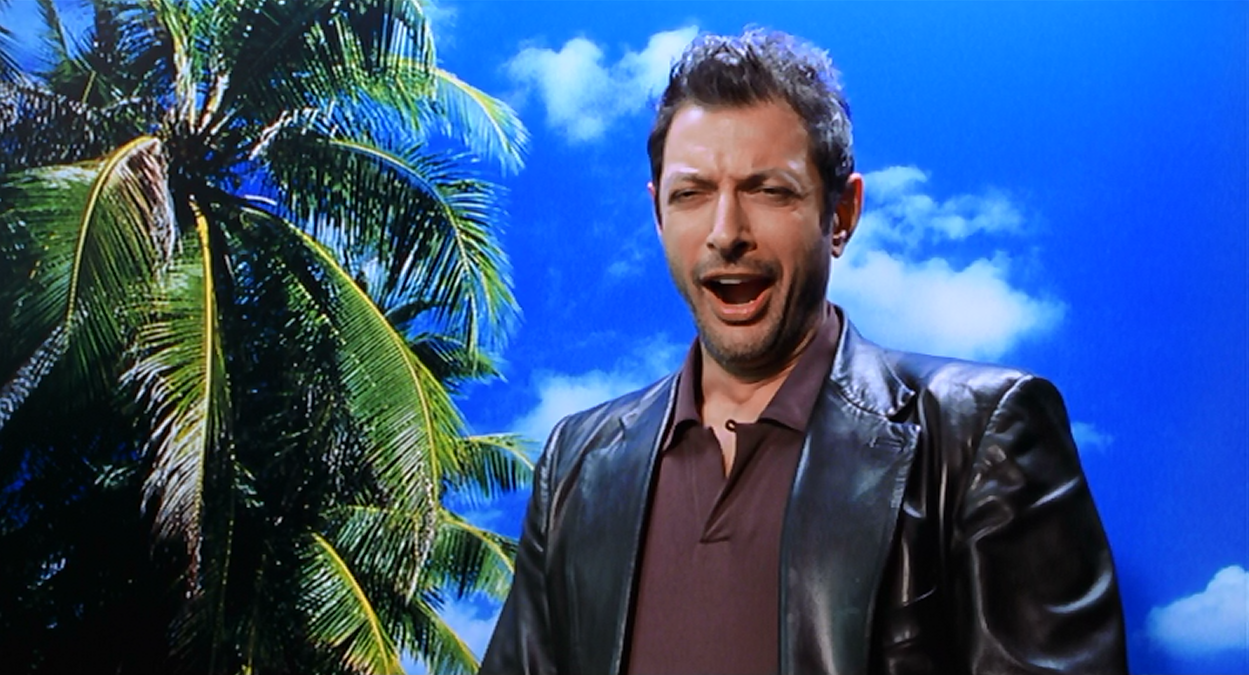
I lost interest in the Jurassic franchise about halfway through The Lost World: Jurassic Park and never got on board the franchise again (I still haven't seen Jurassic Park III and will most likely wait until Jurassic Not-Yet-5, as I like to call it, comes to Blu-ray). I remember falling asleep in the theater during The Lost World--at some point between Julianne Moore nearly falling to her death while glass slowly breaks beneath her and the lame moment when a raptor gets kicked in the face by the gymnastic moves of Jeff Goldblum's preteen daughter, I dozed off with my eyes open--and I got the sense that Spielberg, whose first shot of Goldblum in The Lost World shows the star yawning in a subway station, was equally disinterested with the material in his own sequel. (Fifteen years later, you could sense the same thing when Christopher Nolan only truly became alive during the stunning plane hijack sequence for The Dark Knight Rises, and for the rest of the project, it felt like the death of Dark Knight star Heath Ledger had sapped Nolan of his enthusiasm and energy.) Spielberg was phoning it in. He, in fact, later admitted in interviews to experiencing a constant feeling of "Is that all there is? It's not enough for me" throughout the filming of The Lost World. However, there is one moment in The Lost World where Spielberg didn't phone it in, and it's that literal cliffhanger scene with a petrified Moore unable to move or sneeze, the only genuinely nerve-wracking scene in The Lost World, as well as the only moment where Spielberg is back to his old enthusiastic and alert self, and it's not even a dinosaur attack.
So the Jurassics have never been my favorite kaiju movies. But Korean director Bong Joon-ho's The Host, a.k.a. Gwoemul (Korean for "monster")? Now that, to me, is the perfect kaiju movie, in which the human side of the movie is, for a change, as satisfying as the monster action and isn't an ordeal to sit through in order to get to the monster action. The Host is an effective mix of monster movie thrills, dysfunctional family comedy and political satire (about the incompetence of both American and Korean institutions) that's reminiscent of the anti-nuke satire in Ishirô Honda's original 1954 version of Godzilla.
Bong wanted to take everyday people like the extremely flawed members of the working-class Park family (in comparison to Sam Neill's sole flaw of being awkward and standoffish around kids, which isn't all that interesting as a character flaw) and place them in a central role that's usually reserved in monster movies for scientific geniuses or muscle-bound heroes, the kinds of characters Bong says he finds to be boring. His risky and unconventional decision resulted in my favorite human protagonists in an earthbound kaiju movie since, well, the trio in Jaws. Like all the films in Edgar Wright's superb Cornetto trilogy, The Host isn't a genre spoof; it's a thriller with genuine stakes that happens to be comedic and is full of characters worth being invested in, so that when one of the protagonists dies or is nearly dead, it's a moment that genuinely stings.
Even the creature in The Host, despite being an efficient and single-minded killing machine, or rather, in the parlance of both Matt Hooper and Jaws trailer announcer Percy Rodrigues, an "eating machine," is imbued with personality too. The film's digital FX may vary in quality, but they're never too cartoonish-looking. The creature's clumsy gait cleverly mirrors the klutziness of Host star Song Kang-ho's anti-hero Park Gang-du. Sure, Gang-du learns to be a better dad just like in that sappy Jurassic Park/Billy Crystal/Adam Sandler storytelling device that annoys me so much, but The Host handles that device so much better. It also handles humor better than Roland Emmerich's Jurassic Park-ified 1998 reboot of Godzilla--a kaiju movie in the form of a terrible and unfunny '90s Fox sitcom stretched out to over two excruciating hours--did (the terrible '90s Fox sitcomminess of it all is further enhanced by Emmerich's casting of both Maria Pitillo, star of Fox's short-lived Partners, as Matthew Broderick's love interest, and Simpsons veteran Hank Azaria, star of Herman's Head, a.k.a. Inside Out if it were an oversexed '90s Fox office sitcom).
The Host's effectiveness as both a character study and a creature feature is precisely why I've never warmed up to any of the old-school Godzilla movies, except for the intriguing first movie, which I first caught on TCM, luckily without the stupid Raymond Burr-related changes that were made to it by the movie's first American distributor (the horrendous dubbing in the American versions of these films has also made me avoid the Godzilla franchise; except for spaghetti westerns and some of the Studio Ghibli films, I can't stand watching foreign films when they're redubbed by Americans or the British). As a kid, I took one look at 1973's Godzilla vs. Megalon back when it was once the feature presentation on Mystery Science Theater 3000 and thought, "That's the formula for Godzilla? It's a terrible one. Nah, I think I'll skip the other Godzilla flicks."
Godzilla vs. Megalon is one of the least beloved Godzilla installments, partly because Godzilla was basically a guest star in his own movie. It was produced during a time when the Toho Studios franchise was past its prime and had abandoned its nifty roots as an allegory about post-war Japan to strictly cater to the kids in the audience. I know Godzilla vs. Megalon is a lousy way to be introduced to the Godzilla franchise. It would be like if someone who's never seen any of the 007 movies chose A View to a Kill or Die Another Day as their first 007 flick to watch; they won't understand what all the fuss over the other movies is about. But Godzilla vs. Megalon is a good example of how boring and pointless the human characters tend to be in kaiju movies, a problem that doesn't afflict the 1954 Godzilla and is also a problem I was hoping British director Gareth Edwards wouldn't fall prey to when he got the chance to not repeat Emmerich's countless mistakes while reintroducing Godzilla for a second time (not counting the two Americanized and badly butchered Godzillas that starred Perry Mason) to non-Japanese audiences.
While there's much to enjoy about Edwards' gritty, Fukushima-inspired 2014 version--like Alison Willmore said, the MUTOs (Massive Unidentified Terrestrial Organisms) and the redesigned Godzilla look terrific and are "lumbering and massive with a sense of incredible heft to them, despite being CGI creations"--Edwards, unfortunately, has a problem of focusing his films on white lead characters who aren't as interesting as he thinks they are. It's a problem that goes back to Edwards' prior sci-fi film Monsters, his low-budget 2010 breakthrough. Monsters is a film about Mexico experiencing first contact with giant alien creatures, and it's told not through the eyes of any of its citizens but through the eyes of the most annoying white hipsters since those douches who gentrified the barrio side of Arlen and slipped salmon into Enrique's fish tacos?
As The Daily Dot astutely pointed out, Godzilla suffers from a boring white guy problem--a problem that mars another recent kaiju flick, Pacific Rim--and is part of a long line of Hollywood tentpole blockbusters that opt for the least interesting characters as their leads. Out of a cast that includes the likes of Ken Watanabe, Bryan Cranston, Elizabeth Olsen, David Strathairn and Sally Hawkins as audience surrogates, Edwards chose to center the film around the individual with the least charisma or personality? Yo, Honest Trailers, your "Discount Channing Tatum" line is dead fucking on.
"The funny thing here is that the franchise originated in Japan. I actually haven't seen any of the old movies, but I'm going to assume that they--at least the Japanese ones--don't use Japan and its people as merely the backdrop against which white protagonists can shine and save the day," noted one of the teen authors of the blog Cool Asian Kids. "And that's essentially what the new film does."
Warner Bros. advertised Edwards' whitened-up take on the Japanese franchise as Godzilla and his atomic breath vs. Cranston and his atomic toupee--the studio made it look like Cranston would be channeling Dr. Loomis from Halloween--but (spoilers!) that's not the movie we got. Edwards told Willmore in a BuzzFeed interview that he chose to kill off Cranston's nuclear physicist character early on in Godzilla in order to raise the movie's stakes and create the sense that "anything could happen." Sure, Cranston's physicist dad character is kind of a boring white guy too, but kicking his badacondunk out of the movie so early is such a mistake because Cranston is much more alive and present in his scenes than Blando McBombdefuser--who, as Willmore says, "jumps through a series of increasingly improbable plot hoops to stay in the path of the creatures"--is in his.
It's just the wrong character to be spending a huge chunk of the movie with (and as the type of white savior Cool Asian Kids rightly criticizes him as being, he's amusingly inconsequential in comparison to Godzilla's heroics in the movie), and it's a shame, because Edwards kicks the movie off so promisingly with one of my favorite opening title sequences in a recent tentpole blockbuster. The sequence is a cleverly assembled montage of both real and fake archive footage that establishes the history of MUTOs, nicely scored by Alexandre Desplat--who's skillfully following in the footsteps of the old Akira Ifukube score music that both Pharoahe Monch and Tracy Morgan love so much--and surrounded visually by hastily redacted text from fake government files. The Prologue Studios opening titles are one of the 2014 Godzilla's few instances of humor, one of many things Edwards accomplishes better than Emmerich did. The passages that are redacted to isolate the names of the cast and crew are either silly, freeze-frame-worthy sentences like "The monster communicates through music composed and conducted by Alexandre Desplat" or are full of in-jokes like "Walter Malcolm has claimed that government men dressed in white lab coats routinely appear at site and Bryan Cranston shortly after the event all residents are sworn to silence." Walter is a reference to Breaking Bad, and Malcolm is, of course, a shout-out to Malcolm in the Middle (although shouldn't it say Hal, Cranston's character's name on Malcolm, instead of Malcolm?).
Despite all the sleep-inducing moments involving Discount Channing Tatum, as well as the fact that it's nowhere near the league of The Host, the 2014 Godzilla is superior to Emmerich's previous attempt to bring Godzilla to America and is more effective at building tension and staging monster action. Also, it's not trying to rip off so much of Jurassic Park. Recent Throwback Thursday guest blogger Hardeep Aujla, who hails from Word Is Bond, a U.K.-based hip-hop blog I've contributed pieces to, disagrees. He dislikes the 2014 Godzilla so much that he's skeptical about how Edwards will handle Star Wars in his next directorial effort, Star Wars Anthology: Rogue One. So Hardeep, how would you have improved the 2014 Godzilla if you worked on it? Would you have made the reboot into a boy-and-his-best-friend-who's-a-strange-creature story like the old Godzilla sequels, the Gamera sequels and my favorite of all those stories, The Iron Giant? Or would you have said "Fuck the American audience" and told it from the point of view of Ken Watanabe's scientist character? Or would you have completely gotten rid of any audience surrogate characters and told it from the point of view of Godzilla, which would have probably caused the movie to cost 200 million more American dollars to make but is a kaiju movie that's never been done before?
***
Hardeep Aujla: I think I read that Godzilla's screen-time was only 10 minutes in the whole 130-something minute film. This isn't Jaws, Edwards - less is not more in kaiju films.
As for what I would have done, I love The Iron Giant and that whole story too but I would've gone with your last suggestion, hands down. This is what I always thought AvP should have been. I would have started the film introducing a crack team of badasses equal to Dutch's or Apone's team, but then would've had them torn apart gloriously by the titular creatures (perhaps they stumbled into the vicinity of a one-on-one confrontation). Then the title of the movie comes up accompanied by strong audio tone with the intention of stating "That's fucking right" to the audience and their expectations. I'm thinking a very loud shrill-type noise that starts off monotonous but evolves a couple of seconds later into something with a bit more character before ultimately revealing itself to be the war-cry of either a Predator or an Alien as we cut straight back to the duel (yep, this idea has been rolling around in my head for a while). From there on out we get a pure Aliens versus Predators narrative with no more English spoken.
I haven't seen many of the old kaiju movies (the Gamera trilogy from the 90's is superb though), and the ones I did see were a long time ago, but I do remember some very protracted sequences where it's just Godzilla or his kid doing stuff and the audience just follows along. I may be completely fabricating those memories though. Either way, the challenge for Gareth Edwards would have been to make an engaging film like this in the modern era, one that is good enough to stand strongly unaided by human faces and words. There could of course be some human characters (retaining Ken Watanabe who was wasted in the actual film) but they should have minor roles. I can see how this would be tricky for a character like Godzilla who seemingly doesn't have a rich variety of activities to fill a movie with apart from swim, smash and roar, but therein lies the challenge, and I would be a lot more impressed with Gareth Edwards as a filmmaker if he pulled it off, or at least respect his effort if he tried.
None of Alexandre Desplat's score cues from Godzilla are currently in rotation on AFOS, but Desplat's main title theme ought to be.
Occasionally on Friday, I discuss the week's best first-run animated series episode I saw. It's the "Brokedown Merry-Go-Round" Show of the Week. "Brokedown Merry-Go-Round," a two-hour block of original score tracks from animated shows or movies, airs weekdays at 2pm Pacific on AFOS.
The Pitchfork.tv webseries Frames takes musicians' NSFW anecdotes and reinterprets them in animated form. For example, Detroit rapper Danny Brown's tales of his days as a drug dealer were transformed by Frames into the Hanna-Barbera cartoon I always dreamed of. All that was missing from Frames' Danny Brown episode was Don Messick voicing a Philly blunt that talks and greets Danny Brown with "What up doe?" Now Frames director Mack Williams has taken "The ongoing failure of the PG-13 rating," an excellent 2014 article Chris Klimek wrote for Pitchfork's sister site The Dissolve, and given it the animated treatment for Pitchfork.tv as well. In only two minutes full of genuinely funny sight gags by Williams and the animators at the Brooklyn studio Pig Apple (my favorite sight gag has to be the MPAA disrupting the duo from Once), "A Brief History of PG-13" amusingly elucidates how much the MPAA rating system is bullshit.
As narrator Radam Pooman says in "A Brief History of PG-13," the MPAA created PG-13 in 1984 as a response to the outcry from parents over the violence or intense moments in blockbusters Steven Spielberg either produced or directed. The subversive dark comedy Gremlins, which Spielberg produced and Joe Dante directed, and Indiana Jones and the Temple of Doom (and to a lesser extent, the Spielberg-produced, credited-solely-to-Tobe-Hooper-but-Spielberg-actually-did-a-shitload-of-the-directing-too original version of Poltergeist in 1982) were too graphic and harrowing as PG films. But they also weren't R enough--or rather, as Bullhorn pronounces it in the ad campaign for the original Black Dynamite, R-uh enough--to be stamped with R-uh. In fact, Temple of Doom's posters and ads got stamped with a box that said, "This film may be too intense for younger children." The Dissolve article points out that Spielberg himself approached the MPAA with an idea for a rating between PG and R-uh. So PG-13 was born, crawling out of the MPAA's slimy sac like Stripe in Gremlins, but while Stripe caused small-town mayhem, PG-13 has done something far worse in the years since its inception.
"It makes movies more generic and less adventurous," wrote Andrew Whalen in a 2014 iDigitalTimes article that, just like the Dissolve piece and the Pitchfork.tv animated short, decries the damage PG-13 has done to American filmmaking and the overall brokenness of the rating system. "It was meant to provide more flexibility to filmmakers, not less. It failed because it soon became clear that the PG-13 rating hit the sweet spot for putting butts in seats: not too mature that a family can't attend together, edgy enough that teens don't look down their noses at it."
When film critics like Matt Zoller Seitz complain about a certain sameness in present-day, live-action superhero movies and their lack of inventive filmmaking or even human personality (the fact that the animated superhero movies The Incredibles, Big Hero 6 and Batman: Mask of the Phantasm have more personality in their filmmaking than most of their live-action counterparts is proof that animation is where the superhero genre works best), PG-13 is mostly to blame for those things. In trying to conform to a PG-13, the directors of these movies have ended up stifling their own creativity (or maybe they never had it to begin with). Does anybody ever wonder why Paul Verhoeven, at one time the king of hard R, returned to the Netherlands? It has to be because a film like his hard-R original version of RoboCop--the kind of subversive and offbeat superhero movie the likes of Seitz must be longing to see more of these days--couldn't get made today by a major Hollywood studio. Those studios are too busy chasing PG-13s. In fact, that's exactly what happened to RoboCop when Elite Squad director José Padilha rebooted the former Orion Pictures franchise last year for Sony. It spawned a bland-as-fuck PG-13 remake. When Gremlins gets remade too, that version's bound to get a PG-13 as well, but I wouldn't be surprised if it turns out to be blander than the PG-rated Dante version.
Speaking of which, PG-13 has also led to strange contradictions. As "A Brief History of PG-13" points out, affection between gay characters in Love Is Strange and F-bombs in Once landed those inoffensive and non-violent indies an R. Meanwhile, the exploding head in the 1989 Bond flick Licence to Kill--an example of graphic violence neither "A Brief History of PG-13" nor the Dissolve essay mentions, as well as the most gruesome moment in the Bond franchise, before Daniel Craig's nads came into contact with a carpet beater in Casino Royale--merited only a PG-13. And what did Casino Royale also receive, in spite of that brutal torture scene, the gore and the 22-person body count? Yep: a PG-13.
"A Brief History of PG-13" is such a good animated short that I'd like to see Williams do more animated tie-ins with The Dissolve. The site's discussions of Midnight Run with Adam Scott and Running Scared with Paul Scheer are crying out for the animated treatment, as is Noel Murray's essay "Why great comics don't always make great movies." If there's one thing that's missing from "A Brief History of PG-13," it's an idea for a solution that's better than PG-13. But what would that idea be? /Film's David Chen was onto something when he implied that the MPAA should be dismantled.
"We're heading towards an age when we don't need a mommy-like organization to dictate what our delicate sensibilities can and can't be exposed to," wrote Chen in 2010. "I deeply hope that the MPAA's irrelevance is imminent."
"Williams brings on the movie's signature piece, the 'March from 1941,' which will inform and underlie almost everything that comes after it. The march, instantly hummable, melds the fighting spirit of everything from Kenneth Alford and Malcolm Arnold's 'Colonel Bogey March' (The Bridge on the River Kwai), to the playful exuberance and bombast of Elmer Bernstein'sThe Great Escape, to the echoes of lost national spirit that tumble through Jerry Goldsmith's rousing score forPatton. Yet Williams is never caught cribbing lines or themes--the genius of the music is that is [sic] finds its own spirit, equivalent to the cacophonous madness of the film, yet also coursing with a generous and goofy charm and sense of its own scale that makes a listener laugh even without the attendant imagery."
--from film blogger Dennis Cozzalio's 2010 post about John Williams' 1941 score
Unless it's a Chris Rock routine, a Lewis Black rant, a Will Ferrell girlie-crying jag or Nicolas Cage screaming "Oh no! Not the bees!! Not the bees!! Aaaaaaaaahhhhhhhh!!! Oh! They're in my eyes!! My eyes!!," yelling is such a comedy killer for me. If you like your comedy broad and always shouty, the expensive 1979 WWII farce 1941, Steven Spielberg's first--and not surprisingly, only--attempt at directing a straight-up comedy, is up your alley. But for the rest of us, 1941 can be a chore to watch as it tries too hard to be funny and assumes nonstop loudness--even the end credits curtain call consists of clips of cast members yelling--will automatically yield laughs. No wonder the few funny or amusing moments in Spielberg's John Carter-style financial failure are, of course, moments where no one's yelling.
The whole story of getting 1941 made may be more fascinating than the film itself. 1941 producer and right-wing nutjob John Milius wanted to call his film The Night the Japs Attacked. We have then-MGM production chief Dan Melnick to thank for objecting to the use of "Japs" in the project's early title (back when it was attached to MGM and was nothing more than a Robert Zemeckis/Bob Gale screenplay that was darker-humored and smaller-scale than the finished product). 1941 is an example of a movie where I wish I were a fly on the wall--or better yet, an extra or crew member or whoever was put in charge of the craft services table--because I would have been surrounded by comedy icons like John Belushi, his SNL pal and Blues Brothers bandmate Dan Aykroyd, John Candy and Joe Flaherty; legendary actors like Toshiro Mifune, Christopher Lee and Warren Oates; and '70s hotties like Nancy Allen and that girl from Eight Is Enough. It's the ultimate "film that must have been more fun to make than sit through."
In 1979, 1941 famously tanked. So did the little-known graphic novel tie-in. (Photo source: Steve Bissette)
Spielberg is capable of comedy (see Jaws, Raiders of the Lost Ark, Catch Me If You Can or E.T.'s fish-out-of-water gags), so why did he drop the ball in 1941? Was it because of "too many cooks" syndrome--as 1941 cast member Tim Matheson implied in an A.V. Club "Random Roles" interview where he also noted that "It was fun to shoot, but I didn’t know what the core of it was"--or was the party-animal atmosphere on the set to blame? Vulture's "History Proves the More Fun a Movie Set Is, the Less Fun the Movie Is" slideshow argued that it was the latter.
"Belushi and Aykroyd... turned the set into one big playground where they could wildly drive around in their own vintage New York taxicab and throw out random scene ideas that Spielberg gladly accepted," noted the Vulture list. "First assistant director Jerry Ziesmer's memoir, Ready When You Are, Mr. Coppola, Mr. Spielberg, Mr. Crowe, paints a portrait of an out-of-control set where everybody was constantly cracking each other up."
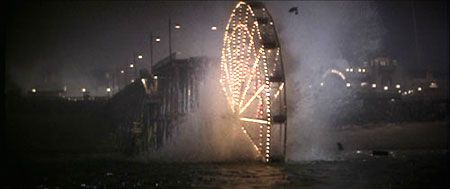
Actually, I come not to bury 1941 (because so many have attacked it so well already, and I'm having a hard time trying to restrain myself from constantly dissing it), but to praise its few highlights. Let's list them now: the skillfully shot USO dance number/fight sequence (it hints at what 1941 would have been like as a musical, which, at one point during production, was what Spielberg wanted to turn 1941 into, and it also proves that the film would have been better off focusing mostly on the teenage characters); the offbeat sight of Robert Stack crying over Dumbo; the wonderful pre-CGI visual effects for the ferris wheel set piece; and the most memorable highlight, John Williams' terrific score.
So I don't find 1941 to be as hilarious as fans of Spielberg's original and longer cut like Dennis Cozzalio do, but I do agree with Cozzalio about Williams' "March from 1941." A great piece of symphonic anarchy, the theme is as loud as the movie's brand of property damage-reliant humor, but aren't all national anthems supposed to be performed loudly? The 1941 march is like the national anthem of Notreadyforprimetimeplayalistica or some country in an alternate reality where comedy nerds run Congress, the Supreme Court justices are stand-ups like Dom Irrera (who's had plenty of judicial experience presiding over Audience Network's Supreme Court of Comedy) and Paul Mooney (too bad he's not a Supreme Court justice because I would love to see Mooney verbally rip apart the conservative justices over matters like President Obama's health care law) and flags were flown at half-mast when Belushi, his '70s SNL colleague Gilda Radner and '80s and '90s SNL regular Phil Hartman died.
Like yesterday's penultimate "March Madness March of the Day," Bear McCreary's Human Target theme, the 1941 march captures the spirit of other classic themes without regurgitating their melodies. It's outlasted the movie it originated from.
My favorite Raiders of the Lost Ark score cue is actually "The Map Room: Dawn" (Indy discovers the Ark's location, and the London Symphony Orchestra is both stoked and disturbed), but the end title theme, which features a full statement of some obscure composition called "The Raiders March" and "Marion's Theme," ain't too shabby either.
"A piece like that is deceptively simple to try to find the few right notes that will make a right leitmotivic identification for a character like Indiana Jones. I remember working on that thing for days and days, changing notes, changing this, inverting that, trying to get something that seemed to me to be just right. I can't speak for my colleagues but for me things which appear to be very simple are not at all, they're only simple after the fact. The manufacture of these things which seem inevitable is a process that can be laborious and difficult."
--John Williams on "The Raiders March," from the liner notes of DCC Compact Classics' 1995 expanded reissue of the Raiders score
Everyone who was involved in Raiders did incredible work in this film, including Steven Spielberg, John Williams, editor Michael Kahn, cinematographer Douglas Slocombe, stars Harrison Ford and KarenAllen, truck chase stunt double Vic Armstrong and even Alfred Molina, in a bit part that was his first role in a feature film (Molina was last seen revisiting the sci-fi/fantasy genre when he played an assistant D.A. who quit prosecuting and was somehow able to get back his never-before-mentioned old job as a cop on Law & Order: L.A.).
Because it's celebrating its 30th anniversary this week (Paramount premiered it on June 12, 1981), here's a clever tribute to Raiders that I first posted in 2009. Ivan Guerrero is a videographer who's a whiz at crafting alternate-reality trailers for contemporary movies out of footage from much older movies. He recently put together a "pre-make" of Joss Whedon's currently-being-filmed Avengers adaptation that showed what the movie would have looked like in a parallel universe where it was made in 1952. One of Guerrero's earlier videos was a similar pre-make of Raiders that used tons of clips from Charlton Heston's Secret of the Incas, a 1954 Paramount B-movie that's been cited as an influence on Raiders.
In the parallel universe that's established by Guerrero's pre-make, their Indy sounds more like Moses than a regular guy who turns into Don Knotts whenever he's around snakes.
Paramount has never released Secret of the Incas on DVD, so Guerrero's fake trailer is one of the few places where we can get glimpses of this proto-Raiders. I enjoyed the fake trailer so much back in 2009 that I even played around in Photoshop and created a snapshot of an old-timey-sounding blurb about the alternate-universe Raiders that would have fit right in with the pre-make.
For the John Williams blog-a-thon, I wish I did an entire post about my favorite out-of-print Williams work, the amusing Long Goodbye score, which I've briefly mentioned on my blog before. But someone beat me to it. I don't want to write another post about Williams' pivotal role in the Star Wars or Indy franchises, so I'll bring some attention to a great unreleased score that hasn't been covered in the blog-a-thon yet.
Williams isn't my favorite film and TV composer--that would be Ennio Morricone--but from the mid-'70s to the early '80s, the American maestro was on fire and wrote terrific score after terrific score. His first score for Steven Spielberg, the 1974 tragicomedy The Sugarland Express, one of my favorite Spielberg flicks, has very little of the grandeur or bombast Williams later became known for in his collaborations with the filmmaker. The last time I saw the Spielberg road movie was also the first or second time I saw it--letterboxed on AMC in 1992, and that's the only way the film should be watched outside the theater--but after all these years, I've never forgotten Williams' understated music.
The score's primary theme is a simple harmonica melody performed by Toots Thielemans. The piece effectively captures the longing of the Poplins (the not-so-bright but sympathetic Texan fugitive couple played by Goldie Hawn and William Atherton) for their baby without being syrupy. It's especially haunting during ace cinematographer Vilmos Zsigmond's glistening end credits images of Michael Sacks' young state trooper standing over the Rio Grande, saddened by the outcome of his experience with the Poplins.
The main theme has been re-recorded a few times, most notably by Williams and the Boston Pops Orchestra for Sony Classical's 1991 Spielberg/Williams Collaboration album, but the full Sugarland score has never been officially released (it's been bootlegged though, with album graphic designs that look like the Poplins just discovered Photoshop). I actually don't mind its unreleased status because outside the context of the film, the minimalist and downbeat score isn't the kind of score I'd listen to a few times on disc, like Williams' scores from Raiders of the Lost Ark, The Long Goodbye and Catch Me If You Can. But within the body of the film (and accompanied by Zsigmond's stunning cinematography), it's powerful stuff.
"Screenwriter David Koepp looked at all the film's previous drafts, and kept what he felt were good ideas. He tried not to make his work a 'fan script,' avoiding any trivial references to the previous films. He noted that the story would have to acknowledge Ford/Jones's age, and also aimed for the mix of comedy and adventure from the first film, trying to make it less dark than the second film and yet less comic than the third film." [IMDb]
I saw Indiana Jones and the Kingdom of the Crystal Skull on opening day, but I kept my thoughts about the movie to myself until now. The Crystal Skull screenplay sounded great on paper. So why doesn't most of the movie live up to the above IMDb description of what Koepp was intending to do?
From the opening credits to the all-practical, CGI-free motorcycle chase, Crystal Skull holds promise. It acknowledges Dr. Jones' age, and there are some clever, witty touches that must have been Spielberg's ideas: the suburban neighborhood that's revealed to be a bomb testing site, Indy's anxiety about turning into an anachronism, which is reflected in the McCarthyism references and the film's only great CGI-created image--Indy gazing up at the mushroom cloud--and finally, a brief diner brawl straight out of a '50s B-movie. Spielberg's current favorite cinematographer Janusz Kaminski, filling in for a retired and now-blind Douglas Slocombe, is even faithful to the legendary Slocombe's bold, crisp pre-CGI cinematography from the previous Indy installments. But then the film moves to the jungle and lets the fakey CGI take over, allowing Kaminski to resume his trademark washed-out color schemes from later Spielberg films like Minority Report and War of the Worlds. The washed-out cinematography works for those more somber films but not for an Indy adventure. All it does is worsen the artificial, soundstagey look of this installment.
Crystal Skull goes downhill once Indy starts to deliver tedious exposition about the skulls to his new sidekick Mutt inside the mental asylum. My eyes glazed over like they do whenever I struggle through reading the opening scroll of The Phantom Menace. From there, the film abandons much of what was wonderfully established in the first half, particularly the references to the Cold War era and Indy's age. If it weren't for the 1957 setting, the rest of the movie could be set in 1987, for all I care. Indy, who utters a certain Star Wars catchphrase for the first and hopefully last time in the series, turns into an infallible superman (this is where the hand of Raiders co-writer Lawrence Kasdan is sorely missed--think of the self-deprecating lines he could have given to this older, frailer Indy). A potentially exciting sword duel between Mutt and Natasha Fatale 2.0 that was obviously shot against a green screen devolves into a rehash of the similarly green-screened light saber fights from the last two Star Wars prequels. The action is disrupted by a lame, overly cutesy Temple of Doom-ish interlude involving a Tarzan-like Mutt and monkeys with greaser hairdos. It's all evidence that Lucas' hand dominated the film's second half.
The best part of the second half is the too-brief interplay between Harrison Ford and his Raiders leading lady Karen Allen. "I don't know how Allen and Ford feel about each other in real life, but boy do they look thrilled to be back together in the movie. At any rate, Indy and Marion are clearly thrilled... It's the rejuvenating moment we've been waiting for and then...nothing comes of it," notes blogger Lance Mannion, who effectively sums up the merits and weaknesses of Crystal Skull in his post.
One of the gazillion Indy clones that have emerged since Raiders better captured the spirit of that first Indy installment than the current real thing. After he co-wrote Last Crusade, the late Jeffrey Boam went on to co-create The Adventures of Brisco County, Jr. with Lost showrunner Carlton Cuse. That cult show--a winning mash-up of Boam's own Indy sequel and the '60s Wild, Wild West--integrated extraterrestrial-related intrigue into a period setting more entertainingly than Crystal Skull does.
The last thing I wanted was a retread of Temple of Doom. The second-to-last thing I wanted was a schizophrenic Indy installment, and that's what Crystal Skull is.