Showing posts with label Better Luck Tomorrow. Show all posts

Monday, June 15, 2015

If you think GoodFellas and The Wolf of Wall Street are inspirational stories of triumph, you need professional fucking help--and a lobotomy from Thelma Schoonmaker

Diminish the role she played in the making of GoodFellas, and she'll inflict cuts on you that are as bad as a jump cut in a Ridley Scott movie.
Thelma Schoonmaker

When I recently wrote about The Wolf of Wall Street, I said, "A lesser filmmaker would rain down judgment on Travis [in Taxi Driver]... or he'd make Rupert [in The King of Comedy] and Belfort... experience a personality change and become remorseful after their short prison time. But not Scorsese. He wants to sit back, let the audience judge Travis/Rupert/Jordan for themselves and see what happens. If many in the audience squirm over their behavior and the repercussions, that's great. If others view them as their hero or spirit animal--like how several Homer Simpsons out there cheered The Wolf of Wall Street on as if it's School of Hard Knockers... to the dismay of those who completely sympathize with Belfort's victims--that's great too. It's weird but great. As for a man named John Hinckley..."

Right-wing film critic Kyle Smith definitely belongs in the "It's weird" category. If you stayed away from Twitter all last week like I've been frequently doing lately, you might have missed the appalled reactions to Smith's umpteenth attempt to troll everyone: "Women are not capable of understanding GoodFellas," his so-ridiculous-it-could-be-easily-mistaken-for-a-ClickHole-parody New York Post op-ed.

It's funny how--like a clown--the New York Post published Smith's op-ed the day after GoodFellas re-entered my consciousness when I stumbled into the film's 25th Anniversary Blu-ray in a rack of Blu-rays at Target, and I became worried that I'd have to double-dip because the new Blu-ray contains a cast and crew commentrak with Scorsese, Ray Liotta, Lorraine Bracco and Paul Sorvino (I was relieved to find out a few days later that my copy of the 2004 GoodFellas DVD contains the same commentrak). In his article, Smith says things like "To a woman, the GoodFellas are lowlifes. To guys, they're hilarious, they're heroes. They rule the roost." Remember Henry Hill's coke-fueled meltdown on his last day as a wiseguy? Yeah, that was really heroic.

Fans of GoodFellas, both male and female, went apeshit on Twitter over Smith's sweeping statement--his op-ed is such a hacky '80s stand-up routine about the differences between men and women that I can practically smell the brick wall--but they went apeshit in sardonic and entertaining ways that made nuance-free, often way-too-shrill-and-humorless-for-my-tastes Twitter worth reading again.


Why do right-wing film critics often misread gangster movies as endorsements of gangster behavior, just like how so many right-wingers misinterpret rap lyrics? Smith's misreading of one of his favorite mob movies as Entourage with guns (I'm looking forward to someone--with way too much time on their hands--mocking the much-ridiculed Smith article by replacing GoodFellas' dialogue with dude-bro dialogue from Entourage) reminds me of when Armond White, who currently writes for the right-wing National Review, panned Better Luck Tomorrow in 2003 because he was dissatisfied with what he thought was the Justin Lin film's endorsement of the Asian American friends' slide into crime and bloodshed. Better Luck wasn't endorsing and fetishizing the murder in the garage towards the end of the movie, you old conservative fuck. Same to you, Mr. Rosso lookalike who prefers his entertainment to be Pollyannaish and, like White, condescendingly accused Lin of selling out his own people by making an "empty and amoral" portrayal of Asian Americans in Better Luck.


What GoodFellas and Better Luck--and in a not-as-gory way, The Wolf of Wall Street--are doing is initially reveling in the allure of a gangster lifestyle (for me, the most alluring part of the gangster lifestyle in Better Luck was Roger Fan's sociopathic character beating up at a party a racist jock who needed his ass kicked). Those films have to do so in order to sell you on why these characters are attracted to crime--Scorsese once described the Copacabana sequence in GoodFellas as a moment when the gangster lifestyle seduces Henry--but then they kick the seat from under you and switch to focusing on the downsides of such a lifestyle. Unlike the boring lifestyle porn of Entourage, those films intend to undermine the gangster fantasy they introduced.

GoodFellas excels at its hard right-hand turn into the downsides of its characters' behavior by not stupidly opting for the bad-movie-screenwriting route of having a character--or an on-the-nose pop song--flat out say, "This is bad, mmm-kay" (Scorsese's terrific use of existing songs to comment on a scene, but only "in an oblique way," was partly why existing songs from GoodFellas like "Monkey Man" were all over the playlist for the now-defunct AFOS block "Rock Box"). The pre-MTV Films, pre-DJ Shadow cut of Better Luck excels at that hard right-hand turn as well. The MTV Films cut? Uh, not so much. Lin, perhaps more rattled by Mr. Rosso's outburst at Sundance than he'd let on, tweaked the ending in the MTV Films version so that the characters, including a pre-Fast and the Furious Han Seoul-Oh, ended up being a little more remorseful about their actions.

Of course Smith wouldn't be aware that a woman edited GoodFellas because he strikes me as an idiot who never reads the credits on the boxes of things. Last time I checked, reading the credits of things is one of the requirements of being a film critic. The outcry over the New York Post article is a good time--hell, it's always a good time--to reassess or pay more attention to longtime Scorsese editor Thelma Schoonmaker's pivotal role in making GoodFellas a classic of adrenalized pacing, rock n' roll filmmaking and moral ambiguity (my favorite line from Schoonmaker about the editing of GoodFellas was her reply to someone's bafflement over how such a demure and unassuming lady could be the cutter of Scorsese's most violent works: "Ah, but they aren't violent until I've edited them").

Scorsese and Schoonmaker's partnership ranks as one of the all-time greatest director/editor partnerships. Without Schoonmaker in the editing suite, I don't think Scorsese would have been able to take four hours' worth of material he shot for The Wolf of Wall Street and whittle all that material down to three hours. Yeah, three hours can be demanding on someone with a weak bladder, but that's why I never buy any beverages at the movie theater or drink anything before the feature presentation.

The outcry over the New York Post article is also a good time to remember that all Rupert Murdoch's right-wing daily is good for is lining a bird cage. One of the 4,080 things I learned from listening to Public Enemy in its prime was to never take anything published by the New York Post seriously. Like Chuck D said, it ain't worth the paper it's printed on.

Sunday, January 18, 2015

"The Whitest Block Ever" on AFOS is being renamed "Color Box"

The 2015 Oscar acting categories are so fucking white the nominee who's got the most rhythm is tango enthusiast Robert Duvall.
The annual Oscar luncheon attended by all the acting nominees will be so white this year the menu will experience an 80 percent increase in mayonnaise. (Photo source: YOMYOMF)

The AFOS weekday morning block name "The Whitest Block Ever" is supposed to be a joke. The block is far from the whitest thing ever. It consists of original themes and score cues from films and TV shows directed by Asian American filmmakers and other directors of color. Jokey name aside, the two-hour 10am block is a way to celebrate these directors' efforts to break into and succeed (or in the case of Asian American YouTube content creators like Wong Fu Productions, to persevere on their own) in a largely white--and often discriminatory--industry that sadly doesn't reflect how most of the rest of America is headed towards becoming a more diverse place.

Bear McCreary's "Courthouse Brawl" and "Stop Running" from Human Target are part of the "Whitest Block Ever" playlist because African American director Kevin Hooks directed the Human Target episode that contains those cues, and the Fresh Prince of Bel-Air theme is in there because Debbie Allen directed the Fresh Prince pilot. Black, Latino and Asian directors aren't the only directors who are celebrated in "The Whitest Block Ever." BC Smith and ULALI's "Forgive Our Fathers Suite" from Native American director Chris Eyre's 1998 work Smoke Signals is part of the playlist, so Native American directors are celebrated as well.

Ava DuVernay directs David Oyelowo to not talk so slowly like Martin Luther King did on The Boondocks.
David Oyelowo and his Selma director Ava DuVernay

But when no actors of color were nominated for this year's Oscars--an overly long-winded award show I stopped caring about years ago because of how frustrating its annual snubs are--and it resulted in the 2015 Oscar acting categories literally being the whitest block ever, the name "The Whitest Block Ever" isn't so amusing anymore. In fact, it's become rather depressing. David Oyelowo's quietly powerful performance as Dr. Martin Luther King during his non-oratorial moments in Selma was overlooked by the 94 percent white, 77 percent male Academy, as was director Ava DuVernay's work on that riveting historical drama, which received from the Academy only Best Picture and Best Original Song nominations. Had DuVernay been nominated for Best Director, she would have been the first black female director to be nominated in that category. I like what Selma co-star Wendell Pierce said about moviegoers' frustrations with the snubs: "The people's reaction speaks for itself. To me, it's what the reaction would have been had Marlon Brando not been nominated for Godfather, if Rod Steiger had not been nominated for The Pawnbroker, if De Niro hadn't been nominated for Taxi Driver. That's what you felt this morning when David Oyelowo was not nominated for an Oscar."

Also, the time for a name change for "The Whitest Block Ever" has been long overdue. So because of those two reasons, I'm dumping the "Whitest Block Ever" name and renaming the 10am block. "Color Box" begins life under its new name with a new addition to the playlist. That addition is the song from the film that's the very thing on the minds of those who have trended #OscarsSoWhite, a tune that won the Golden Globe for Best Original Song last Sunday and is now up for an Oscar: "Glory," the anthemic Selma end title theme that ties the activism in Selma and Montgomery together with the activism in Ferguson and reteamed Selma cast member Common with John Legend, his guest vocalist from one of my favorite Common tracks, "They Say."


You can call it what you want to: "Oh, the Selma snubs were because of the negative publicity created by the smear campaign by LBJ's camp about Selma's portrayal of LBJ" or "Oh, it's because Paramount bungled Selma's Oscar campaign and didn't time it so well." But the Selma snubs are simply industry ignorance about anyone who's neither white nor male. The snubs are one of several ways that white Hollywood basically sends a message that writers and directors of color and their stories--especially stories that are told from the points of view of people of color for a change and aren't marred by the presence of a white savior character to misguidedly make the stories more palatable to white audiences--matter little to them.

It's the same kind of industry ignorance that causes a so-called reporter at the Television Critics Association winter press tour to ask both Eddie Huang--the celebrity chef whose book about growing up in a Taiwanese family, Fresh Off the Boat, has been adapted into an eagerly anticipated and promising-looking ABC sitcom where he provides voiceovers as the off-screen narrator--and the Fresh Off the Boat cast the following question: "I love the Asian culture. And I was just talking about the chopsticks, and I just love all that. Will I get to see that? Or will it be more Americanized?" I would have loved for Huang, who proved twice that he's not one for mincing his words, first in a Vulture tell-all piece about his frustrations with ABC's sitcom version of his own childhood and then again later on in that same TCA panel, to have replied with "That's a stupid fucking question" or--had that person in the audience not been female--"You love chopsticks, right? How about you go shove one up your ass? You'd love that, right, B?"

Fresh Off the Boat is set in Orlando, so Randall Park was going for the 'Wicked Bitch of the Dirty South' look with his dress socks.

So let's set aside those two depressing headlines from last week for now and look at where the new AFOS block name "Color Box" comes from. I named "Beat Box," the 7am AFOS block, after an Art of Noise track. That's why it's spelled "Beat Box," not "Beatbox." The "Beat Box" name continues an AFOS block name template that began with "Rock Box," a now-defunct AFOS block that consisted of existing songs that were used in movies by the likes of Martin Scorsese and Edgar Wright and shows ranging from The Wire to The Boondocks. "Beat Box" has double meaning: there's the connection to the Art of Noise instrumental and then there's the fact that the block is literally a box of beats on the Live365 Broadcast Scheduler grid. "Color Box," another continuation of the station's "Blablabla Box" name template, also has double meaning: it refers to both the directors of color whose works are being represented from 10am to noon on AFOS and the color boxes in Photoshop and Windows XP, which contain as much diversity as the "Color Box" playlist.

What else is in the future for "Color Box"? I'm adding a musical number from The Book of Life, Mexican animator Jorge R. Gutierrez's recent 3D-animated feature film about Día de los Muertos, to "Color Box" rotation later this month. And if Justin Lin--who's represented on the "Color Box" playlist by Semiautomatic's original music from Better Luck Tomorrow, Brian Tyler's score cues from Finishing the Game, Ludwig Göransson's score cues from the Lin-directed Community episode "Modern Warfare" and a few themes from Fast Five and Furious 6--doesn't end up exiting the 2016 Star Trek threequel that Bad Robot beamed him up to direct after Roberto Orci was kicked out of the captain's chair, maybe some Star Trek score cues will be added to "Color Box" some time in the future. What would be especially cool is having those cues sit beside the Fresh Prince theme, Eric B. & Rakim's Juice theme and Dre and Snoop's Deep Cover theme.

Sure, I love it whenever a person of color like Lin directs Star Trek (before the hiring of Lin, Next Generation regular LeVar Burton and Voyager regular Roxann Dawson both got their starts as TV directors helming episodes of their respective shows). But after the empty-headed Star Trek Into Darkness, a misfire that proved how ill-suited the Bad Robot version of Star Trek is in handling terrorism and war, two subjects Deep Space Nine previously tackled with much more nuance, Star Trek needs to be cerebral again. Bad Robot's own show Fringe, which had its protagonists constantly thinking their way through the sci-fi predicament of the week, was closer to the cerebral and exploratory spirit of the '60s Trek and its spinoff shows than Bad Robot's Trek movies themselves have been. I like Lin as both a director and an Asian American creative mind who's both conscious of and candid about industry racism, but his signature movies have been a high-school gangster melodrama with an action-flick aesthetic (Better Luck Tomorrow, still my favorite movie of his) and four action flicks that were sometimes flavored with gangster-melodrama elements (the Fast and the Furious sequels). The latter isn't exactly the cerebral direction I've been wanting Trek to return to. I'd be more thrilled about Hannibal showrunner and former Voyager writer Bryan Fuller--who always wanted to cast Angela Bassett as a starship captain and Rosario Dawson as her first officer, which I'd watch in a heartbeat--getting the chance to helm a new Trek project for TV, the medium where Trek works best. But we shall see what happens with this Trek threequel. At least Lin--who would be reunited with his Better Luck Tomorrow cast member John Cho--in the director's chair is far better than allowing Orci the crazy 9/11 truther to direct. I'm glad Paramount basically said, "Beam us up, Scotty. There's no intelligent life on Orci's planet."

Friday, April 26, 2013

"The Whitest Block Ever," a new AFOS weekday block, begins Monday, April 29

Yo, Spike, You Don't Need To Capitalize Every Single Word In Your Tweets. I Love Most Of Your Films, But That Upper Caps Shit On Twitter Is Fucking Weird-Looking.

The start of Asian Pacific American Heritage Month is the perfect time to introduce AFOS' new late morning block, which will consist of original themes and score cues from films done by Asian American directors and other filmmakers of color (like Spike Lee, pictured above with frequent musical collaborator Terence Blanchard during a Miracle at St. Anna scoring session) who have worked on films or TV series episodes I've admired or enjoyed. I'm calling this block "The Whitest Block Ever."

Saw director James Wan is taking over the Fast and Furious franchise from Justin Lin because what these street racing movies need is a lot more severed fingers.

Justin Lin, a co-founder of the much-buzzed-about YOMYOMF Network and director of the upcoming Fast & Furious 6 (which was scored by Lucas Vidal instead of Brian Tyler, who's pictured above with Lin), will be represented on the "Whitest Block Ever" playlist by Tyler's scores from Finishing the Game and Fast Five and Akiko Carver and DJ Ropstyle's original music from Better Luck Tomorrow, particularly "Eat with Your Eyes."


And if you tune in to "The Whitest Block Ever" and wonder why hip-hop producer CHOPS' "Chinese School" is on the playlist, "Chinese School," the opening title theme for the 2007 sports comedy Ping Pong Playa, is on there to represent the work of Jessica Yu, who directed Ping Pong Playa and is best remembered for her 1997 Oscar acceptance speech, in which she joked about her Oscar outfit costing more than the documentary she won for. The decision to censor characters' F-bombs with basketball dribble sound FX in Ping Pong Playa sort of ruined that film for me. (Remember the original Bad News Bears? Now imagine that flick with some of the shit-talking covered up by baseball bat crack sound FX--that's how dumb the decision to self-censor the dialogue in Ping Pong Playa was.) But I enjoyed both CHOPS' original tunes during Ping Pong Playa and a lot of Yu's other works, like the West Wing episodes she directed, the 1992 short film Sour Death Balls and the 2012 short doc Meet Mr. Toilet.


The current generation of Asian American YouTube content producers will also be represented during "The Whitest Block Ever" by some of George Shaw's score from the 2010 Wong Fu Productions/Ryan Higa collabo Agents of Secret Stuff. "The Whitest Block Ever," which celebrates the efforts of both these YouTube stars and the filmmakers of color who must have inspired them (and in the case of Lin, are now partnering up with them as part of YOMYOMF), airs at 10am-noon on AFOS every weekday, starting Monday.

Here's one more little taste of "The Whitest Block Ever": the Robert Rodriguez/Tito & Tarantula theme from both Grindhouse's fake Machete trailer and Rodriguez's first Machete movie (Machete returns to entertainingly piss off much of the far right again in Machete Kills on September 13).

Monday, April 8, 2013

AFOS finally adds to rotation the expanded score from a great Chicago movie, The Fugitive, while it's time to look back at Chicagoan and Fugitive admirer Roger Ebert's tastes in film music

Look, ma, no CGI!
(Photo source: DVD Beaver)
Jurassic Park, which stomped back into theaters a couple of days ago in a 3D-converted 20th anniversary edition, conquered the box office in the summer of 1993. But that summer, because I was at that time a fan of A&E's reruns of The Fugitive, David Janssen's noirish, anti-authoritarian show from the '60s, I was more excited about--and ended up more enthralled by--a different blockbuster, director Andrew Davis' film version of The Fugitive. Sure, dinosaurs are cool, but white-knuckle, non-CGI-assisted action sequences involving narrow escapes from bus-train collisions and spur-of-the-moment swan dives from dams into waterfalls are cooler.

So are both Harrison Ford in the role of Janssen's memorably laconic and twitchy Dr. Richard Kimble (perfect recasting) and Tommy Lee Jones' entertaining reinterpretation of Gerard, who was a much more unlikable and humorless cop on the original series (Jones won an Oscar for his work, and let's pretend U.S. Marshals never happened). Blink and you'll miss Neil Flynn as a transit cop in a scene that Scrubs later used as a clever gag about the murky past of Flynn's nameless janitor character on the show. A not-as-tiny element of The Fugitive is James Newton Howard's original score.

The first score that Howard composed for a blockbuster is a pretty decent score with a couple of terrific cues. "Helicopter Chase" is the same theme that Debbie Allen's dancers performed a bizarre interpretive dance to at the 1994 Oscars (a moment that elicited snickers from many TV critics, including then-New York Times film critic Janet Maslin, who cracked, "Who ever said the score from The Fugitive had a good beat? Who said you could dance to it?"). The other standout cue is "It's Over/End Credits" (the theme for Kimble during this cue was later recycled by composer Louis Febre in CBS' 2000 Fugitive reboot with Tim Daly as Kimble and William T. Michaelson, er, Mykelti Williamson as Gerard).

In 2009, La-La Land Records released an expanded edition of the Fugitive score and corrected a huge audio mistake on the previous release of Howard's score, which nobody outside of Howard and his fellow musicians would have noticed (someone accidentally reversed the left and right channels on all the tracks). The booklet art on this two-CD La-La Land set is strange because it doesn't contain a single photo of Jones' craggy face and is filled with pics of the One-Armed Man, for the two people out there who are fans of the One-Armed Man. DVD producers can't clear pop songs on box sets of TV shows without ponying up an arm and a leg, and now movie stars' faces inside soundtrack album booklets can't be cleared either?

This new Battlestar Galactica prequel, Blood and Chromeo, sounds interesting. I'm looking forward to hearing all the old-model Cylons speak through P-Thugg's talkbox.
Though I enjoyed the 1993 film, I never got around to copping the 2009 release until a few weeks ago, when La-La Land posted that the album will go out of print in April. Selections from the now-out-of-print album are now part of the "AFOS Prime" playlist, so you don't have to search every warehouse, farmhouse, henhouse, outhouse and doghouse to hear some of this album.

***

The Fugitive made great use of Chicago locations--that St. Patrick's Day parade where Kimble hid from Gerard wasn't in the script and was an event Davis, a Chicago native, received permission to shoot in at the last minute--but that's not the only reason why the late Roger Ebert, who was also a Chicago native, loved the film and considered it "the best of all the summer thrillers" that dropped in 1993.

'I don't care!,' said the dude at La-La Land who put together the Tommy Lee Jones-less Fugitive soundtrack booklet photos as well.
(Photo source: DVD Beaver)
The louder parts of Jones' Oscar-winning performance are what everyone from Scott Glenn in a 2008 Monk guest shot to more recently, Tim on Justified imitates or quotes from (and by the way, Tim was referencing a movie Justified cast member Nick Searcy appeared in), but the quieter parts of Jones' performance were also fascinating to Ebert. "As the chase continues, [Gerard] gradually becomes convinced of the innocence of his prey," wrote Ebert, "but this conviction is wisely never spelled out in dialogue, and remains ambivalent, expressed in the look in his eyes, or his pauses between words."

The original series was notable for delivering exposition through opening voiceovers by narrator William Conrad, which 2000 Fugitive series showrunner John McNamara said were a holdover from radio in an Entertainment Weekly article about the 2000 reboot. The film ditches the narration and avoids having characters deliver infodumpy dialogue, except in believable situations where minor infodumps are called for, like in Gerard's famous "Our fugitive has been on the run for 90 minutes!" speech to his team. As Ebert observed, the characters instead gradually reveal the way they are thinking, mostly through their facial expressions.

"The Fugitive has the standards of an earlier, more classic time, when acting, character and dialogue were meant to stand on their own, and where characters continued to change and develop right up until the last frame," wrote Ebert at the end of his four-star review of the film.

Ebert himself was a writer from an earlier, more classic time, when the newspaper industry that he and Gene Siskel emerged from wasn't in shambles and film criticism was everywhere on TV. Both lovers of all things Chicago and haters of deep-dish "Chicago-style" pizza (I agree with their opinion of "thumbs down" regarding that kind of pizza), Siskel and Ebert pioneered the movie review show format of two critics debating each other. It's a format that, frankly, sucked when Siskel and Ebert weren't the critics debating each other because "the original frenemies," as one of Ebert's Chicago Sun-Times colleagues referred to the duo in an oral history about their friendship, were the only ones who were great at it on-screen.

Tuesday, February 15, 2011

"Rock Box" Track of the Day: The Skyflakes, "Talk About Today"

Harold Goes to the White Castle in the Sky is available wherever DVDs are sold via Paramount Home Entertainment.
Song: "Talk About Today" by the Bay Area-based Filipino American indie band The Skyflakes
Released: 2001
Why's it part of the "Rock Box" playlist?: It's featured in frequent Fast and the Furious sequel director Justin Lin's 2002 breakthrough film Better Luck Tomorrow, a landmark moment in Asian American indie cinema that I referenced in the following webcomic.

The Palace: So This Is Where the Asians Hang Out?, Chapter 5 by Jimmy J. Aquino
Which moment in Better Luck does "Talk About Today" appear?: It turns up during the sequence where Ben (Parry Shen), an overachieving teen athlete striving to get into both an Ivy League school and the pants of unattainable cheerleader Stephanie (Karin Anna Cheung), hangs out with Stephanie (the below photo is from this sequence) and teaches her how to shoot a basket, which she nails on her first try.

Ben gives Stephanie a few pointers about painting that he picked up from watching Bob Ross and lulls her to sleep.
The tune, which is about a snotty overachiever who can't let go of high school ("That's him/Still living in his glory days/Oh no that's him/Still talking about his SAT's"), was a perfect song choice for this film because "Talk About Today" foreshadows what Ben and the band of wannabe gangsters he's fallen in with will be like after college. I think they'll act as if high school never ended and continue to be the same amoral, power-hungry hustlers we saw on display in Better Luck, as hinted by laconic, Tim Riggins-ish Han's post-high school career choice of illegal street racing in Lin's Fast and the Furious installments (Sung Kang's Han character in those films--like the upcoming Fast Five--is the same character Kang played in Better Luck).

As someone who's seen The Skyflakes perform live and also carries around "Bad Thoughts" and "Things to Do" in the iPod, I was jazzed to hear one of their tracks turn up during Better Luck. I can't help liking a Fil-Am band that consists of "movie buffs with a sense of humor," according to an SFGate article that mentions the tracks they've written about movie characters (but the characters they chose aren't typical ones that are written about by most bands--"Cellar Door" is about Donnie Darko, while "Now What Do We Do?" references the Ellen Burstyn character in Requiem for a Dream). The band's Cardigans-esque penchant for dark lyrics underneath a deceptively sunny sound is enjoyable too.

Hear The Skyflakes choose to live in the now at my SwiftFM site.

Thursday, December 30, 2010

This is literally my "Rock Box"

Greatest product Adidas ever made: the sneaks Run-DMC used to rock. Worst product Adidas ever made: those goddamn sandals Mark Zuckerberg always wears--even to formal business meetings, for Christ's sakes! The Adidas brand and ugly-looking sandals go together like Motown and Phil Collins.
I like to use shoeboxes to store the complete runs of three of my favorite comic book series--Y: The Last Man, Gotham Central and the Vertigo version of Human Target (Y ran for 60 issues, Gotham Central lasted for 40 and Human Target had 21, so the complete run of each title can easily fit in a shoebox). I also sometimes use shoeboxes as portable filing cabinets for CDs that have to be utilized for AFOS. One of these boxes contains the CDs that carry all the non-score music tracks (a.k.a. existing songs) I have to presently re-edit and re-upload to my Live365.com music library without the old AFOS "F Zone" sweepers they used to open with--all in time for the "F Zone" programming block's name change to "Rock Box" on January 3.

The time slots for "Rock Box" on AFOS are 4-6am, 9-11am and 3-5pm on Mondays and 5-7am, 9-11am and 3-5pm on Fridays.

I'll miss the Boondocks animated series. It had the most interesting soundtrack for an animated series from 2005 to 2010 outside of The Venture Bros. You'd never hear a DOOM track on The Simpsons or South Park, that's for damn sure.
"Always funky fresh, could never be stale"--Run, "Rock Box"

Friday, April 2, 2010

Alternate movie posterama

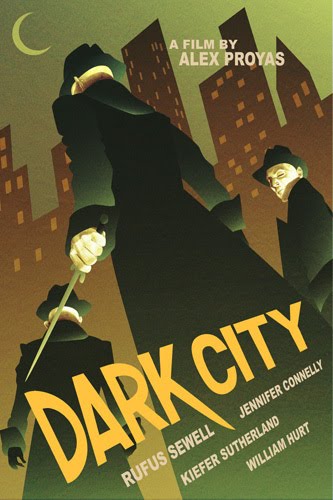
Dark City by Kevin Wada
Another alternate movie poster that's nicer-looking than the original: Kevin Wada's retro Dark City poster, which emphasizes the Strangers, the film's creepy adversaries. [Via Super Punch]

Whitewashed Better Luck Tomorrow by You Offend Me You Offend My Family
The You Offend Me You Offend My Family blog sticks it to Hollywood's tendency to whitewash movies based on source material in which Asians played a central role by whitewashing Better Luck Tomorrow, which starred You Offend Me bloggers Roger Fan and Sung Kang and was directed by their fellow You Offend Me team member Justin Lin. [Via You Offend Me]

Dr. T & the Women II by a Fark.com contributor
A Fark.com "unneeded sequel" entry that imagines a second Dr. T & the Women movie. [Via Super Punch]

Seven Samurai by Grinning-Oni
Seven Samurai by Grinning-Oni.

'Kara Thrace will lead the human race to its end.'
Brandon Schaefer's poster for an advance theatrical screening of the made-for-DVD Battlestar Galactica: Razor in 2007.

Predator by Made by Mat
Predator by Made by Mat. (Wow, that Predators trailer actually doesn't suck. I love how Danny Trejo, Cletus Van Damme and a yakuza are among the human predators. But what's Eric Forman doing in the cast? One of these things is not like the other.) [Via Super Punch]

The Birds by Laz Marquez
The Birds by Laz Marquez. [Via /Film]

Monday, September 21, 2009

My starting six for Asian American cinema

'Fry me to the moon.'A discussion about supporting Asian American cinema inspired blogger and R&B/hip-hop scholar Oliver Wang to invite experts on Asian American cinema to post their lists of six films they would recommend to people whose idea of an Asian American film is Rush Hour. Phil Yu of angry asian man, who helped spread the word about Wang's little starting six project, contributed his own starting six and had a couple of surprising picks on his list, like the corny Flower Drum Song, which he even admitted had some cheesy moments.

I saw Wang's starting six and wanted to post my idea of a starting six on my blog to show people who are underwhelmed by a lot of Asian American cinema that there are a few gems out there.

1. The Breakthrough Film: Chan Is Missing (director: Wayne Wang, 1982)
I first saw Wang's comedy about assimilation and Asian American identity on KQED when I was in high school, and I dug how the film is unsentimental, smart and documentary-like, whereas Wang's other signature Asian American film, the Joy Luck Club adaptation, is annoyingly sentimental, syrupy and cartoonish, with a point of view that constantly and Frankenstein-ishly screams out "Asian man bad!"

2. The Serious Filipino American Film: The Fall of the I-Hotel (director: Curtis Choy, 1983)
This outstanding hour-long documentary about the razing of San Francisco's Manilatown is a landmark work in the short history of Filipino American cinema, and it contains powerful footage of the 1977 protests against the eviction of 50 manongs (elderly Filipinos) from their soon-to-be-demolished Manilatown residential hotel.

3. The Actioner: Big Trouble in Little China (director: John Carpenter, 1986)
Twentieth Century Fox marketed BTILC as a movie in which Kurt Russell's Jack Burton is the hero ("Jack Burton's coming to rescue your summer"). In actuality, Jack is the buffoonish sidekick in a role that's usually reserved for the Asian guy, while the real heroes of the piece are the resourceful badass Wang Chi (Dennis Dun) and the wizardly tour bus driver Egg Shen (Victor Wong). That sly and subversive role reversal is one of the reasons why I admire Carpenter. It's a shame that no Asian American filmmaker has yet made an Asian American-centric action flick as enjoyable and empowering for APA viewers as BTILC (Enter the Dragon and later vehicles for the likes of Brandon Lee, Keanu Reeves, Jackie Chan and Lucy Liu don't count as APA-centric). When are we going to see the APA equivalent of Sweet Sweetback's Baadasssss Song, Shaft, Coffy or El Mariachi?

4. The Humorous Filipino American Film: The Flip Side (director: Rod Pulido, 2001)
José Sáenz is a comedic standout as an untalented Pinoy baller who thinks he's black in the most obscure of my six choices (it's never made it to DVD). Though Pulido's only feature film is more like an 80-minute sitcom than a movie, I prefer it over The Debut, and the sharpest and most dead-on parts of Pulido's screenplay deal with Pinoys who wish they were black and Pinays who pass themselves off as "Hawaiian," whitewash their looks and date only white guys. No other Asian American feature film has irreverently poked fun at self-hating Asian women like The Flip Side did (c'mon Pinoy screenwriters, it's time to rip Michelle Malkin a new one like Law & Order: Criminal Intent and Boston Legal did to Nancy Grace).

5. The Indie Film: Better Luck Tomorrow (director: Justin Lin, 2002)
I prefer the pre-MTV Films version with the ballsier, Taxi Driver-esque ending over the final cut with the slightly modified ending. The conclusion Lin opted for in the final cut is like if Martin Scorsese took Paul Schrader's Taxi Driver screenplay and tacked on a couple of lines at the end in which Travis Bickle says he plans to turn himself in for murder because he suddenly felt sorry for slaughtering all those pimps.

6. The Mainstream Film: Harold & Kumar Go to White Castle (director: Danny Leiner, 2004)
This hilarious cult favorite annoys Asian American film scholars who find it misogynist and slam it for being lowbrow. But it's lowbrow humor for smart people, and even Stephanie "Actresses with not-so-toned bodies should be allowed to do nude scenes too" Zacharek didn't call it misogynist and enjoyed how it's "so unaggressive in the way it addresses the issue of what it means to be a minority in this country that it coaxes you into thinking about it." (If those haters want to see better-written female characters, the somewhat inferior sequel Harold & Kumar Escape from Guantanamo Bay is up their alley. It appears to have been written to appease them.) The fact that many Asian American viewers like myself find Harold & Kumar--which was written and directed by white guys--to be more accurate about our experience than rather shrill and heavy-handed indie dramas with similarly aged lead characters made by Asian American filmmakers is a sign that those indie filmmakers need to step their game up.

This never happened to an Asian American male actor again until Dragon: The Bruce Lee Story 34 years later.Six honorable mentions

The Crimson Kimono (director: Samuel Fuller, 1959)
A lengthy Asian male/white female kiss in 1959? Wow. We have Fuller and his brass ones to thank for that.

Who Killed Vincent Chin? (directors: Christine Choy and Renee Tajima-Peña, 1987)
I don't think I can watch this hard-hitting staple of Asian American studies movie screenings again because the subject matter infuriates me so much.

Robot Stories (director: Greg Pak, 2003)
Matt Zoller Seitz is right. This low-budget anthology from Greg, whom I'm honored to be in the same graphic novel with, is a great sci-fi movie. It contains several terrifically written roles for actresses of color. Lesser-known actresses like Wai Ching Ho (as a grieving mother with a comatose son) and Julienne Hanzelka Kim (as a laconic yet very expressive android) are among the standouts in the cast. If that silent movie I always wanted to write ever gets made, Kim would be perfect for it.

Sucker Free City (director: Spike Lee, 2004)
I know it's a made-for-TV Spike Lee Joint, but this Alex Tse-penned unsold pilot about San Francisco gang life, which co-stars the always superb Ken Leung, premiered first at the Toronto International Film Festival before debuting on Showtime. It ranks with the Twin Peaks and EZ Streets pilots as one of the best feature-length pilots ever made, and it's a more satisfying Tse film than Tse's Watchmen adaptation.

The Motel (director: Michael Kang, 2005)
I appreciate how this indie comedy has none of the formulaic touches that Rotten Tomatoes Show hosts Ellen Fox and Brett Erlich skewered in their "Ode to the Indie."

Beerfest (director: Jay Chandrasekhar, 2006)
The first Broken Lizard flick I ever saw is the funniest one the troupe has done so far, with a hilarious performance by Chandrasekhar as a fallen beer pong legend who's turned to whoring himself out and giving $15 "ZJs."

Coming either later this year or next year: My starting six for Asian American comic books and graphic novels.