Mr. Robot creator/showrunner Sam Esmail and his actors picked up the Golden Globe for Best Drama Series earlier this year.
The second season of Mr. Robot begins this Wednesday on the USA network, three days after the network surprised the Internet by pulling a Beyoncé and posting the entire first half of Mr. Robot's two-part season premiere on Twitter, Snapchat, YouTube and usanetwork.com for only approximately an hour and 50 minutes. After that nearly two-hour period, USA deleted the episode from the four platforms--an enigmatic and cold-hearted move straight out of the titular hacktivist's playbook. So from August 5, 2015, here's a repost of my discussion of the first six episodes of Mr. Robot's compelling first season.
I still remember the date: June 18, 1990. Star Trek had killed off major, non-redshirt crew member characters before (Spock at the end of The Wrath of Khan and Tasha Yar on The Next Generation). But on that date, The Next Generation looked like it was about to go a step further and actually write its captain off the show. What the hell was going on? Was Patrick Stewart's contract not renewed? Did he piss off the Next Generation showrunner? Did he piss off someone from the Minoxidil Mafia?
June 18, 1990 was when The Next Generation finally stepped out of the shadow of the original Star Trek and proved at the end of "The Best of Both Worlds, Part I" that it was going to take certain chances with its storytelling--or rather, boldly go where no Star Trek incarnation had gone before. Sure, The Next Generation had done a few excellent episodes before--"A Matter of Honor," a standout hour where Riker temporarily serves on a Klingon ship, immediately comes to mind--but "The Best of Both Worlds, Part I" upped the ante with an especially tense hour full of possible changes to the show's status quo and moments of Starfleet being under attack in ways that hadn't been seen since Star Trek IV: The Voyage Home.
On the old Star Trek, the Enterprise's most powerful antagonists, whether it was a starship-devouring machine or an actual god, would always be defeated or outwitted by the Enterprise crew in less than an hour. But the Borg, which the Enterprise-D first encountered a year before in "Q Who," were so powerful and unstoppable during "The Best of Both Worlds, Part I" that they clearly weren't going to be put down at the end of act five, especially after they transformed Captain Picard into one of them and assimilated his skills as a commander and his knowledge of Starfleet so that they could now attack the fleet's weaknesses. And it all ended with the most memorable final line in a Star Trek story--Riker saying, "Mr. Worf, fire"--until Picard's "Five-card stud, nothing wild... and the sky's the limit" line at the end of The Next Generation's final episode, that is.
It was one hell of a way to start the summer. I really thought "The Best of Both Worlds" was going to resume the following September with Picard floating around in a white robe and playing a golden Vulcan harp. A few discussions of the impact of "The Best of Both Worlds" have tended to say, "This was before the Internet, so over the summer, Next Generation viewers shared their excitement over the cliffhanger in the most old-fashioned ways: over the watercooler, phone chats, the convention at the Ramada, telegrams, carrier pigeons..." But because these are Star Trek fans we're talking about here, many of them have always been computer-savvy, and the ones who were the most computer-savvy were actually ahead of everyone else communication-wise in 1990 when they speculated over Picard's fate on things called BBSes. Remember those?
Once in a while, a really juicy mystery comes along in the summer and rocks the pop culture world. In 1990, it was "Is Riker going to kill Picard?" In 2010, it was "Is Leonardo DiCaprio still in the dream world? Because that damn top wouldn't stop spinning!" Summer's supposed to be the time for dumb blockbusters and breezy escapism, not thought-provoking and dystopian narratives. So thanks a lot, Mr. Robot, for ruining the summer with your hacktivist leanings, your mistrust of corporations, your frustrations with economic inequality, your moral ambiguity, your clever use of (often moody) music, your unreliable narrator who can't tell apart reality from his imagination and your handful of nifty mysteries that are the next "Is Leo still asleep?"
Mr. Robot is the story of Elliot Alderson (Rami Malek), a morphine-addicted, anti-social Manhattan cybersecurity expert whose skills as a vigilante hacker attract the attention of the titular anarchist (Christian Slater), who recruits Elliot to help him and a band of hackers known as "fsociety" take down corporate America, particularly a conglomerate called E Corp. I can't think of another previous hour-long drama that debuted in the summer and was as stylish or as eerie or as playful about its storytelling as Mr. Robot. People who were born before the Vietnam War--that's all this blog's fucking readership seems to be made up of--will probably say to me, "There was The Prisoner. That premiered in the summer." First of all, stop flaunting your age and all the things you've gotten to watch and read. Second of all, I'm much younger than you. Am I supposed to care that The Prisoner was a summer replacement for Jackie Gleason's variety show? (Really? That's like if Red Skelton temporarily lent his time slot to Superjail.) I first encountered The Prisoner in the same way everyone else has: Netflix and not at all in the summer. I'm supposed to be impressed that you watched The Prisoner before everyone else was watching it? Give it a rest, alright, hipster?
Usually on Throwback Thursday, I pull out from my desk cabinet--with my eyes closed--a movie ticket stub I didn't throw away, and then I discuss the movie on the stub and maybe a little bit of its score, which might be now streaming on AFOS. This Sunday will be the 30th anniversary of the wide release of Better Off Dead, which began on October 11, 1985, so today, instead of drawing some random stub, I'm intentionally pulling out the stub that says "Better Off Dead 30th Anniversary Live Read."
David Wain's They Came Together is a hilarious rom-com spoof I recommend to anyone who longs for a spoof movie that actually doesn't suck. The most worthwhile of its Blu-ray extras is the complete footage of the 2012 live read of the They Came Together screenplay at SF Sketchfest in San Francisco, back when the film was just a project Wain and co-writer Michael Showalter had trouble getting off the ground at Universal, and their silly screenplay, a vicious skewering of--as well as an affectionate homage to--rom-coms, sat quietly in a cabinet until the day Wain, Showalter and their friends from the alt-comedy world unleashed it on stage.
A lot of the gags from the 2012 draft of the screenplay actually made it into the final cut, so the only major differences between the live read and the movie are the absence of a framing device, a few different bits of casting (for instance, Wet Hot American Summer star Marguerite Moreau doesn't appear in They Came Together, but she had a role in the live read) and the sight of actors like Paul Rudd constantly laughing while playing their roles. They were cracking up because they were encountering Wain and Showalter's odd lines--particularly "Oh God, Bubby, I wanna fuck you so bad"--for the very first time, as they were reading them on stage (this was also why They Came Together cast member Bill Hader kept cracking up as Stefon on Weekend Update: then-SNL writer John Mulaney always replaced portions of Hader's cue cards with newly written lines Hader had never seen before).
Despite the shitty video quality of the Sketchfest live read footage, I was so entertained by that They Came Together live read that it caused my largely agoraphobic ass to travel up to Sketchfest for the very first time in its 14-year history and watch a similar live read at the Marines Memorial Theatre. This time it wasn't an unproduced screenplay that was being read by actors on stage--it was the screenplay for Better Off Dead, my favorite '80s teen flick.
To celebrate the 30th anniversary of his film, writer/director Savage Steve Holland got a few original cast members--Curtis Armstrong, Diane Franklin, Amanda Wyss and Kim Darby--to reprise their roles during the live read at the Marines. Napoleon Dynamite star Jon Heder and Kevin Pollak took over the roles that previously belonged to John Cusack and David Ogden Stiers, respectively, and a bunch of Sketchfest regulars like Paul F. Tompkins, Steve Agee and festival co-founder Janet "Korra" Varney filled in for other roles from the film as well.
Why is Better Off Dead--Holland's semi-autobiographical story of a teenage cartoonist with an overactive imagination who attempts to kill himself after he's dumped by his girlfriend Beth (Wyss), but he keeps failing at every suicide attempt--both my favorite '80s teen flick and the one I've watched more times than any other? It's due to the surrealism of it all.
During a classroom scene, the hair on the heads of all the students is seen standing up when their ears are subjected to the sound of chalk screeching down a blackboard. Mute supergenius Badger (Scooter Stevens), the little brother of Cusack's Lane Myer, orders a book about how to attract trashy women and then is later seen arm-in-arm with a bunch of them. Ultra-dorky Ricky Smith (Dan Schneider, who later made a fortune as a producer of Nickelodeon sitcoms, which are also where Holland has spent most of his directorial career after co-creating the '90s Saturday morning cartoon Eek! the Cat) makes a grand entrance to the sound of lightning at a school dance. Lane becomes the Bugs Bunny-ish target of a psychotic paperboy (Demian Slade) who won't leave without the two dollars Lane owes him for his delivery. Those are just some of the many examples of how Better Off Dead is a live-action cartoon, in the same way that Raising Arizona is basically the Coen Brothers bringing to life a Road Runner short--or the same way that many Joe Dante movies are influenced by the Warner Bros. animated shorts Dante adores.
But the uniqueness of Better Off Dead as a live-action cartoon is due to Holland working with traditional '80s teen flick tropes--whether it's a scene at a typically boring and unfulfilling after-school job or a romance with the girl next door (who, in this case, is French)--and taking them in as surreal a direction as he can go. The movie even contains animated interludes that bring to mind Woody Allen's brief transformation of Annie Hall into Disney's Snow White and the Seven Dwarfs (in fact, Wyss once described Holland's work as "like a punk Woody Allen"). It would be inane to react to Better Off Dead with "Badger can't pick up women like that in real life! That's impossible!" Either you sit back and roll with the cartoonishness--and let it reduce you to laughter--or just watch something else. You prefer your movies to be completely laughless and devoid of either larger-than-life storytelling or inventiveness, right? I have the item just for you. It's called the entire filmography of Kirk Cameron.
Holland's film also chooses to take the pain of teenage heartbreak and emphasize the absurdity of that pain rather than go all emo on us and wallow in the pain. Whenever your love life doesn't go the way you want it to, doesn't it feel like the whole world's having a laugh at your expense? No other movie has captured that strange feeling quite like Better Off Dead has. Even something as innocuous as a Flintstones rerun becomes threatening and somehow annoying when you're deep in misery after getting rejected, and in Better Off Dead, that's exactly what happens when Barney Rubble suddenly addresses Lane from the TV screen and asks Lane if he can date Beth too.
Sketchfest's Better Off Dead live read didn't quite nail the surrealism that makes Holland's film unique--it's impossible to do so in a live read--but seeing Armstrong, Franklin, Wyss and Darby reprise their roles and hearing Franklin speak in her French exchange student character's accent again on stage both made the live read the type of enjoyable extra Better Off Dead has always deserved on disc and has never gotten since both its DVD and Blu-ray editions have been disappointingly light on extras. You know how Anton Ego immediately flashes back to being a boy comforted by his mom's home cooking after he takes his first bite of ratatouille? When Franklin finally spoke up at the live read for the first time as Monique in that accent (if you forgot, Monique doesn't speak during the movie's first half), I similarly flashed back to being a little kid watching Better Off Dead for the first of many times on cable in the '80s and thinking, "Who's this French actress? She's funny."
Every Throwback Thursday, I randomly pull out from my desk cabinet--with my eyes closed--a movie ticket I saved. Then I discuss the movie on the ticket and maybe a little bit of its score, which might be now streaming on AFOS.
You know you're watching a Michael Mann movie when the drug trade isn't referred to as the drug trade but as "the exotic substances business." In the 2004 thriller Collateral, Mann is, as usual, simultaneously in love with words and so critical of other directors' overuse of them that he shows how satisfying and gripping cinema can be when it's not so over-reliant on words. Unnecessary exposition is a disease that's so awful to experience while watching films or TV that it needs its own telethon. Like how the Jerry Lewis Telethon used to show every year that same moldy clip of Buddy Hackett weeping over the suffering Jerry's Kids experience due to muscular dystrophy, I'd like to see Bobby Moynihan or Broad City star John Gemberling plead weepingly to viewers to give a few dollars to help out the Nolan brothers and cure Jonathan of his tendency outside of Person of Interest to make characters over-explain themselves.
Collateral is fascinating for the way Mann came up with extremely detailed backstories--whether it's for sociopathic contract killer Vincent (Tom Cruise), Max Durocher (Jamie Foxx), the mild-mannered L.A. cabbie who becomes Vincent's chauffeur, hostage and reluctant accomplice, or the powerful "off-shore narco-trafficking cartel" that employs Vincent and is run by capos like Felix Reyes-Torrena (Javier Bardem)--and then threw almost all of that information out of the movie, perhaps as a challenge to himself to keep his movie from drowning in unnatural-sounding, on-the-nose dialogue. Whenever he'd discuss that approach of making the storytelling as efficient as possible in Collateral, Mann would describe it as chopping off the first and second acts of a movie so that it's only the third act. But those elaborate backstories are all there in the eyes and body language of Cruise and Foxx, and sometimes you can miss those nuances Cruise and Foxx bring to their performances, like when Vincent appears to be nauseated about killing a federal prosecution witness (Barry Shabaka Henley) whose love of the music of jazz legends like Miles Davis (he's seen performing Davis' "Spanish Key") was similar to Vincent's or when Vincent briefly panics in the middle of a scuffle during a Koreatown nightclub shootout. Mann pointed out in his Collateral audio commentary that during the scuffle, Vincent is briefly reverting to his 11-year-old self and re-experiencing the fear he felt when he was being bullied, a childhood fear Vincent never once mentions in the film, and Collateral is all the more better for not having Cruise unconvincingly deliver pages and pages of dialogue about a childhood trauma that keeps him sharp (*SNAP!*), on the edge (*SNAP!*), where he's gotta be.
The three months of weapons and combat training Cruise agreed to undertake for his Collateral role is a great example of why Cruise is batshit, but that craziness is also what makes him fascinating to watch as a man of action in this film, Mission: Impossible--Ghost Protocol and now Mission: Impossible--Rogue Nation. He can be obnoxious as either a romantic lead (if there were a drinking game for whenever he touches the face of his leading lady, we'd all be dead from alcohol poisoning), a talk show guest with a psychotic-sounding, unsettling laugh or a Scientology mouthpiece, but in an actioner like Collateral, he's a remarkable actor and not at all obnoxious. Cruise's physicality and his ease in a business suit with performing marksman stances that may look unconventional on film but are commonplace to expert marksmen--especially during the K-town club sequence--would have made him perfect as the similarly dressed Christopher Chance in a more faithful live-action version of the Peter Milligan/Cliff Chiang/Javier Pulido incarnation of Human Target (which the short-lived and much more family-friendly Fox show of the same name was loosely based on).
Cruise's weapons training really paid off, and he's convincing as a military-trained assassin in Collateral, but then Bardem shows up for his cameo and radiates so much power and quiet menace without ever getting out of his seat that part of me wishes Bardem played Vincent instead of Cruise. Bardem is a huge part of why the scene where Max attempts to trick Felix into thinking he's Vincent in order to recover Vincent's lost intel is my favorite scene in Collateral. Cruise isn't even in this Mexican nightclub scene at all. Once Vincent sets foot in Max's cab, Collateral is non-stop tension, but the tension is at its thickest in the scene between Felix and Max because Max is out of his cab and therefore, out of his element, and impersonating Vincent to prevent him from killing his mother Ida (Irma P. Hall)--a woman Max can barely even tolerate--is somehow an even bigger test for Max than all the other tests Vincent previously put him through. Now Max has to do some acting with a gun to his head, which basically describes every single audition in Hollywood.
Bardem and Foxx play the tension so beautifully (the scene also allows Foxx to tap into some of his skills as a comedic performer, but because this is a Mann thriller and not In Living Color or Horrible Bosses, Foxx doesn't play the humorous side of the scene too broadly). You don't know if or when Felix is going to explode, and you don't know if Max is going to get out of Felix's club alive either. Bardem's smooth dance back and forth between benevolence ("Do you know who they like even better than Santa Claus? His helper. Pedro el Negro. Black Peter...") and pent-up anger ("How do you think jolly old Santa Claus would feel if one day Pedro came into his office and said, 'I lost the list'? How fucking furious do you think he will get?") is a bit more interesting than Cruise's all-intense-all-the-time approach. Oh well, at least Bardem got a chance to basically play Vincent three years later in No Country for Old Men. I think he even won an Oscar for it.
(Photo source: DVD Beaver)
Collateral is the closest the ultra-somber Mann has ever gotten--and will probably ever get--in his film directing career to making a comedy. There are several funny moments in Collateral, whether it's Vincent coaching Meek Max on how to tell his pushy dispatcher to fuck off; the Richard T. Jones cop character's unconvinced reaction to Max's lie about hitting a deer on Slauson Avenue ("A South Central deer?"); the hunter (Mark Ruffalo's Detective Fanning) and the prey (Vincent) not knowing they're in the same elevator; or Max-as-Vincent being unable to resist still being Max the business-minded cabbie when he offers Felix's "Hermès/Façonnable ass" a discount (it's also a clever way for Max to stick it to Vincent and deprive him of some cash). But Mann wisely chooses to play those moments as deadpan and as truthfully and honestly as possible. Even some of Al Pacino's shoutiest or chattiest scenes during Heat aren't quite as humorous as those moments during Collateral. In fact, Mann studied Billy Wilder comedies to nail the right tone and delivery for Vincent's sarcasm.
Jason Statham's cameo in Collateral's first scene as a delivery man who's most likely his Frank Martin character from The Transporter is the first sign that Mann and his actors aren't out to brood about corporate malfeasance, racism or society's encroachment on individualism for two hours and are out to simply entertain and bring summertime moviegoers to the edges of their seats (DreamWorks released Collateral in August). Collateral is to Mann's big-screen filmography what Inside Man is to Spike Lee's: it's his most escapist and most popcorn piece of work. I love how the most comedic scene in Collateral is Max's reluctant introduction of a bizarrely polite and formal Vincent to Ida in her hospital room and how Foxx is the least comedic performer in that scene. Both the hospital room scene and the Bardem/Foxx exchange catapult Collateral into being my favorite of Foxx's serious movies. In another bit of unmentioned backstory Mann revealed in his commentrak, Ida is a Livia Soprano-style cold fish who's alienated all her sons so much that all of them except Max have moved out of L.A. just to get away from her. Ida, who knows nothing about Vincent's killings, appears to like Vincent more than any of her sons. She and the similarly cold-blooded Vincent, whose mother died when he was young (that's why he bristles at Max's reluctance to visit Ida, whom Max unhappily visits every night), were made for each other as mom and son. It's Mann channeling Hitchcock at his most darkly comic.
One of the film's other twisted jokes is that Max's own prudishness, partly instilled by Ida, has stifled and crippled Max so badly (he keeps telling customers about his dream of starting his own limo business but can't admit that he's too scared to act on it) that a sociopath--and not a Manic Pixie Dream Girl, an unorthodox classroom teacher or some little orphan--ends up being the one to snap Max out of it and teach him to grab life by the balls by taking more risks and improvising. Some black Collateral fans interestingly view Mann's movie as an allegory of black liberation and the struggles against white privilege (how fitting that this allegory takes place in racially mixed L.A., a city the privileged and wealthy Vincent despises for being too sprawling and disconnected), with the working-class Max's conflict with Vincent functioning as the modern-day equivalent of a slave learning to outwit the overseer and Vincent's demise signaling the end of white privilege. But I don't think Mann and screenwriter Stuart Beattie are that savvy enough to have considered that kind of interpretation for Collateral (Beattie based his script on a cab ride he took, and the ride made him wonder, "What would happen if this cabbie picked up a homicidal maniac and ended up trusting this maniac?"). I see Collateral as more like Mann and Beattie's way of playing around with a couple of formulas: the aforementioned "stuffy character who's taught by another character to loosen up" movie (I bet Collateral was pitched at an early '00s DreamWorks pitch meeting as "The Last Detail if Jack Nicholson killed people") and the tiresome "Magical Negro" drama (like DreamWorks' earlier release The Legend of Bagger Vance, which starred Mann's Ali lead Will Smith). While considering Foxx for the role that Adam Sandler once expressed interest in playing, I could see Mann thinking, in his usual wordy way of speaking, "Maybe it would be more stimulating to the amygdala if we reverse the 'Magic Negro' narrative and make the African American male the one who's beaten down by life and is too ossified to better appreciate it, and a Caucasian hitman ends up being his preceptor."
Collateral really soars during its character study half, due to the chemistry between the African American male formerly known as Wanda and his preceptor. It's a good thing the digital video cinematography by Paul Cameron, who left the project a few weeks into filming due to creative differences with Mann, and his replacement Dion Beebe is intriguing and striking from start to finish. There are so many nifty visual things going on with the high-def cameras' ability to capture little subtleties in the colors of the L.A. night sky and the shimmering city lights (like Darren Franich said in his lengthy 2014 EWessay about Collateral, "You're constantly aware that those lights represent real people--and that those real people don't notice the horrors being perpetrated by Vincent") that those things are able to distract you from how conventional the third act is compared to the rest of Collateral--a movie Mann thought of as a two-hour third act!--when you think about it afterward.
(Photo source: EW)
The movie ditches the character study stuff and goes into full-on "don't open that door, girl!" thriller mode to place Annie (Jada Pinkett Smith), Max's previous customer and the federal prosecutor who wants to shut down Felix's cartel, in danger and in Vincent's crosshairs. The music becomes conventional too: all those bluesy instrumentals Mann originally had in mind for Thief (before he opted for Tangerine Dream) and all those pulsating source cues by the likes of Groove Armada and Paul Oakenfold give way to James Newton Howard in symphonic and percussion-heavy thriller mode a la The Fugitive. Vincent completely shuts off the internal conflict over killing people he's been starting to experience--a little too abruptly for some film critics' tastes--and becomes the Terminator. Sure, film critics, Collateral is a more arresting thriller when Vincent's in conflicted mode, but on second thought, what else is he going to do? Not finish the job? Like Vincent Hanna and Neil McCauley when they briefly bond during Heat over their existential worries about a life without their jobs, killing is all Vincent knows how to do, and if he's going to die doing the thing he does best, that's fine by him. He's a typical professional in a Mann movie.
Two big legacies emerged from Collateral. Cruise proved he can really pull off playing a villain whose only purpose for living is killing, but only when a director like Mann challenges Cruise to step out of his comfort zone and gets him to do some acting instead of "ACTING!"--which is what his previous turn as a villain was like in Interview with the Vampire. The other big legacy is the movie's innovations in digital video cinematography in order to capture nighttime footage--or things like the SoCal palm trees behind Vincent and Max--that couldn't have been achieved with regular film cameras.
"Here, while the [Collateral] digital photography seems fresh and oftentimes comes across as electrically alive, it still looks pretty crummy," wrote either Rodrigo Perez or Jessica Kiang or that Playlistguy who got arrested for pimping an underage girl (like Matt Zoller Seitz implied, The Playlist's decision to not conclude each capsule review in its Mann movie retrospective with a byline causes its otherwise solid retrospective to be kind of a muddled drag). Eh, it was 2004. Get off the movie's 2004 ass. That's such a reductive way of talking about Collateral's impact on cinematography. Before Collateral, Mann experimented with digital video in Ali and on Robbery Homicide Division, the short-lived CBS procedural he produced, but Collateral is where he, with the help of Cameron and Beebe, finally figured out how to keep digital video from looking as crummy as it often did on Robbery Homicide Division (the only post-Collateral Mann movie I've seen is Public Enemies, and I don't think Dante Spinotti's HD cinematography in that 2009 movie looks as impressive as Collateral's still does). A bunch of mainstream films (some shitty, mostly good) followed in Collateral's footsteps and chose to shoot completely in digital, and like Beebe said to American Cinematographer 10 years after Collateral's release, thanks to his movie, filmmakers at night can go out into a street and shoot under streetlights instead of having to light entire city blocks (according to Mann, that standard way of lighting movie sets at night would have ruined the realistic lighting he wanted for Collateral's street scenes).
Michael Mann
Also, whatever crumminess there is in some of Collateral's HD cinematography actually adds an element of "Hmm, which of the 15% of Collateral that Mann shot on film am I watching now?" to the movie in repeat viewings (while Franich is fascinated in repeat viewings by how "Mann shoots Collateral on video and doesn't try to hide it"). If you watch enough early '00s indie movies that were shot in HD, you start to be able to distinguish digital grain from film grain, as well as notice how early '00s digital video has weird smear effects whenever someone's in motion, so a second or third viewing of Collateral turns into a diverting game of "Which scene was not shot in HD?" (Answers: Debi Mazar's scene; the late afternoon scene of Max speaking in Spanish to the gas station clerk; the shots of Max cleaning his cab and he and the other cabbies preparing to drive out of their garage; the jazz club scene; Bardem's scene; and all the shots of Vincent and Max inside the K-town club except for when Vincent kills his assigned Korean target.)
The visuals Mann and Beebe were able to achieve with HD cinematography also really emphasize how much Mann is a cinematic Edward Hopper, fixated on lives in perpetual limbo, much like Hopper was in his paintings. Franich concludes his essay with an astute interpretation of Collateral as a story about L.A. as a purgatory for Max, who's been driving in circles for the past 12 years. But Franich likes to pretend that after Vincent's death inside a sort of limbo--a subway train that looks like it won't ever stop running--and the last shot of a newly confident Max and an exhausted Annie heading out together into both the morning and an uncertain but hopeful future, Max is doomed to relive the same hellish evening with Vincent for the rest of his life a la Groundhog Day. Nah, that shit's too depressing. Max just learned to break out of the limbo he imposed upon himself, and the reward he gets is a time loop? Sure, it's in keeping with how Mann stories frequently end tragically, ever since Thief and all those Miami Vice episodes with downbeat conclusions and that gut-punch of an "Executive Producer Michael Mann" credit defiantly saying each week, "You expecting a freeze-framed high-five between Don Johnson and Philip Michael Thomas, motherfucker?" But let Max win this one. The motherfucker motherhater earned it.
Every Throwback Thursday, I randomly pull out from my desk cabinet--with my eyes closed--a movie ticket I saved. Then I discuss the movie on the ticket and maybe a little bit of its score, which might be now streaming on AFOS.
When many film directors reach their 60s or 70s and continue to direct, they tend to lose their spark. They're simply no longer the inventive or energetic filmmakers we used to know from their earlier work. Even the most beloved late-night hosts get this way too. In a 2012 WNYC interview, David Letterman, who retired from the late-night airwaves, admitted that one of the differences between his period at NBC, where he hosted two groundbreaking and anarchic talk shows, and the slightly less adventurousLate Show on CBS was simply that "I'm 65; I don't have the energy I had when I was 35."
As for directors as they age, they become either more hackneyed and sentimental or more out-of-touch and complacent--so their later films suffer as a result, and for fans of the original Star Wars trilogy, the worst example of this was the pointless and woodenly acted (except for in the case of Ewan McGregor) Star Wars prequels George Lucas directed after a 22-year hiatus from the director's chair. As the now-defunct Stylus magazine points out in a depressing 2007 overview of bold '70s filmmakers who had trouble sustaining their hot streak after their first few films, "Boldness and originality becomes [sic] harder to achieve as time moves on and business interests close in."
Another example of a distinctive director losing his spark is the late Billy Wilder. Although Wilder remained his usual sharp-witted self in interviews (man, I really ought to check out Cameron Crowe's Conversations with Wilder from the public library one of these days), his movies towards the end of his career aren't as fondly remembered as earlier Wilder masterpieces like Double Indemnity or Some Like It Hot. You don't exactly see cineastes jumping for joy over Buddy Buddy.
But there are a couple of recent exceptions to the theory that as filmmakers get older, they lose their edge. George Miller, who's now 70, was in his late 60s when he shot this summer's incredible Mad Max: Fury Road, and Martin Scorsese was 70 when he directed The Wolf of Wall Street, my favorite of the five films Scorsese has made with Leonardo DiCaprio so far.
Scorsese's invaluable and longtime editor Thelma Schoonmaker--who, together with Scorsese, remarkably whittled down four hours' worth of largely improvised material between DiCaprio and the rest of The Wolf of Wall Street's ensemble cast to 179 minutes--once said to Variety, "Marty's movies are so unusual. He doesn't repeat himself, so [the studios] don't know what to expect." Eh, actually, Scorsese's repeated himself--existing song-wise, that is. His umpteenth use of the Rolling Stones' "Gimme Shelter" in The Departed was a sign of a filmmaker who needed to take a break for a while from hitting repeat on Let It Bleed tracks on his iPod.
But otherwise, Schoonmaker's right. Scorsese's films have never had a problem of being interchangeable (he revisits motifs and themes like greed, media attention, addiction or religious guilt but is somehow able to do so without becoming repetitive and derivative), whereas many of his filmmaking peers have ended up making the same film three or four times--another example of when directors show their age. "Gangs of New York is so different from The Aviator, which was so different from The Departed or Age of Innocence or Kundun," said Schoonmaker to HitFix. And after Scorsese directed 2011's Hugo, he followed up his first family film--as well as one of his least controversial works, unless you're a stickler for accuracy in terms of how the Eiffel Tower gets depicted on film--with perhaps his most sexually explicit film to date, The Wolf of Wall Street.
Adapted from the memoirs of former stockbroker and former cokehead Jordan Belfort by screenwriter Terence Winter (who created and showran Boardwalk Empire, which Scorsese co-produced), the 2013 Scorsese flick reunited the New York filmmaker with an old pal: controversy. Many haters of the film felt it glorified the scummy and misogynist behavior of Belfort the white-collar criminal and his cronies at the Wall Street firm Stratton Oakmont. Other haters--particularly audience members who are about as old as Scorsese or older than him--found the amount of debauchery on display in the film to be excessive. They wished The Wolf of Wall Street contained less debauchery, even after Scorsese already kept the film from getting stamped with a financially risky NC-17 by making a few additional edits, like turning to Rob Legato, the Hugo visual FX wizard whom I'll always remember for giving away on Reading Rainbow the FX magicians' secret of how he filmed the Star Trek: The Next Generation transporter beam FX (hint: glitter stirred in a glass of water), and his team to digitally insert an Eyes Wide Shut-style chair as a visual barricade for a gay orgy scene.
But the excessiveness makes perfect sense in The Wolf of Wall Street: it's a film about hedonistic Wall Street culture and all its emptiness (as well as its enticing qualities), and it would have been inane to depict that culture in a watered-down, Hallmark Channel-friendly way. In the GQ blog post "Olds Heckle The Wolf of Wall Street for Being Too Awesome," Scott Christian nicely criticized the olds and their disgust with Scorsese's focus this time on sex--instead of the usual GoodFellas-style violence he's most known for--when he said, "He's not some pervy old man, he's actually trying to show us how fractured and ugly these characters are... What is shocking is that people are so outraged by a bit of T&A but not by violence. Of course, that's nothing new."
The Wolf of Wall Street is neither a pervy old man's movie nor the shrill cinematic equivalent of an old man shouting at millennials to get off his lawn, which was basically what Aaron Sorkin's The Newsroom was. Scorsese said repeatedly in interviews that he made The Wolf of Wall Street as an expression of his own frustration with how materialism has become a religion in the last 35 years--no wonder Scorsese staged Belfort's office pep talks to his employees as if they're revival meetings--but Scorsese has done something clever with that frustration. The easy way to approach anger over economic inequality and the swindling of ordinary working folk is to turn it into a solemn movie about the Way America Ought to Be, But America's Too Broken and We'll Never Be Able to Fix It. The problem with that kind of movie is that it's been done to death, and it's boring as hell.
Every Throwback Thursday, I randomly pull out from my desk cabinet--with my eyes closed--a movie ticket I saved. Then I discuss the movie on the ticket and maybe a little bit of its score, which might be now streaming on AFOS.
British director Edgar Wright is at the peak of his comedic filmmaking powers in 2013's The World's End, the third and final film in the Cornetto trilogy he co-wrote with Simon Pegg, the star of Wright's groundbreaking sitcom Spaced. Each film in the trilogy is a standalone piece--none of them take place in the same universe--but they all have a bunch of things in common: a Cornetto ice cream treat (a favorite hangover cure of Wright's) always makes a cameo appearance, hence the trilogy's unofficial name Cornetto; Wright reuses several actors; Pegg and his old Spaced co-star Nick Frost always play a pair of friends who are grappling with either the fear of losing their identity or being forced to let go of their adolescence; a fence jump always goes awry; and a seemingly tired genre gets revitalized in the inventive hands of Pegg and Wright each time.
The first Cornetto film, 2004's Shaun of the Dead, expanded upon Pegg and Wright's obsession with George Romero flicks from an early Spaced episode, and the result--a Romero flick with bumbling, hungover Crouch End blokes as the heroes--is still my favorite zombie movie ever. The second Cornetto film, 2007's Hot Fuzz, took Joel Silver and Jerry Bruckheimer cop flicks from America and amusingly tried to wedge the much more mundane reality of British policing into the body of one of those over-the-top cop flicks. Frequently described as "Lethal Weapon in Somerset," Hot Fuzz is not like any other action genre spoof. It's full of humor about fascism, conformity (a theme that resurfaces in The World's End), British genteelness and Grand Guignol violence that's often smarter than the average hacky "hey, let's just reference this recent movie and that recent movie and then call it a day" Friedberg/Seltzer spoof film. Hot Fuzz's genuine affection for American action flicks also elevates Wright's film above action genre spoofs that harbor contempt for the films they're parodying, much like how Shaun's affection for Romero flicks was key to making that film so appealing.
The World's End is more ambitious than the other two Cornetto films and juggles several ideas at once: it's a school reunion comedy about the dangers of nostalgia (set not at an actual class reunion but at a pub crawl Gary King, Pegg's immature alcoholic character, failed to finish as a teen and wants to finally finish with his estranged, now-teetotal friends), an addiction drama, an alien invasion flick and a critique of gentrification, or as Paddy Considine's character calls it, "Starbucking." In lesser hands, this all could have turned into a hot mess--an unwieldy, overly busy third movie that, like so many other third movies in a series, strains to juggle all the ideas running through Pegg and Wright's heads--but like the other two Cornetto films, The World's End is so tightly constructed by Pegg and Wright that the disparate components mesh beautifully and the seams never show.
When the comedic sci-fi action gives way for a scene straight out of an addiction drama, the dramatic scene doesn't feel out of place. Speaking of which, The World's End and Flight would make for a great double bill about alcoholics in denial. But why do the on-the-nose existing songs--particularly Saint Etienne's "Join Our Club" and The Doors' "Alabama Song (Whisky Bar)" in one great marriage of song and scene, due to the actors walking in step and drinking in time to the Doors tune as it was being blasted on the set--work so well for The World's End, while the on-the-nose existing songs don't work as well for Flight? That's because with the exception of the Soup Dragons' overplayed and annoying cover of the Rolling Stones' "I'm Free" and Primal Scream's '90s advertising staple "Loaded," neither of Wright and music supervisor Nick Angel's selections, which are mostly from the late '80s/early '90s era of Britrock, are tunes I've heard a million times before in movies or on TV, like Flight's overplayed choices of "Gimme Shelter" and "Sympathy for the Devil."
The original score by Gravity composer Steven Price is equally effective. My favorite moments of Price's score, which can be heard during the AFOS weekend block "Hall H" and "AFOS Prime," are textural rather than tuneful. They all involve cell phone interference sound FX, which represents the Network, the extraterrestrial collective of gentrifiers behind the gradual robot invasion of the friends' former hometown of Newton Haven, as well as all the technological advances on Earth from the early '90s to 2013 (that means Steve Jobs was a robot, which explains all those black-turtleneck-and-mom-jeans ensembles), and those advances are a huge part of the Network's strategy of seducing the smartphone zombies of the human population into getting rid of their humanity and becoming robots, or "blanks." The interference audio first appears in Price's score when Gary accidentally decapitates the teenage blank in the restroom. Never has cell phone interference sounded so menacing. After Black Mirror and the Network scenes in The World's End, the British are proving to be the craftiest satirists when it comes to material about how smartphone or tablet addiction is causing society to become even more soulless than it was before.
The result of Pegg and Wright's skills with meshing disparate components--and making inspired use of little things like mobile interference audio--is the most entertaining and clever critique of gentrification ever made. It's also the only gentrification satire to involve rousing and dazzlingly staged fight scenes where humans decapitate with their bare hands their blank adversaries and pulverize them with whatever weapon they can find, whether it's a pair of pub stools or the blanks' own torn-off limbs (the terrific World's End fight choreography was done by Scott Pilgrim vs. the World and Kingsman: The Secret Service stunt coordinator Brad Allan, a.k.a. the short white guy Jackie Chan fought during Gorgeous).
The film is so packed with detail that you pick up something new in each viewing. For instance, while watching The World's End for the fourth time in preparation for today's edition of Throwback Thursday, I switched on Pegg and Wright's Blu-ray audio commentary and learned that the film's school disco sequence--in which the Network attempts to lure Gary and his friends into becoming blanks by bringing back a trio of hot girls they liked who were known collectively as "the Marmalade Sandwich" and have eerily not aged a day--is based on an actual clubbing phenomenon. I didn't even know this was a thing in England--women get paid to dance in schoolgirl uniforms, which Pegg and Wright both find to be rather creepy as a male fantasy--and after listening to the commentrak, I received a crash course in school discos from a 2002 Guardian article about the then-new "formula of uniforms, booze and tacky tunes."
The grand entrance of "the Marmalade Sandwich" in The World's End
Sophie Evans (Marmalade Sandwich girl Becky Salt), out of uniform (Photo source: Wales Online)
In The World's End, Wright didn't just revitalize the old sci-fi trope of your friends and neighbors getting replaced by creepy duplicates by brilliantly linking it to the horrors of gentrification. He also revitalized the midlife crisis comedy, taking it back from the Wild Hogses and Old Dogses of the world. A pre-Gone Girl Rosamund Pike does wonders with what little screen time she has--she was pregnant during filming--in the role of Sam, the lone female in Gary's circle of friends (both Pike's delivery of "What happened to you?" to Pegg in the bathroom and her comedic gasp after first seeing Pegg decapitate a female blank are sublime bits of acting), while Pegg and Frost, who switched the roles they had in Shaun and Fuzz so that Frost played the more responsible half of the duo this time, show remarkable range when their characters' respective midlife crises take a turn for the dramatic. Speaking of midlife crisis movies, why do so many SNL alums, whether it's Billy Crystal or Adam Sandler, star in the same old goddamn movie about a middle-aged guy who has to learn to be a better dad? It's why my favorite Billy Crystal movie remains the not-so-maudlin Running Scared, and it's also partly why Anchorman 2, with its "Ron needs to be a better dad" subplot, isn't as consistently funny as its predecessor.
Looking back lately on the artistic triumphs that resulted from Wright revitalizing weather-beaten genres for his Cornetto projects has made Wright's decision to walk away from the movie version of Ant-Man all the more heartbreaking (he had enough of getting into creative disagreements with Marvel Studios). Think of what Wright could have accomplished in revitalizing the superhero movie, a genre that's lately been showing signs of repetition, whether it's pointless and clumsy world-building or tiresome destruction porn. (Speaking of which, I love the shade Pegg once threw at the ways Man of Steel handled its destruction porn: "At the end, they're all at the Daily Planet office just going, 'Hey! Let's go see the Dodgers!' Isn't everyone dead? Isn't New York flat? What do you mean, go see the Dodgers?!" Pegg's involvement in the writing of the next Star Trek movie makes me more hopeful about the Trek movie franchise's return to quality after the mistakes that were made during Star Trek Into Darkness, and one of those mistakes was the same type of destruction porn Pegg was critiquing.) I wouldn't be surprised if Wright, who's kept mum about his tumultuous working experiences with Marvel, quit Ant-Man because what its studio execs wanted to do with his vision for the movie was too reminiscent of the Starbucking he so astutely skewered--or rather, decapitated--in The World's End, a rare third film that doesn't suck.
I was all set to dislike ABC's Fresh Off the Boat before its premiere. It wasn't because it was going to take celebrity chef Eddie Huang's candid and raunchy memoirs about his hip-hop-soundtracked childhood in Orlando in the '90s (which I've read only one or two excerpts of) and water down that book for network TV, which was what Huang, the show's off-screen narrator, said he was initially frustrated about while he consulted on the writing and filming of the Lynn Shelton-directed Fresh Off the Boat pilot (I wish Huang did a little more research about ABC sitcoms before he signed up to do business with ABC: someone should have reminded him it's the home of The Middle and The Goldbergs, not Louie and You're the Worst). I was all set to dislike the show for a different reason: it was going to be another goddamn story about second-generation Asian Americans dealing with identity issues, assimilation and generational differences with their elders.
As someone who's watched a shit-ton of Asian American indie movies, that kind of story was, for a long while, the only kind of Asian American indie flick that was getting made, whether it was Red Doors or American Chai. We're so underrepresented or poorly depicted in everything else in pop culture, and this shit is the best we can do on our own? It was becoming as much of a tired formula as Katherine Heigl rom-coms or "Die Hard on a boat!"--or "Die Hard in an office building!" The earnest indie drama about Asian American assimilation became so grating and hackneyed that graphic novelist Adrian Tomine spent the first five pages of Shortcomings hilariously tearing it apart.
"Why does everything have to be some big 'statement' about race? Don't any of these people just want to make a movie that's good?," grumbles Shortcomings' main character, Berkeley movie theater manager Ben Tanaka, after sitting through yet another Asian American drama about generational conflict.
My beef with the assimilation story has been more like "Can we get something else other than the assimilation story, like a story outside the family? Maybe a movie or show about an Asian American guy handling the many absurdities of the dating scene on his own? We do have lives outside the family, you know." That's why Emily Kapnek's Selfie was such a breath of fresh air--it was mostly about the love life and workplace dilemmas of John Cho's modern-day Henry Higgins, a pharmaceutical marketing whiz who gives rebranding advice to the show's social media-obsessed Eliza Doolittle counterpart, Karen Gillan's Eliza Dooley, and not once did the show insert Henry's parents into the narrative--and that's why its cancellation still stings. So after ABC deleted Selfie, I thought, "Alright, so the show I've longed to see on network TV for over a decade didn't last. I don't like the fact that you're yet another assimilation story, Fresh Off the Boat, but you better be damn well as funny as Selfie was."
Fortunately, Fresh Off the Boat is genuinely funny as it glimpses at the complexities of identity, and its slightly skewed take on the coming-of-age sitcom is what sets it apart from the overly earnest assimilation stories Ben Tanaka and I don't care for. That's mostly due to the guiding hand of showrunner Nahnatchka Khan, the veteran American Dad writer whose signature creation is Don't Trust the B---- in Apartment 23. Khan's sharply written mismatched-roommates comedy revealed James Van Der Beek to be a skilled comedic actor and featured the great unsung pairing of Krysten Ritter and Dreama Walker, who were often so hilariously expressive without dialogue that I could easily picture Ritter and Walker as silent movie comediennes, and I even wished for Khan to do an entire Don't Trust the B---- episode as a silent movie.
All I wanted from Fresh Off the Boat was for the show to retain the weirdness Khan brought to Don't Trust the B----, and it's been doing that frequently. Part of the effectiveness of the surreal gags about the hellishness of the back of the school bus Eddie (Hudson Yang) and his friends ride while pretending to be comatose in "Showdown at the Golden Saddle" is due to the episode never showing what goes on in the back of the bus, as if it's too unpleasant to show on network TV. A classmate character's obsession with an NES game based on the 1980 movie 9 to 5 is a dead-on riff on how NES games would be spun off from the strangest licensed properties, whether it was Home Alone or Wayne's World. And there's a great little scene in "Persistent Romeo" where Evan (Ian Chen), Eddie's youngest brother, screams like a little girl for what feels like two hours after he loses to Grandma Huang (Lucille Soong) during poker. I don't know if it's a reference to this '90s moment, but that would be wonderful if it were. Something about male characters screaming like little girls while their expressions remain absolutely blank always kills me (it must have killed a Fresh Off the Boat crew member too because he can be heard audibly chuckling on the set off-screen while Evan screams).
It helps that Fresh Off the Boat takes some of its stylistic cues not from All-American Girl, the last network sitcom to center on an Asian American family (not counting the TBS show Sullivan & Son), but from the often enjoyable '80s period piece Everybody Hates Chris, which itself took stylistic cues from Everybody Hates Chris co-producer Howard Gewirtz's Oliver Beene, a 2003 Fox sitcom that took place in the early '60s. I remember watching All-American Girl in the '90s and being underwhelmed by it like so many other Asian American viewers, mostly because its version of Margaret Cho--whom Huang actually turned to for advice while initially struggling with the changes that were being made to the depiction of his own life as an 11-year-old--wasn't the Margaret Cho I was familiar with from her raunchy stand-up act. The dominant creative voice on All-American Girl actually belonged not to her, but to a veteran of the lily-white Empty Nest, a huge sign that Cho's show was doomed.
Fortunately, Fresh Off the Boat doesn't have a guy from Empty Nest in charge. Instead, it's the comedic mastermind behind Don't Trust the B----, surrounded by other writers of color like How I Met Your Mother veteran Kourtney Kang and stand-up comic Ali Wong. There wasn't a single authentic bone in All-American Girl's mad-homogenized and heavily micromanaged body, whereas Fresh Off the Boat captures many aspects of Asian American families quite well (like the Huangs' couch being covered in plastic or the Huang parents' "success perm," which isn't just a Chinese thing--it's kind of a Filipino thing as well) and gets a lot of the '90s right, whether it's the music Eddie prefers or the mom jeans look rocked by his cantankerous, Caddyshack-loving mother Jessica. Can we talk about Constance Wu for an hour? She's doing wonders with her role, turning it into something more nuanced than the Tiger Mom caricature that could have emerged in much lesser comedic hands.
Wu is actually much younger than her character, like how Nick Offerman, in real life, is much younger than his Parks and Rec alter ego Ron Swanson, but Ron is such a unique comedic creation that you can't picture anyone else but Offerman playing him had the casting gone differently (except maybe Sam Elliott, who wound up guest-starring as Ron's counterpart in Eagleton), and only Offerman could bring him to life so effectively. I feel the same way about Jessica Huang now. Despite her youth, Wu just brings a certain bearing and dimension--not to mention a certain kind of comic timing--to Jessica that I don't think any other actor could pull off.
Another hero of the show--and this person isn't getting as much praise from the press as Wu--is whoever has been music-supervising Fresh Off the Boat. Securing pricey hip-hop classics by the likes of Ol' Dirty Bastard and Snoop Dogg--it's thrilling to hear on a network sitcom all these tracks I grew up with just like Eddie--was probably no easy feat. The show's '90s hip-hop soundtrack is anchored by an original theme song by Danny Brown, whom Huang himself recruited to record the theme, probably just for the thrill of saying that he slipped Danny Brown, who often makes 2 Live Crew look like the Mormon Tabernacle Choir, into an ABC family sitcom. The brief tune introduces Danny Brown to a new audience and will hopefully get those viewers to become enthralled by the Detroit rapper's storytelling skills in tracks like "Grown Up" and "25 Bucks."
But perhaps my favorite musical moment on the show so far takes place in "Showdown at the Golden Saddle," when Eddie's crush on his neighbor and babysitter Nicole (Luna Blaise, who looks like a teenage Krysten Ritter) is soundtracked by the DeBarge-sampling remix of the Notorious B.I.G./Faith Evans/Mary J. Blige tune "One More Chance." As with all the other existing songs on Fresh Off the Boat, you don't hear "One More Chance" on network TV every day. That "One More Chance" remix is like "I've Got You Under My Skin" to a certain generation. It's that smooth of a song. I could easily imagine Tom Haverford and Donna Meagle ordering bottle service at the Snakehole Lounge to the sounds of "One More Chance" at one time or another. The airing of "Showdown at the Golden Saddle" last week was a stroke of beautiful timing too: yesterday was the date of Biggie's death.
If the show hadn't been able to nab almost all those hip-hop chestnuts that have appeared so far, Fresh Off the Boat would still soar anyway. The writing is frequently sharp (in her piece "Fresh Off the Boat uses black culture to talk more candidly about Asian culture," critic Danielle Henderson put the show's unique Asian American perspective best when she said, "I can't help but feel like Fresh Off the Boat is going to help another generation of kids feel like they're a little less alone"), and the cast, with Wu and Randall Park (as Eddie's dad Louis, whose Orlando steakhouse business is actually a Filipino fried chicken joint in Glendale) as the standouts, is an enticing collection of comedy nerd favorites (Park, Paul Scheer) and always-welcome serial guest stars (Ray Wise, C.S. Lee buried under a success perm wig). For a show that's another goddamn story about second-generation Asian Americans dealing with identity issues, assimilation and generational beefs, Fresh Off the Boat is far from stale.
Every Throwback Thursday, I randomly pull out from my desk cabinet--with my eyes closed--a movie ticket I saved. Then I discuss the movie on the ticket and maybe a little bit of its score, which might be now streaming on AFOS.
Robert Zemeckis' Flight, the story of an airline pilot whose heroism in the cockpit is called into question after investigators discover he was intoxicated, is a rare example of the mismarketing of a film actually paying off. Paramount sold Flight primarily as a "prestige" disaster flick, even though Flight's riveting plane crash sequence lasts only eight minutes in the movie's first half-hour. How the hell do you sell the rest of the movie, a dark addiction drama about both Denzel Washington and Kelly Reilly's struggles to get clean? You just simply don't.
Nobody really enjoys addiction dramas. The only people who enjoy them are the actors who make them and get their kicks--and occasionally, an impressive paycheck--from going Method to portray junkies or alcoholics. Addiction dramas are often such a repetitive slog, due to the addict characters' repetitive habits and relapses, while the ones that are less tedious or simply better-crafted aren't really made for repeat viewing. I admire the filmmaking on display in Requiem for a Dream, but the film's third act was so harrowing and nightmarish I'm not itching to watch it again.
Leaving out Flight's addiction footage and only hinting at it in the legal drama clips was as risky a marketing move for Paramount as emphasizing the addiction angle would have been: what if the most hardcore Denzel stans--particularly black moviegoers with conservative tastes in film (read: Tyler Perry movies) who love it when Denzel plays either a positive role model or an action hero, which, by the way, are the kinds of roles where I tend to find Denzel to be at his least compelling as an actor--come to Flight to see their hero valiantly pilot an endangered plane as advertised, but they wind up being turned off by seeing him portray such a flawed and often unsympathetic boozer for the rest of the film? And then what if they leave the theater feeling had, took, hoodwinked and bamboozled, and as a result, the word-of-mouth for Flight turns sour? Yet Paramount's odd strategy somehow worked because all of Denzel's dramatic material after the badass plane crash sequence turned out to be equally captivating anyway--his subtle, gutsy and convincing performance as alcoholic airline pilot Whip Whitaker is more worthy of a Best Actor Oscar trophy than his Oscar-winning turn in Training Day--and Flight ended up becoming a critical and financial success in 2012.
After a string of often creepy-looking motion-capture fantasy movies that divided both critics and moviegoers, Flight marked the welcome return of the craftsman behind Used Cars, Back to the Future and Cast Away to grown-up filmmaking (yes, he made the Best Picture Oscar winner Forrest Gump, but the sappy and underwhelming Gump is hardly grown-up filmmaking). I haven't watched Used Cars, Zemeckis' only R-rated film until he made Flight, but I'm aware that the 1980 cult favorite is Zemeckis at his most biting and raunchy, raunchier than what the animators attempted to get away with during much of the material involving either Jessica Rabbit, Baby Herman or Betty Boop in Zemeckis' 1988 classic Who Framed Roger Rabbit. This mischievous side of Zemeckis from Used Cars and Roger Rabbit resurfaces in the unlikeliest of movies: Flight.
Part of what makes Flight better than the average addiction drama is the levity Zemeckis sneaks into this mostly somber piece of Denzel Oscar-bait, whether it's in the comic relief scenes where John Goodman temporarily steals the show as Harling Mays, Whip's oddly maternal drug dealer, or the opening hotel room scene where former My Name Is Earl viewers got to finally see Nadine Velazquez in all her full-frontal glory. The opening scene, which establishes Whip's alcoholism and coke habit, as well as the similar substance abuse problems of Velazquez's flight attendant character Katerina, is almost comedic in how it upends moviegoers' expectations about a typical introduction of a Denzel character and basically says, "Whip's not exactly the noble character Denzel frequently plays" (although he's played tormented alcoholics before, like in Courage Under Fire). It's even got Whip making a Bond-style pun while staring at Katerina's naked ass:
Zemeckis even sneaks in a pair of in-jokes about one of Denzel's most frequent collaborators and a past Denzel movie. I'm going to invert the following screen shot like Whip does with his plane.
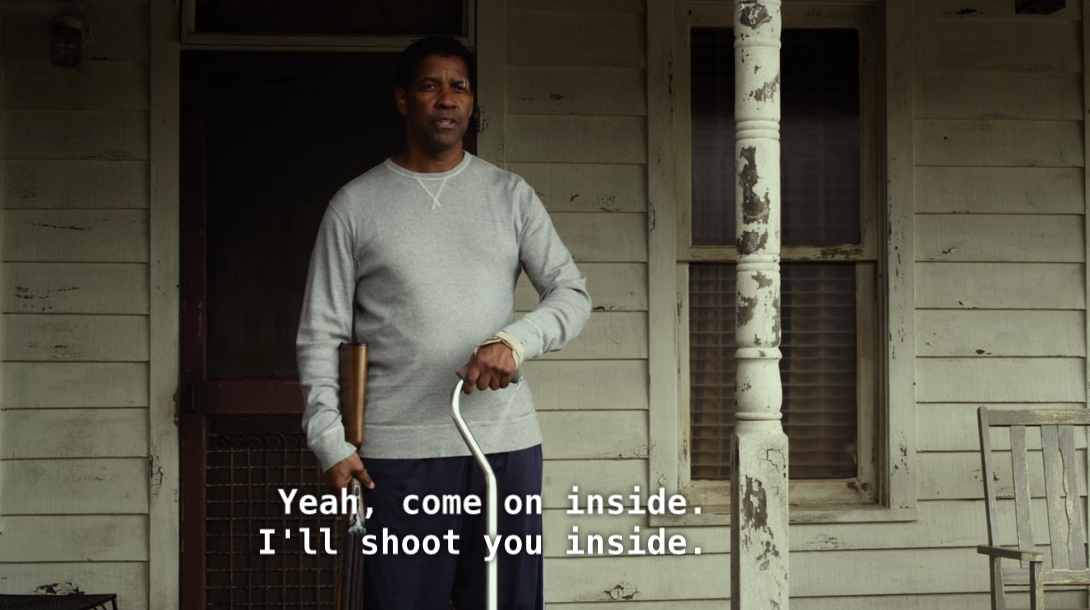
Peep the stack of VHS tapes in the Whitaker family's old countryside house. One of the tapes is a copy of Top Gun, which was made by Tony Scott, who directed Denzel in Crimson Tide, Man on Fire, Déjà Vu, the Taking of Pelham One Two Three remake and Unstoppable. I wouldn't be surprised if that was both Zemeckis and Denzel's way of paying tribute to Scott, even before the Crimson Tide director committed suicide while Flight was in post-production. Another video in that stack is a copy of Denzel's 1987 Steve Biko movie Cry Freedom. That means that Flight takes place in a bizarre reality where Denzel is a movie star and an alcoholic pilot who looks a lot like Denzel becomes a media darling for unconventionally and skillfully piloting a malfunctioning plane to safety, but nobody ever comes up to Whip and says, "Hey, has anybody ever told you you've got the marquee good looks of Denzel? Here's my number at CAA. Let's do lunch some time."
Hmm, I wonder why Virtuosity isn't in that stack of videos. Anyway, another element that elevates Flight above the standard addiction drama is the movie's engaging and non-didactic legal drama side, particularly in the scenes between Denzel and Don Cheadle as Whip's efficient--and quietly frustrated, especially over Whip's behavior--lawyer, which are at times as electric as the scenes between Denzel and Cheadle in Devil in a Blue Dress. In Flight, Denzel and Cheadle reverse their Devil in a Blue Dress roles as, respectively, the straight arrow and the troublemaker who has to be kept in line by the former. Flight is as close to the Denzel-as-Easy/Cheadle-as-Mouse reunion movie we'll sadly never get to see due to Devil in a Blue Dress' box-office failure during the weekend of the O.J. Simpson verdict in 1995.