Showing posts with label Sidney Lumet. Show all posts

Monday, May 18, 2015

Varèse Sarabande's "LP to CD" series is a bonkers idea only hoarders would sign up for

April Fool's Day is also the title of the best Weird Al parody of U2 that Weird Al recorded in a parallel universe that's more fun than our drab-ass universe.
The AFOS blog has a schedule each week: just two (or sometimes three) new posts, and one of the posts is a Throwback Thursday post where I draw from a desk cabinet a movie ticket I saved and discuss at length the movie on the ticket (occasionally, if I draw a ticket for a movie I won't find to be stimulating to write about--like, say, Transformers: The Torture of Hearing Shia LaBeouf Scream "No!" 50,000 Times--I'll change it to a different movie). I chose a two-per-week schedule so that this blog has something new every week and it doesn't wind up looking like tumbleweed drifting across a vacant lot, which is what has happened to so many blogs I used to enjoy reading before their authors simply lost interest and abandoned them without even saying a proper "I'm Swayze."

Finding a topic to write about other than the Throwback Thursday movie-of-the-week has sometimes been difficult. In the last couple of weeks, I've wanted to write about how I wish the late, great movie trailer announcer Percy Rodrigues were alive to read promo copy for Penny Dreadful or trailer copy for 2011's Attack the Block because they look so much like things Rodrigues--whose favorite trailer campaign of mine has got to be the one he recorded for 1995's Tales from the Hood--would have been hired to read copy for when he was alive.


But the problem I've been having with that topic is that it's difficult to write about in a structure that's not a listicle. Earlier this year, I vowed to never write a listicle again because 1) listicles at their worst are such lazy and vapid writing; 2) every time I see an article hed that consists of a numeral followed by a plural noun followed by "That You Didn't Know Were This," I feel like punching a millennial hed writer in the face; and 3) if your film music blog or pop culture site has posted tons of listicles where the hed starts with a numeral, and it continues to post such lists, your blog or site sucks.

So while I was experiencing starts and stops with the topic of trailer campaigns Rodrigues would have been perfect for, I saw "Varèse Sarabande Launches LP to CD Series" in my e-mail. Then I said, "Interesting. I've found my non-TBT topic for next week." And good thing it's the kind of topic that can't be shaped into a fucking listicle.

"Varèse Sarabande has delved deep into our vinyl soundtrack vaults to locate fan favorites and hard-to-find gems that have never been released on CD to date!," announced the inkblot-logoed soundtrack label on its site last week. "The LP to CD subscription series will feature one CD soundtrack per month culled from Varèse Sarabande's archives and available only to subscribers."

The label plans to debut 12 long-out-of-print score albums in CD form instead of in mp3 download form. Subscribers who pre-order for "LP to CD" membership ($10 per month, plus shipping) before June 14 will receive from Varèse (pronounced "vuh-rez") a CD carrying case in the shape of a vintage vinyl carrying case. After June 14, people can join the subscription series on a month-to-month basis. The first out-of-print score in the "LP to CD" series is Charles Bernstein's score to the '80s horror comedy April Fool's Day.


Eh, I've never seen April Fool's Day (even though I kind of remember the tongue-in-cheek April Fool's Day TV spots from when I was a kid, and judging from those TV spots, it looks like the type of horror comedy I'd be into renting these days), so the score doesn't interest me. But bringing 12 score albums from Varèse's pre-CD past back into print is both a nice thing for Varèse to do--it's reminiscent of the MOD (manufactured-on-demand) business model Warner Archive has created to give film geeks access to previously unreleased or out-of-print catalog titles from the Warner Bros. and Turner libraries--and a subscription series I'd get on board with if I had more money.

Actually, I thought it was a subscription series I'd get on board with--until I found out the other 11 score albums in the series haven't been announced by Varèse yet. So anyone who subscribes before June 14 won't have any idea what they'll be filling their red carrying cases with after the April Fool's Day score and maybe whatever score is scheduled to follow that one, which I think is crazy. To be put into that kind of guessing game is the kind of thing I wouldn't sign up for. A guessing game might be great for a pie-of-the-month club, but it wouldn't be so great for a score-album-of-the-month club. To give other score album collectors an approximate idea of what else Varèse might reissue for the "LP to CD" series, someone on the Film Score Monthly message board posted a list of Varèse titles that never made the jump to CD. There are more than 12.

The Ewok movies? Why am I not surprised no one was exactly clamoring for them?

Yeah, that's not exactly an enticing list. Meanwhile, the world's only two or three fans of Blame It on Rio or From the Hip just creamed their pants.

I've always liked Varèse, and I put selections from tons of Varèse albums into rotation on AFOS all the time. My favorite release of theirs has to be the six-CD 2010 release of both Alex North's 1960 Spartacus score and the various cover versions of North's Spartacus love theme, a tune that became a jazz standard and one of the late Nujabes' favorite things to sample. The handsomely packaged, everything-but-the-kitchen-sink Spartacus box set is a release that, on paper, sounds like the old "We've put 50 songs on 50 CDs!" joke from the "Greatest Hits" game on Whose Line Is It Anyway?, but it's no joke, and that box set is the impressive pinnacle of Varèse's work in both giving beloved film and TV scores proper releases and honoring the art of film and TV scoring.

But despite my liking of Varèse, I've never been a Varèse soundtrack release completist like the completists who would subscribe to the "LP to CD" series. Who out there makes it their life's mission to collect every single release put out by a record label--rather than a musician or band they might love--even if an album made by the label contains a score from a movie or TV show they're not familiar with and even if a score released by that label was written by a composer they never liked? That's like if a hip-hop head bought every single release from Def Jam just because it's from Def Jam, including everything from the failed Roc La Familia imprint and even Kingdom Come, which Jay Z considers his worst album. It's just so bizarre. I call it bizarre, while A&E has a different word for it. Maybe you've heard of that word. The word is Hoarders.

Paul Chihara scored The Haunting Passion, an '80s TV-movie that caused me to have a crush on Jane Seymour, even though the movie's kind of cheesy--especially Chihara's softcore porn-ish score--and it's basically about Jane Seymour awkwardly fucking a ghost.
Paul Chihara

Only one out-of-print Varèse score on the above list interests me. It's Paul Chihara's score to 1981's Prince of the City, one of my favorite Sidney Lumet films and a film that inspired Dick Wolf to create for Prince of the City star Jerry Orbach a wiseass Law & Order detective character slightly modeled after Orbach's corrupt and racist NYPD narc character (hey, Law & Order afternoon marathon-obsessed moms and stand-up comics who don't work during the day, remember when Briscoe was introduced as the formerly crooked, estranged-from-his-grown-up-daughters and twice-divorced antithesis of Paul Sorvino's fatherly and happily married Sgt. Cerreta?). Prince of the City is also a film that must have influenced Shawn Ryan in his TV work. The Shield, The Chicago Code and even the non-police-related Last Resort owe a lot to Prince of the City, which the late Lumet signed up for after Brian De Palma left the film (man, take me to the parallel universe where De Palma made Prince of the City!) because Lumet wanted to tackle a portrayal of the police that was more complex and morally ambiguous than his own 1973 smash hit Serpico. Prince of the City is the kind of audacious and grown-up cinematic fare that, like I said in my discussion of Horrible Bosses, major Hollywood studios used to be good at crafting in the days before the stink of PG-13, and it's the kind of fare that's found only as original shows on cable TV or streaming services these days.

The melancholy Prince of the City score--which was recorded in Paris with Jules and Jim and Contempt composer Georges Delerue as conductor instead of Chihara, due to an American musicians' strike at the time--is an important score to me and a noteworthy achievement because it's a solid score written by one of the few Asian American composers in the still-not-so-diverse world of film and TV music. Chihara, who collaborated frequently with Lumet and Farewell to Manzanar director John Korty, may not be as active in that world anymore (his last significant screen scoring credit was additional music for the John Turturro-directed 2005 musical Romance & Cigarettes), but the Japanese American composer remains active in the classical music world.


Outside the context of the film, the Prince of the City score isn't exactly a rollicking good time like, say, "I Don't Know" by Slum Village or "A Roller Skating Jam Named 'Saturdays'" by De La Soul, but it nicely reflects the isolation and angst of Treat Williams' character Daniel Ciello, a corrupt-cop-turned-whistleblower-taking-down-other-corrupt-cops. "Conceptually, Danny Ciello was to be treated always as one instrument: saxophone. Over the body of the picture, his sound was to become more and more isolated, until finally three notes of the original theme, played on sax, was all that remained of the music," wrote Lumet in his 1995 book Making Movies.

Chihara's score is an effective score from a film that's still underappreciated, and if Varèse's "LP to CD" series does rescue the Prince of the City score from the out-of-print doldrums, then we're getting somewhere. For now though, the series' "hey there, completists, for $10 a month, you won't know what you're getting!" concept just gives me bad--not to mention Hoarders-y, crazy cat lady-ish--vibes.

Friday, September 26, 2014

"Brokedown Merry-Go-Round" Show of the Week: South Park, "Go Fund Yourself," and Space Dandy, "Dandy's Day in Court, Baby" (tie)

Welcome to Silicone Valley.
Every Friday in "'Brokedown Merry-Go-Round' Show of the Week," I discuss the week's best first-run animated series episode I saw. "Brokedown Merry-Go-Round," a two-hour block of original score tracks from animated shows or movies, airs weekdays at 2pm Pacific on AFOS.

The last time South Park was on the air, Trey Parker and Matt Stone put together perhaps my favorite South Park episode in years, "The Hobbit." Like many latter-day South Park storylines, "The Hobbit" lampooned a reality TV star whose show will no longer be relevant a year after you first watch South Park mock it--in this case, Kim Kardashian--but then the episode concluded on an unusually devastating note and critiqued the pressures placed on girls to fit certain beauty standards, without turning all Diff'rent Strokes preachy on us during its critique. For its 18th-season premiere, "Go Fund Yourself," South Park critiques another issue, and it's been a huge one in the Native American community for over a year now: Dan Snyder's stubborn refusal to change the racist and outdated name of the NFL team he owns, the Washington Redskins, which resulted in Native American groups starting a "Change the Name" movement.

Throw in a bunch of hilarious gags about the evilness of Snyder's fellow NFL team owners and the recent ineptitude of NFL commissioner Roger Goodell in how he's handled Ray Rice's domestic violence incident--we have South Park's amazingly fast turnaround to thank for those gags about Goodell--and you've got a solid season premiere that's the cathartic laugh we needed after months of constantly being subjected to appalling examples of how much of an evil organization the NFL is, from the head injury scandals to its hypocrisy regarding women's issues. "Go Fund Yourself," which has Cartman, Stan, Kyle and Kenny launching a startup where they make money doing absolutely nothing, also contains some jabs at the dumbest aspects of Silicon Valley culture. Those aspects are always worthy of a skewering because I'm currently stuck living in Silicon Valley, and I despise all things having to do with Silicon Valley culture. It's nice when latter-day South Park goes after subjects that aren't reality TV for a change.

But what really bolsters "Go Fund Yourself" is all the satirical material about the NFL (Snyder enters the picture when he demands that Cartman and his friends stop calling their startup the Washington Redskins). The episode's portrayal of Goodell as a malfunctioning robot is laugh-out-loud funny and perfect, especially in a week when ESPN punishes Bill Simmons for speaking his mind about Goodell's ineptitude and bizarrely gives the Grantland editor-in-chief a suspension that's longer than the one the annoying Stephen A. Smith received for blaming domestic violence victims for provoking their attackers. ESPN's tongue is so far up the NFL's ass it can report to you on SportsCenter what the NFL had for lunch.

***

Suddenly she's talking like a duchess but she's still a waitress.
There's only one episode of Space Dandy left, and at this late point in the game, all we know about the past of Dandy--this doltish hunter of aliens who knows as much as we do about his origins--is that his body was infused with an enormous amount of a highly coveted element called pyonium (also known as "the God particle," it's the same element that once caused QT to increase in size when Dr. Gel's ship accidentally blasted him with it); he's a middle school dropout; he used to date a female heart-in-a-transparent-box who hails from the fourth dimension; and the pyonium enables him to cross dimensions and remember every single one of them, including dimensions where he died. In "Dandy's Day in Court, Baby," we now find out he has no DNA, which confirms a theory I've had since "A World with No Sadness, Baby": Dandy isn't human, baby.

I think Dandy's either the escaped result of an experiment to construct a person out of pyonium or a god who developed amnesia, much like Will Smith in Hancock. Since then, he's been wandering space without any cash in a clunker of a ship for a long-ass time, barely aware of his special pyonium-related power, which the Gogol Empire wants for its own nefarious purposes. Like I've said before about any theory I've had regarding any mystery on Space Dandy, I could be wrong either way, and we'll see how wrong I'll probably be in the final episode of Space Dandy's way-too-brief run.

In the meantime, "Dandy's Day in Court, Baby" is an interesting case of a bottle episode of an animated show that's clearly a bottle episode--BONES Inc. reportedly went all out with the animation for the finale and needed to rush out an episode that's not as expensive--but instead of putting together a clip show like Space Dandy general director Shinichiro Watanabe and Manglobe once did for Samurai Champloo, BONES chose to set most of the episode inside a courtroom to cut costs. The episode actually works despite its downsized scope. For one thing, "Dandy's Day in Court, Baby" isn't recycling old material like those superfluous clip shows do. It's 100 percent new material, including the flashbacks to the crime scene where Dandy inadvertently became a murder suspect, and I'll take a courtroom trial with completely original content over a clip show any day. Plus the whodunit that "Dandy's Day in Court, Baby" writer Dai Sato came up with is simply diverting and full of what the NBC announcer who used to record all its promos (before Dorian Harewood's current stint as the voice of the network) would intone were "those Law & Order twists."

This all-canine remake of Matlock doesn't have enough scenes of Andy Griffith licking himself.
"Dandy's Day in Court, Baby" is more of an homage to the courtroom drama genre than a parody. For the first half, it's played completely straight to trick us into thinking a sad, remorseful-looking and mute Dandy really did kill an alien named Guy Reginald, a rare Lumetian (his race is named after the late director of 12 Angry Men and The Verdict), right in front of Reginald's hot wife Rose, a waitress at Dandy's favorite hangout Boobies (both Reginald and Rose are named after the writer behind 12 Angry Men, Reginald Rose). Instead of aping the original Law & Order, which I don't think is even popular in Japan (and if it were popular over there, Sato would have been aware that Law & Order never spent as much time in the jury room as "Dandy's Day in Court, Baby" does), the episode has more of an Ace Attorney vibe. Ace Attorney is a popular Japanese series of video games where the player gets to be heroic lawyer Phoenix Wright and make legal decisions instead of shooting at zombies or enemy soldiers. I knew all those hours of watching X-Play on G4 despite not being a gamer at all wouldn't go to waste someday.

In the second half of "Dandy's Day in Court, Baby," things get nutty, and the case goes from appearing to be a noirish crime of passion to turning out to be an absurd foofaraw involving a kid who was angry at his best friend for blocking him on Chwitter, Space Dandy's Twitter knockoff; a runaway baseball that contains a massive amount of pyonium like Dandy's body does; Lumetian pro wrestlers' secret identities; and Reginald's sleep apnea, which fooled his wife and the coroners--the dumbest coroners in the galaxy--into thinking Reginald was dead. Dandy is exonerated, and in the episode's best gag, the judges learn why he was being tight-lipped and reserved all through the trial. For a while, I thought the reason why Dandy was immobile was because he skipped the trial to hide from the court and replaced himself with a realistic-looking rubber decoy, but it turns out that he was actually asleep in the courtroom the whole time.

Meow doesn't care for Chwitter's attempts to look visually more like Phasebook.
Then things turn serious again in the episode's great cliffhanger ending. Before "Dandy's Day in Court, Baby," Dandy never once got face-to-face with the Gogol Empire--every time Dr. Gel would come close to capturing Dandy, the alien hunter would be unaware of the presence of Dr. Gel's ship and then Gel's ship would immediately get blown up before Gel could get his mitts on Dandy--but now Dandy and the empire finally get to see each other when the empire's troops surround Dandy outside the courthouse. The conclusion of "Dandy's Day in Court, Baby" also marks the first time that the "To be continued" graphic at the end of many Space Dandy episodes isn't a joke.

Whether Dandy turns out to be a god or the God (or neither), I don't want Space Dandy to end because it's shown so much creativity in its brief run. An extra season of a few more special guest animators bringing their idiosyncratic flair to Dandy's universe(s) would have been nice. It's funny how I initially thought Space Dandy was going to be Shinichiro Watanabe's first artistic failure and just another lewd sci-fi comedy. Instead, it's turned into something better and unexpected: an anthology-like show that captures the adventurous and exploratory spirit of both the original Star Trek and The Hitchhiker's Guide to the Galaxy--and more effectively than the last time Star Trek hit the screen. Now that's a feat as impressive as anything pyonium can do.

Friday, January 14, 2011

"Rock Box" Track of the Day: Elton John, "Amoreena"

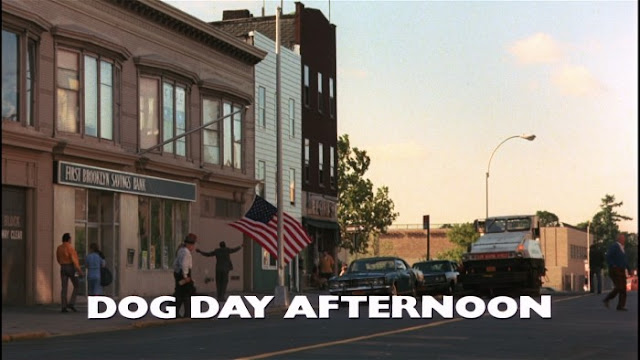
Dog Day Afternoon was nearly given the same title as the Life magazine article it was based on: the corny and unsubtle 'Boys in the Bank.' Because the film intended the Pacino character's homosexuality to be a surprise twist for moviegoers who were unfamiliar with the real-life robbery, that would have been like if The Sixth Sense was instead called I Am Dead.
Song: "Amoreena" by Elton John
Released: 1970
Why's it part of the "Rock Box" playlist?: It's featured in my favorite Al Pacino movie, Dog Day Afternoon.
Which moment in Dog Day Afternoon does it appear?: The opening credits.

Earlier this week, New York magazine film critic David Edelstein named Sidney Lumet's 1975 classic his favorite New York movie because of the soulfulness Pacino brought to Sonny, one of many New York characters he's played in his career, and the way the film turns "the whole crazy paradox of acting, of being private in public" into a metaphor for life in the big city. The opening montage of grimy '70s New York in the summertime--beautifully assembled by legendary editor Dede Allen (who died last April) and accompanied by John's lazy-day tune "Amoreena," the only non-diegetic piece of music in the film--is one of the reasons why Dog Day always winds up in discussions of greatest New York movies like Edelstein's.

Embedding was disabled for the clip of the Dog Day opening that was posted on YouTube, so view the sequence here.

All the other "Rock Box" Tracks of the Day from this week:
Stevie Wonder, "I Believe (When I Fall in Love It Will Be Forever)"
Madvillain feat. M.E.D. a.k.a. Medaphoar, "Raid"
The Who, "I'm One"
Puccio Roelens, "Caravan"

Saturday, July 4, 2009

The Anderson Tapes: "America, man! You know, it's so beautiful I wanna eat it!"

'America, man! You know, it's so beautiful I wanna eat it!'

I can't think of a more fitting quote to put at the top of this Fourth of July Weekend blog post. It's a standout line uttered early on by Christopher Walken in his big-studio debut, the 1971 Columbia Pictures heist flick The Anderson Tapes.

I finally got around to watching The Anderson Tapes the other day. Before Sidney Lumet's nifty little caper made its debut on DVD in September as part of Sony's "Martini Movies" imprint (uh, Sony, I think you missed the lounge movement by about 10 years), it was on my list of films I--a fan of '70s heist flicks like the original Taking of Pelham One Two Three and The Hot Rock--wanted to watch but wasn't able to because they weren't available on disc.


I always dug the Smackwater Jack version of Quincy Jones' Anderson Tapes theme, which features the late Freddie Hubbard on flugelhorn and a nice harmonica solo by Toots Thielemans. That version of the theme actually never turns up during Jones' unreleased, love-it-or-hate-it score, which is filled with early synthesizer bloops and squeals due to the paranoid film's subject of pre-Watergate (and pre-Conversation) surveillance.

The Randomatic sits in storage somewhere with other hilariously now-outdated '70s and '80s gadgets like that Etch-a-Sketch-ish police sketch machine from For Your Eyes Only and the Daggit from the old Battlestar Galactica.

Some viewers find the bloops and squeals to be grating and distracting, while I don't mind them at all. Jones' bloops and squeals--along with the now-goofy-looking Randomatic computer that's used by the film's NYPD officer characters to pull up criminal records--lend The Anderson Tapes a certain analog charm. The groovetastic sound effects remind me of the electronic noises during Roman Coppola's amusing 2001 film about the making of a low-budget French sci-fi flick, CQ, which takes place in the same era.

'Isch that a Lakers jersey under your skirt? Take the bloody thing off! You know I'm all aboat the Knicks.'

Sean Connery ditched the 007 hairpiece--or rather, chose a more revealing hairpiece--to star as Duke Anderson, a newly freed, unrepentant ex-con who plots an elaborate Labor Day heist at the ritzy Fifth Avenue apartment building of his high-priced hooker girlfriend Ingrid (Dyan Cannon). In other Connery/Lumet collabos, particularly The Hill and The Offence (when's that film going to hit DVD?), Lumet clearly loved giving Connery speeches that were long and fiery (yet not overwrought). Eager to move past his rather limited 007 persona, Connery excelled at those speeches, and he pulled off another juicy one here, an anti-authority screed that's more Cool Hand Luke than 007, courtesy of Cool Hand Luke screenwriter Frank Pierson ("What's advertising but a legalized con game? And what the hell's marriage? Extortion, prostitution, soliciting with a government stamp on it.").

Duke Anderson failed to deprive people of their money on Labor Day Weekend without getting caught. He should have just started his own Labor Day telethon for broke ex-cons who can't hack it outside prison.

Anderson's crew includes a younger safecracker known simply as "the Kid" (Walken, whose eccentric line delivery is made even weirder by the fact that he really does look like a kid here), unflappable getaway driver Spencer (Dick Anthony Williams) and gay antiques dealer Tommy (if acting styles were KFC recipes, Martin Balsam's would be Extra Swishy). They'd be the tightest crew in the history of caper movies, if they weren't so oblivious to then-recent advances in surveillance technology, which have allowed government agents or cops to illegally monitor the activities of everyone Anderson comes into contact with, from his associates to his girlfriend. Those lawmen aren't even interested in Anderson's next score. They've been spying on everyone in Anderson's circle because of unrelated improprieties, whether past or alleged. Black Panther-hating Feds are profiling Spencer, who lives near a Panther Party chapter, the IRS is keeping tabs on Anderson's Mafioso benefactor (Alan King), and Ingrid's jealous sugar daddy (Richard B. Schull) has hired a private detective to listen in on her trysts with her clients.

'We're gonna rob every single copy of 'Zardoz,' 'The League of Extraordinary Gentlemen,' 'The Country Bears' and 'Gigli' we can find and then lock them away in a vault, never to be found again. Are you in, kid?'In The Anderson Tapes (which the creatively bankrupt Sony has been attempting to remake, and I hope the box-office failure of their Pelham remake discourages them), it's interesting to see narrative devices and character types Lumet would revisit in later, better-known works. Lumet jumbled the Labor Day heist's time frame--a gimmick the director would re-use in The Offence and Before the Devil Knows You're Dead. The flashbacks to the heist are less distracting here than in Before the Devil. The crooked cops of Serpico, Prince of the City and Night Falls on Manhattan are cut from the same cloth as the lawmen who illegally bug or wiretap Anderson's cohorts (the only likable cop in The Anderson Tapes is a resourceful SWAT team leader played by a pre-SNL Garrett Morris). The victims of Anderson's heist get some standout lines and are as fleshed out as Al Pacino's hostages from my favorite Lumet film, 1975's Dog Day Afternoon. The heist sequence's tension is offset by some welcome comic relief from Judith Lowry as an elderly resident who doesn't seem to mind being robbed (Lowry was the same ornery old lady who stole scenes in Norman Lear's not-yet-on-DVD satire Cold Turkey, also released in 1971).

If you can find Walken's obscure 2000 indie movie The Opportunists, in which he plays a world-weary safecracker whose mentorship of a younger crook carries echoes of the Connery character's mentorship of Walken's upstart safecracker, it would make for an intriguing double feature with The Anderson Tapes. Walken's performance in The Opportunists--it's Walken in not-so-weird Catch Me If You Can mode--is one of his most underrated. Too bad The Opportunists is rather listless for a caper flick. Compared to the fun and nail-biting Anderson Tapes, The Opportunists is--to borrow a line from one of Walken's many quotable SNL sketches--a Stiffly Stifferson.