Sometimes I'm just in awe of some of the people who read this blog. For instance, Edgar Wright stumbled last week into my Throwback Thursday discussion of the brilliance of The World's End as both an anti-gentrification satire and a midlife crisis comedy and retweeted it to his fans. And I know that writers from Bob's Burgers and the short-lived Motorcity, two animated shows I greatly admire, have read this blog because they've thanked me on Twitter for what I've written over here about their shows.
A Bob's Burgers writer is as amazing to me as, say, Rick Ross (ruh!) is amazing to some female fan who faints over getting his autograph. Now I wouldn't faint in the presence of either the controversial MMG impresario or a Bob's Burgers staffer--and I wouldn't say I'd get "the feels" around either of them because I'm over 21, and if you're over 21 and you go around telling people that you get "the feels," miss me with that asinine-sounding shit--but around that Bob's Burgers staffer, I'd be like, "So in episode S05E04, was H. Jon Benjamin actually blotto when he ad-libbed that turkey baster monologue? Was he? Huh, huh, huh, huh, huh?"
In another instance, I once blogged about regretting not buying when I was a kid an issue of Billy Nguyen, Private Eye, a largely forgotten indie comic book that remarkably featured an Asian American P.I. as the protag. My post caught the attention of Billy Nguyen artist Stan Shaw. Stan and I exchanged a few e-mails about Billy Nguyen (Stan turned out to also be an AFOS listener), and months later, he sent me in the mail a gift I'll always treasure: an issue of Billy Nguyen.
About a couple of months ago, I wrote about a now-defunct Canadian DJ mix podcast I miss hearing, Sounding Out the City. It was where I first encountered the late Amy Winehouse's "Valerie," and it was also where I first took notice of Mayer Hawthorne and TOKiMONSTA. The TOKiMONSTA track I heard on Sounding Out the City was "The World Is Ours," which flipped a classic Marvin Gaye/Tammi Terrell duet and is a tune TOKiMONSTA says she loves so much that she's never released it officially.
Back when I had a day job in the racist and misogynist shithole called the Silicon Valley tech world, Sounding Out the City helped make getting through that job, which I started to get bored with about four years into it, a hell of a lot easier. Sounding Out the City selector Rob Fragoso saw my post about his podcast and is now the latest person whose work I've admired to surprise me with an appreciative comment that made my day.
It turned out not to be the Ernestine Anderson "Love for Sale" that Rob featured on his podcast in 2009, but a completely different jam of the same name by Bay Area singer Lillian Alexander, as Rob realized several hours later. Come back to the ones and twos, Rob, we need you! Or if you're actually still mixing, the podcastosphere needs you! Some currently miserable Silicon Valley or Silicon Alley worker who's basically me eight years ago might need you!
It's been such a long time since I've written enthusiastically about a short film that I've forgotten how my own blog style guide's policy goes for when I have to type out titles of short films. So I've had to go back to older material from my blog and verify that policy. It turns out that I'm supposed to bookend titles of short films with quotation marks instead of italicizing them, just like with titles of short stories or TV series episodes.
Stop-motion animator Timothy Reckart's 2012 short Head Ov... "Head Over Heels," which Reckart just recently made available to watch in its entirety online for free, is so good I kind of wish it won the Best Animated Short Oscar in 2013 instead of Disney's "Paperman." (In 2013, "Head Over Heels" and "Paperman" also happened to be up against the Simpsons theatrical short "The Longest Daycare," which I love for both its jab at Ayn Rand and the adversary "Longest Daycare" writers James L. Brooks, Matt Groening, Al Jean, David Mirkin, Michael Price and Joel H. Cohen chose to pit Maggie against.) Like "Head Over Heels," "Paperman" is a clever short about a man struggling to communicate his feelings to a woman he adores. But "Head Over Heels" is about adult problems--like how do you salvage a long-term relationship that has lost its spark, and how do you do that when so many obstacles to communication are in the way?--and that makes it the more intriguing of the two Oscar-nominated 2012 romantic shorts.
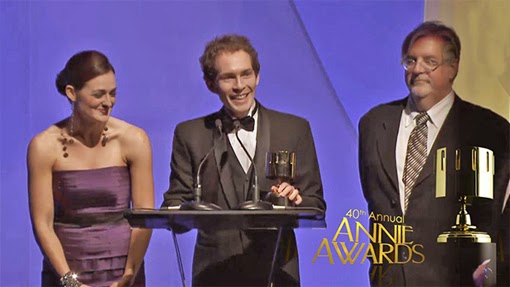
Timothy Reckart, accepting his Annie Award for "Head Over Heels" (Photo source: Animation Magazine)
An Annie Award winner for Best Student Project (it was made at the National Film and Television School in the U.K.), Reckart's 10-minute film is both a dialogue-less and surprisingly affecting comedy about a strained marriage and a nifty sci-fi short story set in a bizarre and unexplained reality where the laws of physics are different from our world's laws of physics. So because of the reality the short takes place in, the biggest obstacle to communication between middle-aged Walter and his ex-ballet dancer wife Madge isn't the increasingly common problem of smartphone addiction. Instead, it's gravity.
Walter and Madge live in a floating house where Walter's ceiling is Madge's floor and her ceiling is his floor. We don't know what exactly caused their marriage to become strained or why they no longer share the same gravity. All we do know is that it's entertaining to watch them go about their day as if everything's normal in their topsy-turvy world.
Meanwhile, in our topsy-turvy world where special features, which, for a long time, have been the best part of a DVD or Blu-ray, are unfortunately becoming an endangered species because younger viewers prefer to stream movies instead of watching bonus-filled physical copies of them, Reckart's strategy of getting viewers to watch his short online is noteworthy. It's not just because of his wish to keep special features alive by treating viewers to a bunch of fascinating little extras about the making of "Head Over Heels" ("On the one hand, the death of DVD is great, because the physical production of DVDs has been a barrier to entry for short filmmakers like me. On the other hand, what happened to special features?," says Reckart). It's also because one of those bonuses is an audio-only featurette about film scoring--and it's almost three times longer than "Head Over Heels" itself, like how the documentary about the making of Superman Returns is much longer than Superman Returns itself (and a slightly more enjoyable film too, simply because of the moment when Kevin Spacey cracks up the film's crew with his Brando impression while audio of Brando as Jor-El is being played aloud on the set).
Any featurette about the film scoring process is worthwhile to me because I put strictly film and TV score music into rotation on my radio station, and I'm always interested in hearing about how that kind of music gets made. Film and TV scoring is a process not a lot of people understand or are aware of, even after the release of Forgetting Sarah Marshall, whose main character was a struggling (and way-too-frequently-naked) TV composer, so the audience saw a few scenes of him at work. Featurettes like the scoring discussion Reckart recorded with Jered Sorkin, his short's composer, are invaluable because they get those outsiders to understand the process.
I had only five questions for Reckart--whose prior stop-motion shorts include 2009's "Token Hunchback," a mockumentary about a Hollywood actor born with a hunchback--when I interviewed him over e-mail. That's because in the extras or in other interviews, he goes into so much detail about the animation process and the music that he basically answers all the other questions I had about the making of "Head Over Heels."
Every Throwback Thursday, I randomly pull out from my desk cabinet--with my eyes closed--a movie ticket I saved. Then I discuss the movie on the ticket and maybe a little bit of its score, which might be now streaming on AFOS.
British director Edgar Wright is at the peak of his comedic filmmaking powers in 2013's The World's End, the third and final film in the Cornetto trilogy he co-wrote with Simon Pegg, the star of Wright's groundbreaking sitcom Spaced. Each film in the trilogy is a standalone piece--none of them take place in the same universe--but they all have a bunch of things in common: a Cornetto ice cream treat (a favorite hangover cure of Wright's) always makes a cameo appearance, hence the trilogy's unofficial name Cornetto; Wright reuses several actors; Pegg and his old Spaced co-star Nick Frost always play a pair of friends who are grappling with either the fear of losing their identity or being forced to let go of their adolescence; a fence jump always goes awry; and a seemingly tired genre gets revitalized in the inventive hands of Pegg and Wright each time.
The first Cornetto film, 2004's Shaun of the Dead, expanded upon Pegg and Wright's obsession with George Romero flicks from an early Spaced episode, and the result--a Romero flick with bumbling, hungover Crouch End blokes as the heroes--is still my favorite zombie movie ever. The second Cornetto film, 2007's Hot Fuzz, took Joel Silver and Jerry Bruckheimer cop flicks from America and amusingly tried to wedge the much more mundane reality of British policing into the body of one of those over-the-top cop flicks. Frequently described as "Lethal Weapon in Somerset," Hot Fuzz is not like any other action genre spoof. It's full of humor about fascism, conformity (a theme that resurfaces in The World's End), British genteelness and Grand Guignol violence that's often smarter than the average hacky "hey, let's just reference this recent movie and that recent movie and then call it a day" Friedberg/Seltzer spoof film. Hot Fuzz's genuine affection for American action flicks also elevates Wright's film above action genre spoofs that harbor contempt for the films they're parodying, much like how Shaun's affection for Romero flicks was key to making that film so appealing.
The World's End is more ambitious than the other two Cornetto films and juggles several ideas at once: it's a school reunion comedy about the dangers of nostalgia (set not at an actual class reunion but at a pub crawl Gary King, Pegg's immature alcoholic character, failed to finish as a teen and wants to finally finish with his estranged, now-teetotal friends), an addiction drama, an alien invasion flick and a critique of gentrification, or as Paddy Considine's character calls it, "Starbucking." In lesser hands, this all could have turned into a hot mess--an unwieldy, overly busy third movie that, like so many other third movies in a series, strains to juggle all the ideas running through Pegg and Wright's heads--but like the other two Cornetto films, The World's End is so tightly constructed by Pegg and Wright that the disparate components mesh beautifully and the seams never show.
When the comedic sci-fi action gives way for a scene straight out of an addiction drama, the dramatic scene doesn't feel out of place. Speaking of which, The World's End and Flight would make for a great double bill about alcoholics in denial. But why do the on-the-nose existing songs--particularly Saint Etienne's "Join Our Club" and The Doors' "Alabama Song (Whisky Bar)" in one great marriage of song and scene, due to the actors walking in step and drinking in time to the Doors tune as it was being blasted on the set--work so well for The World's End, while the on-the-nose existing songs don't work as well for Flight? That's because with the exception of the Soup Dragons' overplayed and annoying cover of the Rolling Stones' "I'm Free" and Primal Scream's '90s advertising staple "Loaded," neither of Wright and music supervisor Nick Angel's selections, which are mostly from the late '80s/early '90s era of Britrock, are tunes I've heard a million times before in movies or on TV, like Flight's overplayed choices of "Gimme Shelter" and "Sympathy for the Devil."
The original score by Gravity composer Steven Price is equally effective. My favorite moments of Price's score, which can be heard during the AFOS weekend block "Hall H" and "AFOS Prime," are textural rather than tuneful. They all involve cell phone interference sound FX, which represents the Network, the extraterrestrial collective of gentrifiers behind the gradual robot invasion of the friends' former hometown of Newton Haven, as well as all the technological advances on Earth from the early '90s to 2013 (that means Steve Jobs was a robot, which explains all those black-turtleneck-and-mom-jeans ensembles), and those advances are a huge part of the Network's strategy of seducing the smartphone zombies of the human population into getting rid of their humanity and becoming robots, or "blanks." The interference audio first appears in Price's score when Gary accidentally decapitates the teenage blank in the restroom. Never has cell phone interference sounded so menacing. After Black Mirror and the Network scenes in The World's End, the British are proving to be the craftiest satirists when it comes to material about how smartphone or tablet addiction is causing society to become even more soulless than it was before.
The result of Pegg and Wright's skills with meshing disparate components--and making inspired use of little things like mobile interference audio--is the most entertaining and clever critique of gentrification ever made. It's also the only gentrification satire to involve rousing and dazzlingly staged fight scenes where humans decapitate with their bare hands their blank adversaries and pulverize them with whatever weapon they can find, whether it's a pair of pub stools or the blanks' own torn-off limbs (the terrific World's End fight choreography was done by Scott Pilgrim vs. the World and Kingsman: The Secret Service stunt coordinator Brad Allan, a.k.a. the short white guy Jackie Chan fought during Gorgeous).
The film is so packed with detail that you pick up something new in each viewing. For instance, while watching The World's End for the fourth time in preparation for today's edition of Throwback Thursday, I switched on Pegg and Wright's Blu-ray audio commentary and learned that the film's school disco sequence--in which the Network attempts to lure Gary and his friends into becoming blanks by bringing back a trio of hot girls they liked who were known collectively as "the Marmalade Sandwich" and have eerily not aged a day--is based on an actual clubbing phenomenon. I didn't even know this was a thing in England--women get paid to dance in schoolgirl uniforms, which Pegg and Wright both find to be rather creepy as a male fantasy--and after listening to the commentrak, I received a crash course in school discos from a 2002 Guardian article about the then-new "formula of uniforms, booze and tacky tunes."
The grand entrance of "the Marmalade Sandwich" in The World's End
Sophie Evans (Marmalade Sandwich girl Becky Salt), out of uniform (Photo source: Wales Online)
In The World's End, Wright didn't just revitalize the old sci-fi trope of your friends and neighbors getting replaced by creepy duplicates by brilliantly linking it to the horrors of gentrification. He also revitalized the midlife crisis comedy, taking it back from the Wild Hogses and Old Dogses of the world. A pre-Gone Girl Rosamund Pike does wonders with what little screen time she has--she was pregnant during filming--in the role of Sam, the lone female in Gary's circle of friends (both Pike's delivery of "What happened to you?" to Pegg in the bathroom and her comedic gasp after first seeing Pegg decapitate a female blank are sublime bits of acting), while Pegg and Frost, who switched the roles they had in Shaun and Fuzz so that Frost played the more responsible half of the duo this time, show remarkable range when their characters' respective midlife crises take a turn for the dramatic. Speaking of midlife crisis movies, why do so many SNL alums, whether it's Billy Crystal or Adam Sandler, star in the same old goddamn movie about a middle-aged guy who has to learn to be a better dad? It's why my favorite Billy Crystal movie remains the not-so-maudlin Running Scared, and it's also partly why Anchorman 2, with its "Ron needs to be a better dad" subplot, isn't as consistently funny as its predecessor.
Looking back lately on the artistic triumphs that resulted from Wright revitalizing weather-beaten genres for his Cornetto projects has made Wright's decision to walk away from the movie version of Ant-Man all the more heartbreaking (he had enough of getting into creative disagreements with Marvel Studios). Think of what Wright could have accomplished in revitalizing the superhero movie, a genre that's lately been showing signs of repetition, whether it's pointless and clumsy world-building or tiresome destruction porn. (Speaking of which, I love the shade Pegg once threw at the ways Man of Steel handled its destruction porn: "At the end, they're all at the Daily Planet office just going, 'Hey! Let's go see the Dodgers!' Isn't everyone dead? Isn't New York flat? What do you mean, go see the Dodgers?!" Pegg's involvement in the writing of the next Star Trek movie makes me more hopeful about the Trek movie franchise's return to quality after the mistakes that were made during Star Trek Into Darkness, and one of those mistakes was the same type of destruction porn Pegg was critiquing.) I wouldn't be surprised if Wright, who's kept mum about his tumultuous working experiences with Marvel, quit Ant-Man because what its studio execs wanted to do with his vision for the movie was too reminiscent of the Starbucking he so astutely skewered--or rather, decapitated--in The World's End, a rare third film that doesn't suck.
John Carpenter, shooting exterior footage for Escape from New York
The most significant and impressive piece of work John Carpenter has made in the last 15 years is neither a feature film nor a TV-movie. It's John Carpenter's Lost Themes, a new collection of original Carpenter instrumentals that, in the Albertus font-loving filmmaker/composer's own words, are "meant to score the movies in your head." The Sacred Bones Records album is Carpenter's entry into the imaginary soundtracks genre, where the likes of Black Dynamite composer Adrian Younge (2000's Venice Dawn) and the duo of Danger Mouse and Magic City composer Daniele Luppi (2011's Rome) have created score cues or theme tunes for movies that don't exist.
Lost Themes tracks like "Vortex" and "Abyss" resemble outtakes from Carpenter's scores to the 1988 cult favorite They Live and the mad-underrated In the Mouth of Madness, and except for the really cheesy Big Trouble in Little China end title theme sung by Carpenter himself, that Carpenter synth sound Lost Themes reacquaints us with has aged remarkably well. It's aged so well that Carpenter's pulsating and frequently sampled 1976 Assault on Precinct 13 main title theme--which Carpenter has said was influenced by Led Zeppelin's "Immigrant Song" and is in rotation during both the AFOS morning block "Beat Box" and "AFOS Prime"--sounds like it could have been recorded yesterday, while the likes of Steven Price, frequent Steven Soderbergh collaborator David Holmes and It Follows composer Rich Vreeland, a.k.a. Disasterpeace, dig the Carpenter sound so much that they borrow from Carpenter in their respective film scores.
I'd add some of the Lost Themes instrumentals to AFOS rotation, but the station format focuses only on score music written for movies and TV shows that aren't imaginary, and I don't have enough station hard drive space to launch a new imaginary soundtrack music block just to stream Lost Themes selections. For about a year, the station schedule included "Rome, Italian Style," an imaginary soundtrack music block I named after one of my favorite SCTV sketches (and a rare SCTV sketch that's not marred by an annoying laugh track). Younge's Venice Dawn tracks and Luppi's Rome tracks were part of the "Rome, Italian Style" playlist, and if the block still existed, those tracks would have shared space with the Lost Themes pieces. The Carpenter sound, which is basically '70s and '80s Italian film music, would have been a nice fit with the '60s Italian film vibe of the Venice Dawn and Rome tracks.
Junta Juleil's Culture Shock and Consequence of Sound both have gotten creative and used the Lost Themes instrumentals to fancast fictional Carpenter movies featuring those tracks. For example, in their movie idea built out of the Lost Themes track "Purgatory," Consequence of Sound imagined a 1988 murder mystery starring Kevin Dillon, Ernie Hudson and Daryl Hannah in her At Play in the Fields of the Lord skinny-dipping scene heyday, while "Purgatory" got Junta Juleil author Sean Gill to envision a completely implausible but much more enticing movie: a Big Trouble in Little China mini-reunion between Dennis Dun and Kurt Russell, who reprises his non-Carpenter role as Captain Ron.
I'd indulge in some Lost Themes-inspired fancasting too, but I don't want to bite Junta Juleil and Consequence of Sound's style, so I'm going to do a completely different approach to playing around with Lost Themes and demonstrating how Carpenter's new instrumentals can make anything sound exciting and atmospheric. I'm going to unearth a plot synopsis I wrote three years ago for a never-finished horror short story and spice it up--or rather, Carpenter it up--with Lost Themes selections.
"The Pet" was my attempt to create a new Filipino monster that would have joined the creepy likes of the aswang and the manananggal. The story would have mixed Filipino monster folklore with one of the most unsettling horror tropes, eye trauma. Here's a good example of how unsettling that trope can be: I was so bothered by a Lasik operation-gone-wrong episode of the short-lived early '00s supernatural show The Others (no relation to the Nicole Kidman haunted house flick of the same name) that I've refused to undergo Lasik surgery to improve my eyesight. At the time I was trying to write "The Pet" as a submission to a Filipino YA horror anthology (it was called HORROR, with the title in all caps, as if it were a book by Meek Mill), I thought, "Eye trauma is terrifying, so how do I work that into the creation of a new monster?"
The result was a story where I only got as far as completing four pages. I ended up missing the anthology submission deadline because I was never satisfied with both the dialogue I wrote and the legal hurdles the story's characters would have overcome in order to acquire the titular creature. Also, I think "The Pet" would be better off as either an episode of a horror comedy anthology show or a short film rather than as a short story in print. I always imagined it as a Joe Dante suburban comedy/thriller with a John Carpenter score--and a Filipino American backdrop.
Every Throwback Thursday, I randomly pull out from my desk cabinet--with my eyes closed--a movie ticket I saved. Then I discuss the movie on the ticket and maybe a little bit of its score, which might be now streaming on AFOS. This week, I pulled out the ticket that said "Man of Steel." But I don't want to write about that goddamn movie, so instead, I'm going to sing the praises of a low-budget movie I saw last week in the theater. In America, it has probably grossed only less than a tenth of what Man of Steel grossed at the box office, but it's 10 times more entertaining than Man of Steel.
One of my favorite SNL sketches that Yahoo's "complete SNL archive" currently doesn't carry is a 1989 Dracula sketch written by Jack Handey and James Downey, who told interviewer Mike Sacks in his 2014 book Poking a Dead Frog: Conversations with Today's Top Comedy Writers that a few other SNL writers disliked his sketch when they first heard about its premise because they thought it sounded hacky: "What if Dracula were AIDS-aware?" The sketch, which featured James Woods as an inquisitive Dracula who asks his potential victims about their medical histories (one of whom was played by the late, great Jan Hooks), turned out to be funny anyway, and it's a shame that Yahoo doesn't have it. If you do fondly remember that James Woods Dracula sketch, then you're bound to get a kick out of the similar "old-world vampire who's had to adapt to the modern world" humor of co-stars/co-directors Jemaine Clement and Taika Waititi's clever 2014 mockumentary What We Do in the Shadows.
At only 86 minutes, What We Do in the Shadows doesn't wear out its welcome. It ends before it can exhaust any of its gags about vampire housemates who are hardly as suave as the stars of True Blood and bicker over household chores or fashion choices, fussy werewolves, chatty and verbose zombies and a modern-day Renfield who's more like a personal assistant than a spider-eating mental patient. If Christopher Guest or the geniuses at Aardman Animations ever wanted to make a mockumentary where all the main characters are famous movie monsters, the result would probably resemble What We Do in the Shadows.
The film, which takes place mostly in an apartment in Wellington, New Zealand that's shared by a group of vampire friends, could have been a one-joke mockumentary. But thanks to the rich screenplay and capable direction by Clement, the bespectacled half of Flight of the Conchords, and Waititi, a fellow New Zealand comedian who directed Clement in the 2007 film Eagle vs. Shark and a few Flight of the Conchords episodes, What We Do in the Shadows is packed with so many effective jokes that it's difficult to catch them all in a single viewing, which makes it a film worth watching again and again.
It's also got a tender side underneath the comedic gore--you're as insane as Renfield if you're expecting What We Do in the Shadows to be a bloodless affair--and the gags about vampire genre clichés. Much of that tender side involves Waititi's character Viago, a 379-year-old aristocrat who traveled to New Zealand in a coffin to marry his girlfriend, but thanks to a coffin postage error, he wound up lost at sea and she married someone else instead. Viago's pining for his lost love is handled beautifully: it's sad, but it's also tinged with some raunchy humor (I've seen tons of TV shows and movies where people fuck each other in coffins, but I've never seen a moment where someone masturbates from inside a coffin, until What We Do in the Shadows came along), which keeps that side of the movie from turning unbearably sappy.
The nicely drawn characters created by Clement and Waititi are a plus, but what's even more enjoyable about What We Do in the Shadows is how its vampire universe is more enticing than most vampire universes from other genre works because it's so amusingly mundane and lived-in. I love the offbeat rules and customs Clement and Waititi came up with for their vampire world, like the bloodsuckers' inability to eat French fries or the little bit of business where they have to draw on notepads to each other how they look in outfits they're trying out because they can't see themselves in mirrors. By emphasizing the mundane, whether it's in those little details or the humorous neuroses of either Viago, his housemates or their werewolf rivals (whose leader is played by Clement's old Conchords co-star Rhys Darby), What We Do in the Shadows takes back the vampire genre from the detestable and banal Twilight and makes vampires relatable--and human--again.