Showing posts with label The Simpsons. Show all posts

Wednesday, November 22, 2017

The problem with The Problem with Apu is that not enough people are going to see Hari Kondabolu's terrific documentary


This is the last all-new blog post before this blog's absolute final post in December 2017.

Fuck all these (predominantly white) superheroes fighting motion-capture-enhanced (and often boring) supervillains on the big screen. The movies I'm way more eager to see are documentaries about ordinary Asian Americans fighting stereotypes. It's a fight I've been a part of in some capacity. Nearly everything I do (even something as insignificant as writing a barely-being-read-by-anybody post for this insignificant and soon-to-go-completely-inactive blog) is some sort of clapback against Asian stereotypes, which have been a pain in my ass since junior high. Filmmaker Salima Koroma's Bad Rap, a doc about Asian American rappers, was the movie I wanted to see the most last year, and now The Problem with Apu, a 49-minute doc directed by Michael Melamedoff and hosted and produced by comedian and Politically Re-Active podcast co-host Hari Kondabolu, is the 2017 film that, despite its skimpy length and non-theatrical status, I've been anticipating the most, much more so than Wonder Woman, Thor: Ragnarok and even Star Wars: The Last Jedi.

The Problem with Apu chronicles the Indian American comedian's love/hate relationship with a little-known Tracey Ullman Show spinoff called The Simpsons. Kondabolu's a Simpsons fan who loves everything about the animated franchise that was brought to life by Matt Groening, James L. Brooks and the late Sam Simon, except for one character. That would be Apu Nahasapeemapetilon, the Indian convenience store owner who, since the show's premiere in 1990 (not counting a 1989 Christmas special that was actually the eighth episode in the first season's production order, "Simpsons Roasting on an Open Fire"), has been voiced by a white guy, longtime Simpsons voice actor Hank Azaria. The character is, as Kondabolu describes him in the doc, "servile, devious and goofy." Apu's shtick on the show is, as Kondabolu memorably said in an extremely funny 2012 Totally Biased with W. Kamau Bell segment about his delight over the rise of Indian American representation on TV, basically "a white guy doing an impression of a white guy making fun of my father!"


The most interesting tidbit about Kondabolu's Totally Biased rant about Apu, which went viral and ended up being shown in high school and college classrooms, is that Kondabolu was initially reluctant to write and perform the segment because he was so tired of complaining about Apu. I like how Bell--the now-defunct FX late night show's titular host and Kondabolu's boss in the Totally Biased writers' room--had to talk Kondabolu into doing it, as if Kondabolu were Logan being dragged out of his dead-end limo driver job to unsheathe his adamantium claws one last time and protect some runaway mutant kid.

Monday, December 5, 2016

AFOS Blog Rewind: Not everyone's a critic, which was why Fox's enormously funny The Critic didn't last


Last week, Uproxx posted a lengthy and enjoyable interview with longtime writing partners Al Jean and Mike Reiss about their short-lived but well-remembered creation, the '90s animated show The Critic. The show centered around Jay Sherman, a persnickety film critic nobody likes, except for Marty, Jay's 13-year-old son, and Margo, Jay's teenage foster sister, who both look up to Jay, and Jeremy Hawke, an easygoing Aussie B-movie star who considers Jay his best friend ever since he was the only critic who didn't trash his first movie. In the Uproxx article, Jean and Reiss recalled the main reason why The Critic lasted from only 1993 to 1995 (the new Fox network president at the time hated it) and the challenges of attempting to give Jay and the other Critic characters the same kind of revival Family Guy and Futurama experienced after they were cancelled by Fox too (three of The Critic's regular voice actors are no longer alive, and Reiss also points out that "Siskel and Ebert are dead and those kinds of shows don't exist anymore. Movie critics used to be all over TV and they used to wield great influence and they just don't"). So from March 18, 2008, here's a post about The Critic, originally posted under the title "'Now who wants to boogie with Baby '37?'"

This weekend, I was surprised to find an eight-hour ReelzChannel marathon of the short-lived animated series The Critic, James L. Brooks' second foray into animation after the success of The Simpsons. Created by Simpsons writers Al Jean and Mike Reiss, The Critic aired on ABC during its first season (1993-94) and then for its second and final season (1994-95), it went to die on Fox (where the show's "Hey! We're on Fox" gags were amusing, while on a non-Fox channel in reruns years later, uh... not so much). The show, which comes complete with Simpsonian catchphrases that never took off ("It stinks!," "Hotchie motchie!," the Chuck McCann-referencing "Hi guy!"), later enjoyed a cultish afterlife in webisode form and on both DVD and Comedy Central's animation lineup.

Wednesday, October 19, 2016

AFOS Blog Rewind: The Simpsons, "Halloween of Horror"

(Photo source: FY Springfield)

This week, The Simpsons aired its 600th episode, "Treehouse of Horror XXVII." The following is a repost of my October 30, 2015 discussion of the first Simpsons Halloween episode that wasn't a "Treehouse of Horror" anthology. This 2015 episode is streamable on FXX's Simpsons World app.

The 27th season of The Simpsons marks the first time the show has produced two Halloween episodes in the same season. In addition to the annual "Treehouse of Horror" anthology--where every short story takes place outside the show's continuity, so a character like Bart or Groundskeeper Willy can be killed off in horrible fashion and then be brought back in the next story or later on in the same half-hour--the show has treated us to its first canonical Halloween episode ever, "Halloween of Horror."

Late-period Simpsons can often be so tiresome and stale or so desperate to be trending again (Homer separates from Marge and goes out with guest star Lena Dunham?: I think I'll pass) that I've sometimes gone for months without watching it, so I wasn't prepared for "Halloween of Horror," which is credited solely to staff writer Carolyn Omine, to fire on so many cylinders. It's a better Halloween episode than this week's "Treehouse of Horror XXVI," which isn't an atrocious edition of "Treehouse," but when its most enjoyable segment is the bizarre and grisly couch gag guest-directed by John Kricfalusi (my favorite detail in Kricfalusi's couch gag is Bart's Huckleberry Hound mask appearing in red instead of blue, because the licensed Huckleberry Hound costume Kricfalusi owned as a kid came in an incorrect red instead of blue), that's how disposable a "Treehouse" episode it is. I would have swapped the "Homerzilla" spoof of both the 1954 Godzilla and the 2014 Godzilla (it's kind of weird how the writers didn't have Harry Shearer deliver any jokes about his involvement in the 1998 Godzilla, a movie Shearer probably Lacuna'd from his memories) for the Psycho parody that the "Halloween of Horror" gag writers joke about being featured "next week."


When even the writing staff is starting to express on the show some boredom with the "Treehouse of Horror" format and showrunner Al Jean is admitting that "we've used up 78 horror stories and you can't do them anymore," maybe The Simpsons should just retire "Treehouse of Horror" and do canonical Halloween episodes like "Halloween of Horror" from now on. The "Treehouse" segments haven't been consistently funny in eons. Or maybe the show should start getting guest couch gag directors like Kricfalusi and Bill Plympton to do more than just guest-direct couch gags by having them guest-direct entire episodes as well (or guest-write them like Judd Apatow once did last season). That could provide late-period Simpsons with the creative shot in the arm it often badly needs.

Monday, August 8, 2016

AFOS Blog Rewind: The Simpsons, "Simpsorama"

(Photo source: FY Springfield)

The following is a repost of my November 14, 2014 discussion of the Simpsons/Futurama crossover. Futurama is back in the limelight again, after Dan Lanigan, a reality TV producer, posted on July 18 a trailer for Fan-O-Rama, an ambitious live-action Futurama fan film he co-wrote and directed. The Simpsons/Futurama crossover is streamable on FXX's Simpsons World app.

"Meanwhile," Futurama's this-time-for-real-it's-the-end series finale, was one of the classiest exits a long-running show has made. "Simpsorama," the Simpsons/Futurama crossover that brings back the Planet Express crew for one more on-screen adventure (while they've experienced an afterlife in print as stars of their own Bongo Comics titles), feels kind of unnecessary as an extra farewell to the Matt Groening/David X. Cohen creation on-screen. (This crossover might not even be the last farewell, if the rumors that Fox is now considering reviving Futurama for a fourth incarnation are true.) Let's put it this way: "Meanwhile" was Star Trek VI. "Simpsorama" is all the scenes with either Kirk, Scotty or Chekov during Star Trek: Generations.

But the scenes with Kirk, Scotty or Chekov were good, even though the material for Scotty and Chekov was a slightly clunky rewrite of material originally written for Spock and McCoy (the rest of Star Trek: Generations--except for the opening titles with the floating Dom Pérignon bottle and the surprisingly effective dramatic scene between Picard and Data on the Stellar Cartography deck--was atrocious). Though "Simpsorama," which was penned by J. Stewart Burns (the writer of my favorite 2010s Simpsons episode so far, "Holidays of Future Passed"), pales in comparison to "Meanwhile" or Futurama at its peak, I actually enjoyed it.


It's a far more satisfying crossover than the terrible Family Guy/Simpsons crossover (and it's non-canonical too, Simpsons fans who despise Futurama and Futurama fans who despise "Simpsorama," in case both of you camps forgot that the appearance of Kang and Kodos, the human-devouring aliens from the non-canonical "Treehouse of Horror" episodes, automatically makes "Simpsorama" a non-canonical Simpsons story). Homer (Dan Castellaneta) and Bender (John DiMaggio)--who's been sent by Professor Farnsworth (Billy West) to 21st-century Springfield to kill Homer but gets distracted from his mission because he and Homer have a lot in common--are a funnier pair than Homer and Peter Griffin, mainly because the two kindred spirits don't get into a tedious chicken fight. An even better comedic combo is Lisa (Yeardley Smith), Professor Frink (Hank Azaria) and Professor Farnsworth in the same room. The sight of an old genius like Farnsworth reverting to a jealous child over "the annoying girl" and her precociousness is a highlight of the crossover. His disdain for Lisa is so thick you could build a Parthenon with it.

Only one joke in the crossover made my eyes roll, and its wretchedness is typical of so many similar bits of fan service in post-season 8 Simpsons episodes. That would be the umpteenth reappearance of Seymour, the dead dog Fry (also West) was briefly reunited with in one of Futurama's most popular episodes, the heart-wrenching "Jurassic Bark" (and again in 2013's "Game of Tones," in which a dream-state version of Seymour, who was voiced by Seth MacFarlane, got to say one line to Fry: "Philip, have you lost weight?"). Seymour's first reappearance in the 2007 made-for-video feature film Bender's Big Score bugged me--as does his cameo in "Simpsorama"--because the film's retconning of "Jurassic Bark" felt like the Futurama writers were saying that they were ashamed of the episode's sad ending. They received hate mail from some viewers at the time of the airing of "Jurassic Bark" for ending that episode on a downbeat note, and I wish I could tell the writers, "Who gives a fuck what those viewers think? That ending was perfect." To borrow a catchphrase from a certain cantankerous Simpsons character, worst concession to irate viewers ever.

(.GIF source: FY Springfield)

Memorable quotes:
* Mayor Quimby (Castellaneta), referring to Lisa's jazz concert in the park getting disrupted by stormy weather: "Even God hates jazz."

* Homer: "Oh... my... God... He's telling the truth. I have to take you to our civic leaders." Cut to Homer and Bender at Moe's.

* Homer: "Hey, uh, what's the robot version of bromance?"
Bender: "Ro-mance."
Homer: "You future guys have a word for everything... pal."

* Marge (Julie Kavner), thinking to herself: "Oh, don't mention her eye. Don't mention her eye."
Leela (Katey Sagal), thinking to herself: "Don't mention her hair. Don't mention her hair."

http://fyspringfield.com/post/111893189712

* Marge: "Can you please just get us out of this lousy future?"
Farnsworth: "Actually, of all probable futures, this is the worst."
Marge: "It is, 'cause my baby's not in it."
Farnsworth: "Motherly love--why did we outlaw that?"

* Farnsworth: "The only way to handle the creatures is to do what we do to each year's Super Bowl losers: shoot them into space."

* Omicronian emperor Lrrr (Maurice LaMarche) to Kang (Harry Shearer) and Kodos (Castellaneta), regarding his upset wife Ndnd (Tress MacNeille): "Uh, perhaps the one of you that is female should go console her." Both Kang and Kodos go console Ndnd, which has to be the funniest button on a concluding Simpsons scene in years.

Friday, October 30, 2015

"Brokedown Merry-Go-Round" Show of Last Week: The Simpsons, "Halloween of Horror"

Thanks a fucking bunch, The Simpsons, for the horrifying visual of what the Van Houtens do in these skimpy costumes behind closed doors.

Occasionally on Friday, I discuss the week's best first-run animated series episode I saw. The "Brokedown Merry-Go-Round" Show of the Week is no longer a weekly feature, but sometimes, I'll catch a really good piece of animated TV one week or a few weeks after its original airdate--that's partly due to being unable to keep up with so much TV being produced, a.k.a. "peak TV," FX CEO John Landgraf's term for the problem of too much content for viewers to make time for and watch--and I'll feel like devoting some paragraphs to that piece of animated TV despite my lateness to the party. Hence the "Brokedown Merry-Go-Round" Show of Last Week. "Brokedown Merry-Go-Round," a two-hour block of original score tracks from animated shows or movies, airs weekdays at 2pm Pacific on AFOS.

The 27th season of The Simpsons marks the first time the show has produced two Halloween episodes in the same season. In addition to the annual "Treehouse of Horror" anthology--where every short story takes place outside the show's continuity, so a character like Bart or Groundskeeper Willy can be killed off in horrible fashion and then be brought back in the next story or later on in the same half-hour--the show has treated us to its first canonical Halloween episode ever, "Halloween of Horror."

Late-period Simpsons can often be so tiresome and stale or so desperate to be trending again (Homer separates from Marge and goes out with guest star Lena Dunham?: I think I'll pass) that I've sometimes gone for months without watching it, so I wasn't prepared for "Halloween of Horror," which is credited solely to staff writer Carolyn Omine, to fire on so many cylinders. It's a better Halloween episode than this week's "Treehouse of Horror XXVI," which isn't an atrocious edition of "Treehouse," but when its most enjoyable segment is the bizarre and grisly couch gag guest-directed by John Kricfalusi (my favorite detail in Kricfalusi's couch gag is Bart's Huckleberry Hound mask appearing in red instead of blue, because the licensed Huckleberry Hound costume Kricfalusi owned as a kid came in an incorrect red instead of blue), that's how disposable a "Treehouse" episode it is. I would have swapped the "Homerzilla" spoof of both the 1954 Godzilla and the 2014 Godzilla (it's kind of weird how the writers didn't have Harry Shearer deliver any jokes about his involvement in the 1998 Godzilla, a movie Shearer probably Lacuna'd from his memories) for the Psycho parody that the "Halloween of Horror" gag writers joke about being featured "next week."


When even the writing staff is starting to express on the show some boredom with the "Treehouse of Horror" format and showrunner Al Jean is admitting that "we've used up 78 horror stories and you can't do them anymore," maybe The Simpsons should just retire "Treehouse of Horror" and do canonical Halloween episodes like "Halloween of Horror" from now on. The "Treehouse" segments haven't been consistently funny in eons. Or maybe the show should start getting guest couch gag directors like Kricfalusi and Bill Plympton to do more than just guest-direct couch gags by having them guest-direct entire episodes as well (or guest-write them like Judd Apatow once did last season). That could provide late-period Simpsons with the creative shot in the arm it often badly needs.

Meanwhile, "Halloween of Horror" is an interesting case where a Lisa episode doesn't suck. I haven't liked a Lisa episode in years. Often on late-period Simpsons, Lisa shows up in one of two modes--either idealized supergenius or self-righteous wet blanket--so it's a relief whenever the show remembers once in a while that Lisa is just a little kid, like in "Lisa on Ice," my favorite classic-era Simpsons story centered on Lisa, and reverts to that mode of Lisa in an episode like "Halloween of Horror." The A-story of this canonical Halloween episode deals with Lisa becoming traumatized by the fake monsters at Krustyland's Halloween Horror Night after Homer takes her and Bart to Halloween Horror Night for the first time. The sight of Lisa being carried around and comforted by Homer and Marge like a baby is such an atypical one. I don't remember ever seeing a Simpsons episode where Lisa looked this small and completely broken.


Monday, October 5, 2015

What makes a shitty trailer? (Horrible music and comatose-sounding announcer copy)

The trailer for the Facebook movie should have just been footage of some right-wing lunatic reading his rambling and racist status update about Obamacare because that's how I would have known the movie's about Facebook.
Examples of the not-so-shitty work of Mark Woollen's trailer house (Photo source: New York magazine)

Movie trailers are a form of advertising I first became fascinated with in 2005, when I started experimenting with using '70s movie radio spots as interstitials to introduce the next piece of music on AFOS. For example, if the next tune on AFOS was the Love Unlimited Orchestra's "Theme from Together Brothers," it was going to be preceded by an actual Together Brothers radio spot from 1974.

A few months later, playing around with those old radio spots made me realize the audio from the spooky Batman Begins bat noises TV spot worked fantastically as a similar intro for any Batman Begins score track on the stream. This saved me the trouble of opening GoldWave and recording an intro to ID the composer and score album for every single track on the four different playlists AFOS consisted of at the time (today, AFOS consists of 56 different playlists).

From then on, I scoured the Interweb tubes for every single trailer or TV spot for a movie or TV show I could get my hands on and then re-edit into interstitials (and I continue to scour for trailer audio, as well as shorten them for radio because a lot of trailers contain huge chunks of wordless visual action or vague-sounding dialogue that would make no sense on radio). I wound up getting a few thumbs up in listener e-mails and on Twitter for this trailer-audio-as-interstitials approach. Someone tweeted that AFOS has a DJ Food vibe because of it. It was better than the occasional harsh criticisms I used to receive about the sound of my voice on AFOS.


By 2006, I had listened to so much trailer audio that I stopped dismissing trailers as annoying commercials that would always get in the way of my enjoyment of the feature presentation, whether I'm watching that feature in the theater or on disc, and I started to respect the art of producing and editing these trailers. I've become a fan of the Buddha Jones trailer house's laugh-out-loud funny trailer campaigns for 2011's The Muppets and Muppets Most Wanted, and I've grown to admire Hollywood trailer producer Mark Woollen and his eponymous trailer house's inventive work on the campaigns for films like Little Children, In the Loop and Gone Girl.

"Mark has the difficult task and very rare talent of finding a film's DNA in 120 seconds. Once he finds it, he translates it not by revealing its story but by expressing, in a clear but mysterious way, the film's emotional essence," said Alejandro González Iñárritu to New York magazine about Woollen, who crafted the trailers and TV spots for Iñárritu's Best Picture Oscar winner Birdman. Woollen has been pushing for stylish trailers that move away from extremely on-the-nose and frequently parodied trailer styles like the tired comedy trailer template The Simpsons once made fun of in its fake trailers for an Ed O'Neill sports comedy called Soccer Mummy and a Going Ape/Dunston Checks In-ish piece of shit called Editor-in-Chimp.

This is Ed O'Neill's worst screen credit, until that whole season of the new Dragnet he barely fucking appeared in.
The New York Post is, in fact, run by a chimp, which explains a lot of its content.

Some of my all-time favorite trailers, like the ones for Albert Brooks' Real Life and the 2002 documentary Comedian, don't even include any footage from the film and are amusing short films by themselves. I also started to respect the art of narrating trailers. I had listened to so much trailer audio by 2006 that I started to be able to identify the names of the voices behind the voiceovers. Before 2006, I used to often get Hal Douglas, the announcer who appeared as himself in the Comedian trailer, mixed up with Don LaFontaine, because their authoritative voices sometimes sounded the same. After 2006, I was able to tell them apart, and I can now do the same with any announcer who's become more prominent in the trailer voiceover biz since the deaths of LaFontaine and later, Douglas ("Yo, that's Ashton Smith in that TV spot. And that's definitely Keith David. Or is that Dorian Harewood, the voice of NBC? Nah, that's definitely David").

So when Childrens Hospital regular Lake Bell starred in and directed In a World..., an indie comedy about a post-LaFontaine trailer voiceover industry (as well as the Bell character's frustrations over that industry being such a sausage fest), I felt like she made that movie just for me. The movie's opening montage of archival footage of LaFontaine at work was excellent as an opening title sequence, and I especially enjoyed how a lot of In a World... took place in recording studios, a world I'm familiar with from my days of either being involved with college radio or recording content for AFOS inside a cozy and loungey studio.


It's also great whenever any publication takes an In a World...-like look at the trailer biz and discusses at length the unknown history of cutting together trailers or, in the case of the A.V. Club, the stylistic choices that go into making a standout trailer (one "AVQ&A" panelist says, "While I appreciate the art of a tasteful teaser, sometimes I just want to be told exactly what the hell is going on," while another panelist says, "My answer happens to be the opposite... I like a trailer that doesn't tell me anything about what's going on"). The A.V. Club's September 25 Q&A with its own staff writers about "What makes a great trailer?" inspired the bloggers over at The Solute--a film discussion blog founded by film lovers who became online friends in the surprisingly calm and civil comments section of Pitchfork Media's much-missed The Dissolve--to discuss examples of terrible trailers for good movies.

The Solute post scores points for not overlooking the most notorious recent example of coming attractions that are so atrociously made that they're incongruous with the word "attraction" and they wind up diminishing the attractiveness of whatever film they're hyping. That example would have to be the shitty trailers that caused the surprisingly enjoyable Edge of Tomorrow to get squished at the box office as if it were Tom Cruise's body getting run over by an Army truck.

But the king of terrible trailers for good or great movies has to be the American trailer for the Samuel Goldwyn Company release of Henry V, Kenneth Branagh's 1989 big-screen directorial debut. In 1989, the most talked-about trailer campaign belonged to Batman, not just because the footage presented a dark Batman who had never been depicted on screen before, but also because of the extremely minimalist approach of the Tim Burton film's 1988 teaser trailer: no voiceover narration, no music (Woollen's Little Children trailer became notable for also containing no music) and not even an appearance by either the title of the film or its about-to-be-ubiquitous, Anton Furst-designed logo at the end of the trailer. The minimalist approach was due to Warner Bros.' eagerness to rush a teaser trailer into theaters to intensify the buzz for Batman. It's funny how the Batman teaser's lack of narration ended up influencing a lot of trailers today when it was really a result of the trailer house not having enough time to record narration for the teaser. A similar minimalist approach also distinguished another trailer from 1989: the original U.K. trailer for Henry V, which opted for no narration and simply relied on Shakespeare's dialogue and Patrick Doyle's epic score from the film to sell the drama and gritty war-movie feel of Branagh's first Shakespeare adaptation for the screen.


Doyle's very first film score kicked off a long-lasting cinematic partnership with Branagh (before Henry V, Doyle had scored Branagh's 1987 stage production of Twelfth Night) that continued recently with Doyle's score for Branagh's version of Cinderella earlier this year. The Henry V score remains my favorite work of Doyle's. That's why selections from the Henry V score are in rotation on AFOS. "One of Pat's great gifts is for melody, and I wanted every tune to make an impact. The great set pieces needed underscoring as powerful and immediate as the words themselves," wrote Branagh in the Henry V score album liner notes.

Henry V's 14-minute St. Crispin's Day speech score cue, which Doyle has covered on piano in his recent Varèse Sarabande release The Music of Patrick Doyle: Solo Piano, is the Branagh film's most memorable example of underscoring that's as powerful and immediate as the words themselves. The Crispin's Day cue also became a staple of trailers or TV broadcast promos for feel-good movies in the '90s. But the Henry V cues that actually better sum up for me the drive and pulse of Branagh's film (recently reissued on Blu-ray by Shout! Factory) are "Opening title--'O! for a Muse of fire,'" which was used in most of the British trailer, and "'Once more unto the breach,'" which is in rotation on AFOS. So how did the trailer house that produced the American trailer for Henry V manage to fuck it all up? It stupidly didn't use "'O!' for a Muse of fire,'" "'Once more unto the breach'" or any other cue from Doyle's exceptional score. The chintzy synth music in Henry V's American trailer is, to borrow a line from Henry V, like a foul and ugly witch limping so tediously away. Cue Jean-Ralphio.


Why the fuck does the American trailer music sound like walk-in music at a 1988 Christian leadership retreat? The music that was chosen by the American trailer house is so atrocious and shoddy-sounding I actually removed as much as I could of it from the intro that transitions into either "'Once more unto the breach'" or "'Non nobis, Domine'" whenever they get streamed by AFOS. Also, the music, which doesn't sound like anything Doyle would ever compose, fails to convey that this is the kind of non-stodgy and visually interesting Shakespeare movie that's capable of a remarkable shot like the epic tracking shot Branagh came up with to powerfully illustrate the costs of war. To its credit, the American trailer doesn't omit Shakespeare's dialogue to make Henry V more palatable to American moviegoers who either are unfamiliar with the play or doze off whenever they hear Shakespeare. But unfortunately, it tacks on an announcer who delivers some of the most drab-sounding late '80s/early '90s trailer copy this side of the 1993 Batman: Mask of the Phantasm trailer ("It was one of history's greatest adventures, led by a soldier who wouldn't retreat").

Combined with that feel-good music that creates the notion that this movie is boring homework, the addition of a cheesy announcer totally kills the mood and the aura of political intrigue that were more effectively indicated by the film's British trailer, a trailer that, stylistically, is much closer to the largely voiceover-less, Woollen-style trailers that are being made today. Henry V's American trailer is exhibit A in how not to shape a trailer out of historical material that can be difficult to market to a non-art-house American crowd, as well as how not to make a trailer, period. "The Samuel Goldwyn Company presents a bold new film by Kenneth Branagh"? Nah, B, it should be "The Samuel Goldwyn Company misrepresents a bold new film by Kenneth Branagh."

Selections from the 1989 Henry V score are in rotation during "AFOS Prime."


Friday, March 27, 2015

Timothy Reckart's inventive "Head Over Heels" may be the first film with a featurette about film scoring that's longer than the film itself

This house is crazier than the Jamiroquai house, where everybody walks around like they're on a treadmill.
It's been such a long time since I've written enthusiastically about a short film that I've forgotten how my own blog style guide's policy goes for when I have to type out titles of short films. So I've had to go back to older material from my blog and verify that policy. It turns out that I'm supposed to bookend titles of short films with quotation marks instead of italicizing them, just like with titles of short stories or TV series episodes.

Stop-motion animator Timothy Reckart's 2012 short Head Ov... "Head Over Heels," which Reckart just recently made available to watch in its entirety online for free, is so good I kind of wish it won the Best Animated Short Oscar in 2013 instead of Disney's "Paperman." (In 2013, "Head Over Heels" and "Paperman" also happened to be up against the Simpsons theatrical short "The Longest Daycare," which I love for both its jab at Ayn Rand and the adversary "Longest Daycare" writers James L. Brooks, Matt Groening, Al Jean, David Mirkin, Michael Price and Joel H. Cohen chose to pit Maggie against.) Like "Head Over Heels," "Paperman" is a clever short about a man struggling to communicate his feelings to a woman he adores. But "Head Over Heels" is about adult problems--like how do you salvage a long-term relationship that has lost its spark, and how do you do that when so many obstacles to communication are in the way?--and that makes it the more intriguing of the two Oscar-nominated 2012 romantic shorts.

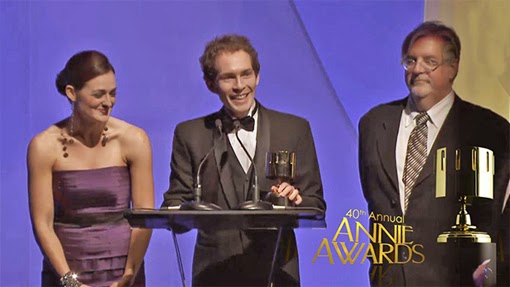
The Annie Awards ceremony is my favorite award show named after an orphan who was born without eyeballs.
Timothy Reckart, accepting his Annie Award for "Head Over Heels" (Photo source: Animation Magazine)

An Annie Award winner for Best Student Project (it was made at the National Film and Television School in the U.K.), Reckart's 10-minute film is both a dialogue-less and surprisingly affecting comedy about a strained marriage and a nifty sci-fi short story set in a bizarre and unexplained reality where the laws of physics are different from our world's laws of physics. So because of the reality the short takes place in, the biggest obstacle to communication between middle-aged Walter and his ex-ballet dancer wife Madge isn't the increasingly common problem of smartphone addiction. Instead, it's gravity.

Walter and Madge live in a floating house where Walter's ceiling is Madge's floor and her ceiling is his floor. We don't know what exactly caused their marriage to become strained or why they no longer share the same gravity. All we do know is that it's entertaining to watch them go about their day as if everything's normal in their topsy-turvy world.


Meanwhile, in our topsy-turvy world where special features, which, for a long time, have been the best part of a DVD or Blu-ray, are unfortunately becoming an endangered species because younger viewers prefer to stream movies instead of watching bonus-filled physical copies of them, Reckart's strategy of getting viewers to watch his short online is noteworthy. It's not just because of his wish to keep special features alive by treating viewers to a bunch of fascinating little extras about the making of "Head Over Heels" ("On the one hand, the death of DVD is great, because the physical production of DVDs has been a barrier to entry for short filmmakers like me. On the other hand, what happened to special features?," says Reckart). It's also because one of those bonuses is an audio-only featurette about film scoring--and it's almost three times longer than "Head Over Heels" itself, like how the documentary about the making of Superman Returns is much longer than Superman Returns itself (and a slightly more enjoyable film too, simply because of the moment when Kevin Spacey cracks up the film's crew with his Brando impression while audio of Brando as Jor-El is being played aloud on the set).


Any featurette about the film scoring process is worthwhile to me because I put strictly film and TV score music into rotation on my radio station, and I'm always interested in hearing about how that kind of music gets made. Film and TV scoring is a process not a lot of people understand or are aware of, even after the release of Forgetting Sarah Marshall, whose main character was a struggling (and way-too-frequently-naked) TV composer, so the audience saw a few scenes of him at work. Featurettes like the scoring discussion Reckart recorded with Jered Sorkin, his short's composer, are invaluable because they get those outsiders to understand the process.

I had only five questions for Reckart--whose prior stop-motion shorts include 2009's "Token Hunchback," a mockumentary about a Hollywood actor born with a hunchback--when I interviewed him over e-mail. That's because in the extras or in other interviews, he goes into so much detail about the animation process and the music that he basically answers all the other questions I had about the making of "Head Over Heels."

Friday, January 16, 2015

"Brokedown Merry-Go-Round" Show of the Week: Black Dynamite, "The Wizard of Watts," and Bob's Burgers, "Speakeasy Rider" (tie)

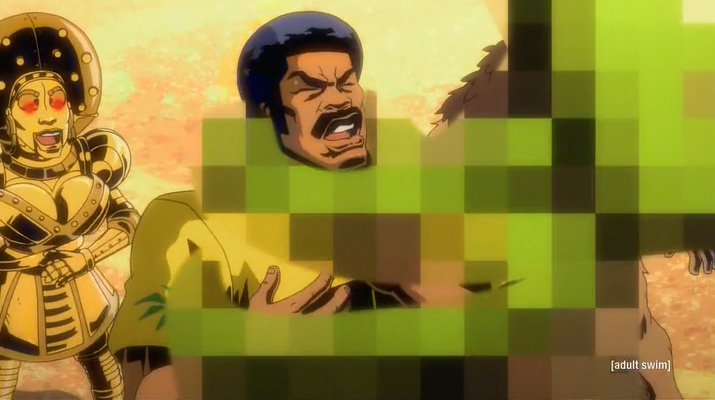
Black Dynamite vs. the IRS
On some Fridays, I discuss the week's best first-run animated series episode I saw. It's the "Brokedown Merry-Go-Round" Show of the Week. "Brokedown Merry-Go-Round," a two-hour block of original score tracks from animated shows or movies, airs weekdays at 2pm Pacific on AFOS.

Adult Swim's animated Black Dynamite is at its weakest when it's recycling sight gags from the 2009 film of the same name (which Black Dynamite star Michael Jai White co-wrote), like when the cold open of "The Wizard of Watts," the show's ambitious second-season finale, runs into the ground the film's funny absurdist gag where Dynamite's sexual prowess is so great he's able to give multiple women in the same bed orgasms at the same time. Dynamite may be able to get half the population of '70s L.A.'s hottest honeys off, but it doesn't get the finale off to a good start.

It's a crazy gag I liked so much during the film--because it makes no anatomical sense at all--that I kept hoping the animated version would never rehash it. But it ended up rehashing it, and not just in "The Wizard of Watts," but earlier in the second season as well. That's my biggest problem with the animated Black Dynamite or any other animated small-screen version of a live-action movie: there's no need to remind viewers of all the scenes we loved in the original (hell, it's also a problem with movies that are sequels to classic comedies, which is why I was relieved when White announced that his next movie with Black Dynamite director Scott Sanders will most likely be an unrelated comedy featuring White and his Black Dynamite co-stars as new characters instead of a Black Dynamite sequel). As kids, we enjoyed The Real Ghostbusters not because of the countless times Peter Venkman would get slimed by Slimer just like in the original Ghostbusters, but because of the effective ways The Real Ghostbusters expanded upon the Ghostbusters universe, thanks to the efforts of a pre-Babylon 5 J. Michael Straczynski as the show's story editor, as well as a few genuinely funny jokes that weren't in the 1984 film, like the moment when a demon opened a thick book that listed his least favorite creatures on Earth and he flipped past a page that said "Mimes." Re-establishing the animated show's connections to the original source material is just lazy writing, when time can be better spent coming up with new comedic material, like any moment where Dynamite finds himself literally tangling with the evil '70s kids' show puppet That Frog Kurtis (J.B. Smoove), an enjoyable antagonist who makes a long-overdue reappearance in "The Wizard of Watts" and is a character that the 2009 film would have been incapable of pulling off due to both budgetary and live-action limitations.

Podrick from Game of Thrones wishes he were this well-endowed.

The rehashed multiple-orgasm gag is a glaring misstep (this show is capable of coming up with cleverer ways to depict Dynamite's month of fighting and fucking), while the rest of the hour-long "Wizard of Watts" is the animated Black Dynamite at its best, whether it's demonstrating why White, who's otherwise known as a star of straight-to-DVD action flicks like the beautifully choreographed MMA fight film Blood and Bone, is a pretty skilled comedic actor (he doesn't overplay the humor) or offering a demented comedic spin on not-so-funny subjects like Donald Sterling's racist attitudes and racially motivated police brutality. The finale was written about a year before the nationwide furor over both Ferguson and Eric Garner's death at the hands of the NYPD (showrunner and episode co-writer Carl Jones' attempt to make the episode more up-to-date by dubbing in audio of Honey Bee saying "I can't breathe" during a riot scene screams out "last-minute"). "The Wizard of Watts" has to be one of the few pieces of television that made me laugh at something so wrong: the sight of Rodney King--he's depicted here as an orphan at the Whorephanage and referred to during the episode as "Little Orphan Rodney King"--getting a beatdown from cops. If you're uncomfortable with humor being mined from the sight of children getting beat up, stay away from "The Wizard of Watts." Honey Bee's big musical number in the episode has her slapping around unruly orphans at the Whorephanage with '60s Batman-style onomatopoeia filling the screen.

"The Wizard of Watts" presents what has to be the world's first parody of the '70s Broadway hit The Wiz. (Let's just forget the unsuccessful 1978 movie version with a badly miscast Sidney Lumet and an ill-suited-to-be-director Diana Ross existed. Get it? Because Diana Ross bossed around both Universal and Motown in order to become part of... Okay, you get it.) The episode jokingly refers to its vision of Watts-as-Oz as "the black version of The Wiz" and places Dynamite in the Dorothy role, a leg-humping, foul-mouthed poodle named Broto (rapper/Loiter Squad star/extraneous comma lover Tyler, the Creator) in the Toto role and the Wicked Bitch of the Westside (Tim Blake Nelson), a pig from the LAPD who's literally a pig, in the nemesis role. The musical numbers in "The Wizard of Watts," which are riffs on both The Wiz's show tunes and '70s hits like the Sugarhill Gang's "Rapper's Delight," exemplify why second-season composer Fatin "10" Horton has been a nice addition to the show: he's like a less family-friendly Weird Al, perfect for the animated Black Dynamite's profane--and according to Jones, "socially irresponsible"--brand of humor.

My favorite numbers in this episode are the ones based on "Don't Nobody Bring Me No Bad News"--Dynamite's chicken-and-waffles chef friend Roscoe sings about both the joys of "mixing Fiddle Faddle, chitlins and fondue" and his promise to "never bring you no fucked-up food"--and "Home." Yes, White himself attempts to sing this episode's version of "Home," without the aid of Auto-Tune to make him sound on-key, and it's one of the funniest things this show has ever done. White once explained in the 2009 Black Dynamite DVD's commentary that his performance in the film was intended to parody Jim Brown's stiffness as an actor, like Brown's visible discomfort with trying to look relaxed during a simple romantic scene like going out on a date (it's easy to forget that White was portraying an injured ex-football star portraying a blaxploitation hero, and the stoic demeanor was partly due to his injured neck). On the animated Black Dynamite, White is committed to making Dynamite sound uncomfortable with any other moment where he has to show some vulnerability--is there anything more vulnerable-looking than singing in public?--and that commitment pays off hilariously here when Dynamite has to sing to get back home. This is what I mean when I say White is a skilled comedic actor. He doesn't treat the material like it's comedy. He treats it like it's any other dead-serious action flick he's starred in and lets the comedy come to him, just like how Dynamite lets the women come to him. Part of that is probably due to Jones' additional work as the show's voice director (I bet the direction Jones gave to White for Dynamite's musical number--or maybe White thought of it himself--was "Sing it like how Jim Brown would have sung it," which is perfect). Erykah Badu, who reprises her recurring role as Whorephanage employee Fatback Taffy (named after the Jill Scott jam, perhaps?) in "The Wizard of Watts," once praised Jones as a voice director and said he's an actor's director who "helps us bring the best out of our characters to leave us room to create who they are."

I was initially worried when Black Dynamite switched from Titmouse Inc. to MOI Animation for the animation work this season. But MOI ended up being a great substitute for Titmouse, and the Korean studio's work on "The Wizard of Watts" resulted in a remarkable-looking finale, a swirly, mindfucky '60s psychedelicization of a '70s Broadway musical that's being retold through 2015 eyes. The clips of past Black Dynamite episodes that are shown during Dynamite's climactic musical number lend "The Wizard of Watts" a sense of finality, not just as a last episode of the season (by the way, the episodes about Roots, Bob Marley and Bill Cosby were my favorites from this season) but as a possible last episode of the show as well. A third season for Black Dynamite hasn't been announced by Adult Swim yet, and if this is indeed the last episode of Black Dynamite, "The Wizard of Watts" is a hell of a way to go out. But part of me feels like the show still has more work to do. There are a lot more stories for Black Dynamite to tell and a lot more subjects from the forever-lampoonable '70s to lampoon or humorously tackle--or rather, a historically inaccurate version of the '70s that's as intentionally and amusingly inaccurate as Everybody Hates Chris and The Goldbergs' respective depictions of the '80s, although Jones' decision to give legendary Asian American Soul Train dancer Cheryl Song a fobby accent in the American Bandstand-vs.-Soul Train episode "American Band Standoff" really bugged me (she doesn't have an accent, bruh). I'm surprised that the show hasn't riffed on the 39-year-old Rocky franchise--which, by the way, will pair up Sylvester Stallone with Michael B. Jordan as both Apollo's grandson and Rocky's protégé in a spinoff movie tentatively titled Creed--because Tommy Davidson, who voices Cream Corn, does the best Stallone impression in the game. The way Davidson nails how white actors like Stallone shout when their characters get angry always kills me. I really wish the show found an opportunity for Davidson to trot out that comedic trump card of his.


And as long as police brutality or the microaggressions within something like New York Times TV desk moron Alessandra Stanley's treatment of Shonda Rhimes continue to be problems, we'll always be in need of satirical takes on these problems from unapologetically black shows like Black Dynamite. Towards the end of "The Wizard of Watts," Dynamite, who usually settles things with violence, finally manages to defeat the Wicked Bitch of the Westside--he melts to the ground, of course--after he chooses to handle the Wicked Bitch in a way that's completely different from how he usually handles his adversaries. Dynamite figures out that "the only way to defeat a crooked pig is to catch him on tape." The scene reminded me of "Oskar Barnack ∞ Oscar Grant," a great 2011 track about responding to police brutality by Blue Scholars (the duo of Prometheus Brown, one of hip-hop's wittiest Filipino American rappers, and producer Sabzi, who's currently killing it as the producer half of another duo, Made in Heights). "Oskar Barnack ∞ Oscar Grant" calls for regular citizens to use cameras as their weapons against racist cops ("Shoot the cops/Shoot the cops/Shoot the cops/Take your cameras out your pocket, people"), and Dynamite kind of does the same thing when he defeats the Wicked Bitch, but he arrives at that decision to use a camera without speechifying about it, which would have been beneath this show. If someone told me 10 years ago that Adult Swim would become a haven for largely experimental, sharply written and sometimes socially conscious comedy from black folks, whether it's a scene like that one between Dynamite and the Wicked Bitch or a show like Black Dynamite, Jones' previous show The Boondocks, Tyler and Odd Future's Loiter Squad, Black Jesus or The Eric Andre Show, I would have said, "Sure, when cops fly."


***

Days of Blunder
"Speakeasy Rider" is a strange case where Bob's Burgers borrows from some of the staff writers' favorite sitcoms but never once feels derivative or tired. It's also a case where the episode title recycles a pun. "Speakeasy Rider" is the second Bob's Burgers episode to play around with the title Easy Rider, after "Ear-sy Rider." Not even that is tired. It's Bob's Burgers. It can get away with it--for now.

The story of siblings becoming Williams sisters-style rivals in the same sport is a familiar one. "Lisa on Ice" is one of my favorite Simpsons episodes because of its outstanding gags about the lunacy of Springfield's citizens, represented in "Lisa on Ice" by their bloodthirsty attitudes about hockey, and its poignant look at the relationship between Bart and Lisa. "Speakeasy Rider," which centers on Tina and Louise's rivalry as go-kart racers (their racing scenes are impressively animated, under the direction of Jennifer Coyle) and was written by Rich Rinaldi, contains a tension-filled dinner table scene between the sisters that's reminiscent of the "I won't have any aggressive condiment passing in this house!" scene in "Lisa on Ice." Even the ending is similar to the outcome of Bart and Lisa's conflict on the hockey rink. And the B-story of Bob and Linda trying to sneak Teddy's surprisingly good home-brewed beer past the tenacious eyes and noses of health inspectors Hugo (Sam Seder) and Ron (Ron Lynch) is essentially one of those old Cheers stories where the bar has to pretend everything's normal while it's operating without a liquor license or the bar has to pretend it's a gay one.

But "Speakeasy Rider" is unmistakably Bob's Burgers all the way, which means it's weird, weird, weird--like when Tina has conversations with her go-kart or when H. Jon Benjamin and Robert Ben Garant ad-lib an awkward picnic moment between Bob and Garant's biker character Critter--as well as warm and affecting in the least expected of places and consistently funny. The day when Bob's Burgers stops being this consistently funny is going to be a sad one, as sad as a burger without buns, unless Loren Bouchard and his crew manage to avoid shark jumping or, to borrow some racing lingo, they end up sandbagging the competition.

Linda gets all her business ideas...

... from '30s movies on TCM.

Thursday, January 1, 2015

Throwback Thursday: The Simpsons Movie

You know you're inside a San Francisco movie theater when villains like the bad guy during The Simpsons Movie get hissed at by the audience.
Throwback Thursday begins today, the first day of the new year, on the AFOS blog. Every Thursday in 2015, I'll be randomly pulling out from my desk cabinet--with my eyes closed--a movie ticket I saved. Then I'll discuss the movie on the ticket and maybe a little bit of its score, which might be now streaming on AFOS.

Much of why 2007's The Simpsons Movie succeeds as both a Simpsons story and a movie is because the movie's writers, a murderers' row of veteran Simpsons scribes (including reclusive former Simpsons writer John Swartzwelder), didn't recycle too much material from its TV counterpart like one of the first genuine blockbusters based on a TV show, 1979's Star Trek: The Motion Picture, so boringly did. Sure, longtime Simpsons gags like Homer choking Bart, the chalkboard gag during the TV version's opening titles and Mr. Burns releasing the hounds are revisited in the movie, as is the light drama of the marital challenges Marge must deal with while living with the perpetually lazy man-child that is Homer, a thread that's been a part of the long-running animated show since 1990's "Life on the Fast Lane." But not once does The Simpsons Movie feel like a tired rehash of the show's greatest hits in the same way that Star Trek: TMP was a rehash of Kirk's battle of wits with a rogue space probe in the classic Trek episode "The Changeling"--or that many Simpsons episodes after season 8 (the show's last consistently great season) have been rehashes of plots from earlier episodes.

It helps that the story in The Simpsons Movie, which FXX included as part of the unprecedented 12-day Simpsons marathon that revived media interest in the show last summer, is both a story that The Simpsons, despite its post-season 8 habits of repetition and derivativeness, hadn't previously done and an ideal one for the scope of the big screen: Homer's clueless treatment of the environment gets Springfield into trouble with the EPA. But when the agency intervenes and makes an already crummy town an even crummier existence for the town's citizens--Simpsons creator Matt Groening and his fellow Simpsons Movie screenwriters enclosed an entire town in a giant dome two years before Stephen King did the same in his novel Under the Dome, which King actually first tried to write back in the '70s--an exiled, on-the-lam Homer must undo the damage he's done and save Springfield. Another bit of storytelling in the movie that the show hadn't done before was a surprisingly affecting subplot where Bart, tired once again of Homer's antics, considers adopting the kindly and deeply religious Flanders as his new father figure. Screw all those Squishees, Buzz Colas and Duff energy drinks Simpsons fans flocked to 7-Eleven for when the convenience store chain temporarily converted some of its stores into Kwik-E-Marts to promote The Simpsons Movie. What I really wanted more than any of those items was the cup of cocoa Flanders makes for Bart.


Both longtime Simpsons episode director David Silverman, who directed The Simpsons Movie, and the movie's writers clearly wanted to craft a large-scale comedic blockbuster in the mold of The Incredibles, Galaxy Quest and Ghostbusters (in fact, The Simpsons Movie's chief villain, voiced by frequent Simpsons guest star Albert Brooks, is an EPA employee, much like the main antagonist in Ghostbusters). They largely succeeded at crafting such a blockbuster. They went bigger and bolder with the action and the humor (many of my favorite sight gags in the movie, like the wide shot of the churchgoers in Rev. Lovejoy's parish and the customers in Moe's Tavern switching places, make clever use of the widescreen, thanks to Silverman being inspired by the widescreen compositions of It's a Mad, Mad, Mad, Mad World and Bad Day at Black Rock), but without neglecting the irreverence and sharp social satire of many of the show's funniest half-hours, whether it's 1997's "The Itchy & Scratchy & Poochie Show" or "Homer Badman," the 1994 episode that, in one of my favorite Simpsons sight gags, turned Gentle Ben into a daytime talk show host. A great example of The Simpsons Movie's sharp social satire is an eerily prescient gag about NSA surveillance of phone calls, which is especially eerie and funny nowadays due to the NSA scandal.

The Simpsons is a breeding ground for writers with an uncanny knack for predicting the future, whether it's The Simpsons Movie's NSA scene or Conan O'Brien's 'In the Year 2000.'Moments like that NSA scene or the church and bar gag bring us back to why we fell in love with The Simpsons in the first place and why we still catch the show on Fox from time to time, despite its many post-season 8 missteps, whether it's the show inanely revealing Principal Skinner to be an imposter or more recently, the Comic Book Guy getting married to a one-dimensional, clichéd-as-fuck Japanese geek girl (an ugly and unattractive white guy hooking up with a hot Asian woman: yeah, I haven't seen that before) or the show's bizarre attachment to Hank Azaria's increasingly dated character of Apu. That character really ought to be retired from the show ever since Simpsons fan Hari Kondabolu sparked an insightful discussion about why The Simpsons' primary Indian character is a tiresome stereotype and a "weird relic from another era" when his humorous Totally Biased with W. Kamau Bell rant about Apu went viral ("A white guy doing an impression of a white guy making fun of my father! If I saw Hank Azaria do that voice at a party, I would kick the shit out of him!"), and Azaria surprisingly agreed with Kondabolu's criticisms.

The Simpsons Movie is as close as Simpsons co-executive producer James L. Brooks--who, outside of The Simpsons, is best known for smaller-scale, character-driven fare like The Mary Tyler Moore Show, Taxi, Broadcast News and As Good as It Gets--has gotten to making a crowd-pleasing action comedy. Brooks had more creative input in The Simpsons Movie than in more recent seasons of the show: for instance, he chose Hans Zimmer, his musical collaborator from the 1994 fiasco I'll Do Anything, As Good as It Gets and Spanglish, over longtime Simpsons series composer Alf Clausen for the task of composing the movie's score. Zimmer took Danny Elfman's Simpsons theme and etched out of it a charming new motif for Homer, the movie's most significant and memorable composition that's not "Spider-Pig." While I would have wanted to hear Clausen work his usual magic on The Simpsons Movie, Zimmer did a solid job musically bringing the characters to the big screen. (By the way, one Simpsons character who didn't make that jump to the big screen and should have was Rainier Wolfcastle, the star of the hilariously over-the-top McBain action flicks the Simpsons were frequently seen watching in the show's earlier seasons. The absence of McBain, a character I would have loved to have seen on the big screen, is the movie's biggest misstep. Rainier was replaced in the movie by a presidential version of the action star Rainier was a parody of, Arnold Schwarzenegger, voiced not by the former Cully-forn-ya governor himself but by Rainier's usual alter ego Harry Shearer.)

Brooks also directed the movie's voice actor recording sessions, something he hadn't done since The Simpsons' earlier seasons. His input, which veteran Simpsons writer Jon Vitti once noted was crucial in making the beloved 1991 episode "Lisa's Substitute" resonate with viewers, is most evident in the movie's most emotional moments, particularly a videotaped farewell message from Julie Kavner's quietly anguished Marge to Homer. "We were really trying to get to a woman who is completely broken and her spirit is defeated. I got there I guess by breaking the actress' spirit. She worked so hard at it and she wanted it to be as good and that's also a big impact Jim had on that whole scene," said Simpsons Movie co-writer Mike Scully to the Canadian site MoviesOnline in 2007. Kavner reportedly did between 100 and 150 takes for Marge's video message scene. The take that was used in the movie is perhaps her most sublime moment as a voice actor.

Homer finds himself reliving a Jack London story, like whatever the fuck that story was that starred Ethan Hawke.

The perfectionism Silverman, Brooks and the writers aimed for in The Simpsons Movie's voice acting was also evident in the movie's outstanding animation work, which was divided among four different studios, including Film Roman, the primary animation studio for The Simpsons since its fourth season. Groening grumbled in 2013 that "[the movie] took us four years [to make] and it killed us." So it's unlikely we'll ever get that Simpsons Movie sequel Maggie was hinting at in the movie's end credits. But if the Simpsons characters' appearances on the big screen are limited to terrific theatrical shorts like 2012's Oscar-nominated Maggie solo short "The Longest Daycare," which Silverman also directed, then I don't mind the lack of a second Simpsons feature film.

"I can't believe we're paying to see something we get on TV for free. If you ask me, everybody in this theater is a giant sucker, especially you!," says Homer from his movie theater seat as he breaks the fourth wall at the start of the movie. Yes, Homer, you're a bit right. All of us who flocked to The Simpsons Movie in the theaters back in the summer of 2007 were giant suckers. But the still-funny Simpsons Movie is hardly a sham.

Selections from Hans Zimmer's Simpsons Movie score can be heard during the animation music block "Brokedown Merry-Go-Round," weekdays at 2pm Pacific on AFOS.