 |
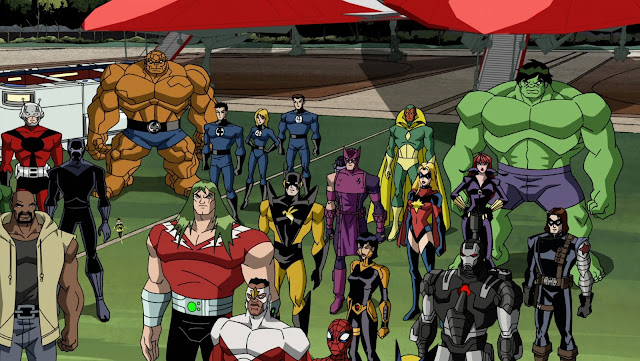
| With that hairdo, Falcon looks like he's about to sing backup on "If I Ever Fall in Love" with Shai. (Photo source: Marvel Animation Age) |
Every Wednesday in "5-Piece Cartoon Dinner," I dine on five of the week's most noteworthy animated cable shows that are found outside my Adult Swim comfort zone. The episodes are reviewed in the order of when they first aired.
These days, I'm more of a
Doctor Who fan than a
Star Wars fan. That's mainly because unlike
Star Wars,
Doctor Who took a huge leap in quality--ever since
Queer as Folk creator Russell T. Davies revived the long-absent show in 2005. Instead of mistakenly thinking that visual effects and spectacle are the only elements that deserved an upgrade, Davies and his fellow writers, including his eventual replacement Steven Moffat, also worked on upgrading the writing and acting on
Doctor Who. They added a new layer to The Doctor's character (in the form of the PTSD and survivor's guilt that Christopher Eccleston's Doctor suffered from due to the off-screen "Time War"), they frequently delved into why The Doctor is the way that he is and they made The Doctor's new companions fully realized characters instead of one-dimensional sounding boards for him like in most of the show's pre-Ace years (some hardcore fans might disagree and have dismissed most of the new female companions as lazily written Mary Sues, especially Billie Piper's Rose Tyler, who was in love with The Doctor and was clearly a stand-in for the openly gay Davies, even more so than omnisexual Captain Jack).
I've avoided watching Cartoon Network's CG-animated
Star Wars: The Clone Wars because it focuses on the characters from the dreadful prequel trilogy--those three movies are among the greatest examples of when a style-over-substance approach goes wrong--and it's not supervised by animator Genndy Tartakovsky, whose cel-animated, nearly dialogue-less 2003
Clone Wars prequel to
Revenge of the Sith was more satisfying than any of the three live-action prequels (why Lucasfilm didn't ask Tartakovsky back for another round of
Clone Wars continues to boggle the mind). But when Peter Mayhew reprised his role as Chewbacca in the 2011 episode "Wookiee Hunt," I finally tuned in, out of love for the first two
Star Wars flicks.
I ended up enjoying "Wookiee Hunt," not just because of Chewie's presence, which briefly helped turn
The Clone Wars into the
Star Wars I grew up with and remember fondly, but because the
Clone Wars character Chewie interacted with, plucky Jedi trainee Ahsoka Tano (
Ashley Eckstein), had a spark to her that was missing from the boring characters in the live-action prequels. Still, "Wookiee Hunt" wasn't enough to make me a regular viewer of
The Clone Wars, which is spearheaded by supervising director Dave Filoni instead of Tartakovsky. I continued to be uninterested in the show until Lucasfilm announced that former
Doctor Who star David Tennant was the guest star in this week's "Test of Strength" episode, which pits Ahsoka and a pack of Jedi younglings (the most badass of the youngling group?:
the Wookiee kid) against Hondo Ohnaka (a
Ricardo Montalban-inspired Jim Cummings), a space pirate who attempts to steal the younglings' lightsaber crystals.
What a casting coup, right?
Some Doctor Who fans feel that Tennant is wasted in his role as Professor Huyang, a wise old droid who designs lightsabers for the Jedi (Tennant signed up for a three-episode arc, by the way, so yay, more Tennant), because the synth effects the show uses to transform Tennant into a droid obscure Tennant's voice too much. But I've had no problem recognizing Tennant's voice. I even had flashbacks to his days as The Doctor when Huyang instructed the younglings with "Reverse the polarity of the neutron flow"-esque technobabble like "You have inverted the emitter matrix, which will cause the power grid to backfire."
I'm still not sure yet if "A Test of Strength" and the two episodes that are left in this four-episode youngling arc will totally convert me to Filoni's
Clone Wars (which is now in its fifth season and like
M*A*S*H, it will end up lasting way longer than the three-year war it's been depicting, if
recent speculation that the Disney/Lucasfilm deal will call for Lucasfilm to produce future
Clone Wars episodes for Disney XD ends up becoming true). But because charismatic Ahsoka is the focus of this arc instead of stuffy young Obi-Wan Kenobi or Ahsoka's not-yet-corrupt master Blandakin Skywalker, I'm interested in how Ahsoka will pull herself out of her current predicament, in which she's captured by Hondo, whose plans for Ahsoka and her body are perhaps not-so-TV-PG-friendly. And if the action sequences continue to be as nifty and engaging as the engine momentum trick Ahsoka comes up with in "A Test of Strength" to eject the pirates from her ship Ellen Ripley style, perhaps the reports from lapsed
Star Wars fans that the franchise has been dead since Tartakovsky's
Clone Wars have been greatly exaggerated.
***
After 52 episodes, the cartoon that began when "there came a day unlike any other" calls it a day. In "Avengers Assemble!" (also the title of Marvel Animation's next show featuring the Avengers team),
The Avengers: Earth's Mightiest Heroes ends its two-season run by pitting the team--as well as the rest of the New York superhero community--against one of Marvel's most giant-sized adversaries, the planet-eating alien god Galactus, a threat Captain America was first warned about earlier this season in
"Prisoner of War," an episode that was a series highlight. "Prisoner of War" was also a better-executed summation of the series' mission statement (disparate personalities who should have no business being in the same room together are forced to unite against threats bigger than themselves) than "Avengers Assemble!"
However, I like what "Avengers Assemble!" writer and series story editor Christopher Yost does here with Iron Man at the start of "Avengers Assemble!," and it's remarkable that Yost is able to insert a moment or two of character depth with Tony, considering how little time Yost has in this action-packed series finale. The Avengers leader has been feeling worn-out from the onslaught of recent villains and has lately been worried about how history will remember him and the rest of the team after they're gone (when one of those recent foes is
a master of mind control who turned you into a fascist who used your inventions against the world, of course you'd start to undergo an existential crisis). Then Tony gets an answer to his question of "How will we be remembered?" in the form of heralds who represent a mute alien stranger named Galactus. They arrive to stir up lots of calamitous shit on Earth so that their ginormous master will be able to devour our planet like a barbecued rib.
 |
| (Photo source: Marvel Animation Age) |
While "Avengers Assemble!" plays to the series' two biggest strengths (efficient storytelling, which Yost often excels at, and action sequences that are even more epic than the ones in Joss Whedon's live-action version) and treats us to several strikingly animated mini-battles between smaller three-person teams of heroes and Galactus' heralds, I'm not so enamored with the way the episode rushes through the Galactus crisis. "Avengers Assemble!" is a victim of Marvel Animation's mistake of tinkering with
Earth's Mightiest Heroes' preference for longer storylines and forcing the show to do more standalone episodes.
The choice of Galactus as the adversary is a great one for the series finale, but one can't help feeling throughout "Avengers Assemble!" that more could have been done with Galactus. "This isn't some supervillain or would-be conqueror. This is different. This is a force of nature," observes Mr. Fantastic (Dee Bradley Baker), and Galactus' calamitous assault on Earth would have been better suited for a two-or-three-part story instead of a standalone. The sense of danger is diminished when you try to cram the war against Galactus into a 22-minute finale.
Justice League Unlimited, DC Animation's
Earth's Mightiest Heroes counterpart, had a more satisfying series finale, simply because storylines like its series-ending Darkseid arc were allowed to take their time and breathe on that show (also,
JLU's characters were a lot wittier, which is surprising because Marvel is often better at witticisms than DC).


