Showing posts with label How to Train Your Dragon. Show all posts

Monday, July 21, 2014

So about that night when Sony Korea accidentally posted all of The Amazing Spider-Man 2 on YouTube…

This picture would be even more awesome if sad Spidey were doing this in the shower, with his suit and mask still both on, and 'Everybody Hurts' was playing.
(Photo by Russell McGovern, @pressthebigredbutton on Flickr)

Someone at Sony Korea is definitely getting both a J. Jonah Jameson-style tongue-lashing and their walking papers for this.

On Saturday night, podcaster and Portland Mercury blogger Bobby Roberts and a bunch of others pointed out on their Twitter feeds that Sony Korea's YouTube account accidentally posted The Amazing Spider-Man 2 in its entirety for free. Well, not all of the movie. The full upload, which Sony Korea immediately removed from YouTube once they realized the screw-up, was missing the mid-credits ad for X-Men: Days of Future Past. Amazing Spider-Man 2 director Marc Webb had to slip the Days of Future Past ad into his film's end credits in order to fulfill an obligation to his contract with Sony rival and Days of Future Past distributor 20th Century Fox.
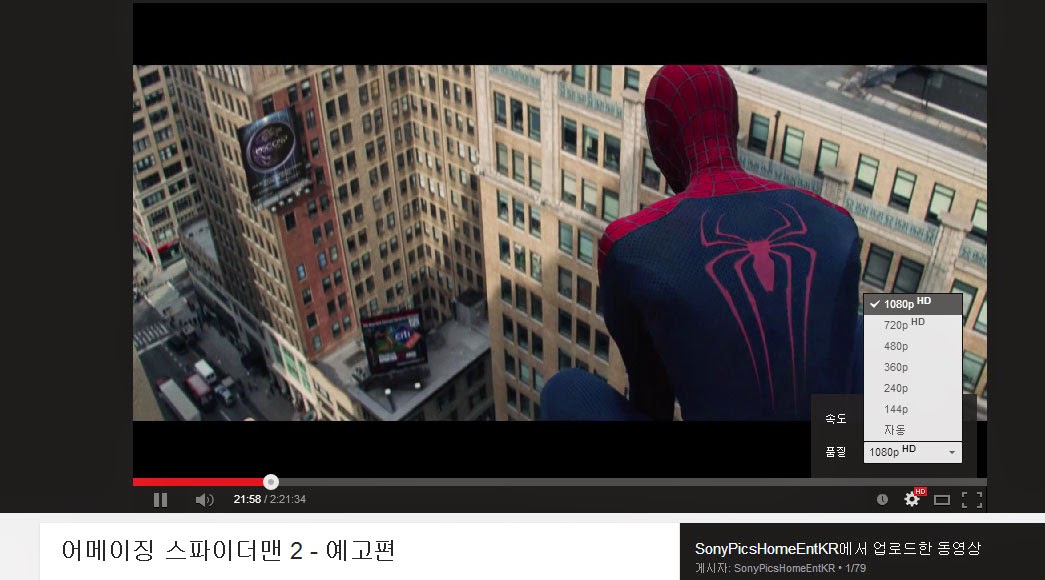
Here we see Spidey doing his best impression of Superman creepily stalking Lois during Superman Returns.
(Photo source: OneHallyu)

The Amazing Spider-Man 2 was an overstuffed and disjointed mess that was difficult to sit through for much of its bloated running time of two hours and 22 minutes, so I was in no mood to rewatch the entire movie right below Roberts' tweet, which he deleted when Sony Korea removed their accidental upload. And nope, not even skimming through the upload of Amazing 2 to revisit only my favorite scenes (and a few of my least favorite) improved the movie, which has become Sony's lowest-grossing Spider-Man movie in America (Sony studio execs' dissatisfaction with the sequel's U.S. box-office performance has caused them to put the kibosh on the studio's plans to do both a threequel and supervillain spinoff movies centering on the Sinister Six and Venom). This second (and this time, only partial) viewing of this extremely corporate product (as ScreenCrush's Britt Hayes tweeted, the movie "looks like it was made to sell pinball machines") failed to erase its flaws (SPOILERS), including...

The two Webb movies' misguided decision to make Peter Parker the Chosen One

Much of the original appeal of the character stemmed from Peter becoming a superhero by accident. When you make Peter a predestined hero like Harry Potter or Superman, you make him less of a relatable everyman. And who cares about all the boring new material about Peter's attempt to uncover the truth about both his dead but could-be-alive scientist/secret agent dad (Campbell Scott), who experimented on Peter and planted the seed for Peter receiving his powers, and his extremely dead secret agent mom (Embeth Davidtz)? (Why do I feel like Amazing 2 co-screenwriter Roberto Orci's bizarre adoration of Dubya the pampered Bush son was responsible for this shit, even though it was carried over from The Amazing Spider-Man, which Orci didn't co-write?)

Sony's inane attempts to build its own Marvel Cinematic Universe out of Webb's movies

Amazing Spider-Man movie universe, you may think you're the Marvel Cinematic Universe, but Amazing Spider-Man movie universe, you're no Marvel Cinematic Universe. Sony's postponement of the threequel and those baffling Sinister Six and Venom projects makes me hope that the postponement takes so long it causes Sony to lose the movie rights to Spidey and hand them over to Marvel Studios. For starters, Amazing Spider-Man movie universe, you have to have interesting villains on a par with Tom Hiddleston's charismatic Loki, which you don't. Speaking of which...

The overabundance of supervillains

Amazing 2 actually isn't a bad movie--that is if some nerd with a lot of time on his hands assembles a "Phantom Edit" of the movie and digitally replaces Jamie Foxx's obsessed Spidey fan character with Foxx's equally beaten-down but much less cartoonish character from Collateral. An even better "Phantom Edit" would be the removal of all material about Electro, Oscorp, the Green Goblin, that Michael Massee character who dresses like all those douches who always wore fedoras in high school and that Marton Csokas mad scientist character who's like a reject from Joel Schumacher's terrible Batman movies. Superhero movie writers and directors still haven't learned anything from the mistakes of those Schumacher Batman movies and other equally overcrowded and excessive superhero movies like Iron Man 2, X-Men Origins: Wolverine and of course, Spider-Man 3.

Part of why Sam Raimi's first two Spidey movies are superior to Webb's is because of their tautness: they pitted Spidey against only one villain in each movie. Like I've said before, Spidey's rogues gallery really pales in comparison to Batman's. I'll take psychotic comedians/showmen (Joker and Harley) and psychologically complex criminals (the Batman: The Animated Series version of Two-Face) over boring, one-dimensional monsters like the Lizard and Electro any day. So why did Sony have to subject us to five of those boring antagonists like they did when they awkwardly shoehorned an equal amount of antagonists into Spider-Man 3? Again, they learned nothing.

The inability to be moved by Gwen Stacy's death

Webb, the director of (500) Days of Summer and countless music videos, excels at two things in these Amazing Spider-Man movies. One of them is any moment where Spidey, whom I'm glad to see has regained his sense of humor after Tobey Maguire's less quippy portrayal, interacts with other New Yorkers, particularly the bullied little kid whose science fair project Spidey takes a shine to. (Spidey's scenes with kids he rescues are where Andrew Garfield--who's oddly derided for not being dorky enough by Spidey comics readers who have somehow developed amnesia about Brian Michael Bendis and Mark Bagley's depiction of a modernized, '60s sweater vest-less Peter in their acclaimed Ultimate Spider-Man comics--is at his best as Spidey. The fact that Garfield would like to see Miles Morales--who famously caused the repugnant Lou Dobbs to soil his Depends because of his biracial heritage and is the second Spidey of color in the comics--suiting up as Spidey in live-action form makes me like Garfield even more.)

Gwen Stacy gets a makeover from Prince like the one he gave to Zooey Deschanel in New Girl's Super Bowl episode.

The other thing Webb excels at is the romance between Peter and Gwen, a more entertaining on-screen relationship than the one between Peter and Mary Jane in the Raimi movies. Amazing 2's unsatisfying story isn't the only reason why its B.O. grosses are lower than those of other Spidey movies. Killing off Emma Stone, the most likable and interesting cast member in Webb's reboot, has a lot to do with its underwhelming B.O. as well. The moment when Gwen's back and head hit the floor made me wince, mostly due to its brutal sound FX, yet this classic angsty moment from the comics that was supposed to raise the reboot franchise's dramatic stakes and shock the audience ended up hampering post-opening weekend word-of-mouth and was oddly unmoving. As Kyle Buchanan noted in Vulture, the film's decision to rush through Peter's depression after failing to save Gwen robs her death of its dramatic impact, whereas Stoick's death and the impact it has on everyone else--not just his son Hiccup and his wife Valka--are better handled in How to Train Your Dragon 2 and therefore, far more moving.

I'm a cold fish. I don't cry during sad movies. But How to Train Your Dragon 2 got me emotional. Dammit, How to Train Your Dragon 2! Instead of weeping and tearing up, my bottom lip tends to tremble like Clint Eastwood's in his "I could have taken that shot" crying scene during In the Line of Fire. When How to Train Your Dragon 2 cut to Hiccup and Astrid's friends mourning Stoick at his Viking funeral and being genuinely serious instead of being their usual comic relief selves, my bottom lip went crazy. The lip didn't quiver once during the cemetery sequence in Amazing 2.

The cheesy "Itsy Bitsy Spider" scene

The most Spider-Man 3-ish--and Schumacher-ish--part of Amazing 2 has to be the source cue by Hans Zimmer and "the Magnificent Six" (a collective that included Pharrell Williams and Johnny Marr) for when Electro plays "Itsy Bitsy Spider" on giant Tesla coils while battling Spidey. It results in the Garfield one-liner that's most reminiscent of the terribly written comedic bits from Disney XD's Ultimate Spider-Man animated series ("I hate this song!"). The other cheesy element of the Zimmer/Magnificent Six score is...

Electro's equally cheesy theme

The nu metal chanting that's supposed to represent Electro's inner dialogue ("He lied to me/He shot at me/He hates on me/He's using me/Fragility/Electricity/He's dead to me") brings back memories of Zimmer's horribly dated, Limp Bizkit-inspired nu metal score to 2000's Mission: Impossible II. (And then that M:I-2 score brings back memories of Will Sasso's brutal impression of Fred Durst on MADtv.)

The Zimmer/Magnificent Six score is a mixed bag, but it also contains the best thing to come out of Amazing 2: "It's On Again," the surprisingly good original theme by Zimmer, the Magnificent Six, Alicia Keys and Kendrick Lamar. Kendrick goes hard in his verse. It's one of many tremendous guest verses from Kendrick.


"It's On Again" marks the first time that an end credits tune in a Spidey movie doesn't suck (and man, has this franchise suffered from such atrocious-sounding pieces of music).

The Zimmer/Pharrell/Alicia/Kendrick tune deserves to conclude a better movie, like the one with Miles--and not Peter--in the Spidey suit that's currently playing in my head or the one with an Asian hero in the suit that's also currently playing in my head.

Any character that disgusts and repulses Lou Dobbs is the fucking illest in my book.

Friday, June 13, 2014

"Brokedown Merry-Go-Round" Show of the Week: Dragons: Riders of Berk, "How to Pick Your Dragon" (from October 10, 2012)

'Sit, Ubu, sit. Good dog.'
(Photo source: Berk's Grapevine)
"'Brokedown Merry-Go-Round' Show of the Week" is in reruns all this June. "Brokedown Merry-Go-Round," a two-hour block of original score tracks from animated shows or movies, airs weekdays at 2pm Pacific on AFOS. "'Brokedown Merry-Go-Round' Show of the Week" will return later this summer with all-new reviews of animated series episodes.

I'm a fan of animated comedy shows made for adults like Rick and Morty, The Venture Bros. and most of the first three seasons of The Boondocks. They're examples of shows that are taking animation back for us adults (American animation started out as being originally for grown-ups; an example of its adult-oriented roots was the Fleischer Brothers' Betty Boop franchise, which began as a risqué series of shorts and then thanks to the Hays Code, turned into a family-friendly and bland-as-shit one). I hate using the word "cartoon" to describe Rick and Morty and The Venture Bros., so I don't do so anymore. "Cartoon" connotes childishness, and the writing on Rick and Morty and The Venture Bros. is far from childish. I'm not so much a fan of animated shows for kids, so I spent about a year of writing reviews of kids' animation as a writing exercise to see if my patience would wear thin. It eventually did wear thin, but I did discover a few decent kids' shows along the way, like Dragons, the TV version of DreamWorks Animation's best feature film to date, the original How to Train Your Dragon.

Because How to Train Your Dragon 2 opens this week, the "Show of the Week" is the most celebrated episode of Dragons, which will move from Cartoon Network to Netflix for its third season in 2015. The episode, which I wrote about in 2012, went on to win two Annie Awards, one of which was for score music composed by John Paesano, who took over for How to Train Your Dragon composer John Powell.

Most family films put me to sleep, but How to Train Your Dragon didn't because it was so imaginatively directed and well-written, even during the "inflexible father learns to better understand his progressively minded son or daughter" trope that's present in so many family films. I'm a cold fish, so I don't get emotional during movies, but there's a quietly powerful moment involving that trope in How to Train Your Dragon that comes close to making me verklempt whenever I think back to it.

It takes place after Stoick the island chief lashes out at Hiccup because of his alliance with dragons and tells him he no longer considers him his son. Stoick walks away from Hiccup and has a moment to himself where, with just a pained and remorseful sigh from Gerard Butler and expressive facial animation by directors Dean DeBlois and Chris Sanders, we see how much it hurts Stoick to have said such dismissive words to his son. We've all experienced that shameful moment where we regretted saying or doing something so vicious and awful to a family member in the heat of an argument, and How to Train Your Dragon captured that pain so well without dialogue.

Except for a majestic flight sequence where Stoick is moved by his first aerial view of Berk, Dragons: Riders of Berk's lighthearted "How to Pick Your Dragon" episode doesn't contain a moment that's as dramatic as that non-verbal scene in the film where Stoick's hard-ass and macho authority figure demeanor briefly disappears, but it revisits in an equally effective manner Hiccup's difficulties in getting Stoick, who's so attached to "the Viking way," to better understand both him and "the dragon way." Hiccup is finally able to persuade Stoick that the dragon way simplifies and quickens arduous tasks and is relieved that his dad is now eager to take up dragon riding. However, he's not so pleased with Stoick using his dragon Toothless to practice his dragon riding, partly because carrying such a Chris Christie-sized Viking on his back for so long exhausts the undersized Night Fury (at one point, Toothless is so tired of dealing with Stoick that he hides away from him).

There's some great subdued character animation by "How to Pick Your Dragon" director Louie del Carmen during Toothless' scenes. Because Toothless' character design was based largely on cats, he's as emotionless as a feline, so del Carmen's ability to convey exasperated body language on a non-verbal and not-so-facially-expressive dragon is remarkable. He accomplishes it mostly through the animation of Toothless' eyes, which is fitting because as Hiccup attempts to point out to Stoick in this episode, eyes are one of the few tools in which humans and dragons can communicate with each other (is it me or does Hiccup sound like the world's first dating coach?).

"It's a father's job to listen to his son without ever letting on that he's heard a word," explains Gobber to Hiccup, who's frustrated by his dad's stubbornness, especially after Stoick prefers to train his new dragon Thornado through Viking-style physical intimidation instead of the eye contact, patience and gentleness that Hiccup's trying to teach him. At the end of the episode, Stoick defies what Gobber says about fatherly communication when he does let on that he's absorbed his son's lessons. But in keeping with the refreshing economy of words and emotion in How to Train Your Dragon and now on Dragons, which are both basically about the challenges of limited communication, whether it's between human and animal or human and macho Viking dad, Stoick simply admits to Hiccup, "I listen."

Monday, May 19, 2014

"I'm making a motion picture, not a jukebox": Excerpts from the five best recent articles involving film music

Reese Witherspoon's face after seeing the opening weekend grosses for This Means War
The following recent articles related to film music are must-reads.

"Pick Flick: An Oral History of Election, 15 Years Later" by Matthew Jacobs (May 7, 2014)

"[Alexander] Payne and [writing partner Jim] Taylor manage to fully develop their characters without sacrificing the cynicism and venom of their satire," I wrote back when Payne's 1999 cult classic Election was first released (Wayback Machine, I'm not going to like it, but take my ass back to an age of ugly HTML design!). Payne recalls battling with MTV Films to keep some of Rolfe Kent's original score from being ousted from Election, as part of a fascinating HuffPo oral history about the making of the Matthew Broderick/Reese Witherspoon political satire, still one of my favorite movies from the legendary movie year of 1999.

"I wanted some degree of Morricone in that score, and indeed we used some actual Morricone. Tracy's mental scream is stolen from a spaghetti Western. Even Quentin Tarantino told me later, 'Oh, I always wanted to use actual spaghetti-Western music.' You hear stolen spaghetti-Western music earlier than you do in any Tarantino film. I got there first. But it was a bit of a difficult situation with the record company that gave us a bunch of the rock songs that are in the film. Between MTV and the record label, they wanted a lot more. I remember the fight I had to go through to have the opening credits have score, not a rock song. It was de rigueur for movies to have some kind of rock song in the opening credits and end credits. I had to tell them I'm making a motion picture, not a jukebox."


***

It's basically the Species movies, but artsier and with lots of ugly-looking dongs!
"How indie musicians are reinventing film music" by David Ehrlich (May 12, 2014)

Over at The Dissolve, David Ehrlich deftly examines the growing wave of indie musicians bringing their talents to film scoring, and how it's resulted in either remarkable, experimental-sounding work (Daniel Hart's Ain't Them Bodies Saints score and Mica Levi's truly alien-sounding Under the Skin score) or unhappy work experiences like the Oblivion score, a collabo between Tron: Uprising composer Joseph Trapanese and a reportedly dissatisfied Anthony Gonzalez of M83. But I don't think the Oblivion score sounds as terrible as Ehrlich makes it out to be. Selections from the Oblivion score can be heard on "AFOS Prime" and "Hall H" on AFOS.

"Movies are challenging musicians to rethink how they write their music, and musicians are challenging movies to rethink how they use it. Now that projectors in most theaters hum with a quiet digital buzz rather than the stampeding clatter of celluloid, it sounds as if scores have finally begun to embrace a new purpose."


***

"Richard Ayoade's The Double, Amazing Spider-Man 2 and Movie Music That Cranks Up the Crazy" by Matt Patches (May 2, 2014)

Another smartly written piece of film writing praises recent cutting-edge score music, but this time, the article emanates from an unlikely source: the sexy sex advice site Nerve.com. Matt Patches explains at length why composer Andrew Hewitt's score for The Double, actor Richard Ayoade's latest directorial effort, excels at taking risks musically. Then Patches briefly points out why a similarly risky approach that Hans Zimmer and "the Magnificent Six" (a collective that included Pharrell Williams and Johnny Marr) brought to the Amazing Spider-Man 2 score doesn't succeed as effectively as Hewitt's effort does.

The risky element of the ASM2 score I'm referring to isn't the Kendrick Lamar guest verse at the start of "It's On Again," the sequel's Zimmer/Pharrell/Alicia Keys end title theme, a Kendrick guest feature I like, of course, because I'm a Kendrick fan. I'm referring to the love-it-or-hate-it, kind of dumb-sounding Electro chanting ("He lied to me/He shot at me"). But Patches gives the Magnificent Six some credit for trying something different.

"Zimmer's attempts to enliven the background with vocalization ultimately fails. Movies need more of failures like that. Spastic horror movies with hyper-editing and lighting of every color prove audiences can stomach directors maximizing each element of filmmaking. So why not music? The 21st century deserves cinematic tunes worth obsessing over (and if they're turned into disco tracks, so be it)."


***

"10 Things I Learned: Thief" by Curtis Tsui (January 14, 2014)

Ever wondered why at the end of Michael Mann's Thief, one-man killing machine James Caan mows down a bunch of mobsters to the tune of a ripoff of Pink Floyd's "Comfortably Numb"? Mann wanted to use "Comfortably Numb" but was unable to clear it, so he asked composer Craig Safan, who later became best known for writing the Last Starfighter score and all the incidental music on Cheers, to write and record a "Comfortably Numb" soundalike (it's called "Confrontation" on Tangerine Dream's Thief soundtrack album). The shootout music tidbit is one of 10 pieces of trivia about the making of the classic 1981 crime flick that Criterion Collection disc producer Curtis Tsui posted in a slideshow article to promote Criterion's recent Blu-ray release of Thief.

I hate slideshow articles, but I dig Thief so much that the slideshow format didn't bother me this time.

"As iconic as Tangerine Dream's electronic score has become, Mann himself still sometimes wonders whether it was the right choice for the film. He appreciates the abstraction of the music from a formal perspective, but his more intuitive inclination was toward the blues."


***

"John Powell on Five of His Notable Scores" by Steve Chagollan / "Billion Dollar Composer: John Powell Ranges from Action to Animation" by Jon Burlingame / "John Powell Plans Sabbatical from Movie Music" by Burlingame (April 23, 2014)

John Powell, who wrote perhaps his best score for How to Train Your Dragon (which can be heard on AFOS) and recently returned to DreamWorks Animation's popular franchise to score the upcoming How to Train Your Dragon 2, was the recent subject of a huge Variety profile. He recalled to the magazine why the score to John Woo's still-entertaining Face/Off, his first major credit, was both a good experience for him as a then-newcomer to Hollywood and one of his five favorite film music projects.

"The premiere was at the Mann Chinese; Hans (Zimmer) got me a limo. There was a big crowd, and as I got out of the limo, there was this sigh of disappointment when they realized that it wasn't John Travolta. I recommend this to all Hollywood composers. Within a small group of people, we may be well known, but it's not why people go to the movies."


Thursday, January 23, 2014

The ruthless and the Toothless: These are among the tracks I've added to AFOS rotation this month

'Lee! Rico! Youngblood! Find out where those drums are coming from!'
Ennio Morricone, "The Strength of the Righteous" (film version) (from The Untouchables; now playing during "AFOS Prime")

"I had an art director that I was working with and we kept looking at shadows. I got the idea that the shadows should be actually cast by the word. And the art director kept saying, 'It's boring,'" recalled Superman: The Movie title designer Richard Greenberg to Art of the Title about his noirish concept for the Untouchables opening titles. "Finally I just looked at him and said, 'It's supposed to be boring.' I wanted it to take its time."

"Boring"? Really? Because I've seen a few alternate Untouchables opening titles on the Internet that were made by Untouchables fans and are much more busy-looking than Greenberg's titles, and they just don't fit Brian De Palma's operatic crime flick like Greenberg's titles do. It's one of my favorite Greenberg intros, partly because of Greenberg's simple and elegant title design and the way it evokes the shadows of prison bars at the start of the sequence.

Here we see Frank Nitti threatening innocent lives late at night, or as George Zimmerman calls it, neighborhood watch.
(Photo source: Radiator Heaven)
But the main reason why those titles leave such an impact--without it, Greenberg's colleague might have been onto something about the titles being boring--is Ennio Morricone's propulsive "Strength of the Righteous." The main title theme, one of my favorite Morricone main title themes, establishes the steadfastness of Eliot Ness and the Untouchables while introducing another motif. The harmonica was the instrument of choice for Charles Bronson's vengeance-seeking protagonist Harmonica in the Morricone-scored Once Upon a Time in the West, but in The Untouchables, Il Maestro used the harmonica to represent one of the villains, Frank Nitti (Billy Drago, who's more menacing than Robert De Niro in the film and with much less dialogue too), the psychotic chief enforcer for ruthless Al Capone (De Niro).

"The fact that Morricone's main title music showcases Nitti's theme rather than Capone's hints at the fact that Ness can never truly confront Capone (in fact the two never met in real life)," wrote Geek magazine's Jeff Bond in the liner notes for La-La Land Records' 2012 expanded reissue of the Untouchables soundtrack, "and that his only physical satisfaction in taking down the crime lord is in executing Nitti."

La-La Land's 2012 reissue opens with the version of "The Strength of the Righteous" that's heard in the film--the major difference between the film version of "Strength" and the 1987 A&M Records version is that Nitti's harmonica motif begins at a much earlier point in the former--and that film version has finally been added to "AFOS Prime" rotation. The Untouchables may be as historically accurate as a Drunk History sketch (Nitti didn't die right after being thrown off a rooftop by Ness in 1930; he committed suicide in 1943), but elements like "Strength," Sean Connery's Oscar-winning performance and that classic "Odessa Steps"/baby carriage sequence Untouchables screenwriter David Mamet reportedly still despises are why, as ScreenCrush writer Damon Houx nicely puts it, the 1987 film forms with the 1976 Carrie and the 1996 Mission: Impossible "an interesting De Palma trilogy of 'fuck you, I can do mainstream better than anyone.'"


That LiveLinks commercial she appeared in left out the part where she says she's also into archery.
Howard Shore, "Barrels Out of Bond" and "The Forest River (Extended Version)" (from The Hobbit: The Desolation of Smaug; now playing during "AFOS Prime" and "New Cue Revue")

The Hobbit remains the only J.R.R. Tolkien novel I've read. Back when I was a kid who watched the 1977 Rankin-Bass Hobbit repeatedly on VHS and wanted to see what Tolkien's original vision of the story was like in print, I dove into the Ballantine Books softcover edition of The Hobbit (the one with the cover artwork of Gandalf and his cohorts taking shelter in the nest of one of the giant eagles that rescued them), and I have to say: Did this light adventure novel about a treasure hunt really have to be stretched out into three 180-minute movies?

Sure, two movies would have been alright to tell Bilbo's journey on the big screen, but three? Padded out to nearly 180 minutes each? With no intermission (because this is a really annoying era of moviegoing where the studios no longer include intermissions--which were, long before I was born, actually a good idea that helped make some of the studios' most interminable epics less of a grueling experience for moviegoers--and now the fuckwads who creep into theaters these days with their smartphones left on think every single minute of the feature presentation is an intermission)?


Though The Hobbit: The Desolation of Smaug is a more enjoyable installment than The Hobbit: An Unexpected Journey (the Phantom Menace of this franchise), Peter Jackson's Hobbit prequel trilogy has so far paled in comparison to his beloved Lord of the Rings trilogy, which itself wasn't perfect (one of my favorite lines in Kiss Kiss Bang Bang is "Don't worry. I saw the last Lord of the Rings. I won't have the movie end 17 times"), but it was a well-made trilogy, even though I'm not much of a sword-and-sorcery genre stan. One of the few additions Jackson has made to The Hobbit that actually works is the newly created character of Tauriel (Evangeline Lilly), an elf warrior who defies her dickish king's isolationism to help protect the dwarves and the inhabitants of Laketown from hordes of orcs. I like Lilly and the action heroine she plays in The Desolation of Smaug, even though Jackson and his credited co-screenwriters Fran Walsh and Philippa Boyens have placed Tauriel at the center of a love triangle that wasn't in Tolkien's novel either, a blatant attempt to take the novel and Twilight it up for tweens who would most likely become bored with Bilbo's journey and would rather journey through the texts on the phones they've left on inside the theater.

If you're one of those moviegoers who kept checking your phones during The Desolation of Smaug's barrel escape sequence, just kill yourself. Right now. The barrel escape sequence, a moment where Tauriel gets to shine as an action heroine as she and Legolas (Orlando Bloom) take on the dwarves' orc enemies along the riverbanks, is one of the most entertaining action sequences of 2013. The sequence is also easily the biggest highlight of Howard Shore's Desolation of Smaug score. Shore gives the heroic theme he wrote for Tauriel its fullest statement in "The Forest River." ("Its elegance and avidity is balanced by a razor-sharp fierceness," said Lord of the Rings/Hobbit score music expert Doug Adams about Tauriel's theme.)

This is the moment where he stops being a Bombur-clat.
The elf guards aren't the only characters who get to shine during the sequence. The mute dwarf Bombur (Stephen Hunter), who, up until this sequence, has been a gluttonous buffoon, smashes his arms through the wine barrel he's escaping in and fights off the orcs with his weapons. The image of Bombur rolling around in his barrel has led, of course, to a bunch of artists' recreations on deviantART and Tumblr. 2013 was the year of rotund nobodies pulling a Sammo Hung and revealing themselves to be agile action heroes: Nick Frost's reserved ex-rugby player wiled out on hordes of alien robots in The World's End, and then Bombur finally made himself useful in The Desolation of Smaug.

'So if you are the big orc/We are the small axe/Ready to cut you down/To cut you down.'
(Photo source: TheRisingSoul)
Betta axe somebody
(Photo source: Strangely Charismatic)
Bombur's new workout plan
(Photo source: Just Jingles)

Wednesday, December 12, 2012

5-Piece Cartoon Dinner (12/12/2012): Dragons: Riders of Berk, Kaijudo, Dan Vs., Tron: Uprising and Motorcity

Dan vs. dehydration
"Forget it, dude. I'm not going back to Romney to shake his hand backstage. You saw what happened to Pacquiao."
Every Wednesday in "5-Piece Cartoon Dinner," I dine on five of the week's most noteworthy animated cable shows that are found outside my Adult Swim comfort zone. The episodes are reviewed in the order of when they first aired.

How to Train Your Dragon fans who have been bored lately with Dragons: Riders of Berk have complained on Toonzone about the character of dragon-hating Mildew (Stephen Root) and have found him to be an underwhelming antagonist compared to Mark Hamill's Alvin ("[Mildew] makes for a terrible villain," "very flat and uninteresting"). As for me, I like how the other major antagonist on Dragons isn't a mustache-twirling thug like Alvin and is more like most of the Republican Party: old, hateful and afraid of change.

Mildew is basically the Viking version of Mrs. Carmody from Stephen King's novella The Mist, the terribly written radio drama-style Mist audiobook from the '80s that starred Bill Sadler (that's the version of The Mist I'm most familiar with) and Frank Darabont's 2007 film version (which also featured Sadler, but in a different role). Both Mildew and Carmody are crazy old zealots who use religion to brainwash neighbors and bully those who don't share their beliefs. In "When Lightning Strikes," Berk is being ravaged by a wave of lightning storms, which Mildew believes to be the thunder god Thor's angry response to Toothless' "unholy" presence after the lightning seems to follow Toothless wherever the dragon goes, and this provides Mildew with another excuse to call for Toothless' banishment. Meanwhile, Hiccup discovers that the reason for the storms has something to do with a concept that's completely foreign to the Vikings and their polytheistic Norse culture: science.

'I am the God of Hellfire, and I bring yeeeeeeew...'
(Photo source: Berk's Grapevine)
Those viewers who despise Mildew's appearances (however, they might be right about these "villagers having difficulty trusting the dragons" episodes becoming tiresome) have said they wish he were thrown off the island, which "When Lightning Strikes" chickens out of doing. The fate I wish for Mildew is far worse than him getting evicted from Berk or getting electrocuted inside his house like at the end of "When Lightning Strikes": the villagers chain him to a chair and force him to listen to the radio drama version of The Mist.

***

"I think Saguru is Ray's presumed-dead father," I wrote back in July, when Kaijudo: Rise of the Duel Masters first introduced the mysterious bounty hunter (Andrew Kishino). "Mr. Okamoto must have used the memory-wiping Cyber Virus creatures on his family to protect them from his life as a Duel Master (what good that did because his son is now part of the Order of the Duel Masters) and then had a Cyber Virus erase his own memories of Earth."

The show's recent confirmation that the one-eyed amnesiac is indeed Ray's long-missing dad was far from shocking. But the additional revelation that Ray's mom Janet (Grey DeLisle) knew all along about the Duel Masters and learned how to use a gauntlet from her husband--whose real name is Ken--came out of nowhere and was the first genuine surprise to emerge from a cartoon that's rolled out one predictable twist after another (Ken and the Choten, the Order's nemesis, used to be friends… a long time ago! Ken is a former Duel Master! Master Brightmore, who was never comfortable with Ray's unorthodox approach to dueling and the changes the kid has brought to the old ways of the Order, switched sides and now works for the Choten!).

Ex-Party of Five star Scott Wolf voices the half-Asian hero of Kaijudo and doesn't have to put on fucking offensive Cloud Atlas makeup to play an Asian guy!
However, the reasons why Ken lost both his memory and his right eye and became Saguru remain a mystery, and the fast-paced first half of "The Rising," Kaijudo's two-part season finale (the best part of this first half, by the way, is Bob the half-dragon's discovery that he can fly), doesn't delve into them. I won't be surprised if the Choten was responsible for mind-wiping Ken and gouging out his eye. I also won't be surprised if the Choten bites the heads off baby pandas for dinner and is a Chris Brown fan.

I've made fun of Kaijudo's occasionally clunky dialogue (particularly when the show has dealt with the hot-button issue of bullying) or its unsurprising twists like I did just now, but to its credit, the show hasn't shied away from depicting how cruel and destructive the Choten has been to Ray's family. This isn't some half-assed villain who makes very little of an impact like any of the heavily watered-down rogues gallery on the frequently underwhelming Ultimate Spider-Man, and Oded Fehr helps make the Choten such an intimidating figure by underplaying him and delivering his lines with nary a shout or Snidely Whiplash-style laugh. Screw the TV-Y7 rating. I want Ray and his dad to dismember and kill this cold and unfeeling bastard by the end of part 2.

***

If you've ever been ripped off by a mechanic before, Dan Vs. has come up with a clever explanation for why many mechanics are unreliable: it's because they steal components of your car to build giant robots for underground robot fights. As a viewer who loved Megas XLR, the entertaining giant-robot-sci-fi spoof that Titmouse has lately been attempting to bring back to TV, I got a kick out of the underground robot fight club scenes in "Dan vs. the Mechanic," even though the robots are much tinier than Megas and equipped with far less weaponry. The casting of RoboCop heavy Kurtwood Smith--who currently voices Gene the ruthless vending machine on Regular Show--as Dan's sloppy mechanic Mike is an inspired choice, as is the ED-209-from-RoboCop-style design for The Widowmaker, the robot that Elise pilots to take down Dan in the ring after she's had enough of his bossiness.

Wednesday, December 5, 2012

5-Piece Cartoon Dinner (12/05/2012): Dragons: Riders of Berk, Tron: Uprising, Motorcity, Adventure Time and Regular Show

I speak for everybody when I say it's a good thing this didn't veer into Women in Love nude wrestling territory.
"Coca-Cola tastes like donkey piss, bitch!," says Pops. (Photo source: Regular Show Wiki)

Every Wednesday in "5-Piece Cartoon Dinner," I dine on five of the week's most noteworthy animated cable shows that are found outside my Adult Swim comfort zone. The episodes are reviewed in the order of when they first aired.

After voicing a droid for a couple of episodes of Star Wars: The Clone Wars, former Doctor Who star David Tennant pops up on another Cartoon Network show, Dragons: Riders of Berk, as the voice of Spitelout Jorgenson in "Thawfest." Spitelout's longtime rivalry with Stoick has been carried on by Snotlout, his overly confident son, and his competitive attitude towards Hiccup, Stoick's son, during Berk's annual Thawfest Games, the Viking equivalent of the Highland Games in Scottish culture. In writers' meetings, the Dragons showrunners must have said, "The movie turned the Vikings into Scotsmen, so which Scottish sporting events should we have them do? Soccer and rugby haven't been invented yet, so let's give them the Highland Games, only we can't call it that because they're Vikings."

'Ha-ha,' says Nelson Mu--er, I mean, Snotlout.
(Photo source: Riders of Berk)

Tennant, who had a blink-and-you'll-miss-hearing-it cameo as Spitelout in How to Train Your Dragon, gets to speak in his normal Scottish accent here. His Doctor was the cockiest Doctor since Colin Baker's Sixth Doctor (but he was more likable than Baker's Herb Tarlek-y coat-wearing asshole of a Doctor, who always looked like a box of Crayola crayons exploded), so as a Doctor Who viewer, I enjoyed seeing Tennant take that cocksure attitude he brought to a larger-than-life alien time-traveler and infuse it into a much smaller kind of character, a lowlife stage dad.

After so many kids' cartoons where the main characters are great athletes or superheroes, Hiccup's lack of athletic prowess is refreshing and so welcome, as we see early on in "Thawfest" when the more athletic Snotlout repeatedly trounces Hiccup during competition. But when the athletes are allowed to compete with dragons for the first time in Thawfest history, Hiccup, a far more skilled dragon trainer than Snotlout, finally has a series of events where he can triumph over Snotlout. However, the dragon portion of the games brings out the worst in Hiccup, who never experienced this much success in sports before, so he never learned how to control the ego one can develop from so many wins.

"Thawfest" is a good winning-isn't-everything story and even more impressive as a series of comedic sports set pieces. I'm no fan of 3D, but I wish Cartoon Network found some way to broadcast Dragons in 3D like how DreamWorks released How to Train Your Dragon in that format because the episode's climactic race between Hiccup/Toothless and Snotlout/Hookfang would have looked even more amazing and immersive in 3D. But if Cartoon Network issued 3D glasses, the channel's people will probably neglect to tell you where to obtain a pair because they're so terrific with their communication skills.

***

For a news organization full of tenacious journalists, the Daily Planet staff--from younger reporters like Lois Lane and Cat Grant to world-weary veterans like Perry White--has such shitty eyesight. This is one thing that annoys me about the characters in Superman stories (the All-Star Superman comic excepted, of course, partly because it came up with an inventive explanation for how Superman is able to keep his secret identity from being revealed). I have to buy that these perceptive journos are unable to notice that their co-worker from Smallville is the not-exactly-well-disguised Man of Steel? Hee-ro please.

So during Tron: Uprising's "Grounded" episode, I loved seeing a superhero show where one of the good guys is perceptive for a change and correctly guesses the main hero's secret identity early on in the show's run (or halfway through the run if Disney XD doesn't renew Tron: Uprising). Able (Reginald VelJohnson), Beck's boss at the garage, becomes frustrated with his mechanic's frequent absences from work. He puts two and two together and finally realizes those absences are because Beck is busy being The Renegade. Fortunately, "Grounded" doesn't cop out and immediately kill off Able because he knows about Beck's double life.

In his den, Mr. Winslow reads that little prick Urkel the riot act.

Able also reveals himself to Beck as the black-suited lightcycle rider who saved his life when a rebooted, powered-up General Tesler nearly derezzed The Renegade in front of millions of Argonian programs. The surprise turn in Able's working relationship with Beck raises the stakes of the show and creates the feeling that the uprising is finally getting somewhere and spreading, even though in the end, as Tron: Legacy foreshadowed, the uprising won't last--unless Disney somehow intervenes and forces the series to end on a positive note. It's called a downbeat ending, Disney. Don't tinker with it. Downbeat endings aren't just dogs dying, you know.

***

I've never been a fan of the irritating sounds of Chuck whimpering (courtesy of Nate Torrence, who played a slightly similar but not-as-shrieky genius in the 2008 Get Smart and its spinoff movie Bruce and Lloyd Out of Control), but for the first time in Motorcity's haphazardly scheduled run on Disney XD, I'm actually glad to hear the cowardly Burner's mewls and girlie screams again after yet another long hiatus. Okay, by the climax of "Reunion," Chuck's screams start to get old, but I've kind of missed the panicky guy.

Not even the fanciest hotel room I stayed in has as nice a view of the city as Dar Gordy's bedroom does. I'd get rid of all those Abraham Kane posters though. He looks like a pedo.

While Chuck continues to be the Jamie Lee Curtis of Motorcity (as in Jamie Lee Curtis the scream queen, not Jamie Lee Curtis the spokeswoman for yogurt that helps you fart, although the latter would be amusing as well), "Reunion" reveals more of the backstory of Dutch, Chuck's much less fearful fellow Burner, which "Going Dutch" remarkably hinted at earlier this season without any dialogue. We learned Dutch left behind his parents (Gary Anthony Williams, Kimberly Brooks) and younger brother Dar (Shake It Up's Roshon Fegan) in Detroit Deluxe because of his frustrations with Abraham Kane's fascist hold over Deluxe and his desire to pursue a life of painting street art in Motorcity, and now in "Reunion," we find out that his biggest reason for leaving was to keep his political activism from endangering the lives of his family.

We also get a last name for Dutch and his family (they're the Gordys, which appears to be a shout-out to Motown Records founder Berry Gordy, like how Chilton, Burners leader Mike's last name, is a reference to Chilton auto repair manuals). Dar, who used to worship Dutch, resents him for leaving, so he moved on to a different idol--Kane--and joined KaneCo as a junior cadet. He doesn't know that his brother is a Burner, so when he does finally learn what Dutch has really been up to in Motorcity, will he seize the opportunity to turn in his own brother?

Wednesday, November 28, 2012

5-Piece Cartoon Dinner (11/28/2012): Dragons: Riders of Berk, Star Wars: The Clone Wars, Dan Vs., Adventure Time and Regular Show

'Splat.'--A dead squirrel's body, two minutes after realizing he can't fly.
Marc Maron chewed on orange-flavored Nicorette acorns for a few weeks in preparation for his role as a squirrel. (Photo source: Adventure Time Wiki)

Every Wednesday in "5-Piece Cartoon Dinner," I dine on five of the week's most noteworthy animated cable shows that are found outside my Adult Swim comfort zone. The episodes are reviewed in the order of when they first aired.

In the solid conclusion of Dragons: Riders of Berk's espionage-filled "Heather Report" two-parter, Outcast spy Heather's motive for working for the evil Vikings turns out not to be because she's evil too, but because the Outcasts have held her parents prisoner and forced her to do their bidding in order to free them. Like Hiccup, Outcasts leader Alvin believes the dragon way is the way of the future, but he wants to use the dragons for selfish, WMD-minded purposes, which is much different from Hiccup's view of cooperating with the dragons to help improve Viking society and make Viking life easier. Alvin failed to capture Hiccup in "Alvin and the Outcasts," so he's moved on to trying to steal Hiccup's Book of Dragons to figure out how to control the dragons he's held captive on Outcast Island, and he sent Heather to Berk to snatch the book for him.

Heather admits to Astrid, who was jealous of the attention Heather received from Hiccup and the others before they found out she's been spying on them for the Outcasts, that she lied about being attacked by pirates in order to save her parents. To retrieve the book, Astrid volunteers to go off on her own to Outcast Island--disguised in dyed-black hair as Heather--and is surprised to find out over there that Heather isn't lying about Alvin holding her parents prisoner.

Look, it's Faux-Heather, or--if this show were more like Fringe--Feather.
(Photo source: Berk's Grapevine)

"Heather Report, Part II" features some great intentionally-bad voice acting by America Ferrera when Astrid first fools the Outcasts into thinking she's Heather, despite having a completely different eye color and sounding nothing like her. When she's posing as Heather, Astrid sounds more like the mocking and inaccurate imitation of Heather as a high-pitched and vapid seductress that she did in front of her dragon Stormfly in part 1. Astrid is a great warrior but a crappy impressionist.

Is it me or does Heather appear to be lesbian? I doubt Dragons: Riders of Berk will go there like Ugly Betty, Ferrera's LGBT-friendly old show, used to do, but I got an inkling that Heather plays for the other team--and I don't mean the Outcasts--after Astrid rescues her parents and recovers the book. When Heather says goodbye to the gang, she hugs Astrid but doesn't hug Hiccup, and when a still-smitten Snotlout whispers "Write me" to Heather as she sails off, she amusingly shuts Snotlout down with a Pussy Galore-style "I'm immune to your charms, James" headshake.

Snotlout's longing look at Heather at the end isn't the only longing glance during this episode at a female character while she sails away. In a nicely directed moment early on in "Heather Report, Part II," Hiccup stops himself from saying "I love you" to Astrid on Berk's beach when she heads off on her dangerous mission. It's the first time we've seen Hiccup view Astrid as more than a friend since his vision of her walking seductively in slo-mo with an explosion behind her at the start of How to Train Your Dragon. I've said before that both that movie and Dragons are about the challenges of limited communication, whether it's between humans and non-verbal dragons or teens and their inflexible parents. Now we can add to those challenges Hiccup's shyness about expressing his feelings for the girl he loves.

***

I was pleased with "A Necessary Bond," the conclusion of Star Wars: The Clone Wars' four-part Jedi younglings arc with special guest star David Tennant as a lightsaber-building droid named Huyang--up until when the Battle Droids showed up and started speaking in those grating Eddie Deezen-ish voices of theirs. Then I remembered why I was underwhelmed by the overtly kid-friendly Phantom Menace and why I've stayed away from The Clone Wars, which, like Genndy Tartakovsky's surprisingly good earlier spinoff of the same name, takes place between the events of Attack of the Clones and Revenge of the Sith. The Battle Droids and their "Roger, roger" catchphrase rank right below Jar Jar, the Asian-accented villains and child actor Jake Lloyd's inability to act as lowlights of The Phantom Menace. Those Deezen-ish droids are emblematic of how flat and not-so-menacing all the villains in The Phantom Menace were.

Fortunately, General Grievous (Matthew Wood, who also voices all the Battle Droids) is the main baddie in the younglings arc instead of the Battle Droids. His conquest of duplicitous intergalactic pirate Hondo Ohnaka (Jim Cummings) and his crew forces Hondo to team up with Ahsoka Tano (Ashley Eckstein) and her younger charges, whose lightsaber crystals Hondo's crew attempted to steal in "A Test of Strength." During "A Necessary Bond," the spider-like armor design of this asthmatic proto-Darth Vader (who made his first appearance in the franchise during Tartakovsky's Clone Wars), the Jedi knights' difficulties with stopping him and his Predator-like trait of collecting the knights' lightsabers as trophies are all reminders of how much of an improvement Grievous was over the Battle Droids as a prequel adversary. When Grievous wiped the floor with all those Jedi during his genuinely riveting introduction in Tartakovsky's Clone Wars, you got the sense that George Lucas realized how insipid the Battle Droids were and how boring Darth Maul was, so he came up with a threat who was more intimidating than either of them.

'Need a lozenge, General? Well I've got something better than that. My foot. Up your ass.'
(Photo source: Toonzone)

Yet Grievous doesn't hold a candle to Vader in the first two Star Wars films or Star Trek's Khan Noonien Singh, whose voice and charismatic personality Cummings channels in his portrayal of Hondo. Though I enjoyed a few elements of this "Young Jedi" arc (Wookiee youngling Gungi, whose growls are amusingly left unsubtitled like Chewbacca's, is an especially intriguing addition to the cast, and the Tenth Doctor does a nice job subbing for Anthony Daniels' C3P0 as a foil to R2D2), I'm still not ready to make The Clone Wars a regular viewing thing. The lack of personality in Grievous and the other prequel characters--except for Huyang, Gungi, Hondo and Ahsoka, who were all created for this show and are as close as the prequel projects have gotten to coming up with new characters on a par with the way more entertaining likes of Han, Leia, Chewie, Lando and yes, even whiny Luke--continues to draw me away.

***

Stalk like an Egyptian

"I remember pitching the cartoon version to [writing partner] Dan [Mandel], saying something like 'If it's a cartoon, we can do 'Dan vs. the Mailman' one week, and 'Dan vs. the Lost City of Atlantis' the next,'" said Dan Vs. co-creator Chris Pearson in a Toonzone Q&A. Mandel and Pearson's Hub cartoon (which was originally conceived by Mandel as a live-action sitcom where the ability to create worlds like Atlantis would have been held back by budget restrictions and the limits of live-action) has gone on to do exactly that at the start of its third and current season. The show pitted the titular misanthrope against something very relatable last week (anger management classes) and then pitted him against something much more fantastical and I Dream of Jeannie-ish this week (an undead, 4,000-year-old Egyptian king who wanders off from a local museum exhibit).

Wednesday, November 21, 2012

5-Piece Cartoon Dinner (11/21/2012): Dragons: Riders of Berk, Kaijudo, Dan Vs., Adventure Time and Regular Show

Nice to see that San Francisco ban on public nudity paying off.
The theme of this episode is "five things I wouldn't expect to see under someone's skirt."

Every Wednesday in "5-Piece Cartoon Dinner," I dine on five of the week's most noteworthy animated cable shows that are found outside my Adult Swim comfort zone. The episodes are reviewed in the order of when they first aired.

On Dragons: Riders of Berk, Snotlout (Zach Pearlman), the overly confident alpha male of the group, and his dragon Hookfang stumble upon a pretty girl (Mae Whitman) who's lying in a shipwreck on Berk's beach and looks like Meg from Disney's Hercules. The girl, who's named Heather, claims to have been attacked by pirates who killed her parents and laid siege to her island.

'I brand all my bitches with this.'

All the guys, including Hiccup (Jay Baruchel), are immediately smitten with Heather, and they each try to impress her, in ways that range from Hiccup's bashful approach of "You can stay at me and my dad the chief's house!" to straight-up spitting game. In the funniest moment in "Heather Report, Part 1," Snotlout tries to show off Hookfang to Heather and orders Hookfang to "get your butt over here!," but the dragon flies away, which proves that either Snotlout is a terrible dragon trainer or Hookfang simply doesn't like Snotlout. Animals that don't listen to trainers always makes for great comedy--or captivating YouTube videos.

Astrid (America Ferrera) is the only teen who isn't drinking the Heather Kool-Aid because she sees Heather sneaking around near her house at night and catches her leafing through the Book of Dragons, plus the girl is suspiciously always asking everyone in the group about their dragon training techniques. Her suspicions about Heather are confirmed when she sees her conferring at night with the Outcasts, the enemies of the island who had previously attempted to invade it in "Alvin and the Outcasts." The gang realizes Astrid has been right about Heather when this girl who's been spying on them for the Outcasts steals both Astrid's dragon Stormfly and the Book of Dragons.

After failing to capture Hiccup so that he could gain control of the gang's dragons, Outcasts leader Alvin (Mark Hamill) wants to capture the next best thing: the book. Alvin, a character who wasn't in How to Train Your Dragon, is always a welcome presence on Dragons: Riders of Berk because his presence means both impressively staged and animated Outcasts-vs.-dragons battles and Hamill doing what he does best: absolute villainy.

***

C3P0's looked a lot different since he's had that sex change.
(Photo source: Kaijudo Wiki)
Kaijudo: Rise of the Duel Masters takes on cyber-bullying--an especially timely issue after all the details of Paula Broadwell's threatening e-mails to Jill Kelley--when the Light Civilization sends Princess Sasha (Kari Wahlgren) to study human behavior, and she experiences the worst of it while disguised as a human girl at the middle school attended by her new human friends Ray, Allie and the smitten-with-Sasha Gabe. A simple misunderstanding about the human invention of toilets, which is reminiscent of what Chiana went through when she first discovered a toilet while on Earth on Farscape, gets caught on several students' camera phones and immediately goes viral.

In a shout-out to a movie none of Kaijudo's kid viewers are likely to have ever seen, the original Carrie, Sasha finally loses her patience with humanity at a school dance when the viral video of her mistaking a "throne" for an actual throne is shown in the auditorium as a prank, and she attacks the attendees, but it's a TV-Y7-rated rampage on the decorations in the auditorium. No one gets hurt, of course, because you can't electrocute and incinerate a crowd full of people on a TV-Y7-rated cartoon like you could in Carrie.

The episode's other shout-out to a movie that kid viewers have no knowledge of and are most likely not allowed by their parents to watch is the title itself: "The Unbareable Being of Lightness," a play on The Unbearable Lightness of Being. I'm looking forward to seeing My Little Pony: Friendship Is Magic become the next Hasbro Studios cartoon to reference steamy and hot-as-hell Lena Olin movies (maybe Romeo Is Bleeding?).

"The Unbareable Being" script's attempt to tackle cyber-bullying can be clunky at times--is it really necessary for Gabe to explain cyber-bullying to the tech-savvy audience?--but luckily, the episode doesn't try to find solutions to this problem through lame speechifying. All that Kaijudo can do is throw up its hands in befuddlement and say cyber-bullying is here, it sucks and there's nothing we can do about it, which is the same reaction most of us adults have to this bizarre form of bullying that's permeated everything from the Star Wars Kid phenomenon to the Asian-bashing UCLA skank's video and now Petraeusgate.

Wednesday, October 17, 2012

5-Piece Cartoon Dinner (10/17/2012): Dragons: Riders of Berk, The Avengers, Randy Cunningham, Adventure Time and Regular Show

The hypochondriac version of this would be called Dawn of the Dristan.
Nice to see Macaulay Culkin getting some acting work again.

Every Wednesday in "5-Piece Cartoon Dinner," I dine on five of the week's most noteworthy animated cable shows that are found outside my Adult Swim comfort zone. The episodes are reviewed in the order of when they first aired.

Wow, those were really short seasons of Green Lantern: The Animated Series and Young Justice: Invasion. They must be going for a Sherlock "leave the viewers wanting more" thing.

Without warning last Saturday, Cartoon Network pulled both first-run episodes of GL:TAS and Young Justice off its schedule after only two weeks of new episodes. Viewers like me who DVR both cartoons were surprised to find back-to-back repeats of Dragons: Riders of Berk in their place while playing back the recordings of both later that morning. Adults and kids who are fans of the "DC Nation" block angrily took to Twitter and Facebook (Cartoon Network's "DC Nation" Facebook page asked viewers who their favorite supervillains were, and many of them snarked, "Cartoon Network execs"). In response, the channel hastily posted a two-sentence statement on Facebook that explained so much ("Fear not, DC NATION fans! Green Lantern: The Animated Series and Young Justice will return in January with new episodes, only on Cartoon Network!").

"Did anyone remind Cartoon Network that the end of the world is this December?," joked dissatisfied GL:TAS co-executive producer Giancarlo Volpe on Twitter.

I wouldn't be surprised if Green Lantern ends up being Giancarlo Volpe's last project with Cartoon Network.

This is stupid, NBC-removes-Community-days-before-its-fourth-season-premiere-level shit. It's also not surprising to see shady behavior like that from Cartoon Network, which moves first-run programs around the schedule--like it did with the short-lived Sym-Bionic Titan last year--without telling the programs' viewers where to find them and without explanation. I'm going to go with "contract dispute" as the reason why "DC Nation" kid viewers like this one are in a sour mood in their parents' Twitpics:

This is exactly how I looked when I found out FX cancelled Terriers.

***

Well, good thing Dragons: Riders of Berk is occupying the "DC Nation" block's slot, not Annoying Orange. If it were the latter, I would have put my fist through the wall.

While the How to Train Your Dragon sequel series isn't always the most original of cartoons, it's definitely a quality kids' show, and a solid episode like "Portrait of Hiccup as a Buff Man" is why I'm glad Dragons is in the "DC Nation" block's slot for the next three months. Like the best episodes of Young Justice, "Portrait of Hiccup" combines well-staged action with rich characterizations as it channels both the integrity and zest of How to Train Your Dragon.

Hiccup looks like the
(Photo source: How to Train Your Dragon Wiki)

Feeling inadequate after Bucket (Thomas F. Wilson) paints an official portrait of him with his father Stoick that inaccurately depicts him as a buffed-up teen, Hiccup embarks on a treasure hunt that Stoick and Gobber failed at to prove his mettle. How to Train Your Dragon stood out from other DreamWorks Animation feature films because it wasn't so reliant on pop-culture reference humor that has sometimes aged really badly in those other films. The treasure hunt in the caves leads to Dragons making what has to be its first-ever pop-culture reference gag when Hiccup does the exact same movements Indiana Jones did with his hands before grabbing the idol at the start of Raiders of the Lost Ark. The gag should have fallen flat, but "Portrait of Hiccup" somehow makes it work and not seem so out-of-place on a show that usually doesn't go for that kind of gag.

Overweight teen Fishlegs (Christopher Mintz-Plasse) is the resident coward in the group of dragon trainers and a frequent source of "what a wimp" humor on the show, but there's an intriguing moment in "Portrait of Hiccup" where Fishlegs rises to the occasion when Hiccup and Toothless' lives are in danger. He persuades a more-panicky-than-usual Astrid that leaving Hiccup and Toothless behind in the caves so that they can send for help is better for the team than being trapped along with Hiccup and Toothless. The usually hypersensitive kid puts aside his cowardice to make the kind of hard decisions the absent Hiccup--and no one else in the group--would have made.

It's as if Fishlegs and Astrid have briefly swapped personalities, but like with the Raiders shout-out, "Portrait of Hiccup" somehow makes the moment work and not feel like it's so out-of-character for Fishlegs to toughen up and Astrid to panic like Fishlegs would usually do. In fact, what that scene actually does is show that there are many sides to these characters, and that kind of rich character writing is an example of why Dragons is more enjoyable than the lame and corny Annoying Oranges of the world.