(Photo source: Venture Bros. character and prop design supervisor Chris George)
Occasionally on Friday, I discuss the week's best first-run animated series episode I saw. It's the "Brokedown Merry-Go-Round" Show of the Week. Stream "Brokedown Merry-Go-Round," my one-hour mix of original score tracks from animated shows or movies, right now!
Venture Bros. co-writers Jackson Publick and Doc Hammer's decision to burn down the Venture Compound and give the newly wealthy Dr. Venture and his sons Dean and Hank a new home in Publick and Hammer's real-life hometown of New York is often, at a late point in a TV show's lifespan, the kind of risky move that screams out creative bankruptcy. When Jenji Kohan similarly burned down the setting of Agrestic and freed the Botwins from their suburban confines, Weeds experienced a creative decline that was so awful it has made me wary of forming an attachment to Kohan's Orange Is the New Black. Is Orange going to lose its way just like post-Agrestic Weeds did? (I wouldn't know. I actually haven't watched a single episode of Orange on Netflix yet.) So all I could think of while watching the three-minute, online-only epilogue of "All This and Gargantua-2," last year's hour-long setup for The Venture Bros.' move to New York, was Weeds and its long, slow and stoner-paced decline.
Publick himself seems to be aware of the failure that can result from the riskiness of getting rid of a setting viewers have grown attached to and bringing wealth into the lives of characters who are distinctive for their lowliness and desperation, because he has said, "Basically, we just had Dr. Venture win the lottery like Roseanne." The lifestyle porn that was on display in Roseanne's much-maligned final season--a season that seemed to reflect Roseanne Barr's love for Absolutely Fabulous (she, in fact, wanted to produce an American version of AbFab at the time)--was deemed as a betrayal by so many of Roseanne's biggest champions in the TV critic community. But if "Hostile Makeover," The Venture Bros.' narratively busy (and maybe way too busy for some viewers) but extremely funny sixth-season premiere, is any indication, Publick and Hammer know what they're doing and are doing their damnedest not to have another Weeds or Roseanne on their hands.
(Photo source: Venture Bros. color design supervisor Liz Artinian)
Of course, the pimpin' Columbus Circle penthouse Dr. Venture inherited from his smarter and now-dead twin brother J.J. looks fantastic, and the Titmouse animators' artwork of Ventech Tower at night is so gorgeous I've been thinking of turning it into wallpaper on my Mac. But all signs of Entourage-y lifestyle porn are quickly done away with when 1) the Venture family's power walk to the penthouse is soundtracked not by some recent Top 40 hit but by a parody of "The Power," Snap's very '90s hit single (the chorus declares that "Rusty's back on top now") and 2) Rusty fires all of J.J.'s employees, which proves that the self-absorbed wanna-be genius hasn't lost any of the pettiness, dickishness and narcissism that have made Dr. Venture so compelling as a comedic creation. Losing J.J., a family member he never really liked, to cancer hasn't softened Dr. Venture either.
Rob McElhenney once said he intentionally gained weight in season 7 of It's Always Sunny in Philadelphia because he wanted to make fun of how sitcom stars become more handsome or thin when they get richer and begin to wave around cash at personal trainers or plastic surgeons. So McElhenney did the opposite and uglied himself up for just that one season. There's a similar "I don't give a fuck"-ishness to what Publick and Hammer are doing with Dr. Venture (and Hank) at the start of the new season.
I think beaches are overrated, and so are swimming pools and waterslide parks. Look, I'm no neckbeard who hates to go outside, but at around college, I outgrew the beaches, pools and waterslide parks I used to spend time in as a kid during some summers and just completely lost interest in the concept of them as enjoyable places to be.
That South Parkepisode where Cartman gets frustrated about first-graders continually pissing in the pool triggered my latent germophobia about pool water, and then decades later, an episode of Ben Schwartz's Disney/Titmouse cartoon Randy Cunningham: 9th Grade Ninja that used kids' leftover snot from waterslide parks as a plot device (don't ask) confirmed my growing suspicions about the grubbiness of waterslide parks. When you're a kid, you're unconcerned about such things. When you're an adult, splashing around in water for hours to keep the heat from killing you loses all its appeal after you discover better and cleanlier ways to keep the heat from murdering you, like a cold beer or an iced tea. Even California-loving Best Coast frontwoman Bethany Cosentino has said she gets creeped out by the idea of swimming in the ocean. I believe I have a clip of her thinking about having to do that.
Hello there, Dubsmash. And so long, Dubsmash. Whenever The Today Show starts acknowledging the existence of an app or meme, its 15 minutes of coolness are immediately over.
So I may not care anymore for beaches and pools, but I'm always running into escapist literature that's ideal for beachside or poolside reading. One of my favorite recent trade paperback collections of a comic book storyline is especially ideal for beachside or poolside reading--or summertime reading anywhere--because of its summertime setting. I highly recommend it also because it's simply an entertaining arc from a superhero comic that's special for not being a typical superhero comic and for being tailor-made for comics readers like myself who find most superhero comics to be either puerile or unreadable due to overly complicated backstories or convoluted and clumsily written tie-ins to unwieldy crossover events.
(Photo source: Errant Critic)
You don't need to have read prior TPB collections of issues of writer Matt Fraction's excellent (and recently concluded) Marvel Now! title Hawkeye to get into Hawkeye: L.A. Woman, although the prior issues are all worth reading, especially Hawkeye #11, an inventively told detective story written from the point of view of a dog and cleverly illustrated by David Aja (with minimal and mostly garbled dialogue by Fraction). The 2014 TPB, the third collection of Fraction's Hawkeye comics, collects Hawkeye Annual #1 (the only issue in the collection illustrated by Javier Pulido, whose minimalist artwork I enjoyed during the Vertigo title Human Target) and issues 14, 16, 18 and 20. All you need to know about Fraction's incarnation of Hawkeye prior to L.A. Woman is that there are two non-superpowered archers who share the mantle of Hawkeye: one of them is recently divorced Avengers member Clint Barton (who, in the Avengers movies, is happily married to a civilian played by Linda Cardellini and raising kids with her out in the Midwest), and the other is the much younger Kate Bishop, a Young Avengers member who may be much better at this hero thing than her mentor Clint. The series alternates between Clint and Kate as the protagonist and follows what both of them are up to when they're not Avengers, and those adventures range from espionage-related peril to slightly more mundane matters like Clint trying to get his apartment building's broken satellite dish to work during a holiday season that's disrupted by tracksuited Russian thugs whose every other word is "bro."
The Russians' addiction to "bro" and the reduction of dialogue in issue 11 so that it's down to only a few words the one-eyed, pizza-loving dog known as Pizza Dog understands (like "collar" and "ex-wife") are hallmarks of the offbeat sense of humor of Fraction, who envisioned Clint as "the Marvel Universe's Jim Rockford" in his update of Hawkeye (the decision to alternate Clint's stories with Kate's is reminiscent of the two-or-more-stars-sharing-the-same-title-role format of another James Garner show, Maverick). Like The Rockford Files, Hawkeye is distinguished by both tongue-in-cheek humor and a bemused hero who'd rather be enjoying a rooftop barbecue with his neighbors (or a show on his DVR he's been itching to catch up on) than stopping trouble, but he always winds up helping out the downtrodden anyway. The Fraction series' parallels to The Rockford Files are particularly visible during the L.A. arc, in which Kate tires of Clint's uncaring attitude and self-destructive streak, packs up everything that belongs to her, like that purple Emma Peeler catsuit made famous by the non-Marvel Avengers (as well as one thing that doesn't belong to her, Pizza Dog), and escapes from New York to L.A., where she starts a private investigation business from her laptop and housesits for the summer a beachside trailer that looks exactly like the Malibu trailer Rockford called home on the show.
That's not all that's borrowed from The Rockford Files. Fraction takes two of Rockfish's occasional sidekicks--Gandolph "Gandy" Fitch, an ex-con who was played on the show by Isaac Hayes, and Marcus "Gabby" Hayes, a private eye who was played by a toupeed Louis Gossett Jr. (and was also a precursor to Tom Selleck's Lance White, a sharp-dressed rival of Rockford's)--and turns them into a newly married gay couple who lives near Kate and tags along with her on her cases. Gandy is renamed Finch, while Marcus gets to keep his name but loses the rug. Finch and Marcus help out Kate as she makes mistakes as a detective along the way but eventually blossoms into both this weird cross between Katniss and Rockfish and a self-sufficient person with a life away from the two father figures who have alienated her (Clint and her actual father, an oily businessman named Derek). Kate's youth and inexperience as a gumshoe might remind Rockford Files fans of another occasional sidekick of Jim's: Richie Brockelman, played by Dennis Dugan, who went on to direct all those terrible Adam Sandler movies that sound like fake Hollywood turkeys David Chase would have made up in one of his Rockford Files scripts that poked fun at SoCal living or how much SoCal pizza sucks ("This ain't a pizza. It's a grilled cheese sandwich").
L.A. Woman also reminds me of the high-quality writing of both Veronica Mars and Terriers, two SoCal P.I. shows that are worthier successors to The Rockford Files than any past or even future attempts to revive Rockford without Garner, whether it's David Shore's unseen and rumored-to-have-been-terrible Rockford reboot pilot with Dermot Mulroney, which failed to get picked up by NBC a few years ago, or the Rockford movie project Vince Vaughn wants to star in and produce. The late Garner's classic show was a once-in-a-lifetime, lightning-in-a-bottle thing that was so infused with Garner's distinctive personality and the late Stephen J. Cannell's equally distinctive creative voice, which is why I'm always skeptical of Universal's attempts to recapture that lightning. When not even the creator of House can get it to work, that's how difficult it is to revive Rockford.
Initially, I was mildly skeptical of the idea of Vaughn playing one of my favorite TV characters. But now I'm way more skeptical. I just can't buy Vaughn anymore as the everyman that Garner was (it would be like getting The Hard Way/The Specialist-era James Woods to play Rockford). Also, ever since Vaughn has become more upfront about his political views, I've been concerned about a Republican who worships guns and has equally strange and bothersome views about race playing a far-from-conservative hero who didn't care for guns (but wasn't afraid to use one) and whose attitudes towards race mirrored those of Garner's in real life, because he's likely going to alter the reluctant-about-guns aspect of the character so that it would be more aligned with his politics. If he does that, then the character's not Rockford anymore. He might as well be Mike Hammer. Now if Vaughn were playing Mike Hammer, that would be a more interesting and perhaps more worthwhile movie.
So now that True Detective's second season has emerged as an unwatchable disaster and is far from the career boost Vaughn must have expected, this Rockford movie project--which, when we last heard about it, was being given a rewrite by 13 Hours: The Secret Soldiers of Benghazi screenwriter Chuck Hogan--is threatening to become more of a reality. If this fucking reboot ever gets made, I wouldn't be surprised if L.A. Woman turns out to be--just like Veronica Mars and Terriers before it--the better Rockford update. Kate may be female and extraordinary with a bow and arrow, but she's already more convincing in the role of an everyman detective than Vaughn will ever be, due to the relatability and humanity both Fraction and a terrific guest artist, Annie Wu, a Venture Bros. storyboarder and the current artist on DC's reimagining of Black Canary as a goth-y rock musician, bring to the character of Kate.
L.A. Woman is such a loving ode to the '70s SoCal P.I. genre that even Elliott Gould's Philip Marlowe from another great '70s SoCal P.I. genre piece, the Robert Altman version of The Long Goodbye, shows up in the form of a new mentor for Kate, an obscure '70s Marvel reporter character named Harold H. Harold. Like Gould in that classic movie, Harold, reimagined by Fraction and Wu as a rumpled P.I. who resembles Gould, is seen shopping for cat food in the supermarket. L.A. Woman is essentially a regular P.I. story about both the alluring and corrupt sides of L.A. that happens to have a masked supervillain as one of the bad guys: Kate's nemesis Whitney Frost, a criminal mastermind who goes by the name of Madame Masque.
Frost's recently announced first appearance in the Marvel Cinematic Universe as an adversary in the upcoming second season of Agent Carter makes L.A. Woman worth picking up for Agent Carter fans who have never read Fraction's Hawkeye and may want to familiarize themselves with Madame Masque, who will be reimagined as a '40s Hollywood actress on the Marvel Studios show. Just like how Agent Carter is a spy show that pits its non-superpowered protagonists against larger-than-life villains straight out of a superhero show and is extremely accessible for people who don't like the superhero genre, Hawkeye, especially during Kate's L.A. arc, is a crime comic where the only superhero comic-ish things about it are the presence of Madame Masque (at one point in the arc, Kate wonders, "What if Madame Masque is the reason why everything in L.A. sucks?") and the occasional cameos by Spider-Man and Wolverine.
With Hawkeye, Fraction wanted to reinvent the superhero comic--and largely succeeded by not approaching it as one. Hawkeye arose from Fraction's frustrations with the inaccessible storylines of most present-day superhero comics. "I think we as an industry fell into this pattern of not caring about new readers anymore," said the Casanova and Sex Criminals creator to the L.A. Times in 2013. "There's a way that you can do it that isn't the clumsy, awkward way that it used to be done where characters refer to themselves in the third person, thinking back on who they are and how they came to be. You don't have to write every comic as if it's the first comic someone's ever read, but you do have to write as though you would like new people to read your comic--which is kind of what Hawkeye is all about."
Artwork by Annie Wu (Photo source: Wu)
The series also arose from Fraction's changing views on heroism and his boredom with dourness in superhero comics, which made him long for what he's described as "the Stephen J. Cannell-ness of it all." Fraction was interested in presenting a counterpoint to Batman. "The older you get, the more you live in the world, it's impossible not to look at Batman through class and race," said Fraction to Paste last year. "Batman is a rich white billionaire who beats up poor brown people and the mentally ill. That's weird, right? Kinda weird. A billionaire, punching poor people. But the idea of a guy who came from nothing and stayed just a couple steps away from it, but can't not help you move a couch, that's interesting."
L.A. Woman is a great example of the down-to-earth hero who "can't not help you move a couch," embodied by Kate in this particular arc. She's also a hero whose adventures benefit from a killer soundtrack that's not of the typical John Williams kind. In the letters section of Hawkeye, series artist David Aja would provide a soundtrack for readers to listen to while reading Hawkeye. For example, two of the musical selections Aja listed for Hawkeye's Christmas issue were cues from Sergei Prokofiev's rousing score to the 1938 Sergei Eisenstein epic Alexander Nevsky. For the arc where Clint's ex-wife Mockingbird, Spider-Woman, Black Widow and Kate have to pull Clint out of trouble when he gets himself entangled in the latest predicament of his current girlfriend, a hot, Bridget Regan-ish thief named Cherry, Aja curated a mix of Frank Zappa, surf-rock and fusion tunes like Lalo Schifrin's 1976 disco instrumental "Black Widow" (intended to accompany Black Widow's Grand Central Terminal pursuit of Cherry), Schifrin and Dizzy Gillespie's 1977 collabo "Unicorn" (intended for Kate's badass fight with a pair of Russian thugs) and Herbie Hancock's 1976 jam "Spider" (chosen for the pages where Clint gets slapped around by a plainclothes Jessica Drew, a.k.a. Spider-Woman). As for the classic Pizza Dog issue, Aja's soundtrack consists mainly of jazz to enhance the detective story vibe for Pizza Dog's hunt for a murderer.
Disappointingly, the TPB editions of Hawkeye omit the playlist info. I have no idea what sort of tunes were intended as the soundtrack for the L.A. arc, but I discovered that re-reading the L.A. Woman TPB with tons of La Luz tracks in my headphones works like gangbusters. Or maybe it should be La Luz tracks together with one of Best Coast's love letters to California needle-dropped for the moment when Kate adjusts to SoCal life. There's a propulsiveness to the all-female Seattle band's surf-rock sound that makes their tunes the perfect soundtrack for Kate's arrow-slinging adventures in L.A. and the vibrant visuals of both Wu, who cites Edgar Wright and Nicolas Winding Refn as among her storytelling influences, and colorist Matt Hollingsworth, who brings a consistency to the palette of the arc, despite the many differences in penciling styles between Wu and the more minimalist Javier Pulido.
One of the few complaints from readers about Fraction's Hawkeye was that the wait between issues would frequently take too long for them. The advantage of reading comics in TPB form, which is how I mainly read comics these days, is that TPB readers like myself don't have to worry about waiting. I don't know what it was like for Hawkeye readers to sit and wait for months for the L.A. Woman issues to come out when they were first released. But that would have definitely messed around with the momentum of the arc and prevented me from enjoying the arc in the manner I got to first enjoy it and the manner I recommend to anyone: as light summertime reading, like so many other well-crafted crime novels I've read in the past, whether they're graphic novels or prose novels. The craftiness of L.A. Woman and other equally satisfying crime novels just like it outdoes wading in snot and chlorine any day of the week.
Jack Sheldon's rendition of "The Long Goodbye" from the Altman film of the same name, a film L.A. Woman pays tribute to, is in rotation during "AFOS Prime" on AFOS.
After I watch any movie, whether on Netflix or in the theater, I like to read the reviews it received or the think pieces it spawned, if it's a movie that has left or is leaving an impact on the zeitgeist. Since its release, Avengers: Age of Ultron has been the subject of many think pieces about either robot sci-fi; the ways innocent bystanders are portrayed in superhero movies; the fear that the Marvel Cinematic Universe will lead to the infantilization of cinema; the lack of female leads in MCU movies (which shows how badly the MCU--the film division, that is, not the TV division behind Agent Carter and A.K.A. Jessica Jones, both projects anchored by female leads and spearheaded by female showrunners--is lagging behind the progressiveness and diversity of current Marvel superheroine comic books like Ms. Marvel, the Marvel Now! revamp of X-Men, the gender-swapped Thor, Spider-Gwen, Silk and A-Force); feminism on social media; or the fact that people on social media really need to take a breath and siddown, relax, have a sandwich, drink a glass of milk, do some fuckin' thing, will ya?
Age of Ultron's connection to the last two items is due to female Marvel geeks' Twitter rants about their frustrations with the film and Age of Ultron director Joss Whedon's departure from Twitter after he encountered so much Twitter vitriol from a not-so-civil segment of those female geeks. I planned to watch this blockbuster that caused these lapsed Whedon fans to Hulk out on Twitter--and broke Whedon's spirit "a little bit" while he worked on it--about three or four weeks after its crowded opening weekend, which is when the crowds for these tentpole blockbusters usually dwindle completely, as does the possibility of having your morning or afternoon movie screening be ruined by an imbecile who brings his tablet to the theater and keeps switching on his tablet during the feature presentation (that, by the way, happened during Kingsman: The Secret Service). Trying not to click to any of the Age of Ultron think pieces during those three weeks before I saw the movie was quite a challenge. I was interested in what the writers of these pieces were talking about, but at the same time, these pieces gave away much of the movie, and I hadn't watched it yet. So it was a relief to finally be able to read them after watching Age of Ultron.
For Age of Ultron and other summer blockbusters, YOMYOMF likes to take several of their writers and have them give roundtable discussions of those blockbusters. I'm often interested in what YOMYOMF has to say in these discussions, even if it results in an inane moment like one of their writers giving director Bong Joon-ho's terrific Snowpiercer--a Chris Evans-led comic book adaptation that, as a movie, is superior to even any of the MCU comic book adaptations that either feature Evans or don't--only one out of four stars (actually, YOMYOMF uses bananas instead of stars for their movie rating system). So I went over to YOMYOMF's discussion of Age of Ultron, and the most interesting part of the discussion has to be the spelling of "take over the reins" as "take over the reigns." Yeah, that's not how you spell it.
It's a common mistake. "Reigns" and "reins" are both homonyms related to control and dominance, so they can be easily mixed up. I don't want to single out YOMYOMF because everyone does it. Even newspapers like the New York Observer misspell "reins" as "reigns" too, like when the Observer brought up South African stand-up comic Trevor Noah's controversial--and, of course, just like in the case of Age of Ultron, led-to-an-outcry-on-Twitter--promotion from Daily Show correspondent to Daily Show host.
It should be "Mr. Noah will officially take the reins on September 28," not "Mr. Noah will officially take the reigns on September 28." The reign of "reigns" over "reins" continues elsewhere.
Like Ann Peebles said, I can't stand the "reigns" against my window. Here's how I differentiate "reigns" from "reins" and avoid misspelling one or the other: yes, both words are related to control and dominance, but "reign," when used as a noun, means the time period when someone--or a team like the Golden State Warriors--is in charge or is dominant. "Rein," as a noun, means either a restraint, as in Tobey Maguire pulling on Seabiscuit's reins to slow the horse down, or a metaphorical steering wheel ("Mr. Noah will officially take the reins").
In verb form, to "reign" means to rule as a king or to conquer like one ("Marvel may currently reign supreme at the box office"), and to "rein" means to restrain, but unlike "reign," "rein" must always be accompanied by "in" or "back" (two such sentences are two of the above sentences with circled typos, which should be spelled as "It reined in character development!" and "The Wild Wild Westreined itself in with Season 3"). Another difference between "reign" and "rein" when they're verbs is that "reign" is an intransitive verb, which means it doesn't take an object, while "rein" is more often a transitive verb, which means it needs an object ("character development," "itself"). Here's a fun way to remember how to differentiate "reign" from "rein": "reign" is the verb that prefers to be alone at the top, while "rein" is the verb that doesn't like being alone. It's the Al Green of verbs.
So on August 6, Jon Stewart will cause Daily Show fans' living rooms to get dusty when he vamooses his exhausted dad-bod out of Comedy Central and hands over the reins of his show to Noah, not the "reigns." Meanwhile, at the end of Age of Ultron, Danny Elfman temporarily takes over the musical reins from the film's other composer, Brian Tyler, and restates for the last time in the film his "New Avengers" theme, a straight-out-of-vintage-Elfman-circa-1990 update of Alan Silvestri's main theme from the first Avengers. Also at the end of Age of Ultron, Joss lets the Russo brothers take the reins of the Avengers movie franchise and is now probably giggling to himself the following: "They are gonna be so exhausted halfway through the making of Infinity War Part I."
I named the AFOS weekend block "Hall H" after the huge-ass hall in the San Diego Convention Center, the home of San Diego Comic-Con, partly because at a total of 10 hours from 7am to 5pm Pacific on Saturday (and again on Sunday), the block is equally huge. "Hall H" is full of selections from scores to shows and films that are popular with the comic or anime con crowd, so it's all the fun and excitement of a comic or anime con, but without the horrifying smells.
So some British show celebrated the 50th anniversary of its premiere over the weekend. Inspector Spacetime didn't just prove that it hasn't shown any signs of aging even though it's a show that's so old Larry King discovered his first liver spot on the day it premiered. It also proved that even when the budget is at its lowest, the zippers on the Ocean Demon monster suits are at their most visible and the corridors that the Inspector and Constable Reggie are often seen running through are at their creakiest, it can still entertain, as long as there's plenty of charisma from whoever's portraying the Inspector and his associate and the storytelling is as impeccable as the Inspector's taste in bowler hats.
These days, Inspector Spacetime, or as it's known to people outside the Community universe, Doctor Who, looks much more spiffy and baller than it used to, and the interior of the time machine our favorite anti-authoritarian time traveler rides around in no longer looks like it's going to tip over if someone sneezed at the roundel-covered wall. The premise remains the same: an eccentric alien hops around space and time to protect the universe and a little planet he's come to love called Earth, and thanks to his bizarre alien physiology (he has two hearts instead of one), he regenerates into a completely different person whenever he dies. But now there's more of a focus on the humans he's befriended and how he's affected their lives, as well as a focus on the angst that makes him tick: guilt over the toughest decision he's ever made. That would be causing the destruction of his own native planet Gallifrey--he's responsible for killing off his own people, the Time Lords--to put an end to the off-screen Time War between them and the Daleks, one of the Doctor's biggest adversaries.
The PTSD from the Time War was added to the character by former showrunner Russell T. Davies, who revived Doctor Who 16 years after its cancellation by the BBC and modernized the show in ways that enhanced and improved it (the less said about Davies' love for farty alien jokes, the better), and not just in visual terms. Towards the end of Sylvester McCoy's late '80s run as the seventh Doctor, the show started to hint that the Doctor was less than saintly and could be as devious and shady as his enemies. Sure, in the past, he's been a cantankerous old man (the first Doctor) and an arrogant asshole (the sixth Doctor). But unless I'm mistaken because I haven't watched all the pre-Davies episodes, the show rarely raised questions about some of the Doctor's actions (I haven't seen all of them because--and longtime Doctor Who heads might disagree with me--I've found some of them to be too slow-paced for my tastes, even when I first caught some of the immensely popular Tom Baker episodes on PBS, and since all of them were shot on videotape, except one of my favorite old-school Doctor Who episodes, the shot-entirely-on-film "Spearhead from Space," they look like moldy '70s and '80s episodes of General Hospital).
Doctor Who was cancelled before it could further explore the dark side of McCoy's Doctor, but when Davies brought the show back and introduced the backstory of the Time War (which took place off-camera during the interval between the 1996 Doctor Who TV-movie starring Paul McGann and the show's 2005 return), he picked up on that dark side. He and several other writers, including current showrunner Steven Moffat, made the character of the Doctor more relatable, imperfect and human, even when the Davies seasons reimagined him as a cross between a thinking person's superhero, a god with a mischievous streak and a rock star who's charming to both women and gay guys (Billie Piper's lovestruck Rose Tyler was clearly a surrogate--some haters will say she was a Mary Sue--for the openly gay Davies; some probably consider John Barrowman's Captain Jack Harkness to be more of a surrogate, but Captain Jack is the dashing gay action hero Davies wishes he could be but isn't).
"The Day of the Doctor," last Saturday night's satisfying 50th anniversary episode, revisits the previously unseen tough decision that's haunted the Doctor since the first season of the Davies/Moffat era and finally gives us glimpses of that much-discussed Time War. To the show's fans, Moffat has been as polarizing a showrunner as Davies was in the last few episodes of his reign--Moffat haters think Moffat's writing on Doctor Who is overly convoluted, repetitive, misogynist and possibly racist and they're not so fond of his rather dickish response to their opinion that the Doctor doesn't have to always regenerate into a white guy--but Moffat has excelled at making us feel the giddiness the Doctor experiences whenever he achieves the impossible, whether it's during the climax of "The Doctor Dances" or during Matt Smith's current run as the 11th Doctor (which will come to a close in next month's Christmas episode, in which the 11th Doctor dies and regenerates into a profanity-free Peter Capaldi).
The quintessential moment of Moffat's take on the Doctor as "the mad man with a box" is that funny and clever scene in "A Christmas Carol" where the Doctor demonstrates to Michael Gambon's skeptical, Scrooge-like miser character that he's going to change his past and make himself appear on screen in the childhood home movie Gambon's watching, right after he leaves the room--and a few seconds later, thanks to the magic of the TARDIS, there he is, up on screen with Gambon's younger self. The Doctor is always rewriting history, and in "The Day of the Doctor," with the help of his current sidekick Clara Oswald (Jenna Coleman), his most recent self (David Tennant), the War Doctor (John Hurt), the "forgotten" past incarnation who obliterated both his own race and the Daleks, and a mysterious figure only the War Doctor can see and who looks an awful lot like Rose (the three Doctors wind up meeting each other for reasons too convoluted to explain here), the Doctor figures out how to rewrite history to fix his biggest mistake, and it's a moment as exhilarating as that home movie scene in "A Christmas Carol." It exemplifies why Doctor Who remains appealing to viewers all over the world (and why the BBC, which is now remorseful about the 1989 cancellation, has gone all-out for the franchise's 50th anniversary by bringing "The Day of the Doctor" to theaters in 3-D and producing An Adventure in Space and Time, a TV-movie that flashes back to Doctor Who's unusual and humble beginnings as TV that originally wasn't designed to scare or thrill kids but to educate them): the three Doctors' solution is--to borrow the words of longtime fan Craig Ferguson when he sang about why he loves the show--the ultimate triumph of intellect and romance over brute force and cynicism.
Selections from Murray Gold's epic score music for the third, fifth and sixth seasons of modern Doctor Who are featured during "Hall H," and they kick off the following sampler of tracks from "Hall H" that are found on Spotify. The complete sampler tracklist is at the very bottom of this post.
The fictional Inspector Spacetime, the Doctor Who counterpart we've seen bits and pieces of on Community (some of Ludwig Göransson's Community score cues are in rotation during "Hall H" but aren't part of the above sampler), is so popular with Community fans that's it's been made into a web series. It's even been cosplayed at cons.
Every Wednesday in "5-Piece Cartoon Dinner," I dine on five of the week's most noteworthy animated shows. The episodes are reviewed in the order of when they first aired.
The first minute of "Legs" is a thing of comedic-editing beauty and an atypical way for Archer to kick off a cold open. It centers not on Archer or a bunch of the major players in the same room but on secondary character Ray and his frustrating morning routine ever since Archer's crash-landing of the escape craft at the end of last season left the gay agent paralyzed (for real this time, after he pretended to be paralyzed for much of the third season).
The sight of Ray struggling with his medical bills and the difficulties that come with being actually paralyzed--like having to relieve himself in a plastic bag--is slightly reminiscent of a much more somber montage during Ed (the Tom Cavanagh lawyer show, not the Matt LeBlanc baseball monkey shitpile), in which handicapped cast member Daryl "Chill" Mitchell, whose character on Ed was wheelchair-bound Eli, wordlessly demonstrated how much longer it takes for a disabled person to get out of bed and change clothes. But because this isn't Ed, where the characters were far less irritable, cynical and TV-MA-mouthed, Ray is grumbling aloud to himself while getting ready for work and cursing Archer, "the other shitbag in my life." Ray is like the long-suffering Frank Grimes to Archer's oblivious Homer Simpson, and this episode's subtlest and cruelest joke (but not as cruel as the countless ways Meg's been humiliated on Family Guy) is that even in an episode where Ray gets to drive much of the story's events, he ends up sidelined for most of it, due to undergoing surgery to receive robotic legs from Krieger.
Despite being a bottle episode, "Legs" is a shining moment for the show's editors. Besides that cold open about Ray's crappy morning, they also demonstrate their editing skills through that "cutting away from one conversation to another so that it sounds like the character in the next scene is replying from faraway" device Archer deploys, but rarely to the extent that the show does in this episode. (The funniest of these gags cuts away from Cyril asking Lana if Terminator cyborgs are asexual to Krieger in mid-conversation with Pam while operating on Ray: "Not when I'm done with him.") It's fitting that "Legs" makes use of this choppy comedic device so often because Ray is being rebuilt in a similar (and much gorier) way.
Word of Ray's surgery causes Archer's fear of robots to resurface, which distracts him from heading to Rome with Lana and Cyril for an ISIS mission. Convinced that the robot apocalypse is near, Archer defies uptight ISIS armory supervisor Rodney and collects an array of weapons from the armory. He tries to thwart the surgical operation by himself, while Krieger races against time to finish Ray's new legs before Archer can burst in and ruin Ray's legs again.
Archer is that rare spy show where the hero occasionally becomes the villain, not because of mind control or brainwashing by some adversary but because he's simply an immature prick. When Archer fires a rocket launcher inside the armory and becomes a danger to the office building, Lana takes up the task of stopping Archer and gets to outwit him while he crawls through ducts like a typical, post-Die Hard '90s action hero. She has a repairman overheat the building's furnace, which causes Archer to doze off. Lana vs. Archer is always an amusing rivalry, whether she's verbally sparring with him in other episodes or pitted against him strategically like in "Legs" (most of her verbal sparring here is with Cyril rather than Archer). But both Archer and Lana wind up looking stupid at the end of "Legs" because Archer is also that rare spy show where the female spy who's supposedly more competent than the lead character sometimes screws up when she gets her chance to step up. Two days after she stops Archer from wreaking further havoc in the building, Lana realizes she forgot to turn off the furnace and let him out of the ducts.
Overheated furnace/ginormous heating bill screw-up aside, Lana and Krieger have helped Ray to receive something the ill-fated Frank Grimes never got: a happy ending. Ray regains the use of his legs--that is until the next time Archer causes him to end up paralyzed again. Because this is Archer, chaos reigns. On this show, happy endings don't last like chaos does--and are not as entertaining.
Stray observations:
* Ray: "I piss and shit in a plastic bag!" Krieger: "Me too!"
* According to Cheryl/Carol's dialogue with Archer about cyborgs, the show takes place in a universe where the Voight-Kampff machine from Blade Runner is now apparently a household item (extra points to Archer for not having Cheryl/Carol awkwardly point out it's from Blade Runner for the folks in the audience who never saw the film). The Voight-Kampff test ought to be used on reality TV stars like Kim Kardashian to confirm that they're all really machines because when most of these attention whore-bots cry on-camera, they don't look like normal people crying--they look like Cameron the Terminator when she creepily imitated human grief during Terminator: The Sarah Connor Chronicles.
* Someone finally came up with the brilliant idea of giving Krieger and the equally crazy Pam a bunch of scenes together. Krieger's form of crazy is rarely in sync with Pam's form of crazy, except for when Pam, the world's worst nurse, asks Krieger if she was supposed to scrub up before surgery. His answer is "Eh, I didn't."
AFOS, which I finally upgraded from mono to stereo earlier this month, was occasionally mentioned on Twitter by other people in 2012, either to express their disappointment in iTunes dumping AFOS from its station list (another reason to dislike iTunes, but I can't really do anything about their decision to dump AFOS) or to praise my station for streaming movie themes they enjoyed hearing. Author Scott Pearson, a contributor to Simon & Schuster's Star Trek: Strange New Worlds and Star Trek: Myriad Universes anthologies, did both:
The AFOS blog's new "5-Piece Cartoon Dinner" column received a few shout-outs and retweets on Twitter, mostly from staffers at Titmouse because I said a few nice things about the animation studio's collabos with Disney: Randy Cunningham: 9th Grade Ninja and the even more impressive--and anti-authoritarian--Motorcity. The latter action cartoon is a one-season wonder that looks remarkably like a big-budget animated feature film each week and is another unfortunate casualty in a TV landscape that hasn't been kind lately to true sci-fi like Motorcity. Alyssa Rosenberg posted a piece on ThinkProgress where she lamented the lack of true sci-fi shows on the currently-more-fantasy-oriented--and crap-oriented--Syfy. Motorcity, which was slept on by even the few TV critics out there who regularly cover animated shows, was exactly the kind of sci-fi show Rosenberg was clamoring for.
I favorited Motorcity writer George Krstic's tweet about my review of his "Power Trip" episode mainly because of the joke he cracked about himself and his colleagues:
Enough about me. What about the rest of 2012?
(Most year-end lists can make for boring and grueling reading. Reflecting on the past year by skimming through tweets I favorited is turning into an entertaining alternative from scrolling through endless year-end articles and think pieces.)
Quite a bit of fun resulted on Twitter from the much-hyped second season of Downton Abbey (I once tweeted, "Note to self: Don't forget to add #DowntonAbbey to the list of 'Shit White People Like That I Don't Understand the Appeal Of.'"):
Artists whom I've been giving heavy airplay to on AFOS got the chance to kick it with their idols:
There was 2 Broke Girls showrunner Michael Patrick King's stupid defense of the racist material that's being written for the Korean Long Duk Dong on the show, or as GQ writer Lauren Bans amusingly calls the openly gay King's brand of humor, "gaycism":
Ignorance came not just from sitcom joke writers but also from TV stars and, as usual, the far right:
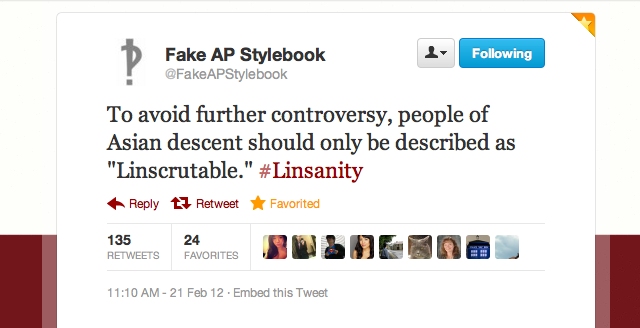
There was Linsanity (and the inevitable and stupid racial slurs in response to the rise of the NBA's first Asian American star player):