Showing posts with label Kumail Nanjiani. Show all posts
Wednesday, March 15, 2017
No Soup for us: The disappointment over E! never archiving The Soup for the show's fans
This is the third of 12 or 13 blog posts that are being posted on a monthly basis until this blog's final post in December 2017.
The longest I laughed over one of Joel McHale's quips on E!'s now-defunct pop culture clip show The Soup ("a sort of national archives of idiocy" was how TV Insider astutely described the show, a few months before its cancellation in 2015) was the moment when The Soup played a Today Show clip of Richard Simmons--this was way before he went "missing"--being Richard Simmons while sitting on a couch with a miniskirted Lisa Rinna. The former Days of Our Lives star, who looks a lot different from her pre-Botox days in Salem, covered her crotch when Simmons lifted up her legs because she thought the viewers at home were getting a glimpse of her Salem's Lot (actually, the viewers at home couldn't see shit).
Neither the accidental quasi-upskirt clip nor McHale's scripted response to the clip were what made me laugh for two or three minutes. The muttered aside that the Soup host clearly ad-libbed right after his scripted response was what caused my sides to hurt from laughing for two minutes: "Her lips are full of collagen."
The Soup studio audience laughed over the ad-lib for longer than half a minute as well. On a broadcast network, Standards and Practices would lamely bleep out "lips" and ruin McHale's joke, but because this was basic cable, E! let the randy ad-lib go. It was a rare wise decision by a cable channel known for a million dumb programming decisions that were made fun of by McHale and his fellow joke writers on the regular during The Soup's 11-year run.
I wish I could revisit that improvised Soup moment and a bunch of other lines that were ad-libbed by McHale (in addition to wishing I could revisit the memes that originated from The Soup, like Spaghetti Cat and "Stay out of it, Nick Lachey!"), just like how I can easily stream an entire episode of The Daily Show from any point of history during the Dubya Administration or how I can easily stream the classic 2007 Colbert Report interview segment where Jane Fonda took Stephen Colbert by surprise (by sitting on his lap and kissing him to persuade his fake Republican alter ego, also named Stephen Colbert, to remove her name from his "On Notice" board). (Also, a search for almost every discriminatory thing that has come out of Steve King's mouth isn't so difficult, thanks to the Colbert archive.)
Unfortunately, I can't revisit as much Soup content as I'd like to because E!'s online staff never bothered to put up an archive of full Soup episodes like how Comedy Central built exhaustive online archives of full Daily Show episodes and lengthy Colbert Report clips. And that lack of a Soup archive--meanwhile, all 12 interminable seasons of Keeping Up with the Kardashians are up on Hulu--is an even dumber move on E!'s part than building an unwatchable reality show around a tanning salon.
Labels:
Comcast,
Community,
CSI,
Danny Pudi,
Desus & Mero,
Disney,
E Entertainment Television,
Joel McHale,
Kal Penn,
Kumail Nanjiani,
memes,
reality TV,
Shows I Miss,
The Colbert Report,
The Daily Show,
The Soup,
YouTube
Thursday, May 26, 2016
AFOS Blog Rewind: Bob's Burgers, "Best Burger"
![]() |
| The cast and crew of Bob's Burgers celebrated the show's 100th episode with a cake that was cut by the perfect person to be seen handling such a ceremony: samurai movie fan Louise Belcher, a.k.a. Kristen Schaal. (Photo source: The Hollywood Reporter) |
The complete fifth season of Bob's Burgers--a show that wrapped up its sixth season on Fox earlier this week with the airing of its 100th episode, a story that entertainingly revisits what has to be the core of Bob's Burgers, Bob's love for his family, in spite of how they frequently get in the way of his attempts at notoriety as a chef--finally became streamable on Netflix on April 1. From December 5, 2014, here's a repost of my discussion of one of my favorite fifth-season Bob's Burgers episodes, "Best Burger," an episode that centers on both the aforementioned core of Bob's Burgers and the making of one of Bob's titular burgers. Speaking of the art of making burgers, at about the same time as Netflix's addition of the fifth season, Universe Publishing finally released The Bob's Burgers Burger Book: Real Recipes for Joke Burgers, a cookbook by Cole Bowden, a chef and Bob's Burgers fan I mentioned in my "Best Burger" discussion. The new book is co-written by Bob's Burgers creator Loren Bouchard and is a compilation of recipes Bowden posted on his blog The Bob's Burger Experiment.
Of all the fictional restaurants I wish would exist, I would probably most want to sample a burger made by the titular restaurant on Bob's Burgers--nominated this week, by the way, for two Annie Animation Awards, including Best Series--because of the creativity Bob brings to the Burgers of the Day that he lists on his restaurant chalkboard. I'd be most interested in the Roquefort Files Burger--awesome pun--or the Bruschetta-bout It Burger, a rare burger that actually wasn't on Bob's chalkboard.
I'm not the only one who wishes Bob's Burgers were a real restaurant: several viewers have become inspired by the show and have posted their attempts to make the show's gourmet burgers, with the most notable example being Cole Bowden of The Bob's Burger Experiment. In "Best Burger," Bob introduces the Bet It All on Black Garlic Burger while competing in a local food festival's burger-tasting contest--by the way, Bowden posted that he's now working on the recipe for that one--and even though I'm not exactly a fan of garlic (and no, I'm not a vampire), I'm dying to try the black garlic burger, based on how much enjoyment the animators clearly had in animating and at one point, slo-moing the scenes where Bob and Linda prepare the meal on-stage.
This Bob's Burgers episode is a good example of how we long for not just the Belchers' restaurant to be real--we also want the food community within the show's unnamed East Coast seaside town to exist as well. In the funniest sequence during "Best Burger," Gene--whose ADHD can be detrimental to others like his dad, especially when he has to win a burger contest he drunkenly signed up for--attempts to make up for all his preceding screw-ups in "Best Burger" by delivering to Bob the missing bulb of black garlic he needs for his contest entry, and he's forced to ignore one food festival temptation after another in order to make it to Bob on time. An agonized Gene must race past free cupcake-flavored ice cream served on a waffle, as well as 10-for-$1 pizza tacos, "robot cake" and the ultimate culinary temptation, a hot fudge car wash, which sounds like an Urban Dictionary sex act. Fuck Brigadoon. Any food community that's got a hot fudge car wash is a more enticing spot than Brigadoon.
Written by Mike Benner, "Best Burger" is a solid Bob/Gene story and acts as sort of a companion piece to both "Beefsquatch," in which Bob seethed over an ape-masked Gene taking attention away from his cooking segments on TV, and "O.T. the Outside Toilet," which entertainingly intertwined sweetness with absurdity when Bob related to Gene the difficulty of looking after either a kid or a pet ("When you were a baby and I was watching you, you ate a fern, and you could have died, but you didn't"). Gene's most endearing quality is his attachment to his Casio keyboard and its wacky sound FX, something series creator Loren Bouchard lifted from his own childhood. That's probably about it in terms of endearing qualities for Gene. He's often the show's most obnoxious character--his shoutiness and attention-seeking childishness both sort of make me understand why some Bob's Burgers haters can't get past his (or Louise's) shoutiness to fully embrace the show--but "Best Burger" gives the character a chance to redeem himself via the aforementioned race against both time and hot fudge car washes.
However, this Gene episode is stolen by Kumail Nanjiani as affable Pakistani celebrity chef Skip Marooch and Thomas Lennon at his Ryan Seacrest-iest as smooth-talking local TV personality Chuck Charles, who emcees the contest and is still bitter over losing his morning talk show due to the Belchers' on-air antics in "Beefsquatch." He keeps blaming Bob for getting him fired and forgets that Linda's boob flash on live TV (in order to stop Bob and Gene from fighting) was what actually got him fired. I suspect Chuck doesn't blame Linda because he got to see her tits.
Chuck's appeared twice before on Bob's Burgers, but in the scenes where Chuck doesn't even bother to hide his disdain for Bob and barely listens to anything he says, Lennon--even more so than in his other guest shots as Chuck--really nails the smugness of these local news personalities who think they're hot shit in their mid-sized TV markets and who care more about how they look on camera than about doing any actual research or being a competent journalist. We've most recently seen that type of not-very-bright local news personality in the viral clip of an awkward Denver morning show interview with Kristen Wiig and Bill Hader (who, interestingly, reprises his role as Wonder Wharf worker--and now pedicab driver--Mickey in "Best Burger"). While promoting the release of their Sundance hit The Skeleton Twins from a press junket room in another city, the two SNL alums collapsed into laughter because their interviewer referred to what he mistakenly thought was a nude scene Wiig did in The Skeleton Twins, which led to the interviewer admitting that he never saw the film. Way to do your research, Denver.
Bound-to-be-viral local TV fails that bring to mind Wiig and Hader's incompetent interviewer are a form of shtick Bob's Burgers does well, in addition to the usual puns and accidental double entendres. "Best Burger" is full of moments about how sexual a lot of descriptions of either the act of eating food or the act of cooking often sound. One of my favorite of these double entendres is Chuck ending the contest with "Time's up! Hands off your meat, chefs." But what I like most about "Best Burger" is the little win Bob gets despite losing the contest. Think of it as the antithesis of "Family Fracas," which many Bob's Burgers fans hated because of how badly Bob got screwed over by his enemies in that episode. An even more affecting moment than Bob trying to tell Gene that "I love you and I love who you are" (which, of course, gets interrupted by Gene's ADHD) is Skip standing in line with a bunch of other curious foodies outside Bob's Burgers and wanting to try out Bob's black garlic burger, even though his Pomegranate and Green Chili Chutney Burger defeated Bob's burger in the contest.
It's affecting because Bob doesn't get to win so often on the show, not even during a competition that's totally in his wheelhouse, like the burger contest, and the sight of this competitor--who's also a chef he respects--suddenly wanting to sample one of his creations is somehow a greater victory than any trophy he could receive, whether it's the contest's burger-shaped trophy or outside the universe of the show, the two Annie Awards that Bob's Burgers is now up for. Sometimes, a trophy is just a trophy.
Other memorable quotes:
* Skip, referring to his grandmother: "She always told me, 'Put spice on everything!' She also said, 'I hate Mondays.' But she never got credit for that."
Chuck: "[Laughs with Skip.] I would love to meet her."
Skip: "Aw... too late."
Chuck: "Ooh."
* Bob: "It's made with black garlic. Uh, it's a fermented garlic. It comes from Korea."
Chuck: "Don't blame Korea for your stupid burger, Bob. Not fair to them or burgers."
Bob: "Uh, I'm not blaming them--"
Chuck: "The Stupid Black Garlic Burger! Put it up on screen."
* "A no is just a yes upside down."
* "Never trust a boy with a skateboard. They're too fast."
* "This has exquisite mouth feel." The animation for the burger judge's tongue as he wraps that tongue around the words "mouth feel" is hilariously creepy. Mike Benner tweeted that the creepy judge was voiced by Andy Daly. The star of the very funny Comedy Central show Review with Forrest MacNeil also voiced the Belcher kid-hating specialty food store owner, whose bulb of black garlic gets stolen by Louise to replace the one Gene accidentally smushed. (By the way, if you haven't watched the first season of Review yet, stream it immediately. Review is as addictive as the coke Daly's title character gets himself hooked on in the first episode.)
* Bob: "You want to try my burger?"
Skip: "Yeah, I smelt it, and now I want you to dealt it, into my mouth."
Thursday, November 26, 2015
Throwback Thursday Throwback: Fight Club
The AFOS blog's year-long Throwback Thursday series concludes its run on December 10. Today's edition of TBT is a repost of a TBT piece from April 9. It's perfect for the day before the day when consumerism whips its dick out and unloads on every single crazed shopper's face.
Cell phones have ruined movies forever. They've made it more difficult for screenwriters to come up with suspenseful situations. You couldn't write either Rear Window or North by Northwest today because every moment of suspense would become impossible for the nitpickers in the audience to take seriously due to "Hmm, you know he or she could use his or her smartphone to save his or her own ass in this situation." The constant advances in cell phone technology have even affected movies that have aged pretty well--when they don't involve phone scenes, that is. The appearance of any kind of phone in a largely timeless movie that's not a present-day cell phone immediately makes that otherwise timeless movie dated.
Thanks to the cutting-edge work of cinematographer Jeff Cronenweth and director David Fincher, whose visuals have always been cutting-edge and distinctive (whether in Fincher-directed music videos like Aerosmith's "Janie's Got a Gun" video or more recent Fincher films like the Cronenweth-lensed Gone Girl), the 1999 anti-consumerism cult favorite Fight Club looks like it could have been filmed yesterday, and it stands the test of time--for several minutes. But then Edward Norton is seen standing in a pay phone booth to dial up his new soap salesman friend Tyler Durden (Brad Pitt), and Fight Club instantly becomes dated.
I had not watched Fight Club in 16 years, before rewatching it as prep for today's edition of Throwback Thursday. In addition to containing the only film score by the Dust Brothers of Paul's Boutique fame (who really ought to compose more scores, due to their outstanding work on the 1999 film, which can be heard during either "AFOS Prime" or the first 33 seconds of the trailer below), Fight Club remains my favorite Fincher film. It's still my favorite even when the appearance of a pay phone wrecks the timelessness and anonymity both Fincher and the various adapters of Chuck Palahniuk's thought-to-have-been-unfilmable 1996 novel of the same name, including credited screenwriter Jim Uhls and uncredited Andrew Kevin Walker from Seven, tried to aim for in their portrayal of modern-day malaise (the city Fight Club takes place in is unspecified, despite the frequent use of L.A. locations, as is the name of Norton's narrator character, although the shooting script referred to him as Jack--we'll call him Jack from this point on).
Much of the appeal of Fight Club stems from the fact that we've all experienced Jack's feelings of malaise (he's nameless for a reason: so that male audience members can name the narrator after themselves). Okay, so you may not be a privileged white male yuppie like Jack, but you can definitely relate to his dissatisfaction with his job as an auto recall specialist and the feeling of emptiness that triggers his insomnia and has him doing anything to feel alive, whether it's going through an IKEA shopping phase, faking diseases and crashing support group meetings with his frenemy Marla Singer (Helena Bonham Carter) or forming with Tyler an underground fight club to blow off steam, for men only (no Marlas allowed).
A good example of the film's ability to connect with viewers long after it tanked at the box office (Palahniuk's material isn't unfilmable--it's unmarketable, as 20th Century Fox realized while inanely trying to sell Fight Club as a TBS Movie for Guys Who Like Movies back in 1999) was when former RogerEbert.com editor Jim Emerson interestingly called Fight Club one of the most accurate depictions of clinical depression ever made and praised how it captures the way that depression is all-consuming. "It helped shake me out of the grips of a depression that was sucking me down at the time," wrote Emerson.
(Spoiler time. Weirdos who have never seen Fight Club can leave now.)
Cell phones have ruined movies forever. They've made it more difficult for screenwriters to come up with suspenseful situations. You couldn't write either Rear Window or North by Northwest today because every moment of suspense would become impossible for the nitpickers in the audience to take seriously due to "Hmm, you know he or she could use his or her smartphone to save his or her own ass in this situation." The constant advances in cell phone technology have even affected movies that have aged pretty well--when they don't involve phone scenes, that is. The appearance of any kind of phone in a largely timeless movie that's not a present-day cell phone immediately makes that otherwise timeless movie dated.
Thanks to the cutting-edge work of cinematographer Jeff Cronenweth and director David Fincher, whose visuals have always been cutting-edge and distinctive (whether in Fincher-directed music videos like Aerosmith's "Janie's Got a Gun" video or more recent Fincher films like the Cronenweth-lensed Gone Girl), the 1999 anti-consumerism cult favorite Fight Club looks like it could have been filmed yesterday, and it stands the test of time--for several minutes. But then Edward Norton is seen standing in a pay phone booth to dial up his new soap salesman friend Tyler Durden (Brad Pitt), and Fight Club instantly becomes dated.
I had not watched Fight Club in 16 years, before rewatching it as prep for today's edition of Throwback Thursday. In addition to containing the only film score by the Dust Brothers of Paul's Boutique fame (who really ought to compose more scores, due to their outstanding work on the 1999 film, which can be heard during either "AFOS Prime" or the first 33 seconds of the trailer below), Fight Club remains my favorite Fincher film. It's still my favorite even when the appearance of a pay phone wrecks the timelessness and anonymity both Fincher and the various adapters of Chuck Palahniuk's thought-to-have-been-unfilmable 1996 novel of the same name, including credited screenwriter Jim Uhls and uncredited Andrew Kevin Walker from Seven, tried to aim for in their portrayal of modern-day malaise (the city Fight Club takes place in is unspecified, despite the frequent use of L.A. locations, as is the name of Norton's narrator character, although the shooting script referred to him as Jack--we'll call him Jack from this point on).
Much of the appeal of Fight Club stems from the fact that we've all experienced Jack's feelings of malaise (he's nameless for a reason: so that male audience members can name the narrator after themselves). Okay, so you may not be a privileged white male yuppie like Jack, but you can definitely relate to his dissatisfaction with his job as an auto recall specialist and the feeling of emptiness that triggers his insomnia and has him doing anything to feel alive, whether it's going through an IKEA shopping phase, faking diseases and crashing support group meetings with his frenemy Marla Singer (Helena Bonham Carter) or forming with Tyler an underground fight club to blow off steam, for men only (no Marlas allowed).
A good example of the film's ability to connect with viewers long after it tanked at the box office (Palahniuk's material isn't unfilmable--it's unmarketable, as 20th Century Fox realized while inanely trying to sell Fight Club as a TBS Movie for Guys Who Like Movies back in 1999) was when former RogerEbert.com editor Jim Emerson interestingly called Fight Club one of the most accurate depictions of clinical depression ever made and praised how it captures the way that depression is all-consuming. "It helped shake me out of the grips of a depression that was sucking me down at the time," wrote Emerson.
![]() |
| (Photo source: DVD Beaver) |
(Spoiler time. Weirdos who have never seen Fight Club can leave now.)
Labels:
'90s nostalgia,
1999,
Brad Pitt,
David Fincher,
Edward Norton,
Fight Club,
film music,
hip-hop,
Kumail Nanjiani,
movie trailers,
Putney Swope,
The Dust Brothers,
Throwback Thursday
Thursday, April 23, 2015
Throwback Thursday: The Artist
Every Throwback Thursday, I randomly pull out from my desk cabinet--with my eyes closed--a movie ticket I saved. Then I discuss the movie on the ticket and maybe a little bit of its score, which might be now streaming on AFOS.
French director Michel Hazanavicius' 2011 silent movie The Artist, the 2012 Best Picture Oscar winner about the end of the silent era in Hollywood, is impossible to dislike. It reteams Jean Dujardin with Hazanavicius' wife Bérénice Bejo--who starred together in OSS 117: Cairo, Nest of Spies, Hazanavicius' amusing 2006 spy spoof about a racist and misogynist '50s French agent--and demonstrates how perfectly cast the two expressive and subtle French stars are as fictional late '20s Hollywood actors who exemplify certain emotive and non-verbal acting styles that were prevalent during The Artist's time period.
In addition to those star turns by Dujardin, who won an Oscar for his role, and the luminous Bejo, a smart and heroic Jack Russell terrier--played by three different dogs--often entertainingly steals the show (the Artist DVD's outtakes of the canine actors missing their cues or ignoring their trainer's instructions are equally entertaining, proving Robert Smigel's theory that much of the funniness of animal actors is due to them not having "any idea what they're part of"). James Cromwell brings his usual material-boosting gravitas to a role that's non-villainous for a change, a stoic and loyal chauffeur who enjoys his work, while, like Dujardin and Bejo, the frequently funny Missi Pyle was born to act in a silent movie, as we see in a way-too-brief role that's clearly an homage to Lina Lamont, Jean Hagen's villainous silent movie star character from Singin' in the Rain.
Another plus is Hazanavicius' attention to the details of late '20s/early '30s Hollywood, with some assistance from his regular composer Ludovic Bource. His Oscar-winning Artist score was influenced by the studio-system-era likes of Max Steiner, Erich Wolfgang Korngold and Bernard Herrmann, whose classic "Scene d'Amour" cue from Vertigo was needle-dropped at one point in The Artist by Hazanavicius, a Hitchcock fan. But the inclusion of a score cue from a well-known 1958 Hitchcock picture during a movie that takes place way before 1958 was too much of an off-putting distraction for some moviegoers, especially Vertigo star Kim Novak, whose bizarre public statement where she angrily referred to the needle drop as "rape" led to a hilarious reaction from Kumail Nanjiani.
It's not as if Hazanavicius soundtracked the movie's angsty climax with Evanescence's "Bring Me to Life," but the purists in the audience who were bent out of shape about the climax would rant and rave as if the director Evanescenced it. Whether or not anachronistic music choices in The Artist or other period pieces like Inglourious Basterds and Public Enemies set off your inner Pierre Bernard, you can't deny how The Artist remarkably never looks like it was made in 2010, thanks mostly to the striking black-and-white visuals of Hazanavicius' regular cinematographer Guillaume Schiffman. At one point, the movie, which Hazanavicius shot entirely in Hollywood, makes beautiful use of the distinctive staircase inside the Bradbury Building, the 122-year-old L.A. filming location most memorably featured in Blade Runner and the 1964 Outer Limits episode "Demon with a Glass Hand."
So like I said before, The Artist is impossible to dislike. But it's hardly the best picture of 2011. As silent movies that were made long after the silent era, Mel Brooks' 1976 farce Silent Movie and Charles Lane's 1989 indie flick Sidewalk Stories are more inventive than The Artist, which, while it does recapture '20s and '30s filmmaking quite well, never really does anything inventive or new with the silent gimmick, other than a memorable nightmare sequence where Dujardin's George Valentin imagines the horrors of being trapped in a new world full of sound. The scenes where George drinks himself into a stupor--over his artistic decline and his inability to adapt to Hollywood's transition from silents to talkies like the box-office successes of Bejo's Peppy Miller--really drag. George's self-pity is about 10 minutes too long. It becomes so repetitive that an enticing-looking two-second clip of Peppy from a fake movie where she stars as a female baseball player ends up being a movie I'd rather watch instead of the actual movie surrounding it.
French director Michel Hazanavicius' 2011 silent movie The Artist, the 2012 Best Picture Oscar winner about the end of the silent era in Hollywood, is impossible to dislike. It reteams Jean Dujardin with Hazanavicius' wife Bérénice Bejo--who starred together in OSS 117: Cairo, Nest of Spies, Hazanavicius' amusing 2006 spy spoof about a racist and misogynist '50s French agent--and demonstrates how perfectly cast the two expressive and subtle French stars are as fictional late '20s Hollywood actors who exemplify certain emotive and non-verbal acting styles that were prevalent during The Artist's time period.
In addition to those star turns by Dujardin, who won an Oscar for his role, and the luminous Bejo, a smart and heroic Jack Russell terrier--played by three different dogs--often entertainingly steals the show (the Artist DVD's outtakes of the canine actors missing their cues or ignoring their trainer's instructions are equally entertaining, proving Robert Smigel's theory that much of the funniness of animal actors is due to them not having "any idea what they're part of"). James Cromwell brings his usual material-boosting gravitas to a role that's non-villainous for a change, a stoic and loyal chauffeur who enjoys his work, while, like Dujardin and Bejo, the frequently funny Missi Pyle was born to act in a silent movie, as we see in a way-too-brief role that's clearly an homage to Lina Lamont, Jean Hagen's villainous silent movie star character from Singin' in the Rain.
Another plus is Hazanavicius' attention to the details of late '20s/early '30s Hollywood, with some assistance from his regular composer Ludovic Bource. His Oscar-winning Artist score was influenced by the studio-system-era likes of Max Steiner, Erich Wolfgang Korngold and Bernard Herrmann, whose classic "Scene d'Amour" cue from Vertigo was needle-dropped at one point in The Artist by Hazanavicius, a Hitchcock fan. But the inclusion of a score cue from a well-known 1958 Hitchcock picture during a movie that takes place way before 1958 was too much of an off-putting distraction for some moviegoers, especially Vertigo star Kim Novak, whose bizarre public statement where she angrily referred to the needle drop as "rape" led to a hilarious reaction from Kumail Nanjiani.
Hey Kim Novak, did you know that only 10% of iconic soundtrack theft is actually reported?
— Kumail Nanjiani (@kumailn) January 9, 2012
Guessing Kim Novak's never been raped.
— Kumail Nanjiani (@kumailn) January 9, 2012
It's not as if Hazanavicius soundtracked the movie's angsty climax with Evanescence's "Bring Me to Life," but the purists in the audience who were bent out of shape about the climax would rant and rave as if the director Evanescenced it. Whether or not anachronistic music choices in The Artist or other period pieces like Inglourious Basterds and Public Enemies set off your inner Pierre Bernard, you can't deny how The Artist remarkably never looks like it was made in 2010, thanks mostly to the striking black-and-white visuals of Hazanavicius' regular cinematographer Guillaume Schiffman. At one point, the movie, which Hazanavicius shot entirely in Hollywood, makes beautiful use of the distinctive staircase inside the Bradbury Building, the 122-year-old L.A. filming location most memorably featured in Blade Runner and the 1964 Outer Limits episode "Demon with a Glass Hand."
So like I said before, The Artist is impossible to dislike. But it's hardly the best picture of 2011. As silent movies that were made long after the silent era, Mel Brooks' 1976 farce Silent Movie and Charles Lane's 1989 indie flick Sidewalk Stories are more inventive than The Artist, which, while it does recapture '20s and '30s filmmaking quite well, never really does anything inventive or new with the silent gimmick, other than a memorable nightmare sequence where Dujardin's George Valentin imagines the horrors of being trapped in a new world full of sound. The scenes where George drinks himself into a stupor--over his artistic decline and his inability to adapt to Hollywood's transition from silents to talkies like the box-office successes of Bejo's Peppy Miller--really drag. George's self-pity is about 10 minutes too long. It becomes so repetitive that an enticing-looking two-second clip of Peppy from a fake movie where she stars as a female baseball player ends up being a movie I'd rather watch instead of the actual movie surrounding it.
Thursday, April 9, 2015
Throwback Thursday: Fight Club
Every Throwback Thursday, I randomly pull out from my desk cabinet--with my eyes closed--a movie ticket I saved. Then I discuss the movie on the ticket and maybe a little bit of its score, which might be now streaming on AFOS.
Cell phones have ruined movies forever. They've made it more difficult for screenwriters to come up with suspenseful situations. You couldn't write either Rear Window or North by Northwest today because every moment of suspense would become impossible for the nitpickers in the audience to take seriously due to "Hmm, you know he or she could use his or her smartphone to save his or her own ass in this situation." The constant advances in cell phone technology have even affected movies that have aged pretty well--when they don't involve phone scenes, that is. The appearance of any kind of phone in a largely timeless movie that's not a present-day cell phone immediately makes that otherwise timeless movie dated.
Thanks to the cutting-edge work of cinematographer Jeff Cronenweth and director David Fincher, whose visuals have always been cutting-edge and distinctive (whether in Fincher-directed music videos like Aerosmith's "Janie's Got a Gun" video or more recent Fincher films like the Cronenweth-lensed Gone Girl), the 1999 anti-consumerism cult favorite Fight Club looks like it could have been filmed yesterday, and it stands the test of time--for several minutes. But then Edward Norton is seen standing in a pay phone booth to dial up his new soap salesman friend Tyler Durden (Brad Pitt), and Fight Club instantly becomes dated.
I had not watched Fight Club in 16 years, before rewatching it as prep for today's edition of Throwback Thursday. In addition to containing the only film score by the Dust Brothers of Paul's Boutique fame (who really ought to compose more scores, due to their outstanding work on the 1999 film, which can be heard during either "AFOS Prime" or the first 33 seconds of the trailer below), Fight Club remains my favorite Fincher film. It's still my favorite even when the appearance of a pay phone wrecks the timelessness and anonymity both Fincher and the various adapters of Chuck Palahniuk's thought-to-have-been-unfilmable 1996 novel of the same name, including credited screenwriter Jim Uhls and uncredited Andrew Kevin Walker from Seven, tried to aim for in their portrayal of modern-day malaise (the city Fight Club takes place in is unspecified, despite the frequent use of L.A. locations, as is the name of Norton's narrator character, although the shooting script referred to him as Jack--we'll call him Jack from this point on).
Much of the appeal of Fight Club stems from the fact that we've all experienced Jack's feelings of malaise (he's nameless for a reason: so that male audience members can name the narrator after themselves). Okay, so you may not be a privileged white male yuppie like Jack, but you can definitely relate to his dissatisfaction with his job as an auto recall specialist and the feeling of emptiness that triggers his insomnia and has him doing anything to feel alive, whether it's going through an IKEA shopping phase, faking diseases and crashing support group meetings with his frenemy Marla Singer (Helena Bonham Carter) or forming with Tyler an underground fight club to blow off steam, for men only (no Marlas allowed).
A good example of the film's ability to connect with viewers long after it tanked at the box office (Palahniuk's material isn't unfilmable--it's unmarketable, as 20th Century Fox realized while inanely trying to sell Fight Club as a TBS Movie for Guys Who Like Movies back in 1999) was when former RogerEbert.com editor Jim Emerson interestingly called Fight Club one of the most accurate depictions of clinical depression ever made and praised how it captures the way that depression is all-consuming. "It helped shake me out of the grips of a depression that was sucking me down at the time," wrote Emerson.
(Spoiler time. Weirdos who have never seen Fight Club can leave now.)
Cell phones have ruined movies forever. They've made it more difficult for screenwriters to come up with suspenseful situations. You couldn't write either Rear Window or North by Northwest today because every moment of suspense would become impossible for the nitpickers in the audience to take seriously due to "Hmm, you know he or she could use his or her smartphone to save his or her own ass in this situation." The constant advances in cell phone technology have even affected movies that have aged pretty well--when they don't involve phone scenes, that is. The appearance of any kind of phone in a largely timeless movie that's not a present-day cell phone immediately makes that otherwise timeless movie dated.
Thanks to the cutting-edge work of cinematographer Jeff Cronenweth and director David Fincher, whose visuals have always been cutting-edge and distinctive (whether in Fincher-directed music videos like Aerosmith's "Janie's Got a Gun" video or more recent Fincher films like the Cronenweth-lensed Gone Girl), the 1999 anti-consumerism cult favorite Fight Club looks like it could have been filmed yesterday, and it stands the test of time--for several minutes. But then Edward Norton is seen standing in a pay phone booth to dial up his new soap salesman friend Tyler Durden (Brad Pitt), and Fight Club instantly becomes dated.
I had not watched Fight Club in 16 years, before rewatching it as prep for today's edition of Throwback Thursday. In addition to containing the only film score by the Dust Brothers of Paul's Boutique fame (who really ought to compose more scores, due to their outstanding work on the 1999 film, which can be heard during either "AFOS Prime" or the first 33 seconds of the trailer below), Fight Club remains my favorite Fincher film. It's still my favorite even when the appearance of a pay phone wrecks the timelessness and anonymity both Fincher and the various adapters of Chuck Palahniuk's thought-to-have-been-unfilmable 1996 novel of the same name, including credited screenwriter Jim Uhls and uncredited Andrew Kevin Walker from Seven, tried to aim for in their portrayal of modern-day malaise (the city Fight Club takes place in is unspecified, despite the frequent use of L.A. locations, as is the name of Norton's narrator character, although the shooting script referred to him as Jack--we'll call him Jack from this point on).
Much of the appeal of Fight Club stems from the fact that we've all experienced Jack's feelings of malaise (he's nameless for a reason: so that male audience members can name the narrator after themselves). Okay, so you may not be a privileged white male yuppie like Jack, but you can definitely relate to his dissatisfaction with his job as an auto recall specialist and the feeling of emptiness that triggers his insomnia and has him doing anything to feel alive, whether it's going through an IKEA shopping phase, faking diseases and crashing support group meetings with his frenemy Marla Singer (Helena Bonham Carter) or forming with Tyler an underground fight club to blow off steam, for men only (no Marlas allowed).
A good example of the film's ability to connect with viewers long after it tanked at the box office (Palahniuk's material isn't unfilmable--it's unmarketable, as 20th Century Fox realized while inanely trying to sell Fight Club as a TBS Movie for Guys Who Like Movies back in 1999) was when former RogerEbert.com editor Jim Emerson interestingly called Fight Club one of the most accurate depictions of clinical depression ever made and praised how it captures the way that depression is all-consuming. "It helped shake me out of the grips of a depression that was sucking me down at the time," wrote Emerson.
![]() |
| (Photo source: DVD Beaver) |
(Spoiler time. Weirdos who have never seen Fight Club can leave now.)
Labels:
'90s nostalgia,
1999,
Brad Pitt,
David Fincher,
Edward Norton,
Fight Club,
film music,
hip-hop,
Kumail Nanjiani,
movie trailers,
Putney Swope,
The Dust Brothers,
Throwback Thursday
Friday, December 5, 2014
"Brokedown Merry-Go-Round" Show of the Week: Bob's Burgers, "Best Burger"
Every Friday in "'Brokedown Merry-Go-Round' Show of the Week," I discuss the week's best first-run animated series episode I saw. "Brokedown Merry-Go-Round," a two-hour block of original score tracks from animated shows or movies, airs weekdays at 2pm Pacific on AFOS.
Of all the fictional restaurants I wish would exist, I would probably most want to sample a burger made by the titular restaurant on Bob's Burgers--nominated this week, by the way, for two Annie Animation Awards, including Best Series--because of the creativity Bob brings to the Burgers of the Day that he lists on his restaurant chalkboard. I'd be most interested in the Roquefort Files Burger--awesome pun--or the Bruschetta-bout It Burger, a rare burger that actually wasn't on Bob's chalkboard.
I'm not the only one who wishes Bob's Burgers were a real restaurant: several viewers have become inspired by the show and have posted their attempts to make the show's gourmet burgers, with the most notable example being Cole Bowden of The Bob's Burger Experiment. In "Best Burger," Bob introduces the Bet It All on Black Garlic Burger while competing in a local food festival's burger-tasting contest--by the way, Bowden posted that he's now working on the recipe for that one--and even though I'm not exactly a fan of garlic (and no, I'm not a vampire), I'm dying to try the black garlic burger, based on how much enjoyment the animators clearly had in animating and at one point, slo-moing the scenes where Bob and Linda prepare the meal on-stage.
This Bob's Burgers episode is a good example of how we long for not just the Belchers' restaurant to be real--we also want the food community within the show's unnamed East Coast seaside town to exist as well. In the funniest sequence during "Best Burger," Gene--whose ADHD can be detrimental to others like his dad, especially when he has to win a burger contest he drunkenly signed up for--attempts to make up for all his preceding screw-ups in "Best Burger" by delivering to Bob the missing bulb of black garlic he needs for his contest entry, and he's forced to ignore one food festival temptation after another in order to make it to Bob on time. An agonized Gene must race past free cupcake-flavored ice cream served on a waffle, as well as 10-for-$1 pizza tacos, "robot cake" and the ultimate culinary temptation, a hot fudge car wash, which sounds like an Urban Dictionary sex act. Fuck Brigadoon. Any food community that's got a hot fudge car wash is a more enticing spot than Brigadoon.
Written by Mike Benner, "Best Burger" is a solid Bob/Gene story and acts as sort of a companion piece to both "Beefsquatch," in which Bob seethed over an ape-masked Gene taking attention away from his cooking segments on TV, and "O.T. the Outside Toilet," which entertainingly intertwined sweetness with absurdity when Bob related to Gene the difficulty of looking after either a kid or a pet ("When you were a baby and I was watching you, you ate a fern, and you could have died, but you didn't"). Gene's most endearing quality is his attachment to his Casio keyboard and its wacky sound FX, something series creator Loren Bouchard lifted from his own childhood. That's probably about it in terms of endearing qualities for Gene. He's often the show's most obnoxious character--his shoutiness and attention-seeking childishness both sort of make me understand why some Bob's Burgers haters can't get past his (or Louise's) shoutiness to fully embrace the show--but "Best Burger" gives the character a chance to redeem himself via the aforementioned race against both time and hot fudge car washes.
However, this Gene episode is stolen by Kumail Nanjiani as affable Pakistani celebrity chef Skip Marooch and Thomas Lennon at his Ryan Seacrest-iest as smooth-talking local TV personality Chuck Charles, who emcees the contest and is still bitter over losing his morning talk show due to the Belchers' on-air antics in "Beefsquatch." He keeps blaming Bob for getting him fired and forgets that Linda's boob flash on live TV (in order to stop Bob and Gene from fighting) was what actually got him fired. I suspect Chuck doesn't blame Linda because he got to see her tits.
Chuck's appeared twice before on Bob's Burgers, but in the scenes where Chuck doesn't even bother to hide his disdain for Bob and barely listens to anything he says, Lennon--even more so than in his other guest shots as Chuck--really nails the smugness of these local news personalities who think they're hot shit in their mid-sized TV markets and who care more about how they look on camera than about doing any actual research or being a competent journalist. We've most recently seen that type of not-very-bright local news personality in the viral clip of an awkward Denver morning show interview with Kristen Wiig and Bill Hader (who, interestingly, reprises his role as Wonder Wharf worker--and now pedicab driver--Mickey in "Best Burger"). While promoting the release of their Sundance hit The Skeleton Twins from a press junket room in another city, the two SNL alums collapsed into laughter because their interviewer referred to what he mistakenly thought was a nude scene Wiig did in The Skeleton Twins, which led to the interviewer admitting that he never saw the film. Way to do your research, Denver.
Bound-to-be-viral local TV fails that bring to mind Wiig and Hader's incompetent interviewer are a form of shtick Bob's Burgers does well, in addition to the usual puns and accidental double entendres. "Best Burger" is full of moments about how sexual a lot of descriptions of either the act of eating food or the act of cooking often sound. One of my favorite of these double entendres is Chuck ending the contest with "Time's up! Hands off your meat, chefs." But what I like most about "Best Burger" is the little win Bob gets despite losing the contest. Think of it as the antithesis of "Family Fracas," which many Bob's Burgers fans hated because of how badly Bob got screwed over by his enemies in that episode. An even more affecting moment than Bob trying to tell Gene that "I love you and I love who you are" (which, of course, gets interrupted by Gene's ADHD) is Skip standing in line with a bunch of other curious foodies outside Bob's Burgers and wanting to try out Bob's black garlic burger, even though his Pomegranate and Green Chili Chutney Burger defeated Bob's burger in the contest.
It's affecting because Bob doesn't get to win so often on the show, not even during a competition that's totally in his wheelhouse, like the burger contest, and the sight of this competitor--who's also a chef he respects--suddenly wanting to sample one of his creations is somehow a greater victory than any trophy he could receive, whether it's the contest's burger-shaped trophy or outside the universe of the show, the two Annie Awards that Bob's Burgers is now up for. Sometimes, a trophy is just a trophy.
Other memorable quotes:
* Skip, referring to his grandmother: "She always told me, 'Put spice on everything!' She also said, 'I hate Mondays.' But she never got credit for that."
Chuck: "[Laughs with Skip.] I would love to meet her."
Skip: "Aw... too late."
Chuck: "Ooh."
* Bob: "It's made with black garlic. Uh, it's a fermented garlic. It comes from Korea."
Chuck: "Don't blame Korea for your stupid burger, Bob. Not fair to them or burgers."
Bob: "Uh, I'm not blaming them--"
Chuck: "The Stupid Black Garlic Burger! Put it up on screen."
* "A no is just a yes upside down."
* "Never trust a boy with a skateboard. They're too fast."
* "It's just that you always... I don't want to say screw everything up, but maybe Louise does?"
* "This has exquisite mouth feel." The animation for the burger judge's tongue as he wraps that tongue around the words "mouth feel" is hilariously creepy. Mike Benner tweeted that the creepy judge was voiced by Andy Daly. The star of the very funny Comedy Central show Review with Forrest MacNeil also voiced the Belcher kid-hating specialty food store owner, whose bulb of black garlic gets stolen by Louise to replace the one Gene accidentally smushed. (By the way, if you haven't watched the first season of Review yet, stream it immediately. Review is as addictive as the coke Daly's title character gets himself hooked on in the first episode.)
* Bob: "You want to try my burger?"
Skip: "Yeah, I smelt it, and now I want you to dealt it, into my mouth."
Of all the fictional restaurants I wish would exist, I would probably most want to sample a burger made by the titular restaurant on Bob's Burgers--nominated this week, by the way, for two Annie Animation Awards, including Best Series--because of the creativity Bob brings to the Burgers of the Day that he lists on his restaurant chalkboard. I'd be most interested in the Roquefort Files Burger--awesome pun--or the Bruschetta-bout It Burger, a rare burger that actually wasn't on Bob's chalkboard.
I'm not the only one who wishes Bob's Burgers were a real restaurant: several viewers have become inspired by the show and have posted their attempts to make the show's gourmet burgers, with the most notable example being Cole Bowden of The Bob's Burger Experiment. In "Best Burger," Bob introduces the Bet It All on Black Garlic Burger while competing in a local food festival's burger-tasting contest--by the way, Bowden posted that he's now working on the recipe for that one--and even though I'm not exactly a fan of garlic (and no, I'm not a vampire), I'm dying to try the black garlic burger, based on how much enjoyment the animators clearly had in animating and at one point, slo-moing the scenes where Bob and Linda prepare the meal on-stage.
This Bob's Burgers episode is a good example of how we long for not just the Belchers' restaurant to be real--we also want the food community within the show's unnamed East Coast seaside town to exist as well. In the funniest sequence during "Best Burger," Gene--whose ADHD can be detrimental to others like his dad, especially when he has to win a burger contest he drunkenly signed up for--attempts to make up for all his preceding screw-ups in "Best Burger" by delivering to Bob the missing bulb of black garlic he needs for his contest entry, and he's forced to ignore one food festival temptation after another in order to make it to Bob on time. An agonized Gene must race past free cupcake-flavored ice cream served on a waffle, as well as 10-for-$1 pizza tacos, "robot cake" and the ultimate culinary temptation, a hot fudge car wash, which sounds like an Urban Dictionary sex act. Fuck Brigadoon. Any food community that's got a hot fudge car wash is a more enticing spot than Brigadoon.
Written by Mike Benner, "Best Burger" is a solid Bob/Gene story and acts as sort of a companion piece to both "Beefsquatch," in which Bob seethed over an ape-masked Gene taking attention away from his cooking segments on TV, and "O.T. the Outside Toilet," which entertainingly intertwined sweetness with absurdity when Bob related to Gene the difficulty of looking after either a kid or a pet ("When you were a baby and I was watching you, you ate a fern, and you could have died, but you didn't"). Gene's most endearing quality is his attachment to his Casio keyboard and its wacky sound FX, something series creator Loren Bouchard lifted from his own childhood. That's probably about it in terms of endearing qualities for Gene. He's often the show's most obnoxious character--his shoutiness and attention-seeking childishness both sort of make me understand why some Bob's Burgers haters can't get past his (or Louise's) shoutiness to fully embrace the show--but "Best Burger" gives the character a chance to redeem himself via the aforementioned race against both time and hot fudge car washes.
However, this Gene episode is stolen by Kumail Nanjiani as affable Pakistani celebrity chef Skip Marooch and Thomas Lennon at his Ryan Seacrest-iest as smooth-talking local TV personality Chuck Charles, who emcees the contest and is still bitter over losing his morning talk show due to the Belchers' on-air antics in "Beefsquatch." He keeps blaming Bob for getting him fired and forgets that Linda's boob flash on live TV (in order to stop Bob and Gene from fighting) was what actually got him fired. I suspect Chuck doesn't blame Linda because he got to see her tits.
Chuck's appeared twice before on Bob's Burgers, but in the scenes where Chuck doesn't even bother to hide his disdain for Bob and barely listens to anything he says, Lennon--even more so than in his other guest shots as Chuck--really nails the smugness of these local news personalities who think they're hot shit in their mid-sized TV markets and who care more about how they look on camera than about doing any actual research or being a competent journalist. We've most recently seen that type of not-very-bright local news personality in the viral clip of an awkward Denver morning show interview with Kristen Wiig and Bill Hader (who, interestingly, reprises his role as Wonder Wharf worker--and now pedicab driver--Mickey in "Best Burger"). While promoting the release of their Sundance hit The Skeleton Twins from a press junket room in another city, the two SNL alums collapsed into laughter because their interviewer referred to what he mistakenly thought was a nude scene Wiig did in The Skeleton Twins, which led to the interviewer admitting that he never saw the film. Way to do your research, Denver.
Bound-to-be-viral local TV fails that bring to mind Wiig and Hader's incompetent interviewer are a form of shtick Bob's Burgers does well, in addition to the usual puns and accidental double entendres. "Best Burger" is full of moments about how sexual a lot of descriptions of either the act of eating food or the act of cooking often sound. One of my favorite of these double entendres is Chuck ending the contest with "Time's up! Hands off your meat, chefs." But what I like most about "Best Burger" is the little win Bob gets despite losing the contest. Think of it as the antithesis of "Family Fracas," which many Bob's Burgers fans hated because of how badly Bob got screwed over by his enemies in that episode. An even more affecting moment than Bob trying to tell Gene that "I love you and I love who you are" (which, of course, gets interrupted by Gene's ADHD) is Skip standing in line with a bunch of other curious foodies outside Bob's Burgers and wanting to try out Bob's black garlic burger, even though his Pomegranate and Green Chili Chutney Burger defeated Bob's burger in the contest.
It's affecting because Bob doesn't get to win so often on the show, not even during a competition that's totally in his wheelhouse, like the burger contest, and the sight of this competitor--who's also a chef he respects--suddenly wanting to sample one of his creations is somehow a greater victory than any trophy he could receive, whether it's the contest's burger-shaped trophy or outside the universe of the show, the two Annie Awards that Bob's Burgers is now up for. Sometimes, a trophy is just a trophy.
Other memorable quotes:
* Skip, referring to his grandmother: "She always told me, 'Put spice on everything!' She also said, 'I hate Mondays.' But she never got credit for that."
Chuck: "[Laughs with Skip.] I would love to meet her."
Skip: "Aw... too late."
Chuck: "Ooh."
* Bob: "It's made with black garlic. Uh, it's a fermented garlic. It comes from Korea."
Chuck: "Don't blame Korea for your stupid burger, Bob. Not fair to them or burgers."
Bob: "Uh, I'm not blaming them--"
Chuck: "The Stupid Black Garlic Burger! Put it up on screen."
* "A no is just a yes upside down."
* "Never trust a boy with a skateboard. They're too fast."
* "It's just that you always... I don't want to say screw everything up, but maybe Louise does?"
* "This has exquisite mouth feel." The animation for the burger judge's tongue as he wraps that tongue around the words "mouth feel" is hilariously creepy. Mike Benner tweeted that the creepy judge was voiced by Andy Daly. The star of the very funny Comedy Central show Review with Forrest MacNeil also voiced the Belcher kid-hating specialty food store owner, whose bulb of black garlic gets stolen by Louise to replace the one Gene accidentally smushed. (By the way, if you haven't watched the first season of Review yet, stream it immediately. Review is as addictive as the coke Daly's title character gets himself hooked on in the first episode.)
* Bob: "You want to try my burger?"
Skip: "Yeah, I smelt it, and now I want you to dealt it, into my mouth."
Thursday, July 24, 2014
Tip-Top Quotables: "Some couples have a song. Ours is the theme from Jaws," plus a few other great lines this week
My favorite monthly section in old Source magazine issues was "Hip-Hop Quotables," in which the Source editors printed out their favorite new rap verse of the month, from the first bar to the last. "Tip-Top Quotables," which I've named after that Source section, is a collection of my favorite quotes of the week from anywhere, whether it's a recent TV show or a new rap verse. "TTQ" won't appear on this blog every week. It'll appear whenever the fuck I feel like it.
* "Tell him that snoring is usually a sign of a condition called sleep apnea, which causes a lot of people to die in their sleep. Be like, 'Here, Google it.' And then he'll be so scared he'll never be able to sleep again."--Kumail Nanjiani, giving advice to an Esquire reader about how to deal with a roommate's boyfriend who snores too loud
* "We've got some very attractive rewards at every level. For instance, $10,000 lands you in a signature CNN mass-shooting coverage six-box. For $25,000, you get to take molly with Fareed Zakaria. What what! For $5 million, CNN will air a 24-hour, two-week hunt for your lost car keys."--Jon Stewart, announcing his Kickstarter to buy CNN
* "Tony played it like a failed Scientologist."--Sam Rockwell, recalling to MTV News his Galaxy Quest co-star Tony Shalhoub's hilarious performance as a constantly stoned, non-Asian TV actor playing an Asian character, which Shalhoub based on constantly stoned Kung Fu star David Carradine, '70s TV's most infamous example of a non-Asian playing an Asian
* "That is not good. The only time when you are happy to hear the words 'Maggots were found' is when you are a maggot whose family was lost at sea."--Last Week Tonight's John Oliver, joking about a news report of maggots being found in prison food supplied by a shady subcontractor
* "Garner was an expert at pulling the viewer into the action and acknowledging the ridiculousness of most television storytelling without quite breaking the fourth wall. He was the guy who crawled out of the screen and sat beside you munching popcorn on the couch."--Todd VanDerWerff, Vox, "James Garner has died; these five roles will remind you of his greatness"
* "If Netanyahu is so bothered by how dead Palestinians look on television then he should stop killing so many of them."--Benjamin Wallace-Wells, New York, "'Telegenically Dead Palestinians': Why Israel Is Losing the American Media War"
* "Tell him that snoring is usually a sign of a condition called sleep apnea, which causes a lot of people to die in their sleep. Be like, 'Here, Google it.' And then he'll be so scared he'll never be able to sleep again."--Kumail Nanjiani, giving advice to an Esquire reader about how to deal with a roommate's boyfriend who snores too loud
* "We've got some very attractive rewards at every level. For instance, $10,000 lands you in a signature CNN mass-shooting coverage six-box. For $25,000, you get to take molly with Fareed Zakaria. What what! For $5 million, CNN will air a 24-hour, two-week hunt for your lost car keys."--Jon Stewart, announcing his Kickstarter to buy CNN
![]() |
| (Photo source: Wendy Liebman) |
* "Tony played it like a failed Scientologist."--Sam Rockwell, recalling to MTV News his Galaxy Quest co-star Tony Shalhoub's hilarious performance as a constantly stoned, non-Asian TV actor playing an Asian character, which Shalhoub based on constantly stoned Kung Fu star David Carradine, '70s TV's most infamous example of a non-Asian playing an Asian
![]() |
| (Photo source: Pia Glenn, the writer behind the #TimeTitles hashtag, which is a mockery of this) |
![]() |
| (Photo source: Hari Kondabolu) |
* "That is not good. The only time when you are happy to hear the words 'Maggots were found' is when you are a maggot whose family was lost at sea."--Last Week Tonight's John Oliver, joking about a news report of maggots being found in prison food supplied by a shady subcontractor
* "Garner was an expert at pulling the viewer into the action and acknowledging the ridiculousness of most television storytelling without quite breaking the fourth wall. He was the guy who crawled out of the screen and sat beside you munching popcorn on the couch."--Todd VanDerWerff, Vox, "James Garner has died; these five roles will remind you of his greatness"
* "If Netanyahu is so bothered by how dead Palestinians look on television then he should stop killing so many of them."--Benjamin Wallace-Wells, New York, "'Telegenically Dead Palestinians': Why Israel Is Losing the American Media War"
Labels:
film music,
Galaxy Quest,
Hari Kondabolu,
James Garner,
Jaws,
John Oliver,
John Williams,
Jon Stewart,
Kumail Nanjiani,
The Daily Show,
The Rockford Files,
Tip-Top Quotables,
Twitter
Friday, June 6, 2014
Tip-Top Quotables: "George R.R. Martin would make a terrible pet sitter," plus a few other great lines this week
My favorite monthly section in old Source magazine issues was "Hip-Hop Quotables," in which the Source editors printed out their favorite new rap verse (or two) of the month, from the first bar to the last bar. "Tip-Top Quotables," which I've named after that Source section, will be a collection of my favorite quotes of the week from anywhere, and maybe one or two of them will be an excerpt from a new hip-hop track, a tiny way to tie things back to "Hip-Hop Quotables."
It won't be a regular thing. But once in a while, I have to keep this blog from looking stale, and using Blogger/Blogspot like it's Twitter or Tumblr won't do the trick because Blogger is neither Twitter nor Tumblr, and I think it looks lame when people use Blogger only for what Twitter or Tumblr are better suited for. Blogger is best suited for long-form content. The other two platforms? Uh, not so much. And a lot of morons on Blogger waste this platform to post either only one sentence, a single image with barely any text beside it or a single video, all things that are better suited for Twitter or Tumblr, which, by the way, is the most frustrating platform to use for composing long-form content. If you want to code something on Tumblr, shoot yourself in the head.
Take it away, Mona Lisa, a.k.a. Liz B.
* "The worst job I ever had was working at American Apparel. It was so gross. I worked at one of the first ones they had in New York in 2005 and it was when people still thought American Apparel was a cool place that cared about sweatshop-free labor. I started to work there because they gave health insurance to their full-time employees, but I didn't get it because I didn't work there for long enough. The owner, Dov [Charney], would come in there and sexually harass everybody and then also give us really long, weird speeches about how everyone thinks he's a hero because he's doing sweatshop-free labor, but, in fact, he's only paying these people a few cents more, but they're doing it in L.A. So I was like 'this is hell, this is so gross.' I really didn't like it there. And I would just sit there and listen to this asshole talk and then he'd say, 'Hey! Let me see you in that gold bikini!' and I'd be like, 'No. No, thank you.'"--Jenny Slate, A.V. Club
* "I'm the Cincinnati's 'Kast in the Cadillac/Midwest trunk funk splashed with some battle rap/Colgate trumped-up chumps don't know how to act/Sold on selling out music in McDonald's ads"--Donwill, "Blow My Mind" by The Other Guys featuring Tanya Morgan
* "It's the worst use of scissors since my failed vasectomy."--Mike McLintock (Matt Walsh) giving his opinion on the veep's ugly new haircut, Veep, "Debate"
* "There are some loopholes. What we need to do is to find those loopholes and find out whether are they loopholes or are they legitimate holes?"--Secretary of Defense Maddox (Isiah Whitlock Jr.) getting nervous and spouting gibberish during the debate, Veep, "Debate"
* "If you can't stand the heat, buy asbestos panties."--Amy Brookheimer (Anna Chlumsky), Veep, "Debate"
* "Ten people died in the Bronx last night, due to a fire that killed 10 people in the Bronx last night during a fire."--Anchorwoman (Jackie Tranchida), Louie, "Elevator (Part 6)"
![]() |
| Author Daniel José Older, reacting to Game of Thrones' latest character death (Photo source: Older) |
![]() |
| (Photo source: Kumail Nanjiani) |
![]() |
| (Photo source: Nanjiani) |
![]() |
| (Photo source: Daniel Radosh of The Daily Show) |
* "Both movies, Daniel? What are you smoking over there, and can I have some?"--Edge of Tomorrow and Let's Be Cops composer Christophe Beck, responding to a question Film Music magazine's Daniel Schweiger asked him about how to make audiences invested in the characters in "both these movies" (thanks, Christophe Beck, for putting in our heads the amusing visual of Daniel Schweiger, who actually sounds like Eddie Deezen, getting lifted)
Beck also worked on Buffy the Vampire Slayer during what I thought were the show's best seasons (two through four). His "Suite from 'Hush'" is currently part of "AFOS Prime" and "Hall H" rotation on AFOS.
An underground avant-garde film called Frozen has become Beck's most popular project to date. None of the music from Frozen is currently part of "AFOS Prime" rotation. Yes, Beck, Idina Menzel and Kristen Bell were great during Frozen, and I'm glad that a Pinoy musician sonned the competition in the Best Original Song Oscar category (Robert Lopez and his wife Kristen Anderson-Lopez shared the Oscar for writing "Let It Go"), but I don't care for show tune music.
![]() |
| (Photo source: Jenny Johnson) |
![]() |
| Speaking of the NBA... (Photo source: Desus) |
* "The iconic image of Yuri speaking with ferocity at a 1968 anti-war demonstration is branded into my brain, and no doubt countless others--young and old, Asian American and non--who, like me, hope to manifest even a small part of her fearless life and vision. This image of Yuri is audacious, it is righteous, and it still quickens my blood every time I see it. It shows someone who does not look like what we've been conditioned to believe a hero can look like in America, but who was nevertheless propelled by the courage of conviction, who boldly lived her values, and who modeled what justice can look like when we build together."--Cynthia Brothers of Hyphen magazine, on the accomplishments of Asian American activist Yuri Kochiyama, who died on June 1
Labels:
Buffy the Vampire Slayer,
Christophe Beck,
Cynthia Brothers,
Disney,
film music,
Frozen,
Game of Thrones,
hip-hop,
Kumail Nanjiani,
Louie,
Louis C.K.,
Marvel,
scripted TV,
Tip-Top Quotables,
Tumblr,
TV music,
Twitter
Monday, December 31, 2012
The year 2012, as told through tweets I favorited
AFOS, which I finally upgraded from mono to stereo earlier this month, was occasionally mentioned on Twitter by other people in 2012, either to express their disappointment in iTunes dumping AFOS from its station list (another reason to dislike iTunes, but I can't really do anything about their decision to dump AFOS) or to praise my station for streaming movie themes they enjoyed hearing. Author Scott Pearson, a contributor to Simon & Schuster's Star Trek: Strange New Worlds and Star Trek: Myriad Universes anthologies, did both:
The AFOS blog's new "5-Piece Cartoon Dinner" column received a few shout-outs and retweets on Twitter, mostly from staffers at Titmouse because I said a few nice things about the animation studio's collabos with Disney: Randy Cunningham: 9th Grade Ninja and the even more impressive--and anti-authoritarian--Motorcity. The latter action cartoon is a one-season wonder that looks remarkably like a big-budget animated feature film each week and is another unfortunate casualty in a TV landscape that hasn't been kind lately to true sci-fi like Motorcity. Alyssa Rosenberg posted a piece on ThinkProgress where she lamented the lack of true sci-fi shows on the currently-more-fantasy-oriented--and crap-oriented--Syfy. Motorcity, which was slept on by even the few TV critics out there who regularly cover animated shows, was exactly the kind of sci-fi show Rosenberg was clamoring for.
I favorited Motorcity writer George Krstic's tweet about my review of his "Power Trip" episode mainly because of the joke he cracked about himself and his colleagues:
Enough about me. What about the rest of 2012?
(Most year-end lists can make for boring and grueling reading. Reflecting on the past year by skimming through tweets I favorited is turning into an entertaining alternative from scrolling through endless year-end articles and think pieces.)
Quite a bit of fun resulted on Twitter from the much-hyped second season of Downton Abbey (I once tweeted, "Note to self: Don't forget to add #DowntonAbbey to the list of 'Shit White People Like That I Don't Understand the Appeal Of.'"):
Artists whom I've been giving heavy airplay to on AFOS got the chance to kick it with their idols:
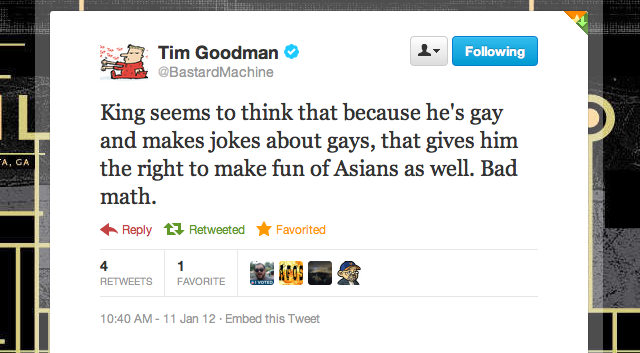
There was 2 Broke Girls showrunner Michael Patrick King's stupid defense of the racist material that's being written for the Korean Long Duk Dong on the show, or as GQ writer Lauren Bans amusingly calls the openly gay King's brand of humor, "gaycism":
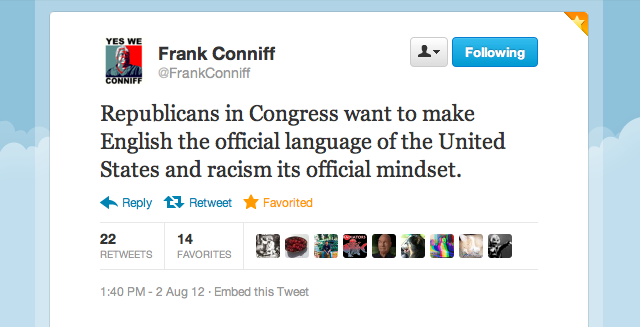
Ignorance came not just from sitcom joke writers but also from TV stars and, as usual, the far right:
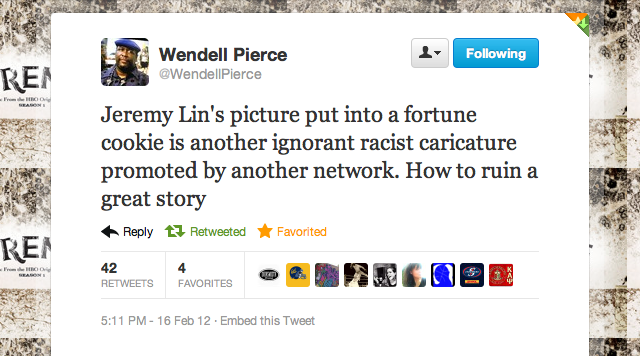
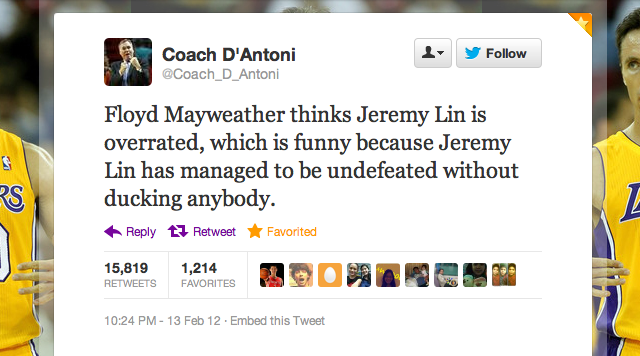
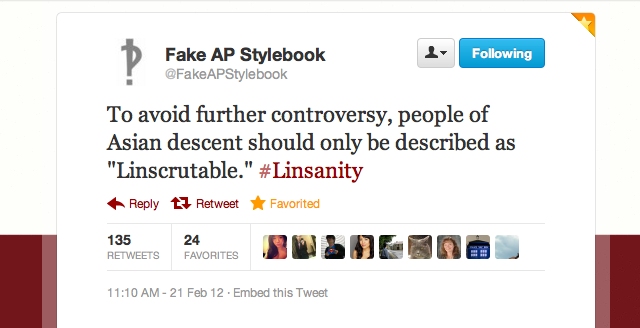
There was Linsanity (and the inevitable and stupid racial slurs in response to the rise of the NBA's first Asian American star player):
There was also the fall of aging (and disappointingly homophobic) champ Manny Pacquiao:
The AFOS blog's new "5-Piece Cartoon Dinner" column received a few shout-outs and retweets on Twitter, mostly from staffers at Titmouse because I said a few nice things about the animation studio's collabos with Disney: Randy Cunningham: 9th Grade Ninja and the even more impressive--and anti-authoritarian--Motorcity. The latter action cartoon is a one-season wonder that looks remarkably like a big-budget animated feature film each week and is another unfortunate casualty in a TV landscape that hasn't been kind lately to true sci-fi like Motorcity. Alyssa Rosenberg posted a piece on ThinkProgress where she lamented the lack of true sci-fi shows on the currently-more-fantasy-oriented--and crap-oriented--Syfy. Motorcity, which was slept on by even the few TV critics out there who regularly cover animated shows, was exactly the kind of sci-fi show Rosenberg was clamoring for.
I favorited Motorcity writer George Krstic's tweet about my review of his "Power Trip" episode mainly because of the joke he cracked about himself and his colleagues:
Enough about me. What about the rest of 2012?
(Most year-end lists can make for boring and grueling reading. Reflecting on the past year by skimming through tweets I favorited is turning into an entertaining alternative from scrolling through endless year-end articles and think pieces.)
Quite a bit of fun resulted on Twitter from the much-hyped second season of Downton Abbey (I once tweeted, "Note to self: Don't forget to add #DowntonAbbey to the list of 'Shit White People Like That I Don't Understand the Appeal Of.'"):
Artists whom I've been giving heavy airplay to on AFOS got the chance to kick it with their idols:
There was 2 Broke Girls showrunner Michael Patrick King's stupid defense of the racist material that's being written for the Korean Long Duk Dong on the show, or as GQ writer Lauren Bans amusingly calls the openly gay King's brand of humor, "gaycism":
Ignorance came not just from sitcom joke writers but also from TV stars and, as usual, the far right:
There was Linsanity (and the inevitable and stupid racial slurs in response to the rise of the NBA's first Asian American star player):
There was also the fall of aging (and disappointingly homophobic) champ Manny Pacquiao:
Subscribe to:
Posts (Atom)