Friday, March 30, 2012

March Madness March of the Day archive

And this is where Jimmy Jam and Terry Lewis got their whole look, except for the jhericurl stuff. A black Muslim in jhericurls would be like a white male dancer on Soul Train: an odd fucking sight.
The "Fruit of Islam" sequence from Malcolm X

Friday, March 2, 2012: Intro
Monday, March 5, 2012: "The Plot" from Mission: Impossible by Lalo Schifrin
Tuesday, March 6, 2012: "The Imperial March (Darth Vader's Theme)" from The Empire Strikes Back by John Williams
Wednesday, March 7, 2012: "Main Title" from The Great Escape by Elmer Bernstein
Thursday, March 8, 2012: "Space March" from You Only Live Twice by John Barry
Friday, March 9, 2012: "Prelude to War" from Battlestar Galactica by Bear McCreary
Monday, March 12, 2012: "Washington Ending & Raiders March" from Raiders of the Lost Ark by John Williams
Tuesday, March 13, 2012: "Fruit of Islam" from Malcolm X by Terence Blanchard
Wednesday, March 14, 2012: "Main Title" from Batman by Danny Elfman
Thursday, March 15, 2012: "Stripes March" by Elmer Bernstein
Friday, March 16, 2012: "Monster Battle March (Main Title)" from Invasion of the Astro-Monster by Akira Ifukube
Monday, March 19, 2012: "Baraat" from Monsoon Wedding by Mychael Danna
Tuesday, March 20, 2012: "Prelude and Main Title" from Superman: The Movie by John Williams
Wednesday, March 21, 2012: "March of the Beggars" from Duck, You Sucker by Ennio Morricone
Thursday, March 22, 2012: "Attack" from Patton by Jerry Goldsmith
Friday, March 23, 2012: "Blame Canada" from South Park: Bigger, Longer & Uncut by Trey Parker and Marc Shaiman
Monday, March 26, 2012: "Captain America March" from Captain America: The First Avenger by Alan Silvestri
Tuesday, March 27, 2012: "Main Title" from Spartacus by Alex North
Wednesday, March 28, 2012: "Main Title" from Star Trek: The Motion Picture by Jerry Goldsmith
Thursday, March 29, 2012: "Theme from Human Target" by Bear McCreary
Friday, March 30, 2012: "1941 End Credits" by John Williams

March Madness March of the Day: "1941 End Credits" by John Williams

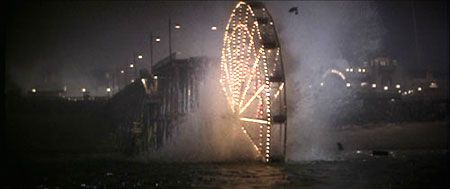
The visual effects in 1941's ferris wheel sequence are wonderful, but the best part isn't a visual effect. It's the brief shot of wanna-be ventriloquist Eddie Deezen covering his dummy's eyes as if it can see.

"Williams brings on the movie's signature piece, the 'March from 1941,' which will inform and underlie almost everything that comes after it. The march, instantly hummable, melds the fighting spirit of everything from Kenneth Alford and Malcolm Arnold's 'Colonel Bogey March' (The Bridge on the River Kwai), to the playful exuberance and bombast of Elmer Bernstein's The Great Escape, to the echoes of lost national spirit that tumble through Jerry Goldsmith's rousing score for Patton. Yet Williams is never caught cribbing lines or themes--the genius of the music is that is [sic] finds its own spirit, equivalent to the cacophonous madness of the film, yet also coursing with a generous and goofy charm and sense of its own scale that makes a listener laugh even without the attendant imagery."

--from film blogger Dennis Cozzalio's 2010 post about John Williams' 1941 score

Unless it's a Chris Rock routine, a Lewis Black rant, a Will Ferrell girlie-crying jag or Nicolas Cage screaming "Oh no! Not the bees!! Not the bees!! Aaaaaaaaahhhhhhhh!!! Oh! They're in my eyes!! My eyes!!," yelling is such a comedy killer for me. If you like your comedy broad and always shouty, the expensive 1979 WWII farce 1941, Steven Spielberg's first--and not surprisingly, only--attempt at directing a straight-up comedy, is up your alley. But for the rest of us, 1941 can be a chore to watch as it tries too hard to be funny and assumes nonstop loudness--even the end credits curtain call consists of clips of cast members yelling--will automatically yield laughs. No wonder the few funny or amusing moments in Spielberg's John Carter-style financial failure are, of course, moments where no one's yelling.

The whole story of getting 1941 made may be more fascinating than the film itself. 1941 producer and right-wing nutjob John Milius wanted to call his film The Night the Japs Attacked. We have then-MGM production chief Dan Melnick to thank for objecting to the use of "Japs" in the project's early title (back when it was attached to MGM and was nothing more than a Robert Zemeckis/Bob Gale screenplay that was darker-humored and smaller-scale than the finished product). 1941 is an example of a movie where I wish I were a fly on the wall--or better yet, an extra or crew member or whoever was put in charge of the craft services table--because I would have been surrounded by comedy icons like John Belushi, his SNL pal and Blues Brothers bandmate Dan Aykroyd, John Candy and Joe Flaherty; legendary actors like Toshiro Mifune, Christopher Lee and Warren Oates; and '70s hotties like Nancy Allen and that girl from Eight Is Enough. It's the ultimate "film that must have been more fun to make than sit through."

If you squint really hard at this cover of the graphic novel adaptation of the megaflop 1941, you can make out John Carter leaping behind John Belushi and attempting to flee from all the press coverage of Disney's big-ass financial loss.
In 1979, 1941 famously tanked. So did the little-known
graphic novel tie-in. (Photo source: Steve Bissette)
Spielberg is capable of comedy (see Jaws, Raiders of the Lost Ark, Catch Me If You Can or E.T.'s fish-out-of-water gags), so why did he drop the ball in 1941? Was it because of "too many cooks" syndrome--as 1941 cast member Tim Matheson implied in an A.V. Club "Random Roles" interview where he also noted that "It was fun to shoot, but I didn’t know what the core of it was"--or was the party-animal atmosphere on the set to blame? Vulture's "History Proves the More Fun a Movie Set Is, the Less Fun the Movie Is" slideshow argued that it was the latter.

"Belushi and Aykroyd... turned the set into one big playground where they could wildly drive around in their own vintage New York taxicab and throw out random scene ideas that Spielberg gladly accepted," noted the Vulture list. "First assistant director Jerry Ziesmer's memoir, Ready When You Are, Mr. Coppola, Mr. Spielberg, Mr. Crowe, paints a portrait of an out-of-control set where everybody was constantly cracking each other up."

Actually, I come not to bury 1941 (because so many have attacked it so well already, and I'm having a hard time trying to restrain myself from constantly dissing it), but to praise its few highlights. Let's list them now: the skillfully shot USO dance number/fight sequence (it hints at what 1941 would have been like as a musical, which, at one point during production, was what Spielberg wanted to turn 1941 into, and it also proves that the film would have been better off focusing mostly on the teenage characters); the offbeat sight of Robert Stack crying over Dumbo; the wonderful pre-CGI visual effects for the ferris wheel set piece; and the most memorable highlight, John Williams' terrific score.

So I don't find 1941 to be as hilarious as fans of Spielberg's original and longer cut like Dennis Cozzalio do, but I do agree with Cozzalio about Williams' "March from 1941." A great piece of symphonic anarchy, the theme is as loud as the movie's brand of property damage-reliant humor, but aren't all national anthems supposed to be performed loudly? The 1941 march is like the national anthem of Notreadyforprimetimeplayalistica or some country in an alternate reality where comedy nerds run Congress, the Supreme Court justices are stand-ups like Dom Irrera (who's had plenty of judicial experience presiding over Audience Network's Supreme Court of Comedy) and Paul Mooney (too bad he's not a Supreme Court justice because I would love to see Mooney verbally rip apart the conservative justices over matters like President Obama's health care law) and flags were flown at half-mast when Belushi, his '70s SNL colleague Gilda Radner and '80s and '90s SNL regular Phil Hartman died.

Like yesterday's penultimate "March Madness March of the Day," Bear McCreary's Human Target theme, the 1941 march captures the spirit of other classic themes without regurgitating their melodies. It's outlasted the movie it originated from.


All the other "March Madness March of the Day" posts from this week:
"Theme from Human Target" by Bear McCreary
"Main Title" from Star Trek: The Motion Picture by Jerry Goldsmith
"Main Title" from Spartacus by Alex North
"Captain America March" from Captain America: The First Avenger by Alan Silvestri

This is the final "March Madness March of the Day" post.

Thursday, March 29, 2012

March Madness March of the Day: "Theme from Human Target" by Bear McCreary

Coming soon: Hunan Target, the all-Chinese version about badass security expert Christopher Chan.
"Bear McCreary's Christopher Chance theme is as important to that character as the Raiders March is to Indiana Jones, the Imperial March to Darth Vader, or Jerry Goldsmith's 'It's A Long Road' theme for the Rambo character," said a Human Target fan in an online petition where he called for Fox to bring back Jonathan E. Steinberg and the Walking Dead scorer as the showrunner/composer duo on Human Target during its second and unsurprisingly final season.

Although it bore little resemblance to the terrific and psychologically complex Vertigo master-of-disguise comic it was based on, the much more straightforward TV version of Human Target, particularly in its first and best season, was an enjoyable action drama in the vein of Burn Notice and Leverage. But it was far more globally minded than the confined-to-Miami Burn Notice (shot on location in Miami) and the confined-to-Boston Leverage (shot in Portland, Oregon, which poses as Boston and other cities, much like how Human Target's Vancouver homebase was disguised--a la the comic book version of Chance--as San Francisco and other locales). So in the music department, Steinberg, who once said his globetrotting and martial arts-heavy version of Human Target was built out of the DNA of the Star Wars, Star Trek and Indiana Jones films he grew up watching, encouraged McCreary to think big and epic.

Mark Valley is living every guy's dream: being handcuffed to Emmanuelle Vaugier.
"The real thrill of scoring Human Target comes from the unprecedented creative freedom I’ve been given to create the kind of sweeping, thematic and adventurous score largely absent from both the small and large screen in recent years. And while the heart of the score is old school, its [sic] not a throwback or a parody," wrote McCreary in his blog post about working on Human Target's pilot episode. "My goal was to create a continuation of classic orchestral scores, not a regurgitation of them."

McCreary's score music, from the 33-second main title march that trumpeted Chance's heroics to the themes he wrote for each love interest or villain, sounded superb. It was reminiscent of the dashing-sounding work of the late Shirley Walker, whom McCreary idolizes, and her staff of composers on Batman: The Animated Series, and it was accomplished on an amazingly large scale, despite a limited network TV budget (snowy Vancouver as not-exactly-snowy SF... again?!). Human Target's first season featured music performed by a 60-piece orchestra or larger, like in the series highlight "Christopher Chance," both the last episode before Steinberg and McCreary's exit and the last good episode (other than a Steinberg-penned second-season ep that reunited Mark Valley's eccentric and remorseful assassin-turned-bodyguard with Lennie James' unrepentant thug Baptiste, his ally-turned-nemesis-turned-ally).

Mark Valley makes an appearance at what ended up being Bear McCreary's final Human Target recording session and offers to teach the dorkiest violinists in the studio some krav maga moves.
One thing I enjoyed about the first-season Human Target opening title sequence, which evoked Human Target's comic book roots and was produced by the highly esteemed Imaginary Forces title design studio of Mad Men fame and directed by Karin Fong, was how it was animated and edited to the rhythms of McCreary's classy and cinematic-sounding march.

"This perfect timing between music and images was achieved because I actually wrote the music first, months in advance, and delivered it to the animators as a guideline," wrote McCreary at the beginning of his Human Target stint. "This combination of imagery and ballsy orchestral music make [sic] a bold statement, that this series is going to be something special. Chance is not your typical action hero and his music is not your typical electronica-inspired TV scoring. The title promises that you are about to watch a movie."


The ballsy orchestral sound lasted only one season. This was due to Human Target becoming a victim of showrunner musical chairs, one of many aspects of the TV industry I'll never fully understand. Tim Jones did decent work as the original score composer for one of Human Target producer McG's other action shows, the more comedic and soapy Chuck, but when Jones replaced McCreary on Human Target, his efforts paled in comparison to McCreary's. Jones' much less epic Chuck sound was wrong for Human Target, as was the whole Chuck-ification of Valley's show that was spearheaded by Steinberg's replacement, Chuck veteran Matt Miller, in Human Target's second season (why do the words "if it ain't broke, don't fix it" come to mind?).

In Human Target's second-season opening titles, Jones' theme briefly references McCreary's Chance theme at the beginning, but it morphs into this strange and unengaging beast that doesn't match the movements of the mostly unchanged opening title graphics. It's emblematic of Jones' less epic approach, which was the opposite of what McCreary said he wanted to achieve with his music for Chance.

Jones' theme is so out-of-place in the opening titles that "Human Touch" by Rick Springfield--who starred as Chance in an earlier and much more short-lived TV incarnation of Human Target--would have been a better replacement.

Wednesday, March 28, 2012

March Madness March of the Day: "Main Title" from Star Trek: The Motion Picture by Jerry Goldsmith

George Takei is thinking, 'I want to slap the costumer who stuck me in this hideous pastel bathrobe.'
(Photo source: They Boldly Went)

Jay-Z is so enthused about the sample of the horns from The Menahan Street Band's "Make the Road by Walking" during his own track "Roc Boys (And the Winner Is)..." that towards the end of the jubilant "Roc Boys," H.O.V.A. says, "This is black superhero music right here, baby!" Jerry Goldsmith's equally jubilant march at the start of Star Trek: The Motion Picture is intergalactic superhero music, baby.

Too bad the film it originated from is more Green Lantern than The Iron Giant (or Iron Giant director Brad Bird's other great superhero movie, the completely earthbound Incredibles). Like the live-action Green Lantern, it's overly solemn, the main adversary is a ginormous yet somehow unintimidating (and amorphous) cloud from outer space and the hero comes off as an unlikable and arrogant jerk.

Having Admiral Kirk aggressively swipe the command of the refurbished Enterprise from a younger officer he actually recommended for the job wasn't exactly a great way to introduce the Kirk character to moviegoers who had never seen Star Trek on TV before. "He's supplanting someone else (someone who may actually be better equipped for the job), and he's bizarrely pissy about it too, like he lost his sense of humor between now and the end of the third season," wrote Zack Handlen about Kirk in his piece on ST:TMP for The A.V. Club. "We're supposed to like Kirk, not vaguely tolerate him."

The tension between Kirk and his ill-defined protégé Will Decker (future 7th Heaven dad Stephen Collins) is supposed to feel dramatic, like we're watching All About Eve in space (and with dudes in ugly pastel space pajamas and unitards instead of divas in evening gowns from the 20th Century Fox wardrobe department), but their conflict is dealt with in such an un-dramatic fashion. It's quickly brushed aside to focus on the money shots of the Enterprise's encounter with The Cloud, a.k.a. V'Ger or the lesser-used Vejur, an alternate spelling that makes it look like the Enterprise is battling an Indian tennis player (speaking of which, Vijay Amritraj has a cameo in Star Trek IV: The Voyage Home as an exhausted Starfleet officer who reports back to the fleet about his downed ship). Kirk's motivation for getting the captain's chair back (other than, of course, the V'Ger crisis, is it due to a midlife crisis or resentment from being a Starfleet paper-pusher for so long or both?) is so underdeveloped in TMP that Nicholas Meyer took notice of its underwritten-ness, expanded upon this older Kirk's insecurity about being an out-of-touch and irrelevant relic and made it such an effective element in Star Trek II: The Wrath of Khan (and again in Star Trek VI: The Undiscovered Country).

They still have traffic cops in the 23rd century? You would think that in the future, people would be better drivers by then. I always liked how the Enterprise had an Asian helmsman because you can shut down racist dipshits who joke about Asian drivers by saying, 'Sulu is proof that Asians can drive, motherfucker.'
I always dug how the Starfleet traffic cop does a backflip, like he's some Pinoy traffic cop entertaining motorists with Michael Jackson dance moves. (Photo source: TrekCore)

During their attempt to relaunch Star Trek on the big screen, the TMP crew--led by series creator and TMP producer Gene Roddenberry and director Robert Wise, who was no slouch at intelligent sci-fi (his 1971 procedural The Andromeda Strain is a much more entertaining and witty '70s sci-fi film than TMP)--focused too much on spectacle, which isn't one of the reasons why the old show is, to borrow one of Spock's favorite words, fascinating.

We want to see Kirk, Spock and McCoy wittily snipe at each other and debate over ethics and fight their way out of trouble like they often did on the old show, not gawk silently for 10 minutes at visual effects (which vary from stunning and on a par with TMP effects whiz Douglas Trumbull's 2001 and Close Encounters work to "passable for their time but haven't aged well") as the Enterprise penetrates V'Ger's V'Jayjay. That character interplay is why I prefer J.J. Abrams' first Star Trek installment, a film that irritates hardcore Treksters, over TMP (I wish Right Stuff director Philip Kaufman made TMP instead of Wise because he would have gotten Toshiro Mifune to play the Enterprise's Klingon nemesis, and that would have ruled).

However, DeForest Kelley delivers a few good quips that keep TMP, which is paced less like the nimble and youthful-feeling original series and more like some square and annoyingly conservative Biblical epic from the '50s or '60s, from being a complete slog (too bad Kelley's the only cast member in TMP who's behaving more like his old self from the show than like a pod person). Goldsmith's score, which restates the main title march a few times in the film's first act and then takes a turn from mostly upbeat to eerie and atonal, also keeps TMP from being a total slog, and it helps elevate the one sequence where shit gets exciting and gripping--the thruster-suited Spock's spacewalk inside V'Ger.

Going back to that march, I feel like it's too good for TMP. It's a theme for the movie Roddenberry and Wise thought they were making, not the underwhelming one that ended up on screen (the DVD-only Director's Edition that Paramount released 12 years ago doesn't quite rectify the screenplay's weaknesses--no updated effects footage ever could--but fortunately, it's faster-paced and snappier than previous cuts of the movie). But without that march, TMP would have been more of a chore to watch than it already is.

An extra on the Director's Edition DVD shows what TMP would have been like without the march. It contains a snippet of a rejected Blue Max-esque take on "The Enterprise," the cue from the lengthy travel pod sequence, or as I like to call that sequence, the "Shatner wants to hug the Enterprise... envelop that Enterprise... make love to the Enterprise" sequence. Wise asked Goldsmith to rework "The Enterprise" and give it more oomph. "There's no theme!," said Wise.


The final result led to this beloved--if kind of overplayed--march that would go on to reappear in a subsequent TV spinoff (although Star Trek: The Next Generation composer Dennis McCarthy came up with a nice arrangement that combined Alexander Courage's '60s Star Trek fanfare with Goldsmith's TMP march, the march sounded much less impressive coming from an orchestra that was smaller than TMP's 90-piece orchestra) and four more feature films. Intergalactic superhero music right here, baby.

Tuesday, March 27, 2012

March Madness March of the Day: "Main Title" from Spartacus by Alex North

Now that's what's missing from the Starz channel's Spartacus: Vengeance: crew cuts.
Spartacus--the film version with Kirk Douglas in the arena, not the Starz show with a frequently topless Xena--isn't a perfect epic, but I prefer it over the 2000 Best Picture Oscar winner Gladiator. Plus, the more dully scripted and much less politically intriguing of the two Roman epics didn't put an end to the Hollywood blacklist, and it doesn't open with killer Saul Bass opening titles accompanied by a riveting and slightly discordant march by Alex North. The main title theme and much of the rest of North's Spartacus score seemed to be, as Jonathan Z. Kaplan theorized in the 2000 "101 Great Film Scores on CD" issue of Film Score Monthly magazine, an attempt to go against the grain of Miklós Rózsa-style epic scores (not that there's anything wrong with the stately Rózsa school of scoring from the '50s, but it wouldn't have belonged in a downbeat and cerebral epic like Spartacus).