Showing posts with label Aziz Ansari. Show all posts

Wednesday, November 22, 2017

The problem with The Problem with Apu is that not enough people are going to see Hari Kondabolu's terrific documentary


This is the last all-new blog post before this blog's absolute final post in December 2017.

Fuck all these (predominantly white) superheroes fighting motion-capture-enhanced (and often boring) supervillains on the big screen. The movies I'm way more eager to see are documentaries about ordinary Asian Americans fighting stereotypes. It's a fight I've been a part of in some capacity. Nearly everything I do (even something as insignificant as writing a barely-being-read-by-anybody post for this insignificant and soon-to-go-completely-inactive blog) is some sort of clapback against Asian stereotypes, which have been a pain in my ass since junior high. Filmmaker Salima Koroma's Bad Rap, a doc about Asian American rappers, was the movie I wanted to see the most last year, and now The Problem with Apu, a 49-minute doc directed by Michael Melamedoff and hosted and produced by comedian and Politically Re-Active podcast co-host Hari Kondabolu, is the 2017 film that, despite its skimpy length and non-theatrical status, I've been anticipating the most, much more so than Wonder Woman, Thor: Ragnarok and even Star Wars: The Last Jedi.

The Problem with Apu chronicles the Indian American comedian's love/hate relationship with a little-known Tracey Ullman Show spinoff called The Simpsons. Kondabolu's a Simpsons fan who loves everything about the animated franchise that was brought to life by Matt Groening, James L. Brooks and the late Sam Simon, except for one character. That would be Apu Nahasapeemapetilon, the Indian convenience store owner who, since the show's premiere in 1990 (not counting a 1989 Christmas special that was actually the eighth episode in the first season's production order, "Simpsons Roasting on an Open Fire"), has been voiced by a white guy, longtime Simpsons voice actor Hank Azaria. The character is, as Kondabolu describes him in the doc, "servile, devious and goofy." Apu's shtick on the show is, as Kondabolu memorably said in an extremely funny 2012 Totally Biased with W. Kamau Bell segment about his delight over the rise of Indian American representation on TV, basically "a white guy doing an impression of a white guy making fun of my father!"


The most interesting tidbit about Kondabolu's Totally Biased rant about Apu, which went viral and ended up being shown in high school and college classrooms, is that Kondabolu was initially reluctant to write and perform the segment because he was so tired of complaining about Apu. I like how Bell--the now-defunct FX late night show's titular host and Kondabolu's boss in the Totally Biased writers' room--had to talk Kondabolu into doing it, as if Kondabolu were Logan being dragged out of his dead-end limo driver job to unsheathe his adamantium claws one last time and protect some runaway mutant kid.

Monday, December 7, 2015

Attach the block: Netflix's Black Mirror: White Christmas imagines a cold future where people can be blocked in offline relationships like on Twitter

Tonight on Channel 4, it's Black Mirror: White Couch.
The following is a repost of a piece from December 17, 2014. It was published right after Black Mirror: White Christmas had its British premiere on December 16, 2014. White Christmas had its American premiere on DirecTV's Audience Network on December 25, 2014 and will finally be added to Netflix this Christmas day.

Goddammit, Black Mirror! Why do you have to be so amazing? Black Mirror isn't just the best anthology franchise currently on the air. It also contains some of the craftiest sci-fi storytelling on TV in 2014, as exemplified by Black Mirror creator Charlie Brooker's feature-length Black Mirror: White Christmas, a delightfully twisted piece of non-traditional holiday entertainment that premiered in the U.K. on Channel 4 last night. White Christmas, which guest-starred Jon Hamm and a couple of Game of Thrones alums, Oona Chaplin and Natalia Tena, feels more like a feature film than a typical Black Mirror episode, which is why I'm writing the title in italics instead of in between quotation marks.

I've written about Black Mirror before, after it was added to Netflix in America, and as someone who stubbornly refuses to become a smartphone zombie like the male smartphone zombies in my family, I just love how much twisted and subversive fun the show has with exploring the dark side of technology. Want to live inside your phone? Well, you get your wish, but you have to part with a little thing called free will. Want to block your significant other from your marriage or any future interactions you have with him or her, just like how you can block some anonymous troll on Twitter? Well, here's the tech to block that bastard, but that person's going to be driven so crazy by being blocked that the bastard will come back later to murder your entire family.

The block isn't hot.

I'm making it sound like Black Mirror is the kind of completely technophobic piece of shit Michael Crichton used to crank out. But the writing in the six previous Black Mirror episodes and White Christmas is more nuanced than that. Black Mirror's attitude isn't "Technology is evil." The show's attitude is more like "People are evil and fucked up, and when they have all this technological power in their hands, they don't know what to do with it." Not every gadget on the show is a detriment. There's one gizmo from the show I'd want to have, and that's the digital drawing board Hayley Atwell uses to create illustrations and graphic designs in "Be Right Back." But as for all the other gadgets, they seem appealing at first because of the immense power they give their users--like the "Entire History of You" device known as "the grain," which allows people to record everything from their workdays to their bedroom sessions with an implant in their skulls--but then they lose their appeal for me because of the horrible mistakes Brooker's characters make with these devices.

The first and third segments in White Christmas' triptych of interconnected horror stories about technology made me notice that there are never any healthy romantic relationships on Black Mirror. They all end badly. (At times, Black Mirror feels like the serious sci-fi version of many of Aziz Ansari's more recent stand-up routines, which have been based on extensive research he did about how much technology has changed relationships and romantic interactions.) Mankind's inability to contain its greed or keep its addiction to technology in moderation poisons everything, especially relationships. Even the original Twilight Zone, a huge influence on Brooker, was less cynical about relationships impacted by machines. When William Shatner and Patricia Breslin escaped the clutches of Satan's fortune-telling machine at the end of "Nick of Time," you knew their marriage was going to turn out okay. That's never the case with any relationship on Black Mirror.

The star of Mad Men, who portrays in White Christmas a futuristic dating coach who, of course, is unable to control the horrible outcome of one such ill-fated relationship, is the Kendrick Lamar of both American and British TV. He appears on everything. (Oh, look, he's on The Increasingly Poor Decisions of Todd Margaret! Now there he is on Parks and Rec, as the only employee of Leslie Knope's who's more incompetent than Jerry!) In White Christmas, I like how Brooker and director Carl Tibbetts got Hamm to tap into his comedic side, as seen in countless comedy podcasts, his 30 Rock guest shots and Bridesmaids, instead of doing nothing but brood a la Don Draper for the entire Christmas special (all the brooding during the special is left to Rafe Spall as a man who receives the aforementioned "block" from his girlfriend, who's played by Salem star Janet Montgomery). Hamm's so skilled at both anchoring Brooker's stories and injecting levity into them (his unreliable narration is the funniest part of the first White Christmas segment) that had Brooker wanted to go old-school instead and have a host introduce each story on Black Mirror, Hamm would have been the perfect Black Mirror host/narrator.

As a viewer of several comic book-inspired shows that are attempting to build shared universes of their own by dropping one reference to either the source material or a sister project after another (with his giddy habit of giving criminals colorful villain names that are the exact same names as their DC Comics print counterparts, Cisco from the CW's The Flash should be called "Mario Sue," as in "mare-ee-oh"), I'm getting kind of Easter-egged out. White Christmas is full of Easter eggs that reference previous Black Mirror episodes--at one point, Spall is seen flipping through TV shows that were featured in "Fifteen Million Merits" and "The Waldo Moment," as a sort of stocking stuffer from Brooker, in addition to this whole feature-length Christmas present he's written--but I don't mind those Easter eggs.

The possibility in White Christmas that all these Black Mirror stories take place in the same universe is interesting, and it reminds me of how the '90s version of The Outer Limits used to take its most well-received episodes and create sequels to them or intertwine those episodes' self-contained continuities with other episodes' continuities. In fact, Black Mirror is essentially an Outer Limits for the age of Google Glass and digital footprints, but better, stronger, faster. And--despite not containing any bug-eyed monsters or Cronenbergian creatures--scarier.

The first two seasons of Black Mirror--just three episodes each--can be streamed on Netflix, and they'll be joined on December 25 by the long-awaited addition of White Christmas to the streaming service. A 12-episode third season was commissioned by Netflix earlier this year and has not yet been given a premiere date.

Thursday, November 12, 2015

Netflix's Master of None is revolutionary, and not just because it's the first half-hour comedy filmed in pimptastic 2.35:1 (ask your film nerd friend)

The 80-year-old tribute from The Hunger Games's crooning game is on fleek.

The following contains spoilers for the final two episodes of Master of None.

Asian American men have been so badly stereotyped and emasculated by Hollywood (peep the Long Duk Dong catchphrase montage from "Good Morning Orlando," last week's Fresh Off the Boat episode, for a refresher course) that several Asian American male indie filmmakers have worked to counteract those stereotypes by casting either themselves or much more polished Asian actors as romantic leads, one of many kinds of roles Asian American men only rarely get to play outside the indie world. But to be honest, even though it's nice to see these directors defying stereotypes, too many of these indie flicks--or more commonly these days, YouTube shows--have turned out to be underwhelming or banal in execution. (A rare example of an indie flick with an Asian American guy as a romantic lead that isn't so underwhelming as a movie is 2011's struggling musician comedy Surrogate Valentine, and although it was directed by a white guy, Dave Boyle, it's thoroughly suffused with the creative voice of Surrogate Valentine star and co-writer Goh Nakamura.)

It's not surprising that the similarly conscious-about-race Aziz Ansari and his fellow Parks and Recreation colleague, writer Alan Yang, the creators of Netflix's remarkable new half-hour comedy Master of None, chose to open their show's very first episode with the ultimate in "Hey, I have sex too! I ain't no emasculated dork like how Hollywood likes to portray me!" moments during stories told from Asian American males' perspectives. Master of None's first glimpse of TV commercial actor Dev Shah, Ansari's alter ego, is Dev in the middle of banging Rachel (former SNL featured player Noël Wells), the record label publicist who will become Dev's permanent love interest later on in the season. The opening scene is the first of many figurative middle fingers Ansari and Yang, whose counterpart on the show is Kelvin Yu's Brian, satisfyingly deliver throughout the show to racist power players from Hollywood who either contribute to marginalizing Asian Americans, whether they're Indian or, in the case of Yang and Yu, Taiwanese, or continue to be in doubt about giving them screen roles like "one of the jobs Bradley Cooper's characters do in movies," as Dev says at one point.


But because Ansari isn't such a vain comedy star--you can tell how much vanity a male comedy star has by how often he gets the staff writers to write shirtless bedroom scenes for him, like the bizarre amount of shirtless bedroom scenes that were written for the late Richard Jeni during his short-lived '90s sitcom Platypus Man--Ansari amusingly cuts short his own first-ever on-screen moment of athletic, TV-MA-rated (but without any nudity) lovemaking. He has his own character's condom suddenly break.

The broken condom scare leads to both frantic Googling of fun facts about pre-ejaculate and an emergency Uber ride for both Dev and Rachel to the nearest pharmacy for a Plan B pill and--because Dev is as passionate a foodie/drinkie as Ansari--an irresistible bottle of Martinelli's apple juice. The mishap perfectly kicks off a series of anxieties Dev experiences about children (he doesn't completely hate them, but like Ansari, he doesn't plan on having any), marriage (again, like with Ansari, the idea of it intimidates Dev), texting etiquette (another subject Ansari has been preoccupied with in his stand-up act), accepting certain acting roles that would pay well but could also cause him to be labeled an "Uncle Taj" and various other life choices.


Master of None--which gets its title from a 2006 Beach House song about a person who hops from fuckbuddy to fuckbuddy but winds up being lonely (the tune is featured at the end of the third episode, "Hot Ticket")--is Ansari's first big endeavor into auteurist TV (he also directed two of the 10 episodes that Netflix dropped all at once last Friday). The show interestingly structures itself as a series of mini-movies--hence the "Master of None Presents" logo during the main titles of each episode--and breaks away from both the joke machine rhythms of network TV ("Alan and I didn't want the show to be so cut-y. Sometimes I'd watch Parks and it's so fast-paced," said Ansari to the A.V. Club) and the studio set-bound nature of many network sitcoms like Parks.

Instead, it embraces the commercial-free pacing of Netflix and favors long single takes during street conversations or hallway exchanges like Dev's amusing exchange with his friend Arnold (Eric Wareheim) about the frustration of being unable to tell if Eminem's 8 Mile theme "Lose Yourself" is being rapped from the point of view of Em or his 8 Mile alter ego B-Rabbit ("[Linklater] has been a huge influence on me, and he has been for a few years," said Ansari in that same A.V. Club interview, while discussing his love for the long takes during Linklater's Before trilogy). The show also favors location shooting in New York (and, for one episode, Nashville) and, in what has to be a first for a half-hour comedy, cinematography shot in the 2.35:1 aspect ratio. That's the same aspect ratio all the Star Wars movies and Bond flicks (except Dr. No, From Russia with Love, Goldfinger, Live and Let Die and The Man with the Golden Gun) are filmed in.

Master of None cinematographer Mark Schwartzbard makes beautiful use of the ultra-widescreen frame. At first, the Scope aspect ratio seems like a bizarre choice for a half-hour comedy. But when Schwartzbard continually composes shots as clever and playful as the one where Brian and his laconic immigrant dad Peter (Clem Cheung) finally bond while reading The Economist, but due to Peter's Ron Swanson-like discomfort with expressing any kind of emotion, they're sitting far apart and at the edges of the frame rather than shoulder to shoulder (or when Schwartzbard sometimes composes shots that are just plain gorgeous), the aspect ratio suits the show.


Thursday, September 3, 2015

Throwback Thursday: Rise of the Planet of the Apes

Too bad Hanna-Barbera doesn't exist anymore because I'd like to see them totally fuck up Dawn of the Planet of the Apes and turn it into a kids' cartoon called Gripe Ape.
Every Throwback Thursday, I randomly pull out from my desk cabinet--with my eyes closed--a movie ticket I saved. Then I discuss the movie on the ticket and maybe a little bit of its score, which might be now streaming on AFOS.

The most astounding thing about director Rupert Wyatt's 2011 surprise hit Rise of the Planet of the Apes, the second and better-received of two different attempts by 20th Century Fox to relaunch its Planet of the Apes franchise from the '60s and '70s, isn't the motion-capture technology the film deployed to bring to life superintelligent simians. It's the film's ability to somehow take otherwise charismatic actors like Brian Cox, Deadbeat star Tyler Labine and David Oyelowo and make them the most boring fucks on Earth.

For instance, the future Martin Luther King plays a villainous businessman here--before seeing Selma, I almost forgot Oyelowo previously appeared in this loose remake of 1972's Conquest of the Planet of the Apes--but he makes way more of an impression as a villain on the animated Star Wars Rebels, even without ever showing his actual face. As the superintelligent chimpanzee Caesar, Andy Serkis, with the help of Weta Digital's motion-capture tech, is the real star of these modern-day Apes movies. After the remarkable and expressive mo-cap acting of Serkis, Karin Konoval, a.k.a. Mrs. Peacock from the ultra-disturbing X-Files episode "Home," and, in 2014's Dawn of the Planet of the Apes, Toby Kebbell, there's no way in that place Charlton Heston damned them all to that these Apes movies are going back to burying the actors under rubber John Chambers ape masks.


This is also how former 20th Century Fox studio exec Tom Rothman titles his family photo albums.
I appreciate how both Rise and Dawn are Caesar's story rather than the story of either his human father, Bay Area pharmaceutical scientist Will Rodman (James Franco)--whose search for a cure for Alzheimer's inadvertently triggers the events that will lead to the dominance of apes over humans--or one of Will's relatives. It's preferable over the way the Autobots are relegated to guest stars in their own live-action Transformers movies. But these modern-day Apes prequels, especially Rise, could really use a human ally character with the personality of either Heston's cantankerous Colonel Taylor from the first two Apes installments or Ricardo Montalban's Armando, Caesar's foster dad from the third and fourth Apes installments (as Will's dad, who's suffering from Alzheimer's, John Lithgow gives the best non-simian performance in Rise).

Franco is in visibly bored, "grrrr, where's my paycheck so that I can get some new leather paddles for my next art installation?" mode here. I wish Caesar's favorite parent were played by either Jeff Goldblum, who would have imbued some personality into Will and would have been able to bring a bit more life to Will's compassion for Caesar (but Will's dad would have had to have been played by someone older than Lithgow), or better yet, an actress like Jessica Chastain, because these modern-day Apes movies are too much of a sausage fest (Freida Pinto and, in Dawn, Keri Russell are little more than background extras).

That's one other thing that's missing from Rise and Dawn: a charismatic female presence like Kim Hunter's when she played Dr. Zira, the banana-hating chimp who becomes an ally of Taylor's, in the first three Apes movies. It's too bad Konoval's kindly circus orangutan Maurice, a simian character I like even more than Caesar, isn't female.


Maurice, who was named after 1968 Apes star Maurice Evans, is a huge part of why Rise is at its best when it moves away from Will and concentrates on the beginnings of Caesar's ape revolt. The dialogue for the scenes between Caesar and his simian followers is delivered in subtitled sign language, and the large amount of subtitled ASL in Rise is something you'd never expect to see in a summer blockbuster. Rise's comfort with silence and minimized dialogue during the ape sanctuary scenes and its confidence in maintaining that silence both make the digitized little girl's voice that translates Amy the gorilla's ASL in 1995's Congo sound all the more stupid.

All the spoken dialogue in the ape sanctuary scenes comes from the apes' mostly sadistic jailers, with the cruelest of them being Dodge Landon, played by Harry Potter villain Tom Felton in a not-very-convincing American accent. I really wish it were William Zabka from the original Karate Kid playing Dodge instead of Felton. It's such a Zabka part. Who wouldn't want to see a 20-something Zabka get smacked around by an angry gorilla?

'Caesar want naked bicyclists to leave city immediately! Caesar no care for human schlongs and derrieres!'

Felton has to deliver the cheesiest line in Rise and the prequel's most blatant callback to the first and best Apes movie: Heston's classic "Take your stinkin' paws off me, you damn dirty ape!" line. It's interesting how the worst line in the movie--a line we really didn't need to hear again because it's all too reminiscent of Tim Burton's misguided 2001 Apes remake--is followed by the movie's most powerful line, a moment that was foreshadowed by Roddy McDowall's Cornelius in the first Apes prequel, 1971's Escape from the Planet of the Apes: Caesar saying his first word, "No!"

Caesar's first word is the moment when Rise changes from a sci-fi prequel that's initially as pointless as The Phantom Menace and Attack of the Clones to the kind of riveting and worthwhile Apes movie we've always wanted to see but couldn't because of early-'70s 20th Century Fox's shoestring budgets and because of how limited creature FX technology was before the geniuses at Weta Digital got their stinkin' paws on it. I dig the city of San Francisco, but Serkis, Konoval and the other mo-cap performers are so skilled at turning Caesar and his lieutenants into sympathetic figures that I ended up rooting for their characters to wreak havoc on San Francisco. Now if only the movie would show Caesar and his army kicking each and every neighborhood gentrifier out of town.

None of Patrick Doyle's score cues from Rise of the Planet of the Apes are currently in rotation on AFOS, but "Golden Gate Bridge" ought to be.

Tuesday, February 24, 2015

Parks and Recreation (2009-2015)

Speaking of which, why would anybody resist chicken and waffles? Because, again, people are idiots.

The last remaining show on NBC that was from the great underwatched Thursday night sitcom lineup that lasted on that network from 2009 to 2013 (the other shows on that lineup: The Office, 30 Rock and, of course, Community, now a Yahoo Screen show), Parks and Recreation takes a bittersweet bow tonight. It's a bow made even more bittersweet by the death of Harris Wittels, one of Parks and Rec's key writers, a week before the airing of the series finale. He was one of many staffers who appeared on the show as examples of the countless crazies who make up Pawnee, Indiana, the show's setting: in Wittels' case, he played Harris the frequently stoned animal control employee. Some feminists hated Wittels for outspoken things he said about free speech that they found to be offensive, while both men and women in the comedy community--particularly anyone from the Parks and Rec fam--adored him and his joke writing, whether on Twitter (a great example of a Wittels tweet: "I don't know if there's a god or not, but I will say this: Cap'n Crunch Oops All Berries is bomb as fuck") or for Parks and Rec.

A special tribute to Wittels from his Parks and Rec colleagues has been tacked on to tonight's hour-long Parks and Rec series finale. The skewed sensibility of writers like Wittels, Megan Amram, Alan Yang, Aisha Muharrar, Joe Mande, Chelsea Peretti and, of course, Parks and Rec co-creator/showrunner Michael Schur helped make Schur's show about small-town government stand out as a small-town comedy. There are small-town comedies like The Andy Griffith Show that older generations of TV viewers tend to love for their likability and warmth, and then there are small-town comedies like the later seasons of Newhart and Parks and Rec--well, actually seasons 2 to 7 of Parks and Rec, to be exact--that are on another level of humor and aren't just merely likable and warm. Post-season 2 Newhart and Parks and Rec are also crazy as fuck. And underneath Parks and Rec's warmth lurks an often biting view of politics outside the world of Pawnee, reflected in its portrayal of the crazy politics within Pawnee.

I always liked how Parks and Rec is basically The West Wing for comedy nerds whose political ideologies echo The West Wing's but who have grown sort of jaded about politics since that older show's demise and have found several of The West Wing's frequently parodied speeches to be too hokey and Hollywood-slick to take seriously anymore (West Wing alum Rob Lowe was even part of the Parks and Rec cast for most of its run, and when Bradley Whitford showed up as a Parks and Rec guest star, that was another enjoyable little collision between the West Wing and Parks and Rec casts). Parks and Rec's idealism was tinged with a satirist's sharp-eyed view of the absurdities of things like government infighting, corporate doublespeak (like whenever Amy Poehler's Leslie Knope had to deal with the local candy manufacturer Sweetums) and this season, Silicon Valley office culture. Speaking of which, both the presence of the fictional Bay Area startup Gryzzl in Pawnee and a three-year time jump--which should have sunk the show but didn't--have resulted in an extremely enjoyable final season full of futuristic sight gags and pause button-worthy Easter eggs, an additional treat on top of Poehler finally getting her longtime wish for Bill Murray to play Pawnee's long-unseen mayor, all the show's longtime threads getting paid off with well-earned emotional moments (Donna tricks everyone into finally calling Jerry by his original name: Garry!) and all the hilarious side characters, from Jean-Ralphio to those accountant dudes who are always seen fangirling over the presence of their former colleague Ben Wyatt (Adam Scott), taking a final bow. My favorite pause button-worthy season 7 Easter egg would have to be this, an exhibit at the William Henry Harrison Museum that displays all the cool things about the alternate reality where President Harrison didn't die 30 days into his presidency:

But does Idris Elba get to take over as James Bond in this reality? That's the shit I want to know.

These other season 7 Easter eggs were pretty funny too:

And by viral, they mean that the sight of rhythmless white people attempting to dance made you want to fucking throw up.

If some fool brings his transparent Gryzzl tablet with him to a movie theater and keeps turning it on in the middle of the feature presentation, does that mean I get to beat the shit out of him with my transparent Gryzzl tablet that can transform into a baseball bat?

I'd love to see what the Old Glory Robot Insurance TV ads were like when Robotgate went down.

From the guys who brought you the riveting legal disclaimer for Happy Fun Ball comes...
(Photo source: Warming Glow)

By the way, why have I left out season 1 of Parks and Rec? Like so many other sitcoms, the show hadn't quite found its voice yet in that abbreviated first season. Parks and Rec's second season led to one of the greatest course corrections of any sitcom since the transformation of The Odd Couple from a strangely airless retread of the 1968 Walter Matthau/Jack Lemmon movie version in the single-camera format to a livelier, funnier and sharper buddy comedy energized by its switch to the multi-cam format.

That course correction mostly had to do with tweaking the heroine at the heart of Parks and Rec, Leslie, via the writers' wise move of changing her from a drab Michael Scott clone to a hyper-competent Tracy Flick type, but without a class-conscious chip on her shoulder and with a ton of friends who will take a bullet for her, whether it's that "beautiful tropical fish" Ann Perkins (Rashida Jones), Ben, Leslie's soulmate and now husband, or breakfast food-loving libertarian Ron Swanson (Nick Offerman), Leslie's mentor (and occasional adversary, ideology-wise). Rewriting Leslie into the straight-woman figure we know and love today shouldn't have worked, but it totally did. And that--along with the fully realized, Springfield-esque universe that surrounds Leslie--is why we have six great seasons of Parks and Rec (although some will argue that seasons 5 and 6 were when the show stumbled creatively a bit), all coming to an end tonight.


I bet DJ Roomba leads the robot revolt that takes down the humans of Pawnee in 2023.

Bruce Willis did the whole superheroes and supervillains in hoodies thing long before Arrow and The Flash started trying to make it hot.

Wednesday, December 17, 2014

Attach the block: Black Mirror: White Christmas imagines a cold future where people can be blocked in offline relationships like on Twitter

Tonight on Channel 4, it's Black Mirror: White Couch.
Goddammit, Black Mirror! Why do you have to be so amazing? Black Mirror isn't just the best anthology franchise currently on the air. It also contains some of the craftiest sci-fi storytelling on TV in 2014, as exemplified by Black Mirror creator Charlie Brooker's feature-length Black Mirror: White Christmas, a delightfully twisted piece of non-traditional holiday entertainment that premiered in the U.K. on Channel 4 last night. White Christmas, which guest-starred Jon Hamm and a couple of Game of Thrones alums, Oona Chaplin and Natalia Tena, feels more like a feature film than a typical Black Mirror episode, which is why I'm writing the title in italics instead of in between quotation marks.

I've written about Black Mirror before, after it was added to Netflix in America, and as someone who stubbornly refuses to become a smartphone zombie like the male smartphone zombies in my family, I just love how much twisted and subversive fun the show has with exploring the dark side of technology. Want to live inside your phone? Well, you get your wish, but you have to part with a little thing called free will. Want to block your significant other from your marriage or any future interactions you have with him or her, just like how you can block some anonymous troll on Twitter? Well, here's the tech to block that bastard, but that person's going to be driven so crazy by being blocked that the bastard will come back later to murder your entire family.

The block isn't hot.

I'm making it sound like Black Mirror is the kind of completely technophobic piece of shit Michael Crichton used to crank out. But the writing in the six previous Black Mirror episodes and White Christmas is more nuanced than that. Black Mirror's attitude isn't "Technology is evil." The show's attitude is more like "People are evil and fucked up, and when they have all this technological power in their hands, they don't know what to do with it." Not every gadget on the show is a detriment. There's one gizmo from the show I'd want to have, and that's the digital drawing board Hayley Atwell uses to create illustrations and graphic designs in "Be Right Back." But as for all the other gadgets, they seem appealing at first because of the immense power they give their users--like the "Entire History of You" device known as "the grain," which allows people to record everything from their workdays to their bedroom sessions with an implant in their skulls--but then they lose their appeal for me because of the horrible mistakes Brooker's characters make with these devices.

The first and third segments in White Christmas' triptych of interconnected horror stories about technology made me notice that there are never any healthy romantic relationships on Black Mirror. They all end badly. (At times, Black Mirror feels like the serious sci-fi version of many of Aziz Ansari's more recent stand-up routines, which have been based on extensive research he did about how much technology has changed relationships and romantic interactions.) Mankind's inability to contain its greed or keep its addiction to technology in moderation poisons everything, especially relationships. Even the original Twilight Zone, a huge influence on Brooker, was less cynical about relationships impacted by machines. When William Shatner and Patricia Breslin escaped the clutches of Satan's fortune-telling machine at the end of "Nick of Time," you knew their marriage was going to turn out okay. That's never the case with any relationship on Black Mirror.

The star of Mad Men, who portrays in White Christmas a futuristic dating coach who, of course, is unable to control the horrible outcome of one such ill-fated relationship, is the Kendrick Lamar of both American and British TV. He appears on everything. (Oh, look, he's on The Increasingly Poor Decisions of Todd Margaret! Now there he is on Parks and Rec, as the only employee of Leslie Knope's who's more incompetent than Jerry!) In White Christmas, I like how Brooker and director Carl Tibbetts got Hamm to tap into his comedic side, as seen in countless comedy podcasts, his 30 Rock guest shots and Bridesmaids, instead of doing nothing but brood a la Don Draper for the entire Christmas special (all the brooding during the special is left to Rafe Spall as a man who receives the aforementioned "block" from his girlfriend, who's played by Salem star Janet Montgomery). Hamm's so skilled at both anchoring Brooker's stories and injecting levity into them (his unreliable narration is the funniest part of the first White Christmas segment) that had Brooker wanted to go old-school instead and have a host introduce each story on Black Mirror, Hamm would have been the perfect Black Mirror host/narrator.

As a viewer of several comic book-inspired shows that are attempting to build shared universes of their own by dropping one reference to either the source material or a sister project after another (with his giddy habit of giving criminals colorful villain names that are the exact same names as their DC Comics print counterparts, Cisco from the CW's The Flash should be called "Mario Sue," as in "mare-ee-oh"), I'm getting kind of Easter-egged out. White Christmas is full of Easter eggs that reference previous Black Mirror episodes--at one point, Spall is seen flipping through TV shows that were featured in "Fifteen Million Merits" and "The Waldo Moment," as a sort of stocking stuffer from Brooker, in addition to this whole feature-length Christmas present he's written--but I don't mind those Easter eggs.

The possibility in White Christmas that all these Black Mirror stories take place in the same universe is interesting, and it reminds me of how the '90s version of The Outer Limits used to take its most well-received episodes and create sequels to them or intertwine those episodes' self-contained continuities with other episodes' continuities. In fact, Black Mirror is essentially an Outer Limits for the age of Google Glass and digital footprints, but better, stronger, faster. And--despite not containing any bug-eyed monsters or Cronenbergian creatures--scarier.

Both seasons of Black Mirror--just three episodes each--can be streamed on Netflix. There haven't been any announcements yet regarding Netflix making White Christmas available to American viewers. Parts of White Christmas are reminiscent of the sci-fi-tinged Batman: The Animated Series episodes "His Silicon Soul," in which a neglected robot clone of Batman believes he's the real Batman, and "Perchance to Dream," in which Bruce Wayne wakes up to discover his parents were never murdered. Excerpts from the late Shirley Walker's superb score from "Perchance to Dream" can be heard during "Brokedown Merry-Go-Round" and "Hall H" on AFOS.

Wednesday, June 5, 2013

5-Piece Cartoon Dinner Extra: The Venture Bros., "What Color Is Your Cleansuit?"

Remember the Bro, the bra for men from Seinfeld? Sgt. Hatred could really use one of them Bros right now.
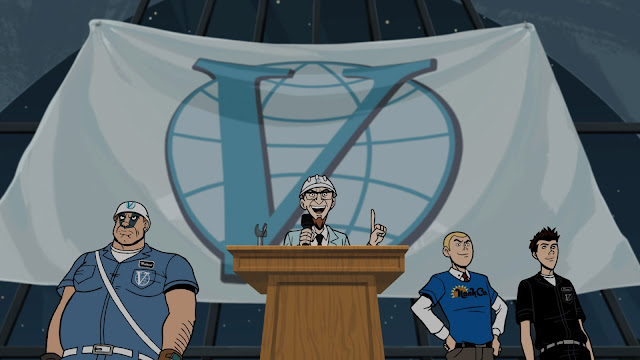
Dr. Venture isn't aware that his "Hail to the V" speech is eliciting giggles from the interns.
"5-Piece Cartoon Dinner" will return in the fall. Pulp's "Like a Friend," which was written and recorded for the Alfonso Cuarón version of Great Expectations but has become synonymous with The Venture Bros. ever since its appearance at the end of the show's fourth-season finale, can now be heard during the "AFOS Prime" block on AFOS.

Many TV critics who binge-watched all 15 new episodes of Arrested Development on Netflix last week complained that the show has lost its spark and its seven-year hiatus "was not good for its comedy." The new season's tacky-looking reliance on green-screen to accommodate the cast members' busy schedules and the forced attempts at political satire, which Arrested excelled at during the dark days of the Bush Administration (although I laughed at the new season's gags about "Halliburton Teen" and Halliburton's ice cream division), were among the haters' most frequent criticisms.

Lovers of smart TV--in other words, TV that doesn't involve singing contests, untalented trophy wives, creepy-looking child pageants or handfishing--who were disappointed with the new Arrested will probably be relieved to know that the return of The Venture Bros., another cult favorite that also experienced a prolonged break between seasons, isn't as shaky a viewing experience as some of those new Arrested episodes on Netflix. The seven-year hiatus has marred one particular aspect of Arrested, the interaction between Bluth family members, which was greatly reduced to cover up Mitchell Hurwitz's difficulties with getting all the original cast members in the same room, whereas the two-and-a-half-year hiatus between The Venture Bros.' fourth and fifth seasons, aside from a couple of specials to tide fans over, including last fall's Halloween special, has had no effect on "What Color Is Your Cleansuit?," The Venture Bros.' outstanding fifth-season premiere (which is actually the ninth episode in the season's production order).

The Venture Bros. is a rare example of a lengthy hiatus paying off hugely. Maybe it's simply because The Venture Bros. is animation, where you can easily work around certain obstacles the Arrested crew had to deal with and you're unable to be distracted by the stars' aging looks and attempts to freeze time on their faces because you can't see those faces. (But you can detect some signs of aging in the stars' voices, like when 2008's Batman: Gotham Knight got longtime Batman voice actor--and soon-to-be-two-time Venture Bros. guest star--Kevin Conroy to voice an anime incarnation of Bruce Wayne who looked as if he didn't shave yet, and the disconnect between middle-aged voice and youthful-looking character design was really off-putting.)

Or maybe it's because Venture Bros. creators Chris McCulloch, a.k.a. Jackson Publick, and Doc Hammer are huge perfectionists who wanted--and were granted--more time from Adult Swim to work on the fifth season, even with Titmouse Inc. now lending a hand with the animation since the Halloween special. (By the way, the addition of Titmouse has resulted in a slight uptick in animation quality--peep the dazzling-looking moment in the Halloween special when Hank, who's voiced by Publick, and his friend Dermott, who's voiced by Hammer, are surrounded by zombies.) Judging from the results of "A Very Venture Halloween" and now the ambitious, hour-long "What Color Is Your Cleansuit?," Publick and Hammer deserved the extra production time (and the duo is more than up to the challenge of crafting consistently funny comedy for an hour-long running time, a format that doesn't often work out so well when other half-hour comedy shows like The Office take a stab at it).

"What Color Is Your Cleansuit?" picks up right where "Operation P.R.O.M." left off and opens during the morning after the home school prom Dr. Venture (James Urbaniak) threw for Dean (Michael Sinterniklaas) and Hank, but it also cleverly ties in to "A Very Venture Halloween," a pivotal story for Dean, who finally learned from Ben, J.K. Simmons' disheveled scientist character, that he and Hank are clones, a helluva thing for Dean to discover when he's still in the middle of trying to get over Triana Orpheus' rejection of him. It turns out that the entire Halloween special occurred between the first and second acts of "What Color Is Your Cleansuit?," so that means the season premiere takes place over the course of several months (the off-screen growth of the angstier, now-Goth-y Dean's hair length from spiky to quasi-emo between the first and second acts is a nice little way for Publick and Hammer to establish the passage of time without relying too much on clunky-ass exposition). The months-long time frame makes Dr. Venture's pathetic inability to notice the gradual mutations his color-coded-cleansuit-clad interns have exhibited even more amusingly pathetic. Their mutations were inadvertently caused by the mutagenic radiation from the ray shield project he's recruited them to finish for his brother Jonas Jr. (Urbaniak)--without pay and with Dr. Venture taking all the credit for their work, of course, because it's Dr. Venture we're talking about here.

"Operation P.R.O.M." was a particularly intriguing episode for this show about failure because it started to point towards redemption for several characters, especially the long-suffering Gary (Hammer), a.k.a. Henchman 21, who grew a backbone over the course of the fourth season, got over the death of his Ray Romano-voiced best friend 24, quit henching for the Monarch and joined SPHINX. But as we see in "What Color Is Your Cleansuit?," Gary still can't catch a break because people still call him 21, and former Venture family bodyguard Brock Samson (Patrick Warburton) prevents 21 from joining his SPHINX team on their exciting missions and saddles him with less exciting Venture Compound security detail (Brock's absence for most of the premiere and perhaps most of the rest of the season, due to what I assume is his investigation of the whereabouts of his once-thought-to-be-dead lover/nemesis Molotov Cocktease, is bound to disappoint Brock's biggest fans).

Martin challenges Dean to an Iggy Pop impersonation duel.
However, what starts out as mundane detail escalates into a situation where the fate of the world is being threatened by mutated college interns with "Sixth Finger"-style telekinetic powers, extra limbs and a vengeful streak, all led by Martin, who's voiced by perfectly cast guest star Aziz Ansari (as Wyatt Cenac's intern character Tommy amusingly notes, you get a bunch of mutated nerds together, and things get all Syfy Original Movie up in this piece). The path towards redemption that "Operation P.R.O.M." started continues when Gary ends up rising to the occasion, as do Billy Quizboy (Hammer) and Pete White (Publick), who are far better scientists than Dr. Venture, and together, Gary, Billy and Pete attempt to save the day.

Dean also gets a chance to triumph here (although temporarily), when he competes with Martin in a series of challenges to become the "Lee-Hun-Took" of Martin's tribe and win the hand of a mutated intern named Thalia (SNL's Kate McKinnon). The more sensitive half of the Venture brothers views Thalia as his rebound girl in a great dream sequence where he fantasizes about Thalia continually placing her hand on his crotch in a hilariously mechanical, TV-14-level (rather than TV-MA-level) manner that proves that even though Dean has burnt up the learning bed that educated him as an act of rebellion, he still has a lot to learn about the opposite sex.

It's funny how...

...the first individual to touch Dean's dick isn't Thalia like in this dream sequence.

Instead, it's that chimp during the Halloween special.
(Photo source: 2ton21)
In the previous four seasons, what distinguished The Venture Bros. from other nerd comedies like Chuck was its stubborn refusal to hand its loser characters huge victories, but I think at this point in the series run, it's earned the right to finally let the likes of Gary, Billy, Pete and Dean win a few battles. This is why I think the increasingly diminished presence of Brock, the killing machine who always saved the day in previous seasons, is great for the show. It gives most of the rest of the show's characters a chance to shine in Brock's old role as hero.

One character who hasn't needed such a moment of redemption because she's always so much smarter and more sensible than the man she both works for and is married to is the raspy-voiced Dr. Mrs. the Monarch (Hammer), née Dr. Girlfriend. In "What Color Is Your Cleansuit?," her suggestions to the Monarch on how to attack Dr. Venture and her overall cognizance of things, lack of knowledge of Game of Thrones aside (she's aware that Gary, who made out with her in the fourth season, quit the Fluttering Horde, while her husband is under the impression that Gary still works for him), all prove once again that this hottie is the real brains of the Monarch's criminal organization.


In addition to Gary's heroism and Billy's smarts, whether in the lab or during a crucial trivia contest with his lifelong rival Augustus St. Cloud (Publick), a nerd collectible-obsessed snob who drives around in the Anton Furst version of the Batmobile, of course, and thinks he excels at nerd trivia (I love the little detail in which Augustus, early on in the episode, misidentifies the first Highlander film as being from 1983 instead of 1986 and isn't corrected by anyone), Dr. Mrs. the Monarch's actions during "What Color Is Your Cleansuit?" reinforce a recurring theme of The Venture Bros.: the second-in-commands or underlings are far more deserving to be running things than the idiots who get to do so in this cruel world, whether they're the Monarch or Dr. Venture. "Don't take this as an insult, but working for you and the Monarch--it's like the same thing," notes Gary to Dr. Venture in one of the premiere's best bits of dialogue.

Is that the Tralfamadore zoo set from the movie version of Slaughterhouse-Five in the back of Augustus St. Cloud's living room? I hate the shit out of this conceited nerd, but I got to admit that having a Slaughterhouse-Five set inside his house is kind of baller.
Dean, Gary and even reformed pedophile Sgt. Hatred (Publick), the Ventures' current bodyguard, have changed a lot over the course of the series run, while Dr. Venture, who's neck and neck with Malory Archer for the worst parent in cable animation ever, still has ways to go. After his scene with Dean while the teen torches the learning bed he confined him to for all of his life instead of letting him experience a normal child's education ("I haven't learned shit! I could tell you how many tastebuds are on the human tongue, but I've never even French-kissed a girl!... I'm sick of living my life in a box!," says Dean to his dad), I now feel like the real villain of the show has never been the Monarch or any of the Guild of Calamitous Intent members. It's self-absorbed Rusty, whose obsession with living up to the legacy of Jonas Sr., his not-so-great-as-the-history-books-say adventurer dad, always results in disaster or bringing down everyone around him. No wonder Brock isn't itching to come back to the Venture Compound any time soon. But what Brock perceives as a low point in his espionage career remains--even after an extended hiatus--wildly funny and entertaining as hell for the rest of us.

Monday, October 8, 2012

Wow, Ben Wyatt's taste in music on Parks and Rec is... so Ben Wyatt

April hasn't held a CD in her hand in three years.
In last week's Parks and Rec, April Ludgate (Aubrey Plaza) was trapped in a car in sweltering D.C. weather with her boss, congressional campaign manager and Star Trek: TNG fanfic author Ben Wyatt (Adam Scott), and she glumly glared at the camera as she regretted putting on one of Ben's mix CDs, which he called "Benji's Cool Times Summer Jamz Mix." The audience heard only one of Ben's jams, Salt-N-Pepa's "Shoop"--as did April, whose consciousness must have left her body by the time that Salt thanks her boo's mother for a butt like that--and now the show's official Facebook page has gone the extra mile and posted the rest of Ben's "Summer Jamz Mix" on Spotify.


These are songs you play at a wedding, where overplayed pop songs go to die and where "Call Me Maybe" and "Gangnam Style" will go to die soon. The uptight Ben is like a Top 40 station stuck in 1996.

I love the attention to detail regarding the characters' musical tastes on Parks and Rec. Ben's CD collection in his car consists mostly of '90s mixtape-style soundtrack albums like the Pulp Fiction CD because Ben loves how those albums are like mixtapes from his favorite directors, a detail that seems to be lifted from Scott's past as a teenage film geek. The actor has admitted in interviews that he admired filmmakers like Martin Scorsese and Spike Lee so much as a teen that instead of bedroom posters of athletes or half-naked starlets, which is what most teenage guys prefer, Scott would put pictures and clippings of his favorite directors up on his bedroom wall.

The apathetic and snooty April is a Neutral Milk Hotel fan, just like Parks showrunner Michael Schur. Her not-too-bright husband Andy Dwyer (Chris Pratt) leads the unsigned Pawnee rock band Mouse Rat, which, according to its fake site, "takes inspiration from the greats--Dave Matthews Band, Counting Crows, and recent (but solid) discovery Train--and then spins it out of control" (I once had a job where I had to rummage through small-town rock band sites and post links to them on my company's sites, and all those bands' bios of themselves sounded exactly like Mouse Rat's, especially during the description of acts like Train as "great"). Ron Swanson (Nick Offerman), who's unabashed about his libertarian politics, isn't as unabashed about his secret off-hours life as saxman and Eagleton smooth jazz sensation Duke Silver, a hit with the (older) ladies of Eagleton. Former Entertainment 720 CEO Tom Haverford (Aziz Ansari), an Indian American who thinks he's the Diddy of Pawnee and lists Flo Rida as one of his heroes, has, of course, a weakness for the Dirty South sound and '90s R&B.


Like April, Tom finds Ben to be terminally uncool. I wonder what Tom's reaction to Ben's "Summer Jamz" CD would be (Tom would probably say, "You still listen to CDs? Ha!"). I also wonder what a Tom Haverford Spotify playlist would look like. It would likely include Soulja Boy's "Turn My Swag On," which Tom rapped along to at the Snakehole Lounge while kickin' it with former Indiana Pacer Detlef Schrempf, and T-Pain's "I'm N Luv (Wit a Stripper)," which Tom briefly sang while in costume as T-Pain.

The day when Entertainment 720 was shut down, Tom's glass of Henny was repossessed and replaced with a Hi-C juice box.
(Photo source: Uproxx)
But what would the rest of that playlist look like? It's time to step into Tom's mind and think like a man who thinks he's so baller.


"Joints That Tom Haverford Probably Bumps on His iPhone" tracklist
1. Soulja Boy Tell'em, "Turn My Swag On"
2. T-Pain featuring Mike Jones, "I'm N Luv (Wit a Stripper)"
3. Montell Jordan, "This Is How We Do It"
4. Fat Joe featuring Lil Wayne, "Make It Rain"
5. Ginuwine, "Pony"
6. Ginuwine, "Differences"
7. R. Kelly, "You Remind Me of Something"
8. R. Kelly featuring Ronald and Ernie Isley, "Down Low (Nobody Has to Know)"
9. The Isley Brothers featuring R. Kelly and Chanté Moore, "Contagious"
10. R. Kelly, "Summer Bunnies"
11. R. Kelly, "Ignition Remix"
12. Jodeci, "Get on Up"
13. Johnny Gill, "Rub You the Right Way"
14. H-Town, "Part Time Lover"
15. The-Dream featuring T.I., "Make Up Bag"
16. Jay-Z, "Change Clothes"
17. Mystikal featuring Nivea, "Danger (Been So Long)"
18. Ludacris, "Southern Hospitality"
19. Rick Ross featuring Styles P, "B.M.F. (Blowin' Money Fast)"
20. Flo Rida featuring T-Pain, "Low"
21. Jamie Foxx featuring T-Pain, "Blame It"
22. Waka Flocka Flame, "Hard in Da Paint"
23. Jay-Z and Kanye West, "Otis" (the video even features a cameo by Ansari as Tom)
24. Kanye West, Big Sean, Pusha T and 2 Chainz, "Mercy"
25. Kanye West, Jay-Z and Big Sean, "Clique"

(Photo source: Flavorwire)

Wednesday, February 23, 2011

"Rock Box" Track of the Day: Death from Above 1979, "Romantic Rights"

Rob Huebel, Jason Woliner, Aziz Ansari and Paul Scheer can't believe how boring my blog profile is.
Song: "Romantic Rights" by the once-disbanded, soon-to-reunite-at-Coachella Canadian duo Death from Above 1979
Released: 2004
Why's it part of the "Rock Box" playlist?: Dig that scratchy opening guitar riff. The opening title theme and bumper music for the Aziz Ansari/Rob Huebel/Paul Scheer MTV show Human Giant is my favorite theme tune for a sketch comedy show since Shadowy Men on a Shadowy Planet's instrumental "Having an Average Weekend" on The Kids in the Hall (Heavy D's second theme for In Living Color wasn't too bad either).

From 2007 to 2008, Human Giant gave us delightful moments like a sex tape in which Will Arnett says he gets turned on by abortions, a biopic about post-9/11 Bush starring a lisping preschooler as "Lil' Bush" ("Deeth colorth don't run!") and an Indian American sketch comic who managed to be funny without relying on minstrel-y, MetroPCS Tech & Talk commercial-style shtick. But the greatest moment from the Human Giant quartet (the fourth and largely off-screen member is segment director Jason Woliner) has to be when Ansari, Huebel and Scheer took over as MTV hosts for 24 hours, brought to the MTV studios musicians they enjoy but TRL and The Hills viewers wouldn't have cared for (like Tapes 'n Tapes and Ted Leo) and were given free rein to air on the channel whatever music videos or old MTV shows they wanted to see. Their hijinks during the 24-hour live telecast made the long-irrelevant channel temporarily watchable again.

After the MTV show ended due to the stars' commitments to other projects, the Human Giant cast members haven't been doing so well. Ansari is now starring in the great ensemble show Parks and Recreation and Zombieland director Ruben Fleischer's upcoming 30 Minutes or Less with Jesse Eisenberg, Danny McBride and Nick Swardson, a film Ansari has called "Heat with two really dumb dudes." Huebel is a cast member on Adult Swim's hilarious Childrens Hospital and has snagged a role as George Clooney's best friend in Alexander Payne's next movie The Descendants. In addition to co-hosting How Did This Get Made?, an amusing podcast in which he and his friends take a crap on crappy movies like Burlesque and Old Dogs, Scheer is starring in both FX's The League and Adult Swim's upcoming Childrens Hospital spinoff NTSF:SD:SUV and got the chance to work in close proximity to Kelly Brook's uncovered boobs in Piranha.

Wednesday, December 2, 2009

My beef

AfterSCRUBS
Scrubs was one of my favorite shows for its first few seasons on NBC. You gotta love a show that gave us an episode like the tokenism-mocking "My Fifteen Minutes" or "My Screw Up" and had the balls to pull off 916-CALL-TURK (when I dialed up that number, I got Bill Lawrence himself and then during another call, "Nervous Guy"). During its first season on ABC (which actually produced Scrubs since its 2001 debut on NBC and was so pleased with its ratings last year that it ordered another season), Scrubs experienced a creative resurgence. Denise (Eliza Coupe), a.k.a. "Jo" (because her butchiness reminded J.D. of Jo from The Facts of Life), is a great addition to the show.

While I'm somewhat glad to see the slightly rebooted Scrubs back on the air, I wish the show delayed J.D.'s return. "My Finale" was such a perfect farewell to Zach Braff and J.D. that seeing Braff immediately again as a lead (but not the lead due to the emphasis on the new medical school setting) undermines that episode. I wouldn't have minded a Scrubs (or as I like to call it, AfterSCRUBS) with Donald Faison as the lead because he's such a funny presence as Turk and because that would have slightly fixed my major problem with AfterSCRUBS so far: the lack of diversity.

'Yay, I'm so white!'
I always enjoyed seeing the likes of Charles Rahi Chun, Lela Lee and a pre-Heroes Masi Oka pop up on Scrubs. Last season, Sacred Heart had three Indian interns. That was especially cool to see. I know Aziz Ansari is a busy man (and Tom on Parks and Recreation is a far more interesting douchey character than Ed), but they couldn't bring back Sunny, the Indian girl who wasn't afraid of the Janitor and made out with Jo to mock J.D. and Turk's guy love? I liked her despite her eternal perkiness. The Sacred Heart med school is all-white now? Sacred Heart Hospital wasn't this white. Yeah, I know there were Asian extras at the school, but c'mon, man.

And after all these years of medical shows, I have yet to see a Filipino nurse or doctor as a regular (the Filipina receptionist from Elliott Gould's E/R--"Stay back of the white line!"--doesn't count). We fucking run Kaiser, so why the hell are we missing from these shows?