Monday, February 2, 2015

Before its license to thrill was revoked by Netflix again, Never Say Never Again was full of music so awful it would make Netflix viewers say "never again" to hearing it

Men like me want to bang her and women want to have her expertise with weapons, while drag queens are wondering where they can get those shiny Missy Elliott black Hefty bag pants of hers.
(Photo source: New York Times)

Have you ever heard score music that's so terrible during a certain movie that its trailer music sounds like Beethoven by comparison? Michel Legrand, whose jazzy and very French score for the original Thomas Crown Affair is one of the highlights of that very '60s caper flick, clearly had an off day when he wrote the score to 1983's Never Say Never Again, the unofficial 007 movie that was the weird result of a legal dispute that allowed Thunderball to get remade with Sean Connery in the role of Bond again. (The messy circumstances that led to the production of the non-canonical Never Say Never Again--the last 007 movie to pit Bond against SPECTRE before next winter's canonical 007 movie Spectre--are like if the Indiana Jones franchise got embroiled in some sort of legal beef between Disney and George Lucas that would be too convoluted to imagine in detail here, and as part of the settlement, Harrison Ford got to star as Indy one last time in a rival Indy movie for another studio while Disney worked on its rumored reboot with Chris Pratt as Indy.)

The much-maligned GoldenEye score by French composer and frequent Luc Besson collaborator Eric Serra--the only cue I really dig during Serra's score is the very first one, the 17-second gunbarrel music--isn't the worst score written for a Bond movie. Nope, the "worst Bond score" honors would have to go to Legrand's tin-eared score. I realized his weirdly chintzy-sounding and sometimes yacht rock-ish score is the worst after I rewatched Never Say Never Again on Netflix only a few hours before the streaming service lost the streaming rights to the movie once again and had to yank it from its library over the weekend. It's the first time I've watched Never Say Never Again in its entirety since the very first time I saw it--on VHS as a kid. I barely paid attention to Never Say Never Again that day because I was too busy playing with the Christmas present my parents gave to me right before they rented a VHS of Never Say Never Again, and that toy happened to be this:

So the castle gives He-Man all those fucking superpowers, but it can't give him a decent haircut?
(Photo source: ActionFigurePics)

This toy was exciting in 1985, but it looks a little boring in 2015. Where's the bathing room where the Sorceress and Evil-Lyn put aside their differences for a few minutes and scrub each other's backs?
(Photo source: Vintage Action Figures)

When you're a kid whose attentions are divided between play-acting battle strategy conversations inside a huge castle playset between He-Man and Mekaneck about how they're going to metaphorically skullfuck the forces of Skeletor and Trap Jaw and watching a VHS of an overlong and clunkily paced but lavish spy flick, it's a little difficult to pay attention to the spy flick. But the one thing I do remember from that Christmastime viewing of the VHS rental of Never Say Never Again is Connery getting stabbed right after the easy-listening sounds of former Sergio Mendes and Brasil '66 vocalist Lani Hall's Never Say Never Again theme song.

Thanks to cable network airings of Never Say Never Again that failed to lure me into rewatching it in its entirety and YouTube clips of the opening titles, I'm constantly reminded of how poorly Hall's ballad--which was composed by Legrand and produced by both Hall's husband Herb Alpert and Mendes himself--fits with the opening action sequence. It's not the worst tune, but "Never Say Never Again" is yacht rock-era Sergio Mendes and Herb Alpert, not "Mas Que Nada"-era Sergio Mendes and Herb Alpert.


Together with Hall and the rest of Brasil '66, "Mas Que Nada"-era Mendes and Alpert were responsible for one of the coolest covers of a Bond song, their remake of "The Look of Love," another tune from an unofficial Bond movie, the 1967 version of Casino Royale. The lackadaisical feel of this later Bond song from Hall, Mendes and Alpert robs Never Say Never Again's opening action sequence of any tension or suspense. Yacht rock and spy movies are a terrible combination. It's why I don't like the Rita Coolidge version of "All Time High" the late John Barry produced for Octopussy--a rare musical misstep by Barry--and I instead prefer the more dangerous-sounding (especially at 3:06) Pulp cover of "All Time High" David Arnold produced for 1997's Shaken and Stirred: The David Arnold James Bond Project, the cover album that landed Arnold the gig as Tomorrow Never Dies score composer.

The rest of Legrand's Never Say Never Again score is far worse than the opening theme and lacks the oomph, tunefulness, grandeur and sexuality of the best of Barry's work for the official Bond movies. Oomph, tunefulness, grandeur and sexuality are four reasons why, like recent "Uptown Funk" mastermind Mark Ronson once said in 2011, Barry's work has been sampled so much by hip-hop artists ("It's mean stuff. It's not pretty or sanitised. It sounds tough," wrote Ronson). Legrand's score is a good example of why French musicians shouldn't be scoring Bond movies. Unless they're Daft Punk. That's because I like those two helmeted motherfuckers and I like how the idea of Daft Punk scoring a Bond flick would make way-too-conservative Bond fanboys--the same fanboys who are way too intense about their hatred of French electronica artist Mirwais for producing Madonna's much-maligned Die Another Day theme--squirm.

Here we see Fatima Blush auditioning for a part in the Go-Go's 'Vacation' video.

The Never Say Never Again trailer music has more oomph than the actual music in the movie. Sure, the unknown composer who wrote the trailer music was clearly imitating Bill Conti's score from an official Bond movie, 1981's For Your Eyes Only, without using the Barry/Monty Norman Bond theme that Conti had the freedom to include and neither Never Say Never Again producer Jack Schwartzman (the late husband of Talia Shire, as well as the father of Jason Schwartzman) nor Warner Bros. had the rights to use for their rival Bond movie.

But the anonymous Conti wannabe's trailer music gives off sparks in ways that Legrand's score fails to do. Combined with both the way the trailer house pieced together footage of the movie and the baritone of Peter Cullen (a.k.a. Optimus Prime), the voice of so many trailers and TV spots for '80s Bond flicks, the trailer music makes Never Say Never Again appear to be a more exciting action movie than it actually is.


The best things about Never Say Never Again are the performances of Connery--who's more awake during Never Say Never Again than he was when he sleepwalked through You Only Live Twice because he was sick and tired of the Bond franchise at the time of You Only Live Twice's filming--and Barbara Carrera, who steals the movie as Fatima Blush (like Luciana Paluzzi did during Thunderball when she played the same villainous character, Fiona Volpe, in that version of the story, 18 years before). Carrera was even nominated for a Golden Globe for her performance as Fatima. Throughout my rewatch of the movie on Netflix, all I could think, especially when Carrera wasn't on screen, was "All that money that's up there on screen, and they couldn't get Raiders of the Lost Ark cinematographer Douglas Slocombe to light the locations with more panache, and they couldn't get Connery a more convincing toupee."

The mid-'80s were not exactly the greatest period for Bond movies, whether official or unofficial, although Octopussy has its moments, dumb Tarzan yell gag and questionable attitudes towards Indians aside. I don't know if the most underwhelming aspects of Never Say Never Again were because of cocaine or because of the Taliafilm production company's cluelessness about how to craft a Bond movie a la the Broccoli family, which runs the Bond movie franchise like a tight ship. But when you hire folks like Legrand, Slocombe, Empire Strikes Back director Irvin Kershner and stuntpeople from Raiders of the Lost Ark and they're not putting in their best work (one minute, Kim Basinger's escaping from a castle on horseback, clad in just a slip, and then the next minute, her stunt double's leaping off the castle fully dressed, or maybe those aren't long sleeves and that's the stunt double's actual skin, which is far lighter than Basinger's), the blame for those underwhelming aspects has to be put on the badly distracted leadership of Schwartzman, who was reportedly too busy dealing with constant legal battles with the Broccoli family and Eon Productions to be present for the day-to-day shooting. His absence "left the actual supervision of production in the hands of barely-qualified subordinates," wrote You Only Blog Twice blogger Bryant Burnette.

Vicki Vale always shows up unprepared and underdressed for all these photojournalism assignments of hers. These Gotham City photojournalists can't seem to get their shit together like the ones in Metropolis do. Yeah, those observant Metropolis journalists with their terrific facial recognition skills.
(Photo source: Lewis Wayne Gallery)

Here we see them doing their impression of Bill Cosby's TV career.
(Photo source: You Only Blog Twice)

Legrand's tepid-sounding Never Say Never Again score cues have been frequently excised from the movie by Bond fanboys in fan edits of Never Say Never Again they've posted on YouTube or outside YouTube. I think they should try inserting into their Never Say Never Again re-edits the theme songs from Bond video games like the Quantum of Solace video game and Blood Stone, which are more enjoyable tunes than most of the opening themes from the '80s and '90s Bond movies themselves.

The Legrand cues are, of course, not part of "AFOS Incognito," the new espionage genre music block at midnight on AFOS. Only the best original music from spy movies or shows is streamed during "AFOS Incognito," like Barry's On Her Majesty's Secret Service cues "This Never Happened to the Other Feller" and "Main Theme." Barry, show 'em how it's done.


Friday, January 30, 2015

Thanks to AFOS shuffle mode, I wonder what a Batman sandwich or a Star Trek sandwich would taste like

These arrows are probably looking for an antidote to the Mirakuru.
Even though it can occasionally be a hassle to try to keep track of 17 hours and 28 minutes of music, which is the average amount of music I calculated from the current total track lengths of the eight different playlists I keep in rotation for the "AFOS Prime" block (plus the extra hours of music that make up the five other blocks on the AFOS station schedule), running AFOS is a pretty simple task. I just hit "Shuffle" and Live365.com does the rest.

Often, weird things I have no control over take place during the shuffle mode I've set for AFOS, which is how I've regularly referred to the station since 2007. It's AFOS. No bloody FOS or FFOS. It's always been AFOS. I've always wanted to shorten the station name to just AFOS because the acronym evokes the four-call-letter names of the terrestrial radio stations I grew up listening to: KFRC, KMEL and so on. But instead of a K as the first letter, it's an A. Also, the acronym can stand for many different phrases besides A Fistful of Soundtracks, and I once jotted down a list of 12 of them. Examples include "Ample Focus on Scores," "All Fantastic Original Scores" and my personal favorite, "Asians Fucking Owning Shit."

Anyway, shuffle mode causes all these fantastic original scores to form either unintentional sets of two or three tracks by the same composer or "sandwiches," which is how I refer to cases where two tracks written by the same composer or emanating from the same movie or TV franchise appear to be sandwiching a completely unrelated track in the "last played" section of the AFOS Live365 site. I often take screen shots of these accidental sets or sandwiches.

'Bad Dog No Biscuits' sounds like something Humpty Hump would say to himself repeatedly after going to sex addiction rehab.
Star Trek sandwiches happen frequently on AFOS. Mmm, Star Trek sandwich. I wonder how a Star Trek sandwich would taste. Maybe it would be like Chief O'Brien's "Altair sandwich" with no mustard from Deep Space Nine. Some Star Trek head who can't spell has defined an Altair sandwich as "three kinds of meet [sic], two cheeses, and any number of other additions." Whattup, future Super Bowl Sunday dish.

Speaking of newly expanded editions, the Starfleet uniforms in Wrath of Khan were completely redone in order to accomodate the newly expanded waistlines. Hey-oh!
Batman sandwiches also happen a lot on AFOS. I wonder what a Batman sandwich would taste like. I figure it would be like the Batman Diner Double Beef at McDonald's in Hong Kong.

This burger was actually created by Bill Finger, but Bob Kane took credit for it.
(Photo source: Geekologie)
Hold up. An egg in a burger?! I hate eggs if they're not scrambled, and even though it's scrambled in this case, eggs don't belong in burgers. I'll pass.

Like the Lord of the Rings movies, The World's End and Game of Thrones are both stories where it's a bunch of people walking.
Occasionally, there are spaghetti western sandwiches on "AFOS Prime." Is there such a thing as a spaghetti western sandwich? Apparently, there is. Somebody blogged about a spaghetti western sandwich shop in Rome. Some of its sandwiches are named after characters from Terence Hill and Bud Spencer's Trinity movies.

I know better than to get between a cracker and their maionese.
(Photo source: Afar)

Here are more screen shots of shuffle mode weirdness I previously collected in 2011, joined by some new and never-before-posted screen shots of more weird music sandwiches and combinations.

Wolverine gets his claws done at the same nail salon where that girl from SWV gets her nails did.
There have been unintentional time travel movie theme double shots.

I'm not Jewish, but I'm all for seeing someone make another Hanukkah movie like The Hebrew Hammer and not so much like Adam Sandler's Eight Crazy Nights.
Mel Gibson, who's so famously fond of Jews, gets followed by a Jew.

Jordan from The Bernie Mac Show apparently sabotaged the playlist that day.
Yeah, I like "Eye of the Tiger" too, Live365, but I don't like it as much as you do apparently.

Where the Wild Things Are had a deleted scene where two of the island beasts have a three-way with Matt Dillon.
Same thing with the movie Wild Things...

Heh-heh, Asgard.
... or the end credits music from the first Thor flick.

Friday, January 23, 2015

"Brokedown Merry-Go-Round" Show of the Week: The Venture Bros., "All This and Gargantua-2"

I've been working this graveshift and I ain't made shit. I wish I could buy me a spaceship and fly past the sky.

On some Fridays, I discuss the week's best first-run animated series episode I saw. It's the "Brokedown Merry-Go-Round" Show of the Week. "Brokedown Merry-Go-Round," a two-hour block of original score tracks from animated shows or movies, airs weekdays at 2pm Pacific on AFOS.

A year and a half after the airing of its fifth-season finale, The Venture Bros. returns to Adult Swim with the one-hour special "All This and Gargantua-2." Just like "What Color Is Your Cleansuit?," the fifth-season premiere, did after a similarly long gap between seasons, the consistently funny one-hour special proves that The Venture Bros. hasn't lost a step despite its long absence.

I didn't become an instant Venture Bros. fan when the show, which Comedy Central turned down (brilliant move, Comedy Central), premiered on Adult Swim in 2004. The show's character designs failed to hook me at first because I was never a Jonny Quest fan and I didn't think a Jonny Quest parody could be sustainable as a TV series. Also, the Warner Bros. Animation superhero spoof Freakazoid! had already come up with the Jonny Quest parody to end all Jonny Quest parodies, a hysterically funny fake '60s cartoon called Toby Danger. I caught up with The Venture Bros. much later, via DVD rentals of the first two seasons from Netflix, and that's when I fell in love with the show.

On DVD, I saw it evolve from a one-joke Jonny Quest parody to an imaginative pastiche of all the non-Jonny Quest things creators/writers/voice actors Jackson Publick (a.k.a. Chris McCulloch) and Doc Hammer are in love with, from spy fiction to old Marvel Comics titles like Strange Tales or Nick Fury, Agent of S.H.I.E.L.D. and forgotten figures from '80s and '90s music videos (for example, the girl from Republica of "Ready to Go" fame). The show is an exploration of adult disappointment and failure, built around a fully realized comedic universe of losers and costumed deviants that rivals Springfield from The Simpsons and Melonville from SCTV (so many different shows could be spun off from The Venture Bros., and I wish McCulloch and Hammer would spin the Order of the Triad off into their own show, but I doubt they'd go for it). "All This and Gargantua-2," which centers on the disastrous opening of the titular space casino resort run by Jonas "J.J." Venture Jr. (James Urbaniak), exemplifies how the show has come a long way from its Jonny Quest riffs and humble Flash-animated roots and taken on epic proportions. The top-notch animation work by Titmouse Inc. has a lot to do with the one-hour special's epic sheen. I'm reluctant to revisit on Netflix Instant the 2004 episode "Careers in Science," the first time Dr. Venture (also Urbaniak) and his sons Dean (Mike Sinterniklaas) and Hank (McCulloch) went up into space (the deceased Jonas Venture Sr.'s Gargantua-1 station, to be exact), simply because the primitiveness of how "Careers in Science" looks would be jarring, in comparison to what Titmouse is able to achieve with The Venture Bros. nowadays.

As is the case with many other animated or live-action sitcoms, The Venture Bros. was trying to find its comedic voice when it started, so early episodes like "Careers in Science" don't have the confidence "All This and Gargantua-2" has in spades. "Gargantua-2" is The Venture Bros. firing on all cylinders comedically, whether it's Dr. Venture's gripes about both J.J.--his more confident and successful brother--and the new casino or the ability of the Sovereign, an adversary more menacing than the Monarch (also McCulloch) will ever be, to somehow find time between Guild of Calamitous Intent meetings to watch Totally Spies, which isn't exactly the kind of entertainment you'd think a criminal mastermind would be aware of. I'm also fond of the fact--which somehow goes unnoticed by the continually dissatisfied and unimpressed Dr. Venture--that J.J. blatantly copied much of Star Trek for the look of Gargantua-2. J.J.'s outfit at the casino opening is Kirk's admiral uniform from Star Trek: The Motion Picture.

Like Shatner, J.J.'s wearing a rug too.

The hair replacement system is the reason why Star Trek: The Motion Picture cost so fucking much in the '70s.
(Photo source: TrekCore)

This logo was also flashed all over screens in Paramount boardrooms after studio execs took a look at Roberto Orci's early script for the Star Trek threequel and didn't know how it could make sense as a movie.

Letterboxing was abolished by the 23rd century.
(Photo source: TrekCore)

It's especially great to hear Stephen Colbert reprise his role--for what Hammer has confirmed will be one last time before Colbert takes over Late Show on CBS--as Professor Impossible/Incorrigible, the Mr. Fantastic-style jerk Colbert voiced in the show's first two seasons. Bill Hader was a decent substitute for Colbert in the role of Richard Impossible, but Colbert, who can play arrogant characters in his sleep, is preferable to Hader in that role.

McCulloch and Hammer refuse to talk down to the audience, which explains why there's no "Previously on..." recap at the start of the special to reorient viewers after the year-and-a-half-long gap. I love the omission of that. McCulloch and Hammer figure that their viewers must have watched the fifth-season finale either dozens of times already or right before "Gargantua-2," so why bother with the previously? The only thing McCulloch and Hammer do to reorient viewers is to repeat a scene from the end of "The Devil's Grip" where the Monarch, Dr. Mrs. the Monarch (Hammer) and Henchman 21 (also Hammer) find a new home after the destruction of their cocoon headquarters.

Some viewers were underwhelmed by "The Devil's Grip" as a season finale and didn't find it dramatic enough for their tastes. But I thought there was plenty that was dramatic about it: the Monarch, Dr. Venture and Dean had moments of "What am I doing with my life?," a recurring question on this show. Even Colonel Gentleman--McCulloch's inspired reimagining of both Sean Connery and his Allan Quatermain character from the mediocre movie version of The League of Extraordinary Gentlemen as a bisexual author with a penchant for scribbling down pre-listicle fluff like "Colonel Gentleman's Hollywood Actresses Who Need a Smack in the Mouth"--had a "What am I doing with my life?" moment in "The Devil's Grip" too. "Gargantua-2" is a cross between the kind of explosive, death-ridden season finale some viewers expected out of "The Devil's Grip" and a comic book annual. I think an annual would be a better way to describe "Gargantua-2." It's an annual where a few character arcs are wrapped up (unlike Molotov Cocktease, who faked her death at the end of the fourth season, it looks like cancer-stricken J.J., General Treister and the Sovereign will stay dead) and the primary setting is destroyed--the Monarch's theatrics and the ineptitude of Dr. Venture's security systems both cause the Venture Compound to be burnt down--in order to make way for the sixth season's New York backdrop, which is tantalizingly introduced at the end of the epilogue at J.J.'s funeral.


As amusing as all the pop-culture references are during "Gargantua-2"--I'd like to know who did uncredited work voicing Roger Moore at the baccarat table--they're, as usual, just the icing on the cake for what really makes The Venture Bros. stand out: the character writing. McCulloch and Hammer are able to take a premise that was sustainable for only 11 minutes on Harvey Birdman, Attorney at Law and was bound to run out of gas beyond that running time--like "What if Shaggy from Scooby-Doo were the Son of Sam?," which Tick creator and current Gotham writer Ben Edlund actually once imagined during The Venture Bros.' second season--and make it work as a half-hour piece of character-driven comedy or, in the case of "Gargantua-2," longer. This show isn't merely "Spot the Reference" humor a la Friedberg/Seltzer in animated form, and the characters on The Venture Bros. aren't simply joke machines. They talk more like either ordinary people--for a guy who's an extraordinary killing machine, Brock Samson (Patrick Warburton) sounds less like a quippy action hero and more like an ordinary and jaded cubicle jockey--or the self-loathing nerds McCulloch and Hammer clearly are.

I've said before that The Venture Bros. mines much of its humor and dramatic moments from how most nerds really are and the ugliness and emptiness of their behavior--the day Dr. Venture stops being so self-centered is the day this show is over--instead of being another nerd fantasy that glorifies what nerds imagine themselves to be. On The Venture Bros., that kind of fantasy gets taken down and skewered with the same kind of precision Dr. Killinger delivers while stabbing or impaling the lightsaber-wielding Investors--his own brothers--with his umbrella towards the end of "Gargantua-2." If there's any kind of message that could be found on this show, which doesn't care for talking down to its audience or delivering any form of speechifying, it would have to be "Life would be easier if you stopped drowning in your own delusions," an idea Dr. Venture is bound to ignore as he and the rest of Team Venture settle into the Venture Industries New York headquarters J.J. bequeathed to Dr. Venture in his will, during a season that will hopefully be as satisfying as "Gargantua-2" is in its 47 epic minutes.

Why's Adam Driver playing baccarat?

Memorable quotes:
* "Never baccarat. It's a dead giveaway. Nobody but spies play baccarat."

* The Sovereign, attempting to lure Dr. Mrs. and her colleagues into a trap by disguising himself as 21: "The Monarch's waiting, and you guys are acting like Alex, Sam and Clover of Totally Spies!"

He may be dead for now, but the Sovereign has a lot of explaining to do about his tastes in spy shows.

* Professor Impossible, after shape-shifting into a black mechanic: "Say, that doesn't count as blackface, does it?"

* Professor Impossible: "You'd have me back?"
Sally Impossible (Mia Barron): "No, idiot. But I'm not about to let our son lose his father because he joined the LARP society."

* Guild Command Dispatch Agent Watch (McCulloch), referring to the Sovereign, who enjoys shape-shifting into the Thin White Duke: "Where did David Bowie go?"
Dr. Mrs: "He's not David Bowie."
Ward (Hammer), Watch's partner: "Aw great, all my signed albums just became worthless."

Sunday, January 18, 2015

"The Whitest Block Ever" on AFOS is being renamed "Color Box"

The 2015 Oscar acting categories are so fucking white the nominee who's got the most rhythm is tango enthusiast Robert Duvall.
The annual Oscar luncheon attended by all the acting nominees will be so white this year the menu will experience an 80 percent increase in mayonnaise. (Photo source: YOMYOMF)

The AFOS weekday morning block name "The Whitest Block Ever" is supposed to be a joke. The block is far from the whitest thing ever. It consists of original themes and score cues from films and TV shows directed by Asian American filmmakers and other directors of color. Jokey name aside, the two-hour 10am block is a way to celebrate these directors' efforts to break into and succeed (or in the case of Asian American YouTube content creators like Wong Fu Productions, to persevere on their own) in a largely white--and often discriminatory--industry that sadly doesn't reflect how most of the rest of America is headed towards becoming a more diverse place.

Bear McCreary's "Courthouse Brawl" and "Stop Running" from Human Target are part of the "Whitest Block Ever" playlist because African American director Kevin Hooks directed the Human Target episode that contains those cues, and the Fresh Prince of Bel-Air theme is in there because Debbie Allen directed the Fresh Prince pilot. Black, Latino and Asian directors aren't the only directors who are celebrated in "The Whitest Block Ever." BC Smith and ULALI's "Forgive Our Fathers Suite" from Native American director Chris Eyre's 1998 work Smoke Signals is part of the playlist, so Native American directors are celebrated as well.

Ava DuVernay directs David Oyelowo to not talk so slowly like Martin Luther King did on The Boondocks.
David Oyelowo and his Selma director Ava DuVernay

But when no actors of color were nominated for this year's Oscars--an overly long-winded award show I stopped caring about years ago because of how frustrating its annual snubs are--and it resulted in the 2015 Oscar acting categories literally being the whitest block ever, the name "The Whitest Block Ever" isn't so amusing anymore. In fact, it's become rather depressing. David Oyelowo's quietly powerful performance as Dr. Martin Luther King during his non-oratorial moments in Selma was overlooked by the 94 percent white, 77 percent male Academy, as was director Ava DuVernay's work on that riveting historical drama, which received from the Academy only Best Picture and Best Original Song nominations. Had DuVernay been nominated for Best Director, she would have been the first black female director to be nominated in that category. I like what Selma co-star Wendell Pierce said about moviegoers' frustrations with the snubs: "The people's reaction speaks for itself. To me, it's what the reaction would have been had Marlon Brando not been nominated for Godfather, if Rod Steiger had not been nominated for The Pawnbroker, if De Niro hadn't been nominated for Taxi Driver. That's what you felt this morning when David Oyelowo was not nominated for an Oscar."

Also, the time for a name change for "The Whitest Block Ever" has been long overdue. So because of those two reasons, I'm dumping the "Whitest Block Ever" name and renaming the 10am block. "Color Box" begins life under its new name with a new addition to the playlist. That addition is the song from the film that's the very thing on the minds of those who have trended #OscarsSoWhite, a tune that won the Golden Globe for Best Original Song last Sunday and is now up for an Oscar: "Glory," the anthemic Selma end title theme that ties the activism in Selma and Montgomery together with the activism in Ferguson and reteamed Selma cast member Common with John Legend, his guest vocalist from one of my favorite Common tracks, "They Say."


You can call it what you want to: "Oh, the Selma snubs were because of the negative publicity created by the smear campaign by LBJ's camp about Selma's portrayal of LBJ" or "Oh, it's because Paramount bungled Selma's Oscar campaign and didn't time it so well." But the Selma snubs are simply industry ignorance about anyone who's neither white nor male. The snubs are one of several ways that white Hollywood basically sends a message that writers and directors of color and their stories--especially stories that are told from the points of view of people of color for a change and aren't marred by the presence of a white savior character to misguidedly make the stories more palatable to white audiences--matter little to them.

It's the same kind of industry ignorance that causes a so-called reporter at the Television Critics Association winter press tour to ask both Eddie Huang--the celebrity chef whose book about growing up in a Taiwanese family, Fresh Off the Boat, has been adapted into an eagerly anticipated and promising-looking ABC sitcom where he provides voiceovers as the off-screen narrator--and the Fresh Off the Boat cast the following question: "I love the Asian culture. And I was just talking about the chopsticks, and I just love all that. Will I get to see that? Or will it be more Americanized?" I would have loved for Huang, who proved twice that he's not one for mincing his words, first in a Vulture tell-all piece about his frustrations with ABC's sitcom version of his own childhood and then again later on in that same TCA panel, to have replied with "That's a stupid fucking question" or--had that person in the audience not been female--"You love chopsticks, right? How about you go shove one up your ass? You'd love that, right, B?"

Fresh Off the Boat is set in Orlando, so Randall Park was going for the 'Wicked Bitch of the Dirty South' look with his dress socks.

So let's set aside those two depressing headlines from last week for now and look at where the new AFOS block name "Color Box" comes from. I named "Beat Box," the 7am AFOS block, after an Art of Noise track. That's why it's spelled "Beat Box," not "Beatbox." The "Beat Box" name continues an AFOS block name template that began with "Rock Box," a now-defunct AFOS block that consisted of existing songs that were used in movies by the likes of Martin Scorsese and Edgar Wright and shows ranging from The Wire to The Boondocks. "Beat Box" has double meaning: there's the connection to the Art of Noise instrumental and then there's the fact that the block is literally a box of beats on the Live365 Broadcast Scheduler grid. "Color Box," another continuation of the station's "Blablabla Box" name template, also has double meaning: it refers to both the directors of color whose works are being represented from 10am to noon on AFOS and the color boxes in Photoshop and Windows XP, which contain as much diversity as the "Color Box" playlist.

What else is in the future for "Color Box"? I'm adding a musical number from The Book of Life, Mexican animator Jorge R. Gutierrez's recent 3D-animated feature film about Día de los Muertos, to "Color Box" rotation later this month. And if Justin Lin--who's represented on the "Color Box" playlist by Semiautomatic's original music from Better Luck Tomorrow, Brian Tyler's score cues from Finishing the Game, Ludwig Göransson's score cues from the Lin-directed Community episode "Modern Warfare" and a few themes from Fast Five and Furious 6--doesn't end up exiting the 2016 Star Trek threequel that Bad Robot beamed him up to direct after Roberto Orci was kicked out of the captain's chair, maybe some Star Trek score cues will be added to "Color Box" some time in the future. What would be especially cool is having those cues sit beside the Fresh Prince theme, Eric B. & Rakim's Juice theme and Dre and Snoop's Deep Cover theme.

Sure, I love it whenever a person of color like Lin directs Star Trek (before the hiring of Lin, Next Generation regular LeVar Burton and Voyager regular Roxann Dawson both got their starts as TV directors helming episodes of their respective shows). But after the empty-headed Star Trek Into Darkness, a misfire that proved how ill-suited the Bad Robot version of Star Trek is in handling terrorism and war, two subjects Deep Space Nine previously tackled with much more nuance, Star Trek needs to be cerebral again. Bad Robot's own show Fringe, which had its protagonists constantly thinking their way through the sci-fi predicament of the week, was closer to the cerebral and exploratory spirit of the '60s Trek and its spinoff shows than Bad Robot's Trek movies themselves have been. I like Lin as both a director and an Asian American creative mind who's both conscious of and candid about industry racism, but his signature movies have been a high-school gangster melodrama with an action-flick aesthetic (Better Luck Tomorrow, still my favorite movie of his) and four action flicks that were sometimes flavored with gangster-melodrama elements (the Fast and the Furious sequels). The latter isn't exactly the cerebral direction I've been wanting Trek to return to. I'd be more thrilled about Hannibal showrunner and former Voyager writer Bryan Fuller--who always wanted to cast Angela Bassett as a starship captain and Rosario Dawson as her first officer, which I'd watch in a heartbeat--getting the chance to helm a new Trek project for TV, the medium where Trek works best. But we shall see what happens with this Trek threequel. At least Lin--who would be reunited with his Better Luck Tomorrow cast member John Cho--in the director's chair is far better than allowing Orci the crazy 9/11 truther to direct. I'm glad Paramount basically said, "Beam us up, Scotty. There's no intelligent life on Orci's planet."

Friday, January 16, 2015

"Brokedown Merry-Go-Round" Show of the Week: Black Dynamite, "The Wizard of Watts," and Bob's Burgers, "Speakeasy Rider" (tie)

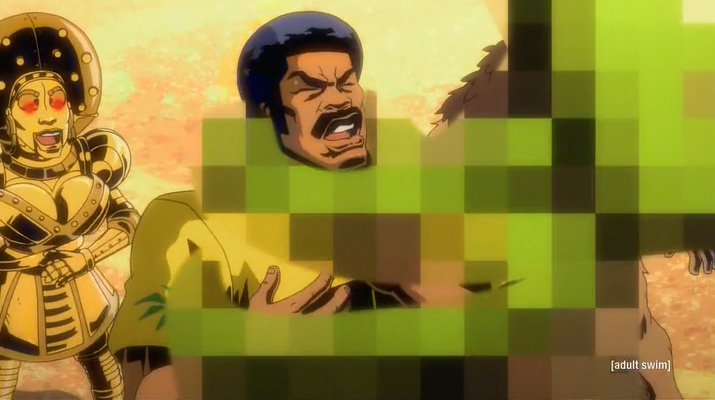
Black Dynamite vs. the IRS
On some Fridays, I discuss the week's best first-run animated series episode I saw. It's the "Brokedown Merry-Go-Round" Show of the Week. "Brokedown Merry-Go-Round," a two-hour block of original score tracks from animated shows or movies, airs weekdays at 2pm Pacific on AFOS.

Adult Swim's animated Black Dynamite is at its weakest when it's recycling sight gags from the 2009 film of the same name (which Black Dynamite star Michael Jai White co-wrote), like when the cold open of "The Wizard of Watts," the show's ambitious second-season finale, runs into the ground the film's funny absurdist gag where Dynamite's sexual prowess is so great he's able to give multiple women in the same bed orgasms at the same time. Dynamite may be able to get half the population of '70s L.A.'s hottest honeys off, but it doesn't get the finale off to a good start.

It's a crazy gag I liked so much during the film--because it makes no anatomical sense at all--that I kept hoping the animated version would never rehash it. But it ended up rehashing it, and not just in "The Wizard of Watts," but earlier in the second season as well. That's my biggest problem with the animated Black Dynamite or any other animated small-screen version of a live-action movie: there's no need to remind viewers of all the scenes we loved in the original (hell, it's also a problem with movies that are sequels to classic comedies, which is why I was relieved when White announced that his next movie with Black Dynamite director Scott Sanders will most likely be an unrelated comedy featuring White and his Black Dynamite co-stars as new characters instead of a Black Dynamite sequel). As kids, we enjoyed The Real Ghostbusters not because of the countless times Peter Venkman would get slimed by Slimer just like in the original Ghostbusters, but because of the effective ways The Real Ghostbusters expanded upon the Ghostbusters universe, thanks to the efforts of a pre-Babylon 5 J. Michael Straczynski as the show's story editor, as well as a few genuinely funny jokes that weren't in the 1984 film, like the moment when a demon opened a thick book that listed his least favorite creatures on Earth and he flipped past a page that said "Mimes." Re-establishing the animated show's connections to the original source material is just lazy writing, when time can be better spent coming up with new comedic material, like any moment where Dynamite finds himself literally tangling with the evil '70s kids' show puppet That Frog Kurtis (J.B. Smoove), an enjoyable antagonist who makes a long-overdue reappearance in "The Wizard of Watts" and is a character that the 2009 film would have been incapable of pulling off due to both budgetary and live-action limitations.

Podrick from Game of Thrones wishes he were this well-endowed.

The rehashed multiple-orgasm gag is a glaring misstep (this show is capable of coming up with cleverer ways to depict Dynamite's month of fighting and fucking), while the rest of the hour-long "Wizard of Watts" is the animated Black Dynamite at its best, whether it's demonstrating why White, who's otherwise known as a star of straight-to-DVD action flicks like the beautifully choreographed MMA fight film Blood and Bone, is a pretty skilled comedic actor (he doesn't overplay the humor) or offering a demented comedic spin on not-so-funny subjects like Donald Sterling's racist attitudes and racially motivated police brutality. The finale was written about a year before the nationwide furor over both Ferguson and Eric Garner's death at the hands of the NYPD (showrunner and episode co-writer Carl Jones' attempt to make the episode more up-to-date by dubbing in audio of Honey Bee saying "I can't breathe" during a riot scene screams out "last-minute"). "The Wizard of Watts" has to be one of the few pieces of television that made me laugh at something so wrong: the sight of Rodney King--he's depicted here as an orphan at the Whorephanage and referred to during the episode as "Little Orphan Rodney King"--getting a beatdown from cops. If you're uncomfortable with humor being mined from the sight of children getting beat up, stay away from "The Wizard of Watts." Honey Bee's big musical number in the episode has her slapping around unruly orphans at the Whorephanage with '60s Batman-style onomatopoeia filling the screen.

"The Wizard of Watts" presents what has to be the world's first parody of the '70s Broadway hit The Wiz. (Let's just forget the unsuccessful 1978 movie version with a badly miscast Sidney Lumet and an ill-suited-to-be-director Diana Ross existed. Get it? Because Diana Ross bossed around both Universal and Motown in order to become part of... Okay, you get it.) The episode jokingly refers to its vision of Watts-as-Oz as "the black version of The Wiz" and places Dynamite in the Dorothy role, a leg-humping, foul-mouthed poodle named Broto (rapper/Loiter Squad star/extraneous comma lover Tyler, the Creator) in the Toto role and the Wicked Bitch of the Westside (Tim Blake Nelson), a pig from the LAPD who's literally a pig, in the nemesis role. The musical numbers in "The Wizard of Watts," which are riffs on both The Wiz's show tunes and '70s hits like the Sugarhill Gang's "Rapper's Delight," exemplify why second-season composer Fatin "10" Horton has been a nice addition to the show: he's like a less family-friendly Weird Al, perfect for the animated Black Dynamite's profane--and according to Jones, "socially irresponsible"--brand of humor.

My favorite numbers in this episode are the ones based on "Don't Nobody Bring Me No Bad News"--Dynamite's chicken-and-waffles chef friend Roscoe sings about both the joys of "mixing Fiddle Faddle, chitlins and fondue" and his promise to "never bring you no fucked-up food"--and "Home." Yes, White himself attempts to sing this episode's version of "Home," without the aid of Auto-Tune to make him sound on-key, and it's one of the funniest things this show has ever done. White once explained in the 2009 Black Dynamite DVD's commentary that his performance in the film was intended to parody Jim Brown's stiffness as an actor, like Brown's visible discomfort with trying to look relaxed during a simple romantic scene like going out on a date (it's easy to forget that White was portraying an injured ex-football star portraying a blaxploitation hero, and the stoic demeanor was partly due to his injured neck). On the animated Black Dynamite, White is committed to making Dynamite sound uncomfortable with any other moment where he has to show some vulnerability--is there anything more vulnerable-looking than singing in public?--and that commitment pays off hilariously here when Dynamite has to sing to get back home. This is what I mean when I say White is a skilled comedic actor. He doesn't treat the material like it's comedy. He treats it like it's any other dead-serious action flick he's starred in and lets the comedy come to him, just like how Dynamite lets the women come to him. Part of that is probably due to Jones' additional work as the show's voice director (I bet the direction Jones gave to White for Dynamite's musical number--or maybe White thought of it himself--was "Sing it like how Jim Brown would have sung it," which is perfect). Erykah Badu, who reprises her recurring role as Whorephanage employee Fatback Taffy (named after the Jill Scott jam, perhaps?) in "The Wizard of Watts," once praised Jones as a voice director and said he's an actor's director who "helps us bring the best out of our characters to leave us room to create who they are."

I was initially worried when Black Dynamite switched from Titmouse Inc. to MOI Animation for the animation work this season. But MOI ended up being a great substitute for Titmouse, and the Korean studio's work on "The Wizard of Watts" resulted in a remarkable-looking finale, a swirly, mindfucky '60s psychedelicization of a '70s Broadway musical that's being retold through 2015 eyes. The clips of past Black Dynamite episodes that are shown during Dynamite's climactic musical number lend "The Wizard of Watts" a sense of finality, not just as a last episode of the season (by the way, the episodes about Roots, Bob Marley and Bill Cosby were my favorites from this season) but as a possible last episode of the show as well. A third season for Black Dynamite hasn't been announced by Adult Swim yet, and if this is indeed the last episode of Black Dynamite, "The Wizard of Watts" is a hell of a way to go out. But part of me feels like the show still has more work to do. There are a lot more stories for Black Dynamite to tell and a lot more subjects from the forever-lampoonable '70s to lampoon or humorously tackle--or rather, a historically inaccurate version of the '70s that's as intentionally and amusingly inaccurate as Everybody Hates Chris and The Goldbergs' respective depictions of the '80s, although Jones' decision to give legendary Asian American Soul Train dancer Cheryl Song a fobby accent in the American Bandstand-vs.-Soul Train episode "American Band Standoff" really bugged me (she doesn't have an accent, bruh). I'm surprised that the show hasn't riffed on the 39-year-old Rocky franchise--which, by the way, will pair up Sylvester Stallone with Michael B. Jordan as both Apollo's grandson and Rocky's protégé in a spinoff movie tentatively titled Creed--because Tommy Davidson, who voices Cream Corn, does the best Stallone impression in the game. The way Davidson nails how white actors like Stallone shout when their characters get angry always kills me. I really wish the show found an opportunity for Davidson to trot out that comedic trump card of his.


And as long as police brutality or the microaggressions within something like New York Times TV desk moron Alessandra Stanley's treatment of Shonda Rhimes continue to be problems, we'll always be in need of satirical takes on these problems from unapologetically black shows like Black Dynamite. Towards the end of "The Wizard of Watts," Dynamite, who usually settles things with violence, finally manages to defeat the Wicked Bitch of the Westside--he melts to the ground, of course--after he chooses to handle the Wicked Bitch in a way that's completely different from how he usually handles his adversaries. Dynamite figures out that "the only way to defeat a crooked pig is to catch him on tape." The scene reminded me of "Oskar Barnack ∞ Oscar Grant," a great 2011 track about responding to police brutality by Blue Scholars (the duo of Prometheus Brown, one of hip-hop's wittiest Filipino American rappers, and producer Sabzi, who's currently killing it as the producer half of another duo, Made in Heights). "Oskar Barnack ∞ Oscar Grant" calls for regular citizens to use cameras as their weapons against racist cops ("Shoot the cops/Shoot the cops/Shoot the cops/Take your cameras out your pocket, people"), and Dynamite kind of does the same thing when he defeats the Wicked Bitch, but he arrives at that decision to use a camera without speechifying about it, which would have been beneath this show. If someone told me 10 years ago that Adult Swim would become a haven for largely experimental, sharply written and sometimes socially conscious comedy from black folks, whether it's a scene like that one between Dynamite and the Wicked Bitch or a show like Black Dynamite, Jones' previous show The Boondocks, Tyler and Odd Future's Loiter Squad, Black Jesus or The Eric Andre Show, I would have said, "Sure, when cops fly."


***

Days of Blunder
"Speakeasy Rider" is a strange case where Bob's Burgers borrows from some of the staff writers' favorite sitcoms but never once feels derivative or tired. It's also a case where the episode title recycles a pun. "Speakeasy Rider" is the second Bob's Burgers episode to play around with the title Easy Rider, after "Ear-sy Rider." Not even that is tired. It's Bob's Burgers. It can get away with it--for now.

The story of siblings becoming Williams sisters-style rivals in the same sport is a familiar one. "Lisa on Ice" is one of my favorite Simpsons episodes because of its outstanding gags about the lunacy of Springfield's citizens, represented in "Lisa on Ice" by their bloodthirsty attitudes about hockey, and its poignant look at the relationship between Bart and Lisa. "Speakeasy Rider," which centers on Tina and Louise's rivalry as go-kart racers (their racing scenes are impressively animated, under the direction of Jennifer Coyle) and was written by Rich Rinaldi, contains a tension-filled dinner table scene between the sisters that's reminiscent of the "I won't have any aggressive condiment passing in this house!" scene in "Lisa on Ice." Even the ending is similar to the outcome of Bart and Lisa's conflict on the hockey rink. And the B-story of Bob and Linda trying to sneak Teddy's surprisingly good home-brewed beer past the tenacious eyes and noses of health inspectors Hugo (Sam Seder) and Ron (Ron Lynch) is essentially one of those old Cheers stories where the bar has to pretend everything's normal while it's operating without a liquor license or the bar has to pretend it's a gay one.

But "Speakeasy Rider" is unmistakably Bob's Burgers all the way, which means it's weird, weird, weird--like when Tina has conversations with her go-kart or when H. Jon Benjamin and Robert Ben Garant ad-lib an awkward picnic moment between Bob and Garant's biker character Critter--as well as warm and affecting in the least expected of places and consistently funny. The day when Bob's Burgers stops being this consistently funny is going to be a sad one, as sad as a burger without buns, unless Loren Bouchard and his crew manage to avoid shark jumping or, to borrow some racing lingo, they end up sandbagging the competition.

Linda gets all her business ideas...

... from '30s movies on TCM.