"I rocked a ginormous beard before everybody in Williamsburg started doing it. Whatever," says Alvin the Treacherous, the first hipster.
Every Wednesday in "5-Piece Cartoon Dinner," I dine on five of the week's most noteworthy animated cable shows that are found outside my Adult Swim comfort zone. The episodes are reviewed in the order of when they first aired.
On Transformers Prime, the Frank Welker-voiced Megatron's latest obsession is the Star Saber, an Excalibur-like sword from Cybertron that's stuck in a giant rock on Earth and can only be removed by Optimus Prime or any Cybertronian who's a Prime. While Megatron tries to get his dibs on the relic before Optimus can, Smokescreen has gotten into hot water with the Autobots for revealing his robot mode to scare the shit out of a human he argued with when the driver experienced road rage over Smokescreen's reckless driving. Too bad Google's driverless cars can't lash out at hostile and psychotic drivers and transform into intimidating robots to scare them away like Smokescreen does in "Legacy."
The Autobots assign Jack to teach the callow Smokescreen how to blend in better with humans, obey traffic laws and not blow his cover, but in a nice acknowledgment that Jack is a 16-year-old, he shirks the assignment and is tempted by Smokescreen into staging pranks on bullies at school and other guys who have wronged him. Unfortunately, "Legacy" goes overboard in taking the sanctimonious Optimus' "Power must be used wisely" side and never shows any of Jack and Smokescreen's pranks, perhaps to prevent the littlest viewers from getting any ideas about how to punk others, like how Burn Notice skips a step or two in its fact-based spy tips to prevent deranged fans from hurting others.
The decision to keep the duo's pranks off-screen robs "Legacy" of some much-needed fun. It also keeps the show from making a grown-up and complex point about pranks, like how some pranks can be harmful and not worth staging, while other pranks can be beneficial and cathartic for the wronged prankster. A cop-out like that is why Transformers Prime is merely an okay cartoon, while Gravity Falls, which took a subversive "Revenge is underrated--that felt awesome!" stance in "Irrational Treasure" while also conveying how revenge can go too far in "Fight Fighters," and Regular Show, which did both those things in "Prankless," are great cartoons.
***
Speaking of bullies, Kaijudo: Rise of the Duel Masters has distinguished itself for addressing the timely issue of bullying and the difficulties of having to put up with racist classmates (it's ironic how Kaijudo airs on a channel that recently indulged in a little racism at Comic-Con) and somehow seamlessly incorporating those problems into an escapist saga for kids that's mainly about monster battles. The show revisits bullying in "Night Moves," but this time, it focuses on girls who do the bullying--in this case, mean girls from Allie's circle of rich middle school friends who mistreat Lucy (Alanna Ubach, a.k.a. the It's Always Sunny in Philadelphia crack whore who memorably exclaimed, "Shut up, baby dick!"), an overalls-clad classmate from the impoverished side of town.
There's an interesting moment early on in "Night Moves" where Allie laughs along with her classmates at the insults directed at Lucy from mean girl Portia (also Ubach), while an upset Ray and Gabe, who are no strangers to being pushed around for being different, see no humor in Portia's remarks. Allie realizes her mistake, so in an attempt to get Portia and Lucy to make peace with each other, she invites Lucy to a sleepover with Portia and another friend, Maribel (Grey DeLisle), at her and her wealthy dad's beachside house. But the sleepover doesn't go smoothly, and the night gets worse when a ghost-story prank Ray and Gabe attempt to subject the four girls to--with the help of a creature from the Darkness Civilization--attracts the attention of evil Duelist Alakshmi Verma (also DeLisle) and her latest monstrous sidekick.
Written by Ross Berger, "Night Moves" makes some dead-on observations about the cruelty of kids at a certain age where they're not quite teens yet. Because Ray and Gabe are middle-schoolers and their hormones haven't gone crazy yet, their way of relating to girls is to scare them instead of getting them to make out with them. Another nice touch is the way that the mean girls' treatment of Lucy is more class-related than race-related (although it's implied that Portia despises immigrants as well). The fact that Maribel is a rich Latina who's mistreating a poorer Latina brings class into this story of bullying and shows that wealth can sometimes be more complicated than race. A lesser cartoon would have made the mean girls all-white or ended the episode with Allie lecturing them about their cruelty. Because Kaijudo is a bit smarter than that, "Night Moves" ends with Allie wordlessly ditching the mean girls and dressing like Lucy as a show of solidarity. And because the dialogue on Kaijudo is remarkably never overwritten (aside from the occasional bit of exposition about kaiju), the John DiMaggio-voiced skater dude who compliments Allie and her new friend on their less ritzy threads dismisses Portia and Maribel with a great episode-closing line: "Pshaw."
On A Fistful of Soundtracks, "Beat Box" airs Mondays at 6-9am and noon-3pm, Tuesdays through Thursdays at 6-9am and 1-4pm and Fridays at 7-9am and 1-3pm. The three-hour block, which is two hours long on Fridays, contains selections from '70s film scores that have been sampled by beatmakers in hip-hop and electronica (like the late Willie Hutch's music from Foxy Brown). If you find most film music to be too staid for your tastes, then "Beat Box" is most likely for you.
Also part of the block are selections from scores that hearken back to the blaxploitation era. One such score is the 2009 Black Dynamite score by Adrian Younge, who also wrote the original music for Titmouse's animated version of Black Dynamite (which concluded its first season on Adult Swim last night with special guest star Clifton Powell voicing the sleazy preacher dad who abandoned Dynamite when he was "a children").
Although some listeners feel like they're '70smacks when they tune in to "Beat Box," the playlist isn't all-'70s all the time. There are also original themes that were performed by hip-hop artists (Public Enemy's "Fight the Power" from Do the Right Thing and The Roots' "What You Want" from The Best Man) and cuts from recent scores that appeal to beatheads, like Steven Price and Basement Jaxx's excellent 2011 Attack the Block score, which Talib Kweli and Z-Trip sampled in their new Attack the Block mixtape.
Attack the Block
On Spotify, I was surprised to find that the service carries the entire Attack the Block soundtrack album, as well as 41 other tracks that are part of the "Beat Box" playlist. Here's a sampler of "Beat Box."
This week's Gravity Falls cryptogram is "hliib, wrkkvi, yfg blfi dvmwb rh rm zmlgsvi xzhgov." The decoded result is "Sorry, Dipper, but your Wendy is in another castle." The last time a Disney cable show contained this many hidden messages was that I'm in the Band episode you had to play back in reverse so that you could hear someone tell you that Satan is awesome. (Photo source: Gravity Falls Wiki)
Every Wednesday in "5-Piece Cartoon Dinner," I dine on five of the week's most noteworthy animated cable shows that are found outside my Adult Swim comfort zone. The episodes are reviewed in the order of when they first aired.
Dipper's rivalry with Robbie for the attentions of Wendy is starting to wear thin on Gravity Falls. I enjoy the show mainly for its comedic take on the paranormal and the title Oregon town's loony and rich backstory and not so much for the love triangle storyline, which surfaces again in "Fight Fighters." There's no way this Disney Channel cartoon is going to romantically pair up a 12-year-old boy with a 15-year-old girl (who looks older than her age, as we saw in that family picture where she towers over her short-statured brothers), so why bother continuing with the triangle?
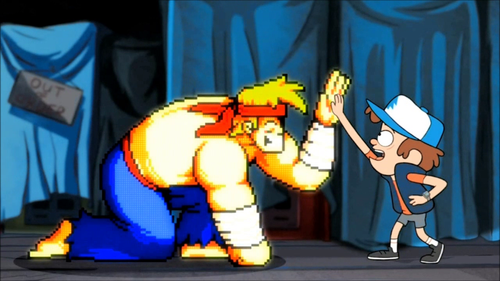
Despite the triangle stuff, "Fight Fighters" is a hilarious and dead-on parody of '80s and early '90s arcade games like Street Fighter II. In the Gravity Falls universe, Street Fighter II is known as Fight Fighters and is the game from which blond warrior Rumble McSkirmish (Brian Bloom) emerges to go beat up Robbie for Dipper, thanks to a hidden Contra-style code on the side of the Fight Fighters machine that allows Dipper to "Unleash Ultimate Power."
The Gravity Falls target audience might not understand the episode's references to Street Fighter II, Contra, Frogger, Pac-Man and Donkey Kong like those of us who grew up playing either of those games do, but they might get a kick out of the episode's swipe at the much more recent Tron: Legacy when Soos is seen playing Nort: The Game Based on the Movie: Based on the Game (no, that extra colon in the title is not a typo). Like Springfield on The Simpsons, the town of Gravity Falls is a great comedic creation where the games, TV shows and songs that the characters enjoy are all amusingly low-rent variations on the games, shows and songs we dig in real life. So in Nort, instead of light cycles, the players have to settle for racing the villains on much less cooler-looking Segways, and instead of The Wendy Williams Show as summertime afternoon viewing, Mabel is seen watching Why You Ackin' So Cray-Cray? It's not every day you see a Disney Channel show referencing the late '90s Mother Love talk show Forgive or Forget.
After appearing to have been destroyed at the end of The Avengers: Earth's Mightiest Heroes' "Ultron Unlimited" episode, the Vision (Peter Jessop), a synthezoid that turned against his evil creator Ultron, re-emerges in "Emperor Stark" fully repaired after a 30-day sleep programmed by Tony Stark, but he notices there's something a little off about New York City. Maybe it's the strange purple energy beam from the sky that showers over the Stark Industries tower. Or maybe it's all the giant robots in red-and-yellow Iron Man armor that are now policing the unsettlingly empty city streets.
While the Vision slept, Stark launched a prototype satellite that generates and transmits free energy to the world, and then he persuaded the United Nations to install him as its new leader. Stark Industries basically runs this new fascist world, where the elimination of war is the corporation's #1 priority and each Avenger has been assigned the task of policing an entire continent with the assistance of remotely controlled Iron Men. This corporate-run society is like the Occupy movement's worst nightmare. But it's not really Stark's doing. He and the other Avengers have been under the mind control of the Purple Man.
Prince Rogers Nelson took over the world? Nope, this Purple Man has nothing to do with Paisley Park. He's an old Marvel villain I've never heard of before, a purple-skinned master manipulator named Zebediah Killgrave who can command the wills of others and prefers to dress like Steve Harvey instead of Doctor Doom. The purple skin and mind control powers are the result of a chemical refinery accident Killgrave experienced while working as a spy.
As the voice of the Purple Man, Brent Spiner is more alive here than in his guest shots as the current big bad on Warehouse 13. Writer Christopher Yost gives Spiner a juicy "deep down, you're just like me"-type monologue where his character tries to twist Stark, who's been attempting to separate his mind from Killgrave's control, into thinking this fascist world was his idea all along. "Everything I’ve made you do in the last few weeks, it all came from you," Killgrave says. "I just gave you the push you needed."
I wish Yost did a little more with the changes implemented by Killgrave-controlled Stark, like briefly showing how food is affected by the military-industrial complex or how this new world deals with poverty. Also, the Avenger-vs.-Avenger battle scenes are a device that's becoming overdone on Earth's Mightiest Heroes. However, it results in one of the show's craziest and most memorable visuals: the Vision increases his density to 500 tons to kick an airborne Thor into the earth, the best "a god gets his ass handed to him" scene since, well, that time Loki got repeatedly pounded into the ground like a rag doll by Hulk in the live-action Avengers.
I've recapped Green Lantern: The Animated Series, Batman: The Animated Series producer Bruce Timm's latest series, a few times for "5-Piece Cartoon Dinner" during the series'first season, and though I'm not really a fan of the Green Lantern Corps space cop characters and I had a nice nap when I went to see the live-action version, I've found this Cartoon Network CG series to be surprisingly good. Aya, a heroic, Spock-like female AI who was created by Timm for the series (and is terrifically voiced by Grey DeLisle), is the breakout character on GL:TAS, as well as one of the reasons why the series is more enjoyable than the much-maligned Ryan Reynolds version (that movie was remarkable for somehow being both overstuffed and undernourished at the same time).
I don't own an iPhone because I currently can't afford one and because I don't care for smartphones. Like Greg Proops, I think smartphones are causing society to become douchier (at 39:57 of "Lobsters," Proops astutely likened iPhone addicts to the subjugated citizens in Brave New World as part of his reply to a Smartest Man in the World listener's question about aspects of 20th century dystopian novels that are pertinent to today). But if I did own an iPhone, I'd kick Siri's ass out and have her replaced with the super-reliable Aya. And at least Aya won't try to tell me jokes that are hilarious only to John Malkovich.
Even though I'm neither a machine like Aya nor a reformed alien thug like Razer, I have an easier time relating to Aya's arc of wanting to be taken seriously as a Green Lantern and Razer's shame over his past as a Red Lantern than I did trying to relate to Hal Jordan's hackneyed daddy issues during that inane movie. That's all due to Timm and his crew's knack for intriguing characters (which raises the question "Why doesn't Warner Bros. ever place the scripts of its non-Batman live-action DC films into the more capable hands of either Timm, Alan Burnett, Paul Dini or any of the other talents who have shepherded DC Animation's hit shows and made-for-video movies?"). Another reason why GL:TAS is superior to the Reynolds movie (which, by the way, was directed by Martin Campbell, who recently wiped out the stench of the live-action GL with the excellent pilot he directed for ABC's new action drama Last Resort) is the simple fact that it's animated. Animation, especially CG, is a more suitable medium for the Lanterns and their cartoony-looking powers than live-action, which was where the Lanterns looked unconvincing and inert.
GL:TAS airs on Saturday mornings, which is an unusual time period for an animated cable show's first-run episodes (because most of them tend to air first-run in the evenings), but it's the same time period where earlier Timm projects like The Adventures of Batman & Robin (a retitled, more Robin-centric version of B:TAS) and Superman: The Animated Series first aired back when network TV ran cartoons on Saturdays. Most of the cartoons I used to watch on Saturdays had terrible, colorless and frequently recycled score music, but GL:TAS doesn't. The crappy-sounding electric guitar work and T.J. Hooker drum machines that used to define Saturday morning score music in the '80s and early '90s are nowhere to be found on GL:TAS.
The show's score music, which comes from newcomer Frederik Wiedmann, is original from start to finish in every episode--"recycling" is a dirty word in the Warner Bros. Animation music department--and suitably majestic. There's lots of brass and choir, plus a motif for each major character (for instance, Razer is represented by an electric violin theme), just like how each hero and villain on B:TAS had a motif or instrument that defined him or her musically (I don't think Robin had his own theme on B:TAS though, and I don't remember if he did because I don't really care for that character). Because of Wiedmann's scores, I always feel like I'm watching an epic sci-fi movie whenever I play back an episode of GL:TAS.
Frederik Wiedmann at the Úbeda PlayFest with future composer Kyan Wiedmann (Photo source: BMI)
As work continues on GL:TAS' second season, La-La Land Records has released 36 of Wiedmann's first-season score cues on the GL:TAS soundtrack album, and I've added my favorite pieces from the album to the "AFOS Prime" and "New Cue Revue" blocks on A Fistful of Soundtracks. Wiedmann's GL:TAS music sounds even better live, as attested by the following footage of a 65-piece orchestra and a 40-piece choir performing a suite of Wiedmann's GL:TAS themes at the PlayFest animation/video game music festival in Úbeda, Spain back in July. At the end of the footage, the man who's pretending to get choked up over the emotional portion of the GL:TAS suite is GL:TAS co-executive producer Giancarlo Volpe:
Though I run a film and TV score music station, I don't listen to score albums all the time. In fact, 95 percent of my iTunes playlists is non-score music. When I open Spotify, I don't even listen to score music all that much (plus most of the score tracks that Spotify carries are craptastic re-recordings). On Spotify, I listen to hip-hop and R&B on the regular, plus a bit of indie.
A lot of the mixtapes in my iTunes playlists contain tracks with cameos by Andre 3000, whose flow is one of the most inventive in hip-hop, as well as one of the most ubiquitous. He's been guesting on a lot of artists' joints lately. Two of my favorite tracks from the summer contain cameos by the ATLien: Rick Ross' "Sixteen"--despite the guitar solo by Andre 3K that everyone'sbeen hating on--and recent SNL musical guest Frank Ocean's "Pink Matter" (dig these Andre couplets: "She had the kind of body/That would probably intimidate/Any of 'em that were un-Southern/Not me, cousin"). Below are 10 of my favorite records with guest verses by one of the greatest MCs around, including, of course, "Sixteen," where Andre flashes back to a time when he was "Drawin' LL Cool J album covers with Crayolas on construction paper" and "Pink Matter," as well as last summer's "Party," which Kanye West and Consequence produced for Beyoncé.
I love the late '80s/early '90s sound of "Party." I grew up listening to that new jack sound on the radio. DJ Jazzy Jeff and Mick Boogie ought to include "Party" on their next Summertime mixtape. Like Dwele, I've been racking my brains trying to remember which exact tunes from that new jack era "Party" reminds me of (at times, it reminds me of the slow jams of Keith Sweat). UGK and OutKast's Mack soundtrack-sampling "International Players Anthem" is on the playlist too. Unfortunately, the version of the UGK/OutKast collabo that Spotify has is the censored-for-radio edit.
Does the song you just wrote suck royally? Maybe what it needs is an Andre 3000 cameo to salvage it.