The following is a repost of my October 1, 2014 discussion of The Fresh Prince of Bel-Air, particularly "Def Poet's Society."
I've been sent music journalist Brian Coleman's second Check the Technique book to review for Word Is Bond, and the new volume, part of Coleman's series of books of exhaustive interviews with rappers and beatmakers about classic albums they recorded, contains behind-the-scenes stories I've always wanted to read about Black Sheep's A Wolf in Sheep's Clothing and Raekwon's Only Built 4 Cuban Linx... One chapter I didn't expect to enjoy was the chapter about DJ Jazzy Jeff and the Fresh Prince's rise from a sensation in Philly to national chart-toppers, thanks to 1988's He's the DJ, I'm the Rapper, the first double album in hip-hop history.
The chapter notes that He's the DJ, I'm the Rapper's double-LP format stemmed from the duo's original conception of the project as a scratch album to showcase Jazzy Jeff's turntablist skills. In the late '80s, a scratch album was unheard of, but today, they're a commonplace thing in hip-hop. For example, DJ Qbert recently dropped simultaneously on iTunes a scratch album and a more accessible-sounding album loaded with guest features by rappers, and those two recent Qbert releases were sort of like if He's the DJ, I'm the Rapper got split into two separate albums instead of being the mammoth two-headed beast we know of today.
That story of He's the DJ, I'm the Rapper's evolution from a DJ-only album to a showcase for both the skills of Jazzy Jeff the beatmaker and Will Smith the storyteller is an interesting read. So are the recollections of the trouble the duo got into with New Line Cinema over "A Nightmare on My Street," their proto-horrorcore track about the '80s and '90s New Line cash cow Freddy Krueger, and Jazzy Jeff's tidbit about him and Smith turning down the script for House Party (Coleman was unable to interview Smith, presumably because Smith's too busy being one of the biggest movie stars in the world).
He's the DJ, I'm the Rapper is best known for introducing the massive 1988 hit "Parents Just Don't Understand" (which isn't my favorite track on the album; that would be the Bob James-sampling "Here We Go Again"). The album doesn't contain the duo's much more frequently quoted theme from The Fresh Prince of Bel-Air because, of course, the hit sitcom--which based its "inner-city kid in a mansion" premise on pop music industry bigwig Benny Medina's life as an extra member of the household of his mentor Berry Gordy--didn't exist yet, and its premiere on NBC was only two years away.
It's great that He's the DJ, I'm the Rapper has gotten the oral history treatment. But I wish The Fresh Prince of Bel-Air received the oral history treatment somewhere else as well, even though the famously bitter and still-disgruntled Janet Hubert, who wrote a tell-all book about how much she hated working with Smith on The Fresh Prince, would probably refuse to participate and then write another tell-all book about how much she hated seeing an oral history about The Fresh Prince.
The show never got much shine from TV critics when it first aired, and it still doesn't--today's critics remain more taken with Seinfeld, Friends and Roseanne as '90s live-action sitcoms. Sure, The Fresh Prince's storylines weren't exactly groundbreaking and formula-defying like Seinfeld's, and Roseanne did a better job at seriousness--when The Fresh Prince tried to get serious with an occasional Very Special Episode, the results would often be preachy and only occasionally effective and genuinely wrenching--but I find myself rewatching The Fresh Prince more often than Seinfeld. Okay, it kind of went off the rails after Hubert was fired and the producers pulled a Darrin on us with a new Aunt Viv, but otherwise, The Fresh Prince is a funnier show than Seinfeld. There, somebody had to say it.
I was too young to catch the late Muhammad Ali in his prime as a boxer and civil rights activist. So it wasn't until the 1996 release of When We Were Kings, Leon Gast and Taylor Hackford's Oscar-winning documentary about the lead-up to Ali's 1974 victory over George Foreman at the Rumble in the Jungle in Zaire, when I started to understand why from the '60s to the early '80s, the world was captivated by this former athlete whom teenage In Living Color viewers like myself knew only as a lethargic roach spray pitchman.
The nicely edited doc caused me to be won over by both Ali's sense of humor--which remained a part of his personality even during his weakened state due to Parkinson's disease, like when he pretended to doze off in the middle of David Frost's 2002 interview with him--and his activism, particularly the brave stand he took against the Vietnam War, which cost him his heavyweight title and his boxing license. He once amazingly said, "Why should they ask me to put on a uniform and go 10,000 miles from home and drop bombs and bullets on brown people in Vietnam while so-called Negro people in Louisville are treated like dogs and denied simple human rights? No, I'm not going 10,000 miles from home to help murder and burn another poor nation simply to continue the domination of white slave masters of the darker people the world over."
Also noteworthy for featuring "Rumble in the Jungle," a catchy original theme song that united the Fugees, Busta Rhymes and A Tribe Called Quest, one of whose members was another beloved African American figure who died this year, Phife Dawg (2016 can go fuck itself), the stirring When We Were Kings remains one of my favorite movies from the '90s. But When We Were Kings suffers from something San Francisco Bay Guardian columnist Johnny Ray Huston criticized Gast and Hackford for at the time of the doc's release--Huston was the only writer I saw point this out back then--and that flaw is devoting too much of its running time to George Plimpton and Norman Mailer doing what's known today as whitesplaining both Ali and a moment of worldwide black pride like the Rumble in the Jungle. Huston's attitude was like "Who gives a fuck what these old white men think, especially when a black perspective would be the perfect one to recall these moments?" He had a point there.
Gast's fascinating archival footage of the G.O.A.T. in his prime more beautifully conveys the speed, grace and brash personality of Ali than any of the talking-head segments Hackford shot in the '90s with Mailer, whose cringeworthy black guy voice while impersonating the boxing legend keeps reminding me of Wyatt Cenac's anecdote about how an improv session between him, another black comic and the late Robin Williams went from awesome to mildly uncomfortable when Williams started trotting out his clichéd black guy voice in front of them. Moments of interminable whitesplaining aside, When We Were Kings is a rare doc that deserves to be seen at least once in a theater with an audience, just to hear how other viewers react to Ali's one-liners, the trash-talking mind games he subjected his rivals to outside the ring and his rapport with his youngest fans.
While other heavyweight boxers at the time tended to be either glum or inarticulate, Ali knew how to charm a crowd. He was the ultimate boxer-as-rock-star. The 1997 theater audience I saw When We Were Kings with wound up cheering for Ali or enjoying his spontaneous antics as if it were 1974 again. That's how charismatic he was. The crowd gets turnt up even when it's just archival footage of him interacting with the press.
"I couldn't stand the Michael Mann film Ali starring Will Smith... The film's great flaw is the fact that no one can really play Muhammad Ali except for Muhammad Ali," wroteNation sports columnist Dave Zirin in 2013. "That is why Muhammad Ali has always been served better by documentaries than dramatic films."
(.GIF source: Muhammad Ali - The Greatest)
And that is why after Ali's death from respiratory problems last Friday, I marathoned for the rest of the weekend a bunch of docs about Ali instead of watching either Mann's beautifully shot but hugely flawed (and stolen by Jamie Foxx as Drew "Bundini" Brown) biopic on HBO Go or 1977's The Greatest, a much less beautifully shot and much more stilted biopic where Ali stars as himself, but, as Zirin noted, "it was a disaster precisely because the wicked improvisation that marked both his style of speech and boxing were [sic] thuddingly absent." Ali's passing makes you eager to revisit the real, unscripted Ali on film, not the Hollywood versions of Ali like Smith's faithful and respectful but also overly mopey (which isn't really Smith's fault--the mopiness is due to Mann's propensity for brooding and largely humorless male lead characters, outside of Dennis Farina on Crime Story and Al Pacino in Heat) recreation of Ali.
My marathoning of all these Ali docs I highly recommend has made me realize there will probably never be another sports figure as simultaneously entertaining and humane as the Greatest was (although he wasn't so humane towards the late Joe Frazier, calling him an Uncle Tom despite the fact that Frazier actually vouched for the reinstatement of Ali's boxing license, but we'll just consider that a rare slip-up by Ali). In the world of hoops, current Oakland hero Steph Curry could be another Ali, but it's too early to tell. And for a while, to us Filipino Americans, it looked like Manny Pacquiao was going to be our humble Pinoy superhero who would make us even more proud to be Filipino because of his heroism in the ring, but then Pacquiao had to open his mouth about same-sex marriage, and he went from being a kindly Ali type to the embarrassing drunk uncle at the merienda table who should really shut the fuck up about politics.
The boxing world, which is currently being eclipsed in popularity by MMA fighting (another sport that, like boxing, has just lost one of its black fighters: Kimbo Slice, the guy whom Tracy Morgan memorably said should be President Obama's Secretary of Defense on Late Night with Conan O'Brien), needs more humane Ali types and less ignorant types like Pacquiao. That's why Ali's passing is a huge loss for boxing. It's also a huge loss for Islam. It loses one of its most eloquent voices in terms of speaking out against the stereotyping of Muslims as terrorists, which has intensified again ever since Donald Drumpf started persecuting them as part of his Penguin-running-for-mayor-ish presidential campaign.
Ali's earlier allegiance to the Nation of Islam (an offshoot of traditional Islam) and the way that Ali's anti-war activism stemmed from his faith are deftly explored in director Bill Siegel's 2013 doc The Trials of Muhammad Ali, which is now streaming on Hulu. Zirin is right about the Siegel doc's ability to communicate with nuance Ali's journey of rebellion against racism and war. This is the film to see if you've always been curious about Ali's activist side, the allure Ali saw in the Nation of Islam (it provided the former Cassius Clay with a way to become empowered as a black man, right when he was starting to question both Eurocentricism and mainstream America's bizarre preferences for white over black in everything from Christianity to nursery rhymes) and the career sacrifices Ali made due to opting to be a conscientious objector.
I don't care for Madonna and her cultural-appropriating ass, but I've always liked the music of William Orbit. The Drake-scaring pop star's hit single from the summer of 1999, "Beautiful Stranger," a '60s-pop-flavored tune she recorded for Austin Powers: The Spy Who Shagged Me, is my favorite pop song Orbit has produced because it's Orbit at his most playful-sounding, from the Ron Burgundy flute funk to the harpsichord riffs (the harpsichord is also integral to why my favorite Michael Jackson tune is "I Wanna Be Where You Are"). "Beautiful Stranger" is featured in The Spy Who Shagged Me for like only 30 seconds, during a non-comedic scene where the titular '60s spy mourns the loss of his mojo. Because of "Beautiful Stranger," I would have been interested in what Madonna and Orbit would have recorded together for Guy Ritchie's upcoming remake of The Man from U.N.C.L.E., had Ritchie and Madonna never split.
"Beautiful Stranger" is pitch-perfect for the breezy, psychedelic, Laugh-In-esque and Derek Flint-inspired Austin Powers franchise, whereas Madonna's other original spy movie theme, the Mirwais-produced electroclash tune "Die Another Day," doesn't quite work for 007 (it would have worked for some other spy franchise: maybe Totally Spies?). The Die Another Day theme makes you wonder if Madonna or Mirwais ever even watched an actual 007 movie beforehand, even though she claimed that the Die Another Day screenplay influenced the lyrics she wrote (the orchestral string riffs during "Die Another Day" came not from Die Another Day score composer David Arnold but from Madonna's "Don't Tell Me" collaborator, the late New Jack City score composer Michel Colombier, and I would have enjoyed Colombier's string riffs a little more if they had at least some ounce of thematic connection to anything Arnold wrote for his score).
I fell in love with "Beautiful Stranger" again a few weeks ago while overhearing it being played on some store PA during a round of book-shopping or grocery-shopping (I can't remember which kind of shopping it was). So that's why I'm adding "Beautiful Stranger" to the playlist for the espionage genre music block "AFOS Incognito," where it can be enjoyed without having to be subjected to any visuals directed by Brett Ratner, Mondays through Thursdays at midnight Pacific on AFOS.
There's one other piece of music from a 1999 spy comedy that I'm adding to "AFOS Incognito," and this spy comedy isn't exactly as beloved as The Spy Who Shagged Me was back in 1999. It's from the second and final film in Warner Bros.' late '90s mission to ruin your favorite TV shows, Wild Wild West, the Will Smith/Kevin Kline blockbuster loosely based on the '60s spy show/proto-steampunk western of nearly the same name (the show was called The Wild Wild West, while the movie omitted "The" from the title).
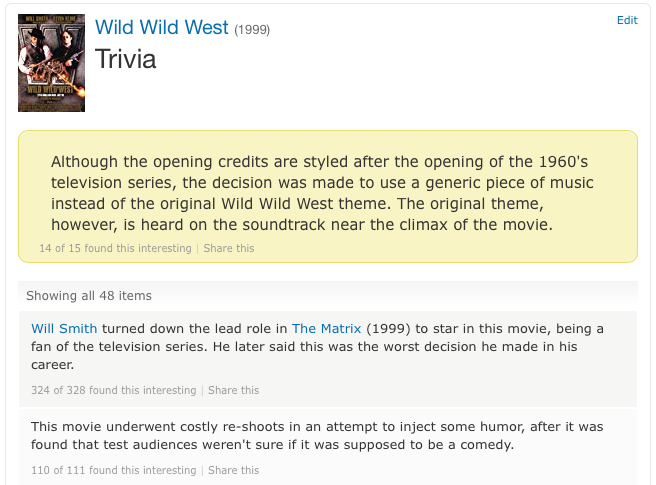
Fortunately, the selected piece of music isn't the ubiquitous-on-the-1999-airwaves Will Smith/Dru Hill theme tune that was never worthy of sampling Stevie Wonder's "I Wish." It's the other memorable piece of music from Wild Wild West: the rousing main title theme by a legendary composer who wrote a million rousing themes for westerns, the late Magnificent Seven score composer Elmer Bernstein. That Bernstein main title theme is the only thing I like about Wild Wild West. IMDb is wrong: it's not "a generic piece of music." It's classic Bernstein western music, faithful in spirit to Richard Markowitz's equally rousing '60s Wild Wild Westtheme tune, which either the filmmakers couldn't get the full rights to or were too dunderheaded to use more often in the film because of their hubris and contempt for the source material (although I wouldn't consider The Wild Wild West a perfect show: it suffers from that old '60s and '70s spy show staple of stupidly putting white actors in yellowface or brownface). The theme is too good for such a hackily written steaming pile and such a chemistry-deficient buddy action flick.
Speaking of chemistry, this might have improved the movie: instead of casting Kline, whom Smith had no chemistry with, as Artemus Gordon, Alfonso Ribeiro, whom Smith had a shitload of chemistry with from 1990 to 1996, should have been cast as Artemus. And instead of the movie's lame depiction of Artemus as this never-convincing master of disguise Kline looked as embarrassed to be portraying as Kline's washed-up Soapdish actor character looked when he had to play Willy Loman in front of confused and senile dinner theater customers, I would have written Ribeiro's short and black Artemus as an excellent master of disguise who--because both the Wild Wild West TV show and movie never gave a shit about being authentic to the period--came up with the most effective and ludicrous-for-any-period prosthetic makeup technology for altering his looks, as well as his height, race or gender. Plus it would have been amusing to have a black guy walk around with the name Artemus.
Anyway, like Stevie Wonder, I wish that theme (BLAM!) was (BLAM!) written for a different score. There lies my problem with adding to AFOS rotation enjoyable score cues from movies that are so terrible. It's so difficult to erase those movies' wretchedness from your mind when you hear these score cues that are the only redeeming elements of those movies. So to enjoy the Bernstein score cue a little more, you just have to pretend it's not from Wild Wild West.
Man, why do post-Blazing Saddles, pre-Django Unchained westerns with black heroes have such a lousy track record? Why do sci-fi westerns that are neither the '60s Wild Wild West nor the cult favorite Brisco County Jr. have such a lousy track record? Smith and his Men in Black director Barry Sonnenfeld clearly wanted to turn Wild Wild West into a Blazing Saddles for the '90s and with splashier action sequences, except Blazing Saddles knew how to be funny.
Blazing Saddles also didn't need a $170 million budget to land its jokes. The Nostalgia Chick pointed out that Shane Black, the writer and director of one of my favorite movies, Kiss Kiss Bang Bang--a buddy comedy that, like Blazing Saddles, was able to dazzle despite a limited budget--was attached to an earlier attempt to make a Wild Wild West movie. It's one of the most interesting parts of the Nostalgia Chick's 17-minute discussion of the many things that went wrong with Sonnenfeld's Razzie sensation, including Smith rejecting the role of Neo in The Matrix and choosing to play such an unlikable and overly cocky spy.
See? This is why Ribeiro would have been a great big-screen partner for Smith: unlike Kline's snooty and stiff Artemus, the equally snooty but more underdog-ish Ribeiro--due to his chemistry with Smith--would have been able to make Smith's overly cocky Agent West more likable and relatable when they interacted with each other. It would have been like how halfway through its run, the small-town lawyer sitcom Ed gave Michael Ian Black's annoying and overly cocky Phil Stubbs character a new bowling alley boss he grew to despise, in the form of the more level-headed Eli Goggins, played by the always charismatic Daryl "Chill" Mitchell. As both Phil's foil and a character who, unlike Tom Cavanagh's rather timid Ed, had the guts to challenge Phil and bring him back down to Earth whenever Phil's antics grated on everyone's nerves, including the viewer's, Eli made Phil the myopic and self-absorbed schemer a much less annoying and one-note character for the rest of the show's run.
I also wish I were in the universe where Will and Carlton reunited on the big screen as West and Artemus. Yeah, maybe it would have been too much of a rehash of the Will/Carlton dynamic from The Fresh Prince of Bel-Air for some moviegoers, but Ribeiro would have given Smith something more interesting to play against than whatever hacky shit Kline was doing. However, a completely different universe where Black's Wild Wild West got made instead is an even more enticing alternate universe. Now that is a version of Wild Wild West that would be worthy of Bernstein's main title theme. How many screenwriters did Wild Wild West have? Black's screenwriting work all by himself is frequently superior to the combined results of the 20,000 screenwriters who tried to polish the turd called Wild Wild West.
Many things doomed The Fresh Prince of Hot-Air, from its constant reshoots to skinny-pantsed '60s Wild Wild West star Robert Conrad's dissatisfaction with the script when Sonnenfeld offered him a cameo and he refused. The original Jim West bad-mouthing a reboot of his show and not giving it his blessing is like if the original Spock, when he was alive, tweeted, "I hope this new Star Trek crashes and burns," or if Michael Keaton stepped out and said, "My son showed me that new Batman trailer. Why is Ben Affleck being such a saggy diaper that leaks?" That doesn't bode well for your reboot. But when your film's key art is basically inverted key art from the 1993 megaflop Super Mario Bros., your film's really doomed.
When the only person who benefited from some part of the film is producer Jon Peters--that giant mechanical spider the extremely weird Peters kept threatening to squeeze into aborted movie versions of '90s Superman comic book storylines and Sandman finally made it into one of his productions--that's how terrible the film is. You know Patton Oswalt's six-minute distillation of the wretchedness and bloatedness of Wild Wild West (while he was being interviewed by the comedy news site/stand-up comedy record label A Special Thing)? It's six times more entertaining than Wild Wild West itself.
What I said about Bad Boys as an "eye Teen Reviewer" for the San Jose Mercury News back in 1995 (April 14, a week after Bad Boys' April 7 opening, to be exact), word for word and with every single Merc style guide preference preserved, straight off a clipping I still have of my own article:
'Bad Boys' is fun — for a formula movie
EYE TEEN REVIEWER Jim Aquino
THE cop-buddy comedy "Bad Boys" (not to be confused with the 1983 Sean Penn prison pic of the same name) is the latest flashy action movie from the Simpson-Bruckheimer assembly line, which has churned out such blockbuster hits as "Beverly Hills Cop" and "Top Gun."
Directed by Michael Bay, the genius behind the popular, Clio-winning "Aaron Burr?" milk commercial, "Bad Boys" sticks to the tried-and-true formula that made Don Simpson and Jerry Bruckheimer big-name producers back in the '80s: gaudy visuals, extravagant action sequences, a big-time soundtrack and a script that's high on concept and low on subtlety.
After producing a low-profile film such as the dark, dialogue-driven comedy "The Ref," it appears that Simpson and Bruckheimer want to go back to making big, dumb movies again. "The Ref" worked because it fit star Denis Leary's edgy, verbose persona, and never tried to soften Leary's cynical humor. "Bad Boys" could have been as satisfying as "The Ref," if its script were as clever overall as the snappy, entertaining interplay between its two leads, sitcom stars Martin Lawrence and Will Smith.
Lawrence and Smith, playing mismatched Miami police detectives Marcus Burnett and Mike Lowery, rise above the formulaic cops-vs.-heroin thieves plot to deliver top-notch performances. "Bad Boys" runs too long at more than two hours, but it remains watchable because of these charismatic, energetic stars and their fast, funny and often improvised delivery.
"Bad Boys," originally written for Dana Carvey and Jon Lovitz, is strong on visuals, thanks to first-time director Bay, who must have watched a lot of Tony Scott movies. The Miami setting is wonderful to look at, and the set pieces are well-staged.
But "Bad Boys" suffers from uninteresting bad guys and a story line that offers few surprises, aside from the amusing subplot in which neurotic family man Burnett and smooth ladies' man Lowery switch identities. Tea Leoni, who was so memorable as the sexy bohemian girlfriend on the short-lived sitcom "Flying Blind," plays a key witness.
"Bad Boys" isn't original or groundbreaking, but it's fun and entertaining, thanks to Lawrence and Smith.
What I think about Bad Boys in 2015, on the day before the date of the 20th anniversary of its release:
Of all the movie reviews I wrote for the Mercury News while in high school and then college, the mixed review of Bad Boys--at that point in his filmography, the Fresh Prince had just won over critics because of his big-screen debut in the film version of Six Degrees of Separation, but he hadn't made Independence Day yet--is one of the only two or three reviews where I still stand by every word. For instance, Michael Bay was at his best as a director of commercials like that classic "Got milk?" ad (although putting the words "Michael Bay" and "genius" in the same sentence back then makes me cringe); The Ref remains a terrific antidote to Yuletide mawkishness; and I still can't remember the name of Burnett and Lowery's boring nemesis. Like Dana Gould did when he couldn't remember the name of the villain Ben Gazzara played in Road House, I'm just going to call their boring nemesis Drago.
All the other reviews I wrote back then can go in the shredder. That was the biggest problem with being a film critic for print media. If some part of your opinion about a film would change (and my opinions sometimes do), you couldn't go back and change what you said in print like you can now easily do on a blog or in digital media.
Aside from a clunky and racist bit of attempted comedy where Shaun Toub--a.k.a. Dr. Yinsen from the first Iron Man flick--shows up as a stereotypical Middle Eastern convenience store clerk (an ominous sign of comedic things to come in Transformers: Revenge of the Fallen) who racially profiles Lawrence and Smith because of the visible guns in their holsters, Bad Boys remains one of Michael Bay's few tolerable movies. That's mainly due to the dialogue between Martin and Will ("Don't be alarmed, we're Negroes"), the most enduring part of the first Bad Boys, which cost only $17 million to make. I prefer smaller-scale Michael Bay over larger-scale, giant-robot-testicles-flashing Michael Bay, which is why I never bothered to watch 2003's much bigger-budgeted and longer-in-running-time Bad Boys II, even though Simon Pegg and Nick Frost were seen worshiping Bad Boys II in Hot Fuzz, an Edgar Wright film that trounces Bad Boys in all sorts of ways, simply because it's an Edgar Wright film (I hear 2013's Pain & Gain is supposed to be a return to Bay's smaller-budgeted roots, but I haven't seen that one yet either).
The Bad Boys original score by Mark Mancina still holds up too and hasn't aged poorly at all. During "AFOS Prime" and "Beat Box" on AFOS, you can hear a previously unreleased version of the film's dancehall-influenced main title theme, Mancina's "Prologue - The Car Jacking," taken from La-La Land Records' out-of-print Bad Boys score album and featured below. (The Bad Boys song album's not too shabby either. I remember practicing to get my driver's license to the sounds of Diana King's dancehall-style "Shy Guy.")
If you still find Bad Boys--or Drago--to be too generic for your tastes, perhaps reading Shield creator Shawn Ryan's mostly sardonic live-tweets of Bay's Bad Boys DVD commentary while he watched Bad Boys for the first time ever in 2012 will make the film go down easier. "Michael goes silent on commentary for a few minutes," tweeted Ryan, who actually likes the movie, during a lull in Bay's pontifi-bating. "Perhaps he took a break to write nasty email to Megan Fox."
Sure, the themes from The Addams Family, the Beverly Hillbillies/Petticoat Junction/Green Acres shared universe--or as I like to call it, the Hooterverse--and The Fresh Prince of Bel-Air are lovable classics. In fact, you can hear the Fresh Prince theme in its entirety, complete with Will Smith's forgotten bars about flying first class (which were in the opening titles for only the first few episodes and then were removed), either during "Beat Box" and "The Whitest Block Ever" on AFOS or right below. But I like how stripped-down broadcast network TV is these days compared to how TV was when I was a kid.
As Andy Greenwald once wrote over at Grantland, the very '80s L.A. Law opening credits are a slow 90 seconds of random clips of people leaving meetings, carrying briefcases and shrugging. Broadcast network TV used to be so slow-paced that shows like Misfits of Science in the '80s and The Wayans Bros. in the '90s got to open with two themes in the same sequence.
The gradual elimination of opening themes from broadcast TV--to accommodate more ad space, as well as to keep fidgety viewers from channel-switching and to somewhat emulate modern-day cinematic blockbusters that have done away with opening credits altogether--took some adjustment for a couple of years, but I'm used to it by now. It won't be long before I spot yet another link to an article from the olds about how TV was better in my day because we had opening themes that were 22 minutes long and so on. No, it wasn't, Grumpy Old Man from Weekend Update. A huge chunk of pre-Sopranos/Wire, pre-niche-programming TV hasn't aged well. (As much as I love the timeless Taxi, there are still some things about it that haven't stood the test of time, like the cheesy product placement for Jeff Conaway's pop album debut during Taxi's "Fantasy Borough" two-parter. Remember that album? Because I don't.)
That's partly what Adult Swim's immensely popular "Too Many Cooks" short is making fun of: all those poor-quality clips of absurdly-lengthy-by-today's-standards opening title sequences from ancient shows that we often watch on YouTube with cringes or "Oh God, for real? This was a thing?"-ish looks on our faces. For example, I don't think my ears will be able to withstand hearing the mega-sappy and mega-anachronistic Joanie Loves Chachi theme on YouTube again. So there's one benefit to phasing out opening themes: never again will someone compose for a network show's opening titles something as abominable and interminable as the Joanie Loves Chachi theme. Never again will someone recycle the theme from Patch Adams (place Sideshow Bob shudder here).
On broadcast TV, almost all the good theme tunes that used to be allowed to breathe at the start of the show are being saved for the end credits. But you have to be a cord-cutter or a subscriber to either Hulu Plus or Netflix in order to hear those end title themes because on Hulu or Netflix, they're not squeezed out by a trailer for next week's episode or a network promo for another show, a network practice I find to be way more annoying than the elimination of opening themes.
All the current live-action shows based on DC Comics properties like Arrow, The Flash and the Game of Thrones-esque Gotham--examples of shows that are attempting to emulate modern-day cinematic blockbusters, and that includes reducing the opening theme to just a few notes over the show's brooding or flashy logo, no pun intended--carry distinctive end title themes that would have also been good as table-setters in a different era of broadcast TV. I like the triumphant little piece Arrow and The Flash composer Blake Neely wrote for the Flash end credits, while Gotham's march at the end by Graeme Revell and David E. Russo--first used outside of the end credits to great effect when Jim Gordon and Harvey Bullock put aside their differences to take down Carmine Falcone in "Penguin's Umbrella," the strongest hour so far of this rather mixed bag of a show--brings to mind both the Dragnet march and Ennio Morricone's work on The Untouchables, with a little bit of Bear McCreary's opening theme from DC Entertainment's one-season wonder Human Target (yeah, there was a second season, but I like to pretend it never happened) in there.
TV theme purists, there's a place where you can enjoy as many lengthy opening themes as you want. It's called premium cable. That's where the art of setting the mood with a distinctive melody has been lovingly preserved. The showrunners of ad-free shows like Game of Thrones and True Detective are free to do whatever they want, and that includes taking as much time as they please in setting the mood, whether it's Ramin Djawadi--with the help of a lavish 3-D map--grandly re-acclimating viewers each week to the power struggle in Westeros or The Handsome Family's 2003 Southern Gothic song "Far from Any Road" (which is amusingly parodied in Key & Peele's current opening titles) establishing the haunted landscapes of Hart and Cohle's home state of Louisiana.
There's another place where lengthy opening themes haven't died out. It's called Japan. Every animated show over there opens with a J-pop song that the anime crowd simply calls an "OP" and ends with a completely different tune for the end credits that's known as an "ED." The same goes for any animated show in America except The Venture Bros. and Regular Show. Bob's Burgers currently kicks off with one of the best mood-setting themes in animation, a ukulele piece accented with xylophone and Casio keyboard FX, in much the same fashion as a burger getting accented with often outré ingredients or toppings by Bob, although I wish it were allowed to run longer at the start of the show. On the Song Exploder podcast, Bob's Burgers creator Loren Bouchard went into detail about how he composed the show's opening theme, which he also revealed is actually a much longer composition than what we currently hear on the show. He said, "I wanted a little bit of hope and optimism in the music. This had to be a story of hardship as it pertains to running a restaurant, but it's supposed to be an optimistic show and a nice slice of life with a lot of happiness in it. The ukulele was perfect, so I knew that I wanted to start with that."
Advertisers (along with network researchers who took note of viewers who changed the channel right when an opening theme began) aren't all to blame for the elimination of opening themes or the shortening of themes like Bouchard's optimistic table-setter. Blame Wings too. Now I always liked Wings--don't get it twisted (and if you don't laugh during the William Hickey or Phil Leeds episodes of Wings that are on Hulu and Netflix, you probably thought Dads was funny)--but in the early '90s, that show introduced the idea of skipping the opening theme, and it led to everyone else in sitcomland following suit. It screwed you blue!
I've been sent music journalist Brian Coleman's second Check the Technique book to review for Word Is Bond, and the new volume, part of Coleman's series of books of exhaustive interviews with rappers and beatmakers about classic albums they recorded, contains behind-the-scenes stories I've always wanted to read about Black Sheep's A Wolf in Sheep's Clothing and Raekwon's Only Built 4 Cuban Linx... One chapter I didn't expect to enjoy was the chapter about DJ Jazzy Jeff and the Fresh Prince's rise from a sensation in Philly to national chart-toppers, thanks to 1988's He's the DJ, I'm the Rapper, the first double album in hip-hop history.
The chapter notes that He's the DJ, I'm the Rapper's double-LP format stemmed from the duo's original conception of the project as a scratch album to showcase Jazzy Jeff's turntablist skills. In the late '80s, a scratch album was unheard of, but today, they're a commonplace thing in hip-hop. For example, DJ Qbert recently dropped simultaneously on iTunes a scratch album and a more accessible-sounding album loaded with guest features by rappers, and those two recent Qbert releases were sort of like if He's the DJ, I'm the Rapper got split into two separate albums instead of being the mammoth two-headed beast we know of today.
That story of He's the DJ, I'm the Rapper's evolution from a DJ-only album to a showcase for both the skills of Jazzy Jeff the beatmaker and Will Smith the storyteller is an interesting read. So are the recollections of the trouble the duo got into with New Line Cinema over "A Nightmare on My Street," their proto-horrorcore track about the '80s and '90s New Line cash cow Freddy Krueger, and Jazzy Jeff's tidbit about him and Smith turning down the script for House Party (Coleman was unable to interview Smith, presumably because Smith's too busy being one of the biggest movie stars in the world).
He's the DJ, I'm the Rapper is best known for introducing the massive 1988 hit "Parents Just Don't Understand" (which isn't my favorite track on the album; that would be the Bob James-sampling "Here We Go Again"). The album doesn't contain the duo's much more frequently quoted theme from The Fresh Prince of Bel-Air because, of course, the hit sitcom--which based its "inner-city kid in a mansion" premise on pop music industry bigwig Benny Medina's life as an extra member of the household of his mentor Berry Gordy--didn't exist yet, and its premiere on NBC was only two years away. However, I do know of one place that contains the Fresh Prince of Bel-Air theme--in its rarely heard entirety--and that would be "The Whitest Block Ever" on AFOS, every weekday at 10am Pacific.
It's great that He's the DJ, I'm the Rapper has gotten the oral history treatment. But I wish The Fresh Prince of Bel-Air received the oral history treatment somewhere else as well, even though the famously bitter and still-disgruntled Janet Hubert, who wrote a tell-all book about how much she hated working with Smith on The Fresh Prince, would probably refuse to participate and then write another tell-all book about how much she hated seeing an oral history about The Fresh Prince.
The show never got much shine from TV critics when it first aired, and it still doesn't--today's critics remain more taken with Seinfeld, Friends and Roseanne as '90s live-action sitcoms. Sure, The Fresh Prince's storylines weren't exactly groundbreaking and formula-defying like Seinfeld's, and Roseanne did a better job at seriousness--when The Fresh Prince tried to get serious with an occasional Very Special Episode, the results would often be preachy and only occasionally effective and genuinely wrenching--but I find myself rewatching The Fresh Prince more often than Seinfeld. Okay, it kind of went off the rails after Hubert was fired and the producers pulled a Darrin on us with a new Aunt Viv, but otherwise, The Fresh Prince is a funnier show than Seinfeld. There, somebody had to say it.
I'll always admire Seinfeld for its disregard for Full House hugs and other equally cuddly Miller-Boyett clichés, as well as finally giving Julia Louis-Dreyfus--who, before Seinfeld, had a less-than-great stint on SNL and was the highlight of Fresh Prince co-creator Andy Borowitz's otherwise bland day care sitcom Day by Day--a shitload of material that was worthy of her comedic talents (Elaine's my favorite Seinfeld character who isn't Bookman the library cop; Bookman is, of course, the greatest character Seinfeld came up with). But Seinfeld is also a very white show with several unfunny and stereotypical moments involving characters of color (and I'm getting less enamored with the show when its star/co-creator, who really should have kept his mouth shut when he was recently asked about the subject of the push for more diversity in comedy, instead chose to respond to the subject with "Who cares?"). The Fresh Prince doesn't have that race problem. Seinfeld would never have done an episode like "Def Poet's Society," where white privilege gets mocked instead of celebrated and reinforced. That brief mockery of white privilege and, of course, the frequently quoted moments of both classic and not-so-classic poetry are why "Def Poet's Society," which was written during the show's first season by John Bowman (a white veteran of SNL and In Living Color who later co-created Martin), remains my favorite Fresh Prince episode, as well as one of my favorite episodes of any '90s sitcom.
Like I said before, The Fresh Prince's storylines weren't exactly original. The "making up a fake poet or musician in order to get into a girl's pants" storyline is as old as "locked in the bank vault with Mr. Mooney." But what "Def Poet's Society" does with it is hysterical. There's the very name of Will's fake street poet Raphael De La Ghetto, network TV's first and only gag about the odd-sounding band name of De La Soul, as well as the inspiration for an Asian American YouTube star to dub himself Timothy DeLaGhetto.
There's the sight of Jazzy Jeff, who, like Smith, had no previous sitcom acting experience but wasn't exactly as charismatic as Smith, taking his lack of range and--just like in all his other appearances on the show--somehow building out of that lack of range a genuinely funny take on the sitcom staple of the lazy and weird best friend character. What about Buddy from Charles in Charge? Nah, Jazz was funnier.
There's British actor Joseph Marcell's lousy impression of an African American street poet when Will talks Geoffrey the butler into donning an Afro and a dashiki to bring to life the reclusive Raphael De La Ghetto (a name that's so great I have to say it in full every time). My favorite part of Marcell's scenes as Raphael De La Ghetto--other than "Cannon to the right of them, cannon to the left of them!"--is a moment that goes unnoticed by the studio audience, and it's when he's unable to keep his fake American accent from slipping when he says "Mask your fears."
Finally, there's Smith himself, no longer nervously mouthing the lines of his co-stars like he did in the Fresh Prince pilot (at the end of the poetry club night scene, he's mouthing Jazz's poem, but that's part of the episode's script this time). He's already the confident and charismatic lead who would continue to help anchor, along with the late, great James Avery as Uncle Phil, The Fresh Prince for five more seasons.
But in recent years, the funniest part of "Def Poet's Society" for me has ended up being neither Jazz nor Geoffrey nor Will. It's any time that Mr. Fellows (Jonathan Emerson), Will and Carlton's English teacher, claims he knows the work of Raphael De La Ghetto or makes that hilarious post-poetry-reading O-face over what he thinks is the brilliance of Raphael De La Ghetto's prose. Mr. Fellows is every single culture vulture I ran into at UC Santa Cruz. He's every white person in the audience who stupidly applauded both Warren Beatty's shitty rapping and Amiri Baraka's cringeworthy line "You got to be a spirit!" back when I saw Beatty's white savior film Bulworth in Santa Cruz in 1998. He's also every single douche in Williamsburg or Silver Lake who claims he was into this band or that band before everybody else.
Like when Tajai from Souls of Mischief tweeted that "Eventually #Hipsters bathe, shave and become the 'out' republicans they are," eerily about a year before the Republican Party's hipster ad, leave it to hip-hop to speak the truth about the fraudulences of hipsters. In the case of The Fresh Prince's classic "Def Poet's Society" episode, it did so long before the present-day form of hipsters existed. Now that's worthy of an exhaustive oral history.
These overly fake-sounding names for imaginary personas always end up being used either by bands (there's a British metal band that's actually called Cletus Van Damme) or message board posters (on the Film Score Monthly boards, I post under a fake name from The Fresh Prince of Bel-Air). They're all easier to pronounce than Blagojevich, a name that must be giving late night talk show hosts anxiety attacks.
1. Fuzzy Dunlop
Herc's fake CI on The Wire. Sometimes The Wire is funnier than most sitcoms.
2. Shecky Shabazz
A stage name the Fresh Prince creates at the last minute for his wack stand-up act.
3. Rafael De La Ghetto
A legendary street poet made up by the Fresh Prince to impress the shawties, with some help from Geoffrey the butler: "Cannon to the right of them, cannon to the left of them, cannon in front of them, volley'd and thunder'd!"
4. Cletus Van Damme
One of The Shield's few running gags: an alias only Shane would come up with.
5. Santos L. Halper
The credit card account name Bart Simpson winds up with after he applies for a card as Santa's Little Helper.