Showing posts with label Prince. Show all posts

Thursday, October 5, 2017

Bad Rap is a timely and often funny look at Asian American rappers who want to have a radio hit like P-Lo or Far East Movement do

Dumbfoundead in Bad Rap

A longer and heavily-updated-in-2020 version of the following blog post can be found in If You Haven't Seen It, It's New to You: The Movies and TV Shows Some of Us Regretted Not Catching Until Later. The 2020 book was written and self-published by yours truly. Get the paperback edition of If You Haven't Seen It, It's New to You now!

***

This is the 12th of 14 or 15 all-new blog posts that are being posted on a monthly basis until this blog's final post in December 2017.

Back in 2011, I typed out an outline for a graphic novel or screenplay I wanted to someday write about the Minneapolis rock music scene in 1985, and the story was to be told from the point of view of a female Filipino American Prince fan who leads a band of otherwise all-male musicians called the Beautifully Complex Women. In the outline, I explained that a rumor spreads around Minneapolis that Prince, the city's favorite son, is looking for a new act to sign to his Paisley Park label, and the Beautifully Complex Women and a whole bunch of other local bands vie, often over-aggressively, for the attention of the unseen Purple One.

I called the script idea The Beautifully Complex Women. It was going to be my way of exploring why it's so difficult for Asian American artists--whether they're the power pop band Moonpools & Caterpillars in the '90s or the Philly rap group Mountain Brothers in the early 2000s--to find mainstream success in the recording industry:


Bad Rap, African American filmmaker Salima Koroma's 2016 documentary about the various hardships Asian American rappers have to deal with in the industry, covers all those above questions and more in a lean, efficient and enjoyably provocative manner that makes me say, "Wow, I think I'll let this 1985 Minneapolis battle-of-the-bands script idea remain a script idea." Her film turned out to be better than my script idea.

Koroma's documentary was the 2016 film I most eagerly wanted to watch last year, even more so than a tentpole blockbuster like Captain America: Civil War or a critics' darling like Moonlight. (Sorry, Barry Jenkins.) Now Bad Rap is streamable on Netflix after a run on the festival circuit, and, man, the doc was worth the wait.

Bad Rap producer Jaeki Cho and director Salima Koroma

Bad Rap, which was crowdfunded on Indiegogo, took Koroma and Korean American producer Jaeki Cho--the (now-former) manager of one of the film's four main subjects--three and a half years to make. The doc follows four Asian American spitters who either have often toured together or have done guest features on each other's tracks.

The amiable and quick-witted Jonathan Park, who's now in his thirties, was an L.A. skater kid who, as a teen, stumbled into the battle rap scene--the Detroit version of the battle rap scene was famously depicted in 8 Mile--and fell in love with the art form, or as I like to call battle rap, "Don Rickles insult humor by people who, unlike Rickles, have rhythm." Park, a.k.a. Dumbfoundead, is a hero in L.A.'s Koreatown (judging from his music videos and YouTube shorts, he is to K-town what De Niro is to New York: the unofficial mayor) and in battle rap circles, but he's unknown elsewhere. Bad Rap reveals--and I wasn't previously aware of this--that Drake is a fan of Dumbfoundead's battle raps, which makes me like Drake a little more.

Tuesday, August 1, 2017

Why I left BuzzFe... er, I mean, why I got the fuck away from terrestrial radio

Baby Driver

This is the eighth of 12 or 13 all-new blog posts that are being posted on a monthly basis until this blog's final post in December 2017.

Named after a Simon & Garfunkel tune that's like a turtlenecked-and-khaki-pantsed precursor to Prince's "Little Red Corvette" ("I hit the road and I'm gone"), Baby Driver is Edgar Wright's wonderful antidote to superhero movie fatigue (the recent thrills of Wonder Woman aside), as well as a subtle rebuke to the often-afraid-of-idiosyncrasy superhero movie studio system that chewed the idiosyncratic Wright up and spat him out (back in 2014). Wright's caper flick is the inventively told, occasionally Kid Koala-scored story of a 20-something getaway driver known simply as Baby, whose method of drowning out the tinnitus he's suffered from since childhood is to continually play the likes of the Jon Spencer Blues Explosion and Bob & Earl in his omnipresent iPod earbuds, even during high-speed car chases. While mowing through truffle parmesan butter popcorn at a Baby Driver screening at the Alamo Drafthouse, I realized Wright basically made a movie about me.

Sure, I'm not a getaway driver and I can't parkour my way out of a tight spot like Baby astoundingly can at one point during Baby Driver, but at all hours in my apartment building, I always wear headphones full of music from my phone or my Mac, not to drown out tinnitus, but to drown out annoying footstep noises from my apartment's paper-thin ceiling. Atop the ceiling, it always sounds like two elephants fucking.

Baby Driver

Part of the challenge of writing these blog posts in the past nine years--and now, in addition to the posts, a prose novel manuscript--has been trying to concentrate while all these infuriating noises from my ceiling ensue. If it weren't for my headphones drowning those noises out, I don't think I could ever get any shit done in my apartment, and I don't think I could ever sleep at night either (for that, I switch off the music and put on in my headphones a copy of one of those eight-hour YouTube audio clips of starship white noise from Star Trek: The Next Generation, and then I'm out cold like Riker after having to listen to Data's poetry slam).

Friday, April 22, 2016

May U live 2 see the disc: Prince's out-of-print Sign o' the Times movie deserves an American Blu-ray because it shows why the late musician was a consummate live performer


I never got to see Prince perform live. But every time the eccentric musical genius and consummate guitarist performed live on TV (instead of lip-syncing on TV, aside from earlier appearances on The Midnight Special and American Bandstand), it was a can't-miss event, even whenever I had to sit through a bunch of unfunny SNL sketches just to watch that SNL episode's purple-loving musical guest, who died yesterday at the too-young age of 57.

Sure, it would have been dope to attend a Prince concert or better yet, rock out to one of his even more legendary surprise sets inside smaller and more intimate venues. But I didn't have to check out Prince live to know that he was tremendously skilled when it came to both putting on a show and making a song (whether it was one of his own songs or another artist's) sound even more alive and vibrant than the original recording of it, especially when he shredded on his electric guitar like there's no tomorrow. On stage, nothing compares to Prince.


Inside both my MacBook and my phone, I have a good-quality mp3 of a terrific Prince cover of Radiohead's "Creep" from Coachella 2008 that I've never removed. Prince, who hated encountering footage of his music he had no control over, assigned one of his techie goons to wipe out all traces of his live "Creep" cover. That goon clearly sucked at attempting to wipe them all out.

I love Prince's epic take on "Creep" more than Radiohead's original version. Even Thom Yorke himself agrees that Prince improved upon "Creep."

Thursday, August 14, 2014

Tip-Top Quotables: "Attention aspiring George Zimmermans," plus a few other great lines this week

'Payday loan industry, don't you ever again lie to me like I'm Montel Williams. I am not Montel Williams. I am not Montel Williams!'
My favorite monthly section in old Source magazine issues was "Hip-Hop Quotables," in which the Source editors printed out their favorite new rap verse of the month, from the first bar to the last. "Tip-Top Quotables," which I've named after that Source section, is a collection of my favorite quotes of the week from anywhere, whether it's a recent TV show or a new rap verse. "TTQ" won't appear on this blog every week. It'll appear whenever the fuck I feel like it.

(Photo source: Hari Kondabolu)

* "The show needed him as much as he needed it. As scripted, Brisco's infallibility has the potential to read as smug and overbearing, and there are moments early in the run where even Campbell's charms can't quite overcome the 'oh thank God the white man is here to save us' vibe. But the clear pleasure the actor takes in everything he does on screen comes through, and keeps the hero from turning into a bland, square-jawed twerp. Typically Campbell plays lovable blowhards and larger-than-life buffoons, but here, he's called on to be a largely traditional leading man, and he delivers a mixture of steadfast decency, optimism, and perpetual bemusement that is just about perfect."--the A.V. Club's Zack Handlen, recalling the one-season wonder The Adventures of Brisco County Jr., which remains rewatchable despite its "oh thank God the white man is here to save us" vibe

* "That's right: some payday lenders are currently dressing themselves up as Native Americans. I thought only Johnny Depp was allowed to do that!"--Last Week Tonight's John Oliver


* "Perfectly placed in a set at a bar's dance night, it will just about burn the place down as sweaty drunk people go absolutely fucking nuts over the Purple One's coos and weird chatter about that 'Electric word, life.' And while Prince is certainly not perfect, though he might think he is, 'Let's Go Crazy,' well, it's as perfect as a song can be."--the A.V. Club's Marah Eakin on "Let's Go Crazy" from Purple Rain


(Photo source: David Roth)

(Photo source: Desus)

(Photo source: Desus)

* "And it is a hip-hop generation that is being stopped and harassed. They are being targeted and forced to carry the weight of assumptions heaped onto them. Just because the music they listen to carries violent themes doesn't mean that they do."--Stephen A. Crockett Jr., The Root, "Rage Is the Right Response to What Happened in Ferguson"

Comedian/performance artist Kristina Wong trolls the SketchFactor app, after racist SketchFactor users posted warnings about ethnic neighborhoods that they deem as "sketchy" (Photo source: Wong)

(Photo source: Wong)

(Photo source: Wong)

(Photo source: Wong)

* "When corporations refuse to protect their employees from harassment through cultural, bureaucratic, and technological failures, they not only enable this sort of specialized abuse but contribute to it. It would be easy—too easy—for people to dismiss this sexist-trolling of Jezebel as the same problems and roadblocks dealt with by any other Gawker site. But, no, the reality is that this abuse is not the same. If companies that publish the writing of authors who disproportionately experience hatred and harassment want to address those issues ethically and according to need, they cannot do so simply by addressing them 'equally'—by asking them, as Jezebel has tacitly been asked, to work within a technological framework that taxes and punishes them significantly more."--Laura Hudson, Wired, "How Indifferent Corporations Help Sexist Internet Trolls Thrive"

* "Bacall is terrified of her first movie role. She can barely hold a match to light her cigarette without trembling like a leaf. In take after take, she tilts her chin downward, burying it into her chest to steady her nerves, while lifting her eyes up—a pose that manages to convey both sexiness and street smarts. It will later be called 'The Look.' Watching the movie, you would never guess she is anything other than defiant and confident. She’s hypnotic."--EW film critic Chris Nashawaty, discussing the late Lauren Bacall's breakout performance in To Have and Have Not

* "We watched the show together every week. And for those thirty minutes, my grandmother and I communicated in a way we couldn't otherwise—through our shared laughter and understanding that what we were witnessing was a phenomenal talent who transcended things like language and culture."--playwright Philip W. Chung, recalling how the late Robin Williams' antics on Mork & Mindy broke the language barrier between his grandmother, who spoke no English, and himself (he spoke barely any Korean)

* "You know, Alan Menken wrote a beautiful score for Aladdin, and he wrote score for the Genie's bits, too. But here's what happened: When we got on the dubbing stage, Alan realized that the score fought Robin's comedy rhythms. It was like two sets of rhythms that you were trying to listen to. So in many cases, we diminished that score when Robin was going to town—or just didn't have it altogether—and instead let his voice provide the rhythm. Comedy is a very delicate thing a lot of the time, and a factor like that can make a huge difference as to whether or not you're laughing."--Aladdin animator Eric Goldberg, recalling the trickiness of finding the right kind of score music to accompany Williams' voice work

* "Comedians can be a sad bunch, you know. You know what's the saying? Ignorance is bliss. So if ignorance is bliss, what's the opposite of ignorance? Must not be bliss. And your job as a comedian, you know, is basically to notice everything. And the better the comedian, the more aware he or she is of the world around them. So you know, it can be not a happy place. Sometimes you can have too much information. Sometimes you can know too much. So no, I was not, I'm never shocked at a comedian dealing with depression."--Chris Rock, explaining to ABC News why he thinks so many comedians suffer from severe depression, which Williams struggled with

(Photo source: Daily Show staff writer Travon Free)

* "It's a role that showcases Williams' underappreciated capacity for nuance — the scene in which he's being comforted by a total stranger and can't stop himself from giggling at the absurdity, a reaction the woman he's talking to keeps mistaking for tears, passing him tissues. Or like this scene from the end (mild spoilers!), in which his face conveys such a quicksilver mix of sadness, regret, resignation, and the slightest touch of mischief. That clip doesn't include the lines that follow, in voiceover, as the soundtrack kicks off the perfect song and a callback to earlier in the film: 'I used to think the worst thing in life was to end up all alone. It's not. The worse thing in life is ending up with people who make you feel all alone.' It's an observation to break your heart, but the sequence that it's a part of is filled with such complex but exhilarated joy and mourning all at once. It's the kind of role Williams could pull off so well. God, he'll be missed."--film writer Alison Willmore, explaining why the 2009 indie World's Greatest Dad contains her favorite Williams performance (it also happens to be my favorite non-genie performance of his)

* "There will be much celebration, in the coming weeks and months, of Robin Williams' life and career. But perhaps the best tribute to him would be if we all reached out to the troubled people in our lives and let them know that we are here for them. Because Robin Williams was there for us."--Paul F. Tompkins

Monday, June 30, 2014

"Bobby, you would be unbelievable if you would read more": Excerpts from the five best recent articles involving film and TV score music

The 2009 film Fish Tank is essentially Andrea Arnold's love letter to Bobby Womack's rendition of 'California Dreamin'.'
The following recent articles related to film and TV music are must-reads.

"Bobby Womack is a thread that runs through soul music" by Travis Atria (first published in 2011; reposted on June 27, 2014 due to Womack's death)

Wax Poetics has posted from its print edition (in what I assume is its first appearance online) a lengthy 2011 Q&A with the late R&B legend, who sang, in my opinion, both the best version of "I Left My Heart in San Francisco" ever and the best version of "California Dreamin'" ever. A protégé of Sam Cooke, Womack made an artistic comeback in 2012 with what ended up being his final album, the Damon Albarn-produced Bravest Man in the Universe. One of Womack's signature tunes was his theme from 1972's Across 110th Street. Quentin Tarantino made the single version of "Across 110th Street" (which sounds significantly different from the version that's featured in the 1972 film) popular again in 1998 when he opened and closed his 1997 Elmore Leonard adaptation Jackie Brown with the single version of Womack's theme tune.

"So when I wrote, 'I was the third brother of five, doin' what I had to do to survive,' that was true. 'Across 110th Street'—I had been there. I said, 'Even small cities got a ghetto. That's where the Black people live.' That song came out like that, so easy. I never really thought about if it was going to be a hit. I learned from that—again, you can't never underestimate the audience. Sam used to always tell me that. He would tell me, 'Bobby, you would be unbelievable if you would read more.' My feeling was, 'Ain't nobody going to ask me who invented the cotton gin. Them people don't want to hear that shit. They want to hear what's happening right today.' He said, 'Yeah, but Bobby, the only way you come up with the standards is to read.' Always, as soon as he'd get into town, he'd send his brother to the library and get him all these books. I would say, 'How you gon' read all them books that quick?' We'd be going to the next gig, but he'd still have the books with him."


Coming soon: Star Trek Ice Capades, with Commander Riker executing triple Axels
"Why movie scores sound better live" by Ivan Radford (June 27, 2014)

Den of Geek examines the growing popularity of live orchestral performances of score music at film screenings, from Mica Levi's live performance of her Under the Skin score at a London concert hall screening of the Scarlett Johansson sci-fier a few weeks ago to Michael Giacchino's Star Trek: Live in Concert tour. I hope the Den of Geek writers are pronouncing Giacchino's last name as "juh-kee-no" in conversation, and not as the erroneous and eye-rollingly incorrect "gee-uh-chee-no," which makes him sound like a new flavor at Starbucks.

"Star Trek sent chills through the Royal Albert Hall audience when Giacchino's French Horn melody took flight, but the live orchestra revealed Giacchino's striking knack for instrumentation. Ever wondered what the hell an Erhu, used on Spock's theme, is? There was the answer, along with how to play it. Tried to pin down why Michael's rendition of Alexander Courage's classic theme sounded so faithful to the original? It partly stems from the bongos, which reprised their offbeat role over the end credits - a touch easily noticed on stage that could easily get lost in a cinema's speakers. (After that and Mission Impossible's In Russia, Phone Dials You, Giacchino is officially King of the Bongo.)"


Louis C.K.'s SweetPosse
SweetPro
"Capturing the Essence of Louie--and New York--in Music" by Aaron Frank (June 13, 2014)

In my post about Louie's original score music (which Louie music coordinator Matt Kilmer and his collective SweetPro gladly linked to on Facebook and retweeted; thanks, SweetPro!), I said "SweetPro layers over many of its Louie score cues some sort of audio filter"--without knowing exactly how SweetPro does it. After four seasons of Louie fans like myself wondering (and not really being told) how the score cues are made to sound like archival recordings unearthed from a Library of Congress vault, a Co.Create profile of Kilmer finally uncovers the mystery of how Kilmer and SweetPro get their cues to sound as old as... [insert any one of Jillian Bell's gazillion 22 Jump Street one-liners about Jonah Hill looking too old to be in college here].

"At C.K.'s request, a large portion of the music on Louie is muffled and distorted to sound like an old mono recording. Kilmer's engineer Adam Tilzer uses a Neve mixing console, but the audio goes straight to ProTools, and several filters are applied to rinse the recording of any modern digital quality... 'We put it through a SansAmp, which is basically a distortion pedal. Then we put it through an EQ and make it mono.'"

Vicki Vale never appeared on Batman: The Animated Series because her ear-piercing screaming would have been too loud for Fox viewers to be subjected to on Saturday mornings.
(Photo source: DVD Beaver)
"25 Years Ago: Batman Saves Prince's Career" by Matthew Wilkening (June 20, 2014)

A gazillion articles about the 25th anniversary of the release of Tim Burton's Batman littered the Internet last week. The Boombox's Matthew Wilkening chose to focus on Prince's much-maligned tie-in album, a so-so but still-intriguing part of his musicography. Prince submitted 11 original songs to Burton. Only three of them were prominently featured in the film: "Partyman," "Trust" and "Scandalous," a slow jam that composer Danny Elfman dug so much that he incorporated it into his Batman score. Wilkening's favorite Batman song album tracks are "The Future" and "Vicki Waiting," while my favorite has to be the blistering "Electric Chair," which can be heard briefly during the film's Wayne Manor charity gala sequence. That track is filthy, which is why it's in rotation on AFOS, during "AFOS Prime," "Beat Box" and "Hall H."

"A fan of the Caped Crusader since his childhood — legend has it the original 'Batman Theme' is the first song he learned to play — Prince got deep into the comic book's psychology for the lyrics of his album, casting various songs from the point of view of Batman, his alter-ego Bruce Wayne, the Joker and the disputed object of their mutual affections, Vicki Vale. Although creative, this move automatically dated the album, as did the various dialogue samples scattered throughout its songs. Basically, it's very hard to listen to this record today and not hear it as the companion piece to a movie that itself has been rendered quaint and out of fashion by the more recent, grittier Dark Knight trilogy that began with 2005's Batman Begins."


Purple Rain spawned a lot of merch in 1984, which is why it's bizarre that nobody ever thought to mass-produce that awesome electric guitar that ejaculates water.
"Purple Rain still reigns at 30" by Odie Henderson (June 19, 2014)

Prince's 1984 hit film Purple Rain is a work that both stands the test of time (the music, the steez of it all...) and doesn't (the misogyny, the screenplay...), according to RogerEbert.com's Odie Henderson in a humorous and well-written piece where he revisits the 1985 Oscar winner for Best Original Song Score (a song score that can be heard during "AFOS Prime").

"The pieces don't fit, but Prince attempts to sell each and every one of them. His intentions are noble, to the point where one must give him an A for effort. He may not actually be able to kick Linc from The Mod Squad's ass, but damn if he doesn't step (and spin) into the room as if he could. Even the Razzie Awards left Prince's acting alone, opting instead to attack a wonderfully trashy yet dreadful song he wrote called 'Sex Shooter.' (Methinks the Academy left that song off the Oscar.)"


Apollonia, in front of not-Lake Minnetonka.

BONUS TRACK: "Chilling in Fargo" excerpt by Kristen Romanelli (June 17, 2014)

I don't binge-watch TV shows. I marathon them. Like I've said before, I prefer to say "marathoning." It sounds more proactive. "Binge-watching" makes watching TV sound like an eating disorder. Sony Classical recently sent radio station managers like myself the FX Fargo score album to listen to and consider for airplay, so the album got me to finally sit down and watch all of the recently concluded first season of Fargo, which I bing... marathoned all last week and enjoyed. (FX hasn't renewed Fargo yet, but after all the accolades and press the first season has received, they'd be crazy not to.)

The show's score music was composed by Jeff Russo, who, before he started scoring TV projects, was part of the alt-rock band Tonic, whose biggest radio hit was 1997's "If You Could Only See." Russo has channeled the spirit of Carter Burwell's atmospheric score music from the original 1996 Fargo without being overly derivative.

I currently don't subscribe to Film Score Monthly Online, so I'm unable to see FSM managing editor Kristen Romanelli's full, subscribers-only version of her Q&A with Russo, but the substantial excerpt of the Q&A that she posted on her Tumblr gives a good picture of what it was like for Russo to work on this Coen Brothers-approved spinoff of their beloved 1996 movie. The 2014 Fargo was a show I initially had misgivings about (when I first heard it wouldn't involve the Marge Gunderson character, I joked, "So why is it still called Fargo? Just call it Marvel's Agents of F.A.R.G.O."). But then when I learned it would be an anthology show along the lines of Ed Brubaker's terrific Criminal comics--as in self-contained, season-long storylines about crooks and lowlifes that take place in the same universe as the first story and have all the cast members replaced with new ones at the start of each season--I changed my tune and became much more interested in what showrunner Noah Hawley planned to do with the material.

And the anthology format has worked out beautifully for Fargo--the first (and hopefully not the only) season was so surprisingly good that by the end of it, I felt like "Marge who?"--although if the show is renewed, the format will also cost us the ability to see more of Allison Tolman as Deputy Molly Solverson (notice how her last name contains "Solver;" if this were CSI, she'd beat out Captain Brass for the prize of "Character with the Cheesiest On-the-Nose Name"). The previously unknown Tolman is so remarkable and commanding in what has become a breakout role for her that part of me wishes Hawley would break his rule of high character turnover--"It would feel false to me if it was the continuing adventures of Molly and Gus," said Hawley to The Hollywood Reporter--and make Molly, who, fortunately, isn't merely a rehash of Marge, the central figure of Fargo for another season (the third one, perhaps?).

The Emmys have been dead to me for a long time. If neither Fargo star Allison Tolman nor Orphan Black star Tatiana Maslany receive some sort of Emmy recognition for their excellent acting on their respective shows, the Emmys will be even deader to me then.
Plus Molly's scenes with her diner owner dad Lou (Keith Carradine) have presented the most intriguing on-screen relationship between a detective and her dad since Kristen Bell's Veronica Mars and Enrico Colantoni's Keith Mars. Lou is a compelling portrait of an ex-cop who's glad to be rid of a job that left him badly injured and constantly subjected him to the worst of what humanity has to offer but whose instincts as a detective and observer of unusual human behavior--traits Molly inherited from her dad--never left him. Those instincts of Lou's are on display in the most nerve-wracking scene in the entire series and perhaps Russo's greatest moment as a TV composer and creator of on-screen suspense: Lou's encounter with psychopathic Lorne Malvo (Billy Bob Thornton).

Each main character, including Malvo and Molly, has his or her own instrumental theme on Fargo, as do Mr. Wrench and Mr. Numbers, the assassin duo played by, respectively, deaf actor Russell Harvard and Adam Goldberg, who, like Russo, worked on Hawley's previous crime show The Unusuals. My favorite character theme during the season is the theme Russo came up with for Wrench and his translator, and it's one of several Fargo score cues I've added to rotation for "AFOS Prime." The Wrench and Numbers theme consists only of percussion--which is a clever way to represent both Wrench's inability to hear and speak aloud and Numbers' anti-social, single-minded nature--and Russo discusses the creation of that primal-sounding drum beat motif in the FSM Q&A.

"When you're in a new series, a lot of times, what they want is to introduce everybody in the first episode. But for us, we waited until episode two to introduce two very important characters to the show. Noah was listening to some music and he was like, 'You know, what if we just did, like, percussion at the beginning.' And I said, 'Okay, let's try it. Let's do that.' And we listened to some different music. He gets his inspiration from I don't know where—it just comes. He listens to music, he watches movies and he has these really great ideas. I was like, 'You know what? What if we do drum kit. Just a rock drum kit but with a swagger.' And that's what I came up with."

Bebop and Rocksteady prepare to go after Lester Nygaard.

Monday, February 24, 2014

13 black artists' covers of white artists' music that surpass the originals (to close out Black History Month)

Quincy Jones and Sarah Vaughan vibe out in front of Peter Graves' tape machine from Mission: Impossible.
Quincy Jones and Sarah Vaughan (Photo source: Jazzinphoto)

The following list was inspired by both Harry Allen the Media Assassin's irritated response to the latest of Jimmy Fallon and Justin Timberlake's "History of Rap" medleys during the first week of The Tonight Show Starring Jimmy Fallon...

True that. Thanks to an awesome editor who must be fucking insane to pour into hours of NBC News clips just to find the right soundbites, both Brian Williams and Lester Holt spitting 'Rapper's Delight' easily trounces those Fallon and Timberlake medleys.

... and Andrew Ti's similar response to the "History of Rap" medleys.

Shelly Lynn, the blond country singer who did 'Your Lies,' likes this? Cool. Wait, her name's Shelby Lynne? Woops. Tells you how much I fucking know about country music.

1. Sarah Vaughan, "Peter Gunn" (both Vaughan's 1965 version and the dope Max Sedgley remix)
"According to the liner notes, we can thank Quincy Jones for the recording. Hank Mancini says he never thought the song would work with lyrics, but Jones kept pestering him to try it. So, Jay Livingston and Ray Evans wrote some lyrics and Bill Holman arranged the song. Vaughan provided the fireworks. Vaughan infuses the song with the same kind of slinkiness found on Peggy Lee's 'Fever,' but Vaughan manages to sound sultry at a much faster tempo."--Cahl's Juke Joint, 2008


2. The Skatalites, "Guns of Navarone"
"The song itself is an adaptation of the theme song to the 1961 film of the same name, and there are in fact two different versions of The Skatalites interpretation. With one clocking in at more than six minutes, it is the shorter, two and a half minute version that exemplifies everything that makes ska so fantastic."--The Daily Guru, 2010


3. Earth, Wind & Fire, "Got to Get You Into My Life"
"In 1978, Earth Wind & Fire appeared in another motion picture, the Beatles movie tribute Sgt. Pepper's Lonely Hearts Club Band. In the film, the band played themselves, performing 'Got To Get You Into My Life' at a concert hall. The film itself was a commercial bomb... Yet despite musical performances on the soundtrack from Aerosmith, Peter Frampton, the Bee Gees and Alice Cooper, Earth Wind & Fire's remake of the Beatles classic was the highest charting pop single from the soundtrack. 'Once more, we had a movie that flopped on us,' said Maurice White, 'but we had a #1 hit out of it... We actually recorded our parts on the set.'"--Goldmine magazine's profile of Earth, Wind & Fire, 1997

"Robert Stigwood called us and asked if we wanted to be in a movie... We said okay, it could be interesting. At that particular time, you didn't see a lot of musical blacks in movies--there was The Wiz, but that was a horrible movie. We had three songs to choose from--'Got To Get You Into My Life' and two ballads. We just did the song Chicago-style. Some people thought George Martin produced the song, but Maurice produced it."--Verdine White, Goldmine, 1997


4. Stevie Wonder, "We Can Work It Out"
"... it's worth mentioning that Stevie's soulful reworking of the original--no doubt powerful in its own glory--makes it sound more searing; indeed, converting it into a freedom song/black power amalgamation. In short, Stevie Wonder's version of 'We Can Work It Out' is nothing short of a magnificent transformation. And to a certain degree, you could say that Stevie Wonder 'flipped' the Beatles original. Does that mean that Stevie Wonder's version of 'We Can Work It' is better than the original? I'm not sure if that's a question worth entertaining."--Amir Said, 2010

Uh, it's a question I'm willing to tackle: hell yes, Wonder's version trounces the original.


Wednesday, January 9, 2013

5-Piece Cartoon Dinner (01/09/2013): Bob's Burgers, American Dad, Motorcity, Adventure Time and Regular Show

Thigh will be done.
Cyndi Lauper looks a lot different ever since she started taking up Krav Maga.

"5-Piece Cartoon Dinner" originally started out as a post about the rivalry between Cartoon Network's "DC Nation" block and Disney XD's "Marvel Universe" block. Named after the Paul's Boutique instrumental "5-Piece Chicken Dinner" as a shout to the late Adam Yauch, "Din" turned into both a way to keep the AFOS blog from looking fallow and a writing exercise/endurance test to see if I would break while I made myself write about animated shows I don't usually watch because they're outside my Adult Swim/Boondocks/Venture Bros. comfort zone.

I did end up breaking halfway through the first season of Ultimate Spider-Man on "Marvel Universe" (it's nicely animated by Film Roman, but its juvenile scripts, except for the one for the Spidey/Iron Fist/Doctor Strange team-up "Strange," have paled in comparison to the writing in the Brian Michael Bendis comic it's loosely based on). I found myself busting out my best Danny Glover and grumbling, "I'm too old for this shit," and I gave up recapping USM. (There's a way to bring out the comedic side of Spidey's adventures without coming off as too juvenile. Unlike USM, Christopher Yost managed to do it during the Spidey guest shots he wrote for The Avengers: Earth's Mightiest Heroes.)

"I'm too old for this shit" was something I frequently thought while catching for the first time shows like the Teenage Mutant Ninja Turtles reboot and Ben 10: Special Victims Unit, so that's why those cartoons and a few others received Cs from me two weeks ago (and I don't think I'll ever have the patience to sit through The Hub's revivals of My Little Pony, Pound Puppies and Care Bears). But I also discovered cartoons that aren't made with just kids in mind and are equal to high-quality works like two of my favorite shows from the late '80s/early '90s animation renaissance, Batman: The Animated Series and The Simpsons (more specifically, seasons two through eight), the aforementioned Adult Swim half-hour hits The Venture Bros. and The Boondocks and the short-lived Cartoon Network gems Megas XLR and Sym-Bionic Titan.

Before "Din," I was already acquainted with the beautifully animated Young Justice, but "Din" has turned me into a Regular Show fan, and I've started to enjoy the Fleischer Brothers-style, "actually made for older viewers and potheads, but kids, you're welcome to take a toke too" vibe of Adventure Time. And I don't think I've ever seen an action cartoon outside of B:TAS that basically says to young viewers, "It's okay to question corporate America," which is one of the reasons why I fell in love with Motorcity. I initially thought, "There's no way this anti-corporate-world cartoon is going to last on Disney XD," and I was right. Disney canned Motorcity after one season.

"Din" is also a chance to bring an adult, "not every other word in the review is the word 'awesome'" perspective to these kids' cartoons (the A.V. Club has been the only site I regularly read that takes animation seriously and assigns writers who are around my age to discuss these shows in posts that, unlike most other online reviews, have been spellchecked, although in the cases of plucked-from-the-blogosphere AVC writers like Phil Dyess-Nugent of the intriguing Phil Dyess-Nugent Experience blog, you can take the blogger out of the misspelling-riddled blogosphere, but you can't take the misspelling-riddled blogosphere out of the blogger). But as early as the first week, I already complained about having to sit through the annoying commercials on kids' networks (my remote was broken at the time, so I couldn't fast-forward through them).

In addition to the aggravating kids' network ads for nightlights and juice pouches, I've started to grow tired of the kids' networks' haphazard episode schedules. Neither HBO nor FX would yank a 13-episode original series in the middle of its run without warning like Cartoon Network did with its serialized "DC Nation" shows about three weeks into their new seasons. That's because HBO and FX are run by grown-ups, and a grown-up way of relating to viewers is to warn them about the preemption beforehand, not afterward. Also, on some weeks, I've found my Adult Swim/HBO/FX-watching self saying, "Can somebody please swear or actually kill somebody? I think I'm going to fucking lose it."

So the first new "Din" column in 2013 means one major modification. I'm changing the "non-Adult Swim cable cartoon" rule and adding to the always-changing "Din" roster the cartoons I watch more frequently: adult cartoons, whether for the broadcast networks or cable (Archer will return to FX on January 17 and IFC will sneak-preview an interesting-looking new one called Out There on January 22 this week).

Whattup, cursing, sex and grown-up problems.

***

It took me about a few episodes of Bob's Burgers to get used to the weirdness of female characters being voiced by male comedians (kind of like how a viewer who's never seen The Venture Bros. before catches TVB for the first time and keeps wondering, "Why does that brunette chick sound like a dude?"), but now that I'm no longer distracted by that casting quirk, I consider Bob's Burgers to be the current crown jewel of the Fox "Animation Domination" block. Bob's Burgers creator Loren Bouchard has taken the best elements of his Squigglevision cartoons Dr. Katz, Professional Therapist and Home Movies--overlapping dialogue, great comedic voice acting by performers who weren't previously associated with animation, nicely written kid characters--and put them into a show with top-shelf animation (no off-putting squiggling during this one).

Add to those elements a recurring and interesting art-vs.-commerce conflict between Bob (H. Jon Benjamin) and his business rivals that Bouchard has said was inspired by the 1996 Italian restaurant movie Big Night--plus timeless storylines that deal with the unspoken affection the family members have for each other without getting too goopy--and you have a cartoon that's outlasted the Allen Gregorys and Napoleon Dynamites of the world and, due to its timeless writing, has the potential to age better in reruns than Family Guy's random pop-culture reference gags and the equally reference-heavy and spotty later seasons of The Simpsons. "Mother Daughter Laser Razor" is a great example of the Bouchard show's exploration of the bonds between the Belchers without resorting to those sitcom hugging scenes that made '80s studio audiences go "Awww" and made me want to go shoot myself.

Written by Nora Smith, "Mother Daughter Laser Razor" pairs off two characters who don't share a lot of scenes together--nine-year-old sociopath Louise (Kristen Schaal) and the parent she doesn't favor, the overly perky Linda (John Roberts, one of two male cast members on this show who voices females)--while continuing to explore how Louise's older sister Tina (Dan Mintz, the other actor playing female) seems to have inherited everything from Bob. Those attributes include a lonely and largely friendless childhood similar to the one we saw young Bob experience in "Bob Fires the Kids," Bob's calm demeanor and now, his hairiness.

Here's a deleted scene between Jeremy Sisto and Jane Levy from Suburgatory.

At Dad's restaurant, Tina overhears a couple of popular classmates gossiping about another girl's hairy legs and realizes her own legs are equally hairy and susceptible to ridicule, so she asks Bob to take her to get her legs waxed after a couple of failed attempts to have them sheared. Lin was supposed to shave Tina's legs, but Lin, who's been fuming over Louise's frequent hostility towards her, is too distracted and angry to be entrusted with a razor, and as resident weirdo sibling Gene (Eugene Mirman) notes in one of the few observations of his that make any sense, "I don't think you should shave angry."

Lin's misguided solution to getting Louise to like her better is to trick her into taking part in a mother-daughter bonding seminar run by Lin's current favorite mommy blogger, "the Phenomimom," who turns out to be a creepy man named Dakota (Tim Heidecker from Tim and Eric Awesome Show, Great Job!) who holds his seminars next door to a laser-tag fun zone that's more to Louise's liking. Dakota's "Modo Time" methods of getting disgruntled kids to bond with their moms are, of course, pointless and ineffective. They range from lame role-reversal improv games to forcing the kids to re-experience their days as fetuses while trapped inside "vagi-sacks," a.k.a. sleeping bags.

Linda and Louise re-create Face/Off, although I don't remember Nicolas Cage running around with bunny ears.

Because Bob's Burgers is a very good cartoon as opposed to a sloppy one like The Simpsons' fake Itchy & Scratchy & Poochie Show that sets up the presence of a fireworks factory and then fails to utilize it as a gag, "Mother Daughter Laser Razor" makes it to the fireworks factory when Louise frees herself and the other kids from their hellish seminar experience and leads them to escape to the laser-tag fun zone, where Louise and Lin finally end up bonding over laser guns aimed at an enraged Dakota. If this were The Young Ones, the anarchic Louise's love of destruction and criminal activity would make her Vyvyan. Between the attraction to laser-tag and her enjoyment of Bob's favorite spaghetti westerns in "Spaghetti Western and Meatballs," I wouldn't be surprised if this mini-Vyv grows up to become an action movie director, just like how Gene is bound to become either a hacky morning zoo DJ or a hacky stand-up and Tina is headed towards becoming either a chef like her dad or an essayist penning Paul Feig-esque best-sellers about her awkward adolescent experiences.

The kid characters are the best part of Bob's Burgers. That's mainly because they--particularly the nutty and over-enthusiastic Gene--talk and behave more like real kids who don't really know much about the world outside the restaurant and the playground and less like precocious Huey Freeman-style stand-ins or Mary Sues for their adult creators (although Aaron McGruder's use of Huey as the voice for his politics on the Boondocks cartoon works quite well for that show).

My favorite example in this episode of the Belcher kids being such kids--other than Gene's desire to get a scrotal wax despite not fully grasping how painful it likely is--is a quick gag that's easy to miss, and a lot of them can be easily missed due to the overlapping dialogue that's distinguished Bob's Burgers from The Simpsons and the Seth MacFarlane cartoons. When Louise tries to back out of mother-daughter time, she communicates to Lin her reluctance to spend time with her by using break-up lines she's overheard from either dozens of break-up conversations between couples at the restaurant or break-up scenes in rom-coms: "Look, I think we should spend some time apart. I'm just not really looking for something serious right now. You understand--I mean, yeah, it's gonna be a little awkward, you've got some of your stuff at my place, we live together..." "I think we should spend some time apart" are words I hope I'll never have to say to Bob's Burgers.

***

I prefer the MacFarlane-produced American Dad (which isn't run by MacFarlane but by co-creators Mike Barker and Matt Weitzman) over the show MacFarlane is better known for and has been more creatively involved in, Family Guy, for several reasons. One of them is because Family Guy doesn't have Patrick Stewart entertainingly pissing all over his fatherly, buttoned-up image as Captain Picard and Professor Xavier almost every week as the voice of Avery Bullock, the batshit crazy boss of CIA agent Stan Smith (MacFarlane, who also voices Roger the alien), like in the latest American Dad episode, the enjoyable "Finger Lenting Good."

Psychotic Avery should never be around cleavers, just like how another Patrick Stewart character, Picard, should never be around mambo music. That brief mambo dancing scene in Star Trek: Insurrection made me uncomfortable, man.

Avery presides over a Lenten pact where the Smiths must rid themselves of their worst vices for all of Lent. For instance, Francine (Wendy Schaal) has to give up smoking, while wimpy teen Steve (Scott Grimes) has to avoid weeping, which Steve can barely keep himself from doing when, in the funniest non-Avery-or-Roger-related gag, Hayley (Rachael MacFarlane, Seth's sister) and Stan sing aloud "Nothing Compares 2 U" to make Steve crack. The first Smith who succumbs to his or her vice has to sacrifice a finger to Avery, who reveals that he wears a bracelet made of severed fingers ("I started collecting when I was in Vietnam. Two summers ago. I was on a sex tour. Did not get laid, had zero game. Just kept... cutting off fingers."). Between Avery episodes like this one and Kate Mulgrew's frequent scene-stealing on NTSF:SD:SUV:: as Kove, Paul Scheer's eyepatch-wearing boss/ex-wife, I've gotten a kick out of seeing post-Kirk Star Trek captains make the space-time leap to absurdist comedy. Your move, Sisko.

***

Mike's not sure if he can stand another whiff of Kane's dragon breath.
(Photo source: the @unseendaydream account on Tumblr)

Like the best final episodes of shows that were taken from us too early, "A Better Tomorrow," the dramatic conclusion of a two-part season finale that's ended up being Motorcity's series finale, functions as a fine summation of what the show wanted to do (in Motorcity's case, it's to blow stuff up) and say (any time corporate America offers you utopia, never be afraid to question it) while also trying not to leave too many threads hanging. Otherwise, we would have been left with a colossal, Heroes season one finale-style letdown. However, one thread is left hanging, and it's my only disappointment with "A Better Tomorrow": after the show made such a big deal about Burners leader Mike's connection to his helmeted nemesis Red (Eric Ladin) in "Vendetta," we never learn Red's identity.

Friday, October 28, 2011

"Rich on personality": 11 songs by fictional musicians from movies and TV that are surprisingly not terrible

I haven't seen this much guyliner since that time I plowed through a marathon of Lost episodes about Richard Alpert.

1. "This Is a Low" by Swipe (Tamara Drewe)
In High Fidelity director Stephen Frears' entertaining 2010 adaptation of Posy Simmonds' Far from the Madding Crowd-inspired comic strip-turned-graphic novel, childish drummer Ben Sergeant (Dominic Cooper) romances Gemma Arterton's title character, a London newspaper columnist and rock music journalist who, unlike most rock music journalists, looks smokin' in a red tanktop and a pair of Daisy Dukes. Ben may be what's known in the U.K. as a git, but the tunes by him and his Britpop band Swipe are pretty damn catchy, especially "This Is a Low," perhaps the catchiest song about a guy getting his ass kicked by his temperamental girlfriend ever written ("This is a call for a domestic dispute/She's got me by the collar and she's going to shoot"), which is why I've added it to the "Assorted Fistful" and "New Cue Revue" blocks on A Fistful of Soundtracks.

Not to be confused with the Blur tune of the same name, "This Is a Low" has an interesting pedigree. In the movie, the song is a source of tension between Swipe and the disgruntled Ben, who wrote "This Is a Low" and is steaming mad that the rest of the band doesn't give him enough credit for his work, but offscreen, it was actually written by Cooper's younger brother Nathan. (In another interesting tidbit, the female vocalist during "This Is a Low" is Sexy Beast star Ray Winstone's daughter Lois, who has a wordless bit part in Tamara Drewe as Ben's female bandmate and ex-girlfriend.)

Cooper's appearance as the younger version of Tony Stark's industrialist father Howard in Captain America: The First Avenger was an amusing bit of casting because in his Tamara Drewe emo garb, Cooper is a dead ringer for the effeminate partyman characters his cinematic son Robert Downey Jr. played in Weird Science and Back to School.


Ho is short for honey! Woops, wrong Black Sheep.

2. "Black Sheep" by The Clash at Demonhead (Scott Pilgrim vs. the World)
One of the best jokes in HBO's Flight of the Conchords TV series was that Bret and Jemaine were nothing like the Bret and Jemaine they imagined themselves to be in the show's fantasy sequences/musical numbers. In those sequences, Bret and Jemaine were expressive, self-confident and brimming with musical ability, while outside those sequences, Bret and Jemaine were inexpressive, socially awkward and sucky as musicians (they were always seen performing the same song, some terrible acoustic clone of Moby's "Bodyrock," and only one person liked their music, Kristen Schaal's child-like stalker Mel). That decision to make Bret and Jemaine untalented musicians that hardly anybody likes is what distinguishes Flight of the Conchords from other shows about fictional wannabe musicians that are filled with elaborate musical numbers but are worshipful of those characters, like The Monkees, Fame and Glee.

A similar joke recurs throughout Bryan Lee O'Malley's Scott Pilgrim graphic novels and Edgar Wright's film version of Pilgrim: Scott (Michael Cera) may be someone we're supposed to root for, despite his dickishness, but the Toronto band he plays bass for, Sex Bob-omb, sounds mediocre (and their Mel is Knives Chau). One of the charms of the original music in Wright's film is the way that Beck, who wrote Sex Bob-omb's material (while Metric, an actual band from Toronto, represented Sex Bob-omb's rival, The Clash at Demonhead, whose wardrobes O'Malley patterned after Metric's), purposely downgraded the quality of his own sound to capture how an amateurish band in the Toronto indie scene would sound like (that is until the climax, when Sex Bob-omb starts to gel at about the same time as Scott gains the power of self-respect).

Scott and his Sex Bob-omb bandmates view the glitzy Clash at Demonhead--led by Scott's ex-girlfriend Envy Adams (Brie Larson)--to be evil corporate sellouts, but the ironic truth is The Clash at Demonhead don't sound as mediocre as Sex Bob-omb do, as we discover during "Black Sheep," sung quite nicely by Larson in the film (while sung by Metric frontwoman Emily Haines in the album version).

"I think that it probably is poking fun at pop music and a band that's just so completely commercialized," said Larson about "Black Sheep" to Collider, "but at the same time, you can't deny that the song is the most infectious song."

No wonder "Black Sheep" was the first tune off the Pilgrim song soundtrack that was introduced to the public. And no wonder Heather Morris likes to do what I imagine are butt crunches to "Black Sheep" while she hears it on her iPod.


Yo, look, it's Cowmeo, the new supergroup formed by Reba McEntire circa 1987 and two of the guys from Cameo.

3. "Odyssey" by Andromeda (Buck Rogers in the 25th Century, "Space Rockers")
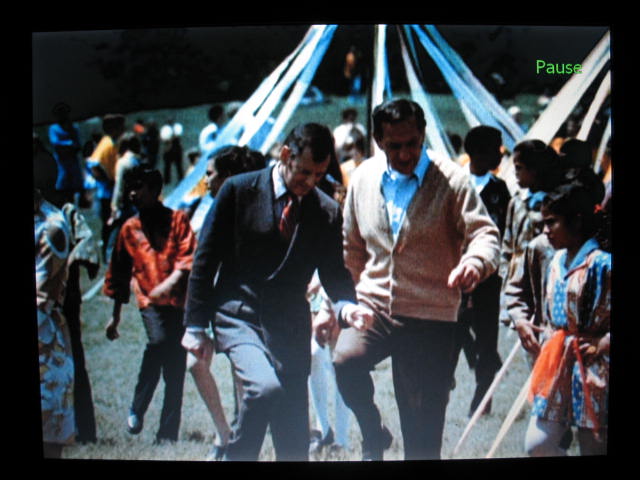
If Buck Rogers in the 25th Century is as accurate about the 25th century as I expect it to be, then in the future, we'll all be dancing with some giant rubber band/hula hoop/glowstick thing wrapped around us like we're some cross between a raver and Tony Randall and Jack Klugman awkwardly doing the Maypole dance in Central Park in the opening credits of The Odd Couple.

You haven't lived until you've heard Jack Klugman sing 'You're So Vain' during the Odd Couple Sings LP.
(Photo source: Gary Dunaier)

The dancing during the Buck Rogers "Space Rockers" episode may be on the lame side, but the music isn't. Scottish composer Johnny Harris, whose other dope contribution to film and TV music is the funktastic score to the 1970 British psychological thriller Fragment of Fear, came up with the proto-Daft Punk synth-pop instrumental sound of Andromeda, the 25th century's most popular rock band.

Bull's got hair!

Twelve years before actor/song-and-dance man Jerry Orbach took on his most famous and final role, Law & Order's Detective Lennie Briscoe (sort of a kinder, gentler version of his crooked cop character in Prince of the City), he was on the opposite side of the law as Andromeda's evil manager Lars Mangros, who plots to use the synth-pop trio's music as a form of mind control on its teen fans.

A late '70s/early '80s TV show ain't complete with a Judy Landers guest appearance. Judy Landers is the Mark Sheppard of late '70s/early '80s TV.

Besides its guest stars (in addition to Orbach, the episode also features a Landers sister and Bull Shannon, or as I prefer to remember Richard Moll because I'm a Batman: The Animated Series fan, Two-Face), "Space Rockers" is my favorite non-Princess Ardala Buck Rogers episode because of the catchy "Odyssey." The Harris instrumental experienced a bit of a resurgence in 2004 when it appeared on the playlist of the Grand Theft Auto: San Andreas funk radio station Bounce FM.

Now here's where the technology that George Lucas utilizes to fuck up his first three Star Wars movies would actually be useful. Get someone to replace the dancers in the Buck Rogers 'Space Rockers' episode with America's Best Dance Crew champions like the Jabbawockeez.

"Odyssey" is surprisingly good synth-pop that's aged well. (The opposite of "Odyssey"--a.k.a. the worst synth-pop ever--has to be that wack "I Am America" song in Herman Cain's weird and creepy cigarette-smoking campaign ad, recorded by some right-wing version of Lady Gaga.) The instrumental is ideal popping-and-locking music. Speaking of which, the Andromeda footage in "Space Rockers" would be much more badass if the Jabbawockeez were on the dance floor instead of those whitebread-looking rubber band/hula hoop/glowstick ravers because the Jabbawockeez are what 25th-century dancing will look more like.


'Let's have some action! Let's have some asses wigglin'... I want some perfection!' I know, I know, it's not a line that The Kid said, but it's my favorite line in Purple Rain.

4. "I Would Die 4 U/Baby I'm a Star" by The Kid (Purple Rain)
Actually, every song by Prince's onscreen alter ego The Kid is not terrible. But the one-two punch of "I Would Die 4 U" and "Baby I'm a Star" has to be my favorite part of both the movie's performance footage and the Purple Rain album. As Jeremy Ohmes notes in PopMatters, "If 'I Would Die 4 U' was Purple Rain's spiritually anguished yin, then 'Baby I'm a Star' was its cocky, narcissistic yang... More than any other song on Purple Rain, 'Baby I'm a Star' documents the unbridled energy and graceful sleaziness that was Prince live."